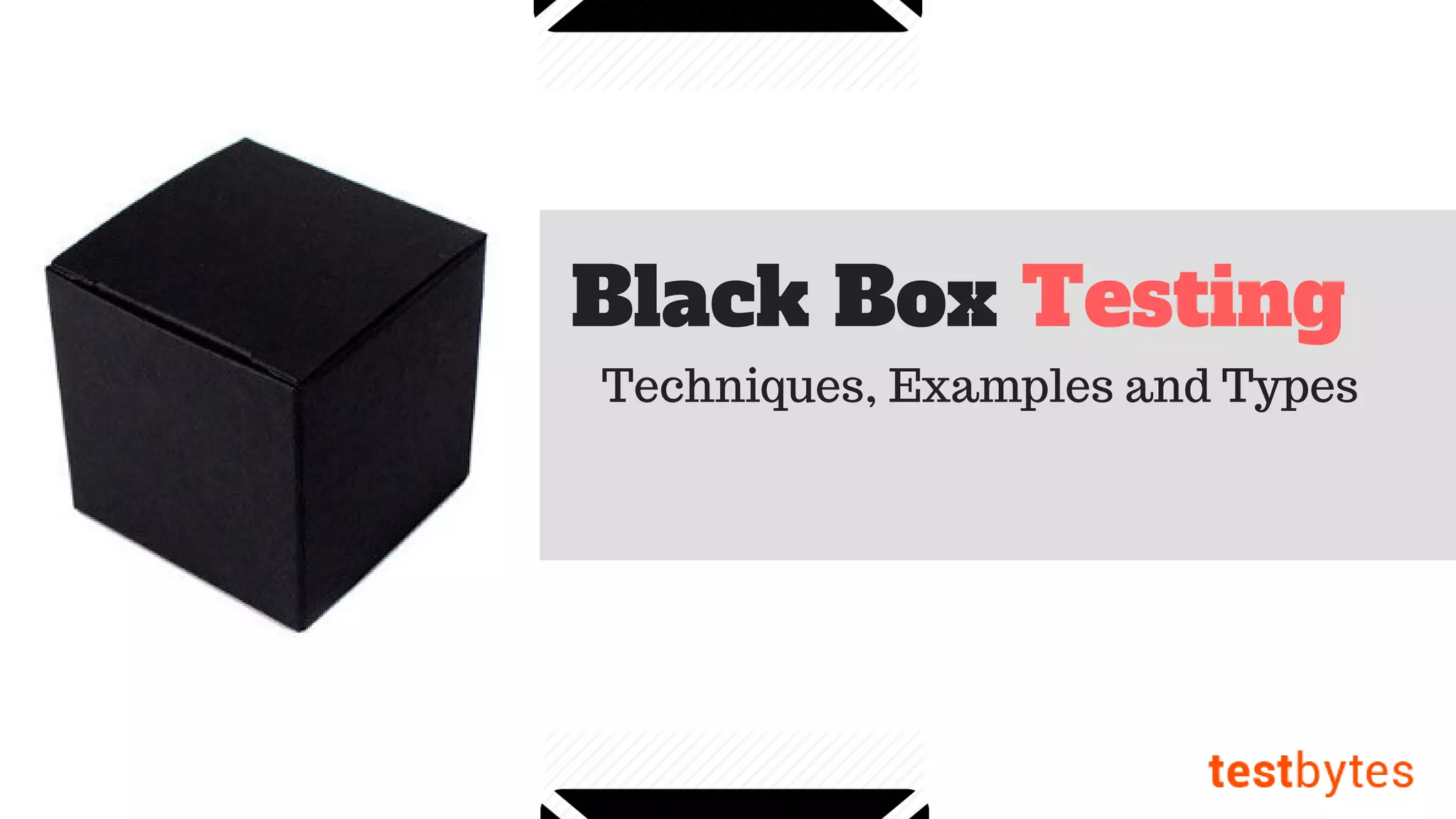
Black Box Testing
Techniques, Examples and Types
What is  Black Box Testing 
Black box testing refers to a software testing
method where the SUT (Software under Test)
functionality is tested without worrying about its
details of implementation, internal path
knowledge and internal code structure of the
software.
What is the purpose of  Black Box Testing 
Focuses on testing the complete functionality of
the system as well as its behavior.
Black Box Testing is critical during the stages of
testing life cycle like regression testing,
acceptance, unit, system, integration and software
development.
Black box testing are beneficial for the end users
who wish to perform software verification.
Techniques of Black Box
Testing
BVA or Boundary Value Analysis
BVA helps in testing any software having a
boundary or extreme values.
BVA is capable of identifying the flaws of the limits
of the input values rather than focusing on the
range of input value.
Boundary Value Analysis deals with the edge or
extreme output values.
Equivalence Class Partitioning
BVA helps in testing any software having a
boundary or extreme values.
BVA is capable of identifying the flaws of the
limits of the input values rather than focusing on
the range of input value.
Boundary Value Analysis deals with the edge or
extreme output values.
State Transition Testing
This technique usually considers the state, outputs
and inputs of a system during a specific period.
It checks for the behavioral changes of a system in
a particular state or another state while
maintaining the same inputs
The test cases for this Black box testing technique
are created by checking the sequence of
transitions and state or events among the inputs.
Graph-Based Testing
Graph based testing involves a graph drawing that
depicts the link between the causes (inputs) and
the effects (output), which trigger the effects..
This testing utilizes different combinations of
output and inputs
It is a helpful technique to understand the
software’s functional performance, as it visualizes
the flow of inputs and outputs in a lively fashion.
Error Guessing Technique
Graph based testing involves a graph drawing that
depicts the link between the causes (inputs) and
the effects (output), which trigger the effects..
This testing utilizes different combinations of
output and inputs
It is a helpful technique to understand the
software’s functional performance, as it visualizes
the flow of inputs and outputs in a lively fashion.
Error Guessing Technique
Graph based testing involves a graph drawing that
depicts the link between the causes (inputs) and
the effects (output), which trigger the effects..
This testing utilizes different combinations of
output and inputs
It is a helpful technique to understand the
software’s functional performance, as it visualizes
the flow of inputs and outputs in a lively fashion.
Types of  Black Box Testing
1.Functional Testing
This type of Black box testing is useful for the testers in
identifying the functional requirements of a software or system.
2.Non Functional Testing
This testing type is not connected with testing for any specific
functionality but relates to non-functional parameters like usability,
scalability and performance.
Contact Us
65 Broadway Suite 1101 New York NY
10006
Kalas road, Vishrantwadi, Pune,
Maharashtra-411015
info@testbytes.net
+91 811 386 5000 , +1 (212) 744-1256
Black Box Testing

Black Box Testing

  • 1.
  • 2.
    What is  BlackBox Testing  Black box testing refers to a software testing method where the SUT (Software under Test) functionality is tested without worrying about its details of implementation, internal path knowledge and internal code structure of the software.
  • 3.
    What is the purposeof  Black Box Testing  Focuses on testing the complete functionality of the system as well as its behavior. Black Box Testing is critical during the stages of testing life cycle like regression testing, acceptance, unit, system, integration and software development. Black box testing are beneficial for the end users who wish to perform software verification.
  • 4.
  • 5.
    BVA or BoundaryValue Analysis BVA helps in testing any software having a boundary or extreme values. BVA is capable of identifying the flaws of the limits of the input values rather than focusing on the range of input value. Boundary Value Analysis deals with the edge or extreme output values.
  • 6.
    Equivalence Class Partitioning BVAhelps in testing any software having a boundary or extreme values. BVA is capable of identifying the flaws of the limits of the input values rather than focusing on the range of input value. Boundary Value Analysis deals with the edge or extreme output values.
  • 7.
    State Transition Testing Thistechnique usually considers the state, outputs and inputs of a system during a specific period. It checks for the behavioral changes of a system in a particular state or another state while maintaining the same inputs The test cases for this Black box testing technique are created by checking the sequence of transitions and state or events among the inputs.
  • 8.
    Graph-Based Testing Graph basedtesting involves a graph drawing that depicts the link between the causes (inputs) and the effects (output), which trigger the effects.. This testing utilizes different combinations of output and inputs It is a helpful technique to understand the software’s functional performance, as it visualizes the flow of inputs and outputs in a lively fashion.
  • 9.
    Error Guessing Technique Graphbased testing involves a graph drawing that depicts the link between the causes (inputs) and the effects (output), which trigger the effects.. This testing utilizes different combinations of output and inputs It is a helpful technique to understand the software’s functional performance, as it visualizes the flow of inputs and outputs in a lively fashion.
  • 10.
    Error Guessing Technique Graphbased testing involves a graph drawing that depicts the link between the causes (inputs) and the effects (output), which trigger the effects.. This testing utilizes different combinations of output and inputs It is a helpful technique to understand the software’s functional performance, as it visualizes the flow of inputs and outputs in a lively fashion.
  • 11.
    Types of  Black BoxTesting 1.Functional Testing This type of Black box testing is useful for the testers in identifying the functional requirements of a software or system. 2.Non Functional Testing This testing type is not connected with testing for any specific functionality but relates to non-functional parameters like usability, scalability and performance.
  • 12.
    Contact Us 65 BroadwaySuite 1101 New York NY 10006 Kalas road, Vishrantwadi, Pune, Maharashtra-411015 info@testbytes.net +91 811 386 5000 , +1 (212) 744-1256