
Black-Box Testing
 Topics covered:
– What is dynamic black-box testing?
– How to reduce the number of test cases by equivalence
partitioning
– How to identify troublesome boundary conditions
– Good data values to use to induce bugs
– How to test software states and state transitions
– How to use repetition, stress, and high loads to locate bugs
– A few secret places where bugs hide
Dynamic Black-Box Testing: Testing the
Software While Blindfolded
 Testing software without having an insight into the
details of underlying code is dynamic black-box
testing
 It's dynamic because the program is running you're
using it as a customer would.
 And, it's black-box because you're testing it without
knowing exactly how it works with blinders on.
 Entering inputs, receiving outputs, and checking the
results.
 name commonly used for dynamic black-box testing
is behavioral testing.
Dynamic Black-Box Testing: Testing the
Software While Blindfolded (cont..)
 To do this effectively requires some definition of:
– what the software does namely
– a requirements document or
– product specification.
 A good product spec will provide you with these details.
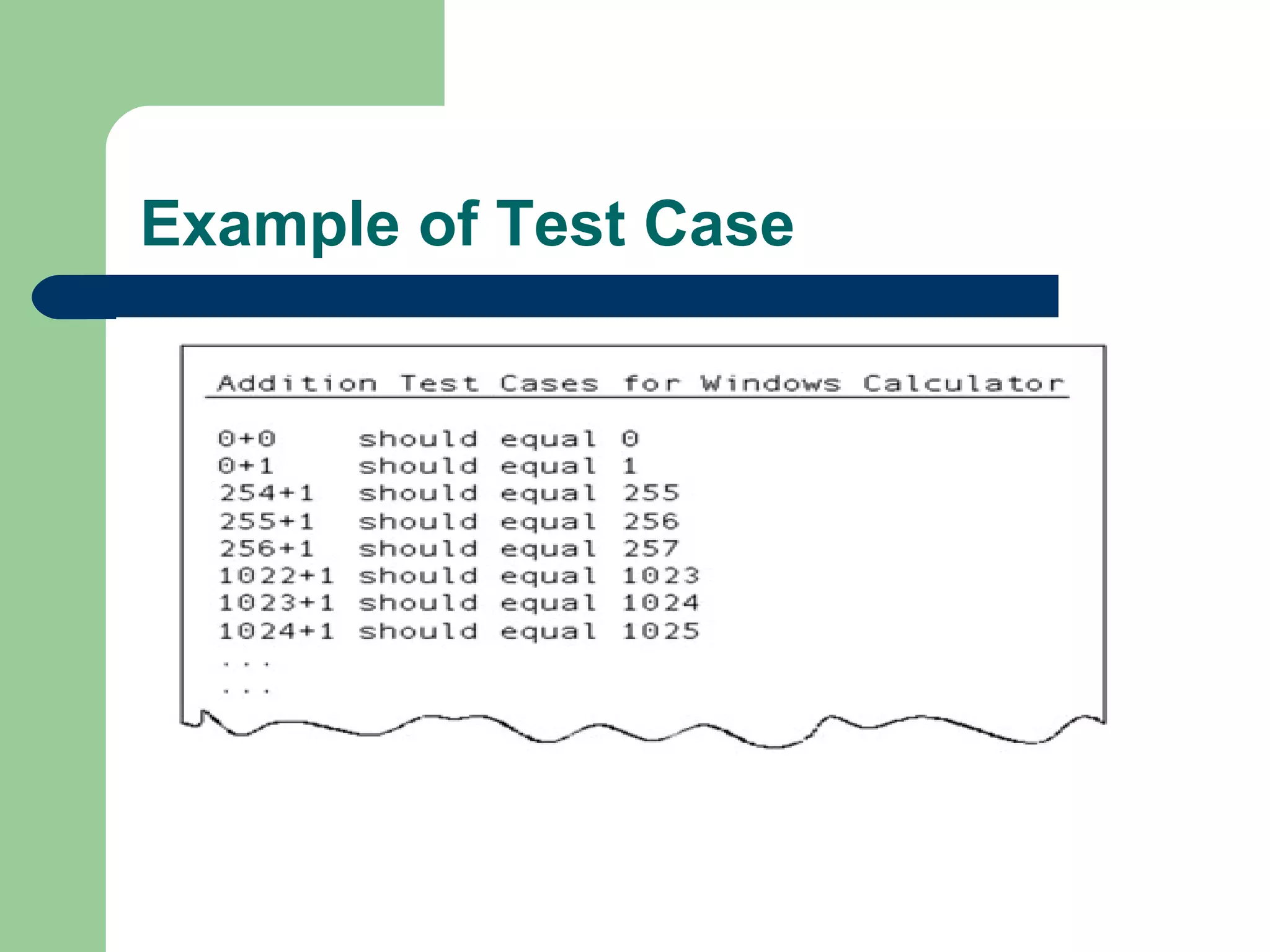
 Next step is to start defining the test cases.
 Test cases are the specific inputs that you'll try and
the procedures that you'll follow when you test the
software.
Example of Test Case
USE EXPLORATORY TESTING IF YOU DON'T
HAVE A SPEC
 A professional, mature software development process
will have a detailed specification for the software
 If you are stuck in code-and-fix model, you may not
have a software spec to base your tests on.
 That's not an ideal situation for a software tester
 Can use a workable solution known as exploratory
testing:
– simultaneously learning the software
– designing tests and
– executing those tests.
USE EXPLORATORY TESTING IF YOU DON'T
HAVE A SPEC (Cont..)
 Need to treat the software as the specification
 Methodically explore the software feature by feature.
 Take notes on what the software does
 Map out the features, and
 Apply some of the static black-box techniques
 Analyze the software as though it is the specification
 In this situation, finding any bugs would be a positive
thing
Test-to-Pass and Test-to-Fail
 There are two fundamental approaches to
testing software:
– test-to-pass and
– test-to-fail
Test-to-Pass and Test-to-Fail (Cont..)
 Test-to-pass, you really assure only that the
software minimally works.
 Don't push its capabilities
 Apply the simplest and most straightforward
test cases.
 When designing and running your test cases,
always run the test-to-pass cases first.
Test-to-Pass and Test-to-Fail (Cont..)
 After assurance that the software does what it's
specified to do in ordinary circumstances
 It's time to put on attempt to find bugs by trying
things that should force them out.
 Designing and running test cases with the sole
purpose of breaking the software is called
testing-to-fail or error-forcing.
Equivalence Partitioning
 Selecting test cases is the single most
important task that software testers do.
 Equivalence partitioning is the process of
methodically reducing the huge (infinite) set of
possible test cases into a much smaller, but
still equally effective set.
 Equivalence partitioning, sometimes called
equivalence classing
 Calculator example
– It's impossible to test all the cases of adding two numbers
together.
– Equivalence partitioning provides a systematic means for
selecting the values that matter and ignoring the ones that
don't.
 When looking for equivalence partitions, think about
ways to group:
– similar inputs
– similar outputs
– and similar operation of the software.
 These groups are your equivalence partitions.
Equivalence Partitioning (cont..)
 An equivalence class or equivalence partition is a set
of test cases that tests the same thing or reveals the
same bug
 What is the difference between 1+999999.. and 1+13?
 In the case of 1+13, it looks like a standard simple
addition, a lot like 1+5 or 1+392.
 1+999... is way out there, on the edge.
 Enter the largest possible number and then add 1 to it,
something bad might happen possibly a bug.
Example of Equivalence Partitions
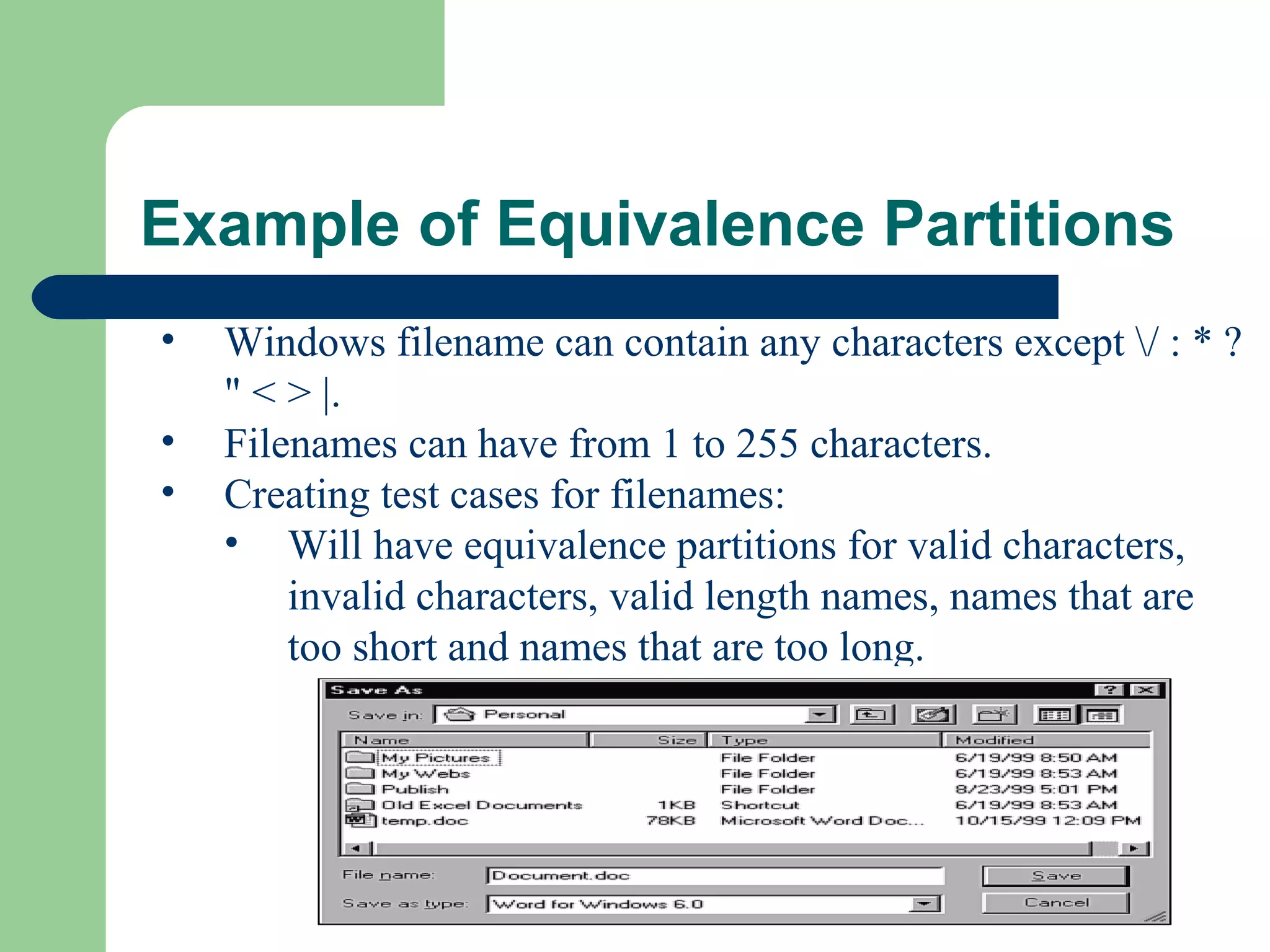
• Windows filename can contain any characters except / : * ?
" < > |.
• Filenames can have from 1 to 255 characters.
• Creating test cases for filenames:
• Will have equivalence partitions for valid characters,
invalid characters, valid length names, names that are
too short and names that are too long.
Equivalence Partitioning (cont..)
 The goal of equivalence partitioning is to reduce the set
of possible test cases into a smaller, manageable set
that still adequately tests the software.
 taking on risk because choosing not to test everything
 need to be careful how you choose your classes
 If you're new to testing, always get someone with more
experience to review your proposed classes.
 Equivalence partitioning can be subjective
 Two testers who test a complex program may arrive at
two different sets of partitions
 That's okay as long as the partitions are reviewed
Black box testing lecture 11

Black box testing lecture 11

  • 1.
    Black-Box Testing  Topicscovered: – What is dynamic black-box testing? – How to reduce the number of test cases by equivalence partitioning – How to identify troublesome boundary conditions – Good data values to use to induce bugs – How to test software states and state transitions – How to use repetition, stress, and high loads to locate bugs – A few secret places where bugs hide
  • 2.
    Dynamic Black-Box Testing:Testing the Software While Blindfolded  Testing software without having an insight into the details of underlying code is dynamic black-box testing  It's dynamic because the program is running you're using it as a customer would.  And, it's black-box because you're testing it without knowing exactly how it works with blinders on.  Entering inputs, receiving outputs, and checking the results.  name commonly used for dynamic black-box testing is behavioral testing.
  • 3.
    Dynamic Black-Box Testing:Testing the Software While Blindfolded (cont..)  To do this effectively requires some definition of: – what the software does namely – a requirements document or – product specification.  A good product spec will provide you with these details.  Next step is to start defining the test cases.  Test cases are the specific inputs that you'll try and the procedures that you'll follow when you test the software.
  • 4.
  • 5.
    USE EXPLORATORY TESTINGIF YOU DON'T HAVE A SPEC  A professional, mature software development process will have a detailed specification for the software  If you are stuck in code-and-fix model, you may not have a software spec to base your tests on.  That's not an ideal situation for a software tester  Can use a workable solution known as exploratory testing: – simultaneously learning the software – designing tests and – executing those tests.
  • 6.
    USE EXPLORATORY TESTINGIF YOU DON'T HAVE A SPEC (Cont..)  Need to treat the software as the specification  Methodically explore the software feature by feature.  Take notes on what the software does  Map out the features, and  Apply some of the static black-box techniques  Analyze the software as though it is the specification  In this situation, finding any bugs would be a positive thing
  • 7.
    Test-to-Pass and Test-to-Fail There are two fundamental approaches to testing software: – test-to-pass and – test-to-fail
  • 8.
    Test-to-Pass and Test-to-Fail(Cont..)  Test-to-pass, you really assure only that the software minimally works.  Don't push its capabilities  Apply the simplest and most straightforward test cases.  When designing and running your test cases, always run the test-to-pass cases first.
  • 9.
    Test-to-Pass and Test-to-Fail(Cont..)  After assurance that the software does what it's specified to do in ordinary circumstances  It's time to put on attempt to find bugs by trying things that should force them out.  Designing and running test cases with the sole purpose of breaking the software is called testing-to-fail or error-forcing.
  • 10.
    Equivalence Partitioning  Selectingtest cases is the single most important task that software testers do.  Equivalence partitioning is the process of methodically reducing the huge (infinite) set of possible test cases into a much smaller, but still equally effective set.  Equivalence partitioning, sometimes called equivalence classing
  • 11.
     Calculator example –It's impossible to test all the cases of adding two numbers together. – Equivalence partitioning provides a systematic means for selecting the values that matter and ignoring the ones that don't.  When looking for equivalence partitions, think about ways to group: – similar inputs – similar outputs – and similar operation of the software.  These groups are your equivalence partitions. Equivalence Partitioning (cont..)
  • 12.
    Equivalence Partitioning (cont..) An equivalence class or equivalence partition is a set of test cases that tests the same thing or reveals the same bug  What is the difference between 1+999999.. and 1+13?  In the case of 1+13, it looks like a standard simple addition, a lot like 1+5 or 1+392.  1+999... is way out there, on the edge.  Enter the largest possible number and then add 1 to it, something bad might happen possibly a bug.
  • 13.
    Example of EquivalencePartitions • Windows filename can contain any characters except / : * ? " < > |. • Filenames can have from 1 to 255 characters. • Creating test cases for filenames: • Will have equivalence partitions for valid characters, invalid characters, valid length names, names that are too short and names that are too long.
  • 14.
    Equivalence Partitioning (cont..) The goal of equivalence partitioning is to reduce the set of possible test cases into a smaller, manageable set that still adequately tests the software.  taking on risk because choosing not to test everything  need to be careful how you choose your classes  If you're new to testing, always get someone with more experience to review your proposed classes.  Equivalence partitioning can be subjective  Two testers who test a complex program may arrive at two different sets of partitions  That's okay as long as the partitions are reviewed