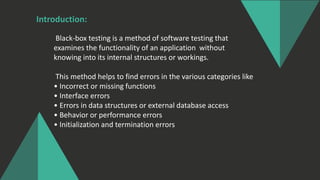
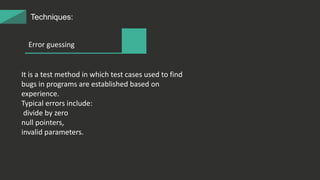
This presentation introduces black box testing, which examines software functionality without knowledge of internal structures. Black box testing can find incorrect, missing, or interface errors, as well as errors in data access or behavior. Examples of systems suitable for black box testing include calculators, operating systems, websites, and databases. The presentation discusses techniques for black box testing like equivalence partitioning, boundary value analysis, decision tables, state transition testing, and error guessing. Advantages are that testing can be done efficiently on large systems by non-technical testers, while disadvantages include difficulty designing test cases without specifications and identifying all possible inputs.