Black Box Testing
Amaar Hassan
Black Box Testing
 Block-box testing (or functional testing, or behavior testing) focuses on the
functional requirements of the software.
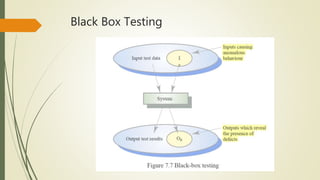
 In black-box testing, the system is like a black-box whose behavior can
only be determined by studying its inputs and the related outputs
 A set of test cases is derived to exercise all functional requirements for the
program.
 These tests are generally derived from the program specification
 Black-box testing attempts to find the error in the following categories
 Incorrect or missing functions
 Interface errors
 Error in data structures or external database access
 Performance errors
 Initialization and termination error
Black Box Testing
Black Box Testing
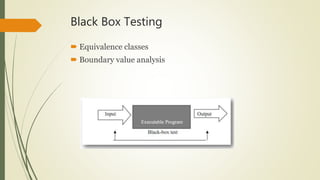
 Equivalence classes
 Boundary value analysis
Why testing is hard
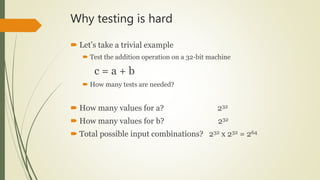
 Let’s take a trivial example
 Test the addition operation on a 32-bit machine
c = a + b
 How many tests are needed?
 How many values for a? 232
 How many values for b? 232
 Total possible input combinations? 232 x 232 = 264
Why testing is hard
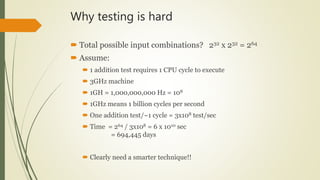
 Total possible input combinations? 232 x 232 = 264
 Assume:
 1 addition test requires 1 CPU cycle to execute
 3GHz machine
 1GH = 1,000,000,000 Hz = 108
 1GHz means 1 billion cycles per second
 One addition test/~1 cycle = 3x10⁸ test/sec
 Time = 264 / 3x108 = 6 x 10¹⁰ sec
= 694,445 days
 Clearly need a smarter technique!!
An Efficient way
 Many tests are redundant
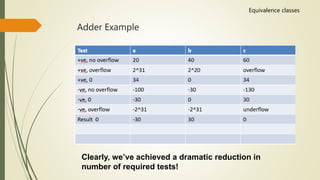
In the adder example, most tests are equivalent.
They do not exercise any new part of the underlying circuit
For example, you might argue that
all additions of +ve numbers without overflow are equivalent
Addition of 0 to a +ve number is the same for all +ve numbers
Similarly for 0 + -ve number … etc.
 This divides the tests into Equivalence Classes
 Only one representative of each class need be tested!
Equivalence Classes
 A set of equivalence classes is a partition of a set such that
Each element of the set is a member of exactly one
equivalence class
 Only one representative of each class needs to be tested!
 All other tests of inputs in the same equivalence class just repeat the
first one!
Dramatic reduction in total number of tests
No loss of ‘coverage’ or satisfaction that tests are complete
Adder Example
Equivalence classes
Clearly, we’ve achieved a dramatic reduction in
number of required tests!
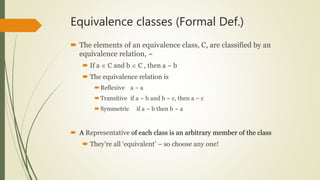
Equivalence classes (Formal Def.)
 The elements of an equivalence class, C, are classified by an
equivalence relation, ~
 If a  C and b  C , then a ~ b
 The equivalence relation is
Reflexive a ~ a
Transitive if a ~ b and b ~ c, then a ~ c
Symmetric if a ~ b then b ~ a
 A Representative of each class is an arbitrary member of the class
 They’re all ‘equivalent’ – so choose any one!
Age Example
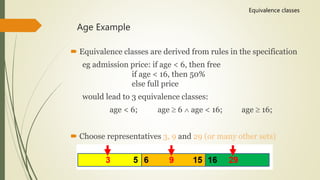
 Equivalence classes are derived from rules in the specification
eg admission price: if age < 6, then free
if age < 16, then 50%
else full price
would lead to 3 equivalence classes:
age < 6; age  6  age < 16; age  16;
 Choose representatives 3, 9 and 29 (or many other sets)
Equivalence classes
Equivalence classes
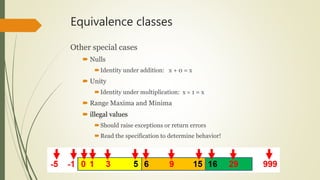
Other special cases
 Nulls
Identity under addition: x + 0 = x
 Unity
Identity under multiplication: x  1 = x
 Range Maxima and Minima
 illegal values
Should raise exceptions or return errors
Read the specification to determine behavior!
Equivalence classes
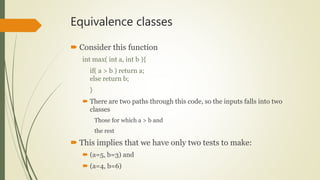
 Consider this function
int max( int a, int b ){
if( a > b ) return a;
else return b;
}
 There are two paths through this code, so the inputs falls into two
classes
Those for which a > b and
the rest
 This implies that we have only two tests to make:
 (a=5, b=3) and
 (a=4, b=6)
Boundary Value Analysis (BVA)
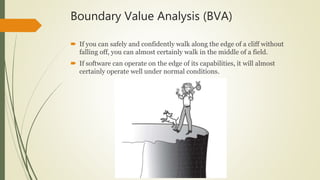
 If you can safely and confidently walk along the edge of a cliff without
falling off, you can almost certainly walk in the middle of a field.
 If software can operate on the edge of its capabilities, it will almost
certainly operate well under normal conditions.
Boundary Value Analysis (BVA)
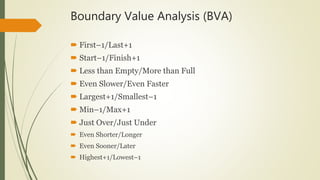
 First–1/Last+1
 Start–1/Finish+1
 Less than Empty/More than Full
 Even Slower/Even Faster
 Largest+1/Smallest–1
 Min–1/Max+1
 Just Over/Just Under
 Even Shorter/Longer
 Even Sooner/Later
 Highest+1/Lowest–1
Example of EC
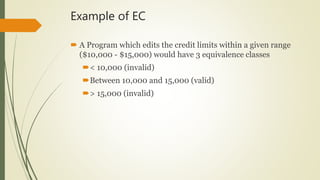
 A Program which edits the credit limits within a given range
($10,000 - $15,000) would have 3 equivalence classes
< 10,000 (invalid)
Between 10,000 and 15,000 (valid)
> 15,000 (invalid)
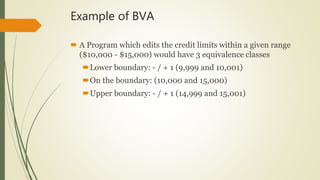
Example of BVA
 A Program which edits the credit limits within a given range
($10,000 - $15,000) would have 3 equivalence classes
Lower boundary: - / + 1 (9,999 and 10,001)
On the boundary: (10,000 and 15,000)
Upper boundary: - / + 1 (14,999 and 15,001)
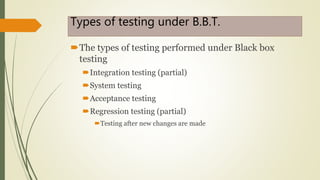
Types of testing under B.B.T.
The types of testing performed under Black box
testing
Integration testing (partial)
System testing
Acceptance testing
Regression testing (partial)
Testing after new changes are made
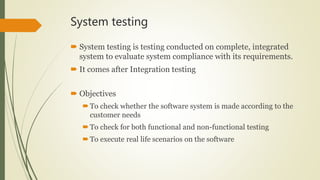
System testing
 System testing is testing conducted on complete, integrated
system to evaluate system compliance with its requirements.
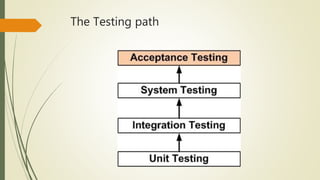
 It comes after Integration testing
 Objectives
To check whether the software system is made according to the
customer needs
To check for both functional and non-functional testing
To execute real life scenarios on the software
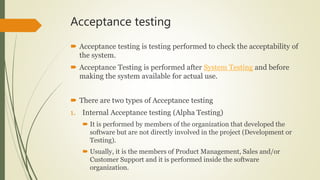
Acceptance testing
 Acceptance testing is testing performed to check the acceptability of
the system.
 Acceptance Testing is performed after System Testing and before
making the system available for actual use.
 There are two types of Acceptance testing
1. Internal Acceptance testing (Alpha Testing)
 It is performed by members of the organization that developed the
software but are not directly involved in the project (Development or
Testing).
 Usually, it is the members of Product Management, Sales and/or
Customer Support and it is performed inside the software
organization.
Acceptance testing
2. External Acceptance testing
It is performed by customer and users.
It has two types
Customer Acceptance Testing
This is done by customers who asked the organization to build the
software for them.
User Acceptance Testing (Beta Testing)
 This is done by the final users of the software at their place
The Testing path
In a bigger picture
 During the process of manufacturing a ballpoint pen, the cap, the
body, the tail and clip, the ink cartridge and the ballpoint are
produced separately and unit tested separately.
 When two or more units are ready, they are assembled and
Integration Testing is performed.
 When the complete pen is integrated, System Testing is performed
to see if meets the specification.
 Once System Testing is complete, Acceptance Testing is performed
so as to confirm that the ballpoint pen is ready to be made available
to the end-users.
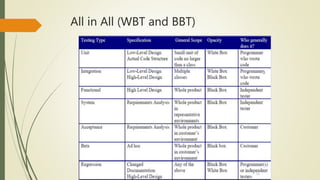
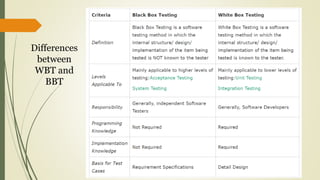
All in All (WBT and BBT)
Differences
between
WBT and
BBT
Gray Box Testing
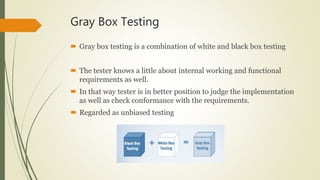
 Gray box testing is a combination of white and black box testing
 The tester knows a little about internal working and functional
requirements as well.
 In that way tester is in better position to judge the implementation
as well as check conformance with the requirements.
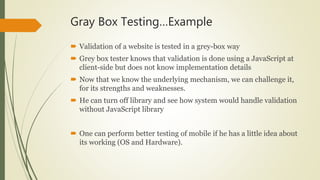
 Regarded as unbiased testing
Gray Box Testing…Example
 Validation of a website is tested in a grey-box way
 Grey box tester knows that validation is done using a JavaScript at
client-side but does not know implementation details
 Now that we know the underlying mechanism, we can challenge it,
for its strengths and weaknesses.
 He can turn off library and see how system would handle validation
without JavaScript library
 One can perform better testing of mobile if he has a little idea about
its working (OS and Hardware).
Gray Box Testing…Example
 Which scenario presents higher probability for a good testing?
 1. Testing a car without knowing the technologies It uses.
 1. Testing a car, while knowing the technologies (hw sw) it uses
That’s all folks

5 black box and grey box testing

  • 1.
  • 2.
    Black Box Testing Block-box testing (or functional testing, or behavior testing) focuses on the functional requirements of the software.  In black-box testing, the system is like a black-box whose behavior can only be determined by studying its inputs and the related outputs  A set of test cases is derived to exercise all functional requirements for the program.  These tests are generally derived from the program specification  Black-box testing attempts to find the error in the following categories  Incorrect or missing functions  Interface errors  Error in data structures or external database access  Performance errors  Initialization and termination error
  • 3.
  • 4.
    Black Box Testing Equivalence classes  Boundary value analysis
  • 5.
    Why testing ishard  Let’s take a trivial example  Test the addition operation on a 32-bit machine c = a + b  How many tests are needed?  How many values for a? 232  How many values for b? 232  Total possible input combinations? 232 x 232 = 264
  • 6.
    Why testing ishard  Total possible input combinations? 232 x 232 = 264  Assume:  1 addition test requires 1 CPU cycle to execute  3GHz machine  1GH = 1,000,000,000 Hz = 108  1GHz means 1 billion cycles per second  One addition test/~1 cycle = 3x10⁸ test/sec  Time = 264 / 3x108 = 6 x 10¹⁰ sec = 694,445 days  Clearly need a smarter technique!!
  • 7.
    An Efficient way Many tests are redundant In the adder example, most tests are equivalent. They do not exercise any new part of the underlying circuit For example, you might argue that all additions of +ve numbers without overflow are equivalent Addition of 0 to a +ve number is the same for all +ve numbers Similarly for 0 + -ve number … etc.  This divides the tests into Equivalence Classes  Only one representative of each class need be tested!
  • 8.
    Equivalence Classes  Aset of equivalence classes is a partition of a set such that Each element of the set is a member of exactly one equivalence class  Only one representative of each class needs to be tested!  All other tests of inputs in the same equivalence class just repeat the first one! Dramatic reduction in total number of tests No loss of ‘coverage’ or satisfaction that tests are complete
  • 9.
    Adder Example Equivalence classes Clearly,we’ve achieved a dramatic reduction in number of required tests!
  • 10.
    Equivalence classes (FormalDef.)  The elements of an equivalence class, C, are classified by an equivalence relation, ~  If a  C and b  C , then a ~ b  The equivalence relation is Reflexive a ~ a Transitive if a ~ b and b ~ c, then a ~ c Symmetric if a ~ b then b ~ a  A Representative of each class is an arbitrary member of the class  They’re all ‘equivalent’ – so choose any one!
  • 11.
    Age Example  Equivalenceclasses are derived from rules in the specification eg admission price: if age < 6, then free if age < 16, then 50% else full price would lead to 3 equivalence classes: age < 6; age  6  age < 16; age  16;  Choose representatives 3, 9 and 29 (or many other sets) Equivalence classes
  • 12.
    Equivalence classes Other specialcases  Nulls Identity under addition: x + 0 = x  Unity Identity under multiplication: x  1 = x  Range Maxima and Minima  illegal values Should raise exceptions or return errors Read the specification to determine behavior!
  • 13.
    Equivalence classes  Considerthis function int max( int a, int b ){ if( a > b ) return a; else return b; }  There are two paths through this code, so the inputs falls into two classes Those for which a > b and the rest  This implies that we have only two tests to make:  (a=5, b=3) and  (a=4, b=6)
  • 14.
    Boundary Value Analysis(BVA)  If you can safely and confidently walk along the edge of a cliff without falling off, you can almost certainly walk in the middle of a field.  If software can operate on the edge of its capabilities, it will almost certainly operate well under normal conditions.
  • 15.
    Boundary Value Analysis(BVA)  First–1/Last+1  Start–1/Finish+1  Less than Empty/More than Full  Even Slower/Even Faster  Largest+1/Smallest–1  Min–1/Max+1  Just Over/Just Under  Even Shorter/Longer  Even Sooner/Later  Highest+1/Lowest–1
  • 16.
    Example of EC A Program which edits the credit limits within a given range ($10,000 - $15,000) would have 3 equivalence classes < 10,000 (invalid) Between 10,000 and 15,000 (valid) > 15,000 (invalid)
  • 17.
    Example of BVA A Program which edits the credit limits within a given range ($10,000 - $15,000) would have 3 equivalence classes Lower boundary: - / + 1 (9,999 and 10,001) On the boundary: (10,000 and 15,000) Upper boundary: - / + 1 (14,999 and 15,001)
  • 18.
    Types of testingunder B.B.T. The types of testing performed under Black box testing Integration testing (partial) System testing Acceptance testing Regression testing (partial) Testing after new changes are made
  • 19.
    System testing  Systemtesting is testing conducted on complete, integrated system to evaluate system compliance with its requirements.  It comes after Integration testing  Objectives To check whether the software system is made according to the customer needs To check for both functional and non-functional testing To execute real life scenarios on the software
  • 20.
    Acceptance testing  Acceptancetesting is testing performed to check the acceptability of the system.  Acceptance Testing is performed after System Testing and before making the system available for actual use.  There are two types of Acceptance testing 1. Internal Acceptance testing (Alpha Testing)  It is performed by members of the organization that developed the software but are not directly involved in the project (Development or Testing).  Usually, it is the members of Product Management, Sales and/or Customer Support and it is performed inside the software organization.
  • 21.
    Acceptance testing 2. ExternalAcceptance testing It is performed by customer and users. It has two types Customer Acceptance Testing This is done by customers who asked the organization to build the software for them. User Acceptance Testing (Beta Testing)  This is done by the final users of the software at their place
  • 22.
  • 23.
    In a biggerpicture  During the process of manufacturing a ballpoint pen, the cap, the body, the tail and clip, the ink cartridge and the ballpoint are produced separately and unit tested separately.  When two or more units are ready, they are assembled and Integration Testing is performed.  When the complete pen is integrated, System Testing is performed to see if meets the specification.  Once System Testing is complete, Acceptance Testing is performed so as to confirm that the ballpoint pen is ready to be made available to the end-users.
  • 24.
    All in All(WBT and BBT)
  • 25.
  • 26.
    Gray Box Testing Gray box testing is a combination of white and black box testing  The tester knows a little about internal working and functional requirements as well.  In that way tester is in better position to judge the implementation as well as check conformance with the requirements.  Regarded as unbiased testing

  • 27.
    Gray Box Testing…Example Validation of a website is tested in a grey-box way  Grey box tester knows that validation is done using a JavaScript at client-side but does not know implementation details  Now that we know the underlying mechanism, we can challenge it, for its strengths and weaknesses.  He can turn off library and see how system would handle validation without JavaScript library  One can perform better testing of mobile if he has a little idea about its working (OS and Hardware).
  • 28.
    Gray Box Testing…Example Which scenario presents higher probability for a good testing?  1. Testing a car without knowing the technologies It uses.  1. Testing a car, while knowing the technologies (hw sw) it uses
  • 29.

Editor's Notes

  • #27 Gray box testing is regarded as unbiased testing because the tester has limited knowledge of implementation, so he won’t be biased towards implementation like a developer. Naturally a developer will test the software in a way that it wont go against his implementation.
  • #29 If we know the technologies of a car including its hardware and software, we can test it by making challenging terrains, low light conditions, bright light conditions, humid areas, rough and patchy roads, long drives, speed ranges etc. Testing a scanner without knowing how it operates vs. testing a scanner or photocopy machine, while knowing how it works.