Dr. Ziad. N. Arandi
Assistant Professor of Psychiatry- An-Najah National University
B. C. Psych - London
D. P. L Psych - London
J. B. C. Psych - Amman
President of Palestinian Psychiatrists Association
Somatoform disorders (Literally ‘Soma’ means ‘Body’.)
=
‫اضطراب‬‫ات‬‫جسدي‬‫ه‬‫الشكل‬
‫هو‬‫نفسي‬ ‫اضطراب‬‫ه‬‫باعراض‬ ‫تتميز‬‫أو‬ ‫اعتالل‬ ‫بوجود‬ ‫توحي‬ ‫والتي‬ ‫جسدية‬‫مرض‬
‫خالل‬ ‫من‬ ‫كامل‬ ‫بشكل‬ ‫تفسر‬ ‫أن‬ ‫يمكن‬ ‫ال‬ ‫أعراض‬ ‫وهي‬ ،‫الجسم‬ ‫في‬‫فحص‬‫الحالة‬
‫خالل‬ ‫من‬ ‫أو‬ ‫العامة‬ ‫الطبية‬‫الطبيه‬ ‫الفحوصات‬
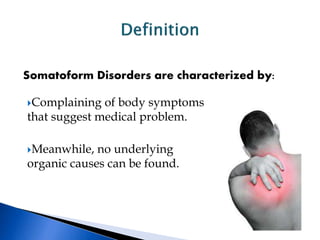
Somatoform Disorders are characterized by:
Complaining of body symptoms
that suggest medical problem.
Meanwhile, no underlying
organic causes can be found.
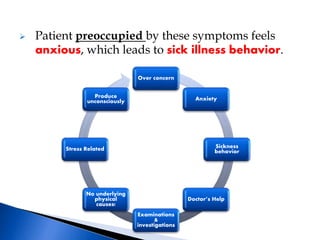
 Patient preoccupied by these symptoms feels
anxious, which leads to sick illness behavior.
Over concern
Anxiety
Sickness
behavior
Doctor’s Help
Examinations
&
investigations
No underlying
physical
causes!
Stress Related
Produce
unconsciously
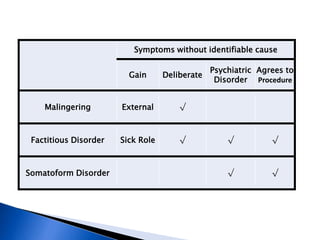
Symptoms without identifiable cause
Gain Deliberate
Psychiatric
Disorder
Agrees to
Procedure
Malingering External √
Factitious Disorder Sick Role √ √ √
Somatoform Disorder √ √
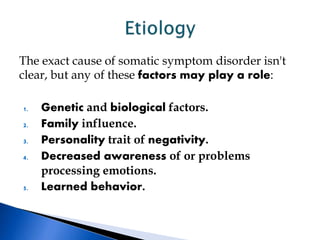
The exact cause of somatic symptom disorder isn't
clear, but any of these factors may play a role:
1. Genetic and biological factors.
2. Family influence.
3. Personality trait of negativity.
4. Decreased awareness of or problems
processing emotions.
5. Learned behavior.
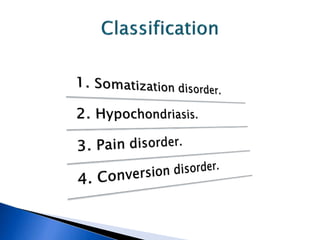
Somatization Disorder
Hypochondriasis.
Pain disorder.
Conversion disorder.
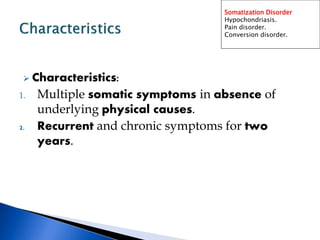
 Characteristics:
1. Multiple somatic symptoms in absence of
underlying physical causes.
2. Recurrent and chronic symptoms for two
years.

Somatization Disorder
Hypochondriasis.
Pain disorder.
Conversion disorder.
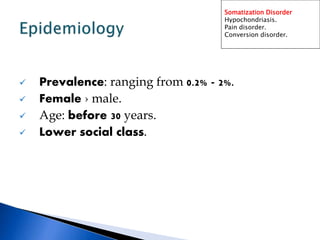
 Prevalence: ranging from 0.2% - 2%.
 Female › male.
 Age: before 30 years.
 Lower social class.
Somatization Disorder
Hypochondriasis.
Pain disorder.
Conversion disorder.
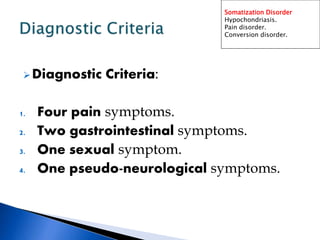
Diagnostic Criteria:
1. Four pain symptoms.
2. Two gastrointestinal symptoms.
3. One sexual symptom.
4. One pseudo-neurological symptoms.
Somatization Disorder
Hypochondriasis.
Pain disorder.
Conversion disorder.
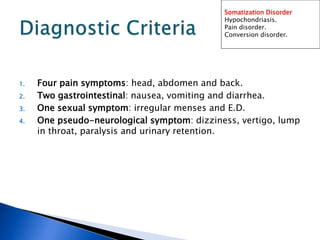
1. Four pain symptoms: head, abdomen and back.
2. Two gastrointestinal: nausea, vomiting and diarrhea.
3. One sexual symptom: irregular menses and E.D.
4. One pseudo-neurological symptom: dizziness, vertigo, lump
in throat, paralysis and urinary retention.
Somatization Disorder
Hypochondriasis.
Pain disorder.
Conversion disorder.
Literally;
‘Hypo’ means ‘Below’
‘Chondriasis’ means ‘Chondrium’.
 Patient is preoccupied with fears of having a serious
disease, based on person’s misinterpretation of body
symptoms.
 Persistence despite reassurance.
 Last for six months.
Somatization Disorder
Hypochondriasis.
Pain disorder.
Conversion disorder.
 Prevalence: ranging from 1% - 5%.
 Female = Male.
 Age: from 20 to 30 years.
 Upper social class.
 Chronic Course.
Somatization Disorder
Hypochondriasis.
Pain disorder.
Conversion disorder.
1. Serious illness from the surrounding.
2. Medical Student.
3. People interesting in Googling!
4. Early childhood problems.
Somatization Disorder
Hypochondriasis.
Pain disorder.
Conversion disorder.
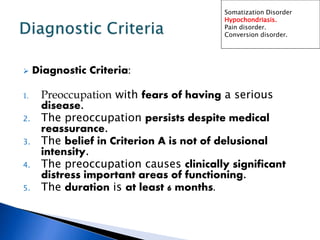
 Diagnostic Criteria:
1. Preoccupation with fears of having a serious
disease.
2. The preoccupation persists despite medical
reassurance.
3. The belief in Criterion A is not of delusional
intensity.
4. The preoccupation causes clinically significant
distress important areas of functioning.
5. The duration is at least 6 months.
Somatization Disorder
Hypochondriasis.
Pain disorder.
Conversion disorder.
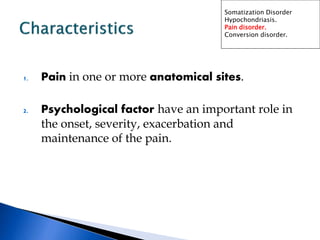
1. Pain in one or more anatomical sites.
2. Psychological factor have an important role in
the onset, severity, exacerbation and
maintenance of the pain.
Somatization Disorder
Hypochondriasis.
Pain disorder.
Conversion disorder.
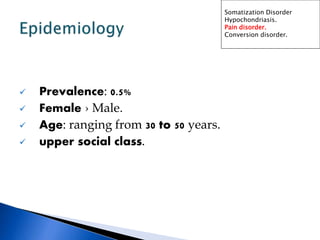
 Prevalence: 0.5%
 Female › Male.
 Age: ranging from 30 to 50 years.
 upper social class.
Somatization Disorder
Hypochondriasis.
Pain disorder.
Conversion disorder.
 Pain is not consciously produced.
 Pain is vague in description.
 Clarifying the patient’s pain rather than
challenging or insight.
 Mainly depression or anxiety are comorbidities.
 Common side is the left side.
Somatization Disorder
Hypochondriasis.
Pain disorder.
Conversion disorder.
 In the past it was called Hysteria
 Hysteria derived from the hystrum.
Somatization Disorder
Hypochondriasis.
Pain disorder.
Conversion disorder.
 Mental disorder characterized by:
1. Loss of the physical function of the organs.
2. Sudden onset after a psychological events.
3. Mainly it involve one or more neurological
systems.
4. Can’t be explained by any neurological
disease.
Somatization Disorder
Hypochondriasis.
Pain disorder.
Conversion disorder.
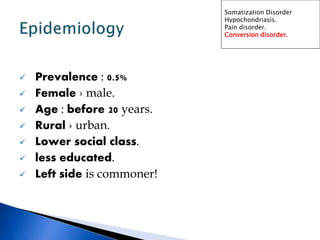
 Prevalence : 0.5%
 Female › male.
 Age : before 20 years.
 Rural › urban.
 Lower social class.
 less educated.
 Left side is commoner!
Somatization Disorder
Hypochondriasis.
Pain disorder.
Conversion disorder.
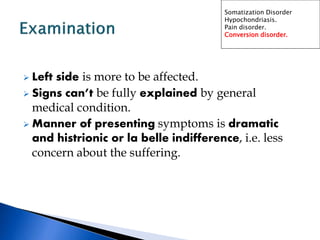
 Left side is more to be affected.
 Signs can’t be fully explained by general
medical condition.
 Manner of presenting symptoms is dramatic
and histrionic or la belle indifference, i.e. less
concern about the suffering.
Somatization Disorder
Hypochondriasis.
Pain disorder.
Conversion disorder.
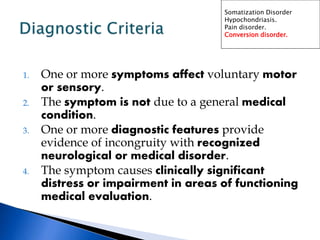
1. One or more symptoms affect voluntary motor
or sensory.
2. The symptom is not due to a general medical
condition.
3. One or more diagnostic features provide
evidence of incongruity with recognized
neurological or medical disorder.
4. The symptom causes clinically significant
distress or impairment in areas of functioning
medical evaluation.
Somatization Disorder
Hypochondriasis.
Pain disorder.
Conversion disorder.
The goal is
management not Cure
Keep in control of the
case
(Gate keeper)
Schedule regular
appointments
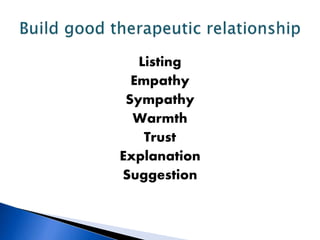
Listing
Empathy
Sympathy
Warmth
Trust
Explanation
Suggestion
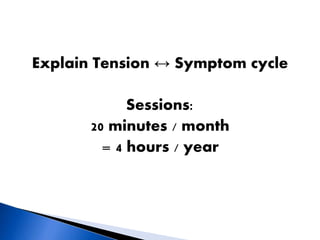
Explain Tension ↔ Symptom cycle
Sessions:
20 minutes / month
= 4 hours / year
 Supportive psychotherapy
 Behavioral Modification
 Relaxation therapy with graded physical
exercise.
 Cognitive psychotherapy.
 In site oriented psychotherapy
 Cope stress psychotherapy
Antidepressants especially
duloxetine (Cymbalta).
Benzodiazepines for short period for
coexisting depression and anxiety
comorbidities.
Dr. ziad arandi (somatoform disorders)

Dr. ziad arandi (somatoform disorders)

  • 1.
    Dr. Ziad. N.Arandi Assistant Professor of Psychiatry- An-Najah National University B. C. Psych - London D. P. L Psych - London J. B. C. Psych - Amman President of Palestinian Psychiatrists Association
  • 2.
    Somatoform disorders (Literally‘Soma’ means ‘Body’.) = ‫اضطراب‬‫ات‬‫جسدي‬‫ه‬‫الشكل‬ ‫هو‬‫نفسي‬ ‫اضطراب‬‫ه‬‫باعراض‬ ‫تتميز‬‫أو‬ ‫اعتالل‬ ‫بوجود‬ ‫توحي‬ ‫والتي‬ ‫جسدية‬‫مرض‬ ‫خالل‬ ‫من‬ ‫كامل‬ ‫بشكل‬ ‫تفسر‬ ‫أن‬ ‫يمكن‬ ‫ال‬ ‫أعراض‬ ‫وهي‬ ،‫الجسم‬ ‫في‬‫فحص‬‫الحالة‬ ‫خالل‬ ‫من‬ ‫أو‬ ‫العامة‬ ‫الطبية‬‫الطبيه‬ ‫الفحوصات‬
  • 3.
    Somatoform Disorders arecharacterized by: Complaining of body symptoms that suggest medical problem. Meanwhile, no underlying organic causes can be found.
  • 4.
     Patient preoccupiedby these symptoms feels anxious, which leads to sick illness behavior. Over concern Anxiety Sickness behavior Doctor’s Help Examinations & investigations No underlying physical causes! Stress Related Produce unconsciously
  • 5.
    Symptoms without identifiablecause Gain Deliberate Psychiatric Disorder Agrees to Procedure Malingering External √ Factitious Disorder Sick Role √ √ √ Somatoform Disorder √ √
  • 6.
    The exact causeof somatic symptom disorder isn't clear, but any of these factors may play a role: 1. Genetic and biological factors. 2. Family influence. 3. Personality trait of negativity. 4. Decreased awareness of or problems processing emotions. 5. Learned behavior.
  • 8.
  • 9.
     Characteristics: 1. Multiplesomatic symptoms in absence of underlying physical causes. 2. Recurrent and chronic symptoms for two years. Somatization Disorder Hypochondriasis. Pain disorder. Conversion disorder.
  • 10.
     Prevalence: rangingfrom 0.2% - 2%.  Female › male.  Age: before 30 years.  Lower social class. Somatization Disorder Hypochondriasis. Pain disorder. Conversion disorder.
  • 11.
    Diagnostic Criteria: 1. Fourpain symptoms. 2. Two gastrointestinal symptoms. 3. One sexual symptom. 4. One pseudo-neurological symptoms. Somatization Disorder Hypochondriasis. Pain disorder. Conversion disorder.
  • 12.
    1. Four painsymptoms: head, abdomen and back. 2. Two gastrointestinal: nausea, vomiting and diarrhea. 3. One sexual symptom: irregular menses and E.D. 4. One pseudo-neurological symptom: dizziness, vertigo, lump in throat, paralysis and urinary retention. Somatization Disorder Hypochondriasis. Pain disorder. Conversion disorder.
  • 14.
  • 15.
     Patient ispreoccupied with fears of having a serious disease, based on person’s misinterpretation of body symptoms.  Persistence despite reassurance.  Last for six months. Somatization Disorder Hypochondriasis. Pain disorder. Conversion disorder.
  • 16.
     Prevalence: rangingfrom 1% - 5%.  Female = Male.  Age: from 20 to 30 years.  Upper social class.  Chronic Course. Somatization Disorder Hypochondriasis. Pain disorder. Conversion disorder.
  • 17.
    1. Serious illnessfrom the surrounding. 2. Medical Student. 3. People interesting in Googling! 4. Early childhood problems. Somatization Disorder Hypochondriasis. Pain disorder. Conversion disorder.
  • 18.
     Diagnostic Criteria: 1.Preoccupation with fears of having a serious disease. 2. The preoccupation persists despite medical reassurance. 3. The belief in Criterion A is not of delusional intensity. 4. The preoccupation causes clinically significant distress important areas of functioning. 5. The duration is at least 6 months. Somatization Disorder Hypochondriasis. Pain disorder. Conversion disorder.
  • 21.
    1. Pain inone or more anatomical sites. 2. Psychological factor have an important role in the onset, severity, exacerbation and maintenance of the pain. Somatization Disorder Hypochondriasis. Pain disorder. Conversion disorder.
  • 22.
     Prevalence: 0.5% Female › Male.  Age: ranging from 30 to 50 years.  upper social class. Somatization Disorder Hypochondriasis. Pain disorder. Conversion disorder.
  • 23.
     Pain isnot consciously produced.  Pain is vague in description.  Clarifying the patient’s pain rather than challenging or insight.  Mainly depression or anxiety are comorbidities.  Common side is the left side. Somatization Disorder Hypochondriasis. Pain disorder. Conversion disorder.
  • 26.
     In thepast it was called Hysteria  Hysteria derived from the hystrum. Somatization Disorder Hypochondriasis. Pain disorder. Conversion disorder.
  • 27.
     Mental disordercharacterized by: 1. Loss of the physical function of the organs. 2. Sudden onset after a psychological events. 3. Mainly it involve one or more neurological systems. 4. Can’t be explained by any neurological disease. Somatization Disorder Hypochondriasis. Pain disorder. Conversion disorder.
  • 28.
     Prevalence :0.5%  Female › male.  Age : before 20 years.  Rural › urban.  Lower social class.  less educated.  Left side is commoner! Somatization Disorder Hypochondriasis. Pain disorder. Conversion disorder.
  • 29.
     Left sideis more to be affected.  Signs can’t be fully explained by general medical condition.  Manner of presenting symptoms is dramatic and histrionic or la belle indifference, i.e. less concern about the suffering. Somatization Disorder Hypochondriasis. Pain disorder. Conversion disorder.
  • 30.
    1. One ormore symptoms affect voluntary motor or sensory. 2. The symptom is not due to a general medical condition. 3. One or more diagnostic features provide evidence of incongruity with recognized neurological or medical disorder. 4. The symptom causes clinically significant distress or impairment in areas of functioning medical evaluation. Somatization Disorder Hypochondriasis. Pain disorder. Conversion disorder.
  • 33.
  • 34.
    Keep in controlof the case (Gate keeper)
  • 35.
  • 36.
  • 37.
    Explain Tension ↔Symptom cycle Sessions: 20 minutes / month = 4 hours / year
  • 38.
     Supportive psychotherapy Behavioral Modification  Relaxation therapy with graded physical exercise.  Cognitive psychotherapy.  In site oriented psychotherapy  Cope stress psychotherapy
  • 39.
    Antidepressants especially duloxetine (Cymbalta). Benzodiazepinesfor short period for coexisting depression and anxiety comorbidities.

Editor's Notes

  • #4 Meanwhile, no underlying organic causes can be found or explaining the symptoms. Which moreover, Interfere with social and occupational activities.
  • #5 Patient seeks a lot of doctors help, a lot of examination and investigations which shows no underlying pathology!
  • #7 The exact cause of somatic symptom disorder isn't clear, but any of these factors may play a role: Genetic and biological factors, such as an increased sensitivity to pain - hypothalamus pituitary suprarenal axis Family influence, which may be genetic or environmental ( child physical or sexual abuse), or both Personality trait of negativity (low self-esteem), which can impact how you identify and perceive illness and bodily symptoms Decreased awareness of or problems processing emotions, causing physical symptoms to become the focus rather than the emotional issues Learned behavior from family and parents complaining — for example, the attention or other benefits gained from having an illness; or "pain behaviors" in response to symptoms, such as excessive avoidance of activity, which can increase your level of disability
  • #10 History of multiple physical complains running for 2 years or more.
  • #12 Four pain symptoms: head, abdomen and back. Two gastrointestinal: nausea, vomiting and diarrhea. One sexual symptom: irregular menses and E.D. One pseudo-neurological symptom: dizziness, vertigo, lump in throat, paralysis and urinary retention.
  • #18 Could the patient or his relatives suffered from
  • #19 A. Preoccupation with fears of having, or the idea that one has, a serious disease based on the person’s misinterpretation of bodily symptoms. B. The preoccupation persists despite appropriate medical evaluation and reassurance. C. The belief in Criterion A is not of delusional intensity (as in Delusional Disorder, Somatic Type) and is not restricted to a circumscribed concern about appearance (as in Body Dysmorphic Disorder). D. The preoccupation causes clinically significant distress or impairment in social, occupational, or other important areas of functioning. E. The duration of the disturbance is at least 6 months. F. The preoccupation is not better accounted for by Generalized Anxiety Disorder, Obsessive-Compulsive Disorder, Panic Disorder, a Major Depressive Episode, Separation Anxiety, or another Somatoform Disorder.
  • #22 1. Pain in one or more anatomical site in the body, head, chest, musculoskeletal, disc, arthritis and neuropathies
  • #24 Common side is the left side of the head, back , abdomen and face
  • #28 Neurological systems; Motor (paralysis, gait disturbance, pseudo-seizures, dysphagia, urinary retention, lump in throat, …) sensory (aphonia, blindness, deafness,…)
  • #31 1. One or more symptoms are present that either affect voluntary motor or sensory function or cause transient loss of consciousness. 2. The symptom is, after appropriate medical assessment, found not to be due to a general medical condition, the direct effects of a substance, or a culturally sanctioned behavior or experience. 3. One or more diagnostic features are present that provide evidence of internal inconsistency or incongruity with recognized neurological or medical disorder. 4. The symptom causes clinically significant distress or impairment in social, occupational, or other important areas of functioning or warrants medical evaluation.
  • #39 1. Supportive psychotherapy: it is useful to demonstrate the link between psychosocial conflict and somatic symptoms, so the aim is symptoms reduction rather than complete cure. 2. Behavioral modification: modifying are made not focusing of symptoms per se, and positive reinforcing normal function
  • #40 In case of pain disorder; add analgesic and anti-inflamatory Cymbalta