Part Three – Solving equations by Elimination Holt Algebra I Text pages 330-334
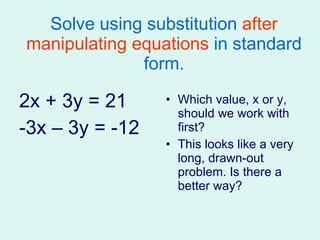
Solve using substitution  after manipulating equations  in standard form. 2x + 3y = 21 -3x – 3y = -12 Which value, x or y, should we work with first?  This looks like a very long, drawn-out problem. Is there a better way?
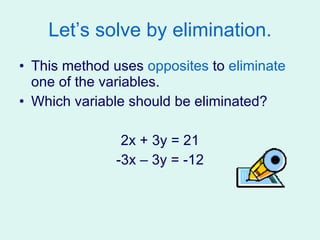
Let’s solve by elimination. This method uses  opposites  to  eliminate  one of the variables. Which variable should be eliminated? 2x + 3y = 21 -3x – 3y = -12
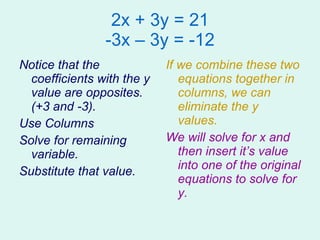
2x + 3y = 21 -3x – 3y = -12 Notice that the coefficients with the y value are opposites. (+3 and -3). Use Columns Solve for remaining variable. Substitute that value. If we combine these two equations together in columns, we can eliminate the y values. We will solve for x and then insert it’s value into one of the original equations to solve for y.
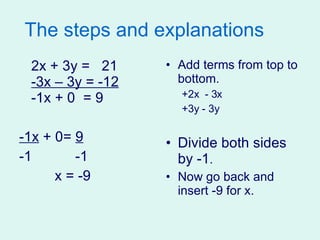
The steps and explanations 2x + 3y =  21 -3x – 3y = -12 -1x + 0 = 9 -1x  + 0=  9 -1  -1 x = -9 Add terms from top to bottom. +2x  - 3x +3y - 3y Divide both sides by -1 . Now go back and insert -9 for x.
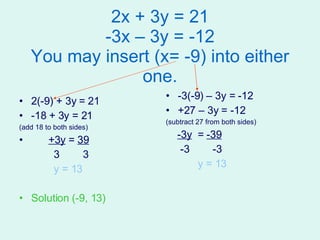
2x + 3y = 21 -3x – 3y = -12 You may insert (x= -9) into either one. 2(-9) + 3y = 21 -18 + 3y = 21 (add 18 to both sides) +3y  =  39 3  3 y = 13 Solution (-9, 13) -3(-9) – 3y = -12 +27 – 3y = -12 (subtract 27 from both sides) -3y   =  -39 -3  -3 y = 13
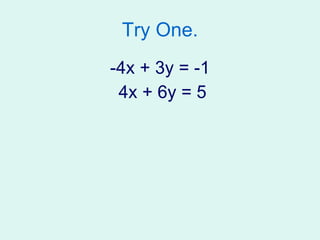
Try One. -4x + 3y = -1 4x + 6y = 5
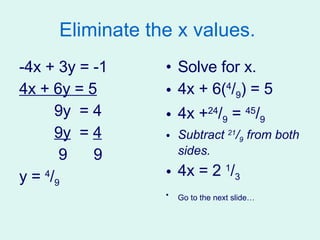
Eliminate the x values.  -4x + 3y = -1 4x + 6y = 5 9y  = 4 9y   =  4 9  9 y =  4 / 9 Solve for x. 4x + 6( 4 / 9 ) = 5 4x + 24 / 9  =  45 / 9 Subtract  21 / 9  from both sides. 4x = 2  1 / 3 Go to the next slide…
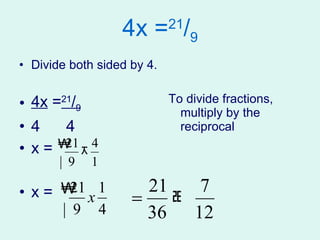
4x = 21 / 9 Divide both sided by 4. 4x  = 21 / 9 4  4 x = x =  To divide fractions, multiply by the reciprocal
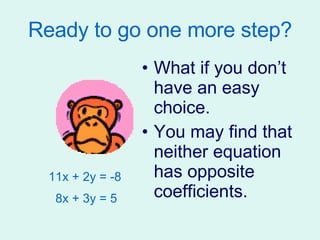
Ready to go one more step? What if you don’t have an easy choice. You may find that neither equation has opposite coefficients. 11x + 2y = -8  8x + 3y = 5
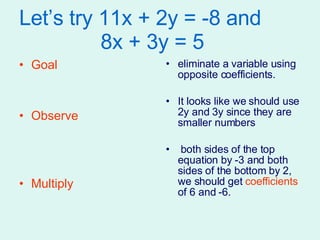
Let’s try 11x + 2y = -8 and   8x + 3y = 5 Goal Observe Multiply  eliminate a variable using opposite coefficients.  It looks like we should use 2y and 3y since they are smaller numbers both sides of the top equation by -3 and both sides of the bottom by 2, we should get  coefficients  of 6 and -6.
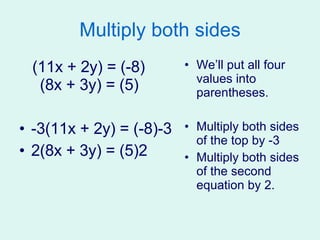
Multiply both sides (11x + 2y) = (-8)   (8x + 3y) = (5) -3(11x + 2y) = (-8)-3 2(8x + 3y) = (5)2 We’ll put all four values into parentheses. Multiply both sides of the top by -3 Multiply both sides of the second equation by 2.
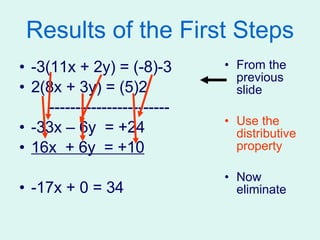
Results of the First Steps -3(11x + 2y) = (-8)-3 2(8x + 3y) = (5)2 ----------------------- -33x – 6y  = +24 16x  + 6y  = +10 -17x + 0 = 34 From the previous slide Use the distributive property Now eliminate
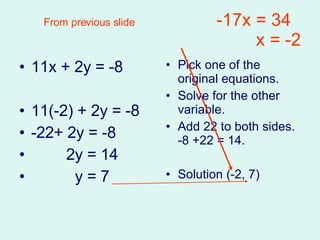
From previous slide  -17x = 34  x = -2 11x + 2y = -8 11(-2) + 2y = -8 -22+ 2y = -8 2y = 14 y = 7 Pick one of the original equations. Solve for the other variable. Add 22 to both sides. -8 +22 = 14. Solution (-2, 7)
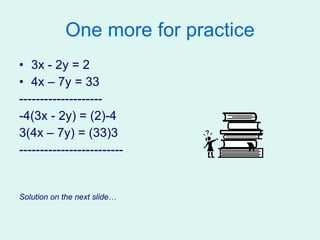
One more for practice 3x - 2y = 2 4x – 7y = 33 -------------------- -4(3x - 2y) = (2)-4 3(4x – 7y) = (33)3 ------------------------- Solution on the next slide…
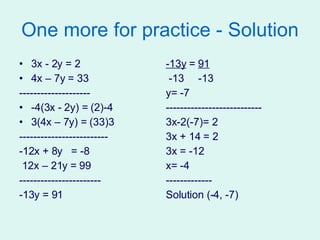
One more for practice - Solution 3x - 2y = 2 4x – 7y = 33 -------------------- -4(3x - 2y) = (2)-4 3(4x – 7y) = (33)3 ------------------------- -12x + 8y  = -8 12x – 21y = 99 ----------------------- -13y = 91 -13y  =  91 -13  -13 y= -7 --------------------------- 3x-2(-7)= 2 3x + 14 = 2 3x = -12  x= -4 ------------- Solution (-4, -7)
Which way of solving works best for you? Graphing? Substitution? Elimination? Make sure you know them all in order to pick the best way to solve each problem.
Assignment: 334:15-33 & 41-47 odds

7 3elimination

  • 1.
    Part Three –Solving equations by Elimination Holt Algebra I Text pages 330-334
  • 2.
    Solve using substitution after manipulating equations in standard form. 2x + 3y = 21 -3x – 3y = -12 Which value, x or y, should we work with first? This looks like a very long, drawn-out problem. Is there a better way?
  • 3.
    Let’s solve byelimination. This method uses opposites to eliminate one of the variables. Which variable should be eliminated? 2x + 3y = 21 -3x – 3y = -12
  • 4.
    2x + 3y= 21 -3x – 3y = -12 Notice that the coefficients with the y value are opposites. (+3 and -3). Use Columns Solve for remaining variable. Substitute that value. If we combine these two equations together in columns, we can eliminate the y values. We will solve for x and then insert it’s value into one of the original equations to solve for y.
  • 5.
    The steps andexplanations 2x + 3y = 21 -3x – 3y = -12 -1x + 0 = 9 -1x + 0= 9 -1 -1 x = -9 Add terms from top to bottom. +2x - 3x +3y - 3y Divide both sides by -1 . Now go back and insert -9 for x.
  • 6.
    2x + 3y= 21 -3x – 3y = -12 You may insert (x= -9) into either one. 2(-9) + 3y = 21 -18 + 3y = 21 (add 18 to both sides) +3y = 39 3 3 y = 13 Solution (-9, 13) -3(-9) – 3y = -12 +27 – 3y = -12 (subtract 27 from both sides) -3y = -39 -3 -3 y = 13
  • 7.
    Try One. -4x+ 3y = -1 4x + 6y = 5
  • 8.
    Eliminate the xvalues. -4x + 3y = -1 4x + 6y = 5 9y = 4 9y = 4 9 9 y = 4 / 9 Solve for x. 4x + 6( 4 / 9 ) = 5 4x + 24 / 9 = 45 / 9 Subtract 21 / 9 from both sides. 4x = 2 1 / 3 Go to the next slide…
  • 9.
    4x = 21/ 9 Divide both sided by 4. 4x = 21 / 9 4 4 x = x = To divide fractions, multiply by the reciprocal
  • 10.
    Ready to goone more step? What if you don’t have an easy choice. You may find that neither equation has opposite coefficients. 11x + 2y = -8 8x + 3y = 5
  • 11.
    Let’s try 11x+ 2y = -8 and 8x + 3y = 5 Goal Observe Multiply eliminate a variable using opposite coefficients. It looks like we should use 2y and 3y since they are smaller numbers both sides of the top equation by -3 and both sides of the bottom by 2, we should get coefficients of 6 and -6.
  • 12.
    Multiply both sides(11x + 2y) = (-8) (8x + 3y) = (5) -3(11x + 2y) = (-8)-3 2(8x + 3y) = (5)2 We’ll put all four values into parentheses. Multiply both sides of the top by -3 Multiply both sides of the second equation by 2.
  • 13.
    Results of theFirst Steps -3(11x + 2y) = (-8)-3 2(8x + 3y) = (5)2 ----------------------- -33x – 6y = +24 16x + 6y = +10 -17x + 0 = 34 From the previous slide Use the distributive property Now eliminate
  • 14.
    From previous slide -17x = 34 x = -2 11x + 2y = -8 11(-2) + 2y = -8 -22+ 2y = -8 2y = 14 y = 7 Pick one of the original equations. Solve for the other variable. Add 22 to both sides. -8 +22 = 14. Solution (-2, 7)
  • 15.
    One more forpractice 3x - 2y = 2 4x – 7y = 33 -------------------- -4(3x - 2y) = (2)-4 3(4x – 7y) = (33)3 ------------------------- Solution on the next slide…
  • 16.
    One more forpractice - Solution 3x - 2y = 2 4x – 7y = 33 -------------------- -4(3x - 2y) = (2)-4 3(4x – 7y) = (33)3 ------------------------- -12x + 8y = -8 12x – 21y = 99 ----------------------- -13y = 91 -13y = 91 -13 -13 y= -7 --------------------------- 3x-2(-7)= 2 3x + 14 = 2 3x = -12 x= -4 ------------- Solution (-4, -7)
  • 17.
    Which way ofsolving works best for you? Graphing? Substitution? Elimination? Make sure you know them all in order to pick the best way to solve each problem.
  • 18.