SOLVE ABSOLUTE VALUE EQUATIONS IN
ONE VARIABLE AND EXPRESS SOLUTIONS
IN VARIOUS NOTATIONS)
OBJECTIVES
The learner will be able to:
1. Review the definition of absolute
value.
2. Solve absolute value equations.
3. Solve absolute value inequalities.
WHAT IS ABSOLUTE VALUE?
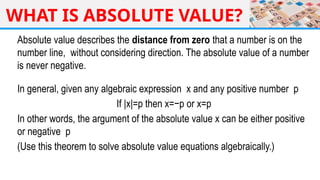
Absolute value describes the distance from zero that a number is on the
number line, without considering direction. The absolute value of a number
is never negative.
In general, given any algebraic expression x and any positive number p
If |x|=p then x=−p or x=p
In other words, the argument of the absolute value x can be either positive
or negative p
(Use this theorem to solve absolute value equations algebraically.)
WHAT IS ABSOLUTE VALUE?
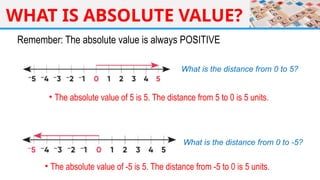
Remember: The absolute value is always POSITIVE
• The absolute value of 5 is 5. The distance from 5 to 0 is 5 units.
What is the distance from 0 to 5?
What is the distance from 0 to -5?
• The absolute value of -5 is 5. The distance from -5 to 0 is 5 units.
WHAT IS ABSOLUTE VALUE?
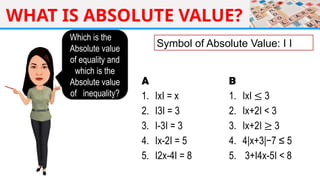
A
1. IxI = x
2. I3I = 3
3. I-3I = 3
4. Ix-2I = 5
5. I2x-4I = 8
Symbol of Absolute Value: I I
B
1. IxI ≤ 3
2. Ix+2I < 3
3. Ix+2I ≥ 3
4. 4|x+3|−7 ≤ 5
5. 3+I4x-5I < 8
Which is the
Absolute value
of equality and
which is the
Absolute value
of inequality?
What is the application of
Absolute value in real life? Absolute value is used in
various real-life
situations to measure
distance, calculate
differences, and
determine magnitude,
ensuring that results
are always non-negative.
This makes it a critical
tool in fields ranging from
navigation and finance to
science and engineering.
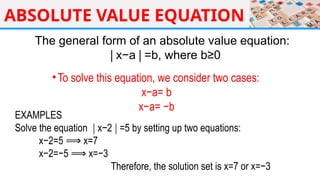
ABSOLUTE VALUE EQUATION
The general form of an absolute value equation:
x−a =b, where b≥0
∣ ∣
•To solve this equation, we consider two cases:
x−a= b
x−a= −b
EXAMPLES
Solve the equation x−2 =5 by setting up two equations:
∣ ∣
x−2=5 x=7
⟹
x−2=−5 x=−3
⟹
Therefore, the solution set is x=7 or x=−3
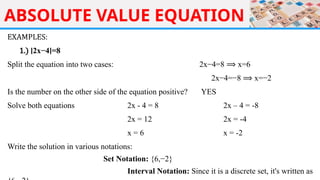
ABSOLUTE VALUE EQUATION
EXAMPLES:
1.) ∣2x−4∣=8
Split the equation into two cases: 2x−4=8 ⟹ x=6
2x−4=−8 ⟹ x=−2
Is the number on the other side of the equation positive? YES
Solve both equations 2x - 4 = 8 2x – 4 = -8
2x = 12 2x = -4
x = 6 x = -2
Write the solution in various notations:
Set Notation: {6,−2}
Interval Notation: Since it is a discrete set, it's written as
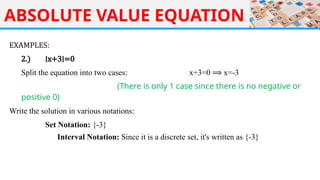
ABSOLUTE VALUE EQUATION
EXAMPLES:
2.) ∣x+3∣=0
Split the equation into two cases: x+3=0 ⟹ x=-3
(There is only 1 case since there is no negative or
positive 0)
Write the solution in various notations:
Set Notation: {-3}
Interval Notation: Since it is a discrete set, it's written as {-3}
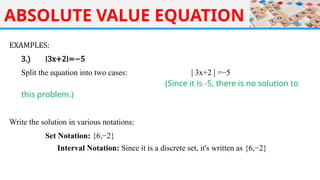
ABSOLUTE VALUE EQUATION
EXAMPLES:
3.) ∣3x+2∣=−5
Split the equation into two cases: 3x+2 =−5
∣ ∣
(Since it is -5, there is no solution to
this problem.)
Write the solution in various notations:
Set Notation: {6,−2}
Interval Notation: Since it is a discrete set, it's written as {6,−2}
INSTRUCTIONS:
1.Group Assignment:
1. Your group has been assigned an absolute value equation to solve.
2. Work together to find all possible solutions for your equation.
2.Solve the Equation:
1. Solve the given absolute value equation step-by-step.
2. Show your work clearly, including all steps needed to arrive at the solutions.
3.Express Solutions in Different Notations:
1. Once you have the solution(s), express them in the following notations:
1. Standard Notation: Write the solution as individual numbers or expressions (e.g., x=3 or x=−7).
2. Set Notation: Use curly braces to represent the set of solutions (e.g., {3,−7}).
3. Interval Notation: Represent the solution as an interval, if applicable (e.g., (−∞,−2] [2,∞).
∪
4.Prepare Your Presentation:
1. Write your final solutions on the provided chart paper.
2. Make sure your work is neat, organized, and large enough for everyone in the class to see.
3. Prepare to explain your reasoning to the class: why you solved the equation in the way you did and how you
arrived at your final answers.
5.Present to the Class:
1. One or more group members will present the solution and reasoning to the class.
2. Be ready to answer any questions from your classmates or the teacher about your solution process.
Group Activity
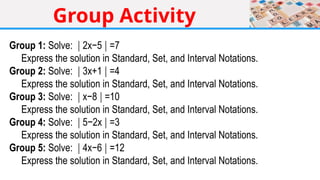
Group 1: Solve: 2x−5 =7
∣ ∣
Express the solution in Standard, Set, and Interval Notations.
Group 2: Solve: 3x+1 =4
∣ ∣
Express the solution in Standard, Set, and Interval Notations.
Group 3: Solve: x−8 =10
∣ ∣
Express the solution in Standard, Set, and Interval Notations.
Group 4: Solve: 5−2x =3
∣ ∣
Express the solution in Standard, Set, and Interval Notations.
Group 5: Solve: 4x−6 =12
∣ ∣
Express the solution in Standard, Set, and Interval Notations.
Group Activity
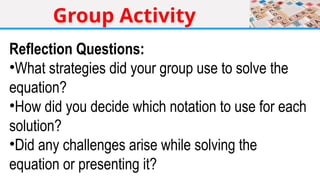
Reflection Questions:
•What strategies did your group use to solve the
equation?
•How did you decide which notation to use for each
solution?
•Did any challenges arise while solving the
equation or presenting it?
RECAP
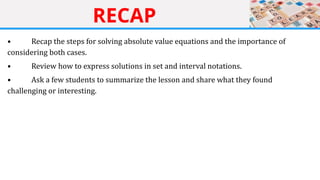
• Recap the steps for solving absolute value equations and the importance of
considering both cases.
• Review how to express solutions in set and interval notations.
• Ask a few students to summarize the lesson and share what they found
challenging or interesting.
WORKSHEET
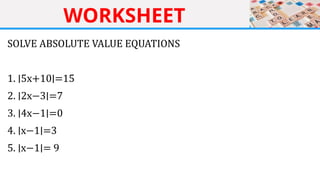
SOLVE ABSOLUTE VALUE EQUATIONS
1. ∣5x+10∣=15
2. ∣2x−3∣=7
3. ∣4x−1∣=0
4. ∣x−1∣=3
5. ∣x−1∣= 9
SOLVE ABSOLUTE VALUE INEQUALITY IN
ONE VARIABLE AND EXPRESS SOLUTIONS
IN VARIOUS NOTATIONS)
OBJECTIVES
The learner will be able to:
1.) Review the definition of absolute
value.
2.) Solve absolute value equations.
3.) Solve absolute value inequalities.
ABSOLUTE VALUE INEQUALITY
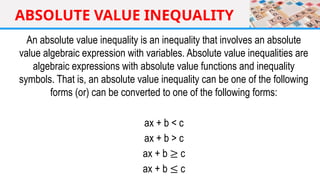
An absolute value inequality is an inequality that involves an absolute
value algebraic expression with variables. Absolute value inequalities are
algebraic expressions with absolute value functions and inequality
symbols. That is, an absolute value inequality can be one of the following
forms (or) can be converted to one of the following forms:
ax + b < c
ax + b > c
ax + b ≥ c
ax + b ≤ c
ABSOLUTE VALUE INQUALITY
Example: x ≤ 4
∣ ∣
This translates to: −4 ≤ x ≤ 4
Interval Notation:
•[−4,4] represents all values of x between -4 and 4
ABSOLUTE VALUE INQUALITY
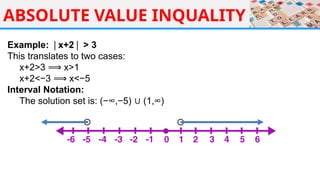
Example: x+2 > 3
∣ ∣
This translates to two cases:
x+2>3 x>1
⟹
x+2<−3 x<−5
⟹
Interval Notation:
The solution set is: (−∞,−5) (1,∞)
∪
Individual Activity
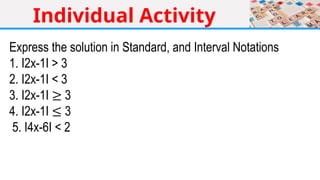
Express the solution in Standard, and Interval Notations
1. I2x-1I > 3
2. I2x-1I < 3
3. I2x-1I ≥ 3
4. I2x-1I ≤ 3
5. I4x-6I < 2

SOLVE ABSOLUTE VALUE EQUATIONS IN ONE VARIABLE AND EXPRESS SOLUTIONS IN VARIOUS NOTATIONS).pptx

  • 1.
    SOLVE ABSOLUTE VALUEEQUATIONS IN ONE VARIABLE AND EXPRESS SOLUTIONS IN VARIOUS NOTATIONS)
  • 2.
    OBJECTIVES The learner willbe able to: 1. Review the definition of absolute value. 2. Solve absolute value equations. 3. Solve absolute value inequalities.
  • 3.
    WHAT IS ABSOLUTEVALUE? Absolute value describes the distance from zero that a number is on the number line, without considering direction. The absolute value of a number is never negative. In general, given any algebraic expression x and any positive number p If |x|=p then x=−p or x=p In other words, the argument of the absolute value x can be either positive or negative p (Use this theorem to solve absolute value equations algebraically.)
  • 4.
    WHAT IS ABSOLUTEVALUE? Remember: The absolute value is always POSITIVE • The absolute value of 5 is 5. The distance from 5 to 0 is 5 units. What is the distance from 0 to 5? What is the distance from 0 to -5? • The absolute value of -5 is 5. The distance from -5 to 0 is 5 units.
  • 5.
    WHAT IS ABSOLUTEVALUE? A 1. IxI = x 2. I3I = 3 3. I-3I = 3 4. Ix-2I = 5 5. I2x-4I = 8 Symbol of Absolute Value: I I B 1. IxI ≤ 3 2. Ix+2I < 3 3. Ix+2I ≥ 3 4. 4|x+3|−7 ≤ 5 5. 3+I4x-5I < 8 Which is the Absolute value of equality and which is the Absolute value of inequality?
  • 6.
    What is theapplication of Absolute value in real life? Absolute value is used in various real-life situations to measure distance, calculate differences, and determine magnitude, ensuring that results are always non-negative. This makes it a critical tool in fields ranging from navigation and finance to science and engineering.
  • 7.
    ABSOLUTE VALUE EQUATION Thegeneral form of an absolute value equation: x−a =b, where b≥0 ∣ ∣ •To solve this equation, we consider two cases: x−a= b x−a= −b EXAMPLES Solve the equation x−2 =5 by setting up two equations: ∣ ∣ x−2=5 x=7 ⟹ x−2=−5 x=−3 ⟹ Therefore, the solution set is x=7 or x=−3
  • 8.
    ABSOLUTE VALUE EQUATION EXAMPLES: 1.)∣2x−4∣=8 Split the equation into two cases: 2x−4=8 ⟹ x=6 2x−4=−8 ⟹ x=−2 Is the number on the other side of the equation positive? YES Solve both equations 2x - 4 = 8 2x – 4 = -8 2x = 12 2x = -4 x = 6 x = -2 Write the solution in various notations: Set Notation: {6,−2} Interval Notation: Since it is a discrete set, it's written as
  • 9.
    ABSOLUTE VALUE EQUATION EXAMPLES: 2.)∣x+3∣=0 Split the equation into two cases: x+3=0 ⟹ x=-3 (There is only 1 case since there is no negative or positive 0) Write the solution in various notations: Set Notation: {-3} Interval Notation: Since it is a discrete set, it's written as {-3}
  • 10.
    ABSOLUTE VALUE EQUATION EXAMPLES: 3.)∣3x+2∣=−5 Split the equation into two cases: 3x+2 =−5 ∣ ∣ (Since it is -5, there is no solution to this problem.) Write the solution in various notations: Set Notation: {6,−2} Interval Notation: Since it is a discrete set, it's written as {6,−2}
  • 11.
    INSTRUCTIONS: 1.Group Assignment: 1. Yourgroup has been assigned an absolute value equation to solve. 2. Work together to find all possible solutions for your equation. 2.Solve the Equation: 1. Solve the given absolute value equation step-by-step. 2. Show your work clearly, including all steps needed to arrive at the solutions. 3.Express Solutions in Different Notations: 1. Once you have the solution(s), express them in the following notations: 1. Standard Notation: Write the solution as individual numbers or expressions (e.g., x=3 or x=−7). 2. Set Notation: Use curly braces to represent the set of solutions (e.g., {3,−7}). 3. Interval Notation: Represent the solution as an interval, if applicable (e.g., (−∞,−2] [2,∞). ∪ 4.Prepare Your Presentation: 1. Write your final solutions on the provided chart paper. 2. Make sure your work is neat, organized, and large enough for everyone in the class to see. 3. Prepare to explain your reasoning to the class: why you solved the equation in the way you did and how you arrived at your final answers. 5.Present to the Class: 1. One or more group members will present the solution and reasoning to the class. 2. Be ready to answer any questions from your classmates or the teacher about your solution process.
  • 12.
    Group Activity Group 1:Solve: 2x−5 =7 ∣ ∣ Express the solution in Standard, Set, and Interval Notations. Group 2: Solve: 3x+1 =4 ∣ ∣ Express the solution in Standard, Set, and Interval Notations. Group 3: Solve: x−8 =10 ∣ ∣ Express the solution in Standard, Set, and Interval Notations. Group 4: Solve: 5−2x =3 ∣ ∣ Express the solution in Standard, Set, and Interval Notations. Group 5: Solve: 4x−6 =12 ∣ ∣ Express the solution in Standard, Set, and Interval Notations.
  • 13.
    Group Activity Reflection Questions: •Whatstrategies did your group use to solve the equation? •How did you decide which notation to use for each solution? •Did any challenges arise while solving the equation or presenting it?
  • 14.
    RECAP • Recap thesteps for solving absolute value equations and the importance of considering both cases. • Review how to express solutions in set and interval notations. • Ask a few students to summarize the lesson and share what they found challenging or interesting.
  • 15.
    WORKSHEET SOLVE ABSOLUTE VALUEEQUATIONS 1. ∣5x+10∣=15 2. ∣2x−3∣=7 3. ∣4x−1∣=0 4. ∣x−1∣=3 5. ∣x−1∣= 9
  • 16.
    SOLVE ABSOLUTE VALUEINEQUALITY IN ONE VARIABLE AND EXPRESS SOLUTIONS IN VARIOUS NOTATIONS)
  • 17.
    OBJECTIVES The learner willbe able to: 1.) Review the definition of absolute value. 2.) Solve absolute value equations. 3.) Solve absolute value inequalities.
  • 18.
    ABSOLUTE VALUE INEQUALITY Anabsolute value inequality is an inequality that involves an absolute value algebraic expression with variables. Absolute value inequalities are algebraic expressions with absolute value functions and inequality symbols. That is, an absolute value inequality can be one of the following forms (or) can be converted to one of the following forms: ax + b < c ax + b > c ax + b ≥ c ax + b ≤ c
  • 19.
    ABSOLUTE VALUE INQUALITY Example:x ≤ 4 ∣ ∣ This translates to: −4 ≤ x ≤ 4 Interval Notation: •[−4,4] represents all values of x between -4 and 4
  • 20.
    ABSOLUTE VALUE INQUALITY Example:x+2 > 3 ∣ ∣ This translates to two cases: x+2>3 x>1 ⟹ x+2<−3 x<−5 ⟹ Interval Notation: The solution set is: (−∞,−5) (1,∞) ∪
  • 21.
    Individual Activity Express thesolution in Standard, and Interval Notations 1. I2x-1I > 3 2. I2x-1I < 3 3. I2x-1I ≥ 3 4. I2x-1I ≤ 3 5. I4x-6I < 2

Editor's Notes

  • #3 ACTIVATING PRIOR KNOWLEDGE Given this definition, |3|=3 and |−3|=−(−3)=3. Therefore, the equation |x|=3 has two solutions for x, namely {±3}  
  • #4 ACTIVATING PRIOR KNOWLEDGE Begin the lesson by reviewing the concept of absolute value.   Definition: Explain that the absolute value of a number is its distance from zero on a number line, regardless of direction.  
  • #5 ACTIVATING PRIOR KNOWLEDGE   Example: |x| represents the absolute value of x. Show examples: |3| = 3 and |-3| = 3.  
  • #6 ACTIVATING PRIOR KNOWLEDGE   Ask students to provide real-life examples where absolute value is used (e.g., distance, temperature differences). Real-Life Examples and Applications of Absolute Value Measuring Distance: Absolute value is used to measure the distance between two points on a number line or coordinate plane. Since distance is always a non-negative quantity, the absolute value ensures that it is represented as such. Example: The distance between two cities located at positions 5 km and -3 km on a number line can be calculated as ∣5−(−3)∣=∣5+3∣=8|5 - (-3)| = |5 + 3| = 8∣5−(−3)∣=∣5+3∣=8 km. Temperature Differences: Absolute value is used to find the difference in temperature, regardless of whether the temperatures are above or below zero. Example: If the temperature is -10°C in the morning and 5°C in the afternoon, the temperature change is ∣−10−5∣=∣−15∣=15|-10 - 5| = |-15| = 15∣−10−5∣=∣−15∣=15°C. Finance and Economics: Absolute value is used to calculate profit and loss, where the focus is on the magnitude of change rather than the direction (gain or loss). Example: If a stock's value changes from $150 to $100, the absolute change is ∣150−100∣=50|150 - 100| = 50∣150−100∣=50 dollars. Engineering and Physics: In physics, absolute value is used in formulas involving distance, speed, and force, where only the magnitude is of interest. Example: When calculating the displacement of an object, absolute value ensures the result is non-negative, even if the direction of movement changes. Navigation and GPS Systems: Absolute value is used in navigation to calculate the shortest path between two points, regardless of their relative positions. Example: A GPS calculates the absolute distance to determine how far a vehicle has traveled from its starting point, regardless of direction. Data Science and Statistics: Absolute value is used to measure deviations and differences from a mean or expected value. Example: The mean absolute deviation (MAD) measures the average distance between each data point and the mean, giving an idea of data spread. Medicine: Absolute value is used in medical diagnostics to measure the deviation of vital signs from normal values. Example: Calculating the absolute difference between a patient’s heart rate and the normal range helps in assessing health conditions. Earthquake Measurement: The Richter scale uses absolute values to measure the magnitude of earthquakes. The scale focuses on the absolute energy released, regardless of the location's positive or negative coordinates. Gaming: In video games, absolute value may be used to determine the shortest path between characters or objects on a grid, or to calculate health points lost or gained in gameplay. Construction and Architecture: Absolute values are used to calculate dimensions and tolerances, where only the magnitude of a measurement matters. Example: The absolute difference between a design blueprint and the actual construction measurements helps identify deviations and ensure accuracy. Summary Absolute value is used in various real-life situations to measure distance, calculate differences, and determine magnitude, ensuring that results are always non-negative. This makes it a critical tool in fields ranging from navigation and finance to science and engineering.
  • #7 Establishing Lesson Purpose Explain the General Approach to Solving Absolute Value Equations: Present the general form of an absolute value equation: ∣x−a∣=b, where b≥0 Explain that to solve this equation, we consider two cases: x−a= b x−a= −b Provide examples: Solve the equation ∣x−2∣=5 by setting up two equations: x−2=5 ⟹ x=7 x−2=−5 ⟹ x=−3 Therefore, the solution set is x=7 or x=−3
  • #8 Provide students with different absolute value equations to solve, such as: ∣2x−4∣=8 ∣x+3∣=0 ∣3x+2∣=−5 (Discuss why this has no solution) Work through the first problem together: Split the equation into two cases: 2x−4=8 ⟹ x=6 2x−4=−8 ⟹ x=−2 Write the solution in various notations: Set Notation: {6,−2} Interval Notation: Since it is a discrete set, it's written as {6,−2}
  • #9 Provide students with different absolute value equations to solve, such as: ∣2x−4∣=8 ∣x+3∣=0 ∣3x+2∣=−5 (Discuss why this has no solution) Work through the first problem together: Split the equation into two cases: 2x−4=8 ⟹ x=6 2x−4=−8 ⟹ x=−2 Write the solution in various notations: Set Notation: {6,−2} Interval Notation: Since it is a discrete set, it's written as {6,−2}
  • #10 In an absolute value equation, if the number on the other side of the equation is negative, the equation has no solution because absolute value is always non-negative. Consider an absolute value equation in the form: ∣A∣=B For this equation to have a solution, B must be greater than or equal to zero (B≥0)
  • #14 GENERALIZATION Recap the steps for solving absolute value equations and the importance of considering both cases. Review how to express solutions in set and interval notations. Ask a few students to summarize the lesson and share what they found challenging or interesting.
  • #15 EVALUATION Hand out worksheets with problems of increasing difficulty, such as: ∣5x+10∣=15 ∣x/2−3∣=7 ∣4x−1∣=0 Encourage students to solve these problems individually while circulating the room to offer support.
  • #18 Establishing Lesson Purpose Explain the General Approach to Solving Absolute Value Equations: Present the general form of an absolute value equation: ∣x−a∣=b, where b≥0 Explain that to solve this equation, we consider two cases: x−a= b x−a= −b Provide examples: Solve the equation ∣x−2∣=5 by setting up two equations: x−2=5 ⟹ x=7 x−2=−5 ⟹ x=−3 Therefore, the solution set is x=7 or x=−3
  • #19 In an absolute value equation, if the number on the other side of the equation is negative, the equation has no solution because absolute value is always non-negative. Consider an absolute value equation in the form: ∣A∣=B For this equation to have a solution, B must be greater than or equal to zero (B≥0)
  • #20 In an absolute value equation, if the number on the other side of the equation is negative, the equation has no solution because absolute value is always non-negative. Consider an absolute value equation in the form: ∣A∣=B For this equation to have a solution, B must be greater than or equal to zero (B≥0)