SOLUTIONS
Physical Pharmacy
Compiled by Dr. Memoona
Solutions
• A solution is a homogeneous mixture of one phase containing two or more
substances at molecular level.
• OR
• A homogeneous mixture of chemical substances, which has same physical
properties and chemical composition is called solution.
• OR
• A homogeneous mixture of solute and solvent which doesn’t interact chemically is
called solution.
• OR
• A solution is a homogenous mixture of two substances but consisting of one
phase.
• PHARMACEUTICAL SOLUTIONS:
• Solutions are dosage form prepared by dissolving the active
ingredient(s) in aqueous or non-aqueous solvent.
• Definitions:
• SYSTEM: System is the bounded space which is under
consideration.
• PHASE: Phase is a distinct homogeneous part of a system
separated by definite boundaries from other parts of the system.
• DISPERSION: Dispersion consists of at least two phases with one
or more dispersed (internal) phase contained in a single
continuous (external) phase.
Solute & Solvent:
• A solution consists of two or more substances; the substance which is
greater in amount is called the solvent while the substance which is
lesser in amount is referred as solute.
•  Generally, in liquid and solid solution the liquid is taken as solvent
while the solid substance is the solute irrespective of material
quantity.
•  Similarly, in case of a solution consisting of water and any other
solid or liquid substance, the water is taken as solvent while the other
substance is the solute irrespective of the material quantity.
•TYPE OF DISPERSION:
•True solution
•Colloidal dispersion
•Coarse dispersion
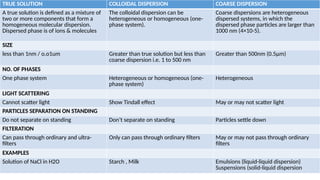
TRUE SOLUTION COLLOIDAL DISPERSION COARSE DISPERSION
A true solution is defined as a mixture of
two or more components that form a
homogeneous molecular dispersion.
Dispersed phase is of ions & molecules
The colloidal dispersion can be
heterogeneous or homogeneous (one-
phase system).
Coarse dispersions are heterogeneous
dispersed systems, in which the
dispersed phase particles are larger than
1000 nm (4×10⁻⁵).
SIZE
less than 1nm / o.o1um Greater than true solution but less than
coarse dispersion i.e. 1 to 500 nm
Greater than 500nm (0.5μm)
NO. OF PHASES
One phase system Heterogeneous or homogeneous (one-
phase system)
Heterogeneous
LIGHT SCATTERING
Cannot scatter light Show Tindall effect May or may not scatter light
PARTICLES SEPARATION ON STANDING
Do not separate on standing Don’t separate on standing Particles settle down
FILTERATION
Can pass through ordinary and ultra-
filters
Only can pass through ordinary filters May or may not pass through ordinary
filters
EXAMPLES
Solution of NaCl in H2O Starch , Milk Emulsions (liquid-liquid dispersion)
Suspensions (solid-liquid dispersion
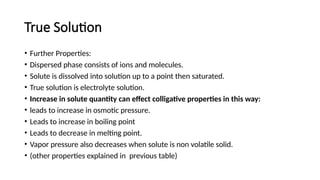
True Solution
• Further Properties:
• Dispersed phase consists of ions and molecules.
• Solute is dissolved into solution up to a point then saturated.
• True solution is electrolyte solution.
• Increase in solute quantity can effect colligative properties in this way:
• leads to increase in osmotic pressure.
• Leads to increase in boiling point
• Leads to decrease in melting point.
• Vapor pressure also decreases when solute is non volatile solid.
• (other properties explained in previous table)
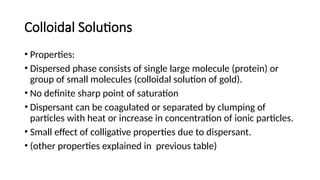
Colloidal Solutions
• Properties:
• Dispersed phase consists of single large molecule (protein) or
group of small molecules (colloidal solution of gold).
• No definite sharp point of saturation
• Dispersant can be coagulated or separated by clumping of
particles with heat or increase in concentration of ionic particles.
• Small effect of colligative properties due to dispersant.
• (other properties explained in previous table)
• BINARY SOLUTION: A solution consisting of only two
substances is known as binary solution.
• Saturated solutions: the solution in which solute is in
equilibrium with solvent phase at that temperature. A
saturated solution is a solution that contains the maximum
amount of solute that is capable of dissolving in a solvent.
• Supersaturated solutions: A supersaturated solution is a
solution that contains more than the maximum amount of
solute that is capable of being dissolved at a given
temperature. It can be diluted by vigorous shaking or
addition of small crystals.
Isotonic solution
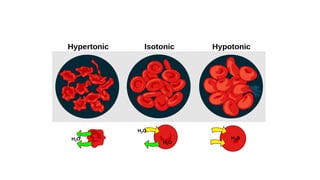
• A solution that has same salt concentration as the normal cells of the body and
blood.
• If the medium has exactly the same water conc. as the cell, there will be no net
movement of water across cell membrane. Such solution is known as isotonic.
• When two solutions have same osmotic pressure and same concentration they are
to be isotonic
• Isotonic solution has no effect on volume of tissues and cells. Thus a cell when
placed in an isotonic solution tends neither to gain or loose water.
• 0.9% solution of NaCl has essentially same salt conc, and osmotic pressure as the
RBC’s content. Thus, it is called isotonic to blood and physiologically saline solution.
• Hypertonic solutions: the solution which has a greater osmotic pressure or
salt concentration than that of reference solution.
• Example: if RBC’s are suspended in 2.0% solution of NaCl, water from RBC
will come out into surrounding to dilute NaCl solution. It causes shrinkage of
RBC’s. This salt solution is said to be hypertonic to blood.
• Hypotonic solutions: the solution having lower osmotic pressure or salt
concentration than that of reference solution is said to be hypotonic.
• Example: if RBC’s are suspended in 0.02% solution of NaCl, then water from
this solution will enter to blood cells to dilute thus causing swelling of RBC’s.
it can lead to rupture of RBC’s thus releasing hemoglobin. Such solution is
hypotonic to blood.
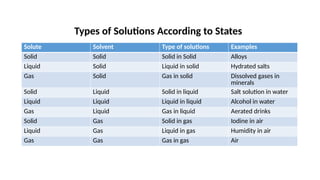
Solute Solvent Type of solutions Examples
Solid Solid Solid in Solid Alloys
Liquid Solid Liquid in solid Hydrated salts
Gas Solid Gas in solid Dissolved gases in
minerals
Solid Liquid Solid in liquid Salt solution in water
Liquid Liquid Liquid in liquid Alcohol in water
Gas Liquid Gas in liquid Aerated drinks
Solid Gas Solid in gas Iodine in air
Liquid Gas Liquid in gas Humidity in air
Gas Gas Gas in gas Air
Types of Solutions According to States
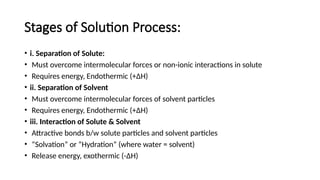
Stages of Solution Process:
• i. Separation of Solute:
• Must overcome intermolecular forces or non-ionic interactions in solute
• Requires energy, Endothermic (+ΔH)
• ii. Separation of Solvent
• Must overcome intermolecular forces of solvent particles
• Requires energy, Endothermic (+ΔH)
• iii. Interaction of Solute & Solvent
• Attractive bonds b/w solute particles and solvent particles
• “Solvation” or “Hydration” (where water = solvent)
• Release energy, exothermic (-ΔH)
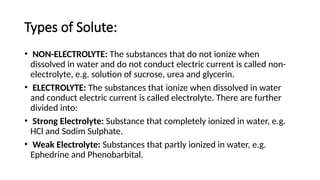
Types of Solute:
• NON-ELECTROLYTE: The substances that do not ionize when
dissolved in water and do not conduct electric current is called non-
electrolyte, e.g. solution of sucrose, urea and glycerin.
• ELECTROLYTE: The substances that ionize when dissolved in water
and conduct electric current is called electrolyte. There are further
divided into:
• Strong Electrolyte: Substance that completely ionized in water, e.g.
HCl and Sodim Sulphate.
• Weak Electrolyte: Substances that partly ionized in water, e.g.
Ephedrine and Phenobarbital.
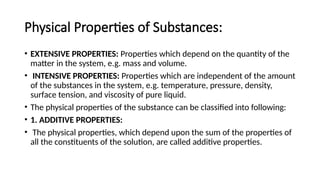
Physical Properties of Substances:
• EXTENSIVE PROPERTIES: Properties which depend on the quantity of the
matter in the system, e.g. mass and volume.
• INTENSIVE PROPERTIES: Properties which are independent of the amount
of the substances in the system, e.g. temperature, pressure, density,
surface tension, and viscosity of pure liquid.
• The physical properties of the substance can be classified into following:
• 1. ADDITIVE PROPERTIES:
• The physical properties, which depend upon the sum of the properties of
all the constituents of the solution, are called additive properties.
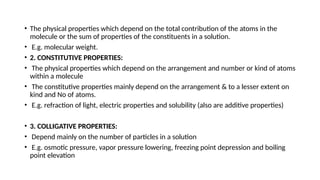
• The physical properties which depend on the total contribution of the atoms in the
molecule or the sum of properties of the constituents in a solution.
• E.g. molecular weight.
• 2. CONSTITUTIVE PROPERTIES:
• The physical properties which depend on the arrangement and number or kind of atoms
within a molecule
• The constitutive properties mainly depend on the arrangement & to a lesser extent on
kind and No of atoms.
• E.g. refraction of light, electric properties and solubility (also are additive properties)
• 3. COLLIGATIVE PROPERTIES:
• Depend mainly on the number of particles in a solution
• E.g. osmotic pressure, vapor pressure lowering, freezing point depression and boiling
point elevation
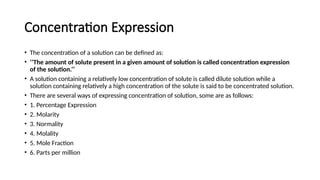
Concentration Expression
• The concentration of a solution can be defined as:
• ‘’The amount of solute present in a given amount of solution is called concentration expression
of the solution.’’
• A solution containing a relatively low concentration of solute is called dilute solution while a
solution containing relatively a high concentration of the solute is said to be concentrated solution.
• There are several ways of expressing concentration of solution, some are as follows:
• 1. Percentage Expression
• 2. Molarity
• 3. Normality
• 4. Molality
• 5. Mole Fraction
• 6. Parts per million
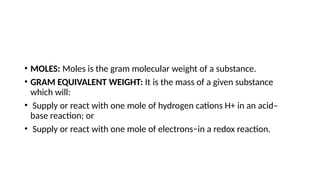
• MOLES: Moles is the gram molecular weight of a substance.
• GRAM EQUIVALENT WEIGHT: It is the mass of a given substance
which will:
• Supply or react with one mole of hydrogen cations H+ in an acid–
base reaction; or
• Supply or react with one mole of electrons−in a redox reaction.
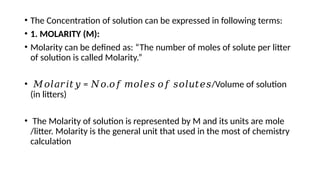
• The Concentration of solution can be expressed in following terms:
• 1. MOLARITY (M):
• Molarity can be defined as: “The number of moles of solute per litter
of solution is called Molarity.”
• 𝑀𝑜𝑙𝑎𝑟𝑖𝑡𝑦 = . /Volume of solution
𝑁𝑜 𝑜𝑓 𝑚𝑜𝑙𝑒𝑠 𝑜𝑓 𝑠𝑜𝑙𝑢𝑡𝑒𝑠
(in litters)
• The Molarity of solution is represented by M and its units are mole
/litter. Molarity is the general unit that used in the most of chemistry
calculation
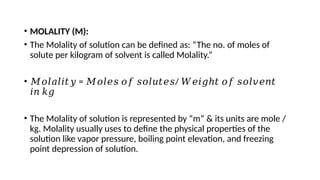
• MOLALITY (M):
• The Molality of solution can be defined as: “The no. of moles of
solute per kilogram of solvent is called Molality.”
• 𝑀𝑜𝑙𝑎𝑙𝑖𝑡𝑦 = /
𝑀𝑜𝑙𝑒𝑠 𝑜𝑓 𝑠𝑜𝑙𝑢𝑡𝑒𝑠 𝑊𝑒𝑖𝑔ℎ𝑡 𝑜𝑓 𝑠𝑜𝑙𝑣𝑒𝑛𝑡
𝑖𝑛 𝑘𝑔
• The Molality of solution is represented by “m” & its units are mole /
kg. Molality usually uses to define the physical properties of the
solution like vapor pressure, boiling point elevation, and freezing
point depression of solution.
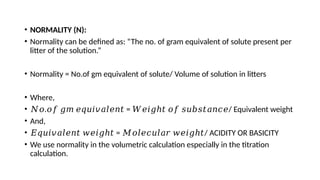
• NORMALITY (N):
• Normality can be defined as: “The no. of gram equivalent of solute present per
litter of the solution.”
• Normality = No.of gm equivalent of solute/ Volume of solution in litters
• Where,
• 𝑁𝑜. = / Equivalent weight
𝑜𝑓 𝑔𝑚 𝑒𝑞𝑢𝑖𝑣𝑎𝑙𝑒𝑛𝑡 𝑊𝑒𝑖𝑔ℎ𝑡 𝑜𝑓 𝑠𝑢𝑏𝑠𝑡𝑎𝑛𝑐𝑒
• And,
• 𝐸𝑞𝑢𝑖𝑣𝑎𝑙𝑒𝑛𝑡 𝑤𝑒𝑖𝑔ℎ𝑡 = / ACIDITY OR BASICITY
𝑀𝑜𝑙𝑒𝑐𝑢𝑙𝑎𝑟 𝑤𝑒𝑖𝑔ℎ𝑡
• We use normality in the volumetric calculation especially in the titration
calculation.
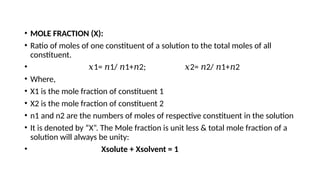
• MOLE FRACTION (X):
• Ratio of moles of one constituent of a solution to the total moles of all
constituent.
• 𝑥1= 1/ 1+ 2; 2= 2/ 1+ 2
𝑛 𝑛 𝑛 𝑥 𝑛 𝑛 𝑛
• Where,
• X1 is the mole fraction of constituent 1
• X2 is the mole fraction of constituent 2
• n1 and n2 are the numbers of moles of respective constituent in the solution
• It is denoted by “X”. The Mole fraction is unit less & total mole fraction of a
solution will always be unity:
• Xsolute + Xsolvent = 1
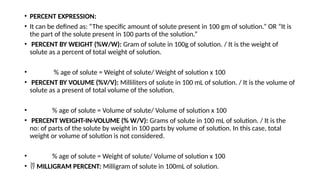
• PERCENT EXPRESSION:
• It can be defined as: “The specific amount of solute present in 100 gm of solution.” OR “It is
the part of the solute present in 100 parts of the solution.”
• PERCENT BY WEIGHT (%W/W): Gram of solute in 100g of solution. / It is the weight of
solute as a percent of total weight of solution.
• % age of solute = Weight of solute/ Weight of solution x 100
• PERCENT BY VOLUME (%V/V): Milliliters of solute in 100 mL of solution. / It is the volume of
solute as a present of total volume of the solution.
• % age of solute = Volume of solute/ Volume of solution x 100
• PERCENT WEIGHT-IN-VOLUME (% W/V): Grams of solute in 100 mL of solution. / It is the
no: of parts of the solute by weight in 100 parts by volume of solution. In this case, total
weight or volume of solution is not considered.
• % age of solute = Weight of solute/ Volume of solution x 100
•  MILLIGRAM PERCENT: Milligram of solute in 100mL of solution.
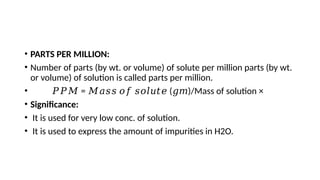
• PARTS PER MILLION:
• Number of parts (by wt. or volume) of solute per million parts (by wt.
or volume) of solution is called parts per million.
• 𝑃𝑃𝑀 = ( )/Mass of solution ×
𝑀𝑎𝑠𝑠 𝑜𝑓 𝑠𝑜𝑙𝑢𝑡𝑒 𝑔𝑚
• Significance:
• It is used for very low conc. of solution.
• It is used to express the amount of impurities in H2O.
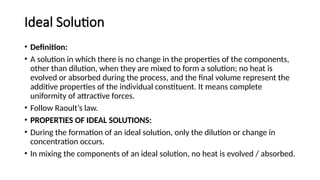
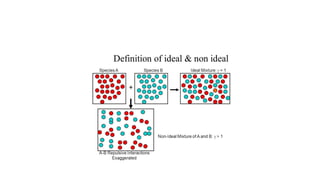
Ideal Solution
• Definition:
• A solution in which there is no change in the properties of the components,
other than dilution, when they are mixed to form a solution; no heat is
evolved or absorbed during the process, and the final volume represent the
additive properties of the individual constituent. It means complete
uniformity of attractive forces.
• Follow Raoult’s law.
• PROPERTIES OF IDEAL SOLUTIONS:
• During the formation of an ideal solution, only the dilution or change in
concentration occurs.
• In mixing the components of an ideal solution, no heat is evolved / absorbed.
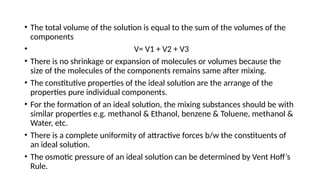
• The total volume of the solution is equal to the sum of the volumes of the
components
• V= V1 + V2 + V3
• There is no shrinkage or expansion of molecules or volumes because the
size of the molecules of the components remains same after mixing.
• The constitutive properties of the ideal solution are the arrange of the
properties pure individual components.
• For the formation of an ideal solution, the mixing substances should be with
similar properties e.g. methanol & Ethanol, benzene & Toluene, methanol &
Water, etc.
• There is a complete uniformity of attractive forces b/w the constituents of
an ideal solution.
• The osmotic pressure of an ideal solution can be determined by Vent Hoff’s
Rule.
Real Solutions
• Definition;
• Solution which does not follow the Raoult’s Law is called non-ideal solution
or real solution. The real solution show deviation from Raoult’s Law, which
are either positive or negative deviation.
• Doesn’t follow Raoult’s law
• PROPERTIES OF REAL SOLUTION:
• Total volume of real solution is not equal to the sum of volumes of all the
components, i.e.
V ≠ V1 + V2 + V3
• During the mixing of components of real solution, there is either evolution
or absorption of heat, i.e. ΔH ≠ O.
• When the components of a real solution are mixed, there will be either
shrinkage or expansion of the molecules of the components.
• Real solutions can be obtained by mixing the components of different properties.
• The attractive forces b/w the components of the real solutions are not the same.
• There must be change in properties of the components of the real solution.
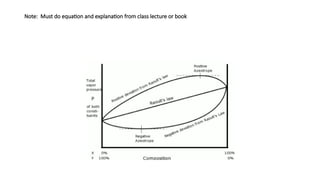
• The real solutions deviate from Raoult’s Law in two ways:
• 1-If the cohesive forces are greater than adhesive forces. Then real solutions
deviate positively from Raoult’s Law. E.g. Acetone, water, Benzene & Ethyl
Alcohol, Ethanol & Water.
• 2-If the adhesive forces b/w the molecules of components are greater that
cohesive forces, then real solution deviate negatively from Raoult’s Law.
E. g. H2O + HCl, Acetone + Chloroform.
Raoult’s Law:
• Raoult’s law states that, any particular temperature, the partial
pressure of one component of a binary mixture is equal to the mole
fraction of that component multiplied by its vapor pressure in the
pure state at this temperature.
• According to Raoult’s law, in an ideal solution the partial pressure (P)
of each volatile constituent is equal to the vapour pressure of the
pure constituent () multiplied by its mole fraction (X).
• P = × X
• ESCAPING TENDENCY: The tendency to escape or expand is called
escaping tendency. The escaping tendency of hotter body is greater
than the escaping tendency of colder one.
Note: Must do equation and explanation from class lecture or book
Colligative Properties
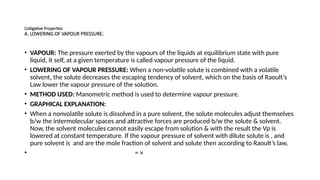
A. LOWERING OF VAPOUR PRESSURE:
• VAPOUR: The pressure exerted by the vapours of the liquids at equilibrium state with pure
liquid, it self, at a given temperature is called vapour pressure of the liquid.
• LOWERING OF VAPOUR PRESSURE: When a non-volatile solute is combined with a volatile
solvent, the solute decreases the escaping tendency of solvent, which on the basis of Raoult’s
Law lower the vapour pressure of the solution.
• METHOD USED: Manometric method is used to determine vapour pressure.
• GRAPHICAL EXPLANATION:
• When a nonvolatile solute is dissolved in a pure solvent, the solute molecules adjust themselves
b/w the intermolecular spaces and attractive forces are produced b/w the solute & solvent.
Now, the solvent molecules cannot easily escape from solution & with the result the Vp is
lowered at constant temperature. If the vapour pressure of solvent with dilute solute is , and
pure solvent is and are the mole fraction of solvent and solute then according to Raoult’s law,
• = ×
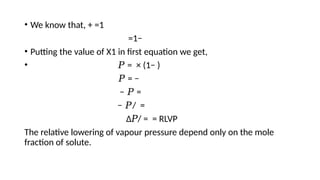
• We know that, + =1
=1−
• Putting the value of X1 in first equation we get,
• 𝑃 = × (1− )
𝑃 = −
− 𝑃 =
− 𝑃/ =
Δ𝑃/ = = RLVP
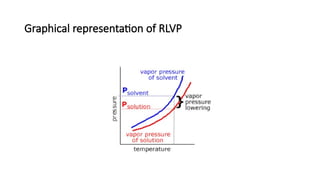
The relative lowering of vapour pressure depend only on the mole
fraction of solute.
Graphical representation of RLVP
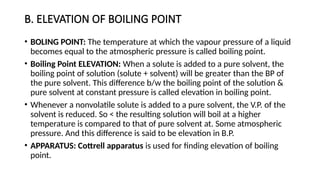
B. ELEVATION OF BOILING POINT
• BOLING POINT: The temperature at which the vapour pressure of a liquid
becomes equal to the atmospheric pressure is called boiling point.
• Boiling Point ELEVATION: When a solute is added to a pure solvent, the
boiling point of solution (solute + solvent) will be greater than the BP of
the pure solvent. This difference b/w the boiling point of the solution &
pure solvent at constant pressure is called elevation in boiling point.
• Whenever a nonvolatile solute is added to a pure solvent, the V.P. of the
solvent is reduced. So < the resulting solution will boil at a higher
temperature is compared to that of pure solvent at. Some atmospheric
pressure. And this difference is said to be elevation in B.P.
• APPARATUS: Cottrell apparatus is used for finding elevation of boiling
point.
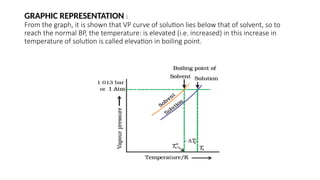
GRAPHIC REPRESENTATION :
From the graph, it is shown that VP curve of solution lies below that of solvent, so to
reach the normal BP, the temperature: is elevated (i.e. increased) in this increase in
temperature of solution is called elevation in boiling point.
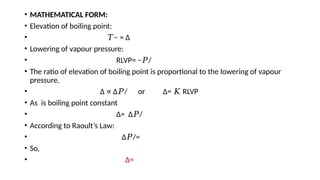
• MATHEMATICAL FORM:
• Elevation of boiling point:
• −
𝑇 = Δ
• Lowering of vapour pressure:
• RLVP= − /
𝑃
• The ratio of elevation of boiling point is proportional to the lowering of vapour
pressure.
• Δ Δ / or Δ= RLVP
∝ 𝑃 𝐾
• As is boiling point constant
• Δ= Δ /
𝑃
• According to Raoult’s Law:
• Δ /=
𝑃
• So,
• Δ=
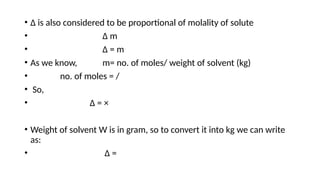
• Δ is also considered to be proportional of molality of solute
• Δ m
• Δ = m
• As we know, m= no. of moles/ weight of solvent (kg)
• no. of moles = /
• So,
• Δ = ×
• Weight of solvent W is in gram, so to convert it into kg we can write
as:
• Δ =
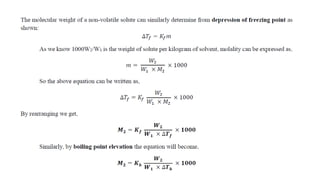
C. DEPRESSION OF FREEZING POINT:
• When a nonvolatile solute is dissolved in a pure solvent, then it will freeze at a lower
temperature than the temperature at which pure solvent freezes. And this difference in
freezing point b/w the pure solvent & solution is called freezing point depression.
• METHOD USED: Beckmann’s Apparatus or Equilibrium Apparatus is used to determine
depression of freezing point.
• EXPLANATION:
• When a nonvolatile solute is added to a pure solvent at triple point, the lowering of
vapour pressure of solution takes place, so in order to again establish equilibrium b/w
solid & liquid, the temperature is further dropped & this leads to depression in freezing
point of the solution as compared to FP of pure solvent and this is called dispersion in
freezing point.
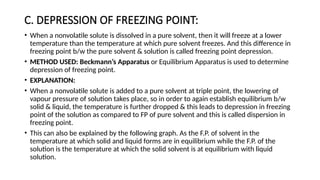
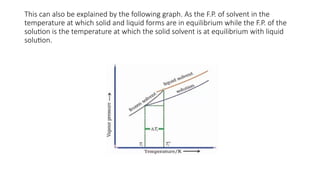
• This can also be explained by the following graph. As the F.P. of solvent in the
temperature at which solid and liquid forms are in equilibrium while the F.P. of the
solution is the temperature at which the solid solvent is at equilibrium with liquid
solution.
This can also be explained by the following graph. As the F.P. of solvent in the
temperature at which solid and liquid forms are in equilibrium while the F.P. of the
solution is the temperature at which the solid solvent is at equilibrium with liquid
solution.
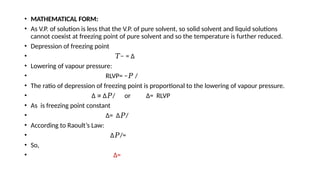
• MATHEMATICAL FORM:
• As V.P. of solution is less that the V.P. of pure solvent, so solid solvent and liquid solutions
cannot coexist at freezing point of pure solvent and so the temperature is further reduced.
• Depression of freezing point
• −
𝑇 = Δ
• Lowering of vapour pressure:
• RLVP= − /
𝑃
• The ratio of depression of freezing point is proportional to the lowering of vapour pressure.
• Δ Δ / or Δ= RLVP
∝ 𝑃
• As is freezing point constant
• Δ= Δ /
𝑃
• According to Raoult’s Law:
• Δ /=
𝑃
• So,
• Δ=
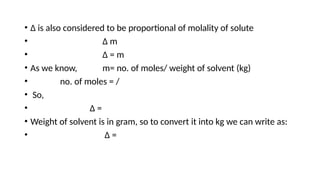
• Δ is also considered to be proportional of molality of solute
• Δ m
• Δ = m
• As we know, m= no. of moles/ weight of solvent (kg)
• no. of moles = /
• So,
• Δ =
• Weight of solvent is in gram, so to convert it into kg we can write as:
• Δ =
D. OSMOTIC PRESSURE:
• Osmosis is defined as the passage of solvent into a solution through semi-
permeable membrane (is barrier which allow only the molecules of one
component to pass through). This process tends to equalize the escaping
tendency of solvent on both sides of semi-permeable membrane. The
escaping tendency can be measured in term of vapour pressure or the
closely related colligative property osmotic pressure.
• Osmotic pressure is defined as the pressure greater than that above the
pure solvent, that must be applied to the solution to prevent the passage
of the solvent through a perfect semipermeable membrane. The
phenomena of osmosis depend upon the fact that the chemical potential
of a solvent molecule is less than that exist in the pure solution. Solvent
therefore passes spontaneously into the solution until the chemical
potentials of solvent and solution are equal.
• EXPLANATION.
• If a pure solvent is placed adjacent to a solution separated by a
semipermeable & so dilute the solution & also raise the volume of the
solution. And with the result the hydrostatic pressure (Osmotic
pressure) is set up on the solution. This osmotic pressure can be
measured by applying a known pressure, which stops any movement.
• This osmotic pressure obtained is therefore proportional to the
reduction in VP brought about by the concentration of solute present.
And so, osmotic pressure is Colligative property.
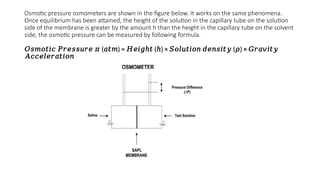
Osmotic pressure osmometers are shown in the figure below. It works on the same phenomena.
Once equilibrium has been attained, the height of the solution in the capillary tube on the solution
side of the membrane is greater by the amount h than the height in the capillary tube on the solvent
side, the osmotic pressure can be measured by following formula.
( ) = ( ) × ( ) ×
𝑂𝑠𝑚𝑜𝑡𝑖𝑐 𝑃𝑟𝑒𝑠𝑠𝑢𝑟𝑒 𝜋 𝑎𝑡𝑚 𝐻𝑒𝑖𝑔ℎ𝑡 ℎ 𝑆𝑜𝑙𝑢𝑡𝑖𝑜𝑛 𝑑𝑒𝑛𝑠𝑖𝑡𝑦 𝜌 𝐺𝑟𝑎𝑣𝑖𝑡𝑦
𝐴𝑐𝑐𝑒𝑙𝑒𝑟𝑎𝑡𝑖𝑜𝑛
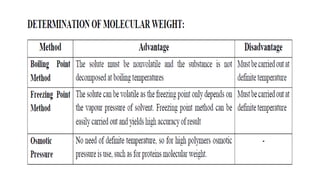
Applications of Colligative Properties:
• Each colligative properties seems to have certain advantages and disadvantages for the
determination of molecular weights.
• The boiling point method can be used only when the solute is nonvolatile and when the
substance is not decomposed at boiling temperature.
• The freezing point method is satisfactory for solutions containing volatile solutes, such as
alcohol, since the freezing point of solution depends on the VP of the solvent alone. The
freezing point method is easily executed and yields results of high accuracy for solutions of small
molecules.
• It is sometimes inconvenient to use freezing point or boiling point method, however, since they
must be carried out at definite temperatures. Osmotic pressure measurements do not have this
disadvantage, and yet the difficulties inherent in this method preclude its wide use.
• In summary, it can be said that the cryoscopic and newer techniques of VP are methods of
choice, except for very high polymers, in which instance the osmotic pressure method is used.
• Since the colligative properties are interrelated, it should be possible to determine the value of
one property from a knowledge of any other.
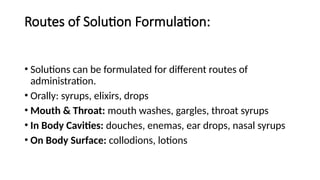
Routes of Solution Formulation:
• Solutions can be formulated for different routes of
administration.
• Orally: syrups, elixirs, drops
• Mouth & Throat: mouth washes, gargles, throat syrups
• In Body Cavities: douches, enemas, ear drops, nasal syrups
• On Body Surface: collodions, lotions
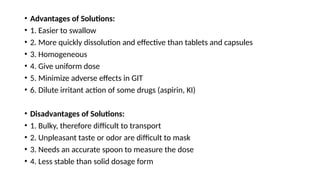
• Advantages of Solutions:
• 1. Easier to swallow
• 2. More quickly dissolution and effective than tablets and capsules
• 3. Homogeneous
• 4. Give uniform dose
• 5. Minimize adverse effects in GIT
• 6. Dilute irritant action of some drugs (aspirin, KI)
• Disadvantages of Solutions:
• 1. Bulky, therefore difficult to transport
• 2. Unpleasant taste or odor are difficult to mask
• 3. Needs an accurate spoon to measure the dose
• 4. Less stable than solid dosage form
• Major Signs of Instability:
• 1. Color changes
• 2. Precipitation
• 3. Microbial growth
• 4. Chemical gas formation
• Applications of Solutions:
• Solutions have a variety of use in pharmaceutical industry.
• They’re used therapeutically as vehicles for oral, parenteral, topical, otic, ophthalmic and
nasal products.
• They’re also used as flavoring, buffers, preservatives and suspending agents for a variety of
liquid dosage forms.
• Concentrated stock solutions serve as component of extemporaneously prepared products.
• Test solutions also play an important role in analysis of pharmaceutical products of all types.

Solutions physical pharmacy first professional

  • 1.
  • 2.
    Solutions • A solutionis a homogeneous mixture of one phase containing two or more substances at molecular level. • OR • A homogeneous mixture of chemical substances, which has same physical properties and chemical composition is called solution. • OR • A homogeneous mixture of solute and solvent which doesn’t interact chemically is called solution. • OR • A solution is a homogenous mixture of two substances but consisting of one phase.
  • 3.
    • PHARMACEUTICAL SOLUTIONS: •Solutions are dosage form prepared by dissolving the active ingredient(s) in aqueous or non-aqueous solvent. • Definitions: • SYSTEM: System is the bounded space which is under consideration. • PHASE: Phase is a distinct homogeneous part of a system separated by definite boundaries from other parts of the system. • DISPERSION: Dispersion consists of at least two phases with one or more dispersed (internal) phase contained in a single continuous (external) phase.
  • 4.
    Solute & Solvent: •A solution consists of two or more substances; the substance which is greater in amount is called the solvent while the substance which is lesser in amount is referred as solute. •  Generally, in liquid and solid solution the liquid is taken as solvent while the solid substance is the solute irrespective of material quantity. •  Similarly, in case of a solution consisting of water and any other solid or liquid substance, the water is taken as solvent while the other substance is the solute irrespective of the material quantity.
  • 5.
    •TYPE OF DISPERSION: •Truesolution •Colloidal dispersion •Coarse dispersion
  • 6.
    TRUE SOLUTION COLLOIDALDISPERSION COARSE DISPERSION A true solution is defined as a mixture of two or more components that form a homogeneous molecular dispersion. Dispersed phase is of ions & molecules The colloidal dispersion can be heterogeneous or homogeneous (one- phase system). Coarse dispersions are heterogeneous dispersed systems, in which the dispersed phase particles are larger than 1000 nm (4×10⁻⁵). SIZE less than 1nm / o.o1um Greater than true solution but less than coarse dispersion i.e. 1 to 500 nm Greater than 500nm (0.5μm) NO. OF PHASES One phase system Heterogeneous or homogeneous (one- phase system) Heterogeneous LIGHT SCATTERING Cannot scatter light Show Tindall effect May or may not scatter light PARTICLES SEPARATION ON STANDING Do not separate on standing Don’t separate on standing Particles settle down FILTERATION Can pass through ordinary and ultra- filters Only can pass through ordinary filters May or may not pass through ordinary filters EXAMPLES Solution of NaCl in H2O Starch , Milk Emulsions (liquid-liquid dispersion) Suspensions (solid-liquid dispersion
  • 7.
    True Solution • FurtherProperties: • Dispersed phase consists of ions and molecules. • Solute is dissolved into solution up to a point then saturated. • True solution is electrolyte solution. • Increase in solute quantity can effect colligative properties in this way: • leads to increase in osmotic pressure. • Leads to increase in boiling point • Leads to decrease in melting point. • Vapor pressure also decreases when solute is non volatile solid. • (other properties explained in previous table)
  • 8.
    Colloidal Solutions • Properties: •Dispersed phase consists of single large molecule (protein) or group of small molecules (colloidal solution of gold). • No definite sharp point of saturation • Dispersant can be coagulated or separated by clumping of particles with heat or increase in concentration of ionic particles. • Small effect of colligative properties due to dispersant. • (other properties explained in previous table)
  • 9.
    • BINARY SOLUTION:A solution consisting of only two substances is known as binary solution. • Saturated solutions: the solution in which solute is in equilibrium with solvent phase at that temperature. A saturated solution is a solution that contains the maximum amount of solute that is capable of dissolving in a solvent. • Supersaturated solutions: A supersaturated solution is a solution that contains more than the maximum amount of solute that is capable of being dissolved at a given temperature. It can be diluted by vigorous shaking or addition of small crystals.
  • 10.
    Isotonic solution • Asolution that has same salt concentration as the normal cells of the body and blood. • If the medium has exactly the same water conc. as the cell, there will be no net movement of water across cell membrane. Such solution is known as isotonic. • When two solutions have same osmotic pressure and same concentration they are to be isotonic • Isotonic solution has no effect on volume of tissues and cells. Thus a cell when placed in an isotonic solution tends neither to gain or loose water. • 0.9% solution of NaCl has essentially same salt conc, and osmotic pressure as the RBC’s content. Thus, it is called isotonic to blood and physiologically saline solution.
  • 11.
    • Hypertonic solutions:the solution which has a greater osmotic pressure or salt concentration than that of reference solution. • Example: if RBC’s are suspended in 2.0% solution of NaCl, water from RBC will come out into surrounding to dilute NaCl solution. It causes shrinkage of RBC’s. This salt solution is said to be hypertonic to blood. • Hypotonic solutions: the solution having lower osmotic pressure or salt concentration than that of reference solution is said to be hypotonic. • Example: if RBC’s are suspended in 0.02% solution of NaCl, then water from this solution will enter to blood cells to dilute thus causing swelling of RBC’s. it can lead to rupture of RBC’s thus releasing hemoglobin. Such solution is hypotonic to blood.
  • 13.
    Solute Solvent Typeof solutions Examples Solid Solid Solid in Solid Alloys Liquid Solid Liquid in solid Hydrated salts Gas Solid Gas in solid Dissolved gases in minerals Solid Liquid Solid in liquid Salt solution in water Liquid Liquid Liquid in liquid Alcohol in water Gas Liquid Gas in liquid Aerated drinks Solid Gas Solid in gas Iodine in air Liquid Gas Liquid in gas Humidity in air Gas Gas Gas in gas Air Types of Solutions According to States
  • 14.
    Stages of SolutionProcess: • i. Separation of Solute: • Must overcome intermolecular forces or non-ionic interactions in solute • Requires energy, Endothermic (+ΔH) • ii. Separation of Solvent • Must overcome intermolecular forces of solvent particles • Requires energy, Endothermic (+ΔH) • iii. Interaction of Solute & Solvent • Attractive bonds b/w solute particles and solvent particles • “Solvation” or “Hydration” (where water = solvent) • Release energy, exothermic (-ΔH)
  • 15.
    Types of Solute: •NON-ELECTROLYTE: The substances that do not ionize when dissolved in water and do not conduct electric current is called non- electrolyte, e.g. solution of sucrose, urea and glycerin. • ELECTROLYTE: The substances that ionize when dissolved in water and conduct electric current is called electrolyte. There are further divided into: • Strong Electrolyte: Substance that completely ionized in water, e.g. HCl and Sodim Sulphate. • Weak Electrolyte: Substances that partly ionized in water, e.g. Ephedrine and Phenobarbital.
  • 16.
    Physical Properties ofSubstances: • EXTENSIVE PROPERTIES: Properties which depend on the quantity of the matter in the system, e.g. mass and volume. • INTENSIVE PROPERTIES: Properties which are independent of the amount of the substances in the system, e.g. temperature, pressure, density, surface tension, and viscosity of pure liquid. • The physical properties of the substance can be classified into following: • 1. ADDITIVE PROPERTIES: • The physical properties, which depend upon the sum of the properties of all the constituents of the solution, are called additive properties.
  • 17.
    • The physicalproperties which depend on the total contribution of the atoms in the molecule or the sum of properties of the constituents in a solution. • E.g. molecular weight. • 2. CONSTITUTIVE PROPERTIES: • The physical properties which depend on the arrangement and number or kind of atoms within a molecule • The constitutive properties mainly depend on the arrangement & to a lesser extent on kind and No of atoms. • E.g. refraction of light, electric properties and solubility (also are additive properties) • 3. COLLIGATIVE PROPERTIES: • Depend mainly on the number of particles in a solution • E.g. osmotic pressure, vapor pressure lowering, freezing point depression and boiling point elevation
  • 18.
    Concentration Expression • Theconcentration of a solution can be defined as: • ‘’The amount of solute present in a given amount of solution is called concentration expression of the solution.’’ • A solution containing a relatively low concentration of solute is called dilute solution while a solution containing relatively a high concentration of the solute is said to be concentrated solution. • There are several ways of expressing concentration of solution, some are as follows: • 1. Percentage Expression • 2. Molarity • 3. Normality • 4. Molality • 5. Mole Fraction • 6. Parts per million
  • 19.
    • MOLES: Molesis the gram molecular weight of a substance. • GRAM EQUIVALENT WEIGHT: It is the mass of a given substance which will: • Supply or react with one mole of hydrogen cations H+ in an acid– base reaction; or • Supply or react with one mole of electrons−in a redox reaction.
  • 20.
    • The Concentrationof solution can be expressed in following terms: • 1. MOLARITY (M): • Molarity can be defined as: “The number of moles of solute per litter of solution is called Molarity.” • 𝑀𝑜𝑙𝑎𝑟𝑖𝑡𝑦 = . /Volume of solution 𝑁𝑜 𝑜𝑓 𝑚𝑜𝑙𝑒𝑠 𝑜𝑓 𝑠𝑜𝑙𝑢𝑡𝑒𝑠 (in litters) • The Molarity of solution is represented by M and its units are mole /litter. Molarity is the general unit that used in the most of chemistry calculation
  • 21.
    • MOLALITY (M): •The Molality of solution can be defined as: “The no. of moles of solute per kilogram of solvent is called Molality.” • 𝑀𝑜𝑙𝑎𝑙𝑖𝑡𝑦 = / 𝑀𝑜𝑙𝑒𝑠 𝑜𝑓 𝑠𝑜𝑙𝑢𝑡𝑒𝑠 𝑊𝑒𝑖𝑔ℎ𝑡 𝑜𝑓 𝑠𝑜𝑙𝑣𝑒𝑛𝑡 𝑖𝑛 𝑘𝑔 • The Molality of solution is represented by “m” & its units are mole / kg. Molality usually uses to define the physical properties of the solution like vapor pressure, boiling point elevation, and freezing point depression of solution.
  • 22.
    • NORMALITY (N): •Normality can be defined as: “The no. of gram equivalent of solute present per litter of the solution.” • Normality = No.of gm equivalent of solute/ Volume of solution in litters • Where, • 𝑁𝑜. = / Equivalent weight 𝑜𝑓 𝑔𝑚 𝑒𝑞𝑢𝑖𝑣𝑎𝑙𝑒𝑛𝑡 𝑊𝑒𝑖𝑔ℎ𝑡 𝑜𝑓 𝑠𝑢𝑏𝑠𝑡𝑎𝑛𝑐𝑒 • And, • 𝐸𝑞𝑢𝑖𝑣𝑎𝑙𝑒𝑛𝑡 𝑤𝑒𝑖𝑔ℎ𝑡 = / ACIDITY OR BASICITY 𝑀𝑜𝑙𝑒𝑐𝑢𝑙𝑎𝑟 𝑤𝑒𝑖𝑔ℎ𝑡 • We use normality in the volumetric calculation especially in the titration calculation.
  • 23.
    • MOLE FRACTION(X): • Ratio of moles of one constituent of a solution to the total moles of all constituent. • 𝑥1= 1/ 1+ 2; 2= 2/ 1+ 2 𝑛 𝑛 𝑛 𝑥 𝑛 𝑛 𝑛 • Where, • X1 is the mole fraction of constituent 1 • X2 is the mole fraction of constituent 2 • n1 and n2 are the numbers of moles of respective constituent in the solution • It is denoted by “X”. The Mole fraction is unit less & total mole fraction of a solution will always be unity: • Xsolute + Xsolvent = 1
  • 24.
    • PERCENT EXPRESSION: •It can be defined as: “The specific amount of solute present in 100 gm of solution.” OR “It is the part of the solute present in 100 parts of the solution.” • PERCENT BY WEIGHT (%W/W): Gram of solute in 100g of solution. / It is the weight of solute as a percent of total weight of solution. • % age of solute = Weight of solute/ Weight of solution x 100 • PERCENT BY VOLUME (%V/V): Milliliters of solute in 100 mL of solution. / It is the volume of solute as a present of total volume of the solution. • % age of solute = Volume of solute/ Volume of solution x 100 • PERCENT WEIGHT-IN-VOLUME (% W/V): Grams of solute in 100 mL of solution. / It is the no: of parts of the solute by weight in 100 parts by volume of solution. In this case, total weight or volume of solution is not considered. • % age of solute = Weight of solute/ Volume of solution x 100 •  MILLIGRAM PERCENT: Milligram of solute in 100mL of solution.
  • 25.
    • PARTS PERMILLION: • Number of parts (by wt. or volume) of solute per million parts (by wt. or volume) of solution is called parts per million. • 𝑃𝑃𝑀 = ( )/Mass of solution × 𝑀𝑎𝑠𝑠 𝑜𝑓 𝑠𝑜𝑙𝑢𝑡𝑒 𝑔𝑚 • Significance: • It is used for very low conc. of solution. • It is used to express the amount of impurities in H2O.
  • 26.
    Ideal Solution • Definition: •A solution in which there is no change in the properties of the components, other than dilution, when they are mixed to form a solution; no heat is evolved or absorbed during the process, and the final volume represent the additive properties of the individual constituent. It means complete uniformity of attractive forces. • Follow Raoult’s law. • PROPERTIES OF IDEAL SOLUTIONS: • During the formation of an ideal solution, only the dilution or change in concentration occurs. • In mixing the components of an ideal solution, no heat is evolved / absorbed.
  • 27.
    • The totalvolume of the solution is equal to the sum of the volumes of the components • V= V1 + V2 + V3 • There is no shrinkage or expansion of molecules or volumes because the size of the molecules of the components remains same after mixing. • The constitutive properties of the ideal solution are the arrange of the properties pure individual components. • For the formation of an ideal solution, the mixing substances should be with similar properties e.g. methanol & Ethanol, benzene & Toluene, methanol & Water, etc. • There is a complete uniformity of attractive forces b/w the constituents of an ideal solution. • The osmotic pressure of an ideal solution can be determined by Vent Hoff’s Rule.
  • 29.
    Real Solutions • Definition; •Solution which does not follow the Raoult’s Law is called non-ideal solution or real solution. The real solution show deviation from Raoult’s Law, which are either positive or negative deviation. • Doesn’t follow Raoult’s law • PROPERTIES OF REAL SOLUTION: • Total volume of real solution is not equal to the sum of volumes of all the components, i.e. V ≠ V1 + V2 + V3 • During the mixing of components of real solution, there is either evolution or absorption of heat, i.e. ΔH ≠ O.
  • 30.
    • When thecomponents of a real solution are mixed, there will be either shrinkage or expansion of the molecules of the components. • Real solutions can be obtained by mixing the components of different properties. • The attractive forces b/w the components of the real solutions are not the same. • There must be change in properties of the components of the real solution. • The real solutions deviate from Raoult’s Law in two ways: • 1-If the cohesive forces are greater than adhesive forces. Then real solutions deviate positively from Raoult’s Law. E.g. Acetone, water, Benzene & Ethyl Alcohol, Ethanol & Water. • 2-If the adhesive forces b/w the molecules of components are greater that cohesive forces, then real solution deviate negatively from Raoult’s Law. E. g. H2O + HCl, Acetone + Chloroform.
  • 31.
    Raoult’s Law: • Raoult’slaw states that, any particular temperature, the partial pressure of one component of a binary mixture is equal to the mole fraction of that component multiplied by its vapor pressure in the pure state at this temperature. • According to Raoult’s law, in an ideal solution the partial pressure (P) of each volatile constituent is equal to the vapour pressure of the pure constituent () multiplied by its mole fraction (X). • P = × X • ESCAPING TENDENCY: The tendency to escape or expand is called escaping tendency. The escaping tendency of hotter body is greater than the escaping tendency of colder one.
  • 32.
    Note: Must doequation and explanation from class lecture or book
  • 33.
    Colligative Properties A. LOWERINGOF VAPOUR PRESSURE: • VAPOUR: The pressure exerted by the vapours of the liquids at equilibrium state with pure liquid, it self, at a given temperature is called vapour pressure of the liquid. • LOWERING OF VAPOUR PRESSURE: When a non-volatile solute is combined with a volatile solvent, the solute decreases the escaping tendency of solvent, which on the basis of Raoult’s Law lower the vapour pressure of the solution. • METHOD USED: Manometric method is used to determine vapour pressure. • GRAPHICAL EXPLANATION: • When a nonvolatile solute is dissolved in a pure solvent, the solute molecules adjust themselves b/w the intermolecular spaces and attractive forces are produced b/w the solute & solvent. Now, the solvent molecules cannot easily escape from solution & with the result the Vp is lowered at constant temperature. If the vapour pressure of solvent with dilute solute is , and pure solvent is and are the mole fraction of solvent and solute then according to Raoult’s law, • = ×
  • 34.
    • We knowthat, + =1 =1− • Putting the value of X1 in first equation we get, • 𝑃 = × (1− ) 𝑃 = − − 𝑃 = − 𝑃/ = Δ𝑃/ = = RLVP The relative lowering of vapour pressure depend only on the mole fraction of solute.
  • 35.
  • 36.
    B. ELEVATION OFBOILING POINT • BOLING POINT: The temperature at which the vapour pressure of a liquid becomes equal to the atmospheric pressure is called boiling point. • Boiling Point ELEVATION: When a solute is added to a pure solvent, the boiling point of solution (solute + solvent) will be greater than the BP of the pure solvent. This difference b/w the boiling point of the solution & pure solvent at constant pressure is called elevation in boiling point. • Whenever a nonvolatile solute is added to a pure solvent, the V.P. of the solvent is reduced. So < the resulting solution will boil at a higher temperature is compared to that of pure solvent at. Some atmospheric pressure. And this difference is said to be elevation in B.P. • APPARATUS: Cottrell apparatus is used for finding elevation of boiling point.
  • 37.
    GRAPHIC REPRESENTATION : Fromthe graph, it is shown that VP curve of solution lies below that of solvent, so to reach the normal BP, the temperature: is elevated (i.e. increased) in this increase in temperature of solution is called elevation in boiling point.
  • 38.
    • MATHEMATICAL FORM: •Elevation of boiling point: • − 𝑇 = Δ • Lowering of vapour pressure: • RLVP= − / 𝑃 • The ratio of elevation of boiling point is proportional to the lowering of vapour pressure. • Δ Δ / or Δ= RLVP ∝ 𝑃 𝐾 • As is boiling point constant • Δ= Δ / 𝑃 • According to Raoult’s Law: • Δ /= 𝑃 • So, • Δ=
  • 39.
    • Δ isalso considered to be proportional of molality of solute • Δ m • Δ = m • As we know, m= no. of moles/ weight of solvent (kg) • no. of moles = / • So, • Δ = × • Weight of solvent W is in gram, so to convert it into kg we can write as: • Δ =
  • 40.
    C. DEPRESSION OFFREEZING POINT: • When a nonvolatile solute is dissolved in a pure solvent, then it will freeze at a lower temperature than the temperature at which pure solvent freezes. And this difference in freezing point b/w the pure solvent & solution is called freezing point depression. • METHOD USED: Beckmann’s Apparatus or Equilibrium Apparatus is used to determine depression of freezing point. • EXPLANATION: • When a nonvolatile solute is added to a pure solvent at triple point, the lowering of vapour pressure of solution takes place, so in order to again establish equilibrium b/w solid & liquid, the temperature is further dropped & this leads to depression in freezing point of the solution as compared to FP of pure solvent and this is called dispersion in freezing point. • This can also be explained by the following graph. As the F.P. of solvent in the temperature at which solid and liquid forms are in equilibrium while the F.P. of the solution is the temperature at which the solid solvent is at equilibrium with liquid solution.
  • 41.
    This can alsobe explained by the following graph. As the F.P. of solvent in the temperature at which solid and liquid forms are in equilibrium while the F.P. of the solution is the temperature at which the solid solvent is at equilibrium with liquid solution.
  • 42.
    • MATHEMATICAL FORM: •As V.P. of solution is less that the V.P. of pure solvent, so solid solvent and liquid solutions cannot coexist at freezing point of pure solvent and so the temperature is further reduced. • Depression of freezing point • − 𝑇 = Δ • Lowering of vapour pressure: • RLVP= − / 𝑃 • The ratio of depression of freezing point is proportional to the lowering of vapour pressure. • Δ Δ / or Δ= RLVP ∝ 𝑃 • As is freezing point constant • Δ= Δ / 𝑃 • According to Raoult’s Law: • Δ /= 𝑃 • So, • Δ=
  • 43.
    • Δ isalso considered to be proportional of molality of solute • Δ m • Δ = m • As we know, m= no. of moles/ weight of solvent (kg) • no. of moles = / • So, • Δ = • Weight of solvent is in gram, so to convert it into kg we can write as: • Δ =
  • 44.
    D. OSMOTIC PRESSURE: •Osmosis is defined as the passage of solvent into a solution through semi- permeable membrane (is barrier which allow only the molecules of one component to pass through). This process tends to equalize the escaping tendency of solvent on both sides of semi-permeable membrane. The escaping tendency can be measured in term of vapour pressure or the closely related colligative property osmotic pressure. • Osmotic pressure is defined as the pressure greater than that above the pure solvent, that must be applied to the solution to prevent the passage of the solvent through a perfect semipermeable membrane. The phenomena of osmosis depend upon the fact that the chemical potential of a solvent molecule is less than that exist in the pure solution. Solvent therefore passes spontaneously into the solution until the chemical potentials of solvent and solution are equal.
  • 45.
    • EXPLANATION. • Ifa pure solvent is placed adjacent to a solution separated by a semipermeable & so dilute the solution & also raise the volume of the solution. And with the result the hydrostatic pressure (Osmotic pressure) is set up on the solution. This osmotic pressure can be measured by applying a known pressure, which stops any movement. • This osmotic pressure obtained is therefore proportional to the reduction in VP brought about by the concentration of solute present. And so, osmotic pressure is Colligative property.
  • 46.
    Osmotic pressure osmometersare shown in the figure below. It works on the same phenomena. Once equilibrium has been attained, the height of the solution in the capillary tube on the solution side of the membrane is greater by the amount h than the height in the capillary tube on the solvent side, the osmotic pressure can be measured by following formula. ( ) = ( ) × ( ) × 𝑂𝑠𝑚𝑜𝑡𝑖𝑐 𝑃𝑟𝑒𝑠𝑠𝑢𝑟𝑒 𝜋 𝑎𝑡𝑚 𝐻𝑒𝑖𝑔ℎ𝑡 ℎ 𝑆𝑜𝑙𝑢𝑡𝑖𝑜𝑛 𝑑𝑒𝑛𝑠𝑖𝑡𝑦 𝜌 𝐺𝑟𝑎𝑣𝑖𝑡𝑦 𝐴𝑐𝑐𝑒𝑙𝑒𝑟𝑎𝑡𝑖𝑜𝑛
  • 47.
    Applications of ColligativeProperties: • Each colligative properties seems to have certain advantages and disadvantages for the determination of molecular weights. • The boiling point method can be used only when the solute is nonvolatile and when the substance is not decomposed at boiling temperature. • The freezing point method is satisfactory for solutions containing volatile solutes, such as alcohol, since the freezing point of solution depends on the VP of the solvent alone. The freezing point method is easily executed and yields results of high accuracy for solutions of small molecules. • It is sometimes inconvenient to use freezing point or boiling point method, however, since they must be carried out at definite temperatures. Osmotic pressure measurements do not have this disadvantage, and yet the difficulties inherent in this method preclude its wide use. • In summary, it can be said that the cryoscopic and newer techniques of VP are methods of choice, except for very high polymers, in which instance the osmotic pressure method is used. • Since the colligative properties are interrelated, it should be possible to determine the value of one property from a knowledge of any other.
  • 51.
    Routes of SolutionFormulation: • Solutions can be formulated for different routes of administration. • Orally: syrups, elixirs, drops • Mouth & Throat: mouth washes, gargles, throat syrups • In Body Cavities: douches, enemas, ear drops, nasal syrups • On Body Surface: collodions, lotions
  • 52.
    • Advantages ofSolutions: • 1. Easier to swallow • 2. More quickly dissolution and effective than tablets and capsules • 3. Homogeneous • 4. Give uniform dose • 5. Minimize adverse effects in GIT • 6. Dilute irritant action of some drugs (aspirin, KI) • Disadvantages of Solutions: • 1. Bulky, therefore difficult to transport • 2. Unpleasant taste or odor are difficult to mask • 3. Needs an accurate spoon to measure the dose • 4. Less stable than solid dosage form
  • 53.
    • Major Signsof Instability: • 1. Color changes • 2. Precipitation • 3. Microbial growth • 4. Chemical gas formation • Applications of Solutions: • Solutions have a variety of use in pharmaceutical industry. • They’re used therapeutically as vehicles for oral, parenteral, topical, otic, ophthalmic and nasal products. • They’re also used as flavoring, buffers, preservatives and suspending agents for a variety of liquid dosage forms. • Concentrated stock solutions serve as component of extemporaneously prepared products. • Test solutions also play an important role in analysis of pharmaceutical products of all types.