Part One – Theory &
Basics
 Sheet Metal Theory
 Definitions & Formulas
 Bending Theory
 Tools Overview
 What tools are available?
 Special Tool Options
 How to Start Part
 Start with SM Features
 Model Part then add SM
Features
Part Two – Adv.
Topics
 Bend Tables
 Advanced Shapes
 Forming Tools
 Using & Creating
 Sheet Metal
Configurations
 Drawing Creation
 Using Imported Bodies
 Best Practices
Compilation
Examples
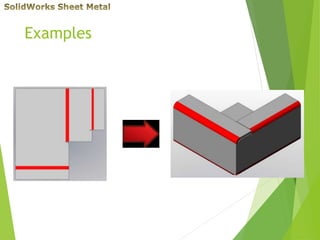
Examples
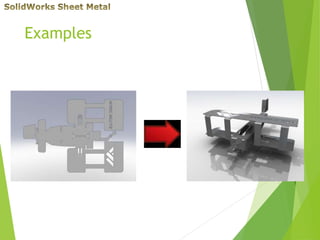
Examples
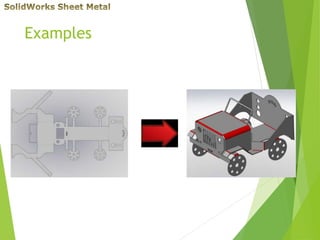
Examples
Sheet Metal Theory
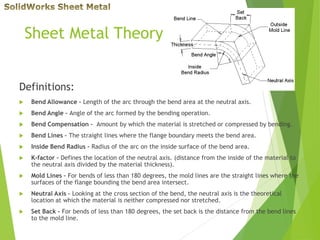
Definitions:
 Bend Allowance – Length of the arc through the bend area at the neutral axis.
 Bend Angle – Angle of the arc formed by the bending operation.
 Bend Compensation – Amount by which the material is stretched or compressed by bending.
 Bend Lines – The straight lines where the flange boundary meets the bend area.
 Inside Bend Radius – Radius of the arc on the inside surface of the bend area.
 K-factor – Defines the location of the neutral axis. (distance from the inside of the material to
the neutral axis divided by the material thickness).
 Mold Lines – For bends of less than 180 degrees, the mold lines are the straight lines where the
surfaces of the flange bounding the bend area intersect.
 Neutral Axis – Looking at the cross section of the bend, the neutral axis is the theoretical
location at which the material is neither compressed nor stretched.
 Set Back - For bends of less than 180 degrees, the set back is the distance from the bend lines
to the mold line.
Sheet Metal Theory
Formulas:
 Bend Allowance = Angle * (PI / 180) * (Radius + K-factor * Thickness)
 Bend Deduction = Bend Allowance – (2 * Set Back)
 Inside Set Back = tan (Angle / 2) * Radius
 Outside Set Back = tan (Angle / 2) * (Radius + Thickness)
Calculating Bends for Your
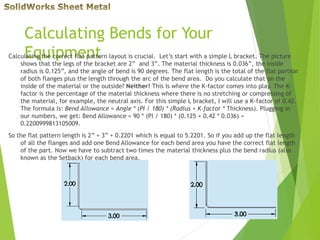
EquipmentCalculating the correct flat pattern layout is crucial. Let’s start with a simple L bracket. The picture
shows that the legs of the bracket are 2” and 3”. The material thickness is 0.036”, the inside
radius is 0.125”, and the angle of bend is 90 degrees. The flat length is the total of the flat portion
of both flanges plus the length through the arc of the bend area. Do you calculate that on the
inside of the material or the outside? Neither! This is where the K-factor comes into play. The K-
factor is the percentage of the material thickness where there is no stretching or compressing of
the material, for example, the neutral axis. For this simple L bracket, I will use a K-factor of 0.42.
The formula is: Bend Allowance = Angle * (PI / 180) * (Radius + K-factor * Thickness). Plugging in
our numbers, we get: Bend Allowance = 90 * (PI / 180) * (0.125 + 0.42 * 0.036) =
0.2200999813105009.
So the flat pattern length is 2” + 3” + 0.2201 which is equal to 5.2201. So if you add up the flat length
of all the flanges and add one Bend Allowance for each bend area you have the correct flat length
of the part. Now we have to subtract two times the material thickness plus the bend radius (also
known as the Setback) for each bend area.
Sample 1 – Converting to
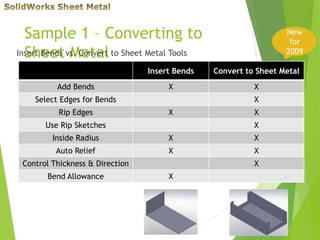
Sheet MetalInsert Bends vs. Convert to Sheet Metal Tools
Insert Bends Convert to Sheet Metal
Add Bends X X
Select Edges for Bends X
Rip Edges X X
Use Rip Sketches X
Inside Radius X X
Auto Relief X X
Control Thickness & Direction X
Bend Allowance X
New
for
2009
Sample 2 – “Ground Up” Tools
ReviewOverview of Sheet Metal Tools while building a part.
 With this we are going to go over the basic Sheet Metal tools SolidWorks
offers, while also introducing some “Best Practices” for creating sheet
metal parts.
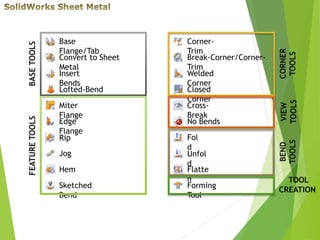
Base
Flange/Tab
Insert
Bends
Convert to Sheet
Metal
Unfol
d
Closed
Corner
Welded
Corner
Break-Corner/Corner-
Trim
Corner-
Trim
Forming
Tool
Sketched
Bend
Lofted-Bend
Jog
Edge
Flange
Miter
Flange
No Bends
Rip
Flatte
n
Fol
d
Cross-
Break
Hem
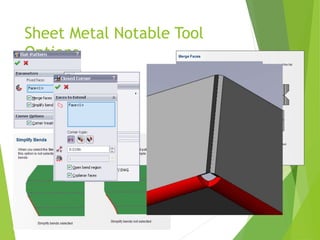
Sheet Metal Notable Tool
Options
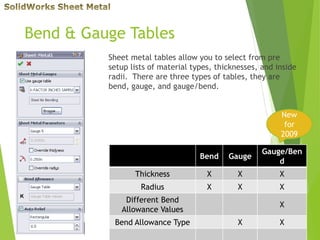
Bend & Gauge Tables
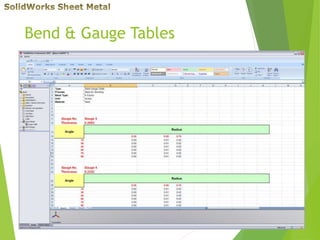
Sheet metal tables allow you to select from pre
setup lists of material types, thicknesses, and inside
radii. There are three types of tables, they are
bend, gauge, and gauge/bend.
Bend Gauge
Gauge/Ben
d
Thickness X X X
Radius X X X
Different Bend
Allowance Values
X
Bend Allowance Type X X
New
for
2009
Bend & Gauge Tables
Advanced Forming Shapes
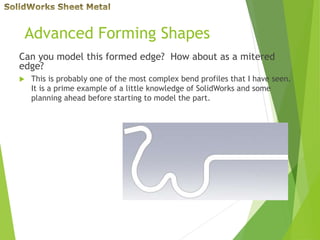
Can you model this formed edge? How about as a mitered
edge?
 This is probably one of the most complex bend profiles that I have seen.
It is a prime example of a little knowledge of SolidWorks and some
planning ahead before starting to model the part.
Forming Tools – Using &
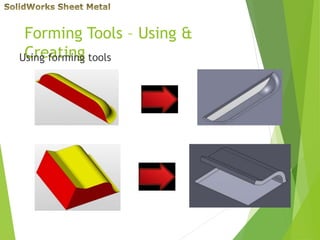
CreatingUsing forming tools
Forming Tools – Using &
CreatingCreating forming tools
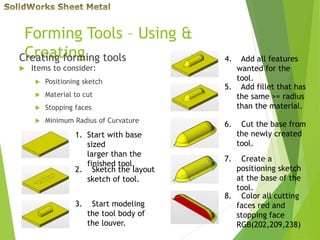
 Items to consider:
 Positioning sketch
 Material to cut
 Stopping faces
 Minimum Radius of Curvature
1. Start with base
sized
larger than the
finished tool.
2. Sketch the layout
sketch of tool.
3. Start modeling
the tool body of
the louver.
4. Add all features
wanted for the
tool.
5. Add fillet that has
the same >= radius
than the material.
6. Cut the base from
the newly created
tool.
7. Create a
positioning sketch
at the base of the
tool.
8. Color all cutting
faces red and
stopping face
RGB(202,209,238)
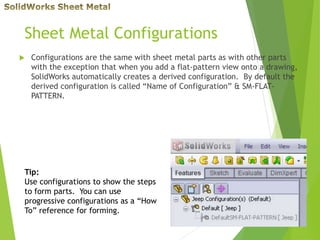
Sheet Metal Configurations
 Configurations are the same with sheet metal parts as with other parts
with the exception that when you add a flat-pattern view onto a drawing,
SolidWorks automatically creates a derived configuration. By default the
derived configuration is called “Name of Configuration” & SM-FLAT-
PATTERN.
Tip:
Use configurations to show the steps
to form parts. You can use
progressive configurations as a “How
To” reference for forming.
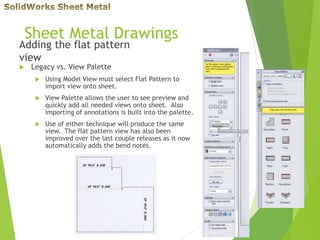
Sheet Metal Drawings
Adding the flat pattern
view
 Legacy vs. View Palette
 Using Model View must select Flat Pattern to
import view onto sheet.
 View Palette allows the user to see preview and
quickly add all needed views onto sheet. Also
importing of annotations is built into the palette.
 Use of either technique will produce the same
view. The flat pattern view has also been
improved over the last couple releases as it now
automatically adds the bend notes.
Using Imported Bodies
Importing Options
 There are two main methods to convert imported geometry to sheet
metal.
 Importing the model and then converting to sheet metal.
 Using FeatureWorks to automatically read the sheet metal features into
SolidWorks.
 Tip: To be able to define the radii of the part, first import as a normal part file
not a sheet metal part. Then use FeatureWorks to identify the radii. Now
remove the radii and then use the Convert to Sheet Metal tool, this will allow
you to define your own radii and not be confined by the import model radii.

SolidWorks Sheet metal Design

  • 1.
    Part One –Theory & Basics  Sheet Metal Theory  Definitions & Formulas  Bending Theory  Tools Overview  What tools are available?  Special Tool Options  How to Start Part  Start with SM Features  Model Part then add SM Features Part Two – Adv. Topics  Bend Tables  Advanced Shapes  Forming Tools  Using & Creating  Sheet Metal Configurations  Drawing Creation  Using Imported Bodies  Best Practices Compilation
  • 2.
  • 3.
  • 4.
  • 5.
  • 6.
    Sheet Metal Theory Definitions: Bend Allowance – Length of the arc through the bend area at the neutral axis.  Bend Angle – Angle of the arc formed by the bending operation.  Bend Compensation – Amount by which the material is stretched or compressed by bending.  Bend Lines – The straight lines where the flange boundary meets the bend area.  Inside Bend Radius – Radius of the arc on the inside surface of the bend area.  K-factor – Defines the location of the neutral axis. (distance from the inside of the material to the neutral axis divided by the material thickness).  Mold Lines – For bends of less than 180 degrees, the mold lines are the straight lines where the surfaces of the flange bounding the bend area intersect.  Neutral Axis – Looking at the cross section of the bend, the neutral axis is the theoretical location at which the material is neither compressed nor stretched.  Set Back - For bends of less than 180 degrees, the set back is the distance from the bend lines to the mold line.
  • 7.
    Sheet Metal Theory Formulas: Bend Allowance = Angle * (PI / 180) * (Radius + K-factor * Thickness)  Bend Deduction = Bend Allowance – (2 * Set Back)  Inside Set Back = tan (Angle / 2) * Radius  Outside Set Back = tan (Angle / 2) * (Radius + Thickness)
  • 8.
    Calculating Bends forYour EquipmentCalculating the correct flat pattern layout is crucial. Let’s start with a simple L bracket. The picture shows that the legs of the bracket are 2” and 3”. The material thickness is 0.036”, the inside radius is 0.125”, and the angle of bend is 90 degrees. The flat length is the total of the flat portion of both flanges plus the length through the arc of the bend area. Do you calculate that on the inside of the material or the outside? Neither! This is where the K-factor comes into play. The K- factor is the percentage of the material thickness where there is no stretching or compressing of the material, for example, the neutral axis. For this simple L bracket, I will use a K-factor of 0.42. The formula is: Bend Allowance = Angle * (PI / 180) * (Radius + K-factor * Thickness). Plugging in our numbers, we get: Bend Allowance = 90 * (PI / 180) * (0.125 + 0.42 * 0.036) = 0.2200999813105009. So the flat pattern length is 2” + 3” + 0.2201 which is equal to 5.2201. So if you add up the flat length of all the flanges and add one Bend Allowance for each bend area you have the correct flat length of the part. Now we have to subtract two times the material thickness plus the bend radius (also known as the Setback) for each bend area.
  • 9.
    Sample 1 –Converting to Sheet MetalInsert Bends vs. Convert to Sheet Metal Tools Insert Bends Convert to Sheet Metal Add Bends X X Select Edges for Bends X Rip Edges X X Use Rip Sketches X Inside Radius X X Auto Relief X X Control Thickness & Direction X Bend Allowance X New for 2009
  • 10.
    Sample 2 –“Ground Up” Tools ReviewOverview of Sheet Metal Tools while building a part.  With this we are going to go over the basic Sheet Metal tools SolidWorks offers, while also introducing some “Best Practices” for creating sheet metal parts.
  • 11.
  • 12.
    Sheet Metal NotableTool Options
  • 13.
    Bend & GaugeTables Sheet metal tables allow you to select from pre setup lists of material types, thicknesses, and inside radii. There are three types of tables, they are bend, gauge, and gauge/bend. Bend Gauge Gauge/Ben d Thickness X X X Radius X X X Different Bend Allowance Values X Bend Allowance Type X X New for 2009
  • 14.
  • 15.
    Advanced Forming Shapes Canyou model this formed edge? How about as a mitered edge?  This is probably one of the most complex bend profiles that I have seen. It is a prime example of a little knowledge of SolidWorks and some planning ahead before starting to model the part.
  • 16.
    Forming Tools –Using & CreatingUsing forming tools
  • 17.
    Forming Tools –Using & CreatingCreating forming tools  Items to consider:  Positioning sketch  Material to cut  Stopping faces  Minimum Radius of Curvature 1. Start with base sized larger than the finished tool. 2. Sketch the layout sketch of tool. 3. Start modeling the tool body of the louver. 4. Add all features wanted for the tool. 5. Add fillet that has the same >= radius than the material. 6. Cut the base from the newly created tool. 7. Create a positioning sketch at the base of the tool. 8. Color all cutting faces red and stopping face RGB(202,209,238)
  • 18.
    Sheet Metal Configurations Configurations are the same with sheet metal parts as with other parts with the exception that when you add a flat-pattern view onto a drawing, SolidWorks automatically creates a derived configuration. By default the derived configuration is called “Name of Configuration” & SM-FLAT- PATTERN. Tip: Use configurations to show the steps to form parts. You can use progressive configurations as a “How To” reference for forming.
  • 19.
    Sheet Metal Drawings Addingthe flat pattern view  Legacy vs. View Palette  Using Model View must select Flat Pattern to import view onto sheet.  View Palette allows the user to see preview and quickly add all needed views onto sheet. Also importing of annotations is built into the palette.  Use of either technique will produce the same view. The flat pattern view has also been improved over the last couple releases as it now automatically adds the bend notes.
  • 20.
    Using Imported Bodies ImportingOptions  There are two main methods to convert imported geometry to sheet metal.  Importing the model and then converting to sheet metal.  Using FeatureWorks to automatically read the sheet metal features into SolidWorks.  Tip: To be able to define the radii of the part, first import as a normal part file not a sheet metal part. Then use FeatureWorks to identify the radii. Now remove the radii and then use the Convert to Sheet Metal tool, this will allow you to define your own radii and not be confined by the import model radii.