WASTE DISPOSAL
Dr Parimala R
III MDS
Dept of Public Health Dentistry
CONTENT
 Introduction
 Solid waste
 Source
 Storage
 Collection
 Methods of disposal
Excreta disposal
Methods of excreta
disposal
Acts
 Conclusion
 Reference
Introduction
• The collection, processing and recycling or deposition of the waste materials
of human society.
• Waste materials are either liquid or solid in form.
• Disposal of wastes is now largely the domain of sanitarians and public health
engineers
• Health professionals need to have a basic knowledge of the subject since
improper disposal of wastes constitutes a health hazard.
Solid wastes
The term “soild wastes” includes:
 Garbage ( food waste)
 Rubbish ( paper, plastics, wood, metal, throw-away containers, glass).
 Demolition products ( Bricks, pipes).
 Sewage treatment residue ( sludge and solids from the coarse screening of domestic
sewage)
 Dead animals,manure and other discarded material.
 It should not contain night soil.
Output of daily waste
The output of daily waste depends upon:
 Dietary habits
 life styles
 Living standards
 Degree of urbanization and industrialization.
 The per capita daily solid waste produced ranges between 0.25 to 2.5kg in
different countries.
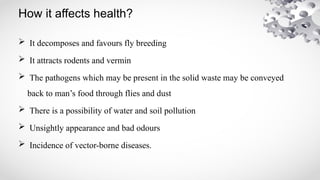
How it affects health?
 It decomposes and favours fly breeding
 It attracts rodents and vermin
 The pathogens which may be present in the solid waste may be conveyed
back to man’s food through flies and dust
 There is a possibility of water and soil pollution
 Unsightly appearance and bad odours
 Incidence of vector-borne diseases.
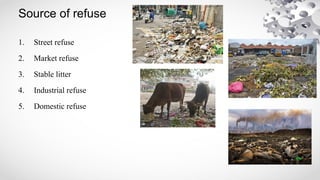
Source of refuse
1. Street refuse
2. Market refuse
3. Stable litter
4. Industrial refuse
5. Domestic refuse
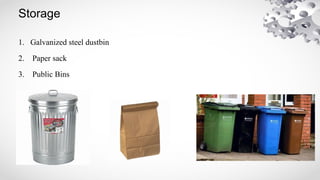
Storage
1. Galvanized steel dustbin
2. Paper sack
3. Public Bins
Storage
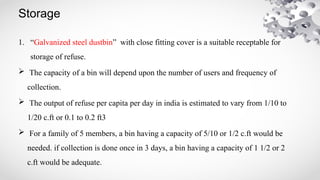
1. “Galvanized steel dustbin” with close fitting cover is a suitable receptable for
storage of refuse.
 The capacity of a bin will depend upon the number of users and frequency of
collection.
 The output of refuse per capita per day in india is estimated to vary from 1/10 to
1/20 c.ft or 0.1 to 0.2 ft3
 For a family of 5 members, a bin having a capacity of 5/10 or 1/2 c.ft would be
needed. if collection is done once in 3 days, a bin having a capacity of 1 1/2 or 2
c.ft would be adequate.
Storage
2. A recent innovation in the western countries is the “ Paper sack”
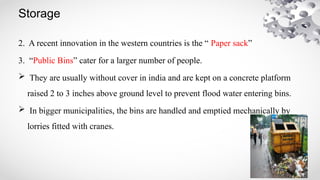
3. “Public Bins” cater for a larger number of people.
 They are usually without cover in india and are kept on a concrete platform
raised 2 to 3 inches above ground level to prevent flood water entering bins.
 In bigger municipalities, the bins are handled and emptied mechanically by
lorries fitted with cranes.
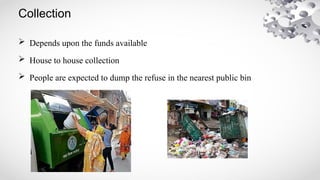
Collection
 Depends upon the funds available
 House to house collection
 People are expected to dump the refuse in the nearest public bin
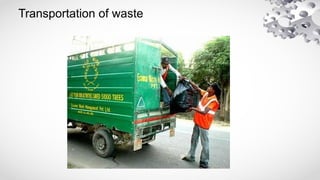
Transportation of waste
Environment hygiene committee (1949)
• The Environment hygiene committee (1949) recommended that
municipalities and other local bodies should arrange for
collection of refuse not only from the public bins but also from
individual houses.
Methods of disposal
• Dumping
• Controlled tipping or sanitary land-fill
• Incineration
• Composting
• Manure pits
• Burial
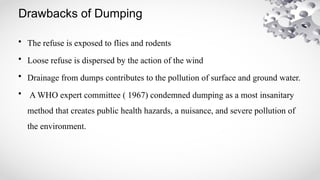
1. Dumping
• Refuse is dumped in low laying areas.
• As a result of bacterial action, refuse decreases considerably in volume and is
converted gradually into humus
Drawbacks of Dumping
• The refuse is exposed to flies and rodents
• Loose refuse is dispersed by the action of the wind
• Drainage from dumps contributes to the pollution of surface and ground water.
• A WHO expert committee ( 1967) condemned dumping as a most insanitary
method that creates public health hazards, a nuisance, and severe pollution of
the environment.
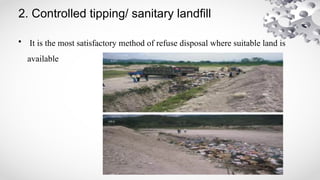
2. Controlled tipping/ sanitary landfill
• It is the most satisfactory method of refuse disposal where suitable land is
available
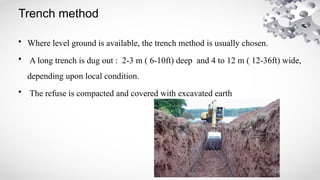
Trench method
• Where level ground is available, the trench method is usually chosen.
• A long trench is dug out : 2-3 m ( 6-10ft) deep and 4 to 12 m ( 12-36ft) wide,
depending upon local condition.
• The refuse is compacted and covered with excavated earth
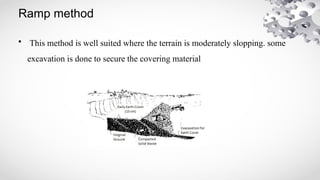
Ramp method
• This method is well suited where the terrain is moderately slopping. some
excavation is done to secure the covering material
3. Incineration
• Refuse can be disposal of hygienically
• It is the method of choice where suitable land is not available
• Hospital refuse which is particularly dangerous is best disposed of by
incineration
• Incineration is practiced in several of the industrialized countries.
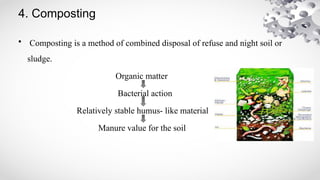
4. Composting
• Composting is a method of combined disposal of refuse and night soil or
sludge.
Organic matter
Bacterial action
Relatively stable humus- like material
Manure value for the soil
• The principal by products are carbon dioxide, water and heat.
• The heat produced during composting, about 60 degree celsius or higher, over
a period of several days - destroys eggs and larvae of flies, weed seeds and
pathogenic agents.
• The end product is a good soil builder containing small amounts of the major
plant nutrients such as nitrates and phosphates.
Method of composting
1. Bangalore method ( Anaerobic method)
2. Mechanical composting ( Aerobic method)
Bangalore methods ( Hot fermentation process)
• Indian council of Agriculture Research at the Indian Institute of Science,
Bangalore.
• It has been recommended as a satisfactory method of disposal of town wastes
and night soil.
Bangalore methods ( Hot fermentation process)
• Trenches are dug 90cm deep, 1.5 to 2.5 m ( 5-8 ft) broad and 4.5 to 10m ( 15-
30ft) long.
• Depths greater than 90 cm ( 3ft) are not recommended because of slow
decomposition
Bangalore methods ( Hot fermentation process)
• First layer - 15cm ( 6 inch) thick is spread at the bottom of the trench.
• Second layer - night soil is added corresponding to a thickness of 5 cm ( 2
inch).
• Third layer - refuse and night soil are added in the proportion of 15 cm and
5cm respectively, till the heap rises to 30cm ( 1ft)
• The top layer should be of refuse, at least 25 cm ( 9 inch) thickness.
Bangalore methods ( Hot fermentation process)
• After 7 days - heat ( over 60 deg. C) is generated in the compost mass - intense
heat which persists over 2 or 3 weeks - decompose the refuse and nightsoil and
to destroy all pathogenic and parasitic organisms.
• After 4 to 6 months, decomposition is complete and the resulting manure is a
well decomposed.
Mechanical composting
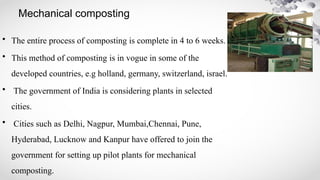
• The entire process of composting is complete in 4 to 6 weeks.
• This method of composting is in vogue in some of the
developed countries, e.g holland, germany, switzerland, israel.
• The government of India is considering plants in selected
cities.
• Cities such as Delhi, Nagpur, Mumbai,Chennai, Pune,
Hyderabad, Lucknow and Kanpur have offered to join the
government for setting up pilot plants for mechanical
composting.
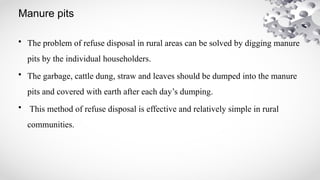
Manure pits
• The problem of refuse disposal in rural areas can be solved by digging manure
pits by the individual householders.
• The garbage, cattle dung, straw and leaves should be dumped into the manure
pits and covered with earth after each day’s dumping.
• This method of refuse disposal is effective and relatively simple in rural
communities.
Burial
• For small camps.
• A trench 1.5m wide and 2 m deep is excavated.
• the contents are used after 4 to 6 months
Public education
• Enforcement of the laws
• Less interest
• Education methods
• Cheapest solution
Excreta disposal
• Human excreta is a source of infection
• It is an important cause of environmental pollution.
• Every society has a responsibility for its safe removal and disposal so
that it doesnot constitute a threat to public health.
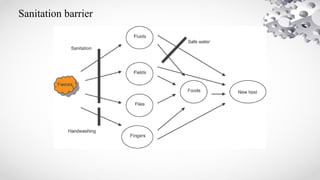
Health hazards of improper excreta disposal are
1. Soil pollution
2. Water pollution
3. Contamination of foods
4. Propagation of flies
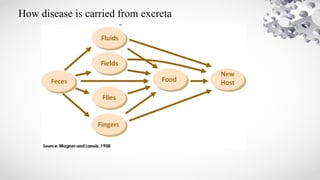
How disease is carried from excreta
Sanitation barrier
Methods of excreta disposal
1. Unsewered areas
• Service type latrines
• Non service type latrines
• Suitable for camps and temporary use
2. Sewered areas
• Primary treatment
• Secondary treatment
Service type ( Conservancy system)
• The collection and removal of nightsoil from bucket or pail latrine by
human agency is called services type or conservancy system
Non- Service type ( Sanitary latrine)
Criteria for a sanitary latrine:-
• Excreta should not contaminated the ground and the surface water.
• Excreta should not pollute the soil
• Excreta should not be accessible to flies, rodents, animals.
• Excreta should not create a nuisance due to odor or unsightly
appearance.
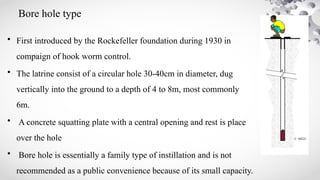
Bore hole type
• First introduced by the Rockefeller foundation during 1930 in
compaign of hook worm control.
• The latrine consist of a circular hole 30-40cm in diameter, dug
vertically into the ground to a depth of 4 to 8m, most commonly
6m.
• A concrete squatting plate with a central opening and rest is place
over the hole
• Bore hole is essentially a family type of instillation and is not
recommended as a public convenience because of its small capacity.
Bore hole type
Merits:
• No need for the service of a sweeper for daily removal of nightsoil.
• Unsuitable for fly breeding
• If located 15m away from the source of water supply, there should be no
danger of water pollution
Bore hole type
Demerits:
• Small capacity
• A special, the auger is required for the construction which may not be readily
available.
• In many places, the sub soil water is high and the soil loose with the results it
may be difficult to dig a hole deeper than 3m.
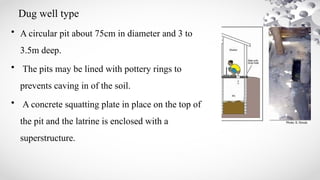
Dug well type
• A circular pit about 75cm in diameter and 3 to
3.5m deep.
• The pits may be lined with pottery rings to
prevents caving in of the soil.
• A concrete squatting plate in place on the top of
the pit and the latrine is enclosed with a
superstructure.
Dug well type
Advantage of Dugwell latrine:-
• It is easy to construct and no special equipment is needed to dig the hit.
• the pit has a longer life than borehole latrine of greater capacity
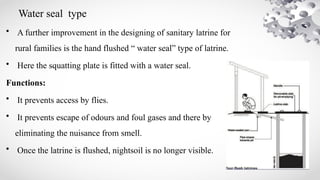
Water seal type
• A further improvement in the designing of sanitary latrine for
rural families is the hand flushed “ water seal” type of latrine.
• Here the squatting plate is fitted with a water seal.
Functions:
• It prevents access by flies.
• It prevents escape of odours and foul gases and there by
eliminating the nuisance from smell.
• Once the latrine is flushed, nightsoil is no longer visible.
Water seal type
Types:
• P.R.A.I Type: Planning, reseach and action institute , lucknow ( U.P)
• RCA Type : Designed by the research- cum- action projects in environmental
sanitation of the ministry of health, government of India.
Essential features of RCA Latrine:
• Sources- squatting plate - pan and trap- construction pipe- dug well-
superstructure- maintenance.
Sulab shauchalaya
• The model inventions of patne based firm
• It consists of specially designed pan and water seal trap
• It is connected to a pit 3 feet square and as deep
• Basically it is an improved version of the standard hand flush latrine ( eg
RCA type)
• The system is to charge Rs 5 per person
Septic tank
• The septic tank is water - tight masonry tank into which household
sewage is admitted for treatment.
• It is a satisfatory means of disposing excreta and liquid wastes from
individual dwellings, small groups of houses and institution which have
adequate water supplies but do not have access to a public sewerage
system
• Capacity: the minimum capacity of a septic tank should be at least 500
gallons
Septic tank
• Lenght: is usually twice the breadth
• Depth: from 1.5 to 2m
• Liquid depth: 1.2m
• Air space: minimum air space of 30cm between the level of liquid in the tank and the
undersurface of the cover.
• Bottom: is sloping towards the inlet end
• Inlet and outlets: both are submerged
• Cover: covered by a concrete slab of suitable thickness and provided with a manhole
• Retention period: are designed to allow a period of 24hrs
AQUA privy
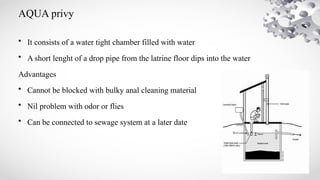
• It consists of a water tight chamber filled with water
• A short lenght of a drop pipe from the latrine floor dips into the water
Advantages
• Cannot be blocked with bulky anal cleaning material
• Nil problem with odor or flies
• Can be connected to sewage system at a later date
AQUA privy
Disadvantages:
• Expensive to build
• Need large volumes of water to work
• Water seal may be hard to maintain.
• Tanks must be emptied about every 3 years
Latrine suitable for temporary use and camps:
1 . Shallow trench latrine:
• The trench is 30cm wide and 90-150cm deep
• Its lenght depend on the number of users: 3-3.5 m for 100 people
Latrine suitable for temporary use and camps:
2. Deep trench latrine
• The trench is 90cm wide and 1.8 - 2.5 m deep
Acts and legislations
• The Environmental Protection Act
This Act was enacted in 1986, and it aims to establish a sufficient protection
system. This Act confers powers to the Central Government to regulate all
forms of waste. It is one of the primary legislatures to protect the environment
and regulation of waste
Acts and legislations
• Bio-Medical Waste (Management and Handling) Rules, 1998
The aim of these Rules is to ensure that bio-medical wastes are safely disposed
. Bio-medical waste can be defined as any waste or byproduct generated during
treatment, immunization and treatment of human beings or animals or in
research activities.
Acts and legislations
• The Batteries (Management and Handling) Rules, 2001
The Batteries Rules were notified to set up a mechanism in place which dealt
with the disposal of lead acid batteries.
Acts and legislations
• The Hazardous Wastes (Management, Handling and
Transboundary Movement) Rules, 2008
The Rules places an obligation on the occupier of hazardous to safe and sound
handling of environmental waste. The occupier is that person under whose
charge there is a plant or unit or factory which produces hazardous waste as a
result of their operation. The occupier must sell or send the hazardous waste to
a re-processor or recycler, who is authorized by the government to dispose of
the waste in a safe manner.
Acts and legislations
• The Plastic Waste (Management and Handling) Rules, 2011
The PWM Rules are set of regulatory framework set up to control the use,
manufacture, and recycling of plastic waste
Acts and legislations
• The E- Waste (Management and Handling) Rules, 2011
The prime aim of the EWM is to put in place a system which manages e-waste
in an environment-friendly way by regulating the issue of recycling and disposal
of e-waste.
Conclusion
• Disposal of waste is an important procedure to be followed by an
individual in a community. Health professionals need to have a basic
knowledge of the subject since improper disposal of wastes constitute a
health hazard. Health professional may be callled upon to give advice in
some special situations, such as coping with waste disposal problems
when there is a disruption or breakdown of community health services in
natural disasters
Reference
• Park K. Park's textbook of preventive and social medicine.
Jabalpur. Banarasidas Bhanot. 2019. 25th
edition.
• https://pib.gov.in/newsite/printrelease.aspx?relid=138591
THANK YOU
Sewage
• Sewage is waste water from a community containing solid and liquid
excreta.
• The average amount of sewage which flows through the sewerage
system in 24 hours is called the dry weather flow.
Health aspects
• Creation fo nuisance, unsightliness and pleasant odours.
• Breeding of flies and mosquitoes.
• Pollution of soil and water supplies.
• Contamination of food.
• Increased incidence of disease.
Aims of sewage purification
• To stabilize the oragnic matter so that it can be disposed off safely.
• To convert the sewage water into an effluent of an acceptable stadard of
purity which can be disposed off into land, rivers or sea.
Strength of sewage
• Biochemical oxygen demand (BOD)
• Chemical oxygen demand (COD)
• Suspended solids
Biochemical oxygen demand (BOD)
• It is defined as the amount of oxygen absorbed by a sample of sewage
during a specified period, generally 5 days at a specified temperature
generally 20 deg C for the aerobic destruction or use of organic matter by
living organisms.
• BOD value range from about 1mg per litre for natural waters to about
300mg/L for untreated domestic sewage.
• If the BOD is 300mg/L and the above, sewage is said to be strong, if it is
100mg/L, it is said to be weak.
Chemical oxygen demand(COD)
• The COD test measures the oxygen equivalent of that portion of the
organic matter in a sample which is susceptible to oxidation by a strong
chemical oxidizer.
Suspended solids
• The amount of suspended solids in domestic sewage may vary from 100
to 500 ppm.
• If the amount of suspended solids is 100mg/L, the sewage is said to be
weak.
• If the amount is 500 mg/L the sewage is said to be strong.
Decomposition of organic matter
• Aeroic process
• Anaerobic process
MODERN SEWAGE TREATMENT
•
Primary treatment
• Screening
– The screen consists of vertical or inclined steel bards usually set 5cm apart.
Primary treatment
• Grit chamber
– This chamber is approximately 10 to 20 m in lenght.
– It is so designed as to maintain a aconstant velocity of about 1 foot per second
with a detention period of 30 seconds to 1 mt.
Primary treatment
• Primary sedimentaion
– It is a very large tank holding from 1/4 to 1/3 the dry weather flow.
– Flow very slowly across the tank at a velocity of 1 to 2 feet per minute.
– The sewage spends about 6 to 8 hours in the tank.
Secondary treatment
• Trickling filter method
• Activated sludge process
The trickling filter
• The trickling filter or percolating filter is a bed of crushed stones or
cinker, 1 to 2 m deep and 2 to 30 m in diameter depending on the of the
population.
Activated sludge process
• The effluent is mixed with sludge drawn from the final settling tank.
• The mixture is subjected to aeration chamber for about 6 to 8 hours.
• The aeration is accomplished either by mechanical agitation or by
forcing compressed air continously from bottom of the aeration tank.
• Organic matter of the sewage gets oxidized into carbondioxide, nitrated,
and water with the help of aerobic bacteria.
Secondary sedimentation
• Detained fro 2-3 hours.
• The sludge that collects in the secondary sedimentation tank is called
aerated sludge.
• Part of the activated sludge is pumped back into the aeration tanks in the
activated sludge process and the rest pumped into the sludge digestion
tanks for treatment and disposal.
Sludge digestion
• Digestion
• Sea disposal
• Land
Digestion
• Incubated under favorable condtions of temperature and pH.
• Undergoes anaerobic auto digestion
• Comples solids are broken down into water, carbomdioxide, methane
and ammonia.
• The volume of sludge is also considerably reduced.
• Dry readily and from an excellent manure.
Disposal of effluent
• Disposal by dilution
– Diluted in the body of water and impurities are oxidized by the dissolved
oxygen in the water.
– The Royal commision in England(1908) recommended that an effluent from a
sewage treatment pland should not have more than 30mg/litre of suspended
solids and the 5 days BOD of the effluent including the suspended matter should
not exceed 20mg/litre.
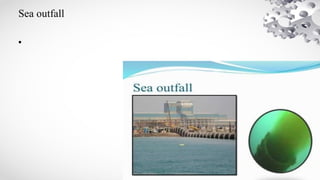
Sea outfall
•
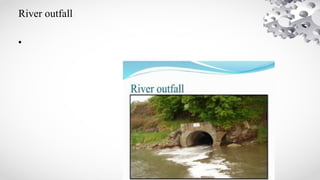
River outfall
•
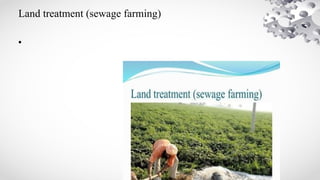
Land treatment (sewage farming)
•
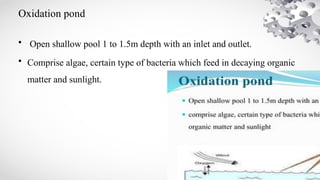
Oxidation pond
• Open shallow pool 1 to 1.5m depth with an inlet and outlet.
• Comprise algae, certain type of bacteria which feed in decaying organic
matter and sunlight.
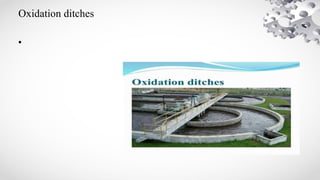
Oxidation ditches
•
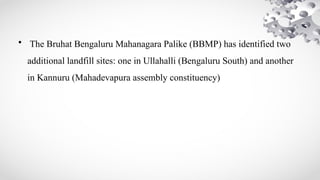
• The Bruhat Bengaluru Mahanagara Palike (BBMP) has identified two
additional landfill sites: one in Ullahalli (Bengaluru South) and another
in Kannuru (Mahadevapura assembly constituency)

WASTE DISPOSAL.pptx presentation pptx dental

  • 1.
    WASTE DISPOSAL Dr ParimalaR III MDS Dept of Public Health Dentistry
  • 2.
    CONTENT  Introduction  Solidwaste  Source  Storage  Collection  Methods of disposal Excreta disposal Methods of excreta disposal Acts  Conclusion  Reference
  • 3.
    Introduction • The collection,processing and recycling or deposition of the waste materials of human society. • Waste materials are either liquid or solid in form. • Disposal of wastes is now largely the domain of sanitarians and public health engineers • Health professionals need to have a basic knowledge of the subject since improper disposal of wastes constitutes a health hazard.
  • 4.
    Solid wastes The term“soild wastes” includes:  Garbage ( food waste)  Rubbish ( paper, plastics, wood, metal, throw-away containers, glass).  Demolition products ( Bricks, pipes).  Sewage treatment residue ( sludge and solids from the coarse screening of domestic sewage)  Dead animals,manure and other discarded material.  It should not contain night soil.
  • 5.
    Output of dailywaste The output of daily waste depends upon:  Dietary habits  life styles  Living standards  Degree of urbanization and industrialization.  The per capita daily solid waste produced ranges between 0.25 to 2.5kg in different countries.
  • 6.
    How it affectshealth?  It decomposes and favours fly breeding  It attracts rodents and vermin  The pathogens which may be present in the solid waste may be conveyed back to man’s food through flies and dust  There is a possibility of water and soil pollution  Unsightly appearance and bad odours  Incidence of vector-borne diseases.
  • 7.
    Source of refuse 1.Street refuse 2. Market refuse 3. Stable litter 4. Industrial refuse 5. Domestic refuse
  • 8.
    Storage 1. Galvanized steeldustbin 2. Paper sack 3. Public Bins
  • 9.
    Storage 1. “Galvanized steeldustbin” with close fitting cover is a suitable receptable for storage of refuse.  The capacity of a bin will depend upon the number of users and frequency of collection.  The output of refuse per capita per day in india is estimated to vary from 1/10 to 1/20 c.ft or 0.1 to 0.2 ft3  For a family of 5 members, a bin having a capacity of 5/10 or 1/2 c.ft would be needed. if collection is done once in 3 days, a bin having a capacity of 1 1/2 or 2 c.ft would be adequate.
  • 10.
    Storage 2. A recentinnovation in the western countries is the “ Paper sack” 3. “Public Bins” cater for a larger number of people.  They are usually without cover in india and are kept on a concrete platform raised 2 to 3 inches above ground level to prevent flood water entering bins.  In bigger municipalities, the bins are handled and emptied mechanically by lorries fitted with cranes.
  • 11.
    Collection  Depends uponthe funds available  House to house collection  People are expected to dump the refuse in the nearest public bin
  • 12.
  • 13.
    Environment hygiene committee(1949) • The Environment hygiene committee (1949) recommended that municipalities and other local bodies should arrange for collection of refuse not only from the public bins but also from individual houses.
  • 14.
    Methods of disposal •Dumping • Controlled tipping or sanitary land-fill • Incineration • Composting • Manure pits • Burial
  • 15.
    1. Dumping • Refuseis dumped in low laying areas. • As a result of bacterial action, refuse decreases considerably in volume and is converted gradually into humus
  • 16.
    Drawbacks of Dumping •The refuse is exposed to flies and rodents • Loose refuse is dispersed by the action of the wind • Drainage from dumps contributes to the pollution of surface and ground water. • A WHO expert committee ( 1967) condemned dumping as a most insanitary method that creates public health hazards, a nuisance, and severe pollution of the environment.
  • 17.
    2. Controlled tipping/sanitary landfill • It is the most satisfactory method of refuse disposal where suitable land is available
  • 18.
    Trench method • Wherelevel ground is available, the trench method is usually chosen. • A long trench is dug out : 2-3 m ( 6-10ft) deep and 4 to 12 m ( 12-36ft) wide, depending upon local condition. • The refuse is compacted and covered with excavated earth
  • 19.
    Ramp method • Thismethod is well suited where the terrain is moderately slopping. some excavation is done to secure the covering material
  • 20.
    3. Incineration • Refusecan be disposal of hygienically • It is the method of choice where suitable land is not available • Hospital refuse which is particularly dangerous is best disposed of by incineration • Incineration is practiced in several of the industrialized countries.
  • 21.
    4. Composting • Compostingis a method of combined disposal of refuse and night soil or sludge. Organic matter Bacterial action Relatively stable humus- like material Manure value for the soil
  • 22.
    • The principalby products are carbon dioxide, water and heat. • The heat produced during composting, about 60 degree celsius or higher, over a period of several days - destroys eggs and larvae of flies, weed seeds and pathogenic agents. • The end product is a good soil builder containing small amounts of the major plant nutrients such as nitrates and phosphates.
  • 23.
    Method of composting 1.Bangalore method ( Anaerobic method) 2. Mechanical composting ( Aerobic method)
  • 24.
    Bangalore methods (Hot fermentation process) • Indian council of Agriculture Research at the Indian Institute of Science, Bangalore. • It has been recommended as a satisfactory method of disposal of town wastes and night soil.
  • 25.
    Bangalore methods (Hot fermentation process) • Trenches are dug 90cm deep, 1.5 to 2.5 m ( 5-8 ft) broad and 4.5 to 10m ( 15- 30ft) long. • Depths greater than 90 cm ( 3ft) are not recommended because of slow decomposition
  • 26.
    Bangalore methods (Hot fermentation process) • First layer - 15cm ( 6 inch) thick is spread at the bottom of the trench. • Second layer - night soil is added corresponding to a thickness of 5 cm ( 2 inch). • Third layer - refuse and night soil are added in the proportion of 15 cm and 5cm respectively, till the heap rises to 30cm ( 1ft) • The top layer should be of refuse, at least 25 cm ( 9 inch) thickness.
  • 27.
    Bangalore methods (Hot fermentation process) • After 7 days - heat ( over 60 deg. C) is generated in the compost mass - intense heat which persists over 2 or 3 weeks - decompose the refuse and nightsoil and to destroy all pathogenic and parasitic organisms. • After 4 to 6 months, decomposition is complete and the resulting manure is a well decomposed.
  • 28.
    Mechanical composting • Theentire process of composting is complete in 4 to 6 weeks. • This method of composting is in vogue in some of the developed countries, e.g holland, germany, switzerland, israel. • The government of India is considering plants in selected cities. • Cities such as Delhi, Nagpur, Mumbai,Chennai, Pune, Hyderabad, Lucknow and Kanpur have offered to join the government for setting up pilot plants for mechanical composting.
  • 29.
    Manure pits • Theproblem of refuse disposal in rural areas can be solved by digging manure pits by the individual householders. • The garbage, cattle dung, straw and leaves should be dumped into the manure pits and covered with earth after each day’s dumping. • This method of refuse disposal is effective and relatively simple in rural communities.
  • 30.
    Burial • For smallcamps. • A trench 1.5m wide and 2 m deep is excavated. • the contents are used after 4 to 6 months
  • 31.
    Public education • Enforcementof the laws • Less interest • Education methods • Cheapest solution
  • 32.
    Excreta disposal • Humanexcreta is a source of infection • It is an important cause of environmental pollution. • Every society has a responsibility for its safe removal and disposal so that it doesnot constitute a threat to public health.
  • 33.
    Health hazards ofimproper excreta disposal are 1. Soil pollution 2. Water pollution 3. Contamination of foods 4. Propagation of flies
  • 34.
    How disease iscarried from excreta
  • 35.
  • 36.
    Methods of excretadisposal 1. Unsewered areas • Service type latrines • Non service type latrines • Suitable for camps and temporary use 2. Sewered areas • Primary treatment • Secondary treatment
  • 37.
    Service type (Conservancy system) • The collection and removal of nightsoil from bucket or pail latrine by human agency is called services type or conservancy system
  • 38.
    Non- Service type( Sanitary latrine) Criteria for a sanitary latrine:- • Excreta should not contaminated the ground and the surface water. • Excreta should not pollute the soil • Excreta should not be accessible to flies, rodents, animals. • Excreta should not create a nuisance due to odor or unsightly appearance.
  • 39.
    Bore hole type •First introduced by the Rockefeller foundation during 1930 in compaign of hook worm control. • The latrine consist of a circular hole 30-40cm in diameter, dug vertically into the ground to a depth of 4 to 8m, most commonly 6m. • A concrete squatting plate with a central opening and rest is place over the hole • Bore hole is essentially a family type of instillation and is not recommended as a public convenience because of its small capacity.
  • 40.
    Bore hole type Merits: •No need for the service of a sweeper for daily removal of nightsoil. • Unsuitable for fly breeding • If located 15m away from the source of water supply, there should be no danger of water pollution
  • 41.
    Bore hole type Demerits: •Small capacity • A special, the auger is required for the construction which may not be readily available. • In many places, the sub soil water is high and the soil loose with the results it may be difficult to dig a hole deeper than 3m.
  • 42.
    Dug well type •A circular pit about 75cm in diameter and 3 to 3.5m deep. • The pits may be lined with pottery rings to prevents caving in of the soil. • A concrete squatting plate in place on the top of the pit and the latrine is enclosed with a superstructure.
  • 43.
    Dug well type Advantageof Dugwell latrine:- • It is easy to construct and no special equipment is needed to dig the hit. • the pit has a longer life than borehole latrine of greater capacity
  • 44.
    Water seal type •A further improvement in the designing of sanitary latrine for rural families is the hand flushed “ water seal” type of latrine. • Here the squatting plate is fitted with a water seal. Functions: • It prevents access by flies. • It prevents escape of odours and foul gases and there by eliminating the nuisance from smell. • Once the latrine is flushed, nightsoil is no longer visible.
  • 45.
    Water seal type Types: •P.R.A.I Type: Planning, reseach and action institute , lucknow ( U.P) • RCA Type : Designed by the research- cum- action projects in environmental sanitation of the ministry of health, government of India. Essential features of RCA Latrine: • Sources- squatting plate - pan and trap- construction pipe- dug well- superstructure- maintenance.
  • 46.
    Sulab shauchalaya • Themodel inventions of patne based firm • It consists of specially designed pan and water seal trap • It is connected to a pit 3 feet square and as deep • Basically it is an improved version of the standard hand flush latrine ( eg RCA type) • The system is to charge Rs 5 per person
  • 47.
    Septic tank • Theseptic tank is water - tight masonry tank into which household sewage is admitted for treatment. • It is a satisfatory means of disposing excreta and liquid wastes from individual dwellings, small groups of houses and institution which have adequate water supplies but do not have access to a public sewerage system • Capacity: the minimum capacity of a septic tank should be at least 500 gallons
  • 48.
    Septic tank • Lenght:is usually twice the breadth • Depth: from 1.5 to 2m • Liquid depth: 1.2m • Air space: minimum air space of 30cm between the level of liquid in the tank and the undersurface of the cover. • Bottom: is sloping towards the inlet end • Inlet and outlets: both are submerged • Cover: covered by a concrete slab of suitable thickness and provided with a manhole • Retention period: are designed to allow a period of 24hrs
  • 49.
    AQUA privy • Itconsists of a water tight chamber filled with water • A short lenght of a drop pipe from the latrine floor dips into the water Advantages • Cannot be blocked with bulky anal cleaning material • Nil problem with odor or flies • Can be connected to sewage system at a later date
  • 50.
    AQUA privy Disadvantages: • Expensiveto build • Need large volumes of water to work • Water seal may be hard to maintain. • Tanks must be emptied about every 3 years
  • 51.
    Latrine suitable fortemporary use and camps: 1 . Shallow trench latrine: • The trench is 30cm wide and 90-150cm deep • Its lenght depend on the number of users: 3-3.5 m for 100 people
  • 52.
    Latrine suitable fortemporary use and camps: 2. Deep trench latrine • The trench is 90cm wide and 1.8 - 2.5 m deep
  • 53.
    Acts and legislations •The Environmental Protection Act This Act was enacted in 1986, and it aims to establish a sufficient protection system. This Act confers powers to the Central Government to regulate all forms of waste. It is one of the primary legislatures to protect the environment and regulation of waste
  • 54.
    Acts and legislations •Bio-Medical Waste (Management and Handling) Rules, 1998 The aim of these Rules is to ensure that bio-medical wastes are safely disposed . Bio-medical waste can be defined as any waste or byproduct generated during treatment, immunization and treatment of human beings or animals or in research activities.
  • 55.
    Acts and legislations •The Batteries (Management and Handling) Rules, 2001 The Batteries Rules were notified to set up a mechanism in place which dealt with the disposal of lead acid batteries.
  • 56.
    Acts and legislations •The Hazardous Wastes (Management, Handling and Transboundary Movement) Rules, 2008 The Rules places an obligation on the occupier of hazardous to safe and sound handling of environmental waste. The occupier is that person under whose charge there is a plant or unit or factory which produces hazardous waste as a result of their operation. The occupier must sell or send the hazardous waste to a re-processor or recycler, who is authorized by the government to dispose of the waste in a safe manner.
  • 57.
    Acts and legislations •The Plastic Waste (Management and Handling) Rules, 2011 The PWM Rules are set of regulatory framework set up to control the use, manufacture, and recycling of plastic waste
  • 58.
    Acts and legislations •The E- Waste (Management and Handling) Rules, 2011 The prime aim of the EWM is to put in place a system which manages e-waste in an environment-friendly way by regulating the issue of recycling and disposal of e-waste.
  • 59.
    Conclusion • Disposal ofwaste is an important procedure to be followed by an individual in a community. Health professionals need to have a basic knowledge of the subject since improper disposal of wastes constitute a health hazard. Health professional may be callled upon to give advice in some special situations, such as coping with waste disposal problems when there is a disruption or breakdown of community health services in natural disasters
  • 60.
    Reference • Park K.Park's textbook of preventive and social medicine. Jabalpur. Banarasidas Bhanot. 2019. 25th edition. • https://pib.gov.in/newsite/printrelease.aspx?relid=138591
  • 61.
  • 62.
    Sewage • Sewage iswaste water from a community containing solid and liquid excreta. • The average amount of sewage which flows through the sewerage system in 24 hours is called the dry weather flow.
  • 63.
    Health aspects • Creationfo nuisance, unsightliness and pleasant odours. • Breeding of flies and mosquitoes. • Pollution of soil and water supplies. • Contamination of food. • Increased incidence of disease.
  • 64.
    Aims of sewagepurification • To stabilize the oragnic matter so that it can be disposed off safely. • To convert the sewage water into an effluent of an acceptable stadard of purity which can be disposed off into land, rivers or sea.
  • 65.
    Strength of sewage •Biochemical oxygen demand (BOD) • Chemical oxygen demand (COD) • Suspended solids
  • 66.
    Biochemical oxygen demand(BOD) • It is defined as the amount of oxygen absorbed by a sample of sewage during a specified period, generally 5 days at a specified temperature generally 20 deg C for the aerobic destruction or use of organic matter by living organisms. • BOD value range from about 1mg per litre for natural waters to about 300mg/L for untreated domestic sewage. • If the BOD is 300mg/L and the above, sewage is said to be strong, if it is 100mg/L, it is said to be weak.
  • 67.
    Chemical oxygen demand(COD) •The COD test measures the oxygen equivalent of that portion of the organic matter in a sample which is susceptible to oxidation by a strong chemical oxidizer.
  • 68.
    Suspended solids • Theamount of suspended solids in domestic sewage may vary from 100 to 500 ppm. • If the amount of suspended solids is 100mg/L, the sewage is said to be weak. • If the amount is 500 mg/L the sewage is said to be strong.
  • 69.
    Decomposition of organicmatter • Aeroic process • Anaerobic process
  • 70.
  • 71.
    Primary treatment • Screening –The screen consists of vertical or inclined steel bards usually set 5cm apart.
  • 72.
    Primary treatment • Gritchamber – This chamber is approximately 10 to 20 m in lenght. – It is so designed as to maintain a aconstant velocity of about 1 foot per second with a detention period of 30 seconds to 1 mt.
  • 73.
    Primary treatment • Primarysedimentaion – It is a very large tank holding from 1/4 to 1/3 the dry weather flow. – Flow very slowly across the tank at a velocity of 1 to 2 feet per minute. – The sewage spends about 6 to 8 hours in the tank.
  • 74.
    Secondary treatment • Tricklingfilter method • Activated sludge process
  • 75.
    The trickling filter •The trickling filter or percolating filter is a bed of crushed stones or cinker, 1 to 2 m deep and 2 to 30 m in diameter depending on the of the population.
  • 76.
    Activated sludge process •The effluent is mixed with sludge drawn from the final settling tank. • The mixture is subjected to aeration chamber for about 6 to 8 hours. • The aeration is accomplished either by mechanical agitation or by forcing compressed air continously from bottom of the aeration tank. • Organic matter of the sewage gets oxidized into carbondioxide, nitrated, and water with the help of aerobic bacteria.
  • 77.
    Secondary sedimentation • Detainedfro 2-3 hours. • The sludge that collects in the secondary sedimentation tank is called aerated sludge. • Part of the activated sludge is pumped back into the aeration tanks in the activated sludge process and the rest pumped into the sludge digestion tanks for treatment and disposal.
  • 78.
  • 79.
    Digestion • Incubated underfavorable condtions of temperature and pH. • Undergoes anaerobic auto digestion • Comples solids are broken down into water, carbomdioxide, methane and ammonia. • The volume of sludge is also considerably reduced. • Dry readily and from an excellent manure.
  • 80.
    Disposal of effluent •Disposal by dilution – Diluted in the body of water and impurities are oxidized by the dissolved oxygen in the water. – The Royal commision in England(1908) recommended that an effluent from a sewage treatment pland should not have more than 30mg/litre of suspended solids and the 5 days BOD of the effluent including the suspended matter should not exceed 20mg/litre.
  • 81.
  • 82.
  • 83.
  • 84.
    Oxidation pond • Openshallow pool 1 to 1.5m depth with an inlet and outlet. • Comprise algae, certain type of bacteria which feed in decaying organic matter and sunlight.
  • 85.
  • 87.
    • The BruhatBengaluru Mahanagara Palike (BBMP) has identified two additional landfill sites: one in Ullahalli (Bengaluru South) and another in Kannuru (Mahadevapura assembly constituency)

Editor's Notes

  • #7 street cleaning service or scavengings large amount ofputrid vegetable waste
  • #8 first consideration given to the storage of refuse
  • #9 c.ft = cubic foot is the unit of volume
  • #10 refuse is stored in the paper sack, and the sack itself is removed with the contents for disposal and a new sack is substituted
  • #12 refuse is stored in the paper sack, and the sack itself is removed with the contents for disposal and a new sack is substituted
  • #13 house to house collection reduce in no of public bins
  • #15 humus is the dark organic matter in soil , decomposition of plant and animanlas, rich in nutrients
  • #22 process of nature by whcih organic matter convertedreakdown under bacterial action
  • #32 rfuse disposal cant br solved without public educatioon
  • #37 F diagram - faeco oral disease transmission
  • #69 amount of dissolved oxygen (DO) consumed by aerobic bacteria as they grow on organic material in a water sample. specific time period and at a specific temperature mg of O2 consumed per liter of sample
  • #70 measure organic compounds in water BOD focus on biological oxydised organic matter COD measures everything that can be chemically oxidized
  • #71 small solid particles which remain in suspension in water as a colloid or due to motion of the water.