Dr PRANAV MK
MPH SCHOLAR
Amrita institute of medical sciences , KOCHI
CHLORINATION &
SMALL SCALE PURIFICATION OF WATER
a) large scale purification of water.
b) Small scale purification water.
c) Disinfection
hypochlorous acid
turbidity.
• Chlorine demand
• Contact period
• Break point the point at which the chlorine demand of water is met
Chlorine gas , chloramine, perchloron
SMALL SCALE PURIFICATION OF WATER
BOILING
CHEMICAL
DISINFECTION
FILTRATION
ULTRAVIOLET
IRRADIATION
MULTISTAGE
REVERSE
OSMOSIS
PURIFICATION
• To be effective : Rolling boil : 10-20 minutes
• It kills all the bacteria ,spores , cysts and ova – also removes hardness – by
driving off carbon dioxide and precipitating calcium carbonate
• Boiled water should be stored in same container – to avoid contamination
Bleaching
powder
Chlorine
solution
High test
hypochlorite
Chlorine tablets
iodine Potassium
permanganate
• Bleaching powder or chlorinated lime (caocl2) : white amorphous with pungent
smell of chlorine.
• Contain 33 % available chlorine – when freshly made.
• Rapidly loss of chlorine content upon exposure to – light , air, moisture.
• Target : free residual chlorine of 0.5 mg/L at the end of one hour.
• May be prepared from bleaching powder
• Similar properties to bleaching powder
• HTH is a calcium compound with 60-70% available chlorine .
• More stable than bleaching powder
• Various types available. (trade names VIZ, halazone tablets.)
• .05 g tablet sufficient to disinfect 20L of water.
• May be used for emergency disinfection of water
• 2 drops of 2 % ethanol solution of iodine – required for 1 L of clear water.
• Contact time 20-30 minutes
• Disadvantage :
 high cost
 Physiological active ( thyroid )
• No longer recommended for disinfection of water
• Kills vibrio cholerae , but ineffective against other pathogen
• Disadvantage :
• Alters – colour , taste , smell of water
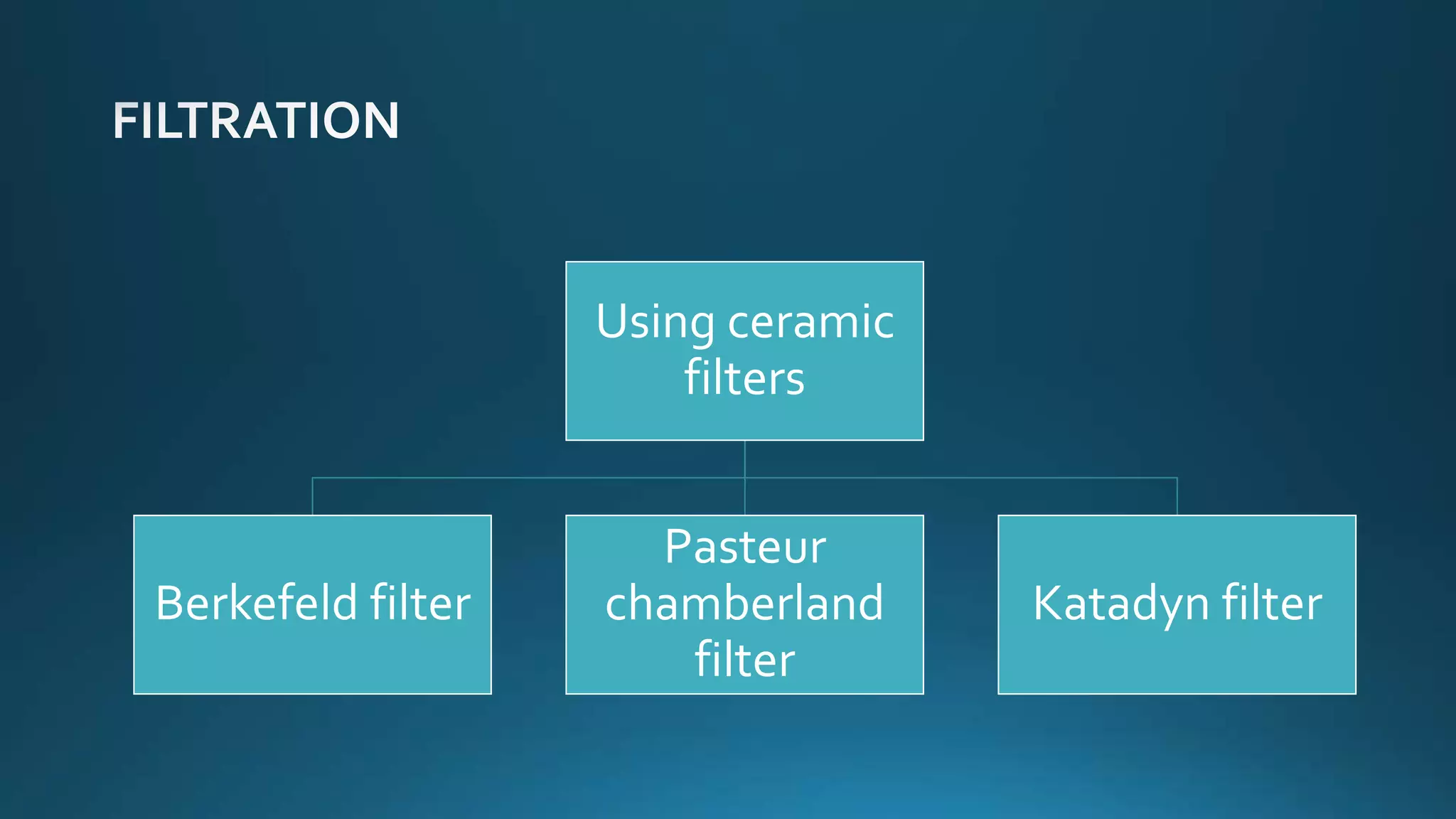
Using ceramic
filters
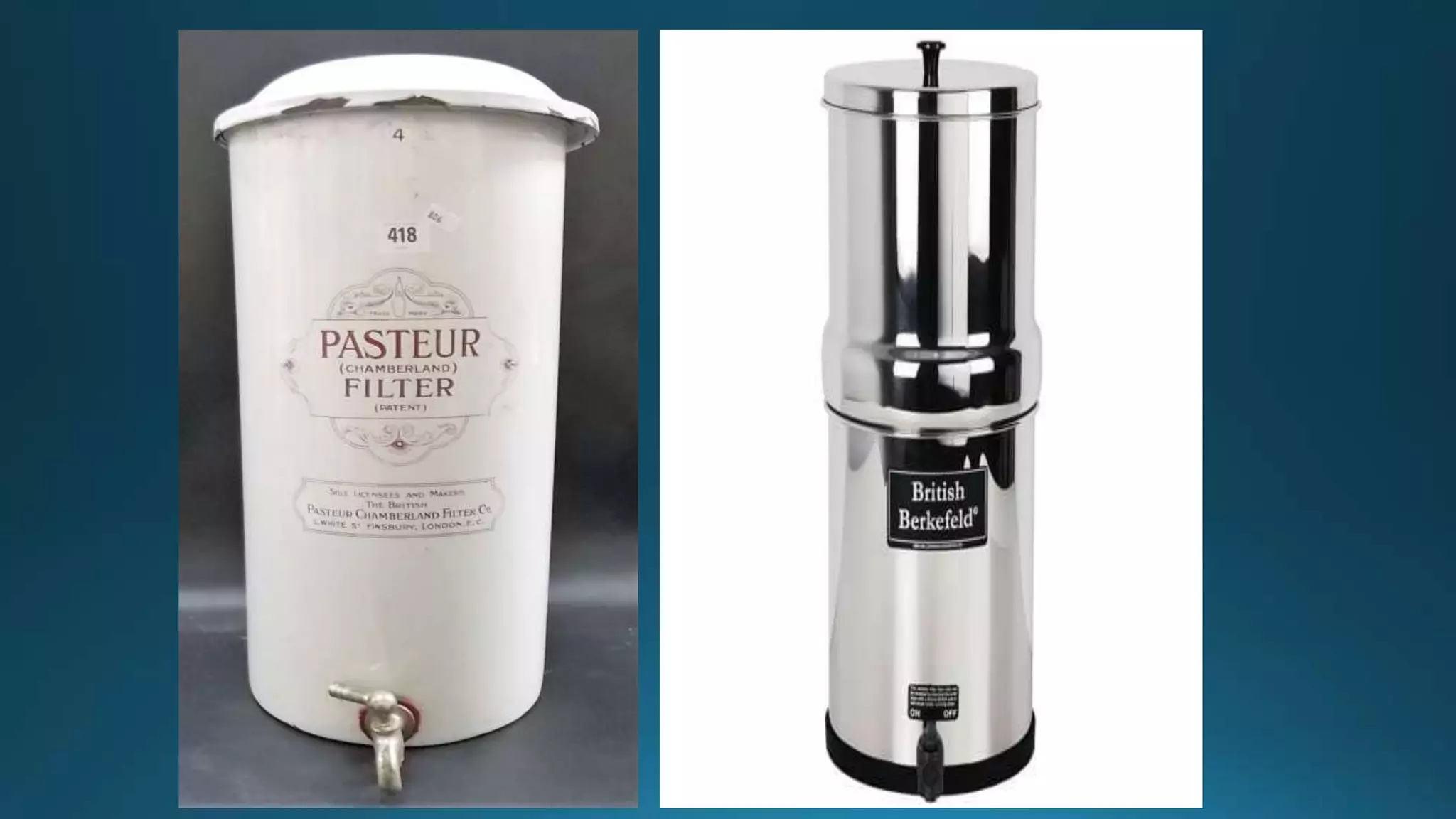
Berkefeld filter
Pasteur
chamberland
filter
Katadyn filter
Can be used for :
• To remove bacteria , but not viruses
• Only with clean water
• A film of water is exposed to UV radiation at 254 nm wavelength.
• The water should be free from :
 Turbidity
 Suspended /colloidal impurities
• Advantages
 Short duration of exposure
 No alteration of taste or odour
 No harmful effects due to overexposure
• Disadvatages
 No residual effect
 Expensive
• Used to make water chemically and micro biologically potent :
• By reducing
Total dissolved solids
Hardness
Heavy metals
Pathogens
Find
volume of
water in
well
Find
amount of
bleaching
powder
required for
disinfection
Dissolve
bleaching
powder in
water
Deliver
chlorine
solution
into well
Contact
period
Test for
residual
volume
• Measure depth of water column (h) in meters.
• Measure diameter of well (d) in meters
• Substitute above value in formula :
• Value (liters) = 3.14*d^2*h * 1000
4
• 1 cubic metre = 1000 litres of water.
• Estimate chlorine demand using Horrock’s apparatus
• 2.5 g good quality bleaching powder required to disinfect 1000 liters of water
• Place bleaching powder (<100g) in a bucket and make into thin paste.
• Add water and make solution till 3/4th of the bucket.
• Stir the contents well , allow to sediment * 5-10 minutes.
• Transfer the supernatant ( chlorine solution ) to another bucket.
• Discard chalk / lime residue.
• Lower bucket containing chlorine solution below water surface.
• Agitate water by violently moving vertically and horizontally several times.
• Allow a Contact Period between the Chlorine and Water
- Contact period of 1 hour allowed before anyone is permitted to draw water from
the well
• Orthotolidine Arsenite Test is then performed at the end of one hour contact
period.
• This is done to check the level of free residual chlorine
• OTA test : if free residual chlorine level is < 0.5 mg/L : repeat chlorination
process
SMALL SCALE PURIFICATION OF WATER.pptx

SMALL SCALE PURIFICATION OF WATER.pptx

  • 1.
    Dr PRANAV MK MPHSCHOLAR Amrita institute of medical sciences , KOCHI CHLORINATION & SMALL SCALE PURIFICATION OF WATER
  • 2.
    a) large scalepurification of water. b) Small scale purification water.
  • 3.
  • 4.
  • 5.
  • 6.
    • Break pointthe point at which the chlorine demand of water is met
  • 8.
    Chlorine gas ,chloramine, perchloron
  • 11.
  • 12.
  • 13.
    • To beeffective : Rolling boil : 10-20 minutes • It kills all the bacteria ,spores , cysts and ova – also removes hardness – by driving off carbon dioxide and precipitating calcium carbonate • Boiled water should be stored in same container – to avoid contamination
  • 14.
  • 15.
    • Bleaching powderor chlorinated lime (caocl2) : white amorphous with pungent smell of chlorine. • Contain 33 % available chlorine – when freshly made. • Rapidly loss of chlorine content upon exposure to – light , air, moisture. • Target : free residual chlorine of 0.5 mg/L at the end of one hour.
  • 16.
    • May beprepared from bleaching powder • Similar properties to bleaching powder
  • 17.
    • HTH isa calcium compound with 60-70% available chlorine . • More stable than bleaching powder
  • 18.
    • Various typesavailable. (trade names VIZ, halazone tablets.) • .05 g tablet sufficient to disinfect 20L of water.
  • 19.
    • May beused for emergency disinfection of water • 2 drops of 2 % ethanol solution of iodine – required for 1 L of clear water. • Contact time 20-30 minutes • Disadvantage :  high cost  Physiological active ( thyroid )
  • 20.
    • No longerrecommended for disinfection of water • Kills vibrio cholerae , but ineffective against other pathogen • Disadvantage : • Alters – colour , taste , smell of water
  • 21.
  • 23.
    Can be usedfor : • To remove bacteria , but not viruses • Only with clean water
  • 24.
    • A filmof water is exposed to UV radiation at 254 nm wavelength. • The water should be free from :  Turbidity  Suspended /colloidal impurities
  • 25.
    • Advantages  Shortduration of exposure  No alteration of taste or odour  No harmful effects due to overexposure • Disadvatages  No residual effect  Expensive
  • 26.
    • Used tomake water chemically and micro biologically potent : • By reducing Total dissolved solids Hardness Heavy metals Pathogens
  • 27.
    Find volume of water in well Find amountof bleaching powder required for disinfection Dissolve bleaching powder in water Deliver chlorine solution into well Contact period Test for residual volume
  • 28.
    • Measure depthof water column (h) in meters. • Measure diameter of well (d) in meters • Substitute above value in formula : • Value (liters) = 3.14*d^2*h * 1000 4 • 1 cubic metre = 1000 litres of water.
  • 29.
    • Estimate chlorinedemand using Horrock’s apparatus • 2.5 g good quality bleaching powder required to disinfect 1000 liters of water
  • 30.
    • Place bleachingpowder (<100g) in a bucket and make into thin paste. • Add water and make solution till 3/4th of the bucket. • Stir the contents well , allow to sediment * 5-10 minutes. • Transfer the supernatant ( chlorine solution ) to another bucket. • Discard chalk / lime residue.
  • 31.
    • Lower bucketcontaining chlorine solution below water surface. • Agitate water by violently moving vertically and horizontally several times.
  • 32.
    • Allow aContact Period between the Chlorine and Water - Contact period of 1 hour allowed before anyone is permitted to draw water from the well
  • 33.
    • Orthotolidine ArseniteTest is then performed at the end of one hour contact period. • This is done to check the level of free residual chlorine • OTA test : if free residual chlorine level is < 0.5 mg/L : repeat chlorination process