Presented by:
Tamer Maged
Outline
1.What is waste?
2.Associated risks
3.Sources of solid waste
4.Types of solid waste
5.Key components of solid waste
management
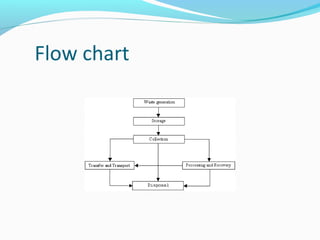
6.Flow chart
What is waste?
Waste :
any unwanted item or substance
resulting from a
human activity or process
More consumption more waste!
Associated risks
1.Disease transmission
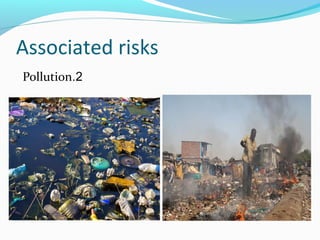
Associated risks
2.Pollution
Associated risks
3.Effect on morale
waste attracts more waste and leads to unhygienic
behaviour in general
Sources of solid waste
In most emergency situations the main sources of solid
waste are:
 Medical centres
 Food stores
 Feeding centres
 Food distribution points
 Slaughter areas
 Warehouses
 Markets
 Domestic areas
Types of solid waste
1.Domestic wastes
 Wastes generated by household activities
 EX-garbage , rubbish , ashes & residue ect.
2.Commercial wastes
 Wastes that are generated by commericial
establishments
3.Industrial wastes
 Discarded solid material of industrial operations
 Ex- domestic appliance, furniture, metals
Continue…….
4.Construction wastes
 Wastes generated from construction sites
 Ex- bricks, cement and waste iron ect.
Key components of solid waste
management
1.Generation
Continue…….
Continue…….
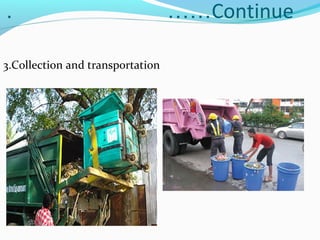
3.Collection and transportation
Continue…….
4.
Reduce
1. In industries, using more efficient manufacturing
processes and better materials will generally reduce
the production of waste.
Reuse
Recycling
1. is the breaking down of the used item into raw
materials which are used to make new items.
 Ex- old newspapers to produce pulp and
new paper
Disposal
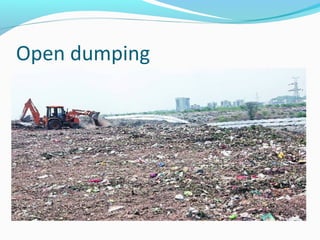
1.Open dumping
2.Land filling
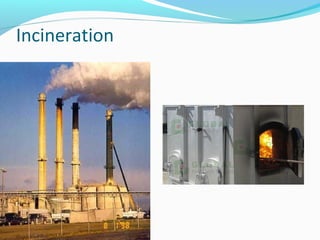
3.Incineration
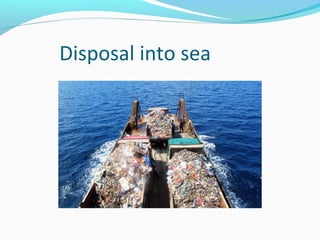
4.Disposal into sea
5 .Pyrolysis
Open dumping
Land filling
Incineration
Disposal into sea
Pyrolysis
Flow chart
Solid waste  management

Solid waste management