By Karl Coelho
Disposal of Polymers
There are 3 ways to dispose of
polymers.
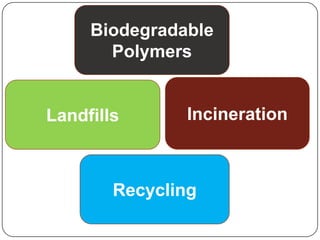
Landfills Incineration
Recycling
Biodegradable
Polymers
LANDFILLS
Waste polymers are
disposed of in
landfill sites. This
uses up valuable
land, and suitable
sites often fill up
quickly. Waste polymers are
disposed of in landfill
sites. This uses up
valuable land, suitable
sites often fill up and
quickly.
LANDFILLS - SPACE
Landfill sites obviously require space.
Although some types of landfill can
be used for other purposes once finished,
they still require land while in use
and restrict possible future uses of the land.
The more land used for landfill,
the less available for agriculture, natural
habitat and
development.
LANDFILLS – GAS EMISSIONS
Organic materials, including paper and cardboard,
decompose. The conditions
of landfill are such that the decomposition
releases large quantities of
dangerous gases, including methane, a potent
greenhouse gas. The gas emissions
contribute to air pollution and climate change.
They are also a potential health
hazard, not to mention being malodorous enough
to constitute an ongoing
nuisance to nearby communities.
LANDFILLS – SOIL POLLUTION
Chemicals can leak into the soil from the accumulation of
waste, and may
eventually end up in the water supply. Modern methods,
such as the use of
landfill liners, can mitigate direct soil pollution to a certain
extent.
However, the risk of pollutants leaching into the soil
remains. Although
hazardous wastes are supposed to go to purpose-built
landfills, be incinerated
or recycled, some inevitably ends up with general trash.
Batteries contain
hazardous chemicals such as lead and often end up with
general trash, simply
because householders are unaware of proper disposal
methods.
LANDFILLS – LOSS OF MATERIALS
Most of the materials sent to landfill could
be used for something else.
Materials such as plastics, paper, metals
and glass are recyclable. All organic
materials can be composted into a rich soil.
Wasting the materials by burying
them in landfills means raw materials are
continuously consumed, wasting energy
and leading to serious habitat destruction.
LANDFILLS – IMPACT ON COMMUNITIES
Open landfills are an eyesore and few
residents want to live near to an
enormous pile of garbage, or even pass one
regularly. Landfill sites also
attract and support pests such as rats and
cockroaches, some of which carry
diseases. The associated noise, air and soil
pollution impacts humans as well as
wildlife.
LANDFILLS – MONETARY COSTS
Landfill sites have associated
economic costs, including land,
design,
transport of waste and maintenance.
They have initial and ongoing costs but
do
not provide any services in return,
other than being a place for
communities to
send their waste.
BURNING
Polymers release a lot
of heat energy when
they burn. This energy
can be used
to heat homes or
generate electricity. But
there are problems with
incineration.
Carbon dioxide is
produced, which adds to
global warming. Toxic
gases are also
produced, unless the
polymers are incinerated
at high
temperatures.
BURNING – ENVIRONMENTAL DAMAGES
Waste disposal has developed into an industry larger than
just removing
waste. Organic waste is separated from inorganic and non-
recyclable waste. This
allows cities to use organic waste to mulch or create
compost for public areas.
Some cities even package and sell the compost to
generate further revenues. The
items that can be recycled are re-processed, and the
materials are used to
create new products. This method reduces the further
consumption of natural
resources and lowers the ultimate waste disposal
needs.
BURNING – HEALTH BENEFITS
It was once a common practice to burn waste either in your
own backyard or at a
landfill. According to the Wisconsin Department of Health
Services, when
household garbage and plastics are burned, they release
particulate matter which
are solid compounds suspended in air. Being exposed to
particulate matter
increases heart disease, asthma, emphysema and
respiratory disease incident
rates. Waste disposal relocates waste to an area where it
can be safely left,
incinerated or otherwise disposed of. Removing waste from
public areas reduces
overall health risks, decreases pest infestation in urban
areas and lowers
exposures to biohazards.
BURNING – WASTE ENERGY
Waste energy is a by-product of some methods of waste
incineration. While
incineration can release large amounts of carbon dioxide
and other pollutants,
there have been modern advances that capture the energy
produced in incineration
and use it to generate electricity. The result is a complex
method of re-using
items to lower the need of future waste. While this is still
being done on a
small scale by industrial factories, it is a start and huge
advantage of proper
waste disposal.
BURNING – WASTE ENERGY
Waste energy is a by-product of some methods of waste
incineration. While
incineration can release large amounts of carbon dioxide
and other pollutants,
there have been modern advances that capture the energy
produced in incineration
and use it to generate electricity. The result is a complex
method of re-using
items to lower the need of future waste. While this is still
being done on a
small scale by industrial factories, it is a start and huge
advantage of proper
waste disposal.
RECYCLING
Polymers have recycling
symbols like this
one for PVC to show
what they areMany polymers can be
recycled. This reduces
disposal problems and
the amount
of crude oil used. But
first the different
polymers must be
separated from each
other. This can be
difficult and expensive.
RECYCLING – SAVING LANDFILL SPACE
Plastic is not a biodegradable material,
which means that it can sit in a
landfill for hundreds or thousands of years.
One ton of recycled plastic can
save approximately 7.4 cubic yards of space
in a landfill. Best of all, plastics
can be indefinitely recycled, which means
they could potentially be eradicated
from landfills altogether.
RECYCLING – ENERGY CONSERVATION
By using recyclable plastic materials, factories can
produce new products
using approximately 2/3 less energy than with raw
material production. A single
pound of recycled plastic bottles made from
polyethylene terephthalate can save
nearly 12,000 BTUs of heat energy. To put it into
terms that hit close to home,
one ton of recycled plastic can save a year's worth
of energy consumption for
two people.
RECYCLING – REDUCING OF HARMFUL EMISSIONS
Factories that produce plastic products
from raw materials also produce a
great deal of harmful greenhouse
gases. By using recycled plastic
materials,
production time is greatly reduced,
which means that less greenhouse
emissions
are making their way into the
atmosphere.
RECYCLING – COSERVATION OF RESOURCES
Oil and natural gas are two of the main
components used for the production of
the raw materials used to make plastic. These
natural resources are not only in
limited supply, but also in high demand for other
important uses such as
powering automobiles and producing electricity.
Because plastic materials are
already in such abundance, recycling these
existing materials means that less
natural resources are used for production of new
plastic
materials.
Advantages and
disadvantages of
land-fill, burning
and recycling
polymers
ADVANTAGES
•The polymers are buried in sites
dedicated to waste.
• Incineration of polymers releases a lot
of heat energy, which can be used
to generate electricity.
•Many polymers now carry labels to
indicate how they should be recycled.
•The clear advantage of recycling is
protection of useful
hydrocarbon esources for the future.
DISADVANTAGES
•The amount of land available is limited and
suitable sites often fill up rapidly.
• Carbon dioxide is produced, which adds to
global warming.
• Toxic gases are also produced, unless the
polymers are incinerated at high
temperatures.
• Recycling polymers is a good idea, but not
always practical. Many polymers are mixed
with other materials and paints or dyes and
separation is difficult and expensive.
Thanks for watching!
Disposal of Polymers
-Karl Coelho

Disposal of Polymers

  • 1.
  • 2.
    There are 3ways to dispose of polymers.
  • 3.
  • 4.
    LANDFILLS Waste polymers are disposedof in landfill sites. This uses up valuable land, and suitable sites often fill up quickly. Waste polymers are disposed of in landfill sites. This uses up valuable land, suitable sites often fill up and quickly.
  • 5.
    LANDFILLS - SPACE Landfillsites obviously require space. Although some types of landfill can be used for other purposes once finished, they still require land while in use and restrict possible future uses of the land. The more land used for landfill, the less available for agriculture, natural habitat and development.
  • 6.
    LANDFILLS – GASEMISSIONS Organic materials, including paper and cardboard, decompose. The conditions of landfill are such that the decomposition releases large quantities of dangerous gases, including methane, a potent greenhouse gas. The gas emissions contribute to air pollution and climate change. They are also a potential health hazard, not to mention being malodorous enough to constitute an ongoing nuisance to nearby communities.
  • 7.
    LANDFILLS – SOILPOLLUTION Chemicals can leak into the soil from the accumulation of waste, and may eventually end up in the water supply. Modern methods, such as the use of landfill liners, can mitigate direct soil pollution to a certain extent. However, the risk of pollutants leaching into the soil remains. Although hazardous wastes are supposed to go to purpose-built landfills, be incinerated or recycled, some inevitably ends up with general trash. Batteries contain hazardous chemicals such as lead and often end up with general trash, simply because householders are unaware of proper disposal methods.
  • 8.
    LANDFILLS – LOSSOF MATERIALS Most of the materials sent to landfill could be used for something else. Materials such as plastics, paper, metals and glass are recyclable. All organic materials can be composted into a rich soil. Wasting the materials by burying them in landfills means raw materials are continuously consumed, wasting energy and leading to serious habitat destruction.
  • 9.
    LANDFILLS – IMPACTON COMMUNITIES Open landfills are an eyesore and few residents want to live near to an enormous pile of garbage, or even pass one regularly. Landfill sites also attract and support pests such as rats and cockroaches, some of which carry diseases. The associated noise, air and soil pollution impacts humans as well as wildlife.
  • 10.
    LANDFILLS – MONETARYCOSTS Landfill sites have associated economic costs, including land, design, transport of waste and maintenance. They have initial and ongoing costs but do not provide any services in return, other than being a place for communities to send their waste.
  • 11.
    BURNING Polymers release alot of heat energy when they burn. This energy can be used to heat homes or generate electricity. But there are problems with incineration. Carbon dioxide is produced, which adds to global warming. Toxic gases are also produced, unless the polymers are incinerated at high temperatures.
  • 12.
    BURNING – ENVIRONMENTALDAMAGES Waste disposal has developed into an industry larger than just removing waste. Organic waste is separated from inorganic and non- recyclable waste. This allows cities to use organic waste to mulch or create compost for public areas. Some cities even package and sell the compost to generate further revenues. The items that can be recycled are re-processed, and the materials are used to create new products. This method reduces the further consumption of natural resources and lowers the ultimate waste disposal needs.
  • 13.
    BURNING – HEALTHBENEFITS It was once a common practice to burn waste either in your own backyard or at a landfill. According to the Wisconsin Department of Health Services, when household garbage and plastics are burned, they release particulate matter which are solid compounds suspended in air. Being exposed to particulate matter increases heart disease, asthma, emphysema and respiratory disease incident rates. Waste disposal relocates waste to an area where it can be safely left, incinerated or otherwise disposed of. Removing waste from public areas reduces overall health risks, decreases pest infestation in urban areas and lowers exposures to biohazards.
  • 14.
    BURNING – WASTEENERGY Waste energy is a by-product of some methods of waste incineration. While incineration can release large amounts of carbon dioxide and other pollutants, there have been modern advances that capture the energy produced in incineration and use it to generate electricity. The result is a complex method of re-using items to lower the need of future waste. While this is still being done on a small scale by industrial factories, it is a start and huge advantage of proper waste disposal.
  • 15.
    BURNING – WASTEENERGY Waste energy is a by-product of some methods of waste incineration. While incineration can release large amounts of carbon dioxide and other pollutants, there have been modern advances that capture the energy produced in incineration and use it to generate electricity. The result is a complex method of re-using items to lower the need of future waste. While this is still being done on a small scale by industrial factories, it is a start and huge advantage of proper waste disposal.
  • 16.
    RECYCLING Polymers have recycling symbolslike this one for PVC to show what they areMany polymers can be recycled. This reduces disposal problems and the amount of crude oil used. But first the different polymers must be separated from each other. This can be difficult and expensive.
  • 17.
    RECYCLING – SAVINGLANDFILL SPACE Plastic is not a biodegradable material, which means that it can sit in a landfill for hundreds or thousands of years. One ton of recycled plastic can save approximately 7.4 cubic yards of space in a landfill. Best of all, plastics can be indefinitely recycled, which means they could potentially be eradicated from landfills altogether.
  • 18.
    RECYCLING – ENERGYCONSERVATION By using recyclable plastic materials, factories can produce new products using approximately 2/3 less energy than with raw material production. A single pound of recycled plastic bottles made from polyethylene terephthalate can save nearly 12,000 BTUs of heat energy. To put it into terms that hit close to home, one ton of recycled plastic can save a year's worth of energy consumption for two people.
  • 19.
    RECYCLING – REDUCINGOF HARMFUL EMISSIONS Factories that produce plastic products from raw materials also produce a great deal of harmful greenhouse gases. By using recycled plastic materials, production time is greatly reduced, which means that less greenhouse emissions are making their way into the atmosphere.
  • 20.
    RECYCLING – COSERVATIONOF RESOURCES Oil and natural gas are two of the main components used for the production of the raw materials used to make plastic. These natural resources are not only in limited supply, but also in high demand for other important uses such as powering automobiles and producing electricity. Because plastic materials are already in such abundance, recycling these existing materials means that less natural resources are used for production of new plastic materials.
  • 21.
    Advantages and disadvantages of land-fill,burning and recycling polymers
  • 22.
    ADVANTAGES •The polymers areburied in sites dedicated to waste. • Incineration of polymers releases a lot of heat energy, which can be used to generate electricity. •Many polymers now carry labels to indicate how they should be recycled. •The clear advantage of recycling is protection of useful hydrocarbon esources for the future.
  • 23.
    DISADVANTAGES •The amount ofland available is limited and suitable sites often fill up rapidly. • Carbon dioxide is produced, which adds to global warming. • Toxic gases are also produced, unless the polymers are incinerated at high temperatures. • Recycling polymers is a good idea, but not always practical. Many polymers are mixed with other materials and paints or dyes and separation is difficult and expensive.
  • 24.
    Thanks for watching! Disposalof Polymers -Karl Coelho