







SOLID Principles
Principles for good design
Three Presentations
1. SOLID Principles Overview
2. Test Driven Development Overview
3. Refactoring Patterns
SOLID - describes five design principles
Michael Feathers and Bob Martin were heavily
involved in formulating these principles
They help us to write testable code
by using good design principles
I'll present these as SDOLI though...
Most importantly
Read up on the principles afterwards and
investigate for yourselves.
Try some of them out
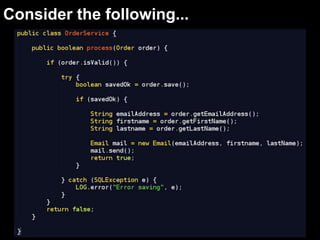
Consider the following...
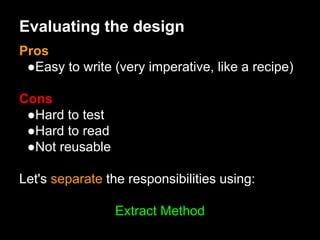
Evaluating the design
Pros
●Easy to write (very imperative, like a recipe)
Cons
●Hard to test
●Hard to read
●Not reusable
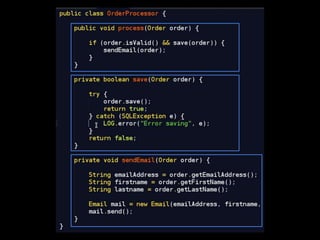
Let's separate the responsibilities using:
Extract Method
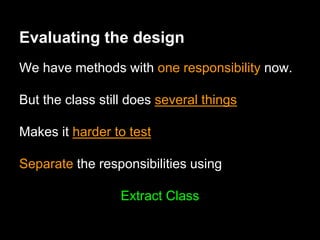
Evaluating the design
We have methods with one responsibility now.
But the class still does several things
Makes it harder to test
Separate the responsibilities using
Extract Class
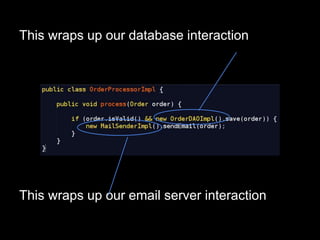
This wraps up our database interaction
This wraps up our email server interaction
Evaluating the design
We have separate classes with responsibilities
Much simpler
It does require us to navigate in our IDE to see
what MailSenderImpl and OrderDAOImpl do
though
Is it easier to test?
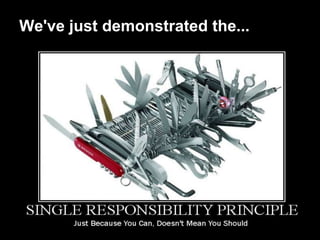
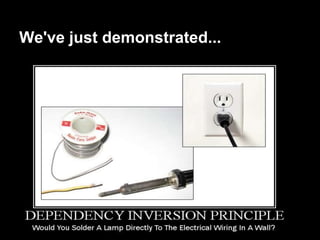
We've just demonstrated the...
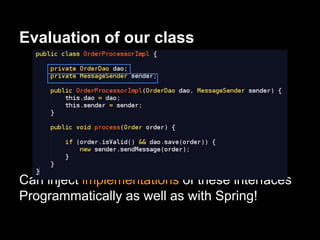
Evaluation of our class
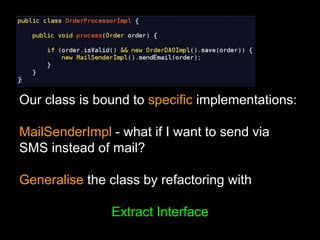
Our class is bound to specific implementations:
MailSenderImpl - what if I want to send via
SMS instead of mail?
Generalise the class by refactoring with
Extract Interface
Can inject implementations of these interfaces
Programmatically as well as with Spring!
Evaluation of our class
We've just demonstrated...
● Should be able to change the external
dependencies of the class
● Without change the class internals
● Well we can do this already!
● We used an Interface and injected our
dependencies into the class
Evaluation of our class
There are other ways to make the class
extensible:
● Dependency Injection - Inject when container starts
● Decorator and composition - Bound at compile time.
Wrap a class providing before method & after method.
● Dynamic language extensibility - Bound at runtime.
One way is to use a dynamic language or bean to
provide functionality.
Other extensibility mechanisms
This one is short because we've already done
the refactoring previously...
In conclusion
Open Closed
We previously demonstrated...
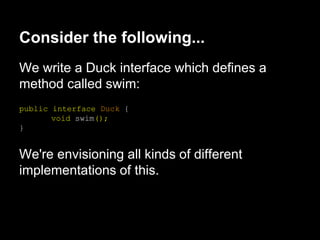
We write a Duck interface which defines a
method called swim:
public interface Duck {
void swim();
}
We're envisioning all kinds of different
implementations of this.
Consider the following...
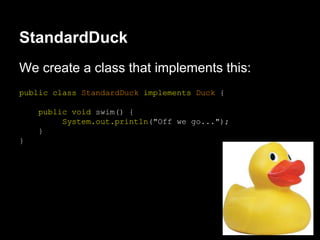
StandardDuck
We create a class that implements this:
public class StandardDuck implements Duck {
public void swim() {
System.out.println("Off we go...");
}
}
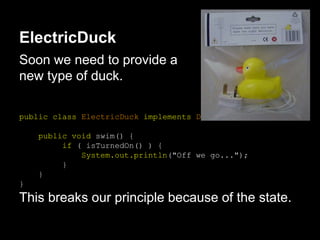
ElectricDuck
Soon we need to provide a
new type of duck.
public class ElectricDuck implements Duck {
public void swim() {
if ( isTurnedOn() ) {
System.out.println("Off we go...");
}
}
}
This breaks our principle because of the state.
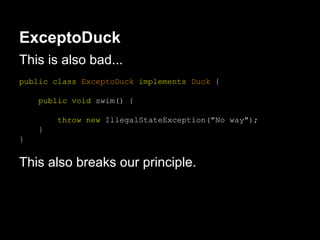
ExceptoDuck
This is also bad...
public class ExceptoDuck implements Duck {
public void swim() {
throw new IllegalStateException("No way");
}
}
This also breaks our principle.
From the pond...
Think of this from a client perspective.
If you have a getDuck() method and you call
swim() on that then you should expect it to just
work
This goes in hand with the:
Principle of Least Astonishment
● An object should be substitutable by it's:
oInterface
oBase Class
● This means that if you create a new class
and implement an interface it shouldn't do
anything surprising
● No side effects - throwing exceptions or
doing things contrary to the interface
Liskov Substitution Principle
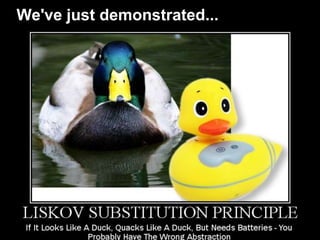
Liskov Substitution
We've just demonstrated...
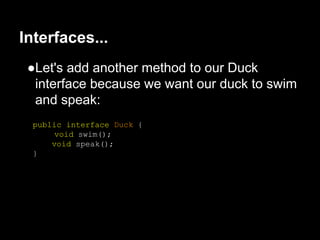
●Let's add another method to our Duck
interface because we want our duck to swim
and speak:
public interface Duck {
void swim();
void speak();
}
Interfaces...
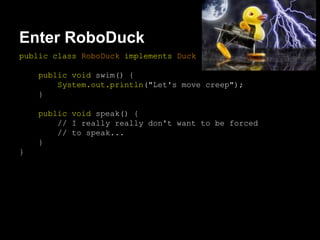
Enter RoboDuck
public class RoboDuck implements Duck {
public void swim() {
System.out.println("Let's move creep");
}
public void speak() {
// I really really don't want to be forced
// to speak...
}
}
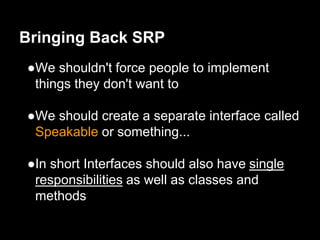
●We shouldn't force people to implement
things they don't want to
●We should create a separate interface called
Speakable or something...
●In short Interfaces should also have single
responsibilities as well as classes and
methods
Bringing Back SRP
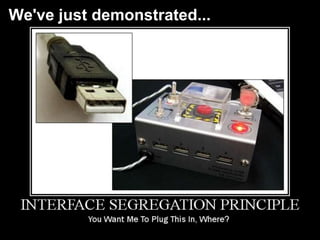
Interface Segregation
We've just demonstrated...
●YAGNI - You Ain't Gonna Need It. Don't
build what you don't need today !
●Don't over-engineer abstractions, hierarchies
or genericise where you don't need to
●It's called Speculative Generality
●And it's way worse than any of the above
because it makes work harder for us
One other principle - YAGNI
●If you have abstract classes that don't do
anything - Collapse Hierarchy
●Don't delegate when you don't need to - fold
the class back in - Inline the Class
●Above all...
If someone proposes a complex design to a
problem then question it until you understand
Some refactoring advice
●Further reading on this...
●One of the single best articles out there on
bad code or code smells
http://www.codinghorror.com/blog/2006/05/code-smells.html
Coding Horror - Code Smells
●Found out about this last night...
http://sourcemaking.com/
SourceMaking.com
●Refactoring
oHow many do you know?
oHow many people use Eclipse for this?
●Test Driven Development
oDoes it help us here with the principles?
oDo people write their tests first?
oDo people use it when fixing bugs?
Discussion

SOLID principles

  • 1.
  • 2.
    Three Presentations 1. SOLIDPrinciples Overview 2. Test Driven Development Overview 3. Refactoring Patterns
  • 3.
    SOLID - describesfive design principles Michael Feathers and Bob Martin were heavily involved in formulating these principles They help us to write testable code by using good design principles I'll present these as SDOLI though...
  • 4.
    Most importantly Read upon the principles afterwards and investigate for yourselves. Try some of them out
  • 6.
  • 7.
    Evaluating the design Pros ●Easyto write (very imperative, like a recipe) Cons ●Hard to test ●Hard to read ●Not reusable Let's separate the responsibilities using: Extract Method
  • 9.
    Evaluating the design Wehave methods with one responsibility now. But the class still does several things Makes it harder to test Separate the responsibilities using Extract Class
  • 10.
    This wraps upour database interaction This wraps up our email server interaction
  • 11.
    Evaluating the design Wehave separate classes with responsibilities Much simpler It does require us to navigate in our IDE to see what MailSenderImpl and OrderDAOImpl do though Is it easier to test?
  • 12.
  • 14.
    Evaluation of ourclass Our class is bound to specific implementations: MailSenderImpl - what if I want to send via SMS instead of mail? Generalise the class by refactoring with Extract Interface
  • 15.
    Can inject implementationsof these interfaces Programmatically as well as with Spring! Evaluation of our class
  • 16.
  • 18.
    ● Should beable to change the external dependencies of the class ● Without change the class internals ● Well we can do this already! ● We used an Interface and injected our dependencies into the class Evaluation of our class
  • 19.
    There are otherways to make the class extensible: ● Dependency Injection - Inject when container starts ● Decorator and composition - Bound at compile time. Wrap a class providing before method & after method. ● Dynamic language extensibility - Bound at runtime. One way is to use a dynamic language or bean to provide functionality. Other extensibility mechanisms
  • 20.
    This one isshort because we've already done the refactoring previously... In conclusion
  • 21.
  • 23.
    We write aDuck interface which defines a method called swim: public interface Duck { void swim(); } We're envisioning all kinds of different implementations of this. Consider the following...
  • 24.
    StandardDuck We create aclass that implements this: public class StandardDuck implements Duck { public void swim() { System.out.println("Off we go..."); } }
  • 25.
    ElectricDuck Soon we needto provide a new type of duck. public class ElectricDuck implements Duck { public void swim() { if ( isTurnedOn() ) { System.out.println("Off we go..."); } } } This breaks our principle because of the state.
  • 26.
    ExceptoDuck This is alsobad... public class ExceptoDuck implements Duck { public void swim() { throw new IllegalStateException("No way"); } } This also breaks our principle.
  • 27.
    From the pond... Thinkof this from a client perspective. If you have a getDuck() method and you call swim() on that then you should expect it to just work This goes in hand with the: Principle of Least Astonishment
  • 28.
    ● An objectshould be substitutable by it's: oInterface oBase Class ● This means that if you create a new class and implement an interface it shouldn't do anything surprising ● No side effects - throwing exceptions or doing things contrary to the interface Liskov Substitution Principle
  • 29.
  • 31.
    ●Let's add anothermethod to our Duck interface because we want our duck to swim and speak: public interface Duck { void swim(); void speak(); } Interfaces...
  • 32.
    Enter RoboDuck public classRoboDuck implements Duck { public void swim() { System.out.println("Let's move creep"); } public void speak() { // I really really don't want to be forced // to speak... } }
  • 33.
    ●We shouldn't forcepeople to implement things they don't want to ●We should create a separate interface called Speakable or something... ●In short Interfaces should also have single responsibilities as well as classes and methods Bringing Back SRP
  • 34.
  • 35.
    ●YAGNI - YouAin't Gonna Need It. Don't build what you don't need today ! ●Don't over-engineer abstractions, hierarchies or genericise where you don't need to ●It's called Speculative Generality ●And it's way worse than any of the above because it makes work harder for us One other principle - YAGNI
  • 36.
    ●If you haveabstract classes that don't do anything - Collapse Hierarchy ●Don't delegate when you don't need to - fold the class back in - Inline the Class ●Above all... If someone proposes a complex design to a problem then question it until you understand Some refactoring advice
  • 37.
    ●Further reading onthis... ●One of the single best articles out there on bad code or code smells http://www.codinghorror.com/blog/2006/05/code-smells.html Coding Horror - Code Smells
  • 38.
    ●Found out aboutthis last night... http://sourcemaking.com/ SourceMaking.com
  • 39.
    ●Refactoring oHow many doyou know? oHow many people use Eclipse for this? ●Test Driven Development oDoes it help us here with the principles? oDo people write their tests first? oDo people use it when fixing bugs? Discussion