S.O.L.I.D
Overview
What is S.O.L.I.D?
About making a better code
Why do we need a good design?
● to deliver faster
● to manage change easily
● to deal with complexity
● to keep maintainable
The psychology reason - Broken Window theory:
The psychology reason -
Broken Window theory
A broken window will trigger a building into a smashed and
abandoned derelict
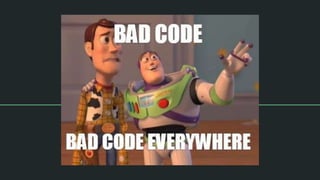
What is a bad code?
● Complex
● Repetition
● Hard to read
● Needs to be explained
How can you identify a bad code?
Design Smells
● Rigidity
● Fragility
● Immobility
● Viscosity
● Needless Complexity
● Needless Repetition
Rigidity
● Hard to change
● Hard to predict how much time will take to change
● Needs to change a lot of parts (cascate)
● High coupling
Fragility
● Breaks easily
● One change breaks many differents places (Modules)
● Collateral effect
● Fear of change
Immobility
● Does not favor reuse
● It contains parts that could be useful in other systems, but the effort and risk of
separating them from the original system are too great
Viscosity
● Caused by work around
● When it is more difficult to change using good designs than using hacks
● It is easier to skip the processes than to follow them (Skip unit tests)
Needless Complexity
● Hard to read
● Hard to understand
● Code not used
Needless repetition
● Copy and Paste instead of isolate and reuse
● Don’t use abstraction
S.O.L.I.D
Principles
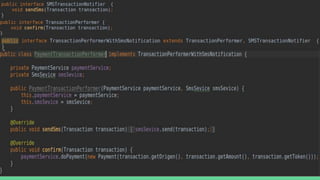
Single Responsibility
Principle
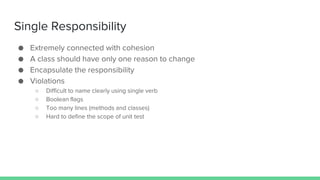
Single Responsibility
● Extremely connected with cohesion
● A class should have only one reason to change
● Encapsulate the responsibility
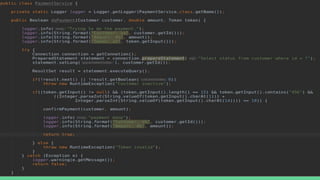
● Violations
○ Difficult to name clearly using single verb
○ Boolean flags
○ Too many lines (methods and classes)
○ Hard to define the scope of unit test
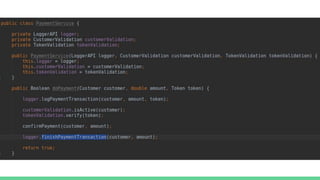
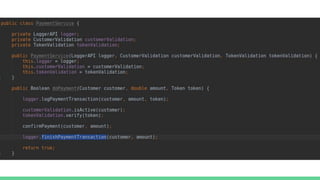
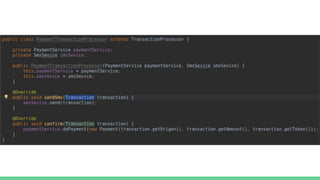
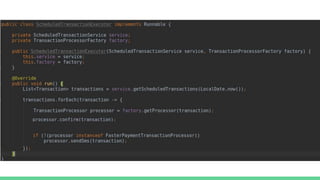
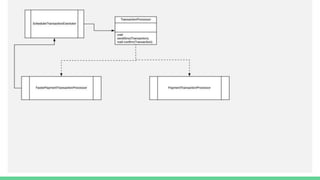
Applying
Principle
Open/Close
Principle
Open/Close
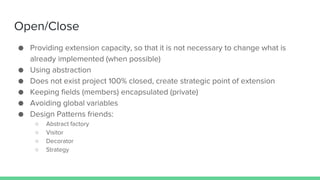
● Providing extension capacity, so that it is not necessary to change what is
already implemented (when possible)
● Using abstraction
● Does not exist project 100% closed, create strategic point of extension
● Keeping fields (members) encapsulated (private)
● Avoiding global variables
● Design Patterns friends:
○ Abstract factory
○ Visitor
○ Decorator
○ Strategy
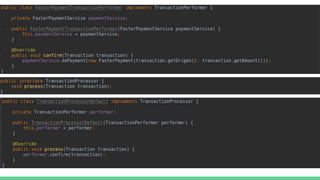
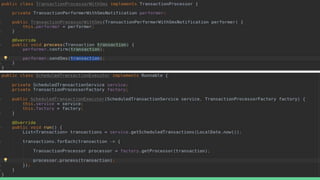
Applying
Principle
https://docs.google.com/presentation/d/15gyVPZRXt57zhagiMP3yDDSrKHBNq93K
hYw7w7dsOoQ/edit#slide=id.g249e99ff54_0_1
Liskov Substitution
Principle
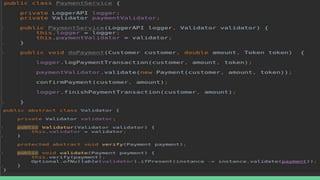
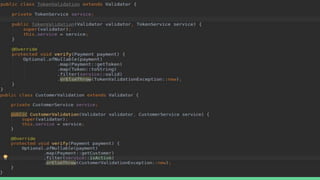
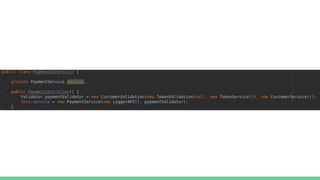
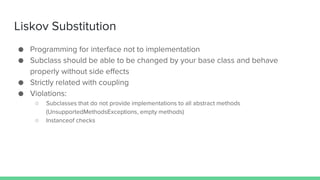
Liskov Substitution
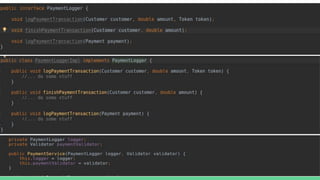
● Programming for interface not to implementation
● Subclass should be able to be changed by your base class and behave
properly without side effects
● Strictly related with coupling
● Violations:
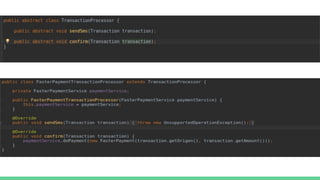
○ Subclasses that do not provide implementations to all abstract methods
(UnsupportedMethodsExceptions, empty methods)
○ Instanceof checks
Interface Segregation
Principle
Interface Segregation
● Programming to behave
● Related with single responsibility
● Avoiding big interfaces
● Client just has to know his needs (what is essential)
Applying
Principles
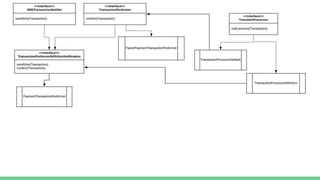
Dependency inversion
Principle
Dependency inversion
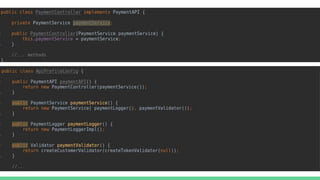
● High-level modules should not depend on low-level modules
● Abstractions should not depend on other details
● Both should depend on abstractions
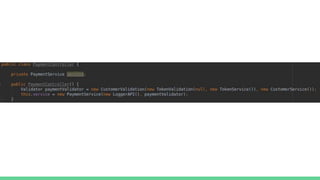
● To ensure that the configuration of services is separated from their use
● Design Patterns friends:
○ Inversion of Control Principle (Don't call us, we'll call you)
○ Factory Method
○ Abstract Factory
○ Prototype
○ Iterator
○ Service Locator
○ Template Methods
Applying
Principles
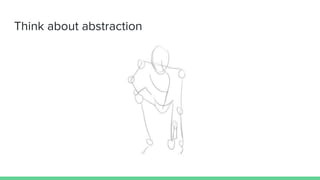
Think about abstraction
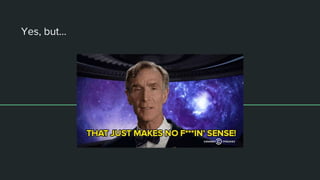
Yes, but...
Conclusion
Conclusion
● The first thing to take in consideration is that we develop code to humans read
● The second one is to attend the propose
● KISS (Keep It Simple Stupid)
● Use OOP principles like:
○ Reusability
○ Design Patterns
○ High cohesion
○ Low coupling
○ DRY (Don't repeat yourself)
● Other principles and references to help you
○ TDD (it is not only about test, but about design)
○ Clean Code
○ Clean Architecture
○ DDD
Bibliography
Bibliography
● OOD Principles - Uncle Bob
● http://en.wikipedia.org
● http://www.oodesign.com
● https://www.infoq.com/solid/
● https://martinfowler.com/articles
● https://pragprog.com/the-pragmatic-programmer/extracts/software-entropy

Solid Principles