Dependency Injection and
Autofac
By: Keith Schreiner & Jeff Benson
Goals
1) Provide basic info about DI.
2) Get you excited to use DI.
3) Get you to recommend using a DI tool (like
Autofac) on your next project.
Why?
DI enables loose coupling, and loose coupling makes
code more maintainable.
Great for medium or big applications that need to be
maintained.
DI can change the way you write software. (Good)
Instead of bottom-up, DI allows for top-down.
(DB to UI)

(UI to DB)
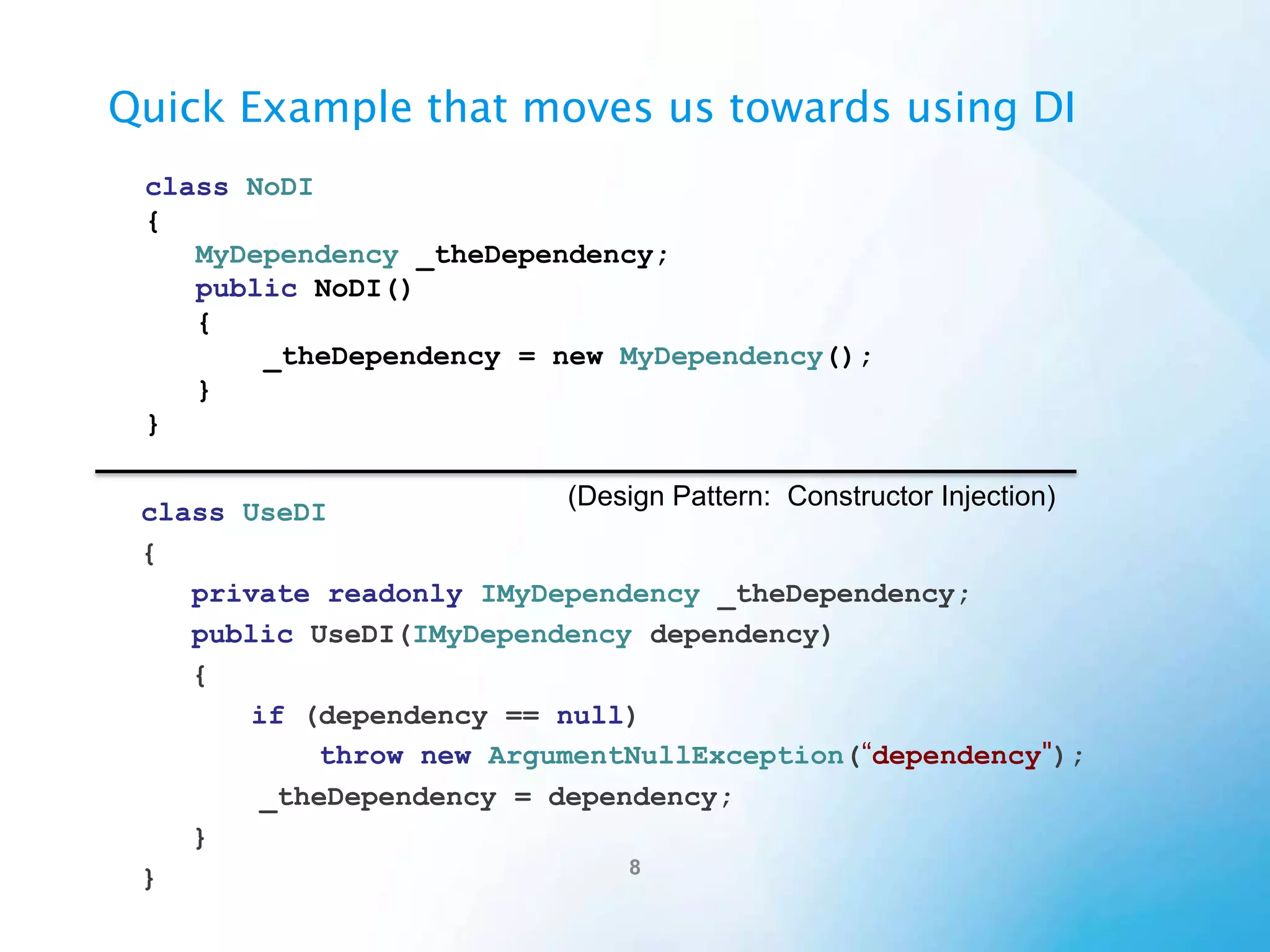
Definition of Dependency Injection
• A set of object-oriented software design principles &
patterns that enable us to develop loosely coupled
code, by passing or setting the dependencies of a
program.
• Instead of components having to request
dependencies, they are given (injected) into the
component.
• (Sounds complex, but really isn’t.)
Explain Dependency Injection to a
5-year old
When you go and get things out of the refrigerator for
yourself, you can cause problems.
You might leave the door open, you might get
something Mommy or Daddy doesn't want you to
have. You might even be looking for something we
don't even have, or which has expired.
What you should be doing is stating a need, "I need
something to drink with lunch," and then we will
make sure you have something when you sit down to
eat.
From John Munsch on Stack Overflow
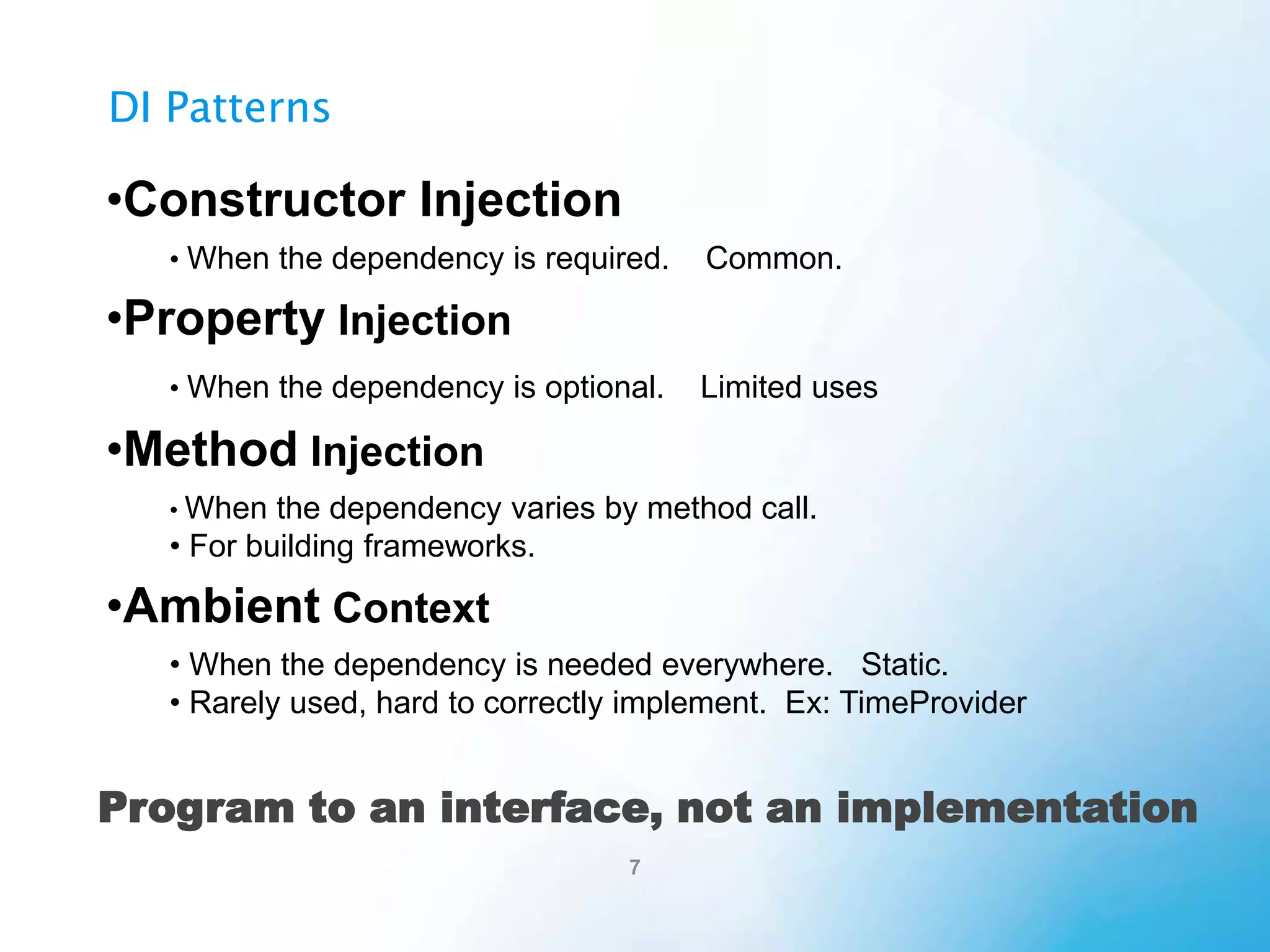
DI is a set of Design Patterns &
Principles
Making code more maintainable through loose
coupling is the core motivation behind many classic
design patterns (dating back to 1995 and the Gang of Four):
Program to an interface, not an implementation
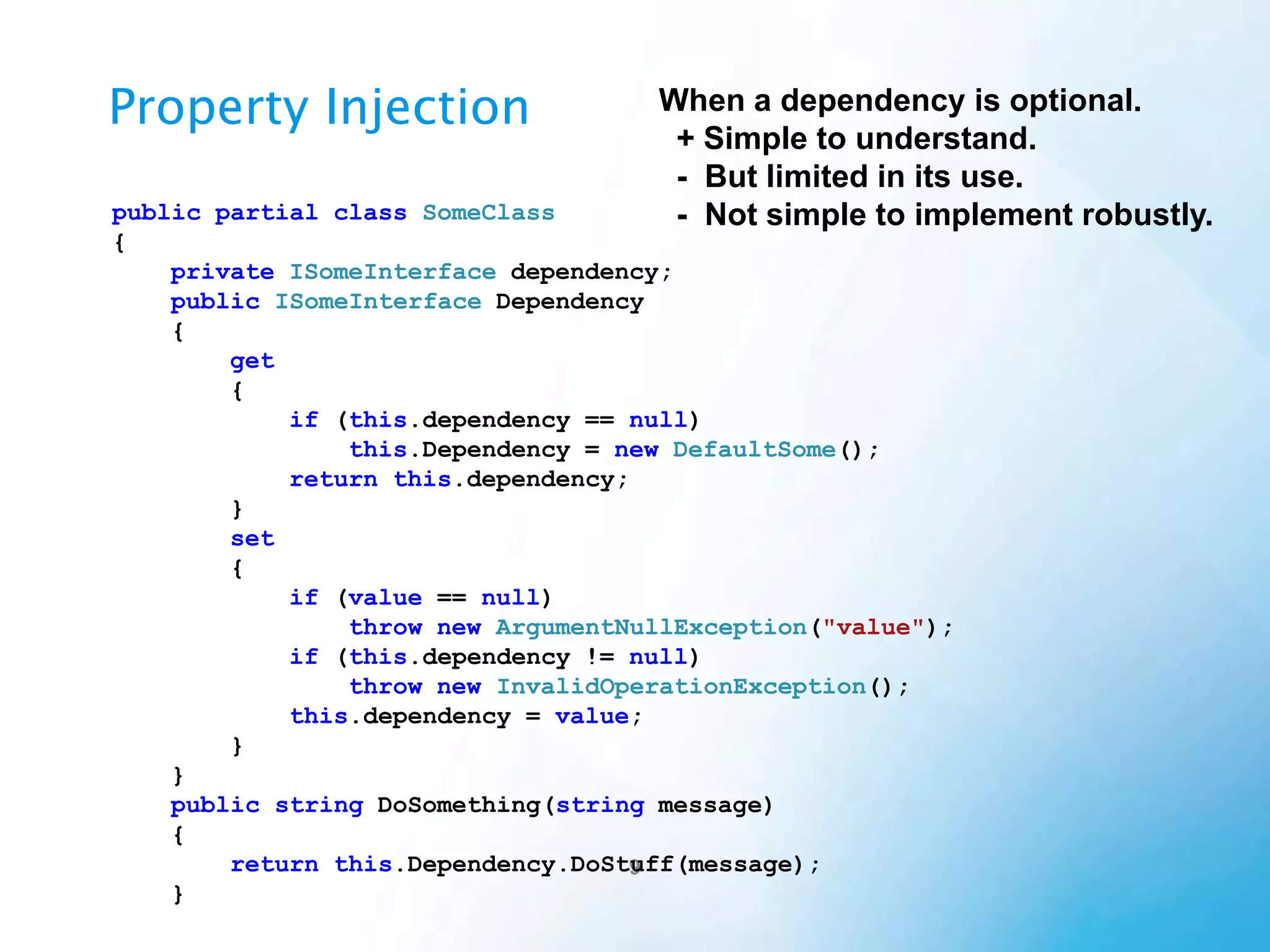
Property Injection
public partial class SomeClass
When a dependency is optional.
{
private ISomeInterface dependency;
+ Simple to understand.
public ISomeInterface Dependency
- But limited in its use.
{
get
- Not simple to implement robustly.
{
if (this.dependency == null)
this.Dependency = new DefaultSome();
return this.dependency;
}
set
{
if (value == null)
throw new ArgumentNullException("value");
if (this.dependency != null)
throw new InvalidOperationException();
this.dependency = value;
}
}
public string DoSomething(string message)
{
return this.Dependency.DoStuff(message);
}
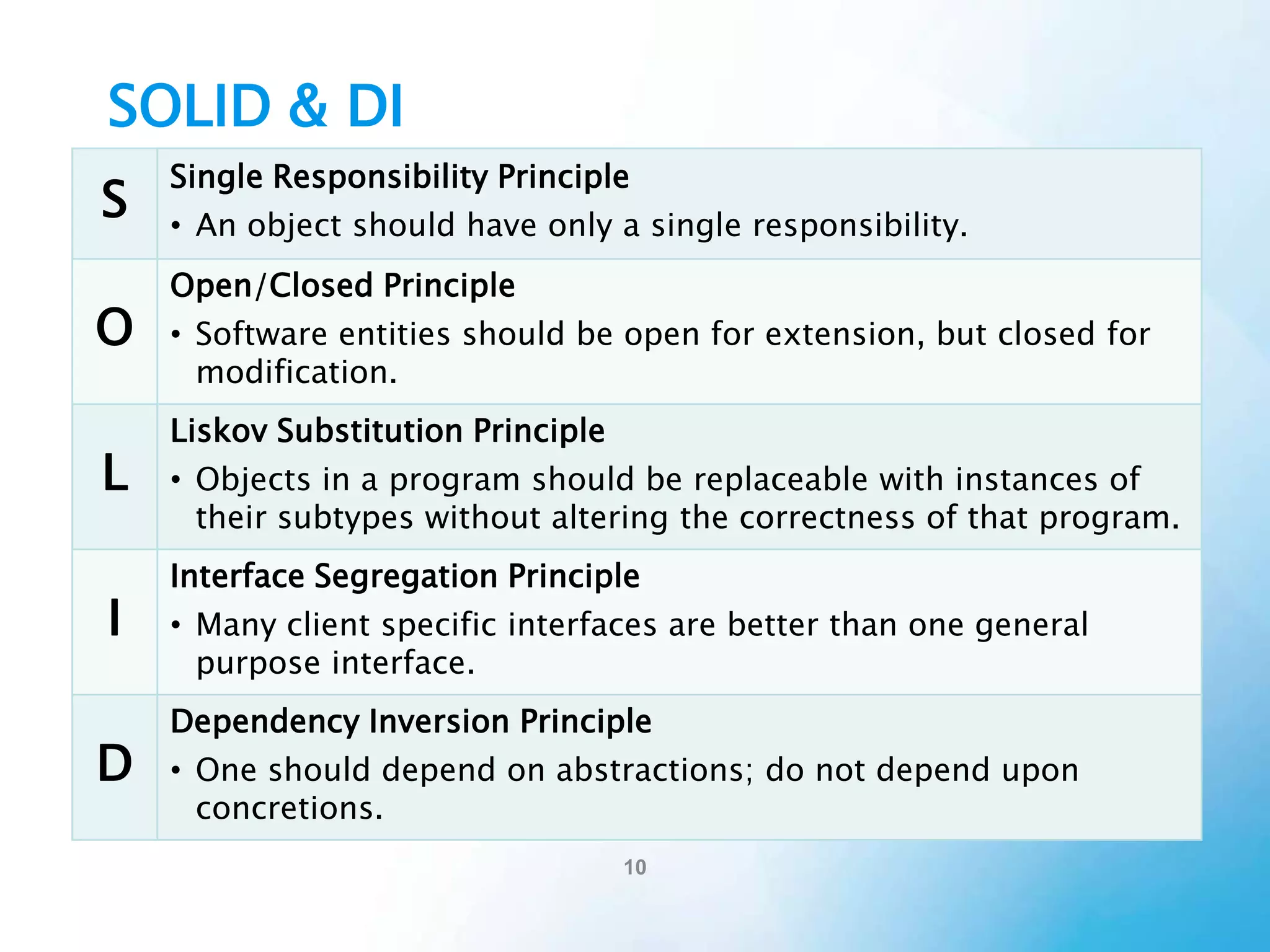
SOLID & DI
S

Single Responsibility Principle

• An object should have only a single responsibility.
Open/Closed Principle

O

• Software entities should be open for extension, but closed for
modification.
Liskov Substitution Principle

L

• Objects in a program should be replaceable with instances of their
subtypes without altering the correctness of that program.
Interface Segregation Principle

I

• Many client specific interfaces are better than one general purpose
interface.
Dependency Inversion Principle

D

• One should depend on abstractions; do not depend upon
concretions.
Benefits of DI
•
•
•
•
•
•

Late Binding
Extensibility
Parallel Development
Maintainability
Testability
Code Structure
– Interface Driven Development
– All dependencies registered in one spot
– Never have to write code to “new-up” objects.
Negatives of DI
• Learning curve.
• Constructor code may look more complicated.

• Code may seem “magical” for developers who
do not know DI.
• Is over-kill for very small projects.
• Makes classes harder to re-use outside of a DI
app.
DI Myths
• Not just relevant for late binding.
• Not just relevant for unit testing.
• Is not just a Service Locator.
DI or Inversion of Control
Sometimes DI and IoC are interchanged.
IoC = Inversion of Control
IoC = A framework controls program flow.

IoC includes DI.
Example
A “Hello World” or any small example will do a
horrible job of showing off DI. But here it is…
[Shipping with Weather]
1.
2.
3.
4.
5.

Write some Interfaces
Implement some classes. Class Foo : IFoo
Create a class to load the modules
In this loading-class, register and configure your classes
In the startup of your program, register this loading-class
DI Dimensions (Ideas)
1) Object Composition
2) Object Interception
3) Object Lifetime Management
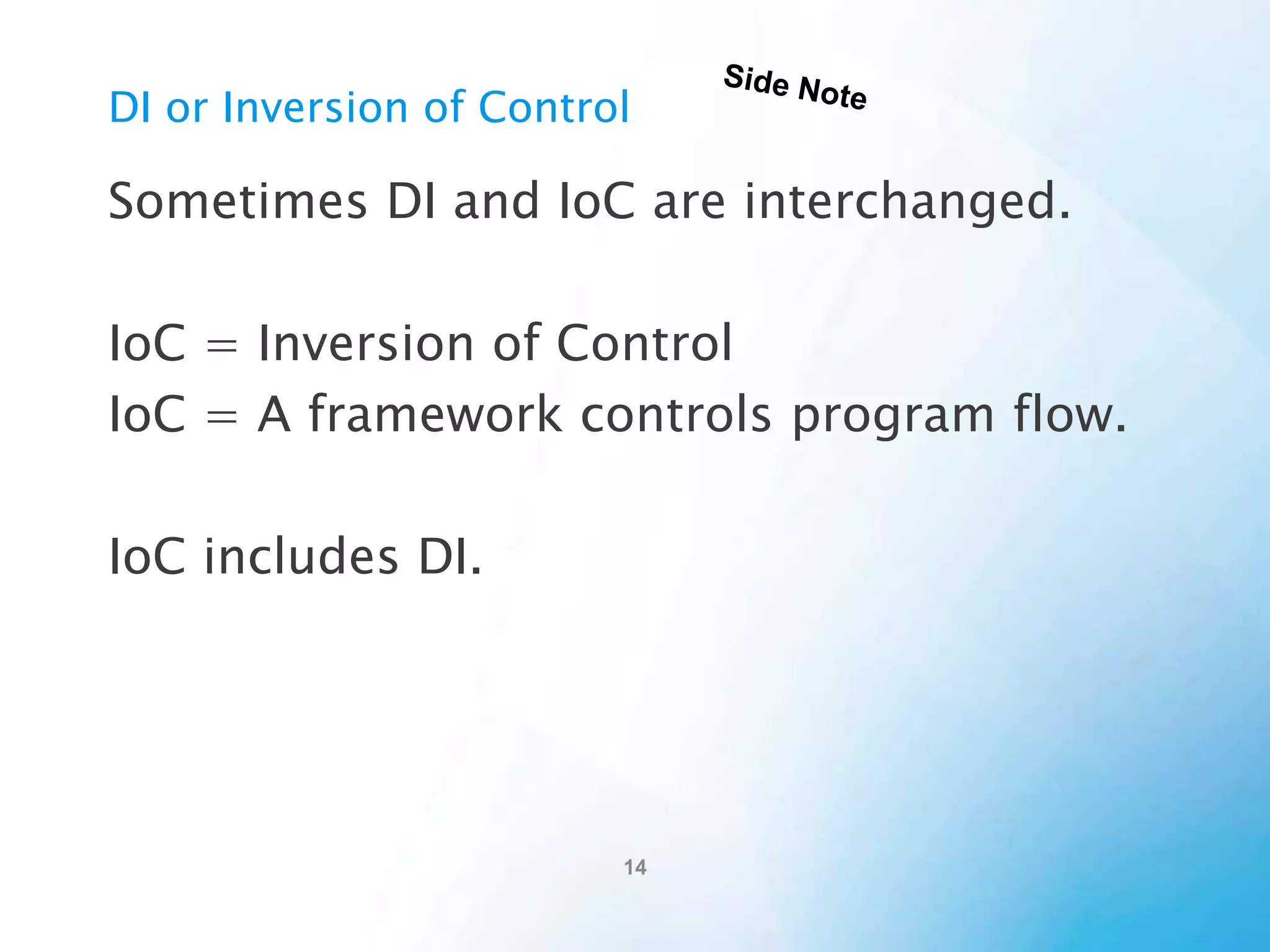
a)

InstancePerDependency

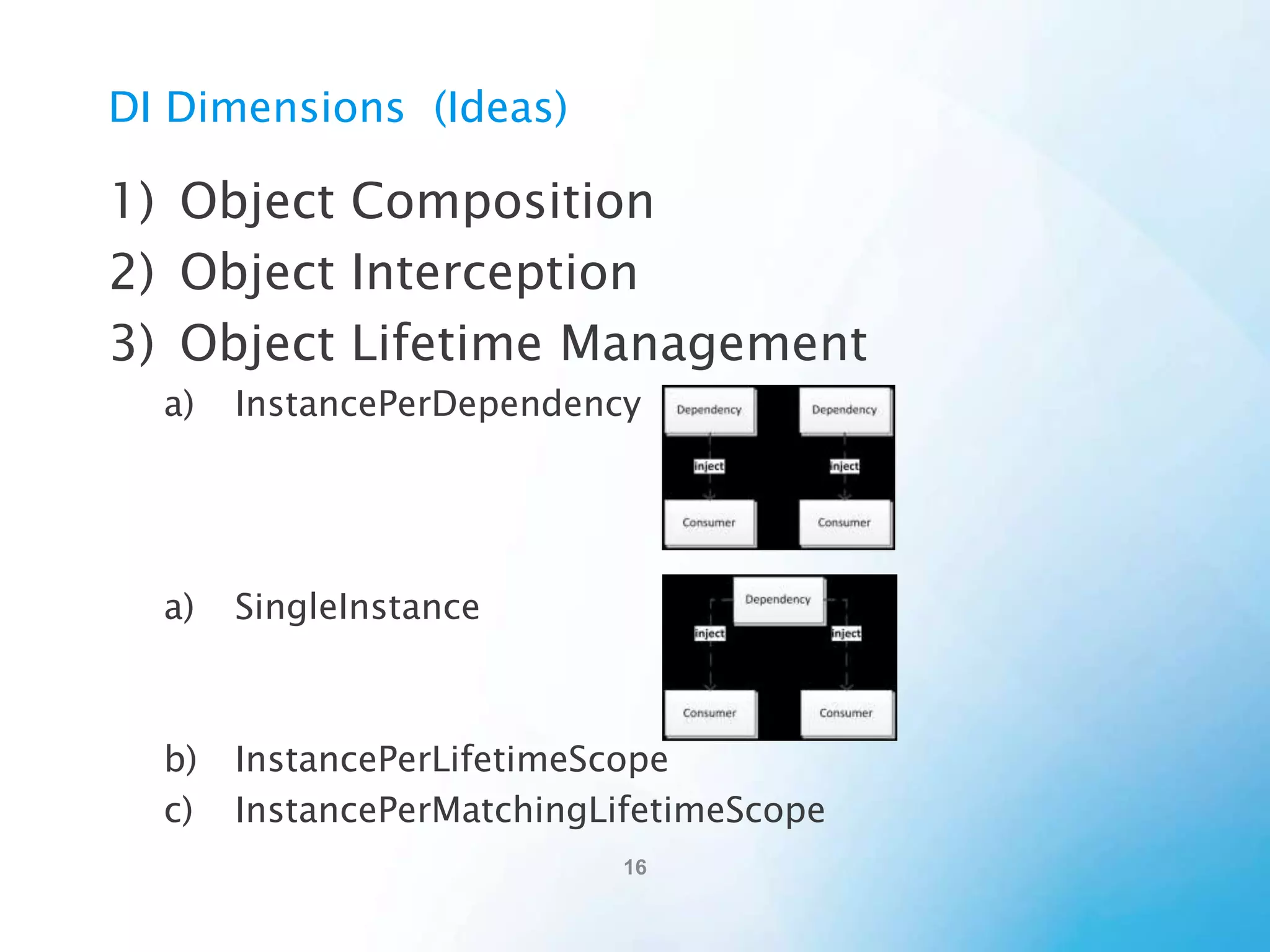
a)

SingleInstance

b)
c)

InstancePerLifetimeScope
InstancePerMatchingLifetimeScope
.NET DI Containers
There are many good choices (feel free to try others):
• Castle Windsor (Popular, but big. Good choice)
• Structure Map (Oldest [2004] .net DI container, popular)
• Spring.NET (port from Java, big learning curve)
• Unity (From Microsoft’s P&P team, solid but different)
• Ninject (Good, simple to use)
• Autofac (Most recent, based on C# 3, gaining popularity)
Plus about 10 other not-as-popular ones.
Autofac
• Get it: http://autofac.org or NuGet.
• What you get: a zip with binaries.
• Platforms: .NET 3.5 SP1, .NET 4, Silverlight 3 & 4, Windows
Phone 7.
• Cost? Free. It is open source.
• Help? http://autofac.org or StackOverflow
• ReSharper also really helps speed-up dev.
Autofac Integration
Autofac has additional packages for integration:
• ASP.NET WebForms
• ASP.NET MVC3
• WCF (Windows Communication Foundation)
• And others
Using Autofac
1) Develop your code using DI-friendly patterns
2) Configure Autofac
1)
2)

Create a ContainerBuilder
Add configuration.
•
Tell the ContainerBuilder your objects, and interfaces, and
lifetimes, etc.
3) Create a Container (from the ContainerBuilder)
4) Use the Container to resolve components (objects).
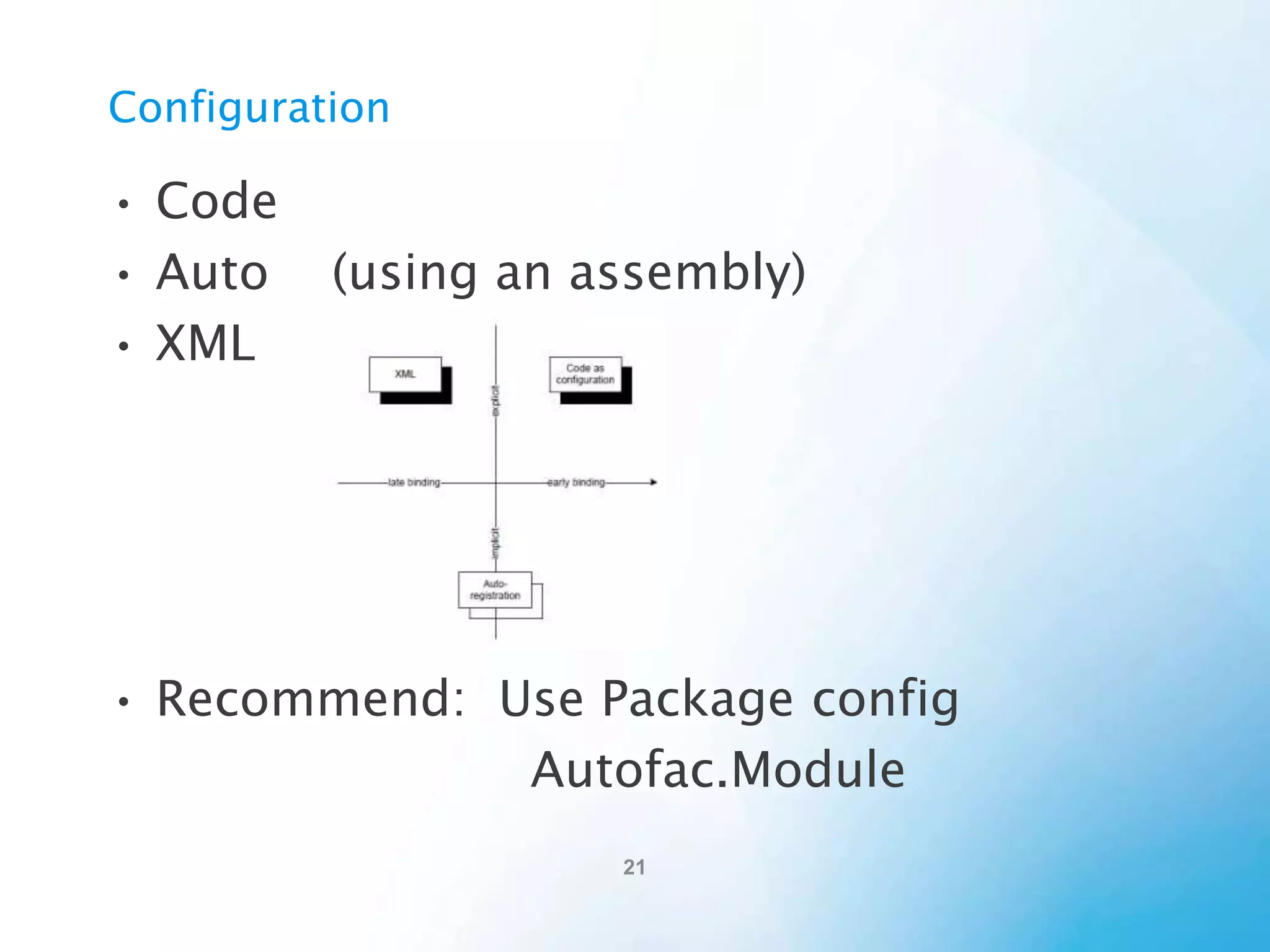
Configuration
• Code
• Auto (using an assembly)
• XML

Recommend: Use Package config Autofac.Module
Registering Dependencies in
Autofac
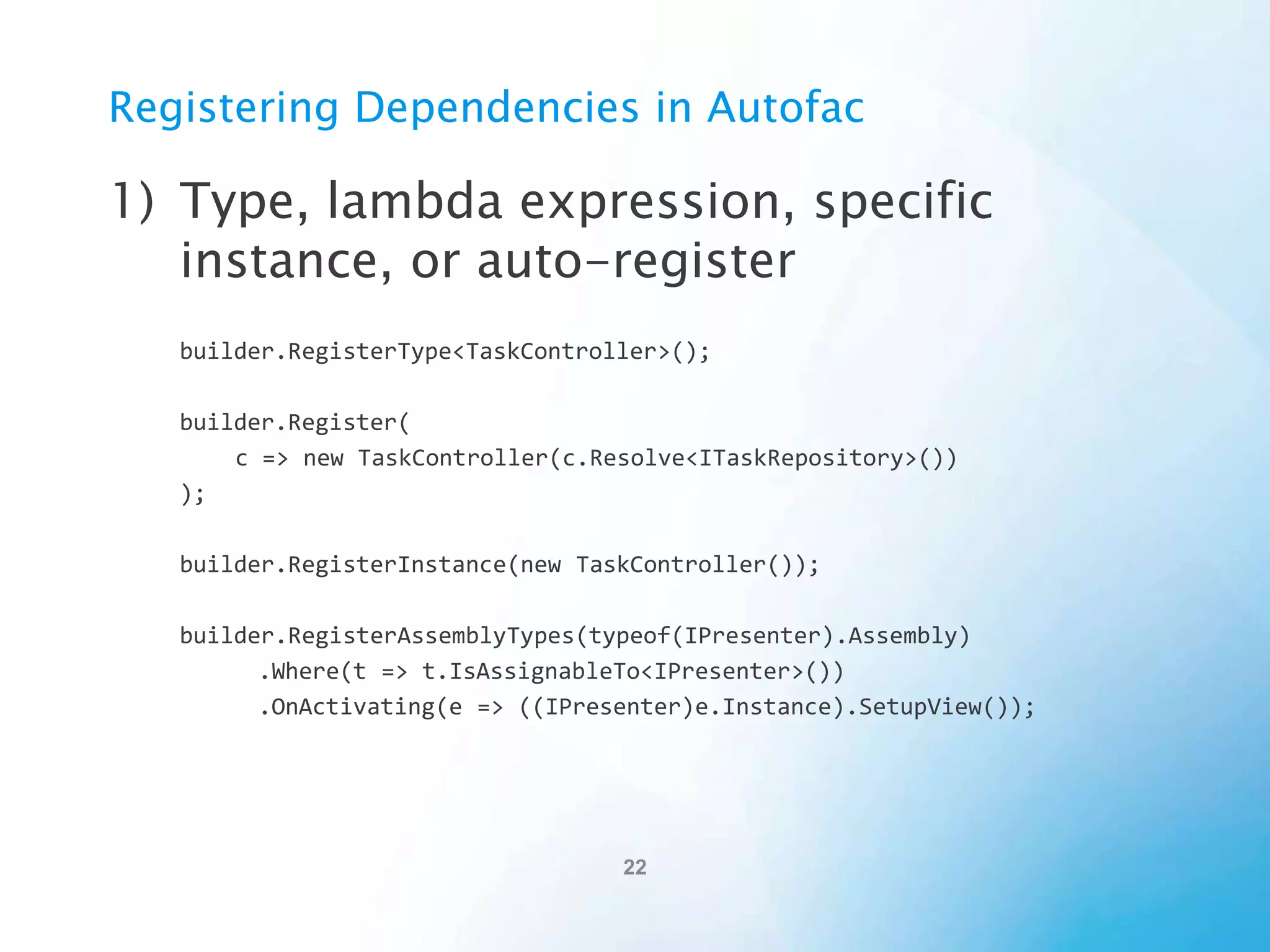
1) Type, lambda expression, specific instance, or
auto-register
builder.RegisterType<TaskController>();

builder.Register(
c => new TaskController(c.Resolve<ITaskRepository>())
);
builder.RegisterInstance(new TaskController());

builder.RegisterAssemblyTypes(typeof(IPresenter).Assembly)
.Where(t => t.IsAssignableTo<IPresenter>())
.OnActivating(e => ((IPresenter)e.Instance).SetupView());
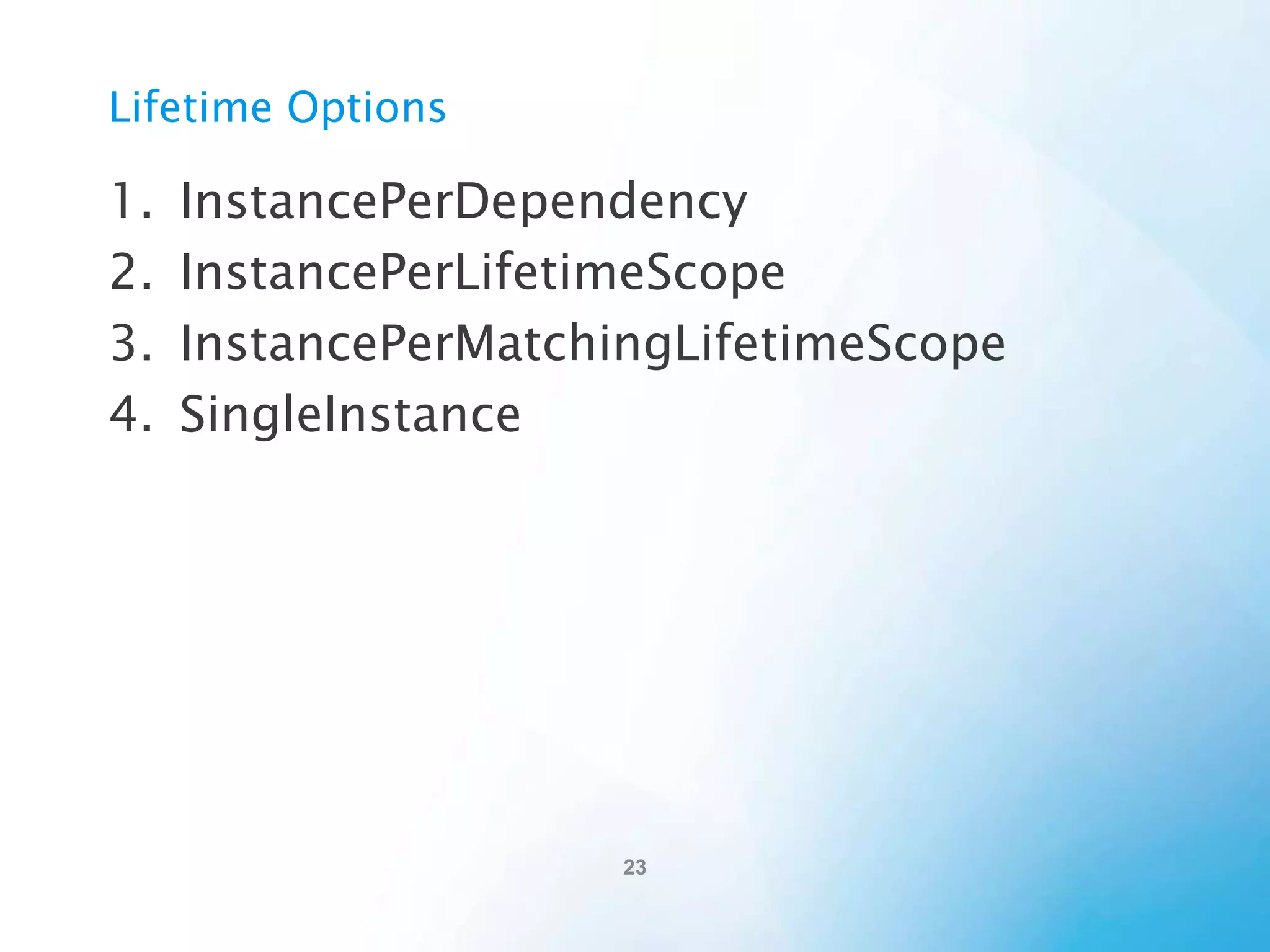
Lifetime Options
1.
2.
3.
4.

InstancePerDependency
InstancePerLifetimeScope
InstancePerMatchingLifetimeScope
SingleInstance
Applying Autofac
• Let’s see how we can use DI and Autofac on a
big project.
• First, how one might normally create the
project without using DI.
• Second, how to create it with DI.
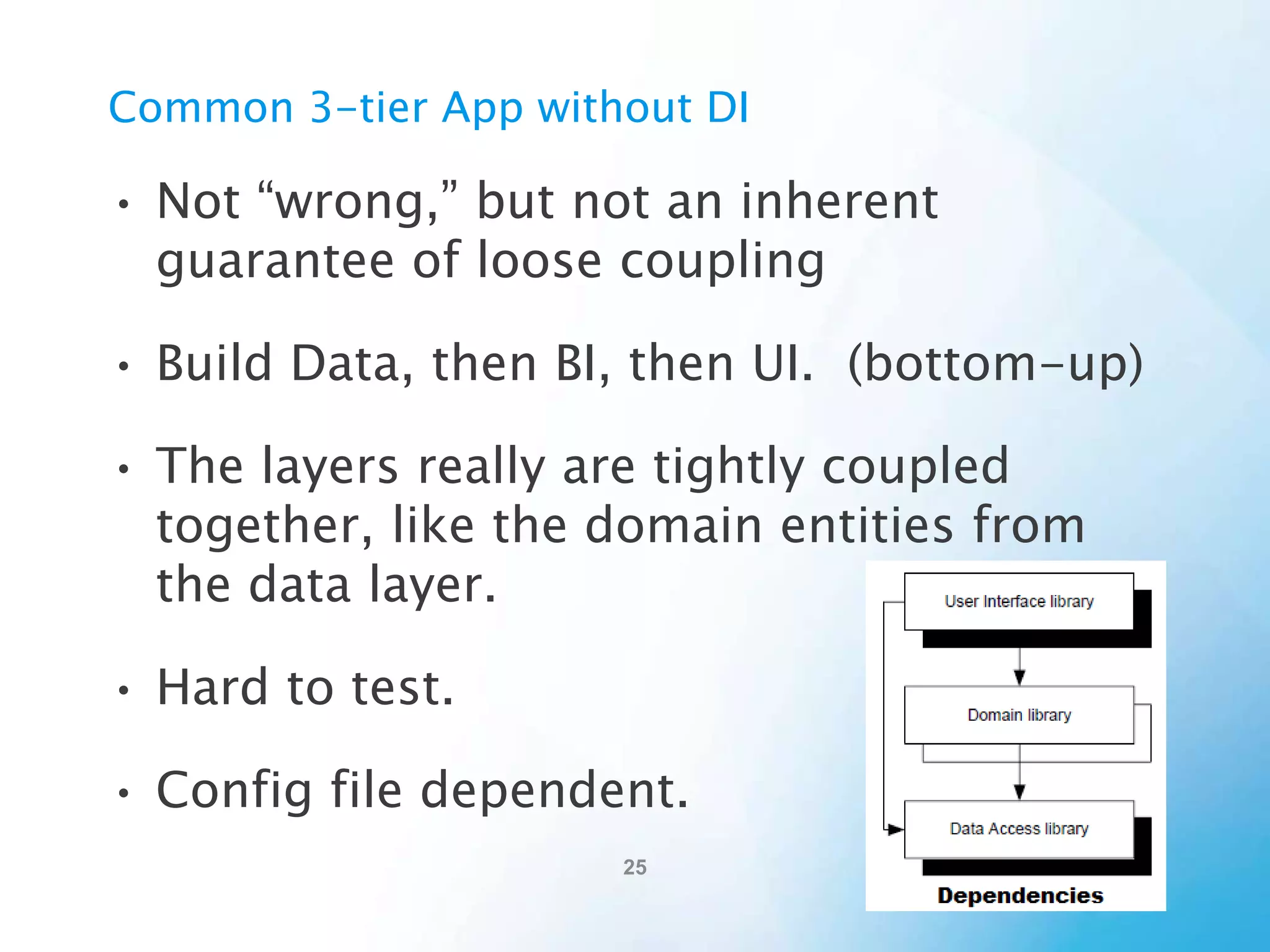
Common 3-tier App without DI
• Not “wrong,” but not an inherent guarantee of loose coupling
• Build Data, then BI, then UI. (bottom-up)
• The layers really are tightly coupled together, like the domain
entities from the data layer.
• Hard to test.

• Config file dependent.
Advanced Configurationg (for more
complex APIs)
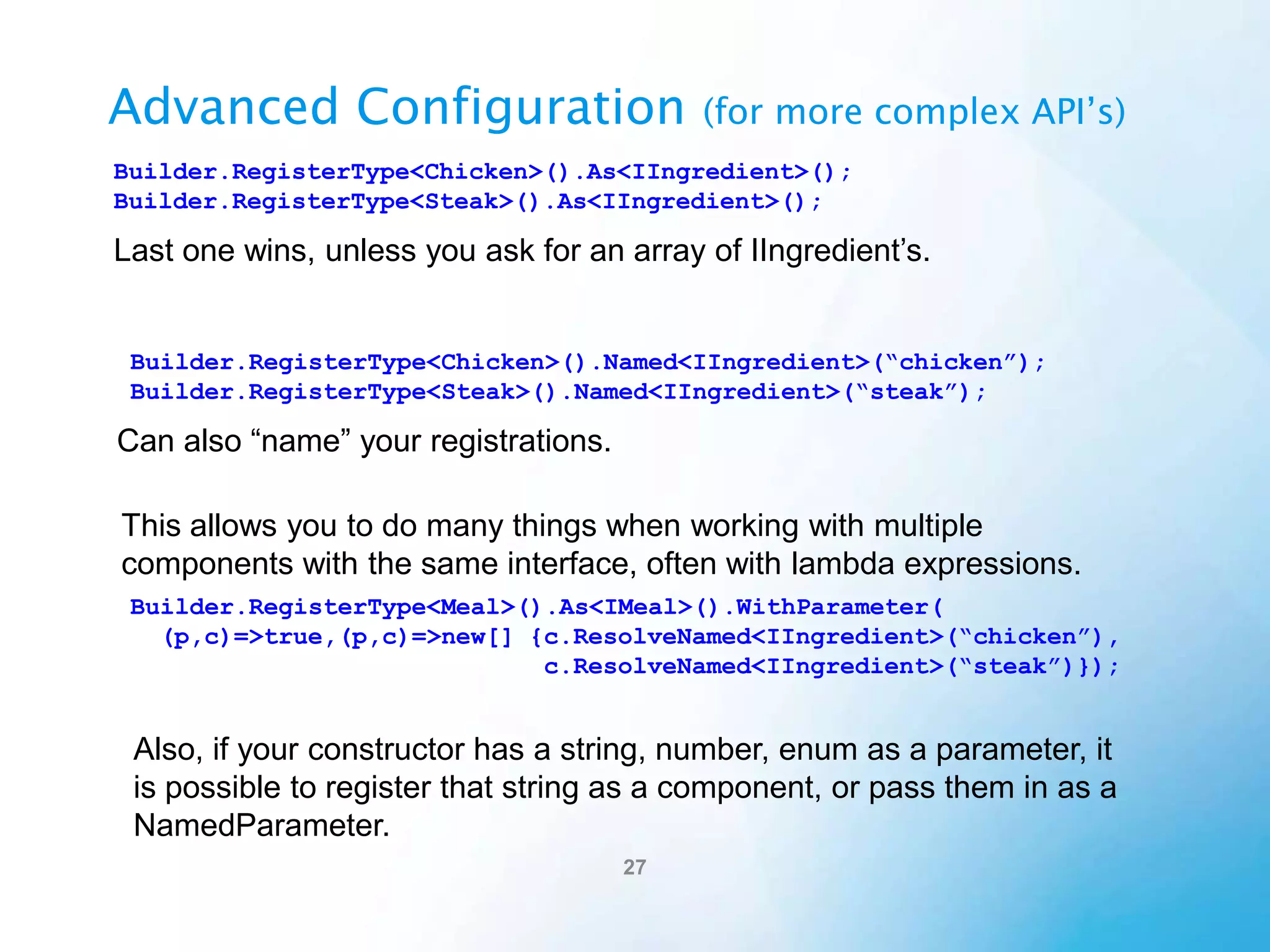
Builder.RegisterType<Chicken>().As<IIngredient>();
Builder.RegisterType<Steak>().As<IIngredient>();
Last one wins, unless you ask for an array of IIngredient’s.
Builder.RegisterType<Chicken>().Named<IIngredient>(“chicken”);
Builder.RegisterType<Steak>().Named<IIngredient>(“steak”);
Can also “name” your registrations.
This allows you to do many things when working with multiple components with the same
interface, often with lambda expressions.
Builder.RegisterType<Meal>().As<IMeal>().WithParameter(
(p,c)=>true,(p,c)=>new[] {c.ResolveNamed<IIngredient>(“chicken”),
c.ResolveNamed<IIngredient>(“steak”)});
Also, if your constructor has a string, number, enum as a parameter, it is possible to register that
string as a component, or pass them in as a NamedParameter.
Summary
• Use DI to enable loose coupling and to make code
more maintainable.
• DI is just a set of good patterns, like programming to
an interface.
• Using DI can change the way you code (for the
better) because of the good patterns.
• There are several DI tools to choose from and
Autofac is good choice.
• Use DI on your next project!
Resources
• Autofac.org

• Book: “Dependency Injection in .NET” by Mark
Seemann.

http://www.manning.com/seemann/

• Podcast with Autofac creator
http://www.dotnetrocks.com/default.aspx?showNum=450

• Advanced relationship types with Autofac
http://nblumhardt.com/2010/01/the-relationship-zoo/

• Stackoverflow.com
Dependency Injection and Autofac

Dependency Injection and Autofac

  • 1.
    Dependency Injection and Autofac By:Keith Schreiner & Jeff Benson
  • 2.
    Goals 1) Provide basicinfo about DI. 2) Get you excited to use DI. 3) Get you to recommend using a DI tool (like Autofac) on your next project.
  • 3.
    Why? DI enables loosecoupling, and loose coupling makes code more maintainable. Great for medium or big applications that need to be maintained. DI can change the way you write software. (Good) Instead of bottom-up, DI allows for top-down. (DB to UI) (UI to DB)
  • 4.
    Definition of DependencyInjection • A set of object-oriented software design principles & patterns that enable us to develop loosely coupled code, by passing or setting the dependencies of a program. • Instead of components having to request dependencies, they are given (injected) into the component. • (Sounds complex, but really isn’t.)
  • 5.
    Explain Dependency Injectionto a 5-year old When you go and get things out of the refrigerator for yourself, you can cause problems. You might leave the door open, you might get something Mommy or Daddy doesn't want you to have. You might even be looking for something we don't even have, or which has expired. What you should be doing is stating a need, "I need something to drink with lunch," and then we will make sure you have something when you sit down to eat. From John Munsch on Stack Overflow
  • 6.
    DI is aset of Design Patterns & Principles Making code more maintainable through loose coupling is the core motivation behind many classic design patterns (dating back to 1995 and the Gang of Four): Program to an interface, not an implementation
  • 7.
    Property Injection public partialclass SomeClass When a dependency is optional. { private ISomeInterface dependency; + Simple to understand. public ISomeInterface Dependency - But limited in its use. { get - Not simple to implement robustly. { if (this.dependency == null) this.Dependency = new DefaultSome(); return this.dependency; } set { if (value == null) throw new ArgumentNullException("value"); if (this.dependency != null) throw new InvalidOperationException(); this.dependency = value; } } public string DoSomething(string message) { return this.Dependency.DoStuff(message); }
  • 8.
    SOLID & DI S SingleResponsibility Principle • An object should have only a single responsibility. Open/Closed Principle O • Software entities should be open for extension, but closed for modification. Liskov Substitution Principle L • Objects in a program should be replaceable with instances of their subtypes without altering the correctness of that program. Interface Segregation Principle I • Many client specific interfaces are better than one general purpose interface. Dependency Inversion Principle D • One should depend on abstractions; do not depend upon concretions.
  • 9.
    Benefits of DI • • • • • • LateBinding Extensibility Parallel Development Maintainability Testability Code Structure – Interface Driven Development – All dependencies registered in one spot – Never have to write code to “new-up” objects.
  • 10.
    Negatives of DI •Learning curve. • Constructor code may look more complicated. • Code may seem “magical” for developers who do not know DI. • Is over-kill for very small projects. • Makes classes harder to re-use outside of a DI app.
  • 11.
    DI Myths • Notjust relevant for late binding. • Not just relevant for unit testing. • Is not just a Service Locator.
  • 12.
    DI or Inversionof Control Sometimes DI and IoC are interchanged. IoC = Inversion of Control IoC = A framework controls program flow. IoC includes DI.
  • 13.
    Example A “Hello World”or any small example will do a horrible job of showing off DI. But here it is… [Shipping with Weather] 1. 2. 3. 4. 5. Write some Interfaces Implement some classes. Class Foo : IFoo Create a class to load the modules In this loading-class, register and configure your classes In the startup of your program, register this loading-class
  • 14.
    DI Dimensions (Ideas) 1)Object Composition 2) Object Interception 3) Object Lifetime Management a) InstancePerDependency a) SingleInstance b) c) InstancePerLifetimeScope InstancePerMatchingLifetimeScope
  • 15.
    .NET DI Containers Thereare many good choices (feel free to try others): • Castle Windsor (Popular, but big. Good choice) • Structure Map (Oldest [2004] .net DI container, popular) • Spring.NET (port from Java, big learning curve) • Unity (From Microsoft’s P&P team, solid but different) • Ninject (Good, simple to use) • Autofac (Most recent, based on C# 3, gaining popularity) Plus about 10 other not-as-popular ones.
  • 16.
    Autofac • Get it:http://autofac.org or NuGet. • What you get: a zip with binaries. • Platforms: .NET 3.5 SP1, .NET 4, Silverlight 3 & 4, Windows Phone 7. • Cost? Free. It is open source. • Help? http://autofac.org or StackOverflow • ReSharper also really helps speed-up dev.
  • 17.
    Autofac Integration Autofac hasadditional packages for integration: • ASP.NET WebForms • ASP.NET MVC3 • WCF (Windows Communication Foundation) • And others
  • 18.
    Using Autofac 1) Developyour code using DI-friendly patterns 2) Configure Autofac 1) 2) Create a ContainerBuilder Add configuration. • Tell the ContainerBuilder your objects, and interfaces, and lifetimes, etc. 3) Create a Container (from the ContainerBuilder) 4) Use the Container to resolve components (objects).
  • 19.
    Configuration • Code • Auto(using an assembly) • XML Recommend: Use Package config Autofac.Module
  • 20.
    Registering Dependencies in Autofac 1)Type, lambda expression, specific instance, or auto-register builder.RegisterType<TaskController>(); builder.Register( c => new TaskController(c.Resolve<ITaskRepository>()) ); builder.RegisterInstance(new TaskController()); builder.RegisterAssemblyTypes(typeof(IPresenter).Assembly) .Where(t => t.IsAssignableTo<IPresenter>()) .OnActivating(e => ((IPresenter)e.Instance).SetupView());
  • 21.
  • 22.
    Applying Autofac • Let’ssee how we can use DI and Autofac on a big project. • First, how one might normally create the project without using DI. • Second, how to create it with DI.
  • 23.
    Common 3-tier Appwithout DI • Not “wrong,” but not an inherent guarantee of loose coupling • Build Data, then BI, then UI. (bottom-up) • The layers really are tightly coupled together, like the domain entities from the data layer. • Hard to test. • Config file dependent.
  • 24.
    Advanced Configurationg (formore complex APIs) Builder.RegisterType<Chicken>().As<IIngredient>(); Builder.RegisterType<Steak>().As<IIngredient>(); Last one wins, unless you ask for an array of IIngredient’s. Builder.RegisterType<Chicken>().Named<IIngredient>(“chicken”); Builder.RegisterType<Steak>().Named<IIngredient>(“steak”); Can also “name” your registrations. This allows you to do many things when working with multiple components with the same interface, often with lambda expressions. Builder.RegisterType<Meal>().As<IMeal>().WithParameter( (p,c)=>true,(p,c)=>new[] {c.ResolveNamed<IIngredient>(“chicken”), c.ResolveNamed<IIngredient>(“steak”)}); Also, if your constructor has a string, number, enum as a parameter, it is possible to register that string as a component, or pass them in as a NamedParameter.
  • 25.
    Summary • Use DIto enable loose coupling and to make code more maintainable. • DI is just a set of good patterns, like programming to an interface. • Using DI can change the way you code (for the better) because of the good patterns. • There are several DI tools to choose from and Autofac is good choice. • Use DI on your next project!
  • 26.
    Resources • Autofac.org • Book:“Dependency Injection in .NET” by Mark Seemann. http://www.manning.com/seemann/ • Podcast with Autofac creator http://www.dotnetrocks.com/default.aspx?showNum=450 • Advanced relationship types with Autofac http://nblumhardt.com/2010/01/the-relationship-zoo/ • Stackoverflow.com

Editor's Notes

  • #3 Keith does “Overview”Jeff dos “Goals”
  • #11 Jeff
  • #17 Jeff
  • #19 Jeff does the rest of these slides.