Building
Data
Pipelines
Jonathan Holloway @jph98
Pipeline
Concepts
What I’ll Cover Tonight...
Basic intro and history of pipelines
Some examples of pipelines
An overview of big data pipelines
Some AWS technologies for building pipelines
History of pipelines
Invented by Douglas Mcllroy
Pipes added to UNIX in 1973
ps -ef | grep java
Processes chained together by their standard
streams
Pipeline concept brought into software
development mainstream
First used this for a message extractor,
analyser and indexing solution circa 2009
Enterprise integration patterns went further
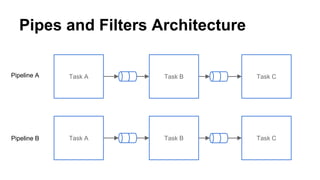
Pipes and Filters Architecture
Task B Task CTask A
Task B Task CTask A
Pipeline A
Pipeline B
Pipes and Filters Architecture
Why? What do we achieve?
Decoupling of tasks
Encapsulation of processing within a task
Reuse of tasks in different workflows possibly
Some Considerations
How do we specify a task?
How do we feed data between the tasks?
When do they run, how often?
Do they run in serial or parallel?
What happens in terms of a step failure?
Pipeline
Solutions
Your point and click, drag to connect
Specify inputs and outputs
Quite laborious IMHO
Lets take a look at some...
Graphical Pipelines
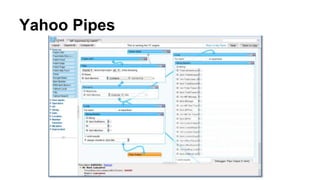
Yahoo Pipes
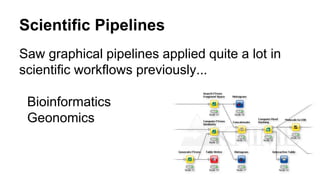
Saw graphical pipelines applied quite a lot in
scientific workflows previously...
Bioinformatics
Geonomics
Scientific Pipelines
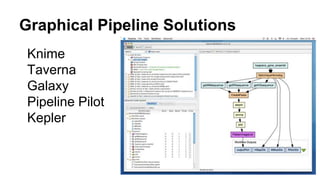
Knime
Taverna
Galaxy
Pipeline Pilot
Kepler
Graphical Pipeline Solutions
Nice, but generally found that:
People don’t like/want to work graphically with
pipelines, especially programmers
Still suitable for non-programmers who just want to
reuse past work though
Graphical Pipeline Summary
There’s some great lightweight solutions for
building pipelines in various languages:
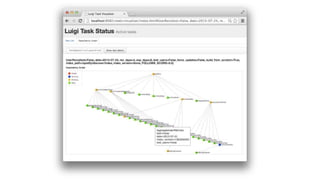
Luigi (Python)
Piecepipe (Ruby)
Spring Integration and Batch (Java)
Lightweight Pipeline Solutions
Seeing as this is Bristol Java Meetup…
there’s a number of (non hadoop) Java data
pipeline frameworks including:
NorthConcepts Data Pipeline
Java Data Processing Framework
Spring Batch (and Spring Integration)
Java Data Pipelines
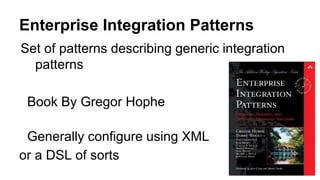
Set of patterns describing generic integration
patterns
Book By Gregor Hophe
Generally configure using XML
or a DSL of sorts
Enterprise Integration Patterns
EIP Implementations
Implementations exist:
Spring Integration
Camel
Nice way of abstracting out components
Somewhat leaky… control of fine grained
threading can be problematic
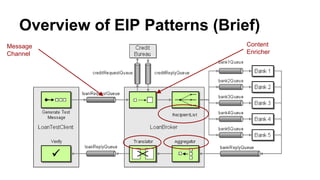
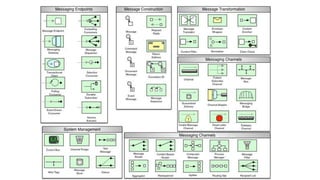
Overview of EIP Patterns (Brief)
Message
Channel
Content
Enricher
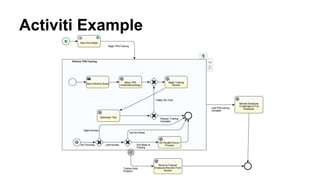
Another way to define a pipeline is as a
workflow with several connected steps
Store intermediate state in a database
JBPM
Activiti
Execute processes written in BPEL or BPMN
Workflow Engines
Activiti Example
Luigi (Python)
Luigi is used internally at Spotify to build
complex data pipelines
Supports Hadoop, Spark for data processing
Supports Hive, HDFS and a range of other
data sinks
class AggregateArtists(luigi.Task):
date_interval = luigi.DateIntervalParameter()
def run(self):
artist_count = defaultdict(int)
for input in self.input():
with input.open('r') as in_file:
for line in in_file:
timestamp, artist, track = line.strip().split()
artist_count[artist] += 1
with self.output().open('w') as out_file:
for artist, count in artist_count.iteritems():
print >> out_file, artist, count
Programmatic Example
Made up of a set of steps (contractive,
iterating, transforming)
Assembly Steps use hashes as their inputs
Piecepipe (Ruby)
PiecePipe::Pipeline.new.
source([{region: region}]).
step(FetchPowerPlantsByRegion).
step(FindWorstReactor).
step(DetermineStatusClass).
step(BuildPlantHealthSummary).
step(SortByRadiationLevelsDescending).
collect(:plant_health_summary).
to_enum
Piecepipe (Ruby)
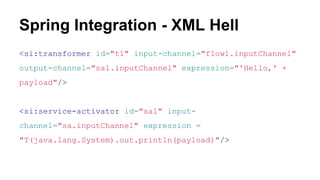
Spring Integration - XML Hell
<si:transformer id="t1" input-channel="flow1.inputChannel"
output-channel="sa1.inputChannel" expression="'Hello,' +
payload"/>
<si:service-activator id="sa1" input-
channel="sa.inputChannel" expression =
"T(java.lang.System).out.println(payload)"/>
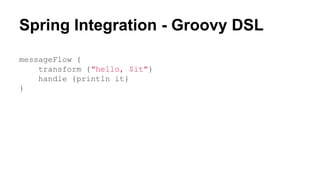
Spring Integration - Groovy DSL
messageFlow {
transform {"hello, $it"}
handle {println it}
}
Spring Batch
More suited to batch processing (as per the
name)
Specify the pipeline in XML or a DSL:
Job
Step, tasklets and chunks
Chunks refer to Spring beans
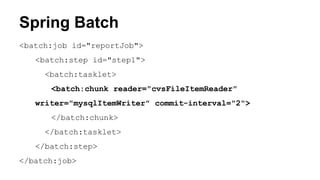
<batch:job id="reportJob">
<batch:step id="step1">
<batch:tasklet>
<batch:chunk reader="cvsFileItemReader"
writer="mysqlItemWriter" commit-interval="2">
</batch:chunk>
</batch:tasklet>
</batch:step>
</batch:job>
Spring Batch
Enterprise Service Bus
And it goes on and on...
I’m not covering this…
Camel, Mule yada yada
Write your Own?
Simplistic set of database tables, abstract
Step, Job and Workflow concepts
Link to scripts in Groovy/Clojure/JRuby for
dynamic
Store state in the filesystem, database or pass
hashmaps between the steps
Simples
Big Data
Pipelines
Everybody loves Big Data right?
There he is the
smiley bastard...
Big Data Pipelines
Pipelines we’ve seen so far
Generally serial - no good when we need to
shift large amounts of data around.
Better option is to parallelise the processing
In some of the cases before (e.g. Luigi) you
can shift processing to Hadoop, Storm etc...
Parallelising the data
Java works well here with a great concurrency
API, executor services, locks etc…
Cumbersome to write, we have to partition the
data correctly to begin with
Spring integration/batch helps with abstractions
Hadoop - map reduce
Hadoop is a good solution for shifting big data
Batch processing though - job startup time can
take minutes
Also it’s pretty cumbersome to write Hadoop
mappers/reducers in Java
Pig and Oozie
Fortunately we have some help
Pig is a SQL like language aimed at making
MapReduce jobs easier to write
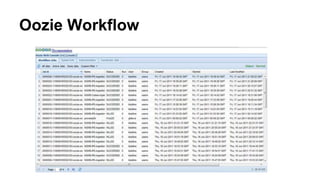
Oozie provides a way of building graphical
pipelines using Hadoop
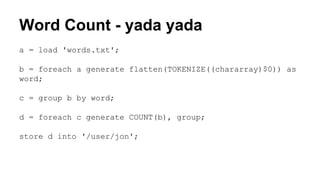
Word Count - yada yada
a = load 'words.txt';
b = foreach a generate flatten(TOKENIZE((chararray)$0)) as
word;
c = group b by word;
d = foreach c generate COUNT(b), group;
store d into '/user/jon';
Oozie Workflow
Hadoop Workflow
There’s lots more...
Netflix Linkedin Cascading Luigi
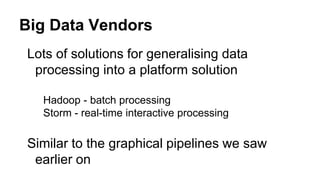
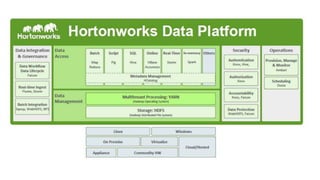
Big Data Vendors
Lots of solutions for generalising data
processing into a platform solution
Hadoop - batch processing
Storm - real-time interactive processing
Similar to the graphical pipelines we saw
earlier on
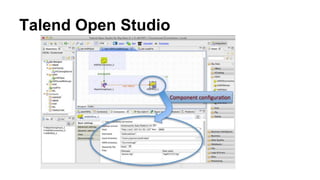
Talend Open Studio
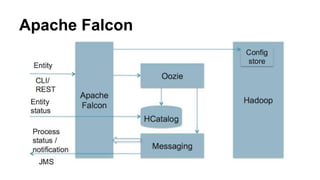
Apache Falcon
Apache Falcon - Data Processing
Apache Incubator project, 0.6 currently
Think of it as an open-source data
management platform
Late data handling, retry policies etc...
Colo and global aggregations
Cloud Pipelines
Amazon Web Service Components
We’re big users of AWS and components:
AWS RDS - main datastore
AWS Datapipe - basic ETL processes (log processing)
AWS DynamoDB - dead code analysis
AWS S3 - Log file source
Also use BigQuery to store large amounts of
parsed access logs
Amazon Web Service Components
AWS provides a number of tools for building
data pipelines
Some are packaged open-source tools
Useful when you don’t want to setup your own
infrastructure.
Not necessarily cheaper though
Google Pipeline Components
Google also has a set of components for
building data pipelines:
Cloud Dataflow - (AWS Data Pipeline)
Google Cloud Storage (AWS S3)
BigQuery - (AWS Redshift)
App Engine Pipeline API
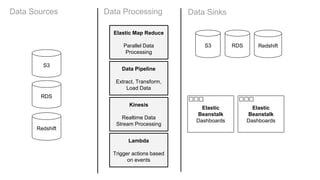
Lambda
Trigger actions based
on events
Elastic Map Reduce
Parallel Data
Processing
Data Pipeline
Extract, Transform,
Load Data
Kinesis
Realtime Data
Stream Processing
S3
RDS
Redshift
Data Sources Data Processing Data Sinks
S3 RDS Redshift
Elastic
Beanstalk
Dashboards
Elastic
Beanstalk
Dashboards
Elastic Map Reduce
Hadoopken...
Hadoop distro is Amazon’s own
Allows you to create a cluster with n nodes
Logs directly to S3
Security/Access through standard IAM
Elastic Map Reduce
Choice of applications to install in addition:
Various databases (Hive, HBase or Impala)
Pig - SQL like data processing
Hunk - Splunk analytics for Hadoop
Ganglia - for monitoring the cluster
Elastic Map Reduce
Bootstrap actions before Hadoop starts
Submit unit of work to the cluster:
Streaming program
Hive
Pig - can do streaming with this as well...
Impala
Custom JAR
Elastic Map Reduce
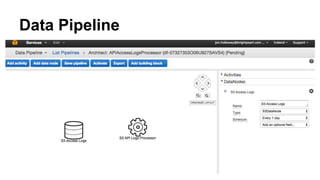
AWS Data Pipeline
Data Pipeline
Data Node - the source of our data
Amazon S3 Filesystem
MySQL, Redshift, Dynamo, SQL Data Node
Activity - processor
Shell Commands
Copy Command
EMR, Pig, Hive
Data Pipeline
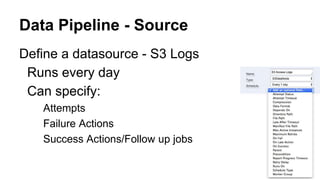
Define a datasource - S3 Logs
Runs every day
Can specify:
Attempts
Failure Actions
Success Actions/Follow up jobs
Data Pipeline - Source
Define a datasource - S3 Logs
Runs every day
Can specify:
Attempts
Failure Actions
Success Actions/Follow up jobs
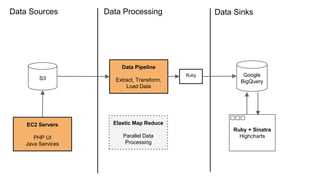
Data Pipeline - Source
Simple processor that specifies a Ruby script to
run to:
Read in files from S3
Parse the access log lines with universal-
access-log-parser (awesome)
Insert the results into a BigQuery table
Data Pipeline - Processor
Elastic Map Reduce
Parallel Data
Processing
Data Pipeline
Extract, Transform,
Load Data
S3
Data Sources Data Processing Data Sinks
Google
BigQuery
Ruby + Sinatra
Highcharts
EC2 Servers
PHP UI
Java Services
Ruby
AWS Kinesis
AWS Kinesis (Real Time Streaming)
Simple set of steps:
Ingestion of data (Producer)
Durable storage of data
Consumers do parallel processing
Only keeps 24 hours of data
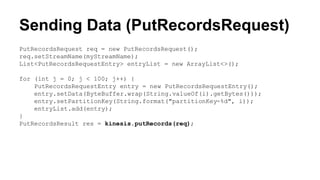
Sending Data (PutRecordsRequest)
PutRecordsRequest req = new PutRecordsRequest();
req.setStreamName(myStreamName);
List<PutRecordsRequestEntry> entryList = new ArrayList<>();
for (int j = 0; j < 100; j++) {
PutRecordsRequestEntry entry = new PutRecordsRequestEntry();
entry.setData(ByteBuffer.wrap(String.valueOf(i).getBytes()));
entry.setPartitionKey(String.format("partitionKey-%d", i));
entryList.add(entry);
}
PutRecordsResult res = kinesis.putRecords(req);
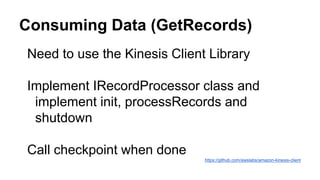
Consuming Data (GetRecords)
Need to use the Kinesis Client Library
Implement IRecordProcessor class and
implement init, processRecords and
shutdown
Call checkpoint when done
https://github.com/awslabs/amazon-kinesis-client
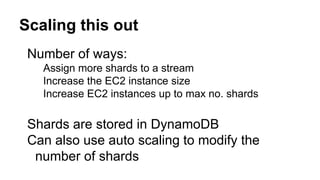
Scaling this out
Number of ways:
Assign more shards to a stream
Increase the EC2 instance size
Increase EC2 instances up to max no. shards
Shards are stored in DynamoDB
Can also use auto scaling to modify the
number of shards
Utilising Kinesis
Alternative to parsing your logs for various
metrics - these might be a day old
Real-time metrics information from various
sources:
Rate of orders being processed
Web application click stream data
Runs code in response to events
Data Events
Scheduled Events
External Events (sensors, alarms etc…)
Provision EC2 instances or AWS Containers
Auto scaling
AWS Lambda (Preview currently)
Sysadmin/Devops
AWS (S3, EC2, Dynamo, Data Pipeline) Ruby and Chef hackery
Senior/Mid Java Developers
Elasticsearch, RabbitMQ, Hazelcast, Spring
Solutions Architect
eCommerce experience
www.brightpearl.com/careers
Questions? Btw… we’re recruiting

Building data pipelines

  • 1.
  • 2.
  • 3.
    What I’ll CoverTonight... Basic intro and history of pipelines Some examples of pipelines An overview of big data pipelines Some AWS technologies for building pipelines
  • 4.
    History of pipelines Inventedby Douglas Mcllroy Pipes added to UNIX in 1973 ps -ef | grep java Processes chained together by their standard streams
  • 5.
    Pipeline concept broughtinto software development mainstream First used this for a message extractor, analyser and indexing solution circa 2009 Enterprise integration patterns went further Pipes and Filters Architecture
  • 6.
    Task B TaskCTask A Task B Task CTask A Pipeline A Pipeline B Pipes and Filters Architecture
  • 7.
    Why? What dowe achieve? Decoupling of tasks Encapsulation of processing within a task Reuse of tasks in different workflows possibly
  • 8.
    Some Considerations How dowe specify a task? How do we feed data between the tasks? When do they run, how often? Do they run in serial or parallel? What happens in terms of a step failure?
  • 9.
  • 10.
    Your point andclick, drag to connect Specify inputs and outputs Quite laborious IMHO Lets take a look at some... Graphical Pipelines
  • 11.
  • 12.
    Saw graphical pipelinesapplied quite a lot in scientific workflows previously... Bioinformatics Geonomics Scientific Pipelines
  • 13.
  • 14.
    Nice, but generallyfound that: People don’t like/want to work graphically with pipelines, especially programmers Still suitable for non-programmers who just want to reuse past work though Graphical Pipeline Summary
  • 15.
    There’s some greatlightweight solutions for building pipelines in various languages: Luigi (Python) Piecepipe (Ruby) Spring Integration and Batch (Java) Lightweight Pipeline Solutions
  • 16.
    Seeing as thisis Bristol Java Meetup… there’s a number of (non hadoop) Java data pipeline frameworks including: NorthConcepts Data Pipeline Java Data Processing Framework Spring Batch (and Spring Integration) Java Data Pipelines
  • 17.
    Set of patternsdescribing generic integration patterns Book By Gregor Hophe Generally configure using XML or a DSL of sorts Enterprise Integration Patterns
  • 18.
    EIP Implementations Implementations exist: SpringIntegration Camel Nice way of abstracting out components Somewhat leaky… control of fine grained threading can be problematic
  • 19.
    Overview of EIPPatterns (Brief) Message Channel Content Enricher
  • 21.
    Another way todefine a pipeline is as a workflow with several connected steps Store intermediate state in a database JBPM Activiti Execute processes written in BPEL or BPMN Workflow Engines
  • 22.
  • 23.
    Luigi (Python) Luigi isused internally at Spotify to build complex data pipelines Supports Hadoop, Spark for data processing Supports Hive, HDFS and a range of other data sinks
  • 24.
    class AggregateArtists(luigi.Task): date_interval =luigi.DateIntervalParameter() def run(self): artist_count = defaultdict(int) for input in self.input(): with input.open('r') as in_file: for line in in_file: timestamp, artist, track = line.strip().split() artist_count[artist] += 1 with self.output().open('w') as out_file: for artist, count in artist_count.iteritems(): print >> out_file, artist, count Programmatic Example
  • 26.
    Made up ofa set of steps (contractive, iterating, transforming) Assembly Steps use hashes as their inputs Piecepipe (Ruby)
  • 27.
  • 28.
    Spring Integration -XML Hell <si:transformer id="t1" input-channel="flow1.inputChannel" output-channel="sa1.inputChannel" expression="'Hello,' + payload"/> <si:service-activator id="sa1" input- channel="sa.inputChannel" expression = "T(java.lang.System).out.println(payload)"/>
  • 29.
    Spring Integration -Groovy DSL messageFlow { transform {"hello, $it"} handle {println it} }
  • 30.
    Spring Batch More suitedto batch processing (as per the name) Specify the pipeline in XML or a DSL: Job Step, tasklets and chunks Chunks refer to Spring beans
  • 31.
    <batch:job id="reportJob"> <batch:step id="step1"> <batch:tasklet> <batch:chunkreader="cvsFileItemReader" writer="mysqlItemWriter" commit-interval="2"> </batch:chunk> </batch:tasklet> </batch:step> </batch:job> Spring Batch
  • 32.
    Enterprise Service Bus Andit goes on and on... I’m not covering this… Camel, Mule yada yada
  • 33.
    Write your Own? Simplisticset of database tables, abstract Step, Job and Workflow concepts Link to scripts in Groovy/Clojure/JRuby for dynamic Store state in the filesystem, database or pass hashmaps between the steps
  • 34.
  • 35.
  • 36.
    Everybody loves BigData right? There he is the smiley bastard... Big Data Pipelines
  • 37.
    Pipelines we’ve seenso far Generally serial - no good when we need to shift large amounts of data around. Better option is to parallelise the processing In some of the cases before (e.g. Luigi) you can shift processing to Hadoop, Storm etc...
  • 38.
    Parallelising the data Javaworks well here with a great concurrency API, executor services, locks etc… Cumbersome to write, we have to partition the data correctly to begin with Spring integration/batch helps with abstractions
  • 39.
    Hadoop - mapreduce Hadoop is a good solution for shifting big data Batch processing though - job startup time can take minutes Also it’s pretty cumbersome to write Hadoop mappers/reducers in Java
  • 40.
    Pig and Oozie Fortunatelywe have some help Pig is a SQL like language aimed at making MapReduce jobs easier to write Oozie provides a way of building graphical pipelines using Hadoop
  • 41.
    Word Count -yada yada a = load 'words.txt'; b = foreach a generate flatten(TOKENIZE((chararray)$0)) as word; c = group b by word; d = foreach c generate COUNT(b), group; store d into '/user/jon';
  • 42.
  • 43.
    Hadoop Workflow There’s lotsmore... Netflix Linkedin Cascading Luigi
  • 44.
    Big Data Vendors Lotsof solutions for generalising data processing into a platform solution Hadoop - batch processing Storm - real-time interactive processing Similar to the graphical pipelines we saw earlier on
  • 46.
  • 47.
  • 48.
    Apache Falcon -Data Processing Apache Incubator project, 0.6 currently Think of it as an open-source data management platform Late data handling, retry policies etc... Colo and global aggregations
  • 49.
  • 50.
    Amazon Web ServiceComponents We’re big users of AWS and components: AWS RDS - main datastore AWS Datapipe - basic ETL processes (log processing) AWS DynamoDB - dead code analysis AWS S3 - Log file source Also use BigQuery to store large amounts of parsed access logs
  • 51.
    Amazon Web ServiceComponents AWS provides a number of tools for building data pipelines Some are packaged open-source tools Useful when you don’t want to setup your own infrastructure. Not necessarily cheaper though
  • 52.
    Google Pipeline Components Googlealso has a set of components for building data pipelines: Cloud Dataflow - (AWS Data Pipeline) Google Cloud Storage (AWS S3) BigQuery - (AWS Redshift) App Engine Pipeline API
  • 53.
    Lambda Trigger actions based onevents Elastic Map Reduce Parallel Data Processing Data Pipeline Extract, Transform, Load Data Kinesis Realtime Data Stream Processing S3 RDS Redshift Data Sources Data Processing Data Sinks S3 RDS Redshift Elastic Beanstalk Dashboards Elastic Beanstalk Dashboards
  • 54.
  • 55.
    Hadoopken... Hadoop distro isAmazon’s own Allows you to create a cluster with n nodes Logs directly to S3 Security/Access through standard IAM Elastic Map Reduce
  • 56.
    Choice of applicationsto install in addition: Various databases (Hive, HBase or Impala) Pig - SQL like data processing Hunk - Splunk analytics for Hadoop Ganglia - for monitoring the cluster Elastic Map Reduce
  • 57.
    Bootstrap actions beforeHadoop starts Submit unit of work to the cluster: Streaming program Hive Pig - can do streaming with this as well... Impala Custom JAR Elastic Map Reduce
  • 58.
  • 59.
    Data Pipeline Data Node- the source of our data Amazon S3 Filesystem MySQL, Redshift, Dynamo, SQL Data Node Activity - processor Shell Commands Copy Command EMR, Pig, Hive
  • 60.
  • 61.
    Define a datasource- S3 Logs Runs every day Can specify: Attempts Failure Actions Success Actions/Follow up jobs Data Pipeline - Source
  • 62.
    Define a datasource- S3 Logs Runs every day Can specify: Attempts Failure Actions Success Actions/Follow up jobs Data Pipeline - Source
  • 63.
    Simple processor thatspecifies a Ruby script to run to: Read in files from S3 Parse the access log lines with universal- access-log-parser (awesome) Insert the results into a BigQuery table Data Pipeline - Processor
  • 64.
    Elastic Map Reduce ParallelData Processing Data Pipeline Extract, Transform, Load Data S3 Data Sources Data Processing Data Sinks Google BigQuery Ruby + Sinatra Highcharts EC2 Servers PHP UI Java Services Ruby
  • 65.
  • 66.
    AWS Kinesis (RealTime Streaming) Simple set of steps: Ingestion of data (Producer) Durable storage of data Consumers do parallel processing Only keeps 24 hours of data
  • 67.
    Sending Data (PutRecordsRequest) PutRecordsRequestreq = new PutRecordsRequest(); req.setStreamName(myStreamName); List<PutRecordsRequestEntry> entryList = new ArrayList<>(); for (int j = 0; j < 100; j++) { PutRecordsRequestEntry entry = new PutRecordsRequestEntry(); entry.setData(ByteBuffer.wrap(String.valueOf(i).getBytes())); entry.setPartitionKey(String.format("partitionKey-%d", i)); entryList.add(entry); } PutRecordsResult res = kinesis.putRecords(req);
  • 68.
    Consuming Data (GetRecords) Needto use the Kinesis Client Library Implement IRecordProcessor class and implement init, processRecords and shutdown Call checkpoint when done https://github.com/awslabs/amazon-kinesis-client
  • 69.
    Scaling this out Numberof ways: Assign more shards to a stream Increase the EC2 instance size Increase EC2 instances up to max no. shards Shards are stored in DynamoDB Can also use auto scaling to modify the number of shards
  • 70.
    Utilising Kinesis Alternative toparsing your logs for various metrics - these might be a day old Real-time metrics information from various sources: Rate of orders being processed Web application click stream data
  • 71.
    Runs code inresponse to events Data Events Scheduled Events External Events (sensors, alarms etc…) Provision EC2 instances or AWS Containers Auto scaling AWS Lambda (Preview currently)
  • 72.
    Sysadmin/Devops AWS (S3, EC2,Dynamo, Data Pipeline) Ruby and Chef hackery Senior/Mid Java Developers Elasticsearch, RabbitMQ, Hazelcast, Spring Solutions Architect eCommerce experience www.brightpearl.com/careers Questions? Btw… we’re recruiting