SOLID -  OO DESIGN PRINCIPLES Andreas Enbohm, Capgemini
Agenda What is SOLID Design Principles? Code Examples  Q&A 26 augusti 2011 Sida
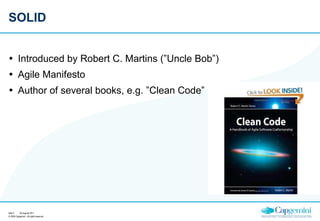
SOLID Introduced by Robert C. Martins (”Uncle Bob”) Agile Manifesto Author of several books, e.g. ”Clean Code” 26 augusti 2011 Sida
SOLID SOLID -  S ingle Responsibility Principle -  O pen Closed Principle -  L iskov Substitution Principle -  I nterface Segregation Principle -  D ependency Inverison Principle Code becomes more  Testably  (remember TDD is not only about testing, more important its about Design) Apply ’smart’ - don’t do stuff ’just because of’ - very importad to see the context of the program/code when applying SOLID - Joel On Software advise – use with common sense! 26 augusti 2011 Sida
Single  Responsibility  Principle "There should never be more than one reason for a class to change." — Robert Martin, SRP paper linked from  The Principles of OOD My translation: A class should concentrate on doing one thing and one thing only 26 augusti 2011 Sida
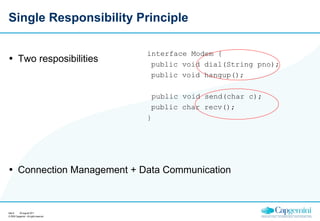
Single Responsibility Principle Two resposibilities Connection Management + Data Communication 26 augusti 2011 Sida  interface Modem { public void dial(String pno); public void hangup(); public void send(char c); public char recv(); }
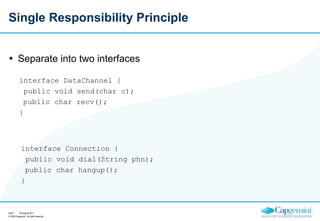
Single Responsibility Principle Separate into two interfaces 26 augusti 2011 Sida  interface DataChannel { public void send(char c); public char recv(); } interface Connection { public void dial(String phn); public char hangup(); }
Open Closed Principle "Software entities (classes, modules, functions, etc.) should be open for extension, but closed for modification." — Robert Martin paraphrasing Bertrand Meyer, OCP paper linked from  The Principles of OOD My translation: Change a class' behavior using inheritance and composition 26 augusti 2011 Sida
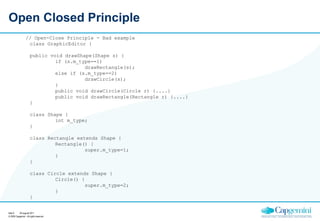
Open Closed Principle 26 augusti 2011 Sida  // Open-Close Principle - Bad example class GraphicEditor { public void drawShape(Shape s) { if (s.m_type==1) drawRectangle(s); else if (s.m_type==2) drawCircle(s); } public void drawCircle(Circle r) {....} public void drawRectangle(Rectangle r) {....} } class Shape { int m_type; } class Rectangle extends Shape { Rectangle() { super.m_type=1; } } class Circle extends Shape { Circle() { super.m_type=2; } }
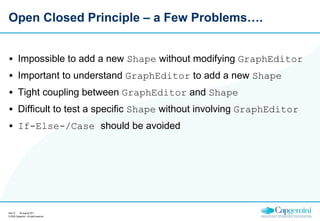
Open Closed Principle – a Few Problems…. Impossible to add a new  Shape  without modifying  GraphEditor Important to understand  GraphEditor  to add a new  Shape Tight coupling between  GraphEditor  and  Shape Difficult to test a specific  Shape  without involving  GraphEditor If-Else-/Case  should be avoided  26 augusti 2011 Sida
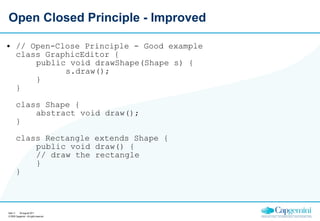
Open Closed Principle - Improved // Open-Close Principle - Good example class GraphicEditor { public void drawShape(Shape s) { s.draw(); } } class Shape { abstract void draw(); } class Rectangle extends Shape { public void draw() { // draw the rectangle } }  26 augusti 2011 Sida
Liskov Substitution Principle "Functions that use pointers or references to base classes must be able to use objects of derived classes without knowing it." — Robert Martin, LSP paper linked from  The Principles of OOD My translation: Subclasses should behave nicely when used in place of their base class 26 augusti 2011 Sida
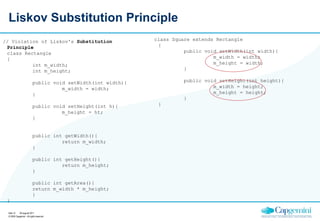
Liskov Substitution Principle 26 augusti 2011 Sida  // Violation of Liskov's  Substitution   Principle class Rectangle { int m_width; int m_height; public void setWidth(int width){ m_width = width; } public void setHeight(int h){ m_height = ht; } public int getWidth(){ return m_width; } public int getHeight(){ return m_height; } public int getArea(){ return m_width * m_height; }  } class Square extends Rectangle  { public void setWidth(int width){ m_width = width; m_height = width; } public void setHeight(int height){ m_width = height; m_height = height; } }
Liskov Substitution Principle class LspTest { private static Rectangle getNewRectangle() { // it can be an object returned by some factory ...  return new Square(); } public static void main (String args[]) { Rectangle r = LspTest.getNewRectangle(); r.setWidth(5); r.setHeight(10); // user knows that r it's a rectangle. It assumes that he's able to set the width and height as for the base class System.out.println(r.getArea()); // now he's surprised to see that the area is 100 instead of 50. } }  26 augusti 2011 Sida
Interface Segregation Principle "Clients should not be forced to depend upon interfaces that they do not use." — Robert Martin, ISP paper linked from  The Principles of OOD My translation: Keep interfaces small 26 augusti 2011 Sida
Interface Segregation Principle Don’t force classes so implement methods they can’t (Swing/Java) Don’t pollute interfaces with a lot of methods Avoid ’fat’ interfaces 26 augusti 2011 Sida
Interface Segregation Principle 26 augusti 2011 Sida  //bad example (polluted interface) interface Worker { void work(); void eat(); } ManWorker implements Worker { void work() {…}; void eat() {30 min break;}; } RobotWorker implements Worker { void work() {…}; void eat() {//Not Appliciable  for a RobotWorker}; }
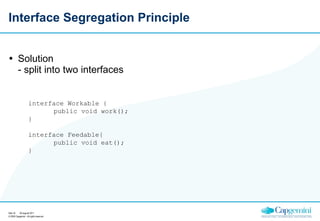
Interface Segregation Principle Solution - split into two interfaces 26 augusti 2011 Sida  interface Workable { public void work(); } interface Feedable{ public void eat(); }
Dependency Inversion Principle "A. High level modules should not depend upon low level modules. Both should depend upon abstractions. B. Abstractions should not depend upon details. Details should depend upon abstractions." — Robert Martin, DIP paper linked from  The Principles of OOD My translation: Use lots of interfaces and abstractions 26 augusti 2011 Sida
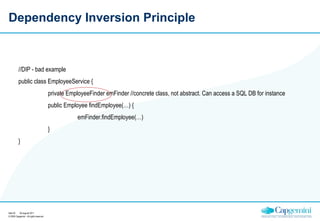
Dependency Inversion Principle 26 augusti 2011 Sida  //DIP - bad example public class EmployeeService { private EmployeeFinder emFinder //concrete class, not abstract. Can access a SQL DB for instance public Employee findEmployee(…) { emFinder.findEmployee(…) } }
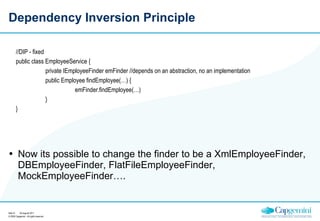
Dependency Inversion Principle Now its possible to change the finder to be a XmlEmployeeFinder, DBEmployeeFinder, FlatFileEmployeeFinder, MockEmployeeFinder…. 26 augusti 2011 Sida  //DIP - fixed public class EmployeeService { private IEmployeeFinder emFinder //depends on an abstraction, no an implementation public Employee findEmployee(…) { emFinder.findEmployee(…) } }
Q&A http://butunclebob.com/ArticleS.UncleBob.PrinciplesOfOod http://www.oodesign.com http://www.slideshare.net/enbohm Twitter: enbohm 26 augusti 2011 Sida

SOLID Design Principles

  • 1.
    SOLID - OO DESIGN PRINCIPLES Andreas Enbohm, Capgemini
  • 2.
    Agenda What isSOLID Design Principles? Code Examples Q&A 26 augusti 2011 Sida
  • 3.
    SOLID Introduced byRobert C. Martins (”Uncle Bob”) Agile Manifesto Author of several books, e.g. ”Clean Code” 26 augusti 2011 Sida
  • 4.
    SOLID SOLID - S ingle Responsibility Principle - O pen Closed Principle - L iskov Substitution Principle - I nterface Segregation Principle - D ependency Inverison Principle Code becomes more Testably (remember TDD is not only about testing, more important its about Design) Apply ’smart’ - don’t do stuff ’just because of’ - very importad to see the context of the program/code when applying SOLID - Joel On Software advise – use with common sense! 26 augusti 2011 Sida
  • 5.
    Single Responsibility Principle "There should never be more than one reason for a class to change." — Robert Martin, SRP paper linked from The Principles of OOD My translation: A class should concentrate on doing one thing and one thing only 26 augusti 2011 Sida
  • 6.
    Single Responsibility PrincipleTwo resposibilities Connection Management + Data Communication 26 augusti 2011 Sida interface Modem { public void dial(String pno); public void hangup(); public void send(char c); public char recv(); }
  • 7.
    Single Responsibility PrincipleSeparate into two interfaces 26 augusti 2011 Sida interface DataChannel { public void send(char c); public char recv(); } interface Connection { public void dial(String phn); public char hangup(); }
  • 8.
    Open Closed Principle"Software entities (classes, modules, functions, etc.) should be open for extension, but closed for modification." — Robert Martin paraphrasing Bertrand Meyer, OCP paper linked from The Principles of OOD My translation: Change a class' behavior using inheritance and composition 26 augusti 2011 Sida
  • 9.
    Open Closed Principle26 augusti 2011 Sida // Open-Close Principle - Bad example class GraphicEditor { public void drawShape(Shape s) { if (s.m_type==1) drawRectangle(s); else if (s.m_type==2) drawCircle(s); } public void drawCircle(Circle r) {....} public void drawRectangle(Rectangle r) {....} } class Shape { int m_type; } class Rectangle extends Shape { Rectangle() { super.m_type=1; } } class Circle extends Shape { Circle() { super.m_type=2; } }
  • 10.
    Open Closed Principle– a Few Problems…. Impossible to add a new Shape without modifying GraphEditor Important to understand GraphEditor to add a new Shape Tight coupling between GraphEditor and Shape Difficult to test a specific Shape without involving GraphEditor If-Else-/Case should be avoided 26 augusti 2011 Sida
  • 11.
    Open Closed Principle- Improved // Open-Close Principle - Good example class GraphicEditor { public void drawShape(Shape s) { s.draw(); } } class Shape { abstract void draw(); } class Rectangle extends Shape { public void draw() { // draw the rectangle } } 26 augusti 2011 Sida
  • 12.
    Liskov Substitution Principle"Functions that use pointers or references to base classes must be able to use objects of derived classes without knowing it." — Robert Martin, LSP paper linked from The Principles of OOD My translation: Subclasses should behave nicely when used in place of their base class 26 augusti 2011 Sida
  • 13.
    Liskov Substitution Principle26 augusti 2011 Sida // Violation of Liskov's Substitution Principle class Rectangle { int m_width; int m_height; public void setWidth(int width){ m_width = width; } public void setHeight(int h){ m_height = ht; } public int getWidth(){ return m_width; } public int getHeight(){ return m_height; } public int getArea(){ return m_width * m_height; } } class Square extends Rectangle { public void setWidth(int width){ m_width = width; m_height = width; } public void setHeight(int height){ m_width = height; m_height = height; } }
  • 14.
    Liskov Substitution Principleclass LspTest { private static Rectangle getNewRectangle() { // it can be an object returned by some factory ... return new Square(); } public static void main (String args[]) { Rectangle r = LspTest.getNewRectangle(); r.setWidth(5); r.setHeight(10); // user knows that r it's a rectangle. It assumes that he's able to set the width and height as for the base class System.out.println(r.getArea()); // now he's surprised to see that the area is 100 instead of 50. } } 26 augusti 2011 Sida
  • 15.
    Interface Segregation Principle"Clients should not be forced to depend upon interfaces that they do not use." — Robert Martin, ISP paper linked from The Principles of OOD My translation: Keep interfaces small 26 augusti 2011 Sida
  • 16.
    Interface Segregation PrincipleDon’t force classes so implement methods they can’t (Swing/Java) Don’t pollute interfaces with a lot of methods Avoid ’fat’ interfaces 26 augusti 2011 Sida
  • 17.
    Interface Segregation Principle26 augusti 2011 Sida //bad example (polluted interface) interface Worker { void work(); void eat(); } ManWorker implements Worker { void work() {…}; void eat() {30 min break;}; } RobotWorker implements Worker { void work() {…}; void eat() {//Not Appliciable for a RobotWorker}; }
  • 18.
    Interface Segregation PrincipleSolution - split into two interfaces 26 augusti 2011 Sida interface Workable { public void work(); } interface Feedable{ public void eat(); }
  • 19.
    Dependency Inversion Principle"A. High level modules should not depend upon low level modules. Both should depend upon abstractions. B. Abstractions should not depend upon details. Details should depend upon abstractions." — Robert Martin, DIP paper linked from The Principles of OOD My translation: Use lots of interfaces and abstractions 26 augusti 2011 Sida
  • 20.
    Dependency Inversion Principle26 augusti 2011 Sida //DIP - bad example public class EmployeeService { private EmployeeFinder emFinder //concrete class, not abstract. Can access a SQL DB for instance public Employee findEmployee(…) { emFinder.findEmployee(…) } }
  • 21.
    Dependency Inversion PrincipleNow its possible to change the finder to be a XmlEmployeeFinder, DBEmployeeFinder, FlatFileEmployeeFinder, MockEmployeeFinder…. 26 augusti 2011 Sida //DIP - fixed public class EmployeeService { private IEmployeeFinder emFinder //depends on an abstraction, no an implementation public Employee findEmployee(…) { emFinder.findEmployee(…) } }
  • 22.
    Q&A http://butunclebob.com/ArticleS.UncleBob.PrinciplesOfOod http://www.oodesign.comhttp://www.slideshare.net/enbohm Twitter: enbohm 26 augusti 2011 Sida