
SOLID DOSAGE FORMS
By
Mrs. Sandhya R. Lanke, Lecturer
SJVPM’S Rasiklal. M. Dhariwal
College of Pharmacy,
Chinchwad, Pune
LEARNING OUTCOMES
1. Define powders
2. Discuss types of powders
3. List advantages and disadvantages of powders
After watching this presentation you will be able to;
Mixture of finely divided drug or chemicals in dry form
They are used internally or externally
They are available in crystalline or amorphous form
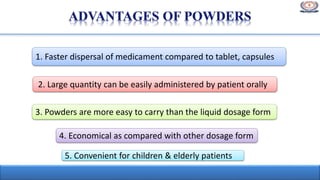
1. Faster dispersal of medicament compared to tablet, capsules
5. Convenient for children & elderly patients
2. Large quantity can be easily administered by patient orally
3. Powders are more easy to carry than the liquid dosage form
4. Economical as compared with other dosage form
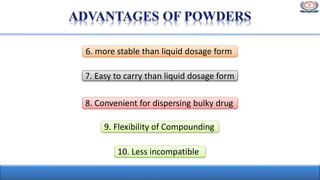
10. Less incompatible
8. Convenient for dispersing bulky drug
6. more stable than liquid dosage form
9. Flexibility of Compounding
7. Easy to carry than liquid dosage form
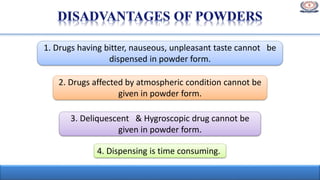
1. Drugs having bitter, nauseous, unpleasant taste cannot be
dispensed in powder form.
2. Drugs affected by atmospheric condition cannot be
given in powder form.
4. Dispensing is time consuming.
3. Deliquescent & Hygroscopic drug cannot be
given in powder form.
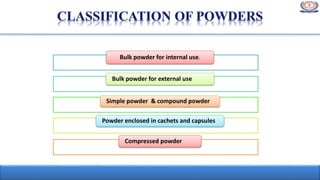
Bulk powder for internal use.
Bulk powder for external use
Simple powder & compound powder
Powder enclosed in cachets and capsules
Compressed powder
 When accuracy of dosage form is not important at that time
powders are dispensed in bulk form.
 Bulk powder contains several doses of powder.
 They are supplied in wide-mouthed containers
 Ex. Laxative powder, Antacid Powder
 Bulk powder for external use are non potent substance.
 These powders are supplied in cardboard,
glass or plastic containers, designed for
the specific method of application.
 Ex. Dusting Powders, Insufflations,
Snuffs, Dentifrices
DUSTING POWDERS
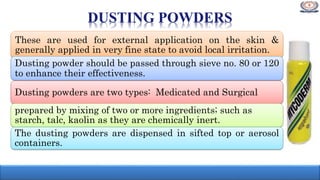
These are used for external application on the skin &
generally applied in very fine state to avoid local irritation.
Dusting powder should be passed through sieve no. 80 or 120
to enhance their effectiveness.
Dusting powders are two types: Medicated and Surgical
prepared by mixing of two or more ingredients; such as
starch, talc, kaolin as they are chemically inert.
The dusting powders are dispensed in sifted top or aerosol
containers.
• Medicated Dusting Powders
• Used mainly for superficial
skin
• Must be free from pathogenic
micro organisms.
• Uses : Antiseptic, Astringent,
Absorbent, Antiperspirant
and Antipruritic
• Surgical Dusting Powders
• Used in body cavities and also
on major wounds due to Burns
and on umbilical cords of
infants.
• Must be sterilized before their
use by dry heat sterilization
method at 1600 C for 2 hrs.
• Used as Lubricant, Protective,
Astringents, Antiseptic
DUSTING POWDERS
DUSTING POWDERS
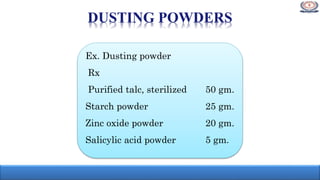
Ex. Dusting powder
Rx
Purified talc, sterilized 50 gm.
Starch powder 25 gm.
Zinc oxide powder 20 gm.
Salicylic acid powder 5 gm.
INSUFFLATIONS
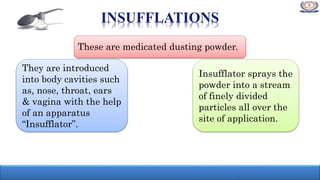
These are medicated dusting powder.
They are introduced
into body cavities such
as, nose, throat, ears
& vagina with the help
of an apparatus
“Insufflator”.
Insufflator sprays the
powder into a stream
of finely divided
particles all over the
site of application.
INSUFFLATIONS
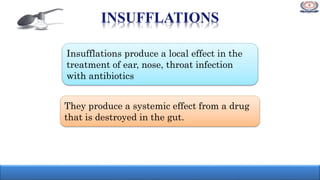
They produce a systemic effect from a drug
that is destroyed in the gut.
Insufflations produce a local effect in the
treatment of ear, nose, throat infection
with antibiotics
SNUFFS
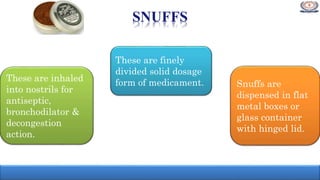
These are finely
divided solid dosage
form of medicament.These are inhaled
into nostrils for
antiseptic,
bronchodilator &
decongestion
action.
Snuffs are
dispensed in flat
metal boxes or
glass container
with hinged lid.
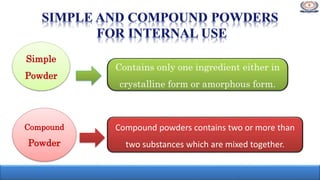
Contains only one ingredient either in
crystalline form or amorphous form.
Compound powders contains two or more than
two substances which are mixed together.
Simple
Powder
Compound
Powder
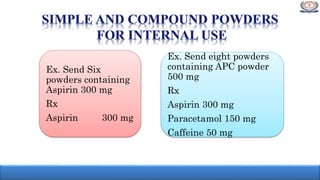
Ex. Send Six
powders containing
Aspirin 300 mg
Rx
Aspirin 300 mg
Ex. Send eight powders
containing APC powder
500 mg
Rx
Aspirin 300 mg
Paracetamol 150 mg
Caffeine 50 mg
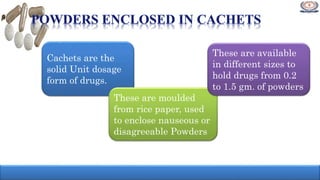
Cachets are the
solid Unit dosage
form of drugs.
These are moulded
from rice paper, used
to enclose nauseous or
disagreeable Powders
These are available
in different sizes to
hold drugs from 0.2
to 1.5 gm. of powders
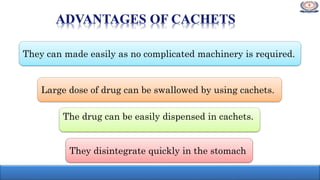
They can made easily as no complicated machinery is required.
They disintegrate quickly in the stomach
The drug can be easily dispensed in cachets.
Large dose of drug can be swallowed by using cachets.
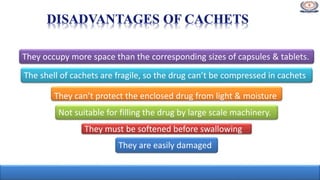
The shell of cachets are fragile, so the drug can’t be compressed in cachets
Not suitable for filling the drug by large scale machinery.
They can’t protect the enclosed drug from light & moisture
They occupy more space than the corresponding sizes of capsules & tablets.
They are easily damaged
They must be softened before swallowing
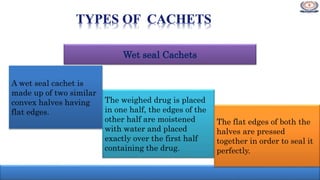
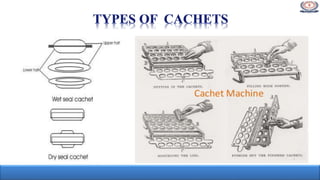
Wet seal Cachets
A wet seal cachet is
made up of two similar
convex halves having
flat edges.
The weighed drug is placed
in one half, the edges of the
other half are moistened
with water and placed
exactly over the first half
containing the drug.
The flat edges of both the
halves are pressed
together in order to seal it
perfectly.
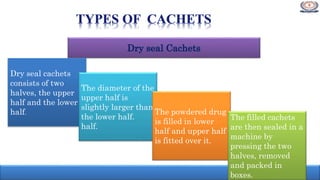
Dry seal Cachets
Dry seal cachets
consists of two
halves, the upper
half and the lower
half.
The diameter of the
upper half is
slightly larger than
the lower half.
half.
The powdered drug
is filled in lower
half and upper half
is fitted over it.
The filled cachets
are then sealed in a
machine by
pressing the two
halves, removed
and packed in
boxes.
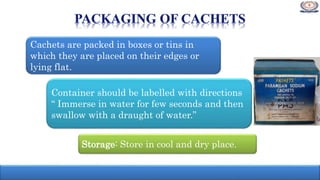
Cachets are packed in boxes or tins in
which they are placed on their edges or
lying flat.
Container should be labelled with directions
“ Immerse in water for few seconds and then
swallow with a draught of water.”
Storage: Store in cool and dry place.
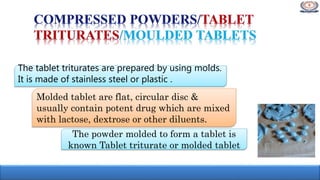
The powder molded to form a tablet is
known Tablet triturate or molded tablet
Molded tablet are flat, circular disc &
usually contain potent drug which are mixed
with lactose, dextrose or other diluents.
The tablet triturates are prepared by using molds.
It is made of stainless steel or plastic .
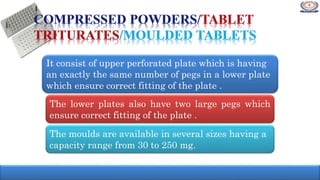
It consist of upper perforated plate which is having
an exactly the same number of pegs in a lower plate
which ensure correct fitting of the plate .
The lower plates also have two large pegs which
ensure correct fitting of the plate .
The moulds are available in several sizes having a
capacity range from 30 to 250 mg.
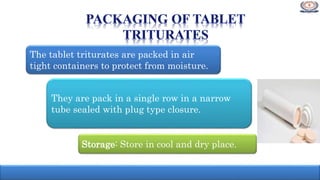
The tablet triturates are packed in air
tight containers to protect from moisture.
They are pack in a single row in a narrow
tube sealed with plug type closure.
Storage: Store in cool and dry place.
Solid Dosage Forms

Solid Dosage Forms

  • 1.
    SOLID DOSAGE FORMS By Mrs.Sandhya R. Lanke, Lecturer SJVPM’S Rasiklal. M. Dhariwal College of Pharmacy, Chinchwad, Pune
  • 2.
    LEARNING OUTCOMES 1. Definepowders 2. Discuss types of powders 3. List advantages and disadvantages of powders After watching this presentation you will be able to;
  • 3.
    Mixture of finelydivided drug or chemicals in dry form They are used internally or externally They are available in crystalline or amorphous form
  • 4.
    1. Faster dispersalof medicament compared to tablet, capsules 5. Convenient for children & elderly patients 2. Large quantity can be easily administered by patient orally 3. Powders are more easy to carry than the liquid dosage form 4. Economical as compared with other dosage form
  • 5.
    10. Less incompatible 8.Convenient for dispersing bulky drug 6. more stable than liquid dosage form 9. Flexibility of Compounding 7. Easy to carry than liquid dosage form
  • 6.
    1. Drugs havingbitter, nauseous, unpleasant taste cannot be dispensed in powder form. 2. Drugs affected by atmospheric condition cannot be given in powder form. 4. Dispensing is time consuming. 3. Deliquescent & Hygroscopic drug cannot be given in powder form.
  • 7.
    Bulk powder forinternal use. Bulk powder for external use Simple powder & compound powder Powder enclosed in cachets and capsules Compressed powder
  • 8.
     When accuracyof dosage form is not important at that time powders are dispensed in bulk form.  Bulk powder contains several doses of powder.  They are supplied in wide-mouthed containers  Ex. Laxative powder, Antacid Powder
  • 9.
     Bulk powderfor external use are non potent substance.  These powders are supplied in cardboard, glass or plastic containers, designed for the specific method of application.  Ex. Dusting Powders, Insufflations, Snuffs, Dentifrices
  • 10.
    DUSTING POWDERS These areused for external application on the skin & generally applied in very fine state to avoid local irritation. Dusting powder should be passed through sieve no. 80 or 120 to enhance their effectiveness. Dusting powders are two types: Medicated and Surgical prepared by mixing of two or more ingredients; such as starch, talc, kaolin as they are chemically inert. The dusting powders are dispensed in sifted top or aerosol containers.
  • 11.
    • Medicated DustingPowders • Used mainly for superficial skin • Must be free from pathogenic micro organisms. • Uses : Antiseptic, Astringent, Absorbent, Antiperspirant and Antipruritic • Surgical Dusting Powders • Used in body cavities and also on major wounds due to Burns and on umbilical cords of infants. • Must be sterilized before their use by dry heat sterilization method at 1600 C for 2 hrs. • Used as Lubricant, Protective, Astringents, Antiseptic DUSTING POWDERS
  • 12.
    DUSTING POWDERS Ex. Dustingpowder Rx Purified talc, sterilized 50 gm. Starch powder 25 gm. Zinc oxide powder 20 gm. Salicylic acid powder 5 gm.
  • 13.
    INSUFFLATIONS These are medicateddusting powder. They are introduced into body cavities such as, nose, throat, ears & vagina with the help of an apparatus “Insufflator”. Insufflator sprays the powder into a stream of finely divided particles all over the site of application.
  • 14.
    INSUFFLATIONS They produce asystemic effect from a drug that is destroyed in the gut. Insufflations produce a local effect in the treatment of ear, nose, throat infection with antibiotics
  • 15.
    SNUFFS These are finely dividedsolid dosage form of medicament.These are inhaled into nostrils for antiseptic, bronchodilator & decongestion action. Snuffs are dispensed in flat metal boxes or glass container with hinged lid.
  • 16.
    Contains only oneingredient either in crystalline form or amorphous form. Compound powders contains two or more than two substances which are mixed together. Simple Powder Compound Powder
  • 17.
    Ex. Send Six powderscontaining Aspirin 300 mg Rx Aspirin 300 mg Ex. Send eight powders containing APC powder 500 mg Rx Aspirin 300 mg Paracetamol 150 mg Caffeine 50 mg
  • 18.
    Cachets are the solidUnit dosage form of drugs. These are moulded from rice paper, used to enclose nauseous or disagreeable Powders These are available in different sizes to hold drugs from 0.2 to 1.5 gm. of powders
  • 19.
    They can madeeasily as no complicated machinery is required. They disintegrate quickly in the stomach The drug can be easily dispensed in cachets. Large dose of drug can be swallowed by using cachets.
  • 20.
    The shell ofcachets are fragile, so the drug can’t be compressed in cachets Not suitable for filling the drug by large scale machinery. They can’t protect the enclosed drug from light & moisture They occupy more space than the corresponding sizes of capsules & tablets. They are easily damaged They must be softened before swallowing
  • 21.
    Wet seal Cachets Awet seal cachet is made up of two similar convex halves having flat edges. The weighed drug is placed in one half, the edges of the other half are moistened with water and placed exactly over the first half containing the drug. The flat edges of both the halves are pressed together in order to seal it perfectly.
  • 22.
    Dry seal Cachets Dryseal cachets consists of two halves, the upper half and the lower half. The diameter of the upper half is slightly larger than the lower half. half. The powdered drug is filled in lower half and upper half is fitted over it. The filled cachets are then sealed in a machine by pressing the two halves, removed and packed in boxes.
  • 24.
    Cachets are packedin boxes or tins in which they are placed on their edges or lying flat. Container should be labelled with directions “ Immerse in water for few seconds and then swallow with a draught of water.” Storage: Store in cool and dry place.
  • 25.
    The powder moldedto form a tablet is known Tablet triturate or molded tablet Molded tablet are flat, circular disc & usually contain potent drug which are mixed with lactose, dextrose or other diluents. The tablet triturates are prepared by using molds. It is made of stainless steel or plastic .
  • 26.
    It consist ofupper perforated plate which is having an exactly the same number of pegs in a lower plate which ensure correct fitting of the plate . The lower plates also have two large pegs which ensure correct fitting of the plate . The moulds are available in several sizes having a capacity range from 30 to 250 mg.
  • 27.
    The tablet trituratesare packed in air tight containers to protect from moisture. They are pack in a single row in a narrow tube sealed with plug type closure. Storage: Store in cool and dry place.