Built for the real world Solectria Renewables / Company Confidential © 2014 
www.solectria.com 
Being Good Citizens of 
the Grid 
Claude Colp 
Applications Engineer 
Claude.colp@solectria.com 
@ClaudeColp
Introduction 
1. Company Overview 
2. Relays 27, 59, 81, ect. 
3. Effective Grounding 
4. Power curtailment 
5. Power Factor 
6. Reactive power support 
7. Solectria’ s work at ESIF 
8. Reactive power support 
Built for the real world Solectria Renewables / Company Confidential © 2014 
www.solectria.com 
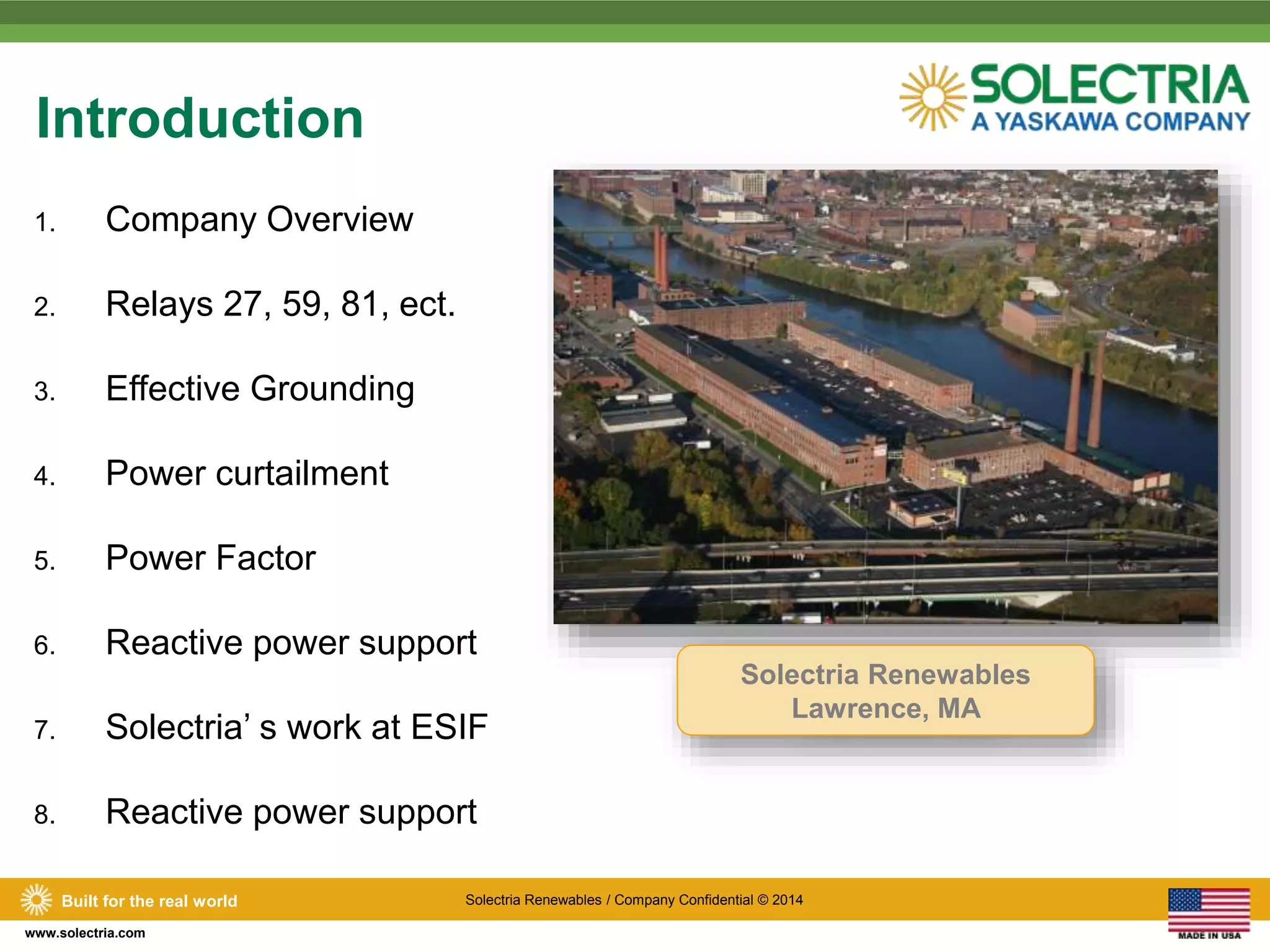
Solectria Renewables 
Lawrence, MA
Built for the real world Solectria Renewables / Company Confidential © 2014 
www.solectria.com 
Company Overview
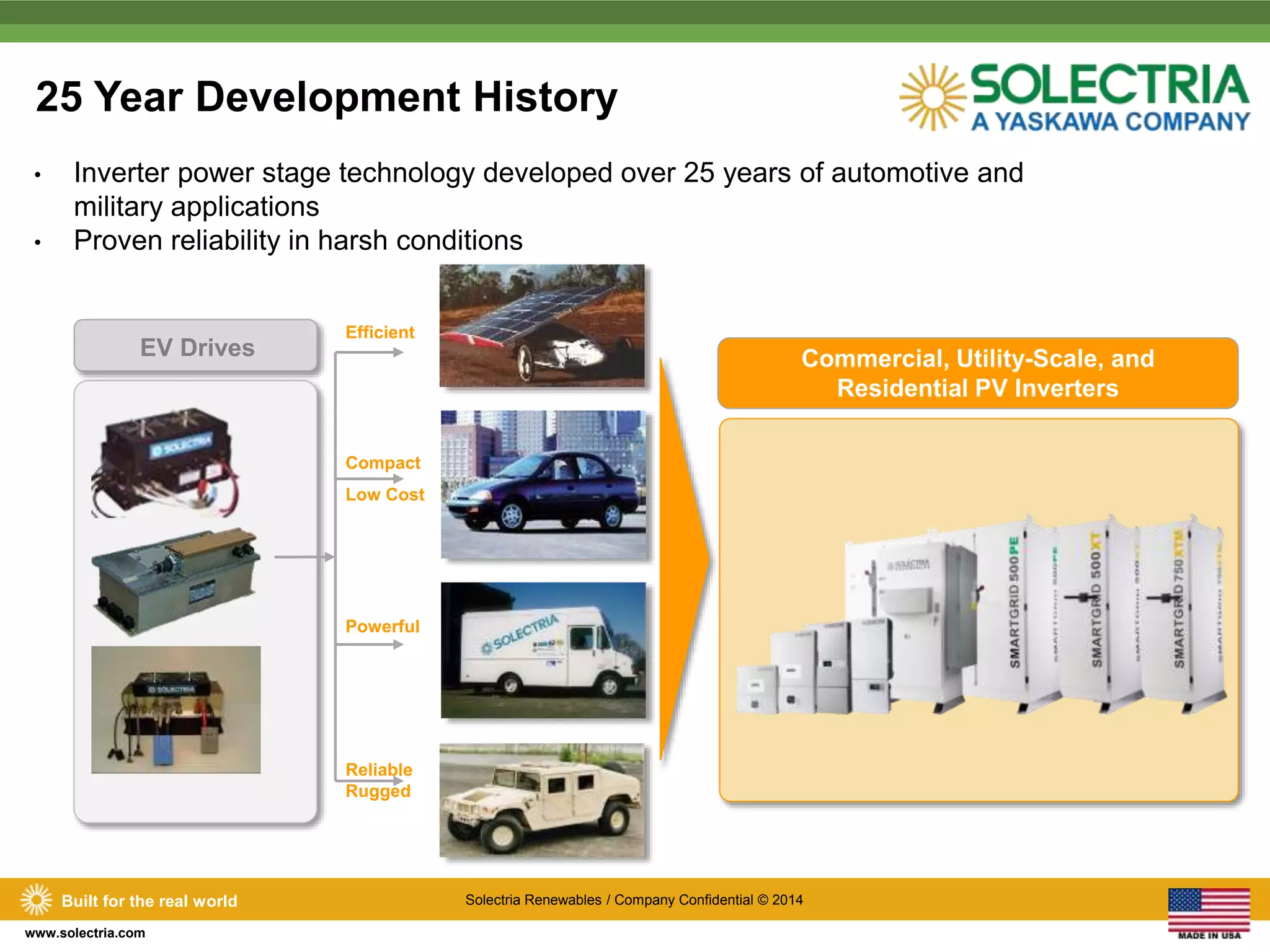
25 Year Development History 
• Inverter power stage technology developed over 25 years of automotive and 
military applications 
• Proven reliability in harsh conditions 
Built for the real world Solectria Renewables / Company Confidential © 2014 
www.solectria.com 
Efficient 
Powerful 
Reliable 
Rugged 
Commercial, Utility-Scale, and 
Residential PV Inverters 
Compact 
Low Cost 
EV Drives
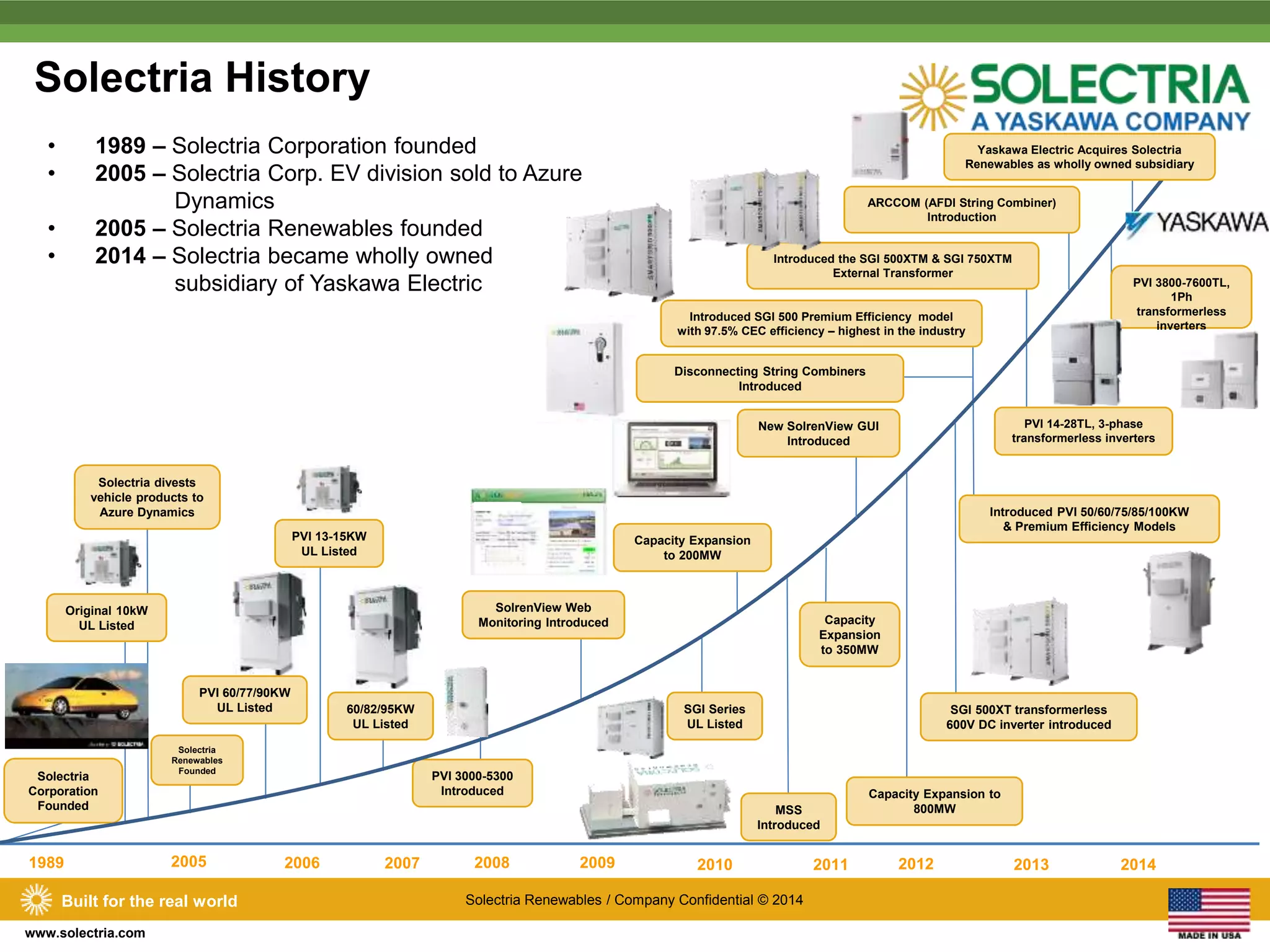
Solectria History 
Solectria divests 
vehicle products to 
Azure Dynamics 
Original 10kW 
UL Listed 
Solectria 
Corporation 
Founded 
Introduced the SGI 500XTM & SGI 750XTM 
External Transformer 
1989 2005 2006 2007 2008 2009 2010 2011 2012 
Built for the real world Solectria Renewables / Company Confidential © 2014 
www.solectria.com 
60/82/95KW 
UL Listed 
SolrenView Web 
Monitoring Introduced 
Capacity Expansion 
to 200MW 
PVI 60/77/90KW 
UL Listed 
PVI 13-15KW 
UL Listed 
PVI 3000-5300 
Introduced 
MSS 
Introduced 
Capacity Expansion to 
800MW 
Disconnecting String Combiners 
Introduced 
PVI 3800-7600TL, 
PVI 14-28TL, 3-phase 
transformerless inverters 
SGI 500XT transformerless 
600V DC inverter introduced 
2013 
2014 
1Ph 
transformerless 
inverters 
Introduced SGI 500 Premium Efficiency model 
with 97.5% CEC efficiency – highest in the industry 
Capacity 
Expansion 
to 350MW 
Introduced PVI 50/60/75/85/100KW 
& Premium Efficiency Models 
• 1989 – Solectria Corporation founded 
• 2005 – Solectria Corp. EV division sold to Azure 
Dynamics 
• 2005 – Solectria Renewables founded 
• 2014 – Solectria became wholly owned 
subsidiary of Yaskawa Electric 
Solectria 
Renewables 
Founded 
SGI Series 
UL Listed 
New SolrenView GUI 
Introduced 
Yaskawa Electric Acquires Solectria 
Renewables as wholly owned subsidiary 
ARCCOM (AFDI String Combiner) 
Introduction
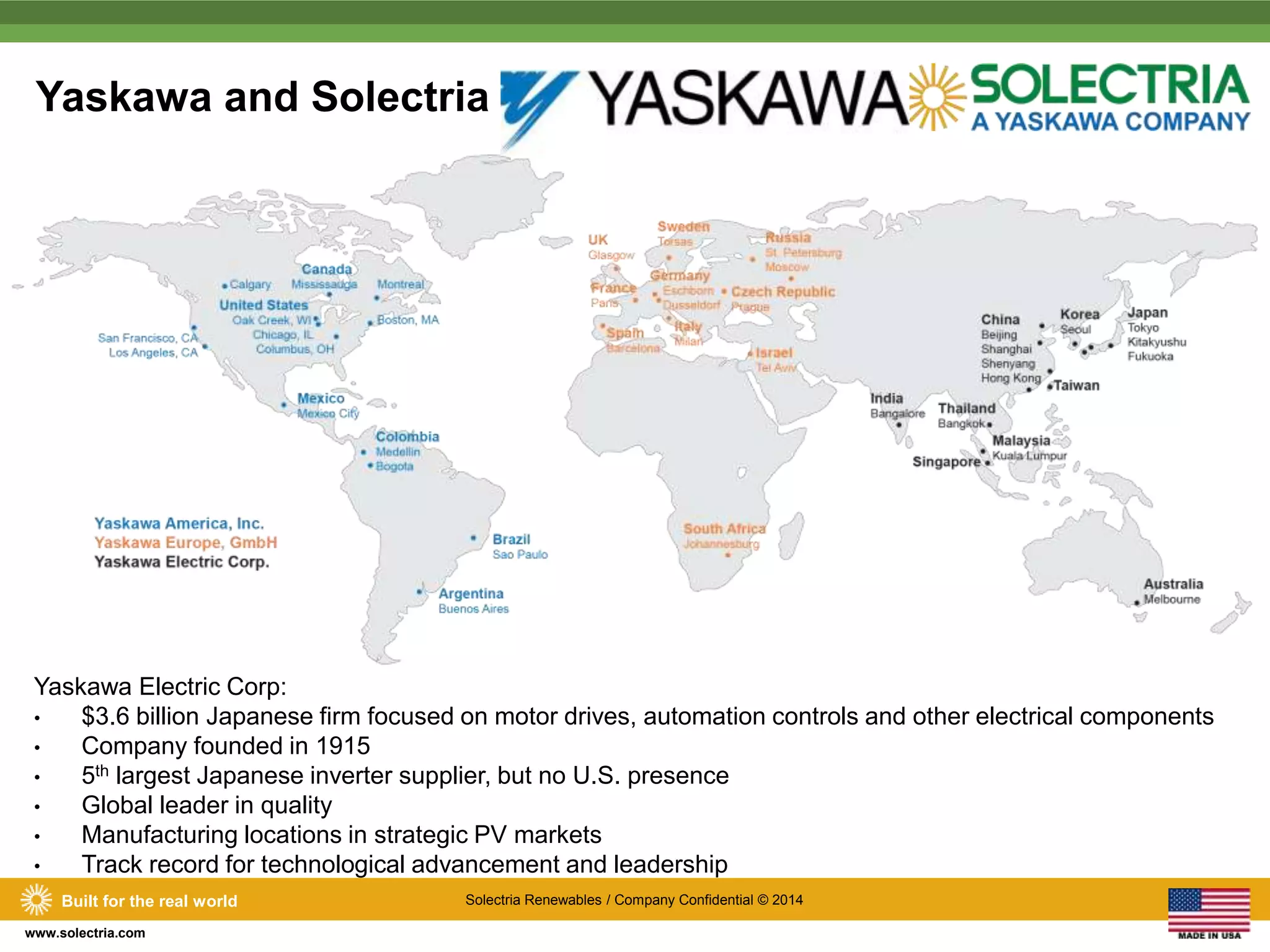
Yaskawa and Solectria 
Yaskawa Electric Corp: 
• $3.6 billion Japanese firm focused on motor drives, automation controls and other electrical components 
• Company founded in 1915 
• 5th largest Japanese inverter supplier, but no U.S. presence 
• Global leader in quality 
• Manufacturing locations in strategic PV markets 
• Track record for technological advancement and leadership 
Built for the real world Solectria Renewables / Company Confidential © 2014 
www.solectria.com
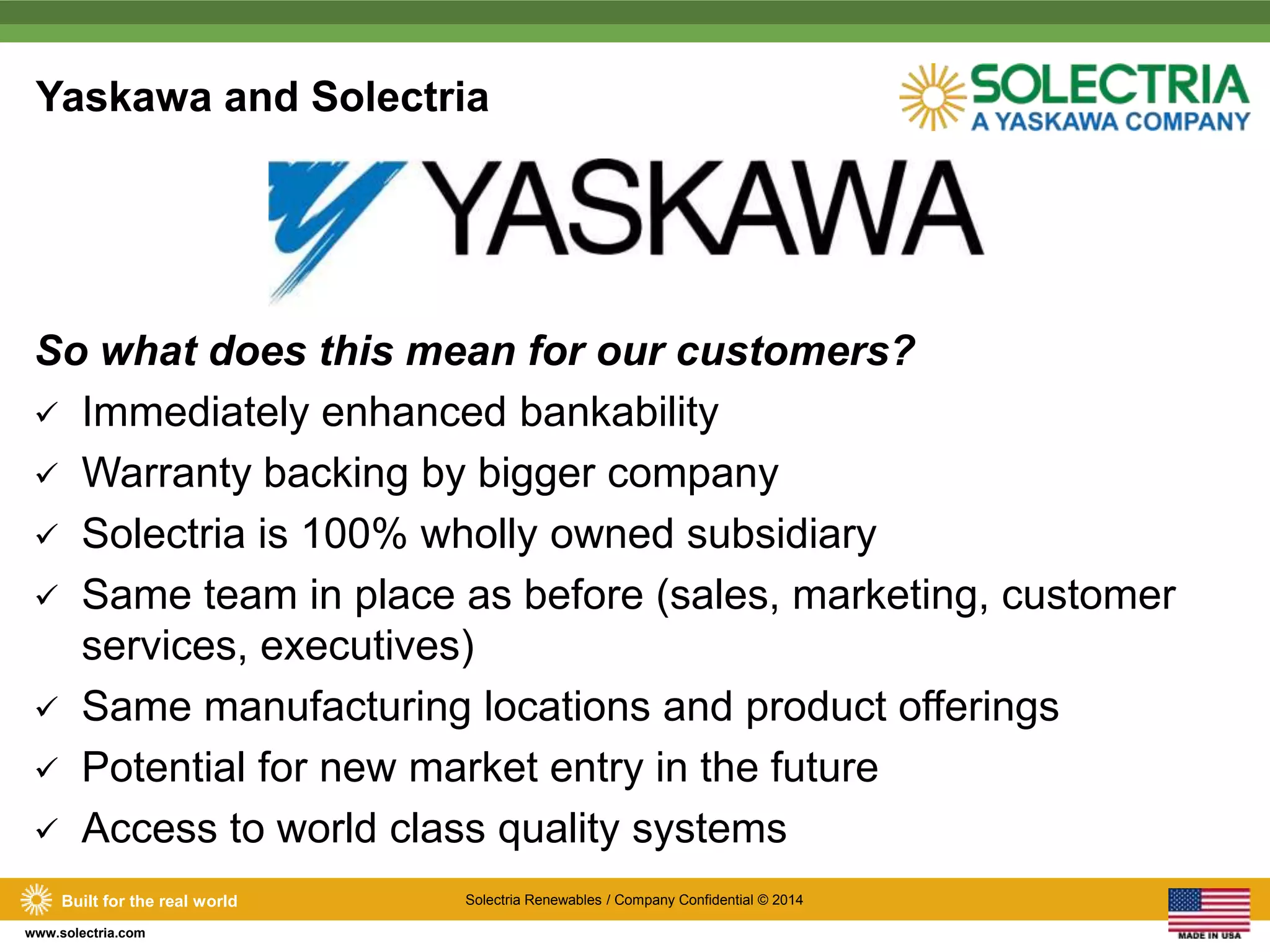
Yaskawa and Solectria 
So what does this mean for our customers? 
 Immediately enhanced bankability 
 Warranty backing by bigger company 
 Solectria is 100% wholly owned subsidiary 
 Same team in place as before (sales, marketing, customer 
services, executives) 
 Same manufacturing locations and product offerings 
 Potential for new market entry in the future 
 Access to world class quality systems 
Built for the real world Solectria Renewables / Company Confidential © 2014 
www.solectria.com
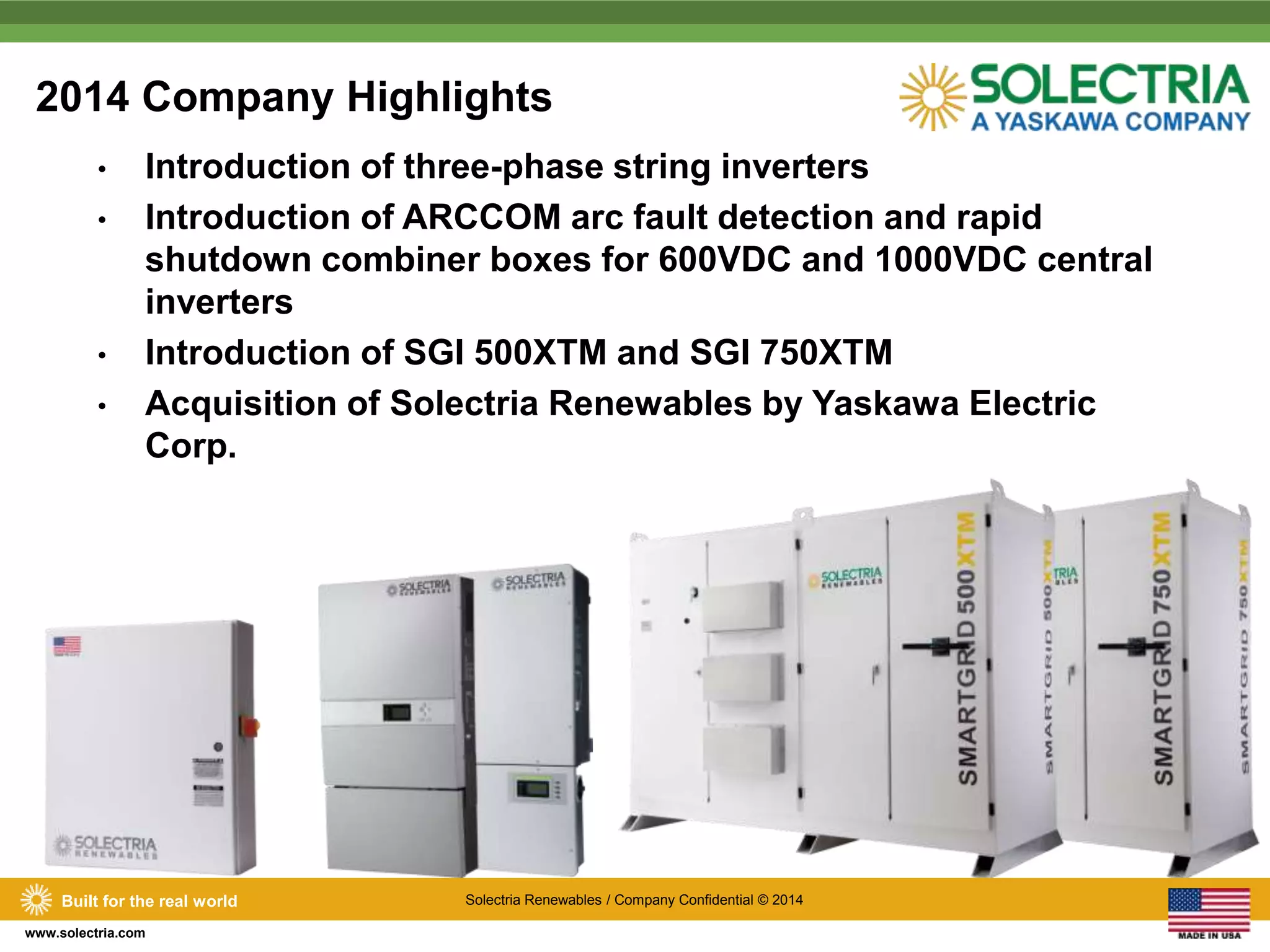
2014 Company Highlights 
• Introduction of three-phase string inverters 
• Introduction of ARCCOM arc fault detection and rapid 
shutdown combiner boxes for 600VDC and 1000VDC central 
inverters 
• Introduction of SGI 500XTM and SGI 750XTM 
• Acquisition of Solectria Renewables by Yaskawa Electric 
Corp. 
Built for the real world Solectria Renewables / Company Confidential © 2014 
www.solectria.com
Built for the real world Solectria Renewables / Company Confidential © 2014 
www.solectria.com 
Protective Relaying
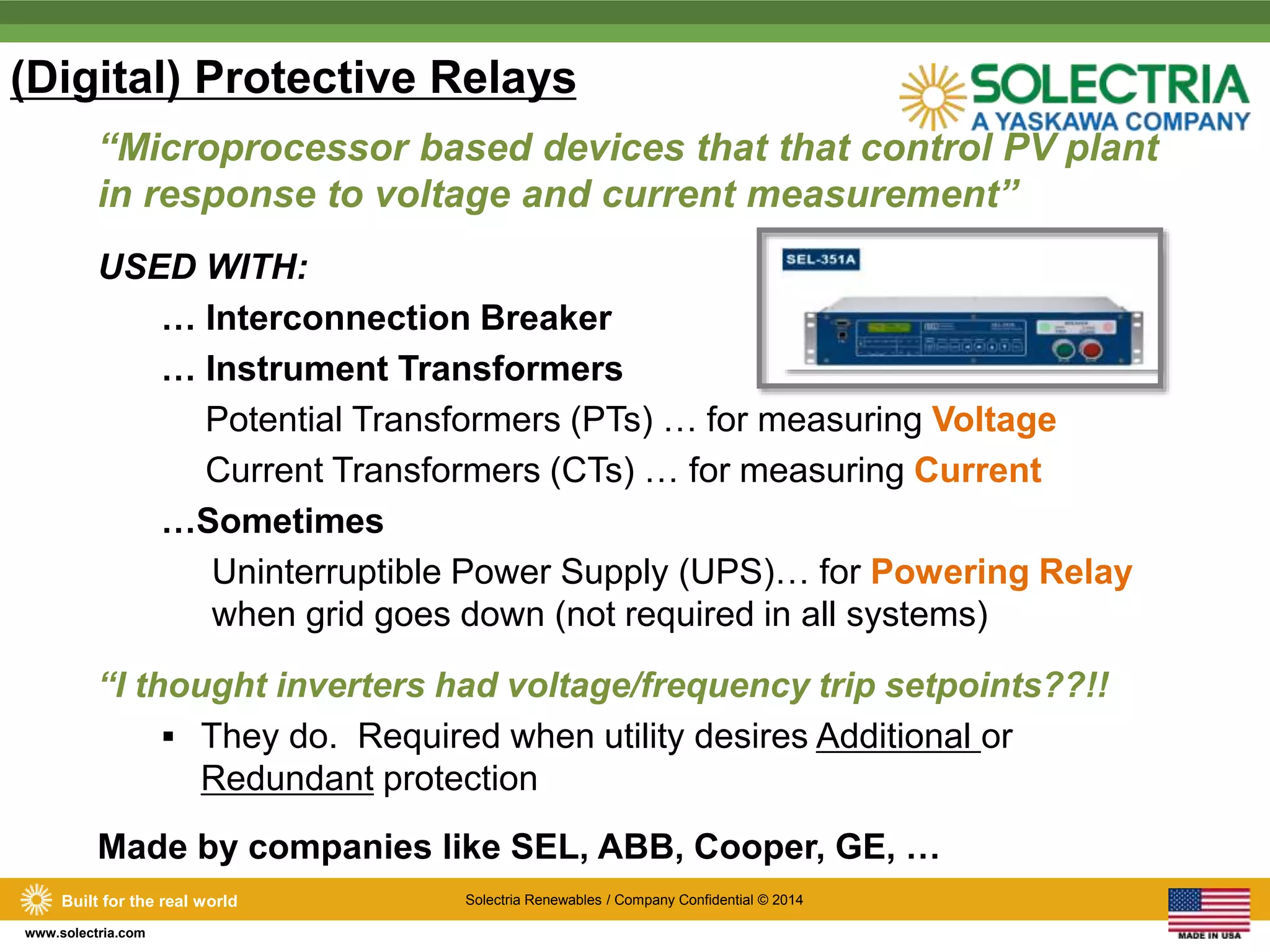
(Digital) Protective Relays 
“Microprocessor based devices that that control PV plant 
in response to voltage and current measurement” 
USED WITH: 
Built for the real world Solectria Renewables / Company Confidential © 2014 
www.solectria.com 
… Interconnection Breaker 
… Instrument Transformers 
Potential Transformers (PTs) … for measuring Voltage 
Current Transformers (CTs) … for measuring Current 
…Sometimes 
Uninterruptible Power Supply (UPS)… for Powering Relay 
when grid goes down (not required in all systems) 
“I thought inverters had voltage/frequency trip setpoints??!! 
 They do. Required when utility desires Additional or 
Redundant protection 
Made by companies like SEL, ABB, Cooper, GE, …
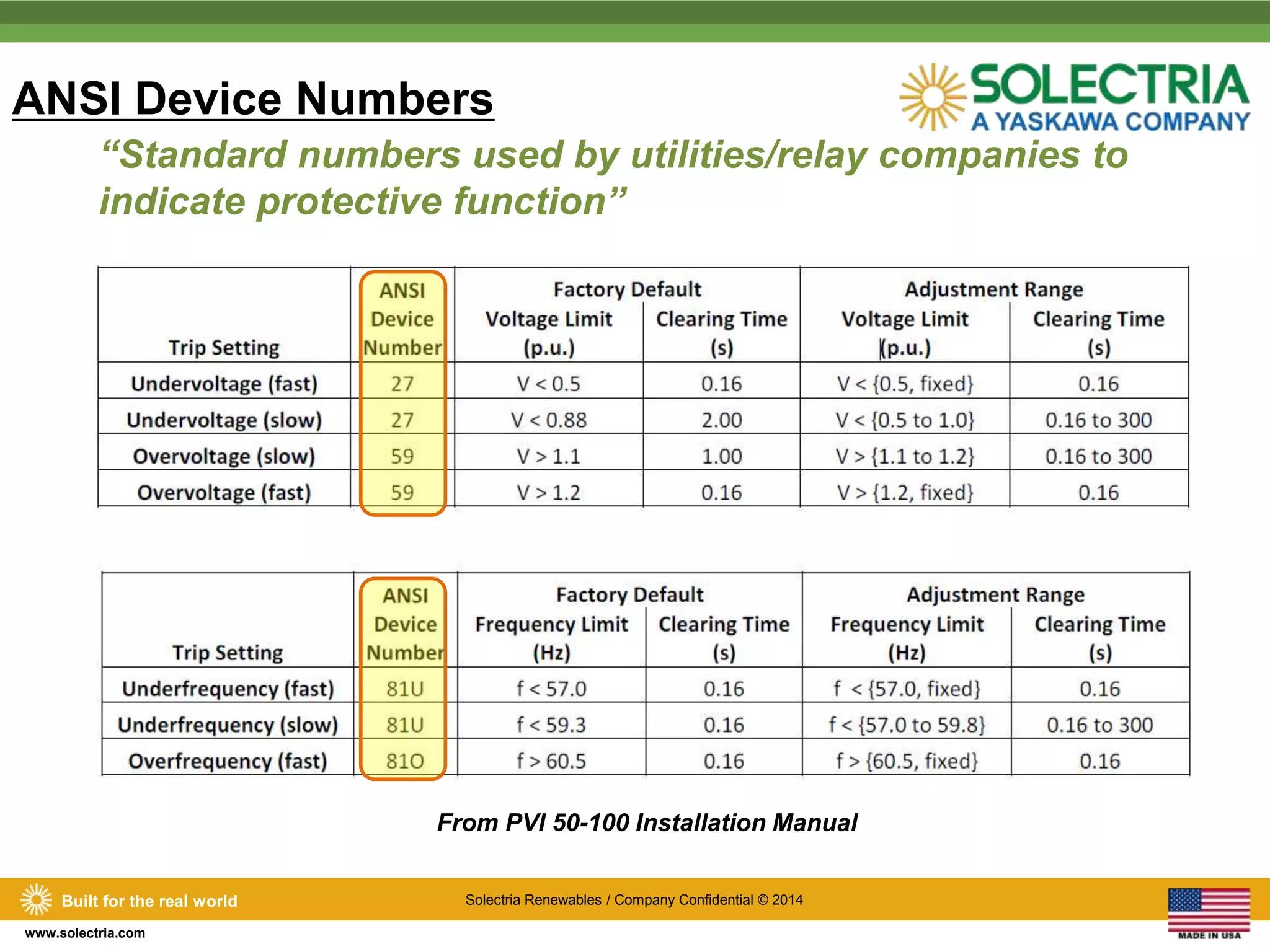
ANSI Device Numbers 
“Standard numbers used by utilities/relay companies to 
indicate protective function” 
Built for the real world Solectria Renewables / Company Confidential © 2014 
www.solectria.com 
From PVI 50-100 Installation Manual
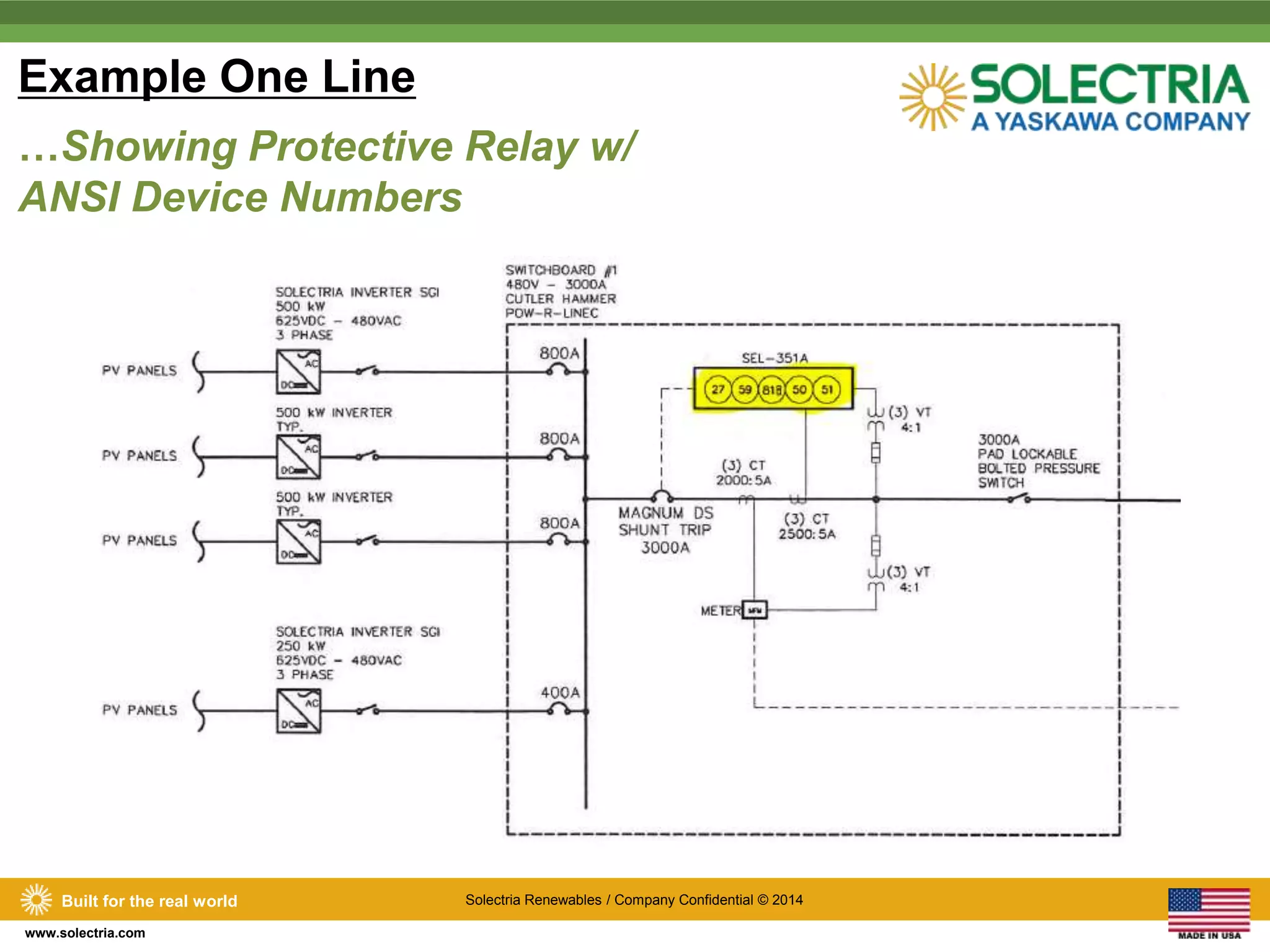
Example One Line 
…Showing Protective Relay w/ 
ANSI Device Numbers 
Built for the real world Solectria Renewables / Company Confidential © 2014 
www.solectria.com
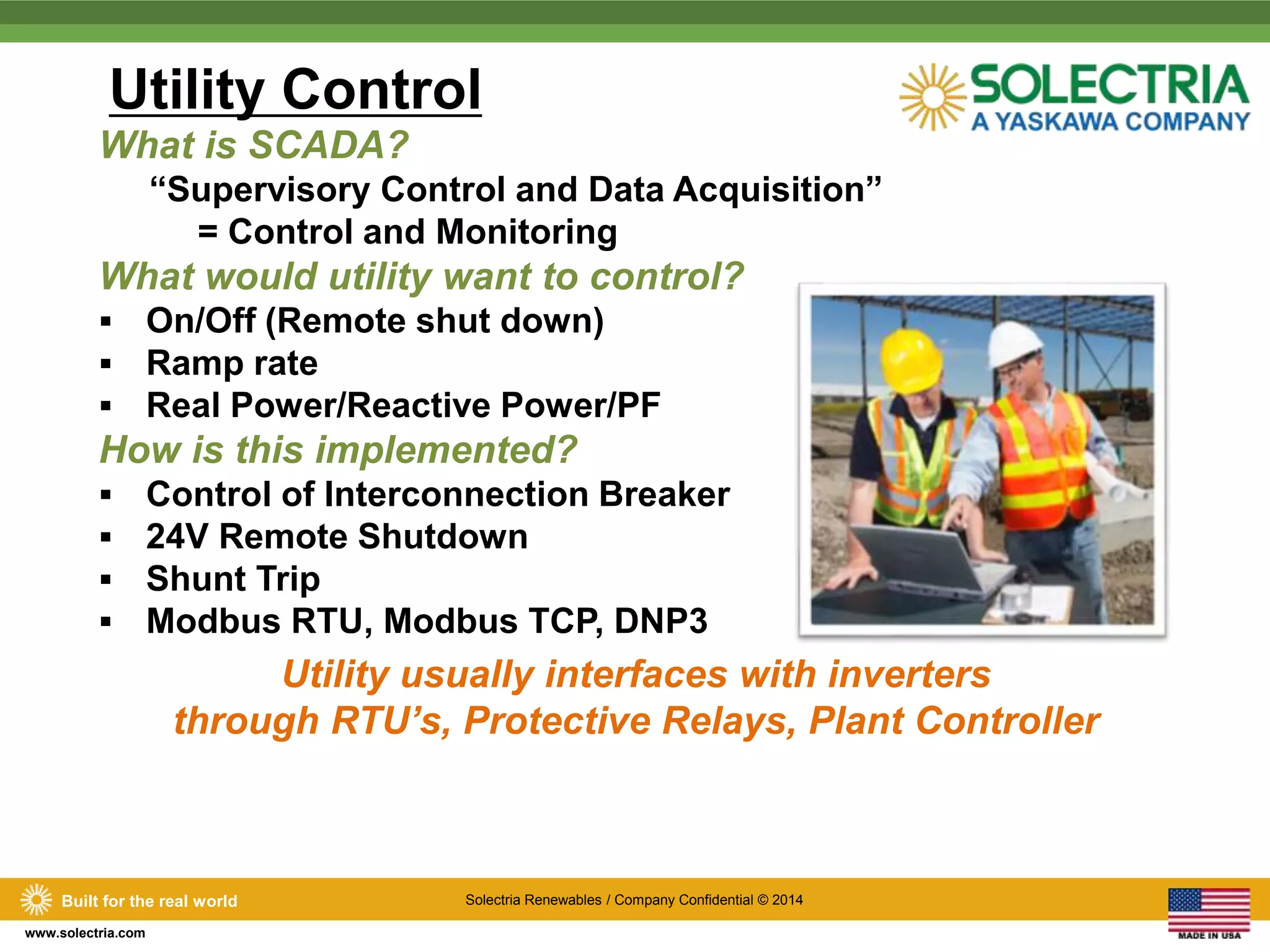
Utility Control 
What is SCADA? 
Built for the real world Solectria Renewables / Company Confidential © 2014 
www.solectria.com 
“Supervisory Control and Data Acquisition” 
= Control and Monitoring 
What would utility want to control? 
 On/Off (Remote shut down) 
 Ramp rate 
 Real Power/Reactive Power/PF 
How is this implemented? 
 Control of Interconnection Breaker 
 24V Remote Shutdown 
 Shunt Trip 
 Modbus RTU, Modbus TCP, DNP3 
Utility usually interfaces with inverters 
through RTU’s, Protective Relays, Plant Controller
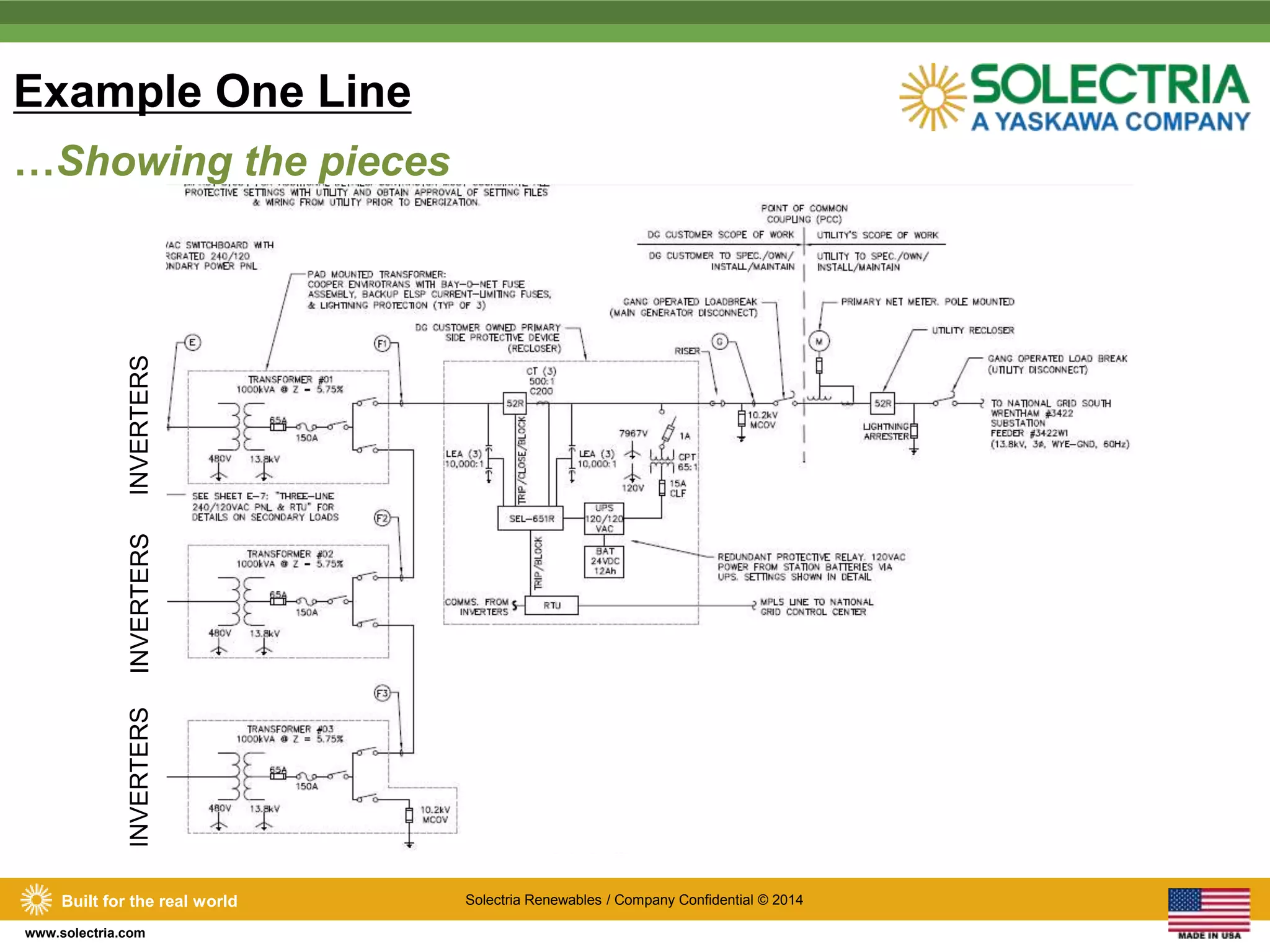
Example One Line 
…Showing the pieces 
INVERTERS INVERTERS INVERTERS 
Built for the real world Solectria Renewables / Company Confidential © 2014 
www.solectria.com 
I
Built for the real world Solectria Renewables / Company Confidential © 2014 
www.solectria.com 
Effective Grounding 
of PV inverters
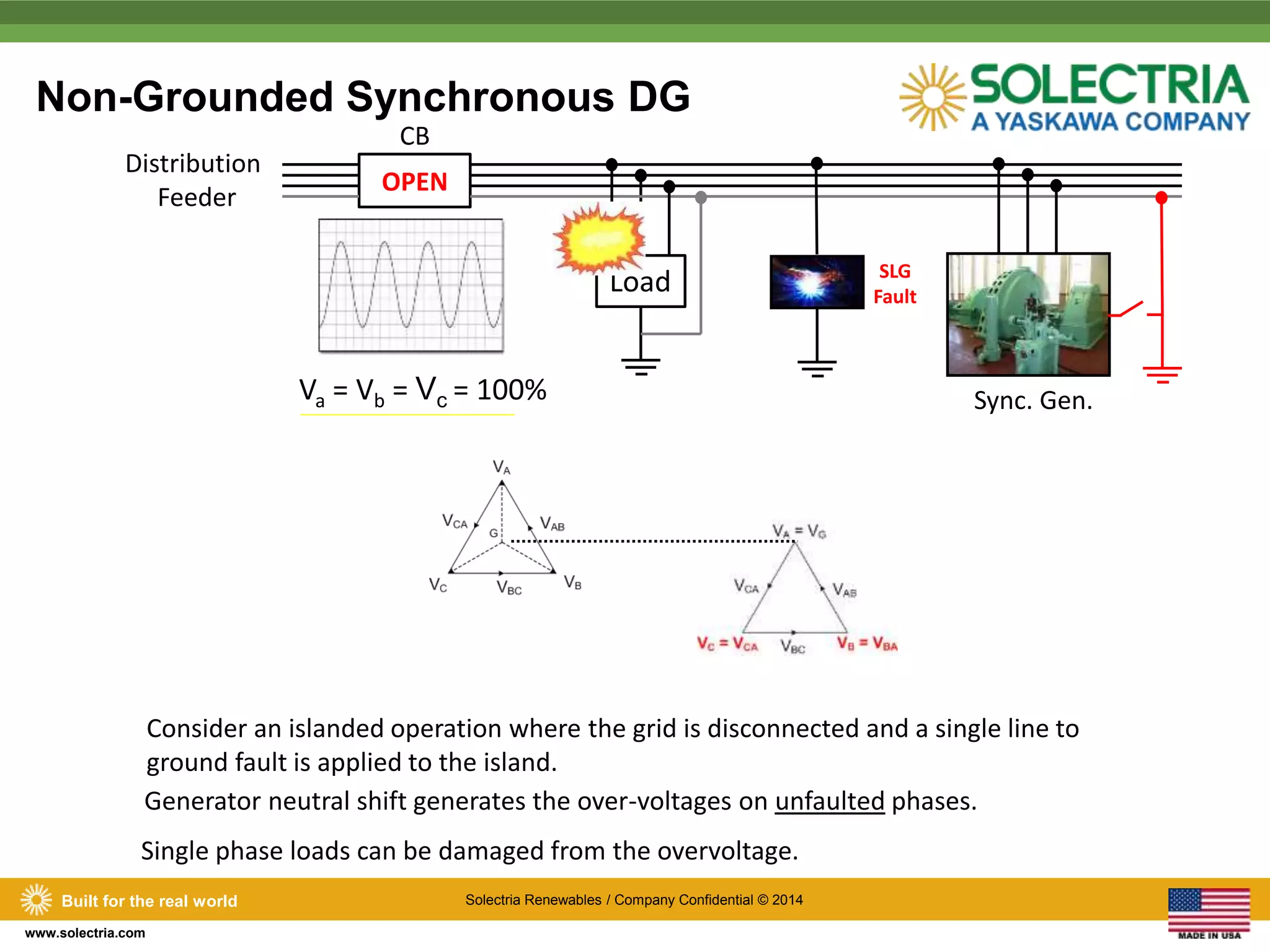
Non-Grounded Synchronous DG 
Distribution 
CB 
COLOPSEEND 
Va = Vb = Vc = 100% 
Built for the real world Solectria Renewables / Company Confidential © 2014 
www.solectria.com 
Feeder 
Load 
Vb = Vc = 173% 
SLG 
Fault 
Sync. Gen. 
Consider an islanded operation where the grid is disconnected and a single line to 
ground fault is applied to the island. 
Generator neutral shift generates the over-voltages on unfaulted phases. 
Single phase loads can be damaged from the overvoltage.
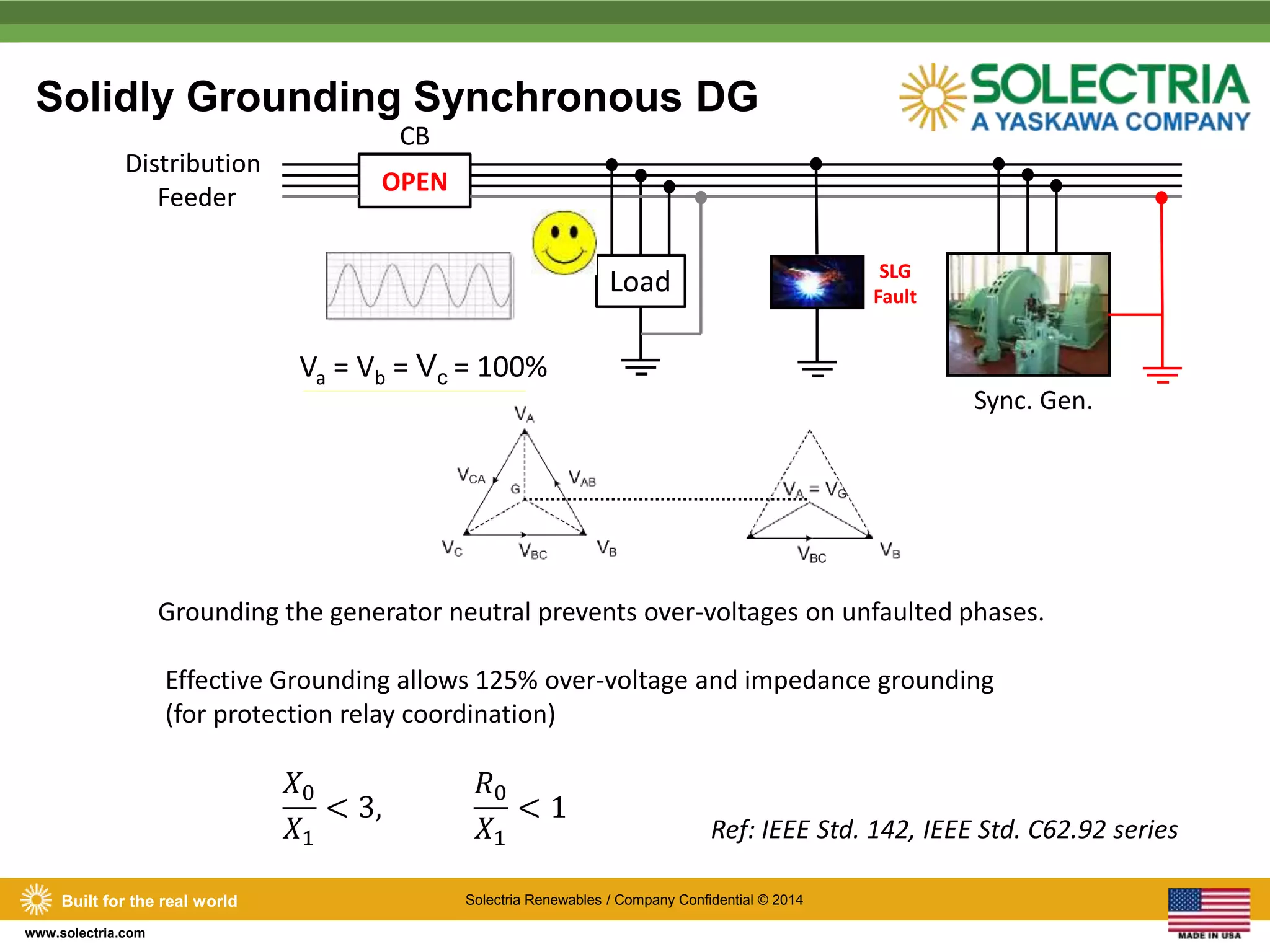
Solidly Grounding Synchronous DG 
Distribution 
CB 
Va = Vb = Vc = 100% 
Grounding the generator neutral prevents over-voltages on unfaulted phases. 
Built for the real world Solectria Renewables / Company Confidential © 2014 
www.solectria.com 
Feeder 
Load 
COLOPSEEND 
SLG 
Fault 
Sync. Gen. 
Vb = Vc = 100% 
Effective Grounding allows 125% over-voltage and impedance grounding 
(for protection relay coordination) 
푋0 
푋1 
< 3, 
푅0 
푋1 
< 1 
Ref: IEEE Std. 142, IEEE Std. C62.92 series
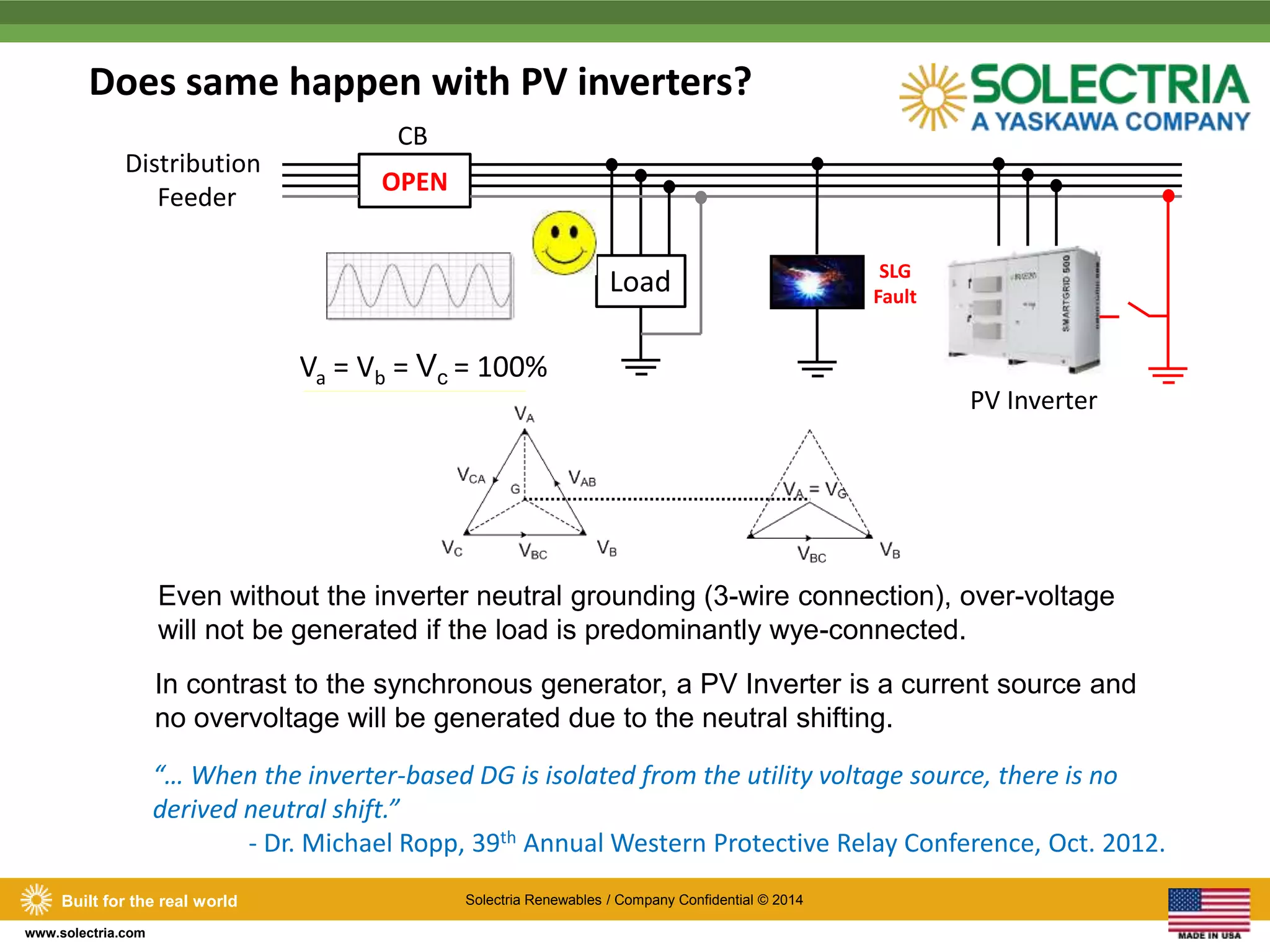
Does same happen with PV inverters? 
Distribution 
CB 
Va = Vb = Vc = 100% 
Even without the inverter neutral grounding (3-wire connection), over-voltage 
will not be generated if the load is predominantly wye-connected. 
Built for the real world Solectria Renewables / Company Confidential © 2014 
www.solectria.com 
Feeder 
Load 
COLOPSEEND 
SLG 
Fault 
PV Inverter 
Vb = Vc = 100% 
In contrast to the synchronous generator, a PV Inverter is a current source and 
no overvoltage will be generated due to the neutral shifting. 
“… When the inverter-based DG is isolated from the utility voltage source, there is no 
derived neutral shift.” 
- Dr. Michael Ropp, 39th Annual Western Protective Relay Conference, Oct. 2012.
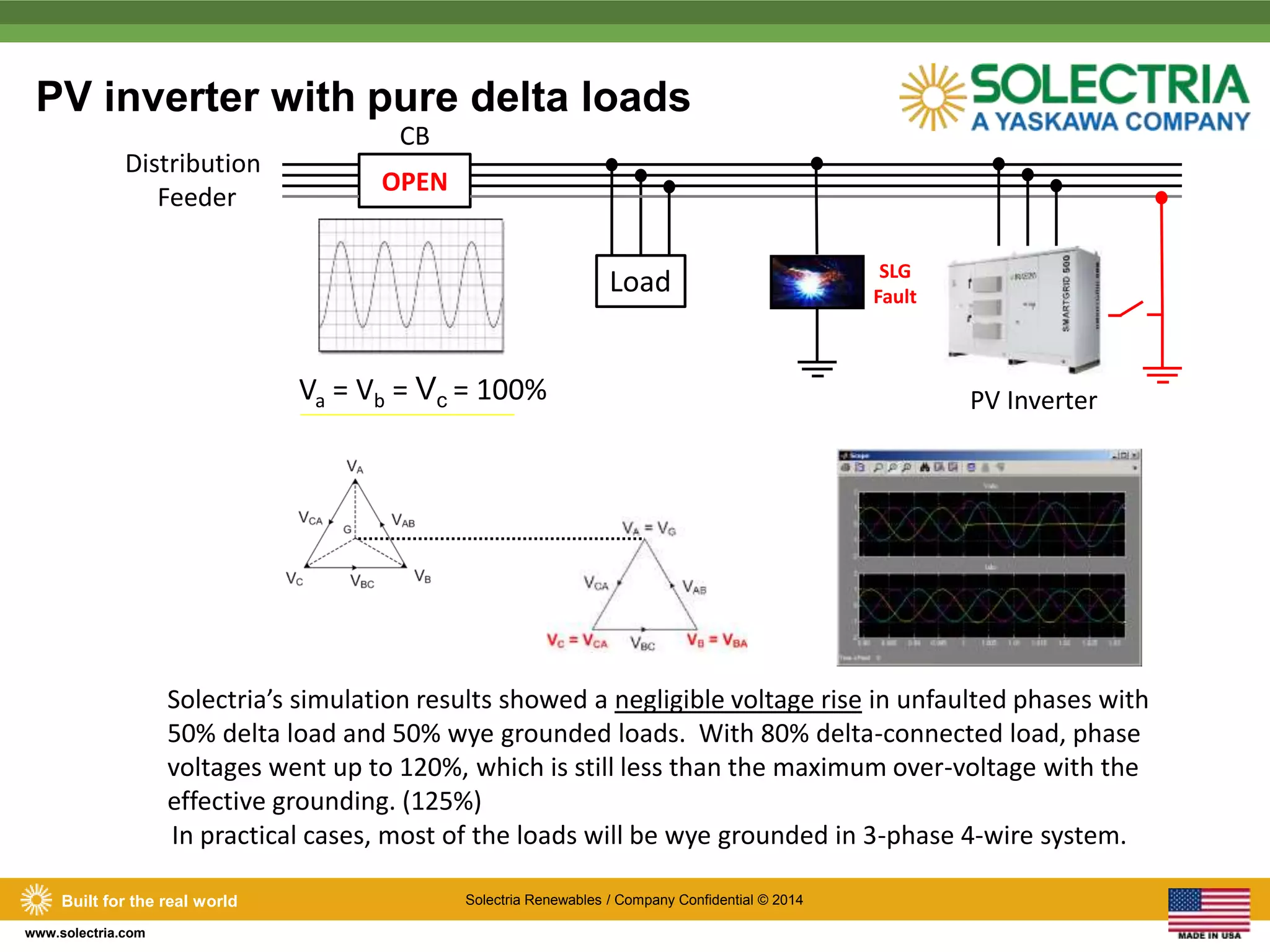
PV inverter with pure delta loads 
Distribution 
CB 
COLOPSEEND 
Va = Vb = Vc = 100% PV Inverter 
Built for the real world Solectria Renewables / Company Confidential © 2014 
www.solectria.com 
Feeder 
Load 
Vb = Vc = 173% 
SLG 
Fault 
Solectria’s simulation results showed a negligible voltage rise in unfaulted phases with 
50% delta load and 50% wye grounded loads. With 80% delta-connected load, phase 
voltages went up to 120%, which is still less than the maximum over-voltage with the 
effective grounding. (125%) 
In practical cases, most of the loads will be wye grounded in 3-phase 4-wire system.
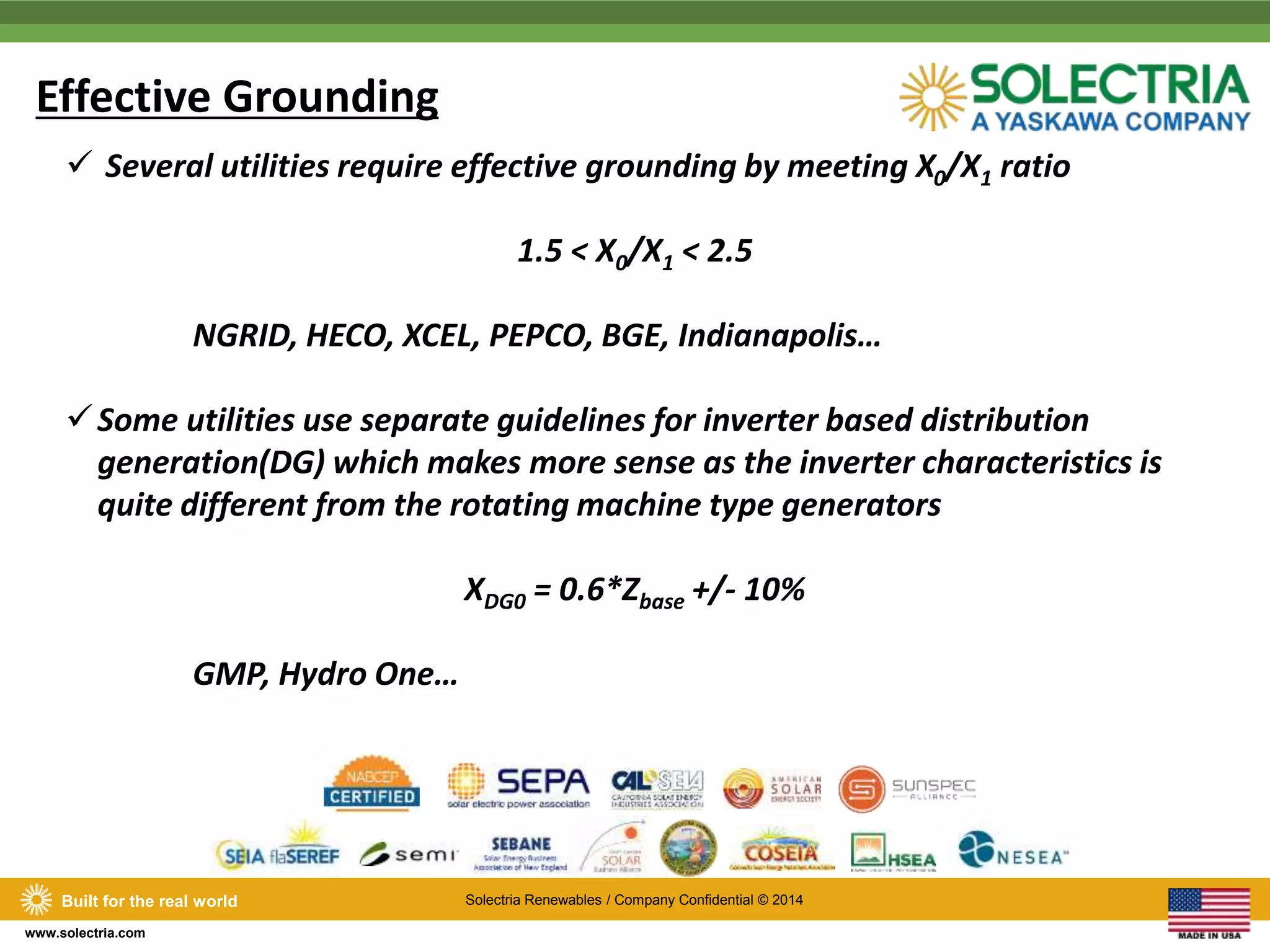
Effective Grounding 
 Several utilities require effective grounding by meeting X0/X1 ratio 
Built for the real world Solectria Renewables / Company Confidential © 2014 
www.solectria.com 
1.5 < X0/X1 < 2.5 
NGRID, HECO, XCEL, PEPCO, BGE, Indianapolis… 
Some utilities use separate guidelines for inverter based distribution 
generation(DG) which makes more sense as the inverter characteristics is 
quite different from the rotating machine type generators 
XDG0 = 0.6*Zbase +/- 10% 
GMP, Hydro One…
Suggested Design Practice 
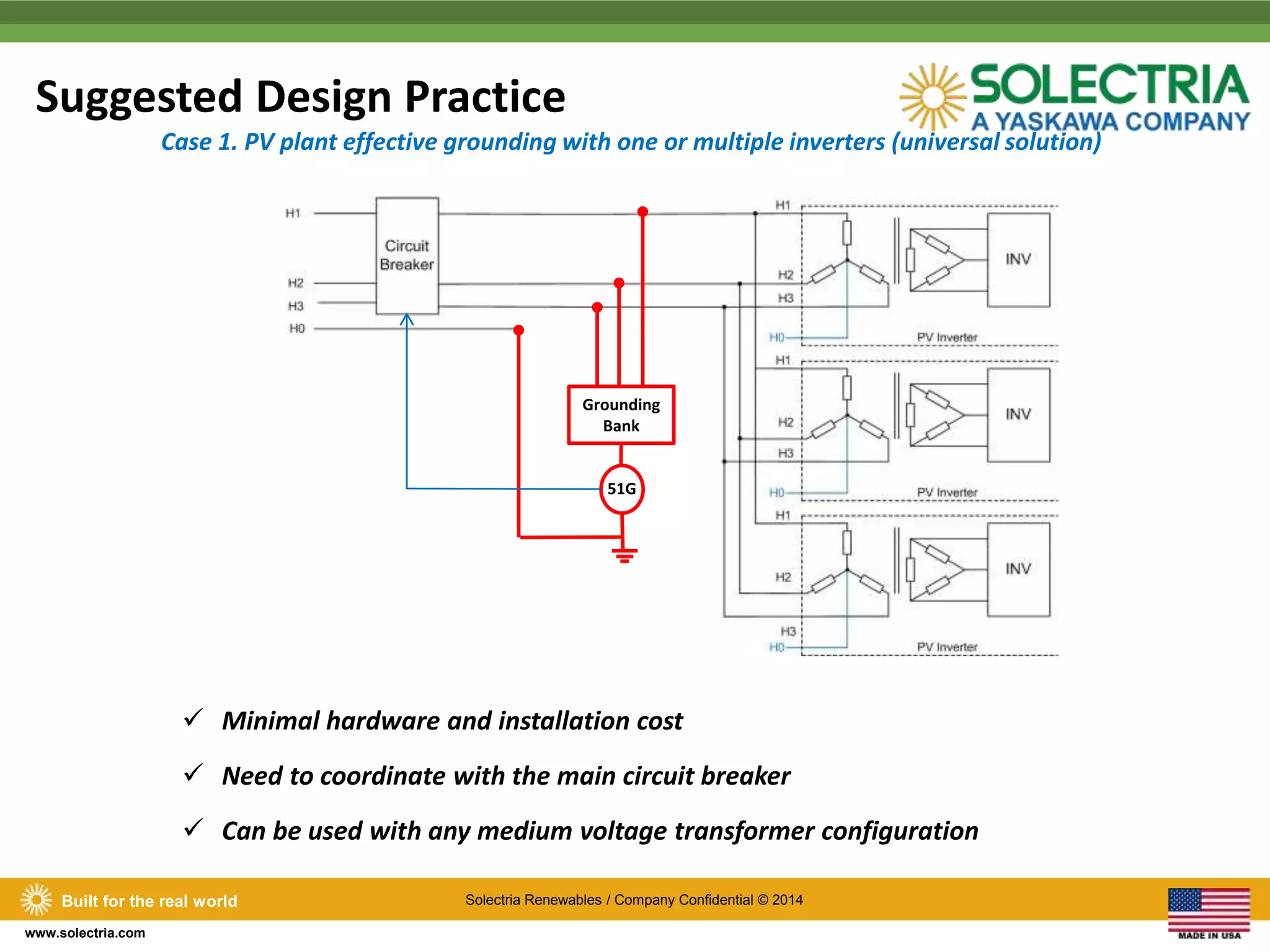
Case 1. PV plant effective grounding with one or multiple inverters (universal solution) 
Grounding 
Bank 
51G 
Built for the real world Solectria Renewables / Company Confidential © 2014 
www.solectria.com 
 Minimal hardware and installation cost 
 Need to coordinate with the main circuit breaker 
 Can be used with any medium voltage transformer configuration
Effective Grounding 
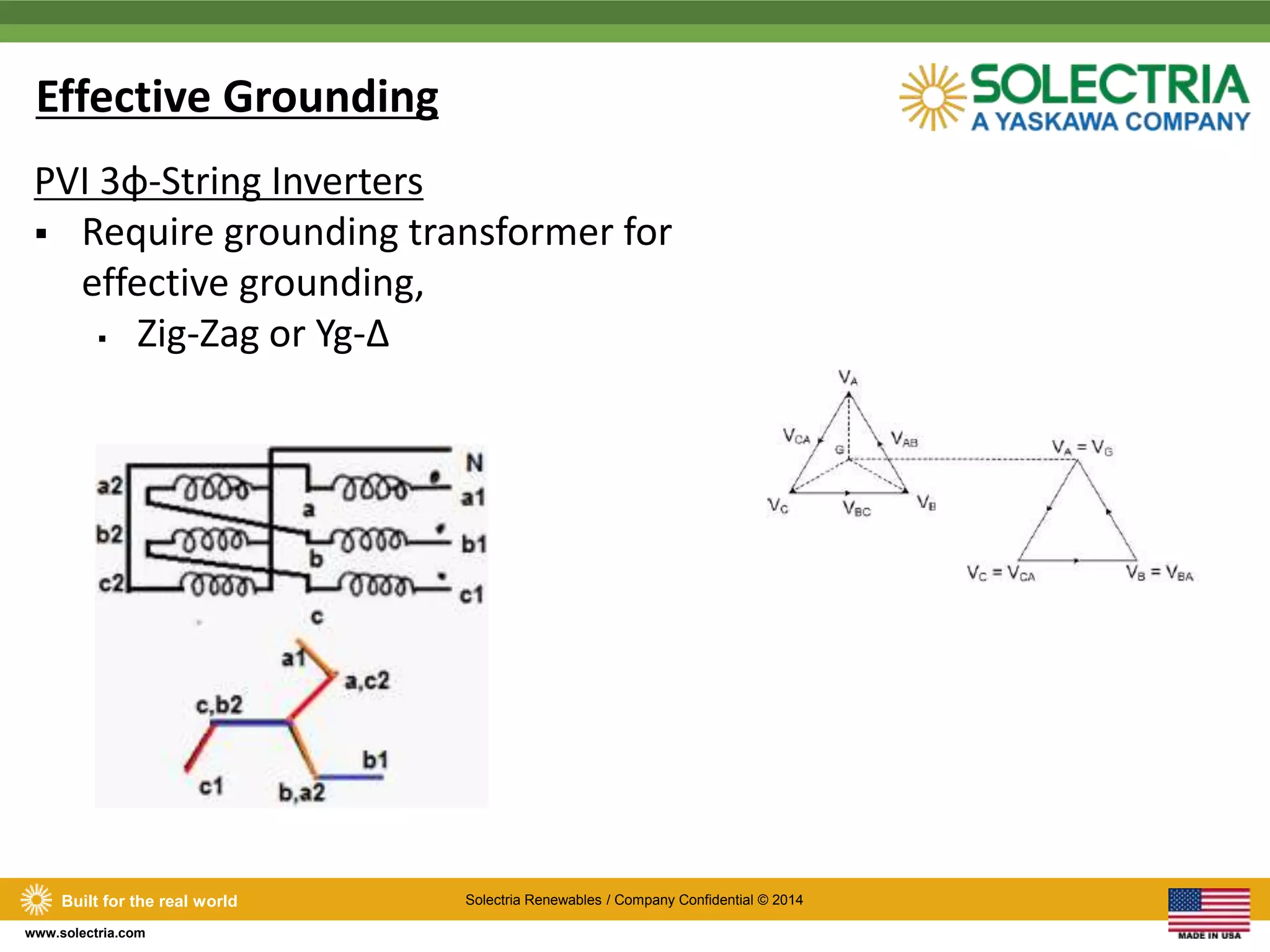
PVI 3ɸ-String Inverters 
 Require grounding transformer for 
effective grounding, 
 Zig-Zag or Yg-Δ 
Built for the real world Solectria Renewables / Company Confidential © 2014 
www.solectria.com
Grounding bank (transformer) 
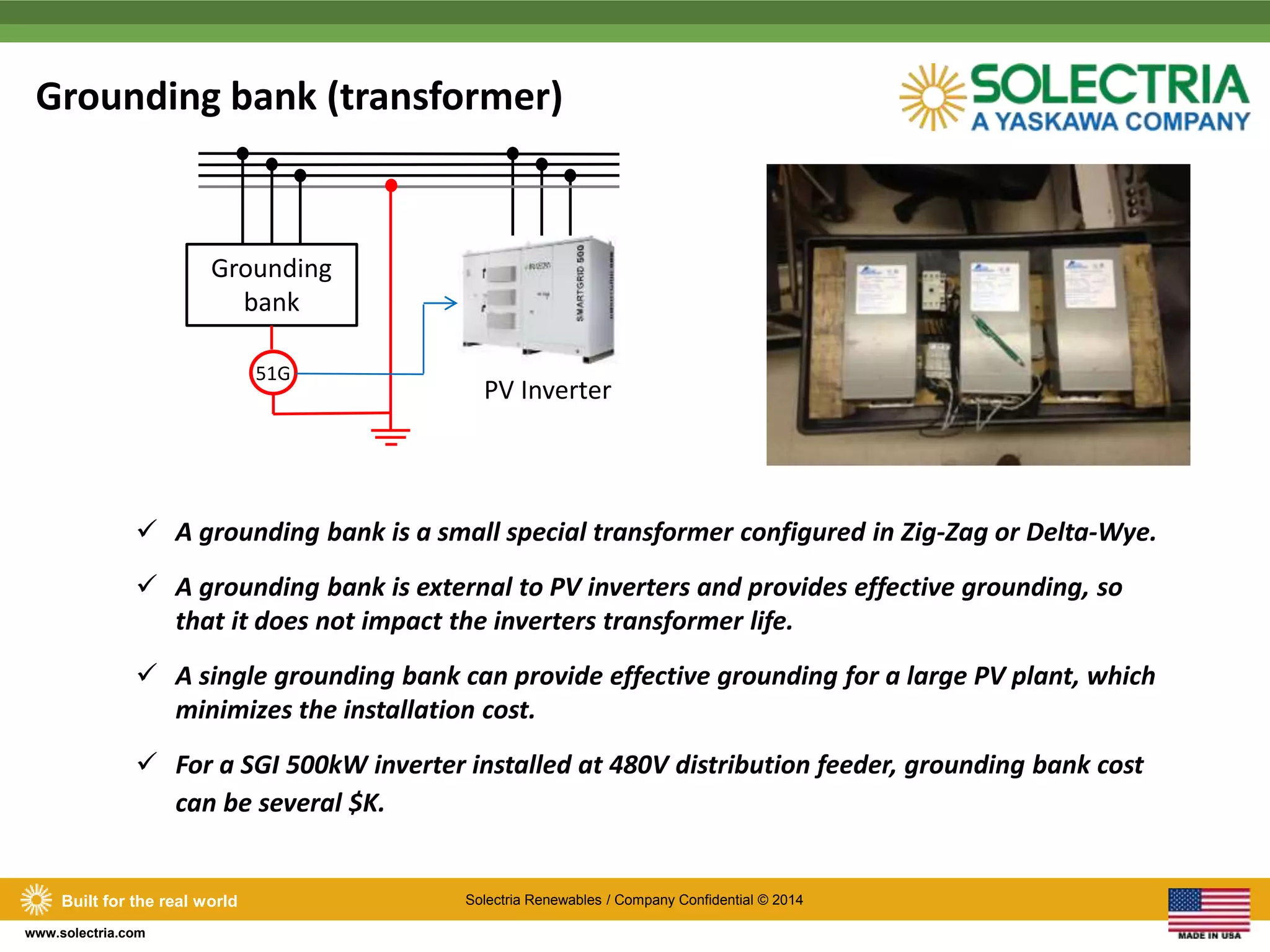
 A grounding bank is a small special transformer configured in Zig-Zag or Delta-Wye. 
 A grounding bank is external to PV inverters and provides effective grounding, so 
Built for the real world Solectria Renewables / Company Confidential © 2014 
www.solectria.com 
that it does not impact the inverters transformer life. 
 A single grounding bank can provide effective grounding for a large PV plant, which 
minimizes the installation cost. 
 For a SGI 500kW inverter installed at 480V distribution feeder, grounding bank cost 
can be several $K. 
PV Inverter 
Grounding 
bank 
51G
Suggested Design Practice 
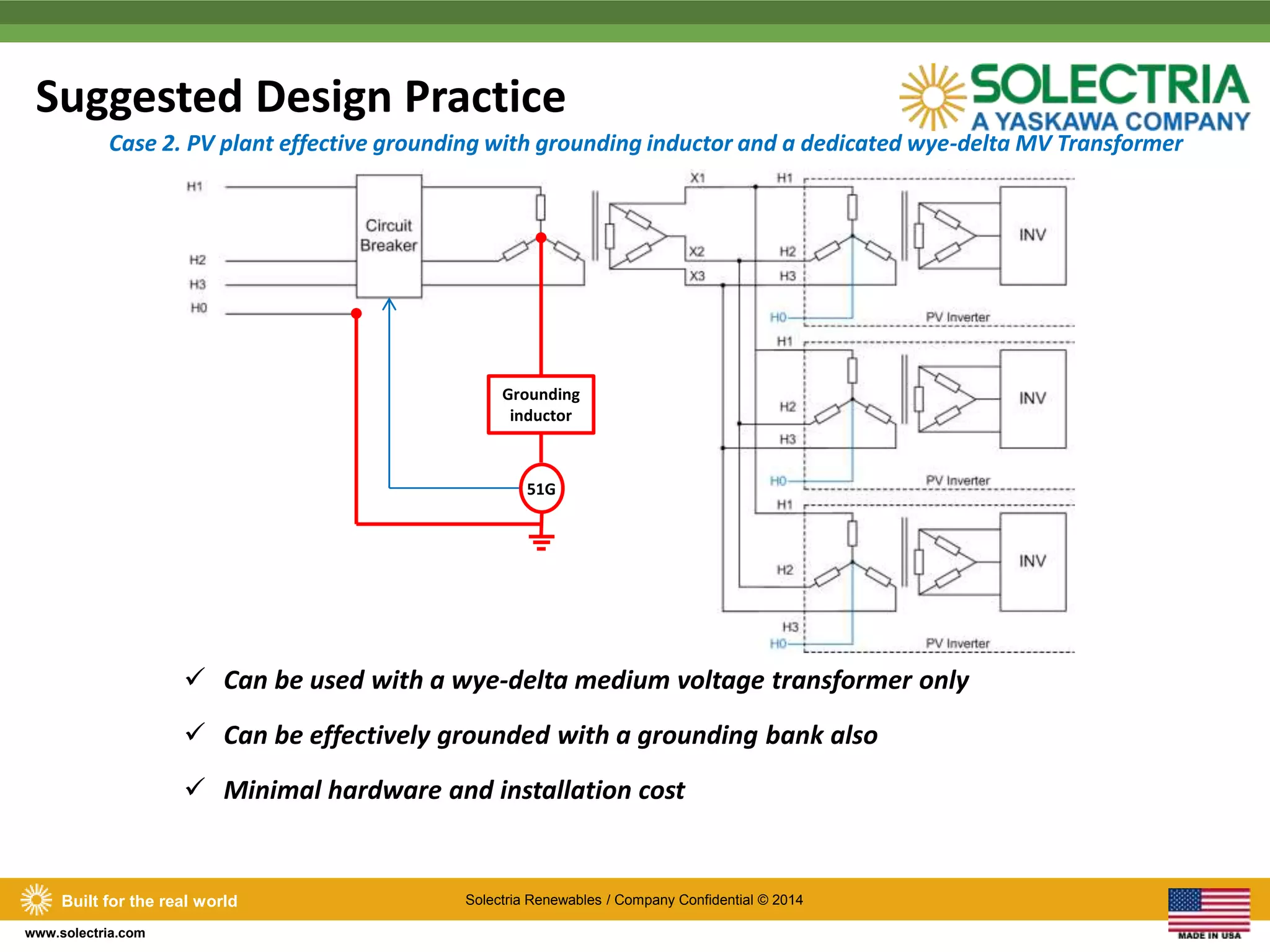
Case 2. PV plant effective grounding with grounding inductor and a dedicated wye-delta MV Transformer 
Grounding 
inductor 
51G 
Built for the real world Solectria Renewables / Company Confidential © 2014 
www.solectria.com 
 Can be used with a wye-delta medium voltage transformer only 
 Can be effectively grounded with a grounding bank also 
 Minimal hardware and installation cost
Effective Grounding Summary 
 Most 3-phase 4-wire systems support single phase loads, which puts the 
effective grounding requirement for PV inverters in question. 
 Many utilities request effective grounding with a controlled impedance for 
relay protection coordination. 
 Solectria provides impedance tables for all commercial and utility scale PV 
inverters to help customers design an effectively grounded PV system. 
 Effective grounding using Zig-Zag transformer is a universal solution for 
ungrounded DG. 
 Many Solectria inverters have an internal wye-delta isolation transformer with 
a neutral connection which can be used to provide effective grounding. When 
used, neutral over-current protection is strongly recommended. 
Built for the real world Solectria Renewables / Company Confidential © 2014 
www.solectria.com
Built for the real world Solectria Renewables / Company Confidential © 2014 
www.solectria.com 
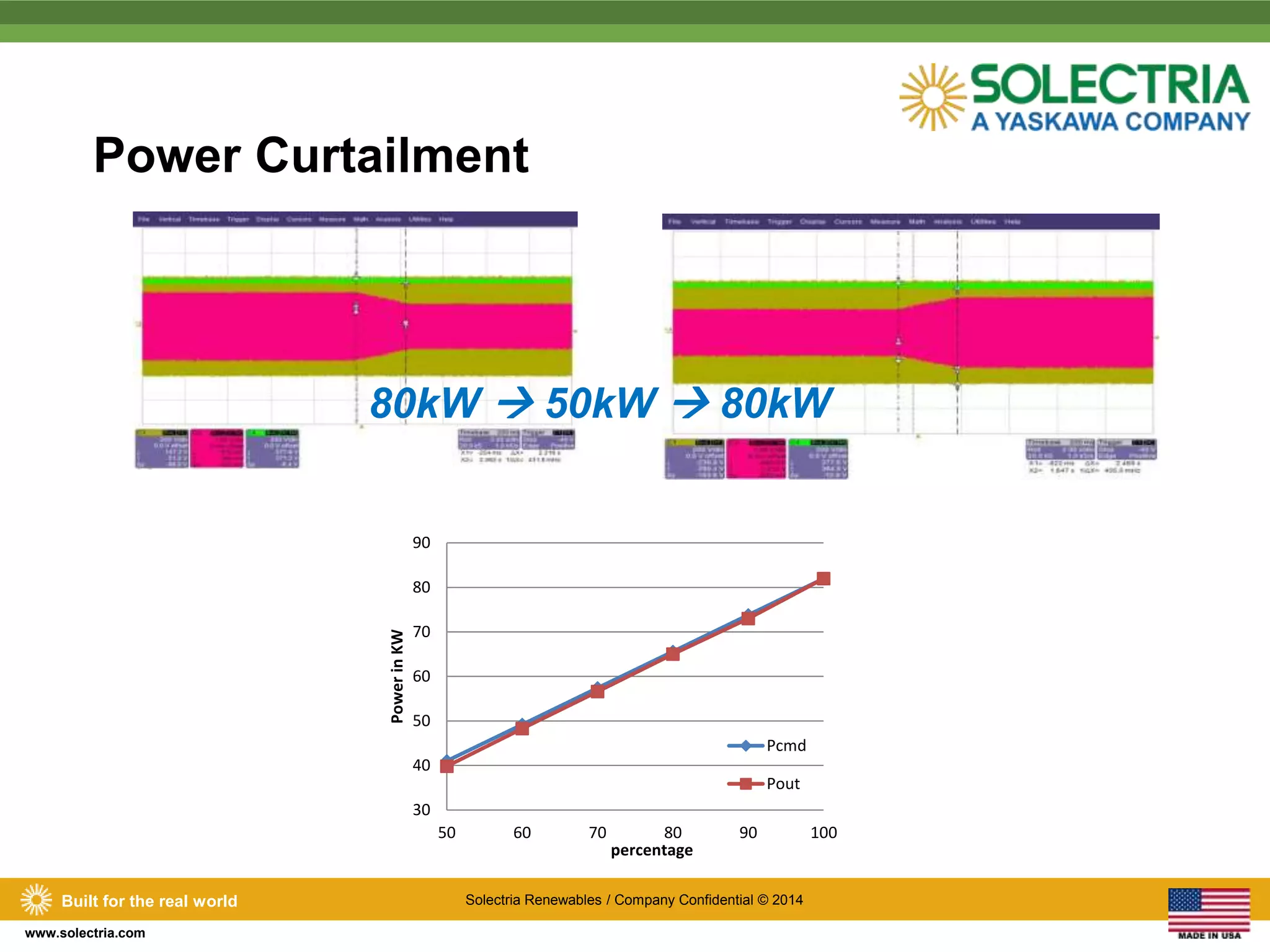
Power Curtailment
Power Curtailment 
80kW  50kW  80kW 
90 
80 
70 
60 
50 
40 
Built for the real world Solectria Renewables / Company Confidential © 2014 
www.solectria.com 
30 
50 60 70 80 90 100 
Power in KW 
percentage 
Pcmd 
Pout
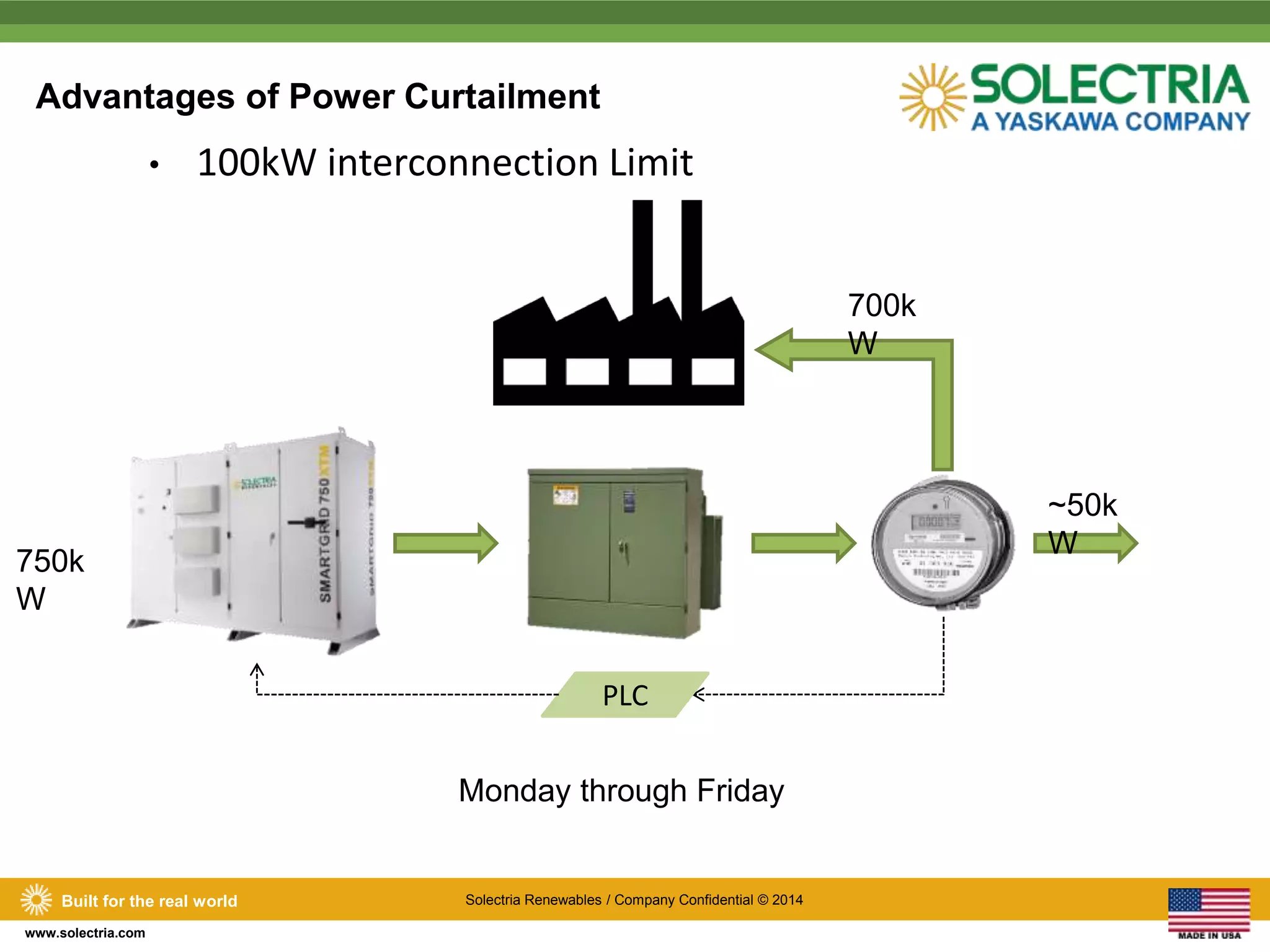
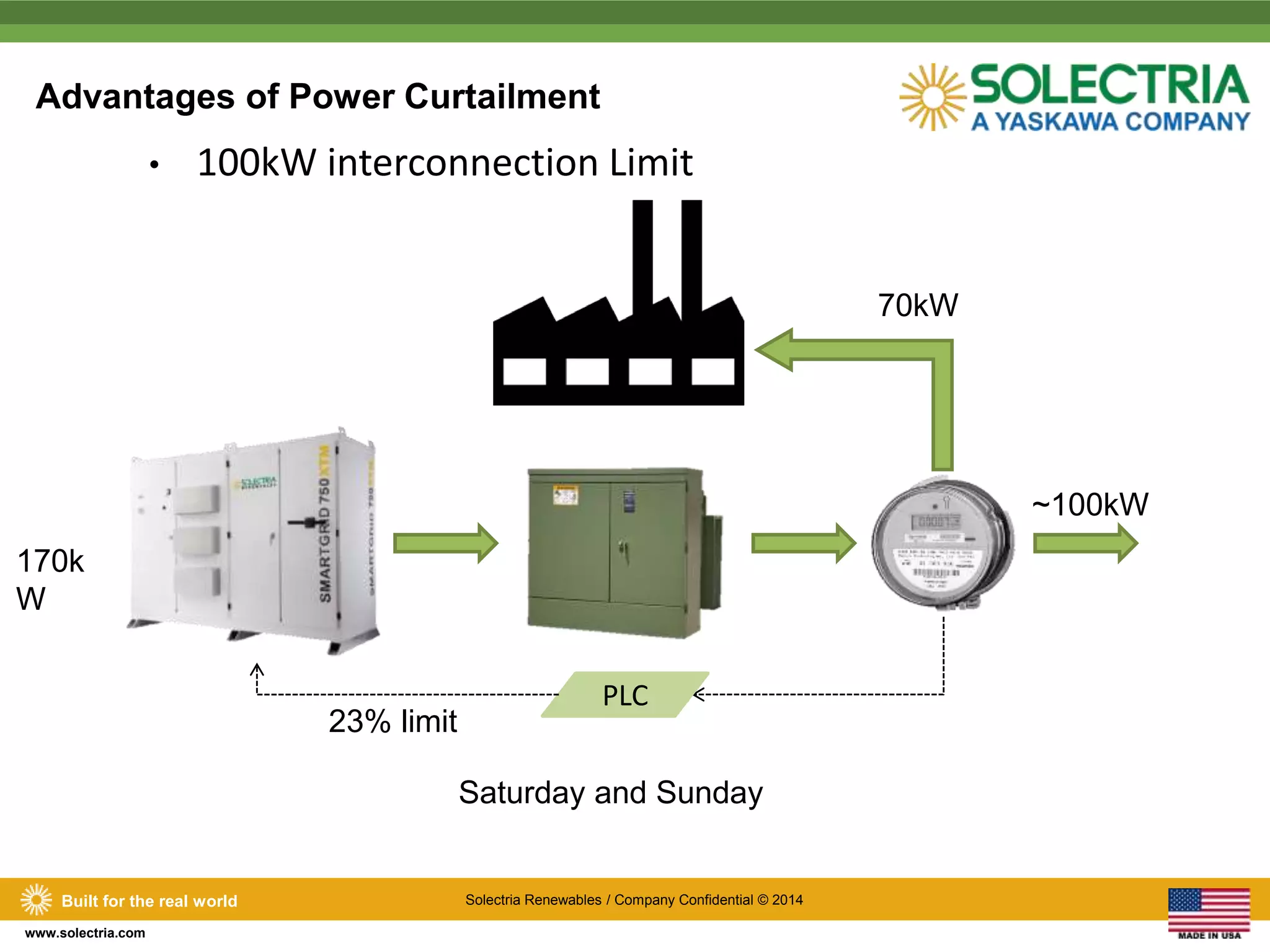
Advantages of Power Curtailment 
Built for the real world Solectria Renewables / Company Confidential © 2014 
www.solectria.com 
• 100kW interconnection Limit 
PLC 
700k 
W 
750k 
W 
~50k 
W 
Monday through Friday
Advantages of Power Curtailment 
• 100kW interconnection Limit 
Built for the real world Solectria Renewables / Company Confidential © 2014 
www.solectria.com 
PLC 
170k 
W 
70kW 
~100kW 
Saturday and Sunday 
23% limit
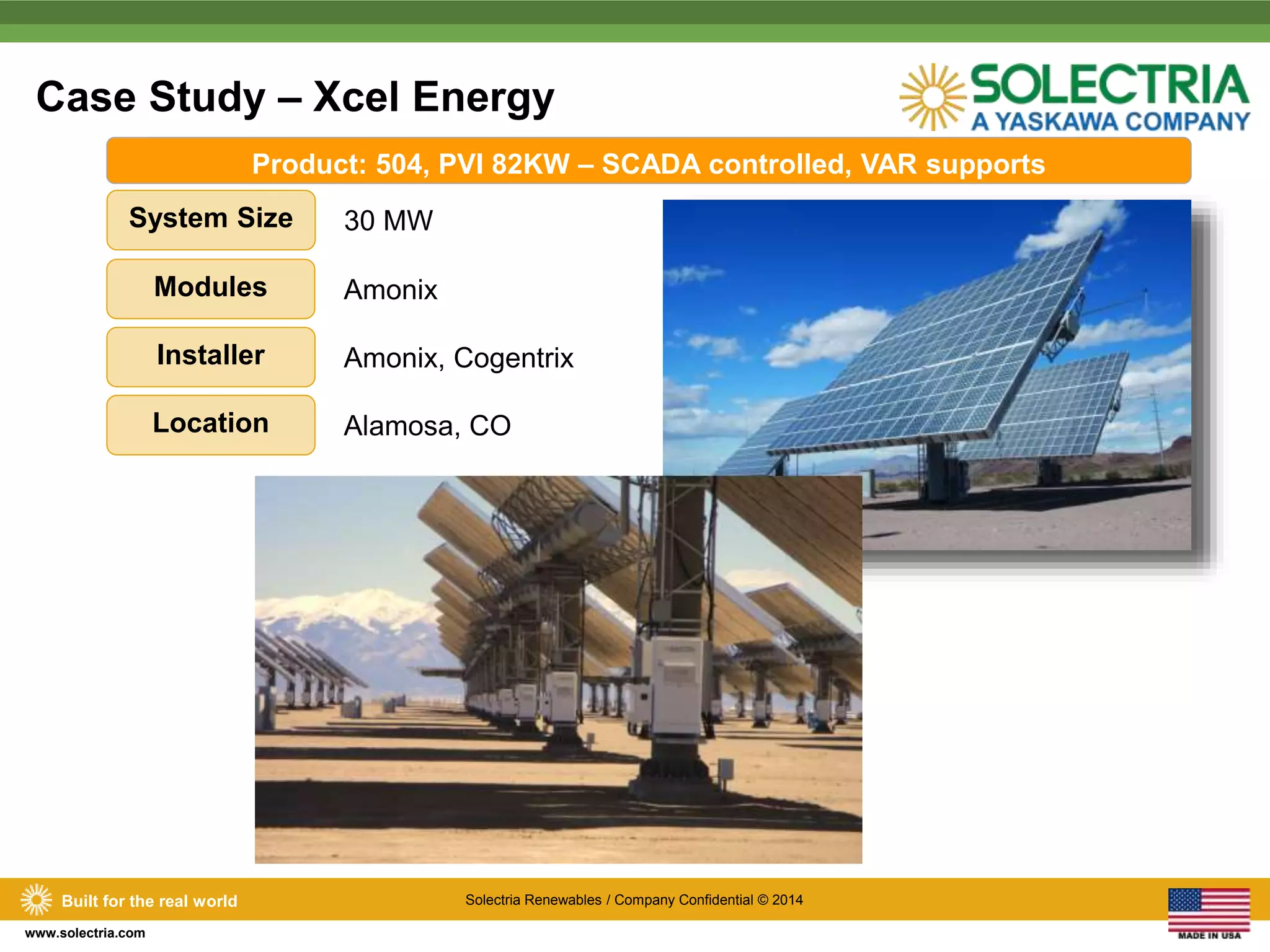
Case Study – Xcel Energy 
System Size 30 MW 
Built for the real world Solectria Renewables / Company Confidential © 2014 
www.solectria.com 
Product: 504, PVI 82KW – SCADA controlled, VAR supports 
Modules Amonix 
Installer Amonix, Cogentrix 
Location Alamosa, CO
Built for the real world Solectria Renewables / Company Confidential © 2014 
www.solectria.com 
Reactive Power
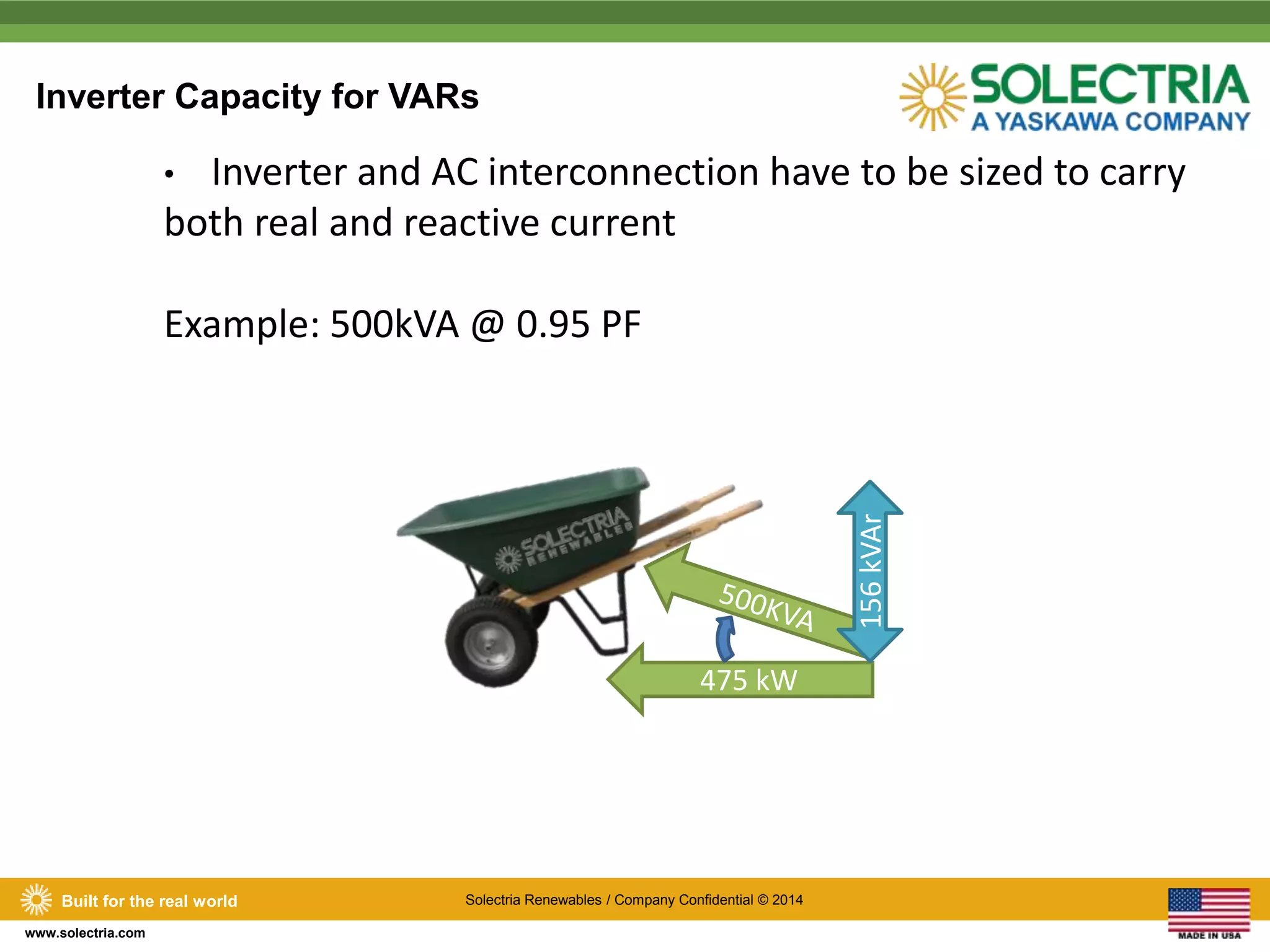
Inverter Capacity for VARs 
Built for the real world Solectria Renewables / Company Confidential © 2014 
www.solectria.com 
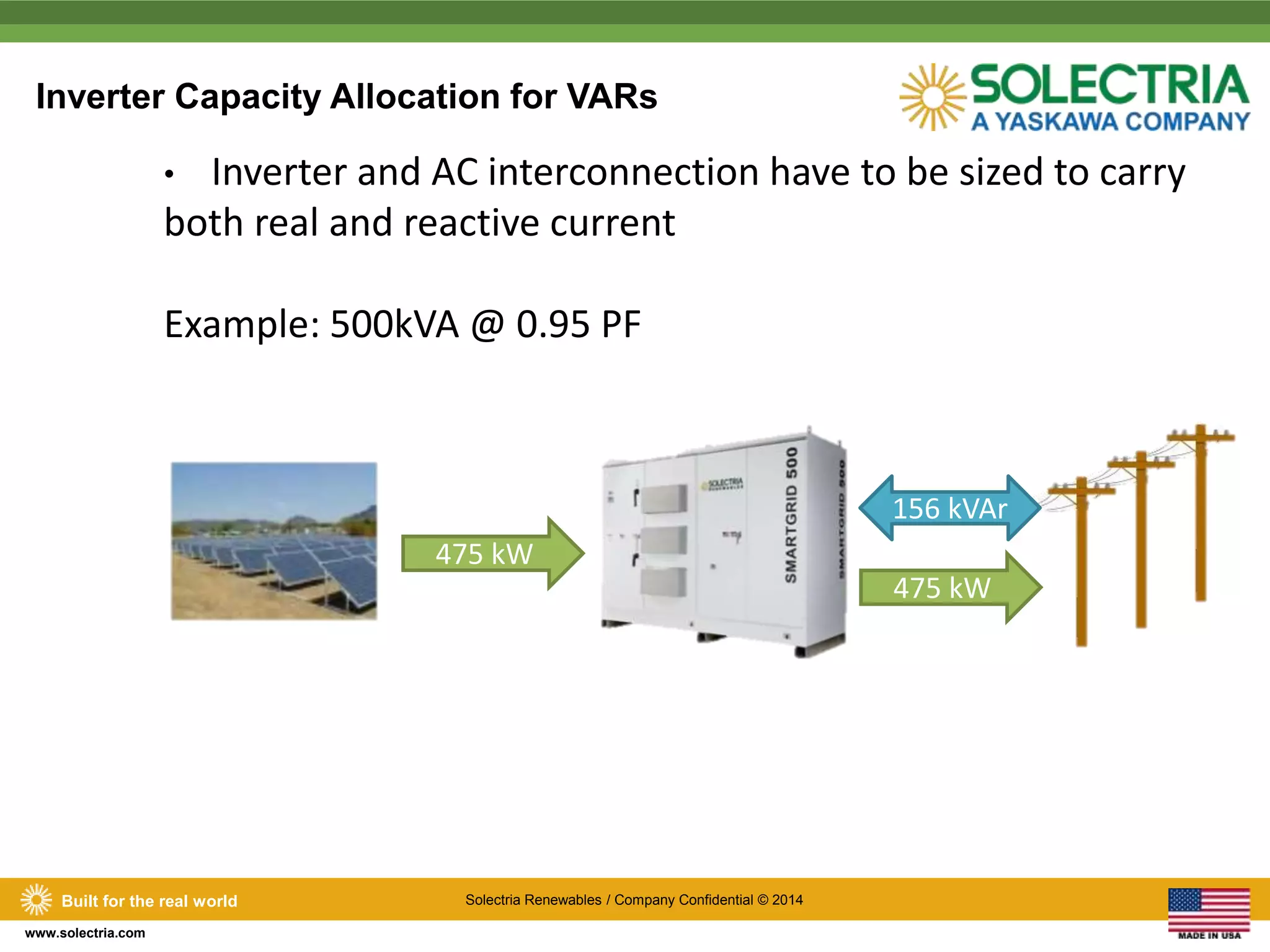
• Inverter and AC interconnection have to be sized to carry 
both real and reactive current 
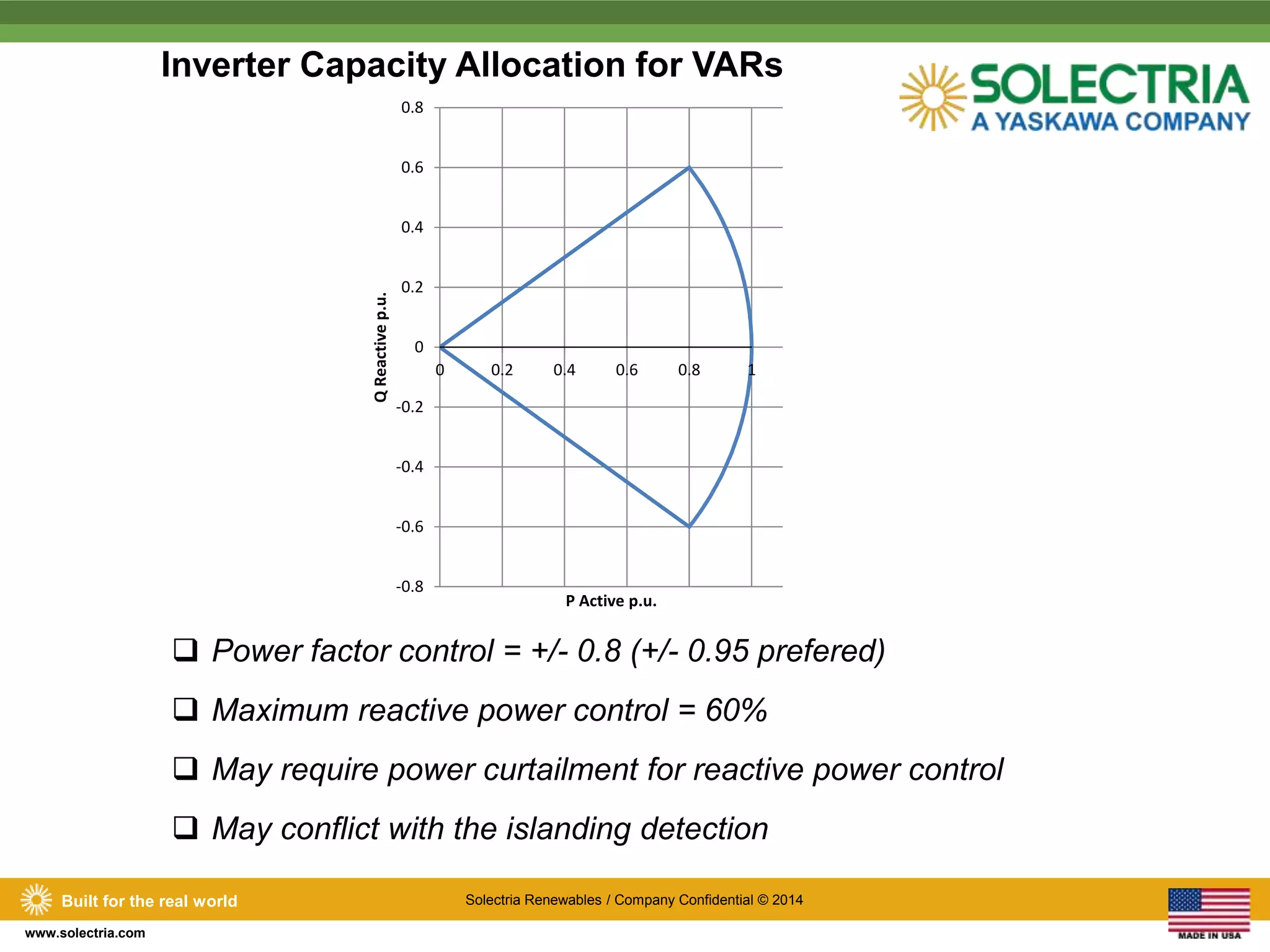
Example: 500kVA @ 0.95 PF 
475 kW 
156 kVAr
Inverter Capacity for VARs 
Built for the real world Solectria Renewables / Company Confidential © 2014 
www.solectria.com 
• Inverter and AC interconnection have to be sized to carry 
both real and reactive current 
Example: 500kVA @ 0.95 PF 
475 kW 
475 kW 
156 kVAr
Inverter Capacity Allocation for VARs 
Built for the real world Solectria Renewables / Company Confidential © 2014 
www.solectria.com 
• Inverter and AC interconnection have to be sized to carry 
both real and reactive current 
Example: 500kVA @ 0.95 PF 
475 kW 
156 kVAr 
475 kW
Inverter Capacity Allocation for VARs 
0.8 
0.6 
0.4 
0.2 
0 
-0.2 
-0.4 
-0.6 
-0.8 
0 0.2 0.4 0.6 0.8 1 
Q Reactive p.u. 
P Active p.u. 
Built for the real world Solectria Renewables / Company Confidential © 2014 
www.solectria.com 
 Power factor control = +/- 0.8 (+/- 0.95 prefered) 
 Maximum reactive power control = 60% 
 May require power curtailment for reactive power control 
 May conflict with the islanding detection
VAR support 
(remote utility option) 
1000 
800 
600 
400 
200 
0 
-720 -630 -540 -450 -360 -270 -180 -90 0 90 180 270 360 450 540 630 720 
-200 
-400 
-600 
-800 
-1000 
voltage current power (rms) real power (rms) 
Built for the real world Solectria Renewables / Company Confidential © 2014 
www.solectria.com 
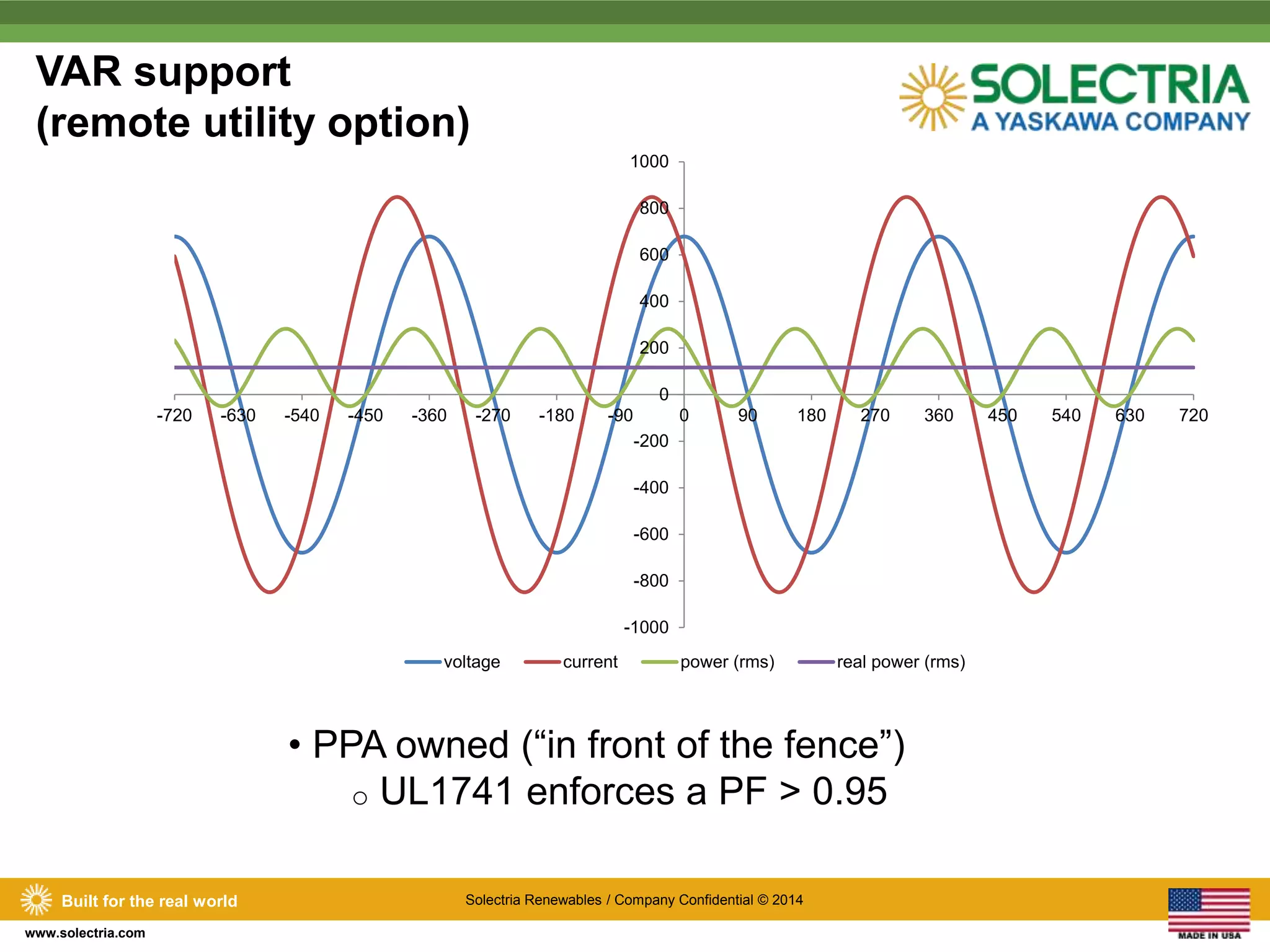
• PPA owned (“in front of the fence”) 
o UL1741 enforces a PF > 0.95
Built for the real world Solectria Renewables / Company Confidential © 2014 
www.solectria.com 
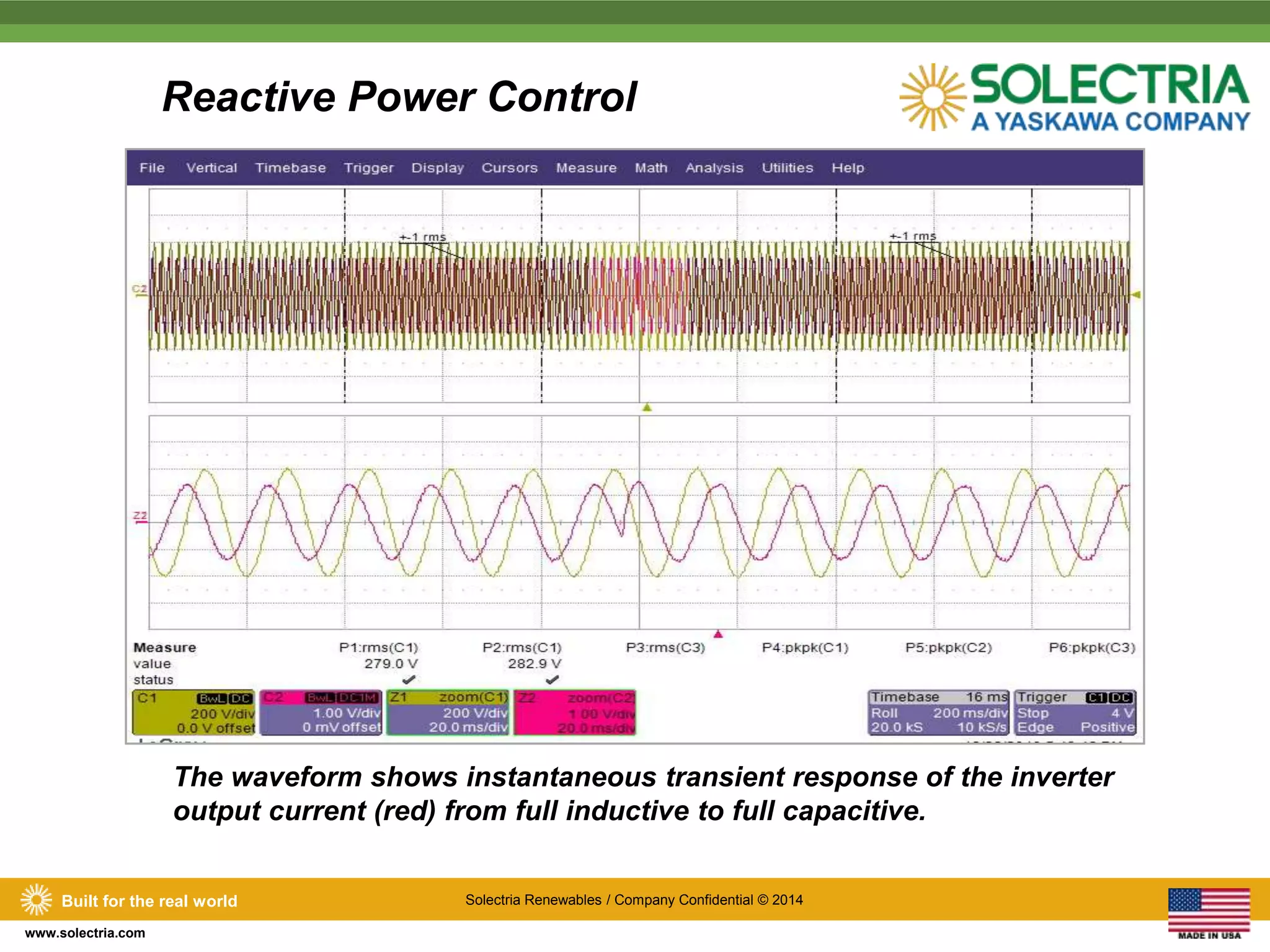
Reactive Power Control 
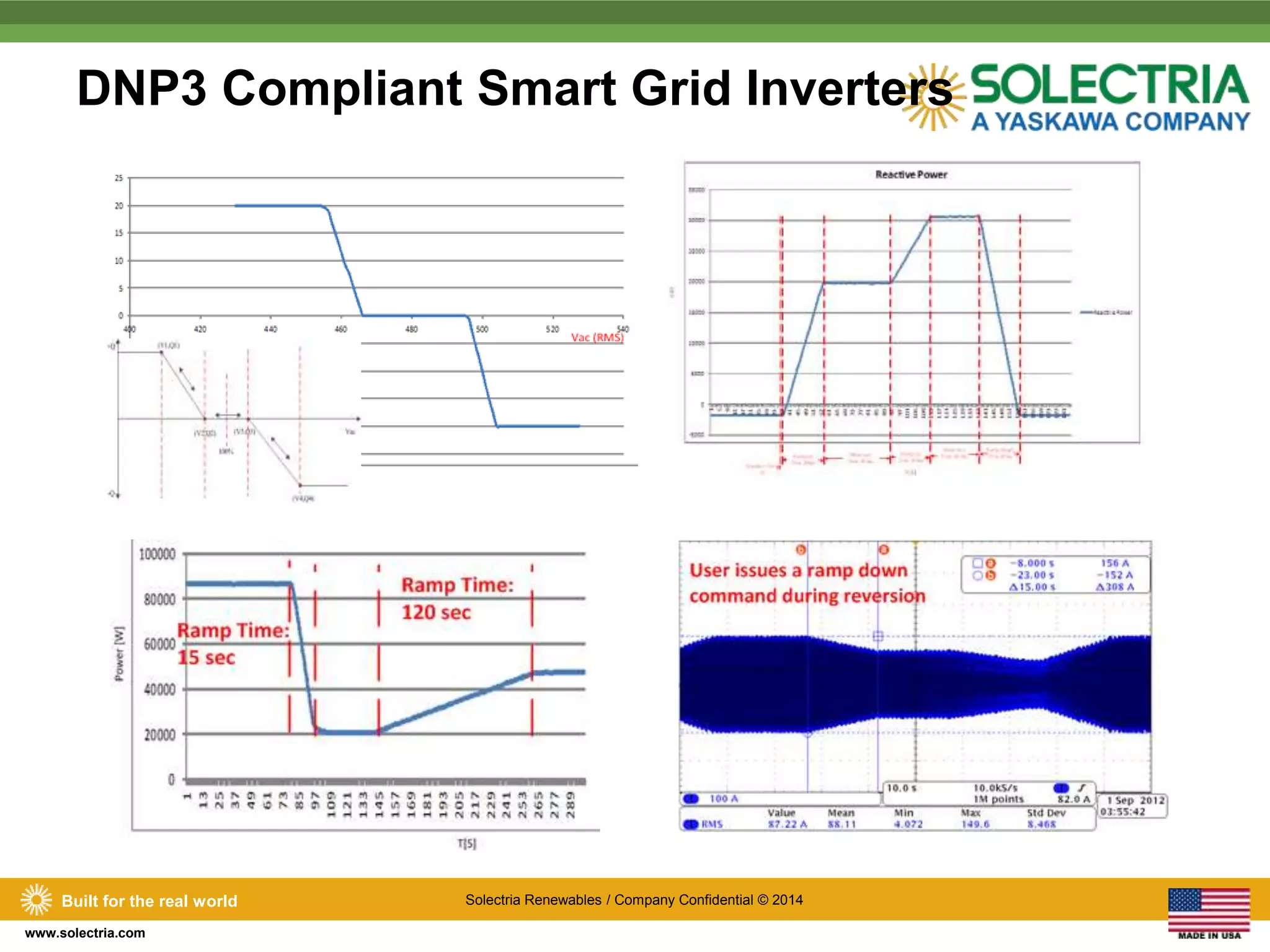
The waveform shows instantaneous transient response of the inverter 
output current (red) from full inductive to full capacitive.
DNP3 Compliant Smart Grid Inverters 
Built for the real world Solectria Renewables / Company Confidential © 2014 
www.solectria.com
High Penetration Scenario Example: 
Built for the real world Solectria Renewables / Company Confidential © 2014 
www.solectria.com 
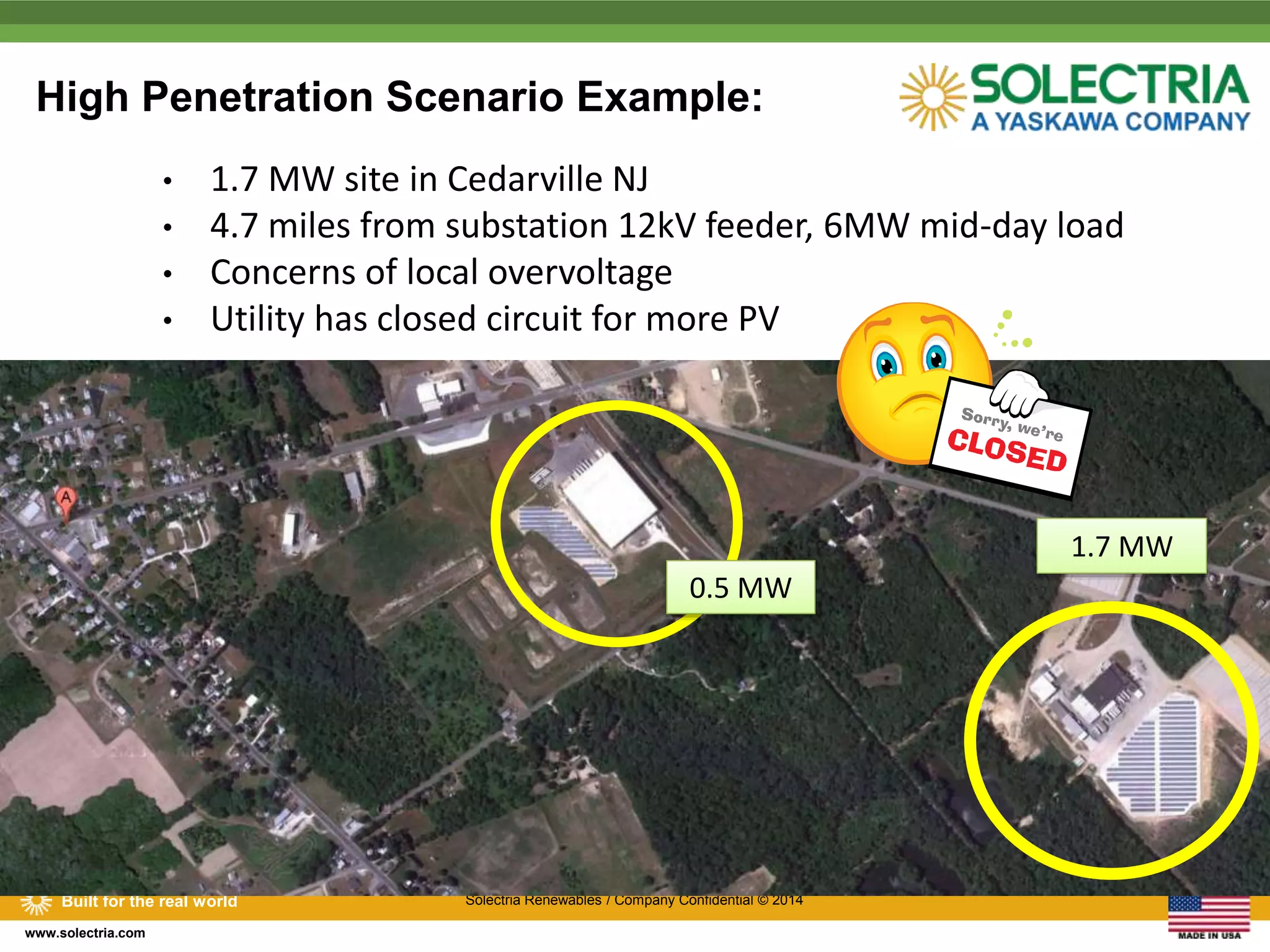
• 1.7 MW site in Cedarville NJ 
• 4.7 miles from substation 12kV feeder, 6MW mid-day load 
• Concerns of local overvoltage 
• Utility has closed circuit for more PV 
0.5 MW 
1.7 MW
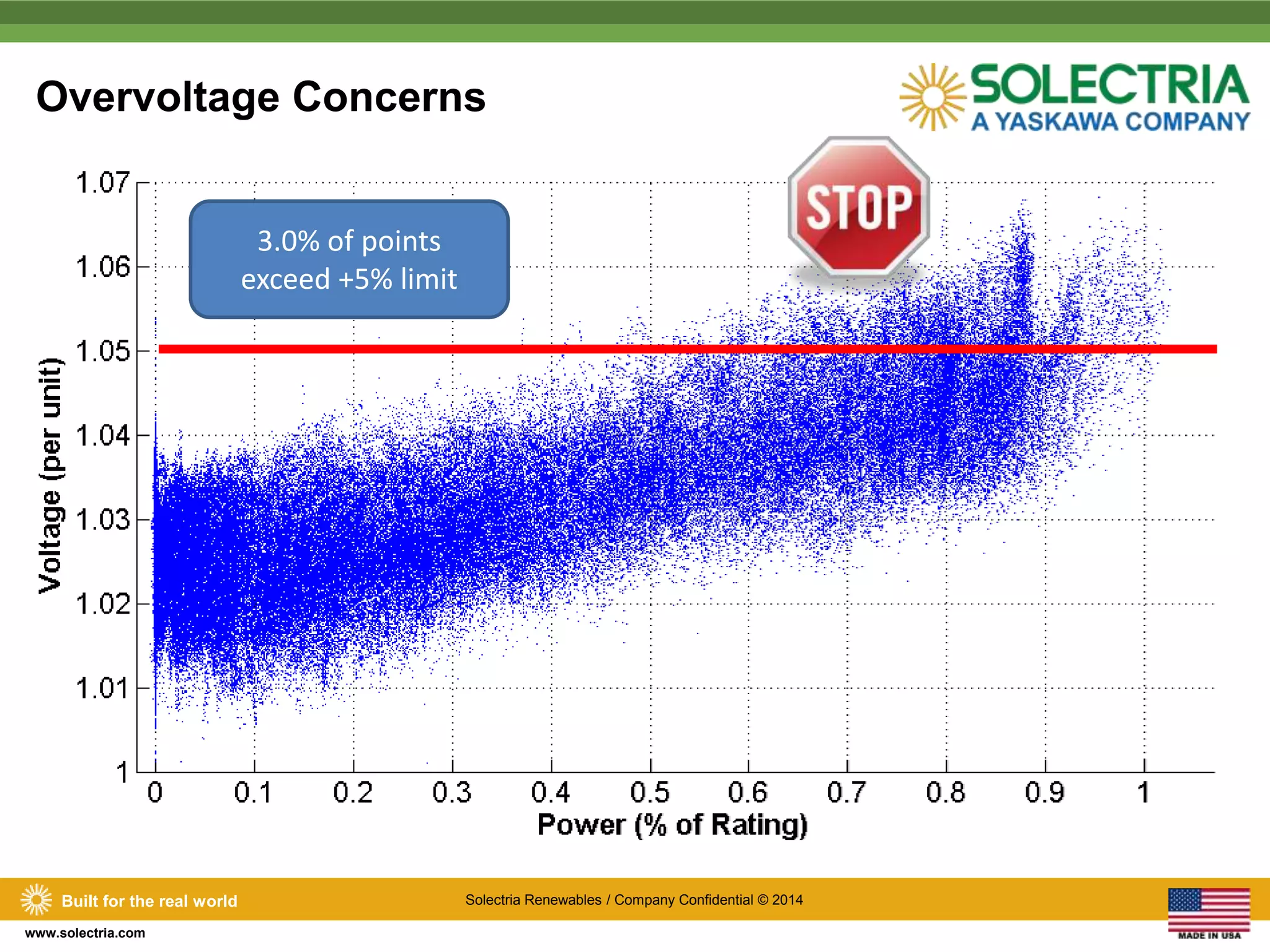
Overvoltage Concerns 
Built for the real world Solectria Renewables / Company Confidential © 2014 
www.solectria.com 
3.0% of points 
exceed +5% limit
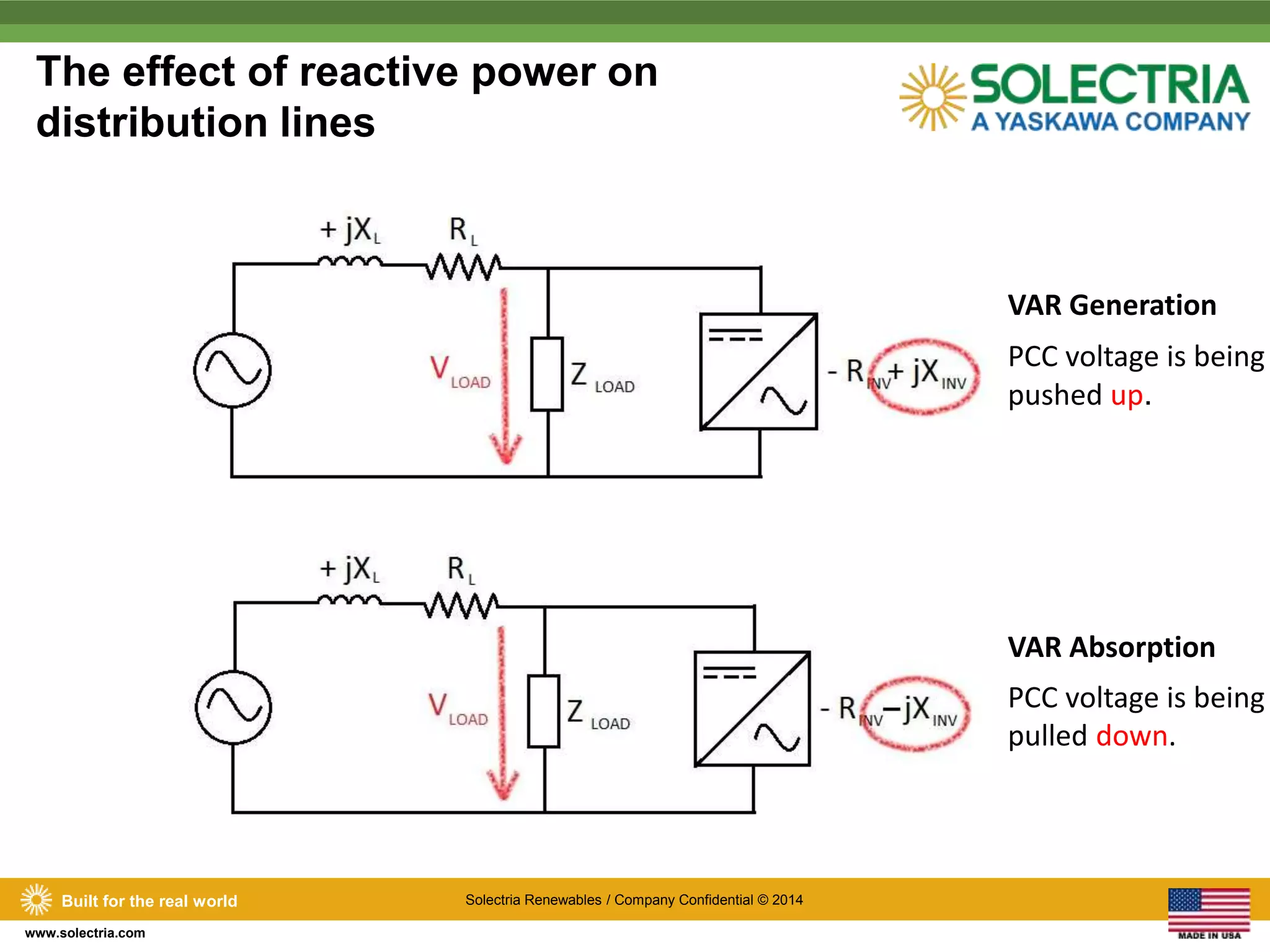
The effect of reactive power on 
distribution lines 
Built for the real world Solectria Renewables / Company Confidential © 2014 
www.solectria.com 
VAR Generation 
PCC voltage is being 
pushed up. 
VAR Absorption 
PCC voltage is being 
pulled down.
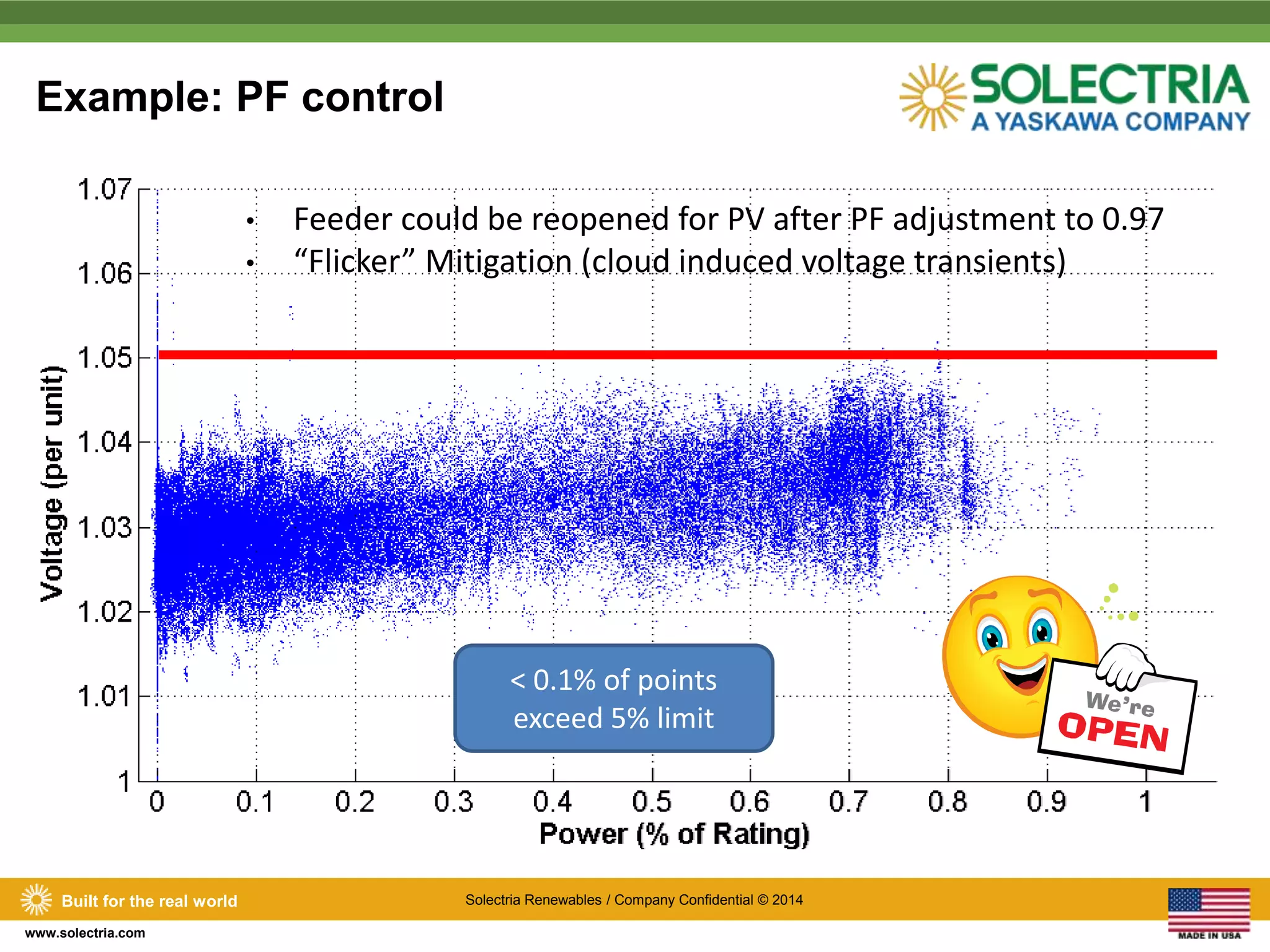
Example: PF control 
Built for the real world Solectria Renewables / Company Confidential © 2014 
www.solectria.com 
• Feeder could be reopened for PV after PF adjustment to 0.97 
• “Flicker” Mitigation (cloud induced voltage transients) 
< 0.1% of points 
exceed 5% limit
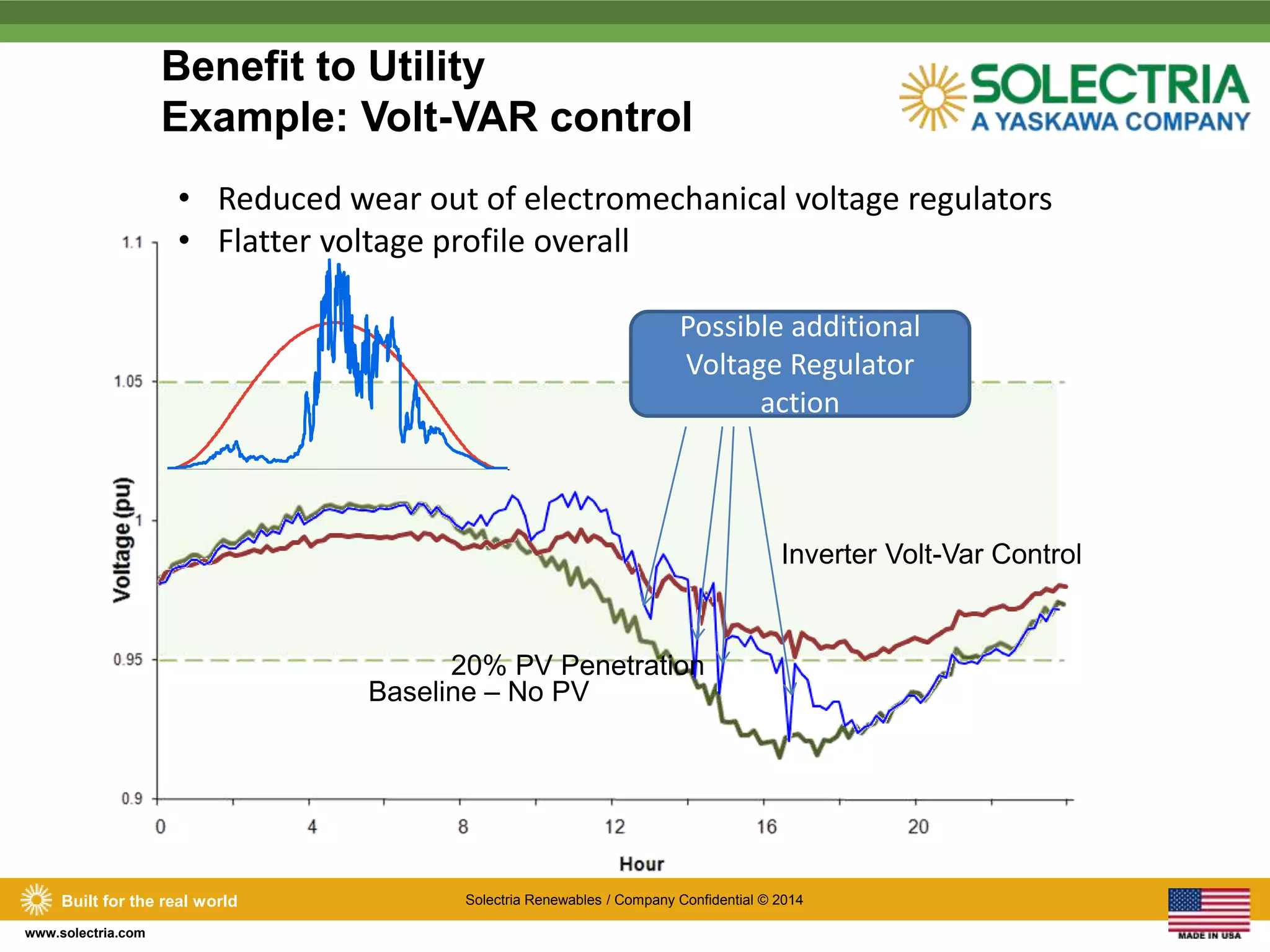
Benefit to Utility 
Example: Volt-VAR control 
• Reduced wear out of electromechanical voltage regulators 
• Flatter voltage profile overall 
Possible additional 
Voltage Regulator 
Built for the real world Solectria Renewables / Company Confidential © 2014 
www.solectria.com 
Baseline – No PV 
Inverter Volt-Var Control 
20% PV Penetration 
action
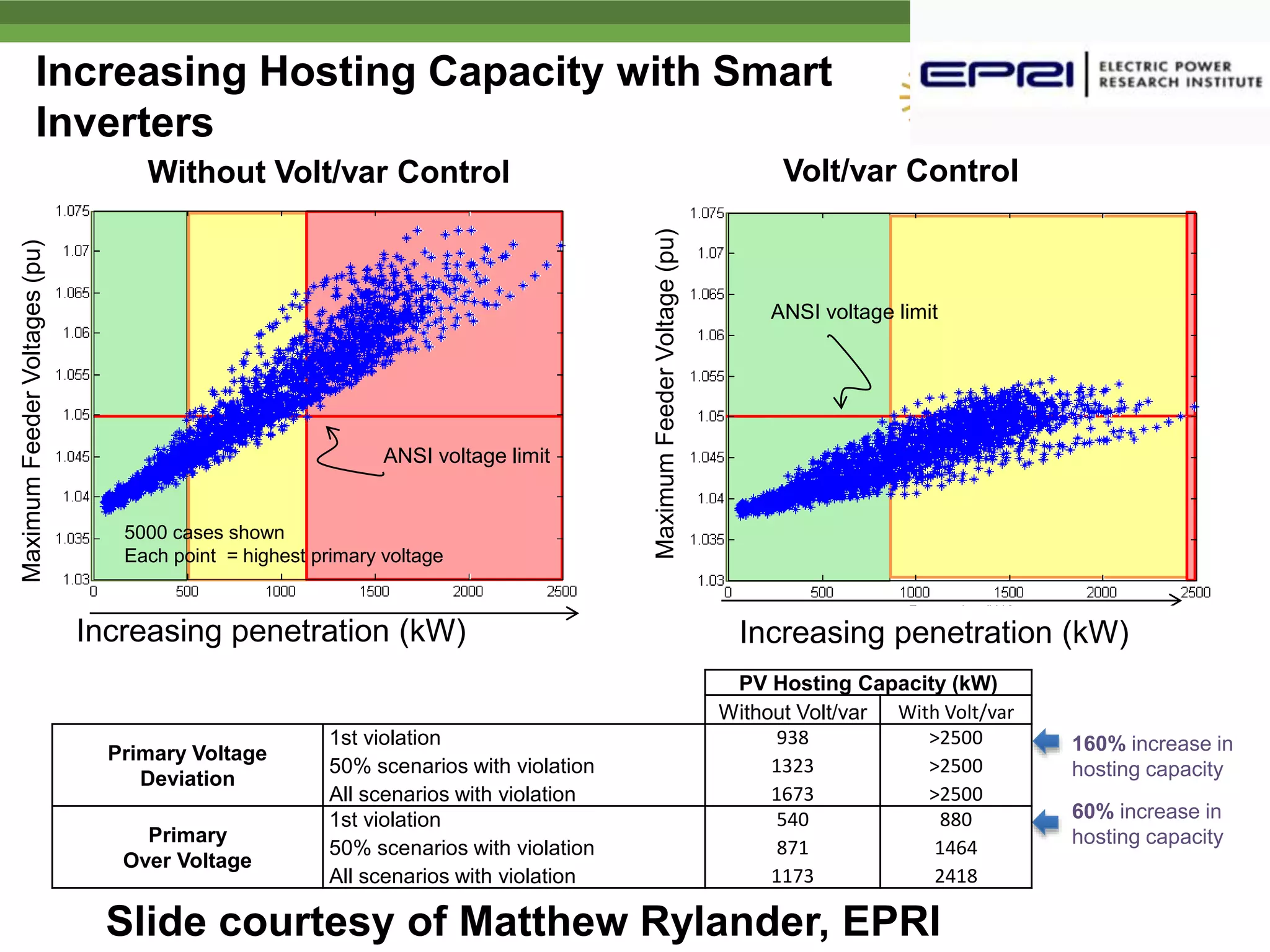
Increasing Hosting Capacity with Smart 
Inverters 
Without Volt/var Control Volt/var Control 
ANSI voltage limit 
Increasing penetration (kW) 
Built for the real world Solectria Renewables / Company Confidential © 2014 
www.solectria.com 
Matthew Rylander 
5000 cases shown 
Each point = highest primary voltage 
ANSI voltage limit 
160% increase in 
hosting capacity 
60% increase in 
hosting capacity 
Maximum Feeder Voltage (pu) 
Maximum Feeder Voltages (pu) 
Increasing penetration (kW) 
No observable violations regardless of size/location 
Possible violations based upon size/location 
Observable violations occur regardless of 
size/location 
PV Hosting Capacity (kW) 
Without Volt/var With Volt/var 
Primary Voltage 
Deviation 
1st violation 938 >2500 
50% scenarios with violation 1323 >2500 
All scenarios with violation 1673 >2500 
Primary 
Over Voltage 
1st violation 540 880 
50% scenarios with violation 871 1464 
All scenarios with violation 1173 2418 
Slide courtesy of Matthew Rylander, EPRI
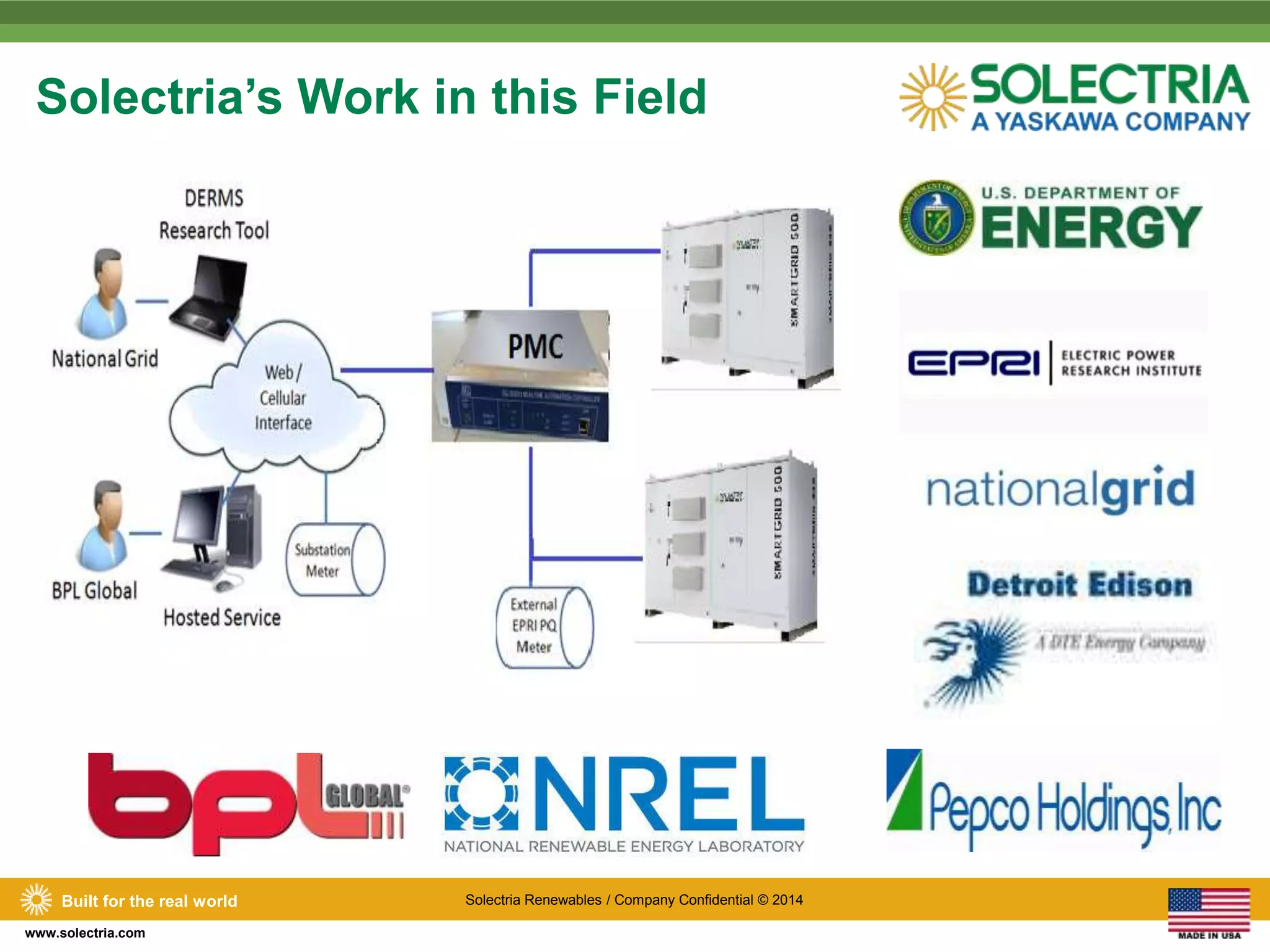
Solectria’s Work in this Field 
Built for the real world Solectria Renewables / Company Confidential © 2014 
www.solectria.com
o Smart Grid Ready Inverter Development 
 Implement and test grid support functions on existing 
Built for the real world Solectria Renewables / Company Confidential © 2014 
www.solectria.com 
commercial and utility scale inverters. 
 Add DNP3 communication capability on to the existing inverters 
 Hardware reliability enhancement and efficiency increase 
 Cost Reduction 
o Plant Master Controller Development 
 Support smart grid inverters with the latest DNP3 protocol 
 Plant level supervisory controller with customizable system 
integration capability 
 Secondary protection and preventive maintenance
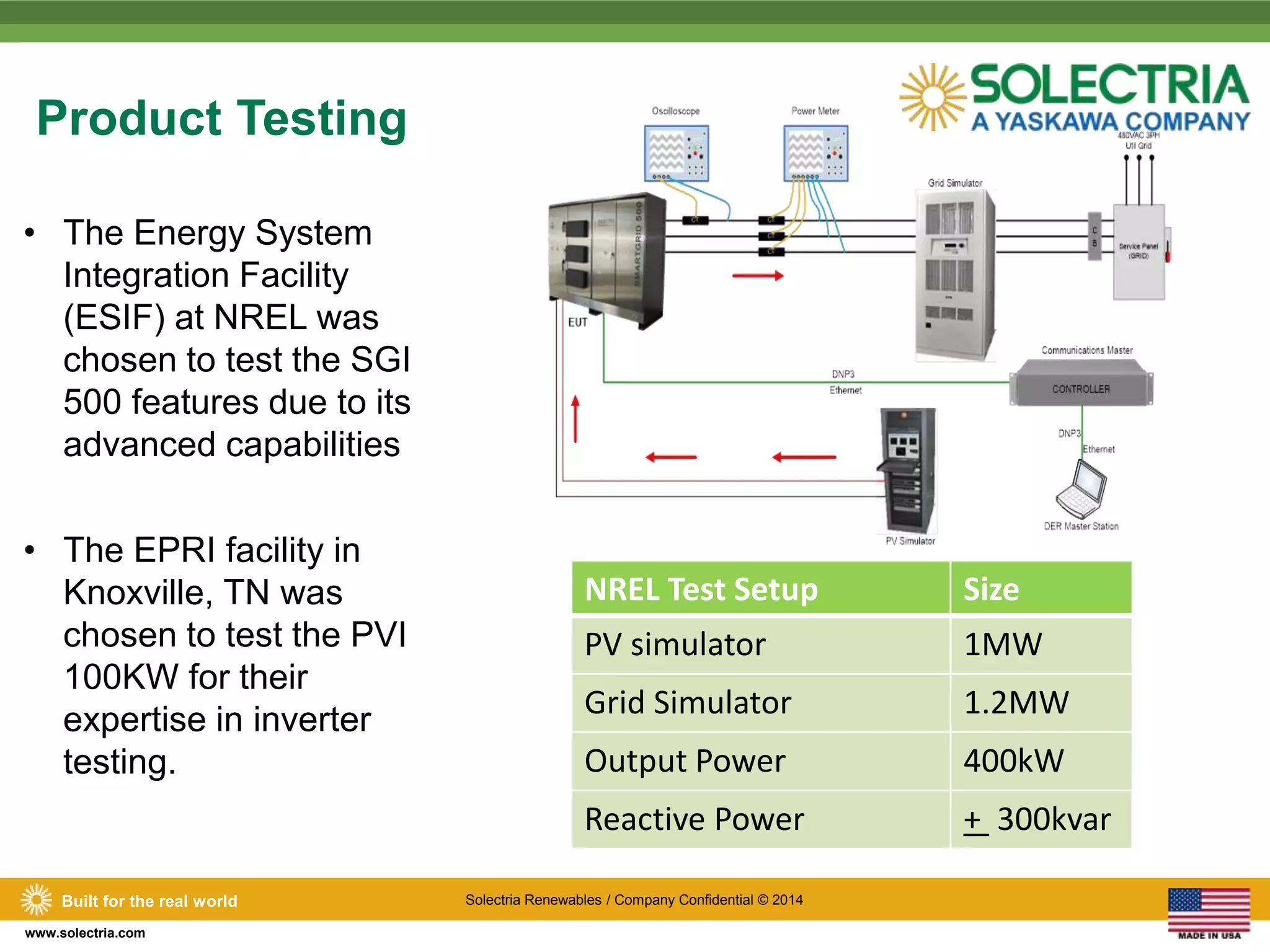
Product Testing 
• The Energy System 
Integration Facility 
(ESIF) at NREL was 
chosen to test the SGI 
500 features due to its 
advanced capabilities 
• The EPRI facility in 
Knoxville, TN was 
chosen to test the PVI 
100KW for their 
expertise in inverter 
testing. 
Built for the real world Solectria Renewables / Company Confidential © 2014 
www.solectria.com 
NREL Test Setup Size 
PV simulator 1MW 
Grid Simulator 1.2MW 
Output Power 400kW 
Reactive Power + 300kvar
Built for the real world Solectria Renewables / Company Confidential © 2014 
www.solectria.com 
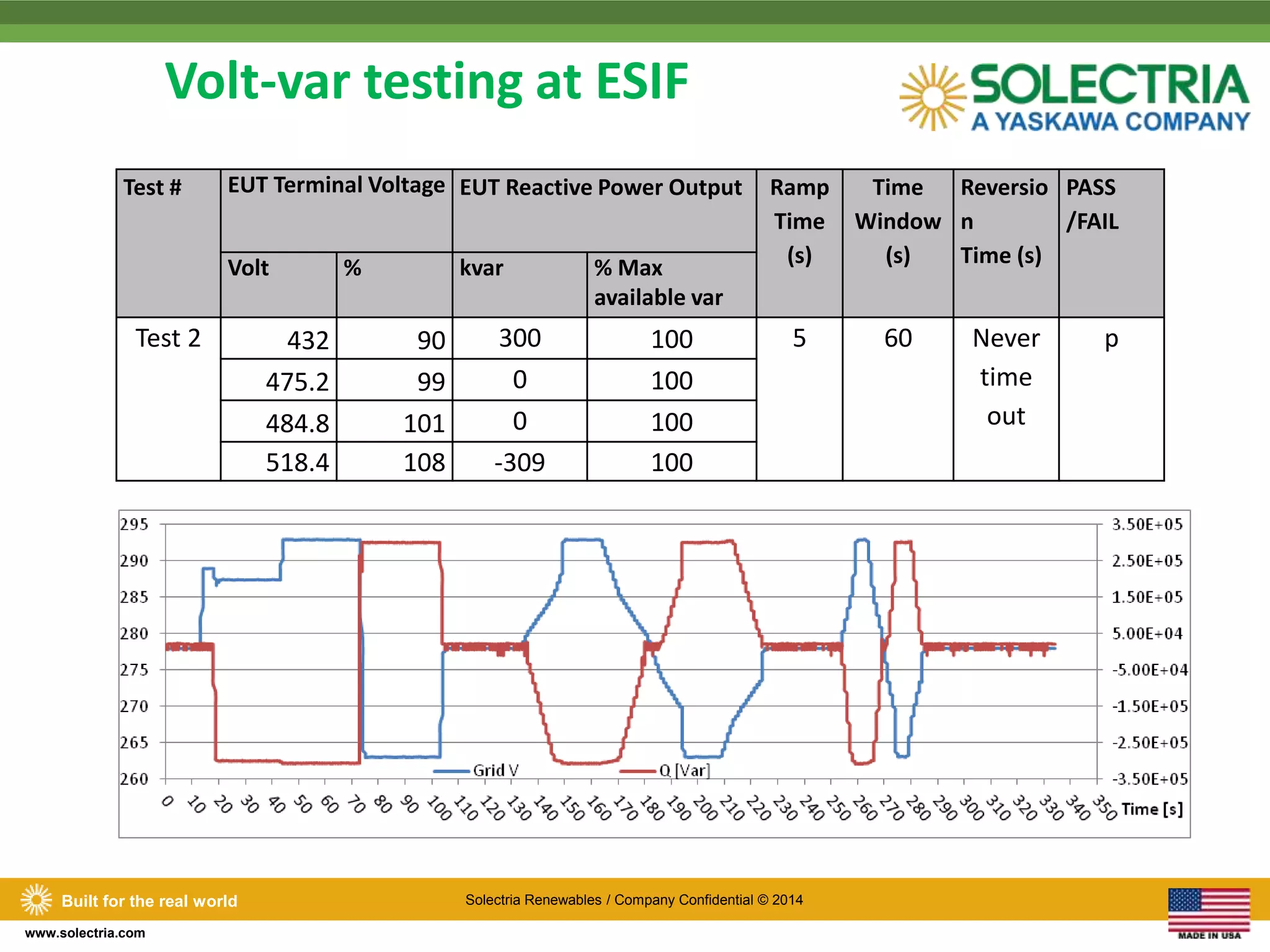
Volt-var testing at ESIF 
Test # EUT Terminal Voltage EUT Reactive Power Output Ramp 
Time 
(s) 
Time 
Window 
(s) 
Reversio 
n 
Time (s) 
PASS 
/FAIL 
Volt % kvar % Max 
available var 
Test 2 432 90 300 100 5 60 Never 
time 
out 
p 
475.2 99 0 100 
484.8 101 0 100 
518.4 108 -309 100
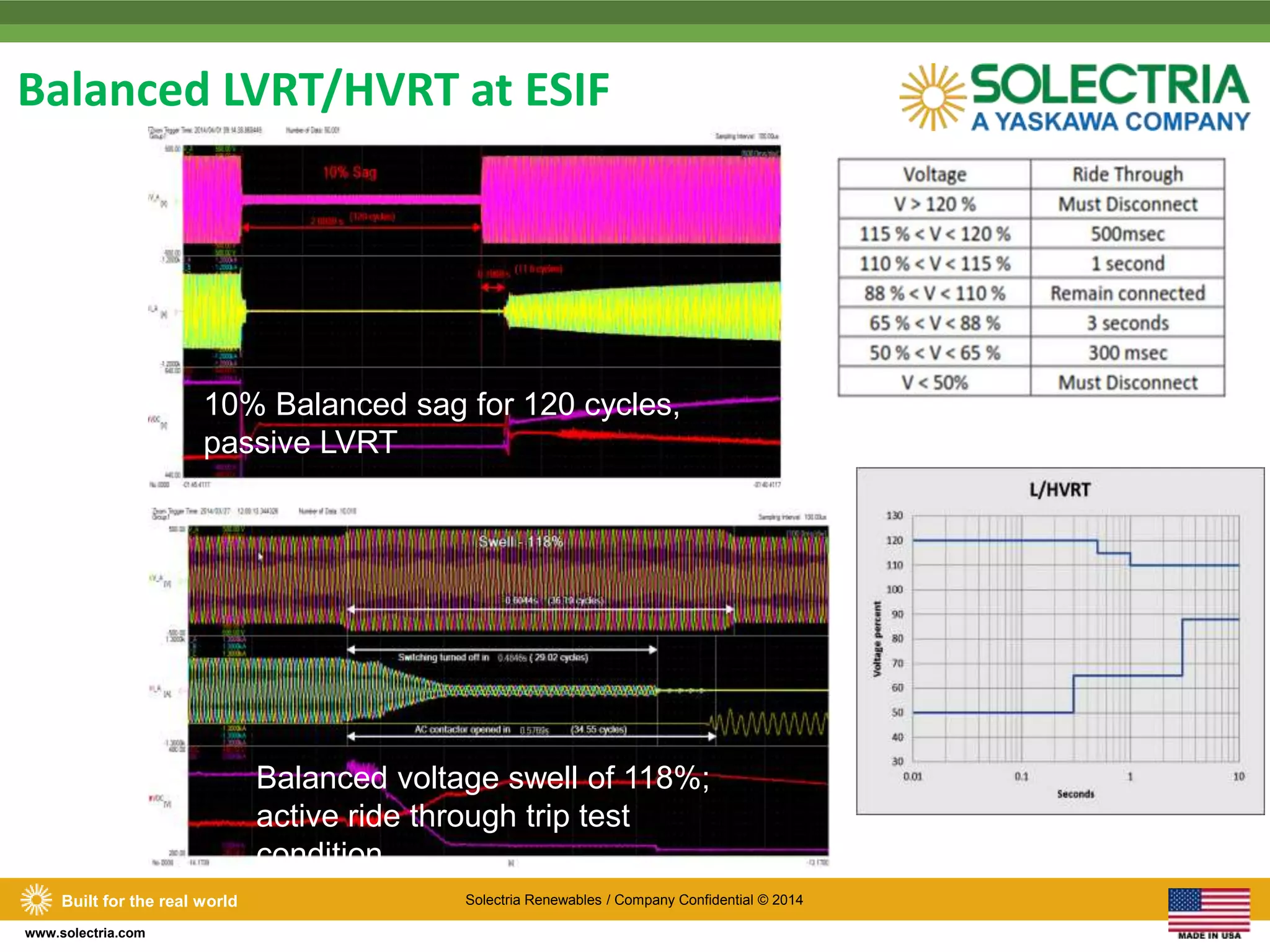
Balanced LVRT/HVRT at ESIF 
Built for the real world Solectria Renewables / Company Confidential © 2014 
www.solectria.com 
10% Balanced sag for 120 cycles, 
passive LVRT 
Balanced voltage swell of 118%; 
active ride through trip test 
condition
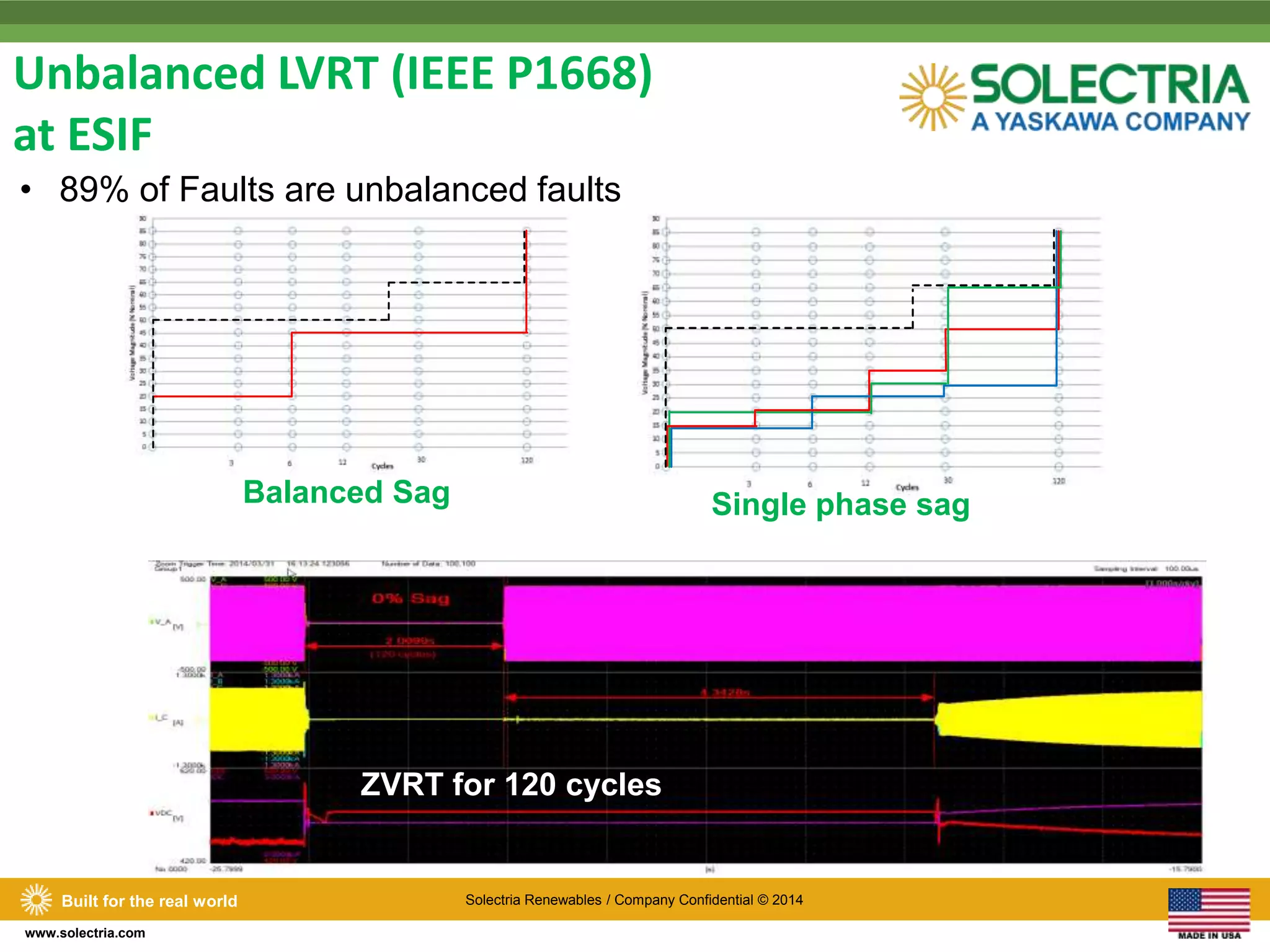
Unbalanced LVRT (IEEE P1668) 
at ESIF 
• 89% of Faults are unbalanced faults 
Balanced Sag Single phase sag 
Built for the real world Solectria Renewables / Company Confidential © 2014 
www.solectria.com 
ZVRT for 120 cycles
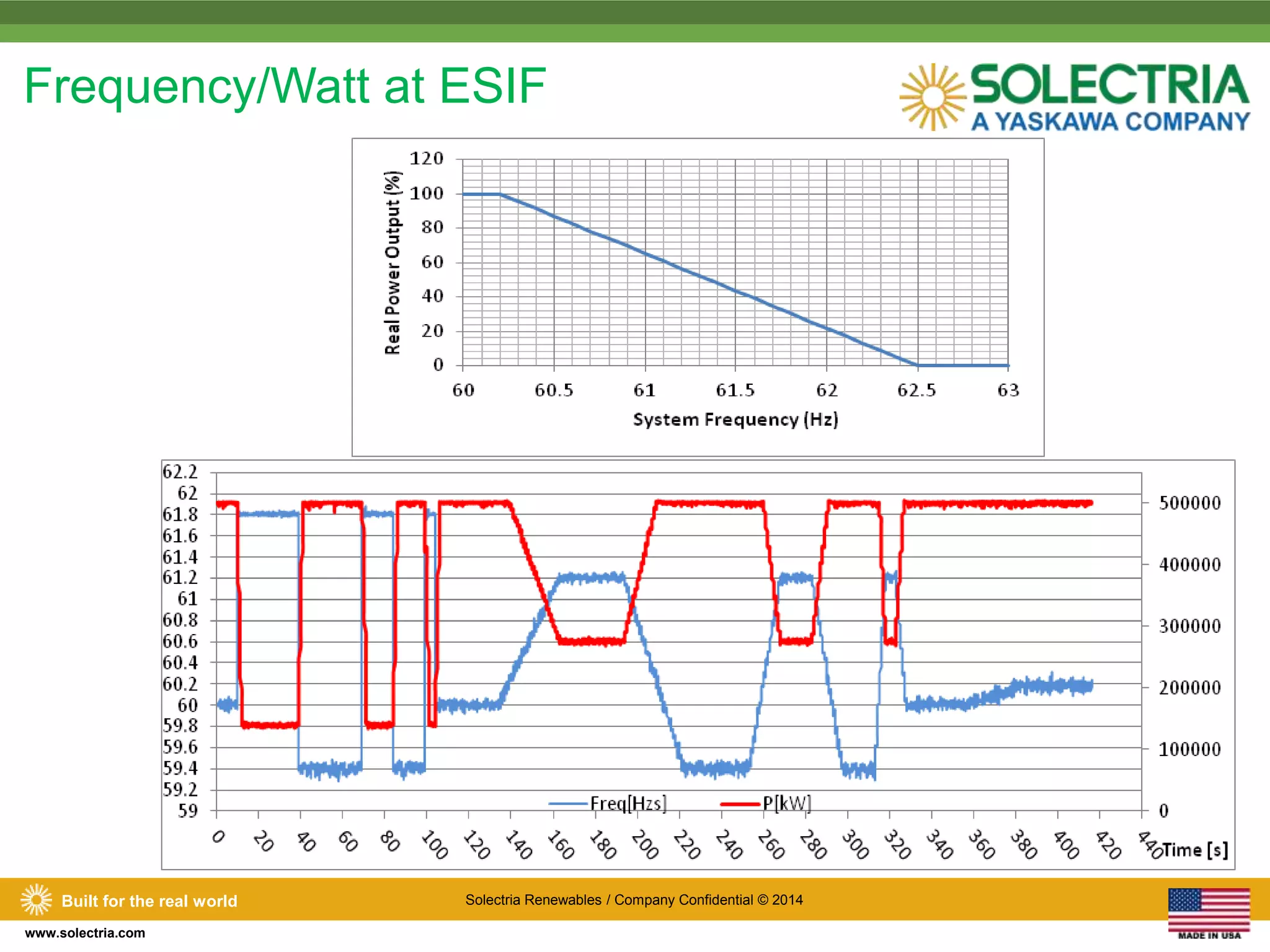
Frequency/Watt at ESIF 
Built for the real world Solectria Renewables / Company Confidential © 2014 
www.solectria.com
Watts, Hz and Volts 
• Utilities like their “Volts” and “Hz” to stay within boundaries. 
• When generation is High (+Watts) system wide frequency rises 
(+Hz) 
 Functions that control “Watts” depending on “Hz”, such as 
Frequency-Watt, are essential for being a good citizen on the grid. 
• An increase in generation (+Watts) results in a local increase in 
Voltage (+Volts) 
 Functions that control “Watts” depending on ”Volts”, such as Volt- 
Watt, can be useful to regulate local voltage when the vars are 
exhausted. 
Built for the real world Solectria Renewables / Company Confidential © 2014 
www.solectria.com
Built for the real world Solectria Renewables / Company Confidential © 2014 
www.solectria.com 
Questions?
Thank You! 
One size doesn’t fit all, 
But one company does 
Built for the real world Solectria Renewables / Company Confidential © 2014 
www.solectria.com

Solectria Smart Inverters, Effective Grounding, and how to work with the Utility

  • 1.
    Built for thereal world Solectria Renewables / Company Confidential © 2014 www.solectria.com Being Good Citizens of the Grid Claude Colp Applications Engineer Claude.colp@solectria.com @ClaudeColp
  • 2.
    Introduction 1. CompanyOverview 2. Relays 27, 59, 81, ect. 3. Effective Grounding 4. Power curtailment 5. Power Factor 6. Reactive power support 7. Solectria’ s work at ESIF 8. Reactive power support Built for the real world Solectria Renewables / Company Confidential © 2014 www.solectria.com Solectria Renewables Lawrence, MA
  • 3.
    Built for thereal world Solectria Renewables / Company Confidential © 2014 www.solectria.com Company Overview
  • 4.
    25 Year DevelopmentHistory • Inverter power stage technology developed over 25 years of automotive and military applications • Proven reliability in harsh conditions Built for the real world Solectria Renewables / Company Confidential © 2014 www.solectria.com Efficient Powerful Reliable Rugged Commercial, Utility-Scale, and Residential PV Inverters Compact Low Cost EV Drives
  • 5.
    Solectria History Solectriadivests vehicle products to Azure Dynamics Original 10kW UL Listed Solectria Corporation Founded Introduced the SGI 500XTM & SGI 750XTM External Transformer 1989 2005 2006 2007 2008 2009 2010 2011 2012 Built for the real world Solectria Renewables / Company Confidential © 2014 www.solectria.com 60/82/95KW UL Listed SolrenView Web Monitoring Introduced Capacity Expansion to 200MW PVI 60/77/90KW UL Listed PVI 13-15KW UL Listed PVI 3000-5300 Introduced MSS Introduced Capacity Expansion to 800MW Disconnecting String Combiners Introduced PVI 3800-7600TL, PVI 14-28TL, 3-phase transformerless inverters SGI 500XT transformerless 600V DC inverter introduced 2013 2014 1Ph transformerless inverters Introduced SGI 500 Premium Efficiency model with 97.5% CEC efficiency – highest in the industry Capacity Expansion to 350MW Introduced PVI 50/60/75/85/100KW & Premium Efficiency Models • 1989 – Solectria Corporation founded • 2005 – Solectria Corp. EV division sold to Azure Dynamics • 2005 – Solectria Renewables founded • 2014 – Solectria became wholly owned subsidiary of Yaskawa Electric Solectria Renewables Founded SGI Series UL Listed New SolrenView GUI Introduced Yaskawa Electric Acquires Solectria Renewables as wholly owned subsidiary ARCCOM (AFDI String Combiner) Introduction
  • 6.
    Yaskawa and Solectria Yaskawa Electric Corp: • $3.6 billion Japanese firm focused on motor drives, automation controls and other electrical components • Company founded in 1915 • 5th largest Japanese inverter supplier, but no U.S. presence • Global leader in quality • Manufacturing locations in strategic PV markets • Track record for technological advancement and leadership Built for the real world Solectria Renewables / Company Confidential © 2014 www.solectria.com
  • 7.
    Yaskawa and Solectria So what does this mean for our customers?  Immediately enhanced bankability  Warranty backing by bigger company  Solectria is 100% wholly owned subsidiary  Same team in place as before (sales, marketing, customer services, executives)  Same manufacturing locations and product offerings  Potential for new market entry in the future  Access to world class quality systems Built for the real world Solectria Renewables / Company Confidential © 2014 www.solectria.com
  • 8.
    2014 Company Highlights • Introduction of three-phase string inverters • Introduction of ARCCOM arc fault detection and rapid shutdown combiner boxes for 600VDC and 1000VDC central inverters • Introduction of SGI 500XTM and SGI 750XTM • Acquisition of Solectria Renewables by Yaskawa Electric Corp. Built for the real world Solectria Renewables / Company Confidential © 2014 www.solectria.com
  • 9.
    Built for thereal world Solectria Renewables / Company Confidential © 2014 www.solectria.com Protective Relaying
  • 10.
    (Digital) Protective Relays “Microprocessor based devices that that control PV plant in response to voltage and current measurement” USED WITH: Built for the real world Solectria Renewables / Company Confidential © 2014 www.solectria.com … Interconnection Breaker … Instrument Transformers Potential Transformers (PTs) … for measuring Voltage Current Transformers (CTs) … for measuring Current …Sometimes Uninterruptible Power Supply (UPS)… for Powering Relay when grid goes down (not required in all systems) “I thought inverters had voltage/frequency trip setpoints??!!  They do. Required when utility desires Additional or Redundant protection Made by companies like SEL, ABB, Cooper, GE, …
  • 11.
    ANSI Device Numbers “Standard numbers used by utilities/relay companies to indicate protective function” Built for the real world Solectria Renewables / Company Confidential © 2014 www.solectria.com From PVI 50-100 Installation Manual
  • 12.
    Example One Line …Showing Protective Relay w/ ANSI Device Numbers Built for the real world Solectria Renewables / Company Confidential © 2014 www.solectria.com
  • 13.
    Utility Control Whatis SCADA? Built for the real world Solectria Renewables / Company Confidential © 2014 www.solectria.com “Supervisory Control and Data Acquisition” = Control and Monitoring What would utility want to control?  On/Off (Remote shut down)  Ramp rate  Real Power/Reactive Power/PF How is this implemented?  Control of Interconnection Breaker  24V Remote Shutdown  Shunt Trip  Modbus RTU, Modbus TCP, DNP3 Utility usually interfaces with inverters through RTU’s, Protective Relays, Plant Controller
  • 14.
    Example One Line …Showing the pieces INVERTERS INVERTERS INVERTERS Built for the real world Solectria Renewables / Company Confidential © 2014 www.solectria.com I
  • 15.
    Built for thereal world Solectria Renewables / Company Confidential © 2014 www.solectria.com Effective Grounding of PV inverters
  • 16.
    Non-Grounded Synchronous DG Distribution CB COLOPSEEND Va = Vb = Vc = 100% Built for the real world Solectria Renewables / Company Confidential © 2014 www.solectria.com Feeder Load Vb = Vc = 173% SLG Fault Sync. Gen. Consider an islanded operation where the grid is disconnected and a single line to ground fault is applied to the island. Generator neutral shift generates the over-voltages on unfaulted phases. Single phase loads can be damaged from the overvoltage.
  • 17.
    Solidly Grounding SynchronousDG Distribution CB Va = Vb = Vc = 100% Grounding the generator neutral prevents over-voltages on unfaulted phases. Built for the real world Solectria Renewables / Company Confidential © 2014 www.solectria.com Feeder Load COLOPSEEND SLG Fault Sync. Gen. Vb = Vc = 100% Effective Grounding allows 125% over-voltage and impedance grounding (for protection relay coordination) 푋0 푋1 < 3, 푅0 푋1 < 1 Ref: IEEE Std. 142, IEEE Std. C62.92 series
  • 18.
    Does same happenwith PV inverters? Distribution CB Va = Vb = Vc = 100% Even without the inverter neutral grounding (3-wire connection), over-voltage will not be generated if the load is predominantly wye-connected. Built for the real world Solectria Renewables / Company Confidential © 2014 www.solectria.com Feeder Load COLOPSEEND SLG Fault PV Inverter Vb = Vc = 100% In contrast to the synchronous generator, a PV Inverter is a current source and no overvoltage will be generated due to the neutral shifting. “… When the inverter-based DG is isolated from the utility voltage source, there is no derived neutral shift.” - Dr. Michael Ropp, 39th Annual Western Protective Relay Conference, Oct. 2012.
  • 19.
    PV inverter withpure delta loads Distribution CB COLOPSEEND Va = Vb = Vc = 100% PV Inverter Built for the real world Solectria Renewables / Company Confidential © 2014 www.solectria.com Feeder Load Vb = Vc = 173% SLG Fault Solectria’s simulation results showed a negligible voltage rise in unfaulted phases with 50% delta load and 50% wye grounded loads. With 80% delta-connected load, phase voltages went up to 120%, which is still less than the maximum over-voltage with the effective grounding. (125%) In practical cases, most of the loads will be wye grounded in 3-phase 4-wire system.
  • 20.
    Effective Grounding Several utilities require effective grounding by meeting X0/X1 ratio Built for the real world Solectria Renewables / Company Confidential © 2014 www.solectria.com 1.5 < X0/X1 < 2.5 NGRID, HECO, XCEL, PEPCO, BGE, Indianapolis… Some utilities use separate guidelines for inverter based distribution generation(DG) which makes more sense as the inverter characteristics is quite different from the rotating machine type generators XDG0 = 0.6*Zbase +/- 10% GMP, Hydro One…
  • 21.
    Suggested Design Practice Case 1. PV plant effective grounding with one or multiple inverters (universal solution) Grounding Bank 51G Built for the real world Solectria Renewables / Company Confidential © 2014 www.solectria.com  Minimal hardware and installation cost  Need to coordinate with the main circuit breaker  Can be used with any medium voltage transformer configuration
  • 22.
    Effective Grounding PVI3ɸ-String Inverters  Require grounding transformer for effective grounding,  Zig-Zag or Yg-Δ Built for the real world Solectria Renewables / Company Confidential © 2014 www.solectria.com
  • 23.
    Grounding bank (transformer)  A grounding bank is a small special transformer configured in Zig-Zag or Delta-Wye.  A grounding bank is external to PV inverters and provides effective grounding, so Built for the real world Solectria Renewables / Company Confidential © 2014 www.solectria.com that it does not impact the inverters transformer life.  A single grounding bank can provide effective grounding for a large PV plant, which minimizes the installation cost.  For a SGI 500kW inverter installed at 480V distribution feeder, grounding bank cost can be several $K. PV Inverter Grounding bank 51G
  • 24.
    Suggested Design Practice Case 2. PV plant effective grounding with grounding inductor and a dedicated wye-delta MV Transformer Grounding inductor 51G Built for the real world Solectria Renewables / Company Confidential © 2014 www.solectria.com  Can be used with a wye-delta medium voltage transformer only  Can be effectively grounded with a grounding bank also  Minimal hardware and installation cost
  • 25.
    Effective Grounding Summary  Most 3-phase 4-wire systems support single phase loads, which puts the effective grounding requirement for PV inverters in question.  Many utilities request effective grounding with a controlled impedance for relay protection coordination.  Solectria provides impedance tables for all commercial and utility scale PV inverters to help customers design an effectively grounded PV system.  Effective grounding using Zig-Zag transformer is a universal solution for ungrounded DG.  Many Solectria inverters have an internal wye-delta isolation transformer with a neutral connection which can be used to provide effective grounding. When used, neutral over-current protection is strongly recommended. Built for the real world Solectria Renewables / Company Confidential © 2014 www.solectria.com
  • 26.
    Built for thereal world Solectria Renewables / Company Confidential © 2014 www.solectria.com Power Curtailment
  • 27.
    Power Curtailment 80kW 50kW  80kW 90 80 70 60 50 40 Built for the real world Solectria Renewables / Company Confidential © 2014 www.solectria.com 30 50 60 70 80 90 100 Power in KW percentage Pcmd Pout
  • 28.
    Advantages of PowerCurtailment Built for the real world Solectria Renewables / Company Confidential © 2014 www.solectria.com • 100kW interconnection Limit PLC 700k W 750k W ~50k W Monday through Friday
  • 29.
    Advantages of PowerCurtailment • 100kW interconnection Limit Built for the real world Solectria Renewables / Company Confidential © 2014 www.solectria.com PLC 170k W 70kW ~100kW Saturday and Sunday 23% limit
  • 30.
    Case Study –Xcel Energy System Size 30 MW Built for the real world Solectria Renewables / Company Confidential © 2014 www.solectria.com Product: 504, PVI 82KW – SCADA controlled, VAR supports Modules Amonix Installer Amonix, Cogentrix Location Alamosa, CO
  • 31.
    Built for thereal world Solectria Renewables / Company Confidential © 2014 www.solectria.com Reactive Power
  • 32.
    Inverter Capacity forVARs Built for the real world Solectria Renewables / Company Confidential © 2014 www.solectria.com • Inverter and AC interconnection have to be sized to carry both real and reactive current Example: 500kVA @ 0.95 PF 475 kW 156 kVAr
  • 33.
    Inverter Capacity forVARs Built for the real world Solectria Renewables / Company Confidential © 2014 www.solectria.com • Inverter and AC interconnection have to be sized to carry both real and reactive current Example: 500kVA @ 0.95 PF 475 kW 475 kW 156 kVAr
  • 34.
    Inverter Capacity Allocationfor VARs Built for the real world Solectria Renewables / Company Confidential © 2014 www.solectria.com • Inverter and AC interconnection have to be sized to carry both real and reactive current Example: 500kVA @ 0.95 PF 475 kW 156 kVAr 475 kW
  • 35.
    Inverter Capacity Allocationfor VARs 0.8 0.6 0.4 0.2 0 -0.2 -0.4 -0.6 -0.8 0 0.2 0.4 0.6 0.8 1 Q Reactive p.u. P Active p.u. Built for the real world Solectria Renewables / Company Confidential © 2014 www.solectria.com  Power factor control = +/- 0.8 (+/- 0.95 prefered)  Maximum reactive power control = 60%  May require power curtailment for reactive power control  May conflict with the islanding detection
  • 36.
    VAR support (remoteutility option) 1000 800 600 400 200 0 -720 -630 -540 -450 -360 -270 -180 -90 0 90 180 270 360 450 540 630 720 -200 -400 -600 -800 -1000 voltage current power (rms) real power (rms) Built for the real world Solectria Renewables / Company Confidential © 2014 www.solectria.com • PPA owned (“in front of the fence”) o UL1741 enforces a PF > 0.95
  • 37.
    Built for thereal world Solectria Renewables / Company Confidential © 2014 www.solectria.com Reactive Power Control The waveform shows instantaneous transient response of the inverter output current (red) from full inductive to full capacitive.
  • 38.
    DNP3 Compliant SmartGrid Inverters Built for the real world Solectria Renewables / Company Confidential © 2014 www.solectria.com
  • 39.
    High Penetration ScenarioExample: Built for the real world Solectria Renewables / Company Confidential © 2014 www.solectria.com • 1.7 MW site in Cedarville NJ • 4.7 miles from substation 12kV feeder, 6MW mid-day load • Concerns of local overvoltage • Utility has closed circuit for more PV 0.5 MW 1.7 MW
  • 40.
    Overvoltage Concerns Builtfor the real world Solectria Renewables / Company Confidential © 2014 www.solectria.com 3.0% of points exceed +5% limit
  • 41.
    The effect ofreactive power on distribution lines Built for the real world Solectria Renewables / Company Confidential © 2014 www.solectria.com VAR Generation PCC voltage is being pushed up. VAR Absorption PCC voltage is being pulled down.
  • 42.
    Example: PF control Built for the real world Solectria Renewables / Company Confidential © 2014 www.solectria.com • Feeder could be reopened for PV after PF adjustment to 0.97 • “Flicker” Mitigation (cloud induced voltage transients) < 0.1% of points exceed 5% limit
  • 43.
    Benefit to Utility Example: Volt-VAR control • Reduced wear out of electromechanical voltage regulators • Flatter voltage profile overall Possible additional Voltage Regulator Built for the real world Solectria Renewables / Company Confidential © 2014 www.solectria.com Baseline – No PV Inverter Volt-Var Control 20% PV Penetration action
  • 44.
    Increasing Hosting Capacitywith Smart Inverters Without Volt/var Control Volt/var Control ANSI voltage limit Increasing penetration (kW) Built for the real world Solectria Renewables / Company Confidential © 2014 www.solectria.com Matthew Rylander 5000 cases shown Each point = highest primary voltage ANSI voltage limit 160% increase in hosting capacity 60% increase in hosting capacity Maximum Feeder Voltage (pu) Maximum Feeder Voltages (pu) Increasing penetration (kW) No observable violations regardless of size/location Possible violations based upon size/location Observable violations occur regardless of size/location PV Hosting Capacity (kW) Without Volt/var With Volt/var Primary Voltage Deviation 1st violation 938 >2500 50% scenarios with violation 1323 >2500 All scenarios with violation 1673 >2500 Primary Over Voltage 1st violation 540 880 50% scenarios with violation 871 1464 All scenarios with violation 1173 2418 Slide courtesy of Matthew Rylander, EPRI
  • 45.
    Solectria’s Work inthis Field Built for the real world Solectria Renewables / Company Confidential © 2014 www.solectria.com
  • 46.
    o Smart GridReady Inverter Development  Implement and test grid support functions on existing Built for the real world Solectria Renewables / Company Confidential © 2014 www.solectria.com commercial and utility scale inverters.  Add DNP3 communication capability on to the existing inverters  Hardware reliability enhancement and efficiency increase  Cost Reduction o Plant Master Controller Development  Support smart grid inverters with the latest DNP3 protocol  Plant level supervisory controller with customizable system integration capability  Secondary protection and preventive maintenance
  • 47.
    Product Testing •The Energy System Integration Facility (ESIF) at NREL was chosen to test the SGI 500 features due to its advanced capabilities • The EPRI facility in Knoxville, TN was chosen to test the PVI 100KW for their expertise in inverter testing. Built for the real world Solectria Renewables / Company Confidential © 2014 www.solectria.com NREL Test Setup Size PV simulator 1MW Grid Simulator 1.2MW Output Power 400kW Reactive Power + 300kvar
  • 48.
    Built for thereal world Solectria Renewables / Company Confidential © 2014 www.solectria.com Volt-var testing at ESIF Test # EUT Terminal Voltage EUT Reactive Power Output Ramp Time (s) Time Window (s) Reversio n Time (s) PASS /FAIL Volt % kvar % Max available var Test 2 432 90 300 100 5 60 Never time out p 475.2 99 0 100 484.8 101 0 100 518.4 108 -309 100
  • 49.
    Balanced LVRT/HVRT atESIF Built for the real world Solectria Renewables / Company Confidential © 2014 www.solectria.com 10% Balanced sag for 120 cycles, passive LVRT Balanced voltage swell of 118%; active ride through trip test condition
  • 50.
    Unbalanced LVRT (IEEEP1668) at ESIF • 89% of Faults are unbalanced faults Balanced Sag Single phase sag Built for the real world Solectria Renewables / Company Confidential © 2014 www.solectria.com ZVRT for 120 cycles
  • 51.
    Frequency/Watt at ESIF Built for the real world Solectria Renewables / Company Confidential © 2014 www.solectria.com
  • 52.
    Watts, Hz andVolts • Utilities like their “Volts” and “Hz” to stay within boundaries. • When generation is High (+Watts) system wide frequency rises (+Hz)  Functions that control “Watts” depending on “Hz”, such as Frequency-Watt, are essential for being a good citizen on the grid. • An increase in generation (+Watts) results in a local increase in Voltage (+Volts)  Functions that control “Watts” depending on ”Volts”, such as Volt- Watt, can be useful to regulate local voltage when the vars are exhausted. Built for the real world Solectria Renewables / Company Confidential © 2014 www.solectria.com
  • 53.
    Built for thereal world Solectria Renewables / Company Confidential © 2014 www.solectria.com Questions?
  • 54.
    Thank You! Onesize doesn’t fit all, But one company does Built for the real world Solectria Renewables / Company Confidential © 2014 www.solectria.com