Abdulaziz Baras
4/30/2016
1
o Abdulaziz Baras has a Master of Science degree in
Material Science and Engineering from King Abdullah
University of Science and Technology (KAUST), class of
2009 the founding and first graduating class.
o He has developed doped ZnO nanowires used to increase
solar cells efficiency. Also, he has developed doped ZnO
films for spintronic applications.
o In 2011, he joined King Abdullah City for Atomic and
Renewable Energy (K.A.CARE), researcher in solar
energy.
o He has participated in understanding and implementing
the challenges and solutions of solar energy in the
Kingdom of Saudi Arabia. This includes: renewable
resources assessment, dust mitigation, solar standards,
solar value chain, national power strategy and
establishing solar research facilities. He was selected as
one of the top 10 solar pioneers in MENA region.
o Currently he is the deputy leader of the electricity group.
o His dream is to support the world to live in growing and
green environment.
3
Introduction and Basics of Solar Energy
Solar Energy Economics
Challenges and Opportunities
SaudiVision 2030
Discussion
Introduction and Basics of Solar
Energy
4
Direct irradiation (DNI):
For CSP and CPV.
Diffused irradiation.
Global irradiation(GHI):
For PV
Solar Spectrum
5
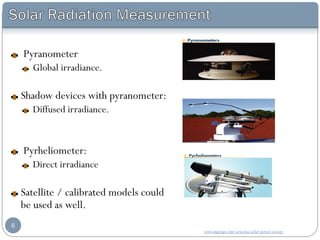
Pyranometer
Global irradiance.
Shadow devices with pyranometer:
Diffused irradiance.
Pyrheliometer:
Direct irradiance
Satellite / calibrated models could
be used as well.
www.meetup.com/arizona-solar-power-society
6
7
8
K.A.CARE launched the solar Atlas website two years ago,
Live data, monthly data, hourly data (charge) and other weather
information
https://rratlas.kacare.gov.sa/RRMMPublicPortal/
Solar
Energy
PV
Crystalline
Silicon
Thin
Film
Multijunction
cells (CPV)
CSP
Concentration in a
point
Central
Tower
Stirling
Dish
Concentration
in a line
Parabolic
Trough
Fresnel
Mirrors
9
PV Technologies
10
PV concept was discovered in
the 1839, Mr. Becquerel at
age 19.
In 1883, first solar cells was
made by Charles Fritts.
Classification:
Materials based
Structure type.
Junction multiplicity
Three junction and organic
cells show promising roadmap
Note: the difference between
cell and module efficiency is
≈3%
11
12
Mono-Crystalline Silicon
High cell efficiency 25%
Expensive
Large energy consumption (1,500 C)
Wasted area in the module (white area in the
image))
Poly-crystalline is cheaper and 22%
Amorphous Si
Produced at low temperature (< 300C)
It could be grown on different substrates
p-i-n cell: improves mobility
It is cheaper but less efficiency
Better performance in low light condition
Unstable (dangling bond, hot research area)
Not common
13
CadmiumTelluride (CdTe):
Module efficiency 16%
less susceptible to cell temperature
variations.
Copper-indium-gallium-selenide
(CIGS)
C, I and G prices are increasing
annually by approx. 25%
Materials shortage will limit the
CIGS growth.
However, alternative materials are in
the R&D
14
Features:
↳ Similar to PV, that is , generating DC current.
↳ Different efficiencies up to 30 to 36%
↳ Tracking devices are used whereas PV are mostly fixed.
↳ High DNI is required.
↳ Most companies have bankrupted.
15
The battery
is optional.
16
17
Many tools, websites and software simulate PV systems:
PVSYST. (charge)
PVWatt
PVJRC, free, easy and very useful
RETScreen
http://re.jrc.ec.europa.eu/pvgis/
10 MW PV power plant in Riyadh, 2012.
Factor/ Supplier First Solar
(CdTe)
Solar Frontier
(CIGS)
Suntech (Si-
poly)
Efficiency (STC) 11.15 % 10.1 % 12.39 %
Temperature
losses
8.8% 11.8 % 16.8 %
Energy output
per year (MWh)
19450 18525 17345
(Lowest
although the
highest %)!
18
Abdulaziz Baras
Solar Energy Economics
19
Module prices were 70$/W in the 1970s while now are within 50
cents/W
20
6$/W
2$/W
100$/W
21
Source: IRENA, Rethinking Energy, 2014
22
LCOE is the NPV of all the cost of the energy plant / “net present
energy” produced by the plant discounted at the same rate
By definition: Cn = LCOE × Qn
where Qn = energy produced in year n and Cn is the equivalent total
annual cost to produce it
Solving for LCOE:
𝐿𝐶𝑂𝐸 =
𝐶 𝑛
1 + 𝑑 𝑛
𝑡
𝑛=0
𝑄 𝑛
1 + 𝑑 𝑛
𝑡
𝑛=1
23
24
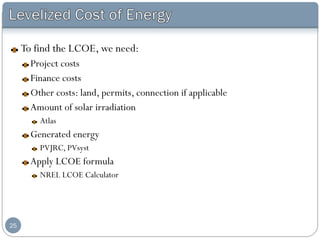
To find the LCOE, we need:
Project costs
Finance costs
Other costs: land, permits, connection if applicable
Amount of solar irradiation
Atlas
Generated energy
PVJRC, PVsyst
Apply LCOE formula
NREL LCOE Calculator
25
Challenges and Opportunities
26
Power Generation
BIPV
Solar roadways
27
Satellite
Remote areas
Street light
28
http://www.cleanenergybusinesscounc
il.com/en/map/
Pilots/projects:
KAUST 2 MW rooftop, Farasn 500 KW,
ARAMCO carpark 10 MW, KAPSARC
5.3 MW, system )
Riyadh Munucipility solar street light
CPC-Jeddah: 132 Kw CPV,
decommissioned
Meehan Green CPV plant, NOFA farm,
will be decommissioned
29
Soiling:
Diffuse light, dust accumulation
<5%- 15% reduction per month
Temperature
Affects the silicon modules more than thin
films
See module data sheet
Module Quality
IEC 61215, IEC 61646
Gird Connection
transmission Grid code for utility scale
projects is available
Not available for distribution level such as
rooftops
30
31
High solar irradiation
Increasing Energy demand
Solar energy is feasible even when oil prices between 35-50$/barrel.
Today is 46$/barrel
Solar tariff is increasing
Solar LCOE is within 20 halala/ kWh, for large scale projects
For small scale double or triple 20 halala
Solar Market price:
1 KW costs 10,000 to 15,000 SAR
32
33
1st of May 2016, Dubai
announced the lowest
bidder for the 850 MW
solar plant is:
2.99 US cent/kWh
• This price is beating even
2025 forecast.
http://www.thenational.ae/business/energy/cos
ts-tumble-as-dubais-mohammed-bin-rashid-al-
maktoum-solar-park-sets-the-mark
34
K.A.CARE team
Atlas team
Educational:
http://pveducation.org/pvcdrom
SaudiArabia Renewable
Resources:
https://rratlas.kacare.gov.sa/RRM
MPublicPortal/
Existing Projects:
http://www.cleanenergybusinesscou
ncil.com/en/map/
Simulation:
http://re.jrc.ec.europa.eu/pvgis/
Market:
IRENA
PV directory:
Photon magazine
35

Solar Energy Seminar

  • 1.
  • 2.
    o Abdulaziz Barashas a Master of Science degree in Material Science and Engineering from King Abdullah University of Science and Technology (KAUST), class of 2009 the founding and first graduating class. o He has developed doped ZnO nanowires used to increase solar cells efficiency. Also, he has developed doped ZnO films for spintronic applications. o In 2011, he joined King Abdullah City for Atomic and Renewable Energy (K.A.CARE), researcher in solar energy. o He has participated in understanding and implementing the challenges and solutions of solar energy in the Kingdom of Saudi Arabia. This includes: renewable resources assessment, dust mitigation, solar standards, solar value chain, national power strategy and establishing solar research facilities. He was selected as one of the top 10 solar pioneers in MENA region. o Currently he is the deputy leader of the electricity group. o His dream is to support the world to live in growing and green environment.
  • 3.
    3 Introduction and Basicsof Solar Energy Solar Energy Economics Challenges and Opportunities SaudiVision 2030 Discussion
  • 4.
    Introduction and Basicsof Solar Energy 4
  • 5.
    Direct irradiation (DNI): ForCSP and CPV. Diffused irradiation. Global irradiation(GHI): For PV Solar Spectrum 5
  • 6.
    Pyranometer Global irradiance. Shadow deviceswith pyranometer: Diffused irradiance. Pyrheliometer: Direct irradiance Satellite / calibrated models could be used as well. www.meetup.com/arizona-solar-power-society 6
  • 7.
  • 8.
    8 K.A.CARE launched thesolar Atlas website two years ago, Live data, monthly data, hourly data (charge) and other weather information https://rratlas.kacare.gov.sa/RRMMPublicPortal/
  • 9.
    Solar Energy PV Crystalline Silicon Thin Film Multijunction cells (CPV) CSP Concentration ina point Central Tower Stirling Dish Concentration in a line Parabolic Trough Fresnel Mirrors 9
  • 10.
  • 11.
    PV concept wasdiscovered in the 1839, Mr. Becquerel at age 19. In 1883, first solar cells was made by Charles Fritts. Classification: Materials based Structure type. Junction multiplicity Three junction and organic cells show promising roadmap Note: the difference between cell and module efficiency is ≈3% 11
  • 12.
  • 13.
    Mono-Crystalline Silicon High cellefficiency 25% Expensive Large energy consumption (1,500 C) Wasted area in the module (white area in the image)) Poly-crystalline is cheaper and 22% Amorphous Si Produced at low temperature (< 300C) It could be grown on different substrates p-i-n cell: improves mobility It is cheaper but less efficiency Better performance in low light condition Unstable (dangling bond, hot research area) Not common 13
  • 14.
    CadmiumTelluride (CdTe): Module efficiency16% less susceptible to cell temperature variations. Copper-indium-gallium-selenide (CIGS) C, I and G prices are increasing annually by approx. 25% Materials shortage will limit the CIGS growth. However, alternative materials are in the R&D 14
  • 15.
    Features: ↳ Similar toPV, that is , generating DC current. ↳ Different efficiencies up to 30 to 36% ↳ Tracking devices are used whereas PV are mostly fixed. ↳ High DNI is required. ↳ Most companies have bankrupted. 15
  • 16.
  • 17.
    17 Many tools, websitesand software simulate PV systems: PVSYST. (charge) PVWatt PVJRC, free, easy and very useful RETScreen http://re.jrc.ec.europa.eu/pvgis/
  • 18.
    10 MW PVpower plant in Riyadh, 2012. Factor/ Supplier First Solar (CdTe) Solar Frontier (CIGS) Suntech (Si- poly) Efficiency (STC) 11.15 % 10.1 % 12.39 % Temperature losses 8.8% 11.8 % 16.8 % Energy output per year (MWh) 19450 18525 17345 (Lowest although the highest %)! 18 Abdulaziz Baras
  • 19.
  • 20.
    Module prices were70$/W in the 1970s while now are within 50 cents/W 20 6$/W 2$/W 100$/W
  • 21.
  • 22.
  • 23.
    LCOE is theNPV of all the cost of the energy plant / “net present energy” produced by the plant discounted at the same rate By definition: Cn = LCOE × Qn where Qn = energy produced in year n and Cn is the equivalent total annual cost to produce it Solving for LCOE: 𝐿𝐶𝑂𝐸 = 𝐶 𝑛 1 + 𝑑 𝑛 𝑡 𝑛=0 𝑄 𝑛 1 + 𝑑 𝑛 𝑡 𝑛=1 23
  • 24.
  • 25.
    To find theLCOE, we need: Project costs Finance costs Other costs: land, permits, connection if applicable Amount of solar irradiation Atlas Generated energy PVJRC, PVsyst Apply LCOE formula NREL LCOE Calculator 25
  • 26.
  • 27.
  • 28.
  • 29.
    http://www.cleanenergybusinesscounc il.com/en/map/ Pilots/projects: KAUST 2 MWrooftop, Farasn 500 KW, ARAMCO carpark 10 MW, KAPSARC 5.3 MW, system ) Riyadh Munucipility solar street light CPC-Jeddah: 132 Kw CPV, decommissioned Meehan Green CPV plant, NOFA farm, will be decommissioned 29
  • 30.
    Soiling: Diffuse light, dustaccumulation <5%- 15% reduction per month Temperature Affects the silicon modules more than thin films See module data sheet Module Quality IEC 61215, IEC 61646 Gird Connection transmission Grid code for utility scale projects is available Not available for distribution level such as rooftops 30
  • 31.
    31 High solar irradiation IncreasingEnergy demand Solar energy is feasible even when oil prices between 35-50$/barrel. Today is 46$/barrel Solar tariff is increasing Solar LCOE is within 20 halala/ kWh, for large scale projects For small scale double or triple 20 halala Solar Market price: 1 KW costs 10,000 to 15,000 SAR
  • 32.
  • 33.
    33 1st of May2016, Dubai announced the lowest bidder for the 850 MW solar plant is: 2.99 US cent/kWh • This price is beating even 2025 forecast. http://www.thenational.ae/business/energy/cos ts-tumble-as-dubais-mohammed-bin-rashid-al- maktoum-solar-park-sets-the-mark
  • 34.
    34 K.A.CARE team Atlas team Educational: http://pveducation.org/pvcdrom SaudiArabiaRenewable Resources: https://rratlas.kacare.gov.sa/RRM MPublicPortal/ Existing Projects: http://www.cleanenergybusinesscou ncil.com/en/map/ Simulation: http://re.jrc.ec.europa.eu/pvgis/ Market: IRENA PV directory: Photon magazine
  • 35.