June 08 Bulk Solar Power Generation : CSP and CPV technologies Fernando Nuño European Copper Institute [email_address]
Index  Solar energy : why should it make sense? Definitions CSP review Technology Project Development Issues Generation costs – Market perspectives – Support schemes CPV review Technology Generation costs – Market perspectives Ratios and comparisons
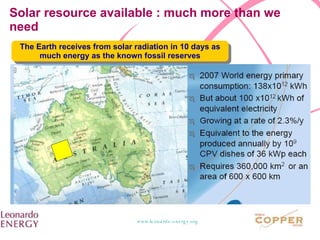
Solar resource available : much more than we need The Earth receives from solar radiation in 10 days as much energy as the known fossil reserves
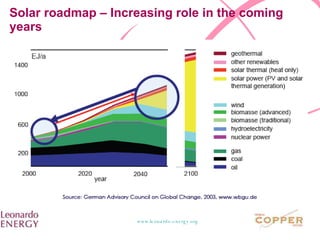
Solar roadmap – Increasing role in the coming years
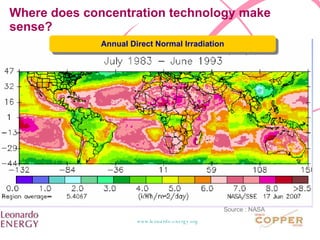
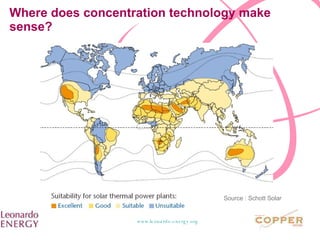
Where does concentration technology make sense? Annual Direct Normal Irradiation Source : NASA
Where does concentration technology make sense? Source : Schott Solar
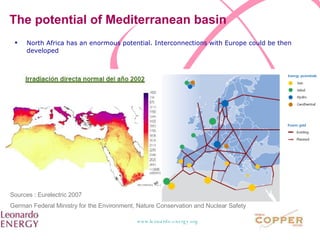
The potential of Mediterranean basin North Africa has an enormous potential. Interconnections with Europe could be then developed Sources : Eurelectric 2007 German Federal Ministry for the Environment, Nature Conservation and Nuclear Safety
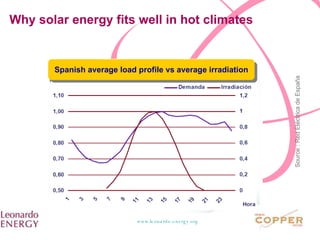
Why solar energy fits well in hot climates Spanish average load profile vs average irradiation Source : Red Eléctrica de España
Index  Solar energy : why should it make sense? Definitions CSP review Technology Project Development Issues Generation costs – Market perspectives – Support schemes CPV review Technology Generation costs – Market perspectives Ratios and comparisons
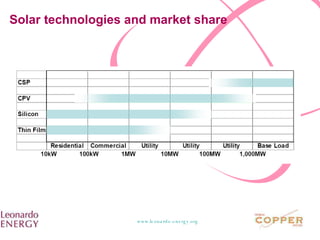
Solar technologies and market share
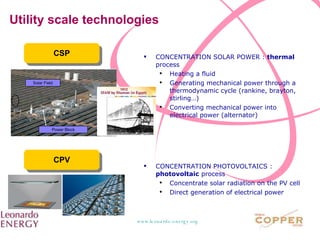
Utility scale technologies CSP CPV CONCENTRATION SOLAR POWER :  thermal  process Heating a fluid Generating mechanical power through a thermodynamic cycle (rankine, brayton, stirling…) Converting mechanical power into electrical power (alternator) CONCENTRATION PHOTOVOLTAICS :  photovoltaic  process Concentrate solar radiation on the PV cell Direct generation of electrical power
Index  Solar energy : why should it make sense? Definitions CSP review Technology Project Development Issues Generation costs – Market perspectives – Support schemes CPV review Technology Generation costs – Market perspectives Ratios and comparisons
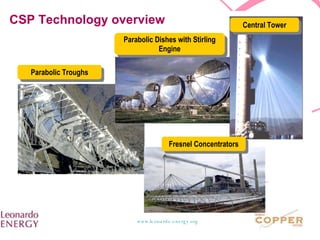
CSP Technology overview Parabolic Troughs Parabolic Dishes with Stirling Engine Central Tower Fresnel Concentrators
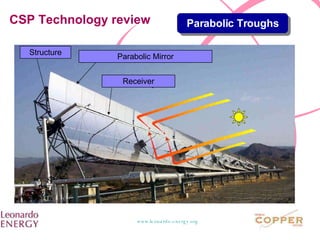
CSP Technology review Parabolic Troughs Structure Parabolic Mirror Receiver
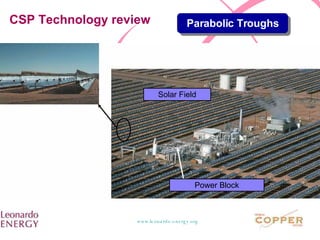
CSP Technology review Parabolic Troughs Solar Field Power Block
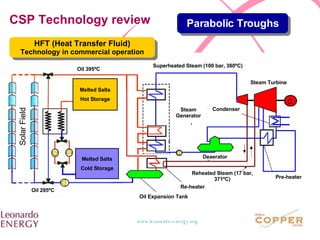
CSP Technology review HFT (Heat Transfer Fluid) Technology in commercial operation Parabolic Troughs Melted Salts Hot Storage Solar Field Melted Salts Cold Storage Steam Generator Steam Turbine Superheated Steam (100 bar, 380ºC) Reheated Steam (17 bar, 371ºC) Condenser Pre-heater Re-heater Oil Expansion Tank Deaerator Oil 395ºC Oil 295ºC
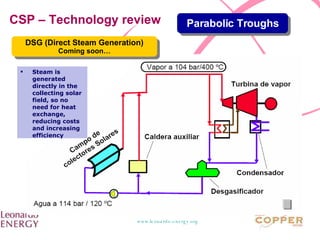
CSP – Technology review Steam is generated directly in the collecting solar field, so no need for heat exchange, reducing costs and increasing efficiency Parabolic Troughs DSG (Direct Steam Generation) Coming soon…
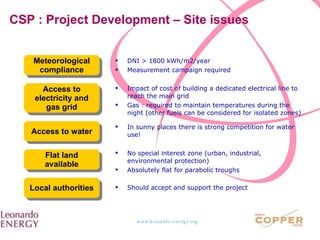
CSP : Project Development – Site issues Meteorological compliance DNI > 1800 kWh/m2/year Measurement campaign required Access to electricity and gas grid Access to water Flat land available No special interest zone (urban, industrial, environmental protection) Absolutely flat for parabolic troughs Local authorities Should accept and support the project In sunny places there is strong competition for water use! Impact of cost of building a dedicated electrical line to reach the main grid Gas : required to maintain temperatures during the night (other fuels can be considered for isolated zones)
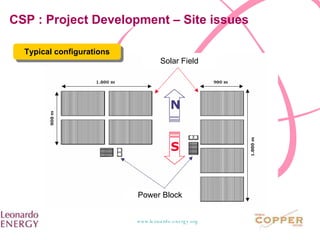
CSP : Project Development – Site issues Typical configurations Solar Field Power Block
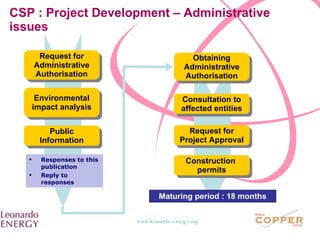
CSP : Project Development – Administrative issues Request for Administrative Authorisation Environmental impact analysis Public Information Obtaining Administrative Authorisation Consultation to affected entities Responses to this publication Reply to responses  Request for Project Approval Construction  permits Maturing period : 18 months
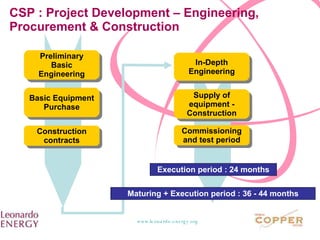
CSP : Project Development – Engineering, Procurement & Construction Preliminary Basic Engineering Basic Equipment Purchase Construction contracts In-Depth Engineering Supply of equipment - Construction Commissioning and test period Execution period : 24 months Maturing + Execution period : 36 - 44 months
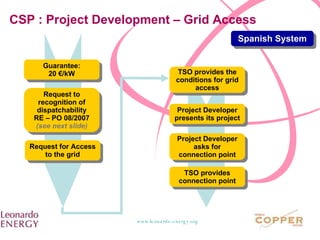
CSP : Project Development – Grid Access Guarantee: 20 €/kW Request to recognition of dispatchability RE – PO 08/2007 (see next slide) Request for Access to the grid TSO provides the conditions for grid access Spanish System Project Developer presents its project Project Developer asks for connection point TSO provides connection point
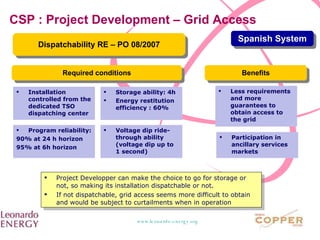
CSP : Project Development – Grid Access Dispatchability RE – PO 08/2007 Spanish System Installation controlled from the dedicated TSO dispatching center  Program reliability: 90% at 24 h horizon 95% at 6h horizon  Required conditions Storage ability: 4h Energy restitution efficiency : 60% Voltage dip ride-through ability (voltage dip up to 1 second) Benefits Less requirements and more guarantees to obtain access to the grid Participation in ancillary services markets Project Developper can make the choice to go for storage or not, so making its installation dispatchable or not. If not dispatchable, grid access seems more difficult to obtain and would be subject to curtailments when in operation
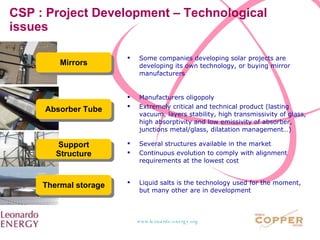
CSP : Project Development – Technological issues Mirrors Some companies developing solar projects are developing its own technology, or buying mirror manufacturers Absorber Tube Support Structure Thermal storage Manufacturers oligopoly Extremely critical and technical product (lasting vacuum, layers stability, high transmissivity of glass, high absorptivity and low emissivity of absorber, junctions metal/glass, dilatation management…) Several structures available in the market Continuous evolution to comply with alignment requirements at the lowest cost Liquid salts is the technology used for the moment, but many other are in development
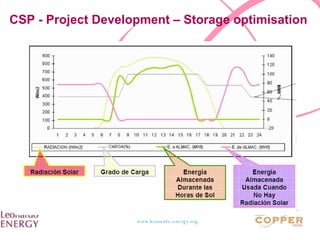
CSP - Project Development – Storage optimisation
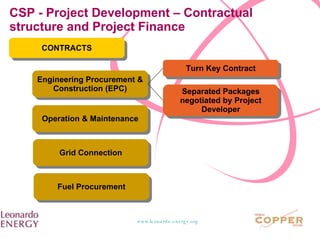
CSP - Project Development – Contractual structure and Project Finance CONTRACTS Engineering Procurement & Construction (EPC) Turn Key Contract Separated Packages negotiated by Project Developer Operation & Maintenance Grid Connection Fuel Procurement
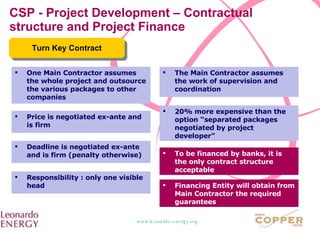
CSP - Project Development – Contractual structure and Project Finance Turn Key Contract One Main Contractor assumes the whole project and outsource the various packages to other companies Price is negotiated ex-ante and is firm Deadline is negotiated ex-ante and is firm (penalty otherwise) Responsibility : only one visible head One Main Contractor assumes the whole project and outsource the various packages to other companies Responsibility : only one visible head The Main Contractor assumes the work of supervision and coordination 20% more expensive than the option “separated packages negotiated by project developer” To be financed by banks, it is the only contract structure acceptable Financing Entity will obtain from Main Contractor the required guarantees
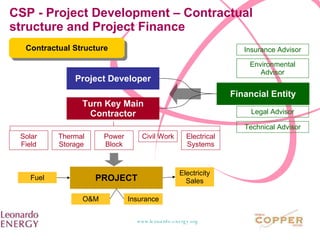
CSP - Project Development – Contractual structure and Project Finance Contractual Structure Project Developer Financial Entity Legal Advisor Technical Advisor Insurance Advisor Environmental Advisor Turn Key Main Contractor Solar Field Thermal Storage Power Block Civil Work Electrical Systems PROJECT Fuel O&M Insurance Electricity Sales
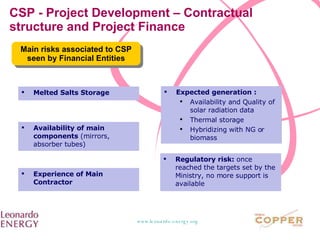
CSP - Project Development – Contractual structure and Project Finance Main risks associated to CSP seen by Financial Entities Melted Salts Storage Expected generation :  Availability and Quality of solar radiation data Thermal storage Hybridizing with NG or biomass Availability of main components  (mirrors, absorber tubes) Experience of Main Contractor Regulatory risk:  once reached the targets set by the Ministry, no more support is available
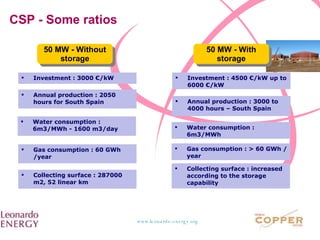
CSP - Some ratios 50 MW - Without storage Investment : 3000 €/kW  50 MW - With storage Annual production : 2050 hours for South Spain Water consumption : 6m3/MWh  Gas consumption : 60 GWh /year Collecting surface : 287000 m2, 52 linear km Investment : 4500 €/kW up to 6000 €/kW Annual production : 3000 to 4000 hours – South Spain Collecting surface : increased according to the storage capability Water consumption : 6m3/MWh - 1600 m3/day Gas consumption : > 60 GWh / year
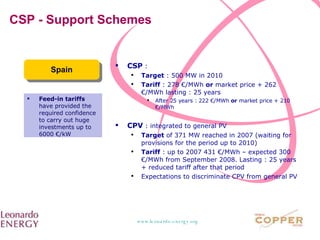
CSP - Support Schemes Spain CSP  :  Target  : 500 MW in 2010 Tariff  : 278 €/MWh  or  market price + 262 €/MWh lasting : 25 years  After 25 years : 222 €/MWh  or  market price + 210 €/MWh  CPV  : integrated to general PV Target  of 371 MW reached in 2007 (waiting for provisions for the period up to 2010) Tariff  : up to 2007 431 €/MWh – expected 300 €/MWh from September 2008. Lasting : 25 years + reduced tariff after that period Expectations to discriminate CPV from general PV Feed-in tariffs  have provided the required confidence to carry out huge investments up to 6000 €/kW
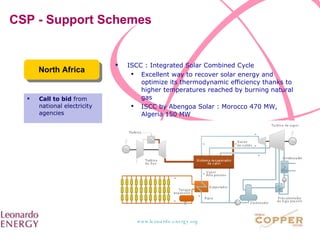
CSP - Support Schemes North Africa Call to bid  from national electricity agencies ISCC : Integrated Solar Combined Cycle Excellent way to recover solar energy and optimize its thermodynamic efficiency thanks to higher temperatures reached by burning natural gas ISCC by Abengoa Solar : Morocco 470 MW, Algeria 150 MW
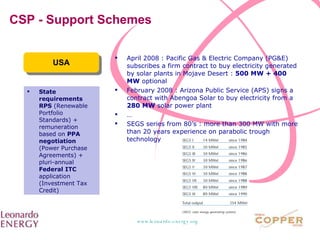
CSP - Support Schemes USA State requirements   RPS  (Renewable Portfolio Standards) + remuneration based on  PPA negotiation  (Power Purchase Agreements) + pluri-annual  Federal ITC  application (Investment Tax Credit) April 2008 : Pacific Gas & Electric Company (PG&E) subscribes a firm contract to buy electricity generated by solar plants in Mojave Desert :  500 MW + 400 MW  optional February 2008 : Arizona Public Service (APS) signs a contract with Abengoa Solar to buy electricity from a  280 MW  solar power plant … SEGS series from 80’s : more than 300 MW with more than  2 0 years experience on parabolic trough technology
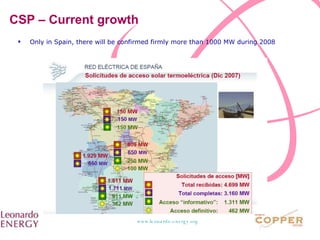
CSP – Current growth Only in Spain, there will be confirmed firmly more than 1000 MW during 2008
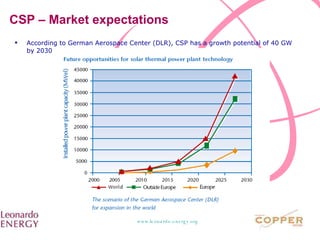
CSP – Market expectations According to German Aerospace Center (DLR), CSP has a growth potential of 40 GW by 2030
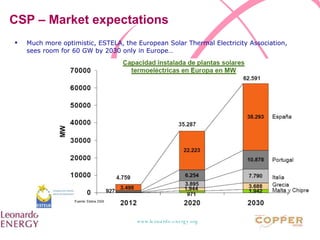
CSP – Market expectations Much more optimistic, ESTELA, the European Solar Thermal Electricity Association, sees room for 60 GW by 2030 only in Europe…
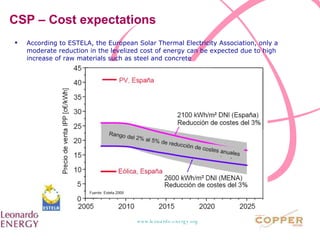
CSP – Cost expectations According to ESTELA, the European Solar Thermal Electricity Association, only a moderate reduction in the levelized cost of energy can be expected due to high increase of raw materials such as steel and concrete
Index  Solar energy : why should it make sense? Definitions CSP review Technology Project Development Issues Generation costs – Market perspectives – Support schemes CPV review Technology Generation costs – Market perspectives Ratios and comparisons
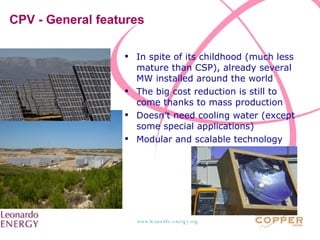
CPV - General features In spite of its childhood (much less mature than CSP), already several MW installed around the world The big cost reduction is still to come thanks to mass production Doesn’t need cooling water (except some special applications) Modular and scalable technology
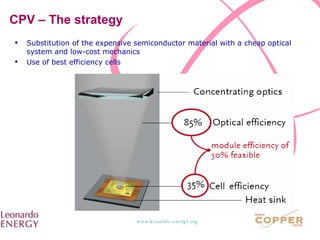
CPV – The strategy Substitution of the expensive semiconductor material with a cheap optical system and low-cost mechanics Use of best efficiency cells
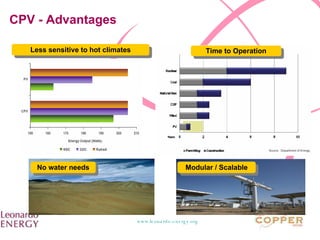
CPV - Advantages No water needs Time to Operation Less sensitive to hot climates Modular / Scalable
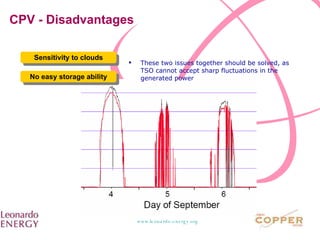
CPV - Disadvantages Sensitivity to clouds No easy storage ability These two issues together should be solved, as TSO cannot accept sharp fluctuations in the generated power
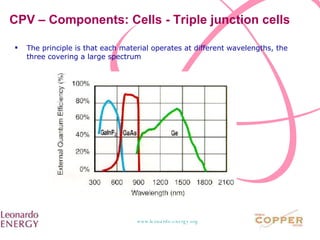
CPV – Components: Cells - Triple junction cells The principle is that each material operates at different wavelengths, the three covering a large spectrum
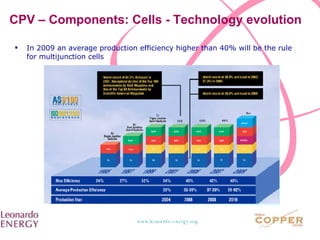
CPV – Components: Cells - Technology evolution In 2009 an average production efficiency higher than 40% will be the rule for multijunction cells
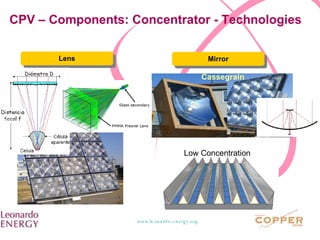
CPV – Components: Concentrator - Technologies Lens Mirror Low Concentration  Cassegrain
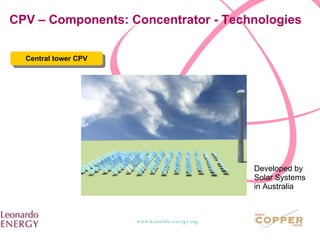
CPV – Components: Concentrator - Technologies Central tower CPV Developed by Solar Systems in Australia
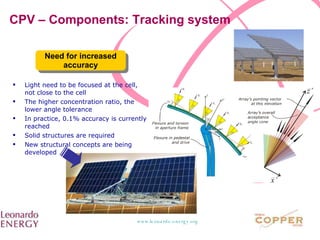
CPV – Components: Tracking system Light need to be focused at the cell, not close to the cell The higher concentration ratio, the lower angle tolerance In practice, 0.1% accuracy is currently reached Solid structures are required New structural concepts are being developed Need for increased accuracy
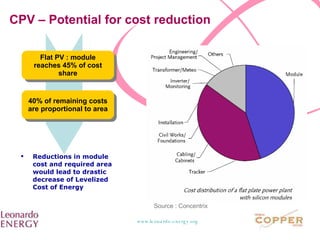
CPV – Potential for cost reduction Flat PV : module reaches 45% of cost share 40% of remaining costs are proportional to area Reductions in module cost and required area would lead to drastic decrease of Levelized Cost of Energy Source : Concentrix
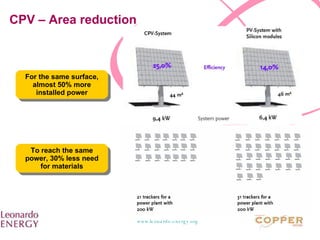
CPV – Area reduction For the same surface, almost 50% more installed power To reach the same power, 30% less need for materials
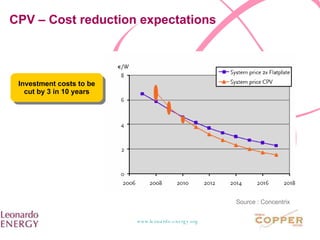
CPV – Cost reduction expectations Investment costs to be cut by 3 in 10 years Source : Concentrix
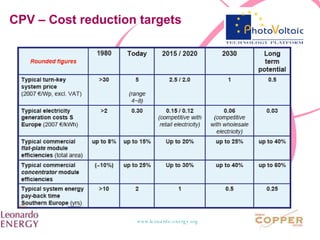
CPV – Cost reduction targets
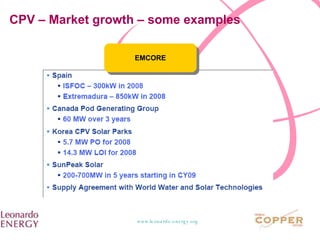
CPV – Market growth – some examples EMCORE
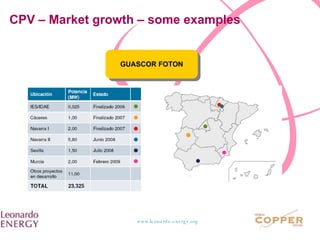
CPV – Market growth – some examples GUASCOR FOTON
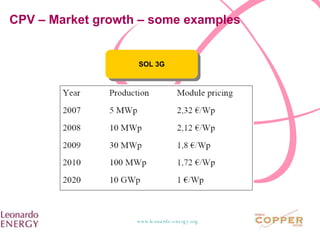
CPV – Market growth – some examples SOL 3G
Index  Solar energy : why should it make sense? Definitions CSP review Technology Project Development Issues Generation costs – Market perspectives – Support schemes CPV review Technology Generation costs – Market perspectives Ratios and comparisons
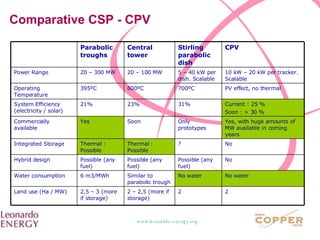
Comparative CSP - CPV 2 2 2 – 2,5 (more if storage) 2,5 – 3 (more if storage) Land use (Ha / MW) No water No water Similar to parabolic trough 6 m3/MWh Water consumption No Possible (any fuel) Possible (any fuel) Possible (any fuel) Hybrid design No ? Thermal : Possible Thermal : Possible Integrated Storage Yes, with huge amounts of MW available in coming years Only prototypes Soon Yes Commercially available Current : 25 % Soon : > 30 % 31% 23% 21% System Efficiency (electricity / solar) PV effect, no thermal 700ºC 600ºC 395ºC Operating Temperature 10 kW – 20 kW per tracker. Scalable 5 – 40 kW per dish. Scalable 20 – 100 MW 20 – 300 MW Power Range CPV Stirling parabolic dish Central tower Parabolic troughs
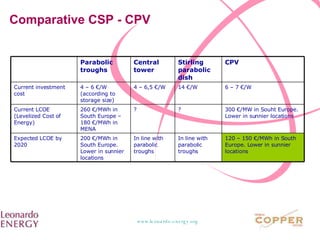
Comparative CSP - CPV 120 – 150 €/MWh in South Europe. Lower in sunnier locations In line with parabolic troughs In line with parabolic troughs 200 €/MWh in South Europe. Lower in sunnier locations Expected LCOE by 2020 300 €/MW in Souht Europe. Lower in sunnier locations ? ? 260 €/MWh in South Europe – 180 €/MWh in MENA Current LCOE (Levelized Cost of Energy) 6 – 7 €/W 14 €/W 4 – 6,5 €/W 4 – 6 €/W (according to storage size) Current investment cost CPV Stirling parabolic dish Central tower Parabolic troughs
References CSP summit – Madrid February 2008 – Intereconomía Conferencias CPV summit, Madrid 1-2 April 2008 (http://www.cpvtoday.com/index.shtml) http://www.schott.com/csp/english/download/schott_memorandum_e.pdf http://www.wbgu.de/wbgu_publications_annual.html http://www.eupvplatform.org/ http://www.csptoday.com/
Thank you!

Bulk Solar Power Generation :CSP and CPV technologies

  • 1.
    June 08 BulkSolar Power Generation : CSP and CPV technologies Fernando Nuño European Copper Institute [email_address]
  • 2.
    Index Solarenergy : why should it make sense? Definitions CSP review Technology Project Development Issues Generation costs – Market perspectives – Support schemes CPV review Technology Generation costs – Market perspectives Ratios and comparisons
  • 3.
    Solar resource available: much more than we need The Earth receives from solar radiation in 10 days as much energy as the known fossil reserves
  • 4.
    Solar roadmap –Increasing role in the coming years
  • 5.
    Where does concentrationtechnology make sense? Annual Direct Normal Irradiation Source : NASA
  • 6.
    Where does concentrationtechnology make sense? Source : Schott Solar
  • 7.
    The potential ofMediterranean basin North Africa has an enormous potential. Interconnections with Europe could be then developed Sources : Eurelectric 2007 German Federal Ministry for the Environment, Nature Conservation and Nuclear Safety
  • 8.
    Why solar energyfits well in hot climates Spanish average load profile vs average irradiation Source : Red Eléctrica de España
  • 9.
    Index Solarenergy : why should it make sense? Definitions CSP review Technology Project Development Issues Generation costs – Market perspectives – Support schemes CPV review Technology Generation costs – Market perspectives Ratios and comparisons
  • 10.
  • 11.
    Utility scale technologiesCSP CPV CONCENTRATION SOLAR POWER : thermal process Heating a fluid Generating mechanical power through a thermodynamic cycle (rankine, brayton, stirling…) Converting mechanical power into electrical power (alternator) CONCENTRATION PHOTOVOLTAICS : photovoltaic process Concentrate solar radiation on the PV cell Direct generation of electrical power
  • 12.
    Index Solarenergy : why should it make sense? Definitions CSP review Technology Project Development Issues Generation costs – Market perspectives – Support schemes CPV review Technology Generation costs – Market perspectives Ratios and comparisons
  • 13.
    CSP Technology overviewParabolic Troughs Parabolic Dishes with Stirling Engine Central Tower Fresnel Concentrators
  • 14.
    CSP Technology reviewParabolic Troughs Structure Parabolic Mirror Receiver
  • 15.
    CSP Technology reviewParabolic Troughs Solar Field Power Block
  • 16.
    CSP Technology reviewHFT (Heat Transfer Fluid) Technology in commercial operation Parabolic Troughs Melted Salts Hot Storage Solar Field Melted Salts Cold Storage Steam Generator Steam Turbine Superheated Steam (100 bar, 380ºC) Reheated Steam (17 bar, 371ºC) Condenser Pre-heater Re-heater Oil Expansion Tank Deaerator Oil 395ºC Oil 295ºC
  • 17.
    CSP – Technologyreview Steam is generated directly in the collecting solar field, so no need for heat exchange, reducing costs and increasing efficiency Parabolic Troughs DSG (Direct Steam Generation) Coming soon…
  • 18.
    CSP : ProjectDevelopment – Site issues Meteorological compliance DNI > 1800 kWh/m2/year Measurement campaign required Access to electricity and gas grid Access to water Flat land available No special interest zone (urban, industrial, environmental protection) Absolutely flat for parabolic troughs Local authorities Should accept and support the project In sunny places there is strong competition for water use! Impact of cost of building a dedicated electrical line to reach the main grid Gas : required to maintain temperatures during the night (other fuels can be considered for isolated zones)
  • 19.
    CSP : ProjectDevelopment – Site issues Typical configurations Solar Field Power Block
  • 20.
    CSP : ProjectDevelopment – Administrative issues Request for Administrative Authorisation Environmental impact analysis Public Information Obtaining Administrative Authorisation Consultation to affected entities Responses to this publication Reply to responses Request for Project Approval Construction permits Maturing period : 18 months
  • 21.
    CSP : ProjectDevelopment – Engineering, Procurement & Construction Preliminary Basic Engineering Basic Equipment Purchase Construction contracts In-Depth Engineering Supply of equipment - Construction Commissioning and test period Execution period : 24 months Maturing + Execution period : 36 - 44 months
  • 22.
    CSP : ProjectDevelopment – Grid Access Guarantee: 20 €/kW Request to recognition of dispatchability RE – PO 08/2007 (see next slide) Request for Access to the grid TSO provides the conditions for grid access Spanish System Project Developer presents its project Project Developer asks for connection point TSO provides connection point
  • 23.
    CSP : ProjectDevelopment – Grid Access Dispatchability RE – PO 08/2007 Spanish System Installation controlled from the dedicated TSO dispatching center Program reliability: 90% at 24 h horizon 95% at 6h horizon Required conditions Storage ability: 4h Energy restitution efficiency : 60% Voltage dip ride-through ability (voltage dip up to 1 second) Benefits Less requirements and more guarantees to obtain access to the grid Participation in ancillary services markets Project Developper can make the choice to go for storage or not, so making its installation dispatchable or not. If not dispatchable, grid access seems more difficult to obtain and would be subject to curtailments when in operation
  • 24.
    CSP : ProjectDevelopment – Technological issues Mirrors Some companies developing solar projects are developing its own technology, or buying mirror manufacturers Absorber Tube Support Structure Thermal storage Manufacturers oligopoly Extremely critical and technical product (lasting vacuum, layers stability, high transmissivity of glass, high absorptivity and low emissivity of absorber, junctions metal/glass, dilatation management…) Several structures available in the market Continuous evolution to comply with alignment requirements at the lowest cost Liquid salts is the technology used for the moment, but many other are in development
  • 25.
    CSP - ProjectDevelopment – Storage optimisation
  • 26.
    CSP - ProjectDevelopment – Contractual structure and Project Finance CONTRACTS Engineering Procurement & Construction (EPC) Turn Key Contract Separated Packages negotiated by Project Developer Operation & Maintenance Grid Connection Fuel Procurement
  • 27.
    CSP - ProjectDevelopment – Contractual structure and Project Finance Turn Key Contract One Main Contractor assumes the whole project and outsource the various packages to other companies Price is negotiated ex-ante and is firm Deadline is negotiated ex-ante and is firm (penalty otherwise) Responsibility : only one visible head One Main Contractor assumes the whole project and outsource the various packages to other companies Responsibility : only one visible head The Main Contractor assumes the work of supervision and coordination 20% more expensive than the option “separated packages negotiated by project developer” To be financed by banks, it is the only contract structure acceptable Financing Entity will obtain from Main Contractor the required guarantees
  • 28.
    CSP - ProjectDevelopment – Contractual structure and Project Finance Contractual Structure Project Developer Financial Entity Legal Advisor Technical Advisor Insurance Advisor Environmental Advisor Turn Key Main Contractor Solar Field Thermal Storage Power Block Civil Work Electrical Systems PROJECT Fuel O&M Insurance Electricity Sales
  • 29.
    CSP - ProjectDevelopment – Contractual structure and Project Finance Main risks associated to CSP seen by Financial Entities Melted Salts Storage Expected generation : Availability and Quality of solar radiation data Thermal storage Hybridizing with NG or biomass Availability of main components (mirrors, absorber tubes) Experience of Main Contractor Regulatory risk: once reached the targets set by the Ministry, no more support is available
  • 30.
    CSP - Someratios 50 MW - Without storage Investment : 3000 €/kW 50 MW - With storage Annual production : 2050 hours for South Spain Water consumption : 6m3/MWh Gas consumption : 60 GWh /year Collecting surface : 287000 m2, 52 linear km Investment : 4500 €/kW up to 6000 €/kW Annual production : 3000 to 4000 hours – South Spain Collecting surface : increased according to the storage capability Water consumption : 6m3/MWh - 1600 m3/day Gas consumption : > 60 GWh / year
  • 31.
    CSP - SupportSchemes Spain CSP : Target : 500 MW in 2010 Tariff : 278 €/MWh or market price + 262 €/MWh lasting : 25 years After 25 years : 222 €/MWh or market price + 210 €/MWh CPV : integrated to general PV Target of 371 MW reached in 2007 (waiting for provisions for the period up to 2010) Tariff : up to 2007 431 €/MWh – expected 300 €/MWh from September 2008. Lasting : 25 years + reduced tariff after that period Expectations to discriminate CPV from general PV Feed-in tariffs have provided the required confidence to carry out huge investments up to 6000 €/kW
  • 32.
    CSP - SupportSchemes North Africa Call to bid from national electricity agencies ISCC : Integrated Solar Combined Cycle Excellent way to recover solar energy and optimize its thermodynamic efficiency thanks to higher temperatures reached by burning natural gas ISCC by Abengoa Solar : Morocco 470 MW, Algeria 150 MW
  • 33.
    CSP - SupportSchemes USA State requirements RPS (Renewable Portfolio Standards) + remuneration based on PPA negotiation (Power Purchase Agreements) + pluri-annual Federal ITC application (Investment Tax Credit) April 2008 : Pacific Gas & Electric Company (PG&E) subscribes a firm contract to buy electricity generated by solar plants in Mojave Desert : 500 MW + 400 MW optional February 2008 : Arizona Public Service (APS) signs a contract with Abengoa Solar to buy electricity from a 280 MW solar power plant … SEGS series from 80’s : more than 300 MW with more than 2 0 years experience on parabolic trough technology
  • 34.
    CSP – Currentgrowth Only in Spain, there will be confirmed firmly more than 1000 MW during 2008
  • 35.
    CSP – Marketexpectations According to German Aerospace Center (DLR), CSP has a growth potential of 40 GW by 2030
  • 36.
    CSP – Marketexpectations Much more optimistic, ESTELA, the European Solar Thermal Electricity Association, sees room for 60 GW by 2030 only in Europe…
  • 37.
    CSP – Costexpectations According to ESTELA, the European Solar Thermal Electricity Association, only a moderate reduction in the levelized cost of energy can be expected due to high increase of raw materials such as steel and concrete
  • 38.
    Index Solarenergy : why should it make sense? Definitions CSP review Technology Project Development Issues Generation costs – Market perspectives – Support schemes CPV review Technology Generation costs – Market perspectives Ratios and comparisons
  • 39.
    CPV - Generalfeatures In spite of its childhood (much less mature than CSP), already several MW installed around the world The big cost reduction is still to come thanks to mass production Doesn’t need cooling water (except some special applications) Modular and scalable technology
  • 40.
    CPV – Thestrategy Substitution of the expensive semiconductor material with a cheap optical system and low-cost mechanics Use of best efficiency cells
  • 41.
    CPV - AdvantagesNo water needs Time to Operation Less sensitive to hot climates Modular / Scalable
  • 42.
    CPV - DisadvantagesSensitivity to clouds No easy storage ability These two issues together should be solved, as TSO cannot accept sharp fluctuations in the generated power
  • 43.
    CPV – Components:Cells - Triple junction cells The principle is that each material operates at different wavelengths, the three covering a large spectrum
  • 44.
    CPV – Components:Cells - Technology evolution In 2009 an average production efficiency higher than 40% will be the rule for multijunction cells
  • 45.
    CPV – Components:Concentrator - Technologies Lens Mirror Low Concentration Cassegrain
  • 46.
    CPV – Components:Concentrator - Technologies Central tower CPV Developed by Solar Systems in Australia
  • 47.
    CPV – Components:Tracking system Light need to be focused at the cell, not close to the cell The higher concentration ratio, the lower angle tolerance In practice, 0.1% accuracy is currently reached Solid structures are required New structural concepts are being developed Need for increased accuracy
  • 48.
    CPV – Potentialfor cost reduction Flat PV : module reaches 45% of cost share 40% of remaining costs are proportional to area Reductions in module cost and required area would lead to drastic decrease of Levelized Cost of Energy Source : Concentrix
  • 49.
    CPV – Areareduction For the same surface, almost 50% more installed power To reach the same power, 30% less need for materials
  • 50.
    CPV – Costreduction expectations Investment costs to be cut by 3 in 10 years Source : Concentrix
  • 51.
    CPV – Costreduction targets
  • 52.
    CPV – Marketgrowth – some examples EMCORE
  • 53.
    CPV – Marketgrowth – some examples GUASCOR FOTON
  • 54.
    CPV – Marketgrowth – some examples SOL 3G
  • 55.
    Index Solarenergy : why should it make sense? Definitions CSP review Technology Project Development Issues Generation costs – Market perspectives – Support schemes CPV review Technology Generation costs – Market perspectives Ratios and comparisons
  • 56.
    Comparative CSP -CPV 2 2 2 – 2,5 (more if storage) 2,5 – 3 (more if storage) Land use (Ha / MW) No water No water Similar to parabolic trough 6 m3/MWh Water consumption No Possible (any fuel) Possible (any fuel) Possible (any fuel) Hybrid design No ? Thermal : Possible Thermal : Possible Integrated Storage Yes, with huge amounts of MW available in coming years Only prototypes Soon Yes Commercially available Current : 25 % Soon : > 30 % 31% 23% 21% System Efficiency (electricity / solar) PV effect, no thermal 700ºC 600ºC 395ºC Operating Temperature 10 kW – 20 kW per tracker. Scalable 5 – 40 kW per dish. Scalable 20 – 100 MW 20 – 300 MW Power Range CPV Stirling parabolic dish Central tower Parabolic troughs
  • 57.
    Comparative CSP -CPV 120 – 150 €/MWh in South Europe. Lower in sunnier locations In line with parabolic troughs In line with parabolic troughs 200 €/MWh in South Europe. Lower in sunnier locations Expected LCOE by 2020 300 €/MW in Souht Europe. Lower in sunnier locations ? ? 260 €/MWh in South Europe – 180 €/MWh in MENA Current LCOE (Levelized Cost of Energy) 6 – 7 €/W 14 €/W 4 – 6,5 €/W 4 – 6 €/W (according to storage size) Current investment cost CPV Stirling parabolic dish Central tower Parabolic troughs
  • 58.
    References CSP summit– Madrid February 2008 – Intereconomía Conferencias CPV summit, Madrid 1-2 April 2008 (http://www.cpvtoday.com/index.shtml) http://www.schott.com/csp/english/download/schott_memorandum_e.pdf http://www.wbgu.de/wbgu_publications_annual.html http://www.eupvplatform.org/ http://www.csptoday.com/
  • 59.