1 © Alexis Kwasinski, 2010
Microgrids and the grid interaction
• Microgrids could have a grid interconnection to
• Improve system economics
• Improve operation
• Improve availability
• With a suitable planning, grid planning can benefit from having
microgrids by
• Reducing conductor’s size
• Improving availability
• Improving stability
• Tools, strategies and techniques for an effective integration of a
microgrid into the main grid:
• Net metering – bi-directional power flow.
• Peak shaving
• Advanced communications and controls
• Demand response (?)
2 © Alexis Kwasinski, 2010
Microgrids and the grid interaction
• Interconnection practice / recommendation: IEEE standard 1547
• Potential issues with microgrids integration into the main grid:
• Infrastructure long term planning / economics:
• There is no coordination in planning the grid and
microgrids.
• The grid is planned on a long term basis considering
traditional loads.
• Microgrids may “pop-up” afterwards “without notice.”
• Grid’s planning links economic (cost of grid’s electricity,
future demand…..) and technical aspects (line congestion….)
• Stability: microgrids are variable loads with positive and
negative impedance (they can act to the grid as generators)
3 © Alexis Kwasinski, 2010
Microgrids and the grid interaction
• More potential issues with microgrids integration into the main grid:
• Safety: When there is a fault in the grid, power from the
microgrid into the grid should be interrupted (islanding)
• Availability: Microgrids can trigger protections (directional
relays) upstream in the grid and interrupt service to other loads
• Key issue: microgrids are supposed to be independently controlled
cells within the main grid.
• How much independence microgrids should have?
• Does independence apply also to planning?
• How much interaction / communications should be
between the grid and the microgrid?
4 © Alexis Kwasinski, 2010
Microgrids and the grid interaction
• Example of microgrid development. Initial condition.
• Equipment and
financial planning is
done with all the load
in the figure in mind.
5 © Alexis Kwasinski, 2010
Microgrids and the grid interaction
• Example of microgrid development. Planning issues. A microgrid is installed few years
later.
Transformers
and
conductors
can now be
oversized
(remember
this aspect
for PEV and
PHEV
integration)
Microgrid’s area
6 © Alexis Kwasinski, 2010
Microgrids and the grid interaction
• Example of microgrid development. Initial normal power flow direction
Directional
Relay
7 © Alexis Kwasinski, 2010
Microgrids and the grid interaction
• Example of microgrid operational issues. New power flow with a microgrid.
Directional
Relay
• The microgrid’s
power trips open the
directional relay
• Is it possible to
change the grid’s
state fast enough to
prevent voltage
collapse due to loss
of stability caused by
the sudden load
changes introduced
by the microgrid?
• What microgrid’s
control action
follows?
• Can the microgrid
stop injecting power
back into the grid
(i.e. prevents
islanding)?
Microgrid’s area
8 © Alexis Kwasinski, 2010
Microgrids and the grid interaction
• Example of microgrid operation. Islanding.
• If islanding occurs
the microgrid will
continue to provide
power to a portion of
the grid even though
the grid connection
upstream has been
interrupted.
• Potential issues:
• Utility crews
safety.
• Power quality
at the energized
portion could be
poor. Loads
could be
damaged.
Microgrid’s area
“Island”
9 © Alexis Kwasinski, 2010
Microgrids and the grid interaction
• Grid interconnection might be different for dc or ac microgrids
• For ac microgrids, grid interconnection can be done directly, with a
disconnect switch, and a transformer only.
• For dc microgrids an inverter is necessary
• Examples:
CERTS microgrid (ac) NTT Facilities Sendai project (ac and dc)
10 © Alexis Kwasinski, 2010
Microgrids and the grid interaction
• dc microgrids integration with the grid
• The interface may or may not allow for bidirectional power flow.
Bidirectional power flow can be needed for:
•`Energy storage
• dc loads
11 © Alexis Kwasinski, 2010
Smart grids
• There are two similar but not equal approaches to the smart grid
concept.
• EU-led vision (customer and environmentally driven):
• Europe’s electricity networks in 2020 and beyond will be:
• Flexible: Fulfilling customers’ needs whilst responding to the
changes and challenges ahead;
• Accessible: Granting connection access to all network users,
particularly for renewable energy sources and high efficiency
local generation with zero or low carbon emissions;
• Reliable: Assuring and improving security and quality of supply,
consistent with the demands of the digital age;
• Economic: Providing best value through innovation, efficient
energy management and ‘level playing field’ competition and
regulation.
“European Technology Platform SmartGrids. Vision and Strategy for Europe’s Electricity Networks of the Future”
European Commission KI-NA-22040-EN-C EUR 22040
12 © Alexis Kwasinski, 2010
Smart grids
• US led vision (security
and consumer driven)
- Motivated by needs in
availability improvements
“The NETL Modern Grid Initiative A VISION FOR THE MODERN GRID”, US DOE
13 © Alexis Kwasinski, 2010
• There are many views of what is In reality, a smart grid is not a single
concept but rather a combination of technologies and methods intended
to modernize the existing grid in order to improve flexibility, availability,
energy efficiency, and costs.
• Smart Grid 1.0:
• Intelligent meters
• Smart Grid 2.0 (“Energy Internet”
enabler):
• advanced autonomous controls,
• distributed energy storage,
• distributed generation, and
• flexible power architectures.
• Distributed generation (DG), flexible power architectures, autonomous
controls and loads constitute local low-power grids (micro-grids).
The smart grid conceptThe smart grid concept
14 © Alexis Kwasinski, 2010
• Centralized
operation and control
• Passive
transmission and
distribution.
• Lack of flexibility
• Vulnerable
Smart grid evolution: dullSmart grid evolution: dull
past/presentpast/present
15 © Alexis Kwasinski, 2010
• Still primarily centralized
control.
• Limited active distribution
network (distributed local
generation and storage). Use
of virtual storage (demand-
response)
• Addition of communication
systems
• More efficient loads
• Flexibility issues
• Somewhat more robust
Smart grid evolution: present/immediateSmart grid evolution: present/immediate
futurefuture
16 © Alexis Kwasinski, 2010
• Distributed operation
and control
• Active distribution
network (distributed local
generation and storage).
• Integrated
communications
• Advanced more efficient
loads
• Flexible
• More robust
Smart grid evolution: FutureSmart grid evolution: Future
17 © Alexis Kwasinski, 2010
Smart grids
• Technologies and concepts:
• Distributed energy resources (generation and storage) are
fundamental parts. They provide the necessary active characteristics
to an otherwise passive grid.
• Advanced and distributed communications. All the grid
components are able to communicate. The grid operates like a
power-Internet (distributed, multiple-redundant, interactive and
autonomous). I.e. a Power-Net.
• Intelligent metering.
• Policies and regulatory actions. Necessary to achieve integration of
all the parts. Inadequate pricing models is a significant barrier to
introduce service-based business models (vs. energy-based).
• Grid modernization.
18 © Alexis Kwasinski, 2010
• DOE view for a smart grid:
- “An electrical grid is a network of
technologies that delivers
electricity from power plants to
consumers in their homes and
offices.”
• A Power-Net expands this
view based on paradigms
from the Internet.
• Some features compared with
conventional power grids:
more reliable, efficient, and
flexible.
The Power-Net
19 © Alexis Kwasinski, 2010
The Power-Net
• Like the Internet, the Power-Net involves diverse and redundant path
for the power to flow from distributed generators to users. Its control
resides in autonomous distributed agents.
• Power is generated in distributed generators, usually from alternative or
renewable energy sources. Power buffers are included to match
generators and loads dynamics. Energy buffers are added to make
variable sources dispatchable.
• Contrary to the Internet, the Power-Net involves a local approach for
power interactions.
20 © Alexis Kwasinski, 2010
• Desired Internet features:
• distributed and autonomous control,
• diverse information routing and redundant data or application
storage,
• performance degradation instead of full failure,
• link transmission rate control through temporary data storage
in buffers.
The InternetThe Internet
.M BT=
Buffer
size
Link
bandwidth
Maximum
(delay) time
21 © Alexis Kwasinski, 2010
• Key aspect: add distributed generation (fuel cells, microturbines, PV
modules, small wind, reciprocating engines) close to the load to make
power grids distribution portion an active electric circuit.
• Autonomous and distributed controls can be implemented with DG.
• Power vs. Energy buffers:
Extending the Internet into SmartExtending the Internet into Smart
gridsgrids
Ultracapacitors
or flywheels
(power buffer)
Batteries
(Energy buffer)
Predicted solar radiation
on PV module
.W PT=
22 © Alexis Kwasinski, 2010
Control and communication issuesControl and communication issues
• Coordination is needed in order to integrate variable generation sources (such
as PV modules) in the grid.
• Centralized control requires significant communication resources (i.e., large
bandwidth spectrum allocation) which in general is not available.
• The alternative is to provide all active nodes with an autonomous control that
allows controlling power interactions with the grid without dedicated
communication links. These more intelligent nodes become agents.
VS.
23 © Alexis Kwasinski, 2010
• Smart grid planning for disaster resiliency must consider disaster
impact on lifelines. During disasters special attention should be paid to
dissimilar ways in which disasters affect different DG technologies.
• Renewable sources do not have lifelines but they are not dispatchable,
they are expensive, and they require large footprints.
• Most DG technologies have availabilities lower than that of the grid.
• DG needs diverse power supply in order to achieve high availabilities.
• DG provides a technological solution to the vulnerable availability point
existing in air conditioners power supply.
•DG provides the active component to grid’s distribution portion,
essential for advanced self-healing power architectures.
Distributed generationDistributed generation
(DG)(DG)
24 © Alexis Kwasinski, 2010
Grid’s behaviorduringGrid’s behaviorduring
disastersdisasters» Power supply issues during disasters is
a grid’s problem transferred to the
load.
» Power grids are extremely fragile
systems.
25 © Alexis Kwasinski, 2010
Grid’s behaviorduringGrid’s behaviorduring
disastersdisasters» Common concept of damage to the electric grid during
disasters:
» Real sustained damage in more than 90 % of the area:
26 © Alexis Kwasinski, 2010
Conventional grid redundancy
• Redundancy is not common in distribution and sub-transmission
portions because redundancy may be very expensive.
27 © Alexis Kwasinski, 2010
Conventional grid diversity
• Diversity implies more than one different components performing
the same function.
28 © Alexis Kwasinski, 2010
Traditional Electricity Delivery Methods: Reliability
• With disasters affecting large areas, grid interconnection and/or
centralized control imply lack of diversity and a single point of failure.
29 © Alexis Kwasinski, 2010
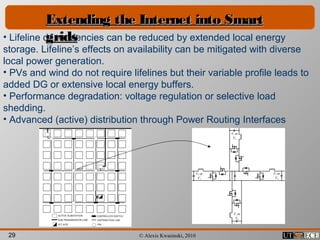
• Lifeline dependencies can be reduced by extended local energy
storage. Lifeline’s effects on availability can be mitigated with diverse
local power generation.
• PVs and wind do not require lifelines but their variable profile leads to
added DG or extensive local energy buffers.
• Performance degradation: voltage regulation or selective load
shedding.
• Advanced (active) distribution through Power Routing Interfaces
Extending the Internet into SmartExtending the Internet into Smart
gridsgrids
30 © Alexis Kwasinski, 2010
• A hybrid ac (solid lines) and dc (doted lines) architecture with
both centralized and distributed generation resources.
Advanced Power Architectures
Monitoring points
Power routers
31 © Alexis Kwasinski, 2010
• Problem: Typical home peak power
consumption is below 5 kW. An electric
vehicle may require 1 kW to be charged in 8
hrs. or up to 8 kW for shorter charging profiles.
Also, PEV and PHEV penetration is not uniform (higher for
neighborhoods with higher economical household income).
Hence, grid’s distribution transformers can be easily overloaded
PEV and PHEV even if charging is done during nighttime.
• DG avoids overloading distribution transformers but economical
issues still need to be addressed
• Combination of DG and energy storage may be a suitable
solution.
Smart grids: PHEV and PEV integration

solar smart grid

  • 1.
    1 © AlexisKwasinski, 2010 Microgrids and the grid interaction • Microgrids could have a grid interconnection to • Improve system economics • Improve operation • Improve availability • With a suitable planning, grid planning can benefit from having microgrids by • Reducing conductor’s size • Improving availability • Improving stability • Tools, strategies and techniques for an effective integration of a microgrid into the main grid: • Net metering – bi-directional power flow. • Peak shaving • Advanced communications and controls • Demand response (?)
  • 2.
    2 © AlexisKwasinski, 2010 Microgrids and the grid interaction • Interconnection practice / recommendation: IEEE standard 1547 • Potential issues with microgrids integration into the main grid: • Infrastructure long term planning / economics: • There is no coordination in planning the grid and microgrids. • The grid is planned on a long term basis considering traditional loads. • Microgrids may “pop-up” afterwards “without notice.” • Grid’s planning links economic (cost of grid’s electricity, future demand…..) and technical aspects (line congestion….) • Stability: microgrids are variable loads with positive and negative impedance (they can act to the grid as generators)
  • 3.
    3 © AlexisKwasinski, 2010 Microgrids and the grid interaction • More potential issues with microgrids integration into the main grid: • Safety: When there is a fault in the grid, power from the microgrid into the grid should be interrupted (islanding) • Availability: Microgrids can trigger protections (directional relays) upstream in the grid and interrupt service to other loads • Key issue: microgrids are supposed to be independently controlled cells within the main grid. • How much independence microgrids should have? • Does independence apply also to planning? • How much interaction / communications should be between the grid and the microgrid?
  • 4.
    4 © AlexisKwasinski, 2010 Microgrids and the grid interaction • Example of microgrid development. Initial condition. • Equipment and financial planning is done with all the load in the figure in mind.
  • 5.
    5 © AlexisKwasinski, 2010 Microgrids and the grid interaction • Example of microgrid development. Planning issues. A microgrid is installed few years later. Transformers and conductors can now be oversized (remember this aspect for PEV and PHEV integration) Microgrid’s area
  • 6.
    6 © AlexisKwasinski, 2010 Microgrids and the grid interaction • Example of microgrid development. Initial normal power flow direction Directional Relay
  • 7.
    7 © AlexisKwasinski, 2010 Microgrids and the grid interaction • Example of microgrid operational issues. New power flow with a microgrid. Directional Relay • The microgrid’s power trips open the directional relay • Is it possible to change the grid’s state fast enough to prevent voltage collapse due to loss of stability caused by the sudden load changes introduced by the microgrid? • What microgrid’s control action follows? • Can the microgrid stop injecting power back into the grid (i.e. prevents islanding)? Microgrid’s area
  • 8.
    8 © AlexisKwasinski, 2010 Microgrids and the grid interaction • Example of microgrid operation. Islanding. • If islanding occurs the microgrid will continue to provide power to a portion of the grid even though the grid connection upstream has been interrupted. • Potential issues: • Utility crews safety. • Power quality at the energized portion could be poor. Loads could be damaged. Microgrid’s area “Island”
  • 9.
    9 © AlexisKwasinski, 2010 Microgrids and the grid interaction • Grid interconnection might be different for dc or ac microgrids • For ac microgrids, grid interconnection can be done directly, with a disconnect switch, and a transformer only. • For dc microgrids an inverter is necessary • Examples: CERTS microgrid (ac) NTT Facilities Sendai project (ac and dc)
  • 10.
    10 © AlexisKwasinski, 2010 Microgrids and the grid interaction • dc microgrids integration with the grid • The interface may or may not allow for bidirectional power flow. Bidirectional power flow can be needed for: •`Energy storage • dc loads
  • 11.
    11 © AlexisKwasinski, 2010 Smart grids • There are two similar but not equal approaches to the smart grid concept. • EU-led vision (customer and environmentally driven): • Europe’s electricity networks in 2020 and beyond will be: • Flexible: Fulfilling customers’ needs whilst responding to the changes and challenges ahead; • Accessible: Granting connection access to all network users, particularly for renewable energy sources and high efficiency local generation with zero or low carbon emissions; • Reliable: Assuring and improving security and quality of supply, consistent with the demands of the digital age; • Economic: Providing best value through innovation, efficient energy management and ‘level playing field’ competition and regulation. “European Technology Platform SmartGrids. Vision and Strategy for Europe’s Electricity Networks of the Future” European Commission KI-NA-22040-EN-C EUR 22040
  • 12.
    12 © AlexisKwasinski, 2010 Smart grids • US led vision (security and consumer driven) - Motivated by needs in availability improvements “The NETL Modern Grid Initiative A VISION FOR THE MODERN GRID”, US DOE
  • 13.
    13 © AlexisKwasinski, 2010 • There are many views of what is In reality, a smart grid is not a single concept but rather a combination of technologies and methods intended to modernize the existing grid in order to improve flexibility, availability, energy efficiency, and costs. • Smart Grid 1.0: • Intelligent meters • Smart Grid 2.0 (“Energy Internet” enabler): • advanced autonomous controls, • distributed energy storage, • distributed generation, and • flexible power architectures. • Distributed generation (DG), flexible power architectures, autonomous controls and loads constitute local low-power grids (micro-grids). The smart grid conceptThe smart grid concept
  • 14.
    14 © AlexisKwasinski, 2010 • Centralized operation and control • Passive transmission and distribution. • Lack of flexibility • Vulnerable Smart grid evolution: dullSmart grid evolution: dull past/presentpast/present
  • 15.
    15 © AlexisKwasinski, 2010 • Still primarily centralized control. • Limited active distribution network (distributed local generation and storage). Use of virtual storage (demand- response) • Addition of communication systems • More efficient loads • Flexibility issues • Somewhat more robust Smart grid evolution: present/immediateSmart grid evolution: present/immediate futurefuture
  • 16.
    16 © AlexisKwasinski, 2010 • Distributed operation and control • Active distribution network (distributed local generation and storage). • Integrated communications • Advanced more efficient loads • Flexible • More robust Smart grid evolution: FutureSmart grid evolution: Future
  • 17.
    17 © AlexisKwasinski, 2010 Smart grids • Technologies and concepts: • Distributed energy resources (generation and storage) are fundamental parts. They provide the necessary active characteristics to an otherwise passive grid. • Advanced and distributed communications. All the grid components are able to communicate. The grid operates like a power-Internet (distributed, multiple-redundant, interactive and autonomous). I.e. a Power-Net. • Intelligent metering. • Policies and regulatory actions. Necessary to achieve integration of all the parts. Inadequate pricing models is a significant barrier to introduce service-based business models (vs. energy-based). • Grid modernization.
  • 18.
    18 © AlexisKwasinski, 2010 • DOE view for a smart grid: - “An electrical grid is a network of technologies that delivers electricity from power plants to consumers in their homes and offices.” • A Power-Net expands this view based on paradigms from the Internet. • Some features compared with conventional power grids: more reliable, efficient, and flexible. The Power-Net
  • 19.
    19 © AlexisKwasinski, 2010 The Power-Net • Like the Internet, the Power-Net involves diverse and redundant path for the power to flow from distributed generators to users. Its control resides in autonomous distributed agents. • Power is generated in distributed generators, usually from alternative or renewable energy sources. Power buffers are included to match generators and loads dynamics. Energy buffers are added to make variable sources dispatchable. • Contrary to the Internet, the Power-Net involves a local approach for power interactions.
  • 20.
    20 © AlexisKwasinski, 2010 • Desired Internet features: • distributed and autonomous control, • diverse information routing and redundant data or application storage, • performance degradation instead of full failure, • link transmission rate control through temporary data storage in buffers. The InternetThe Internet .M BT= Buffer size Link bandwidth Maximum (delay) time
  • 21.
    21 © AlexisKwasinski, 2010 • Key aspect: add distributed generation (fuel cells, microturbines, PV modules, small wind, reciprocating engines) close to the load to make power grids distribution portion an active electric circuit. • Autonomous and distributed controls can be implemented with DG. • Power vs. Energy buffers: Extending the Internet into SmartExtending the Internet into Smart gridsgrids Ultracapacitors or flywheels (power buffer) Batteries (Energy buffer) Predicted solar radiation on PV module .W PT=
  • 22.
    22 © AlexisKwasinski, 2010 Control and communication issuesControl and communication issues • Coordination is needed in order to integrate variable generation sources (such as PV modules) in the grid. • Centralized control requires significant communication resources (i.e., large bandwidth spectrum allocation) which in general is not available. • The alternative is to provide all active nodes with an autonomous control that allows controlling power interactions with the grid without dedicated communication links. These more intelligent nodes become agents. VS.
  • 23.
    23 © AlexisKwasinski, 2010 • Smart grid planning for disaster resiliency must consider disaster impact on lifelines. During disasters special attention should be paid to dissimilar ways in which disasters affect different DG technologies. • Renewable sources do not have lifelines but they are not dispatchable, they are expensive, and they require large footprints. • Most DG technologies have availabilities lower than that of the grid. • DG needs diverse power supply in order to achieve high availabilities. • DG provides a technological solution to the vulnerable availability point existing in air conditioners power supply. •DG provides the active component to grid’s distribution portion, essential for advanced self-healing power architectures. Distributed generationDistributed generation (DG)(DG)
  • 24.
    24 © AlexisKwasinski, 2010 Grid’s behaviorduringGrid’s behaviorduring disastersdisasters» Power supply issues during disasters is a grid’s problem transferred to the load. » Power grids are extremely fragile systems.
  • 25.
    25 © AlexisKwasinski, 2010 Grid’s behaviorduringGrid’s behaviorduring disastersdisasters» Common concept of damage to the electric grid during disasters: » Real sustained damage in more than 90 % of the area:
  • 26.
    26 © AlexisKwasinski, 2010 Conventional grid redundancy • Redundancy is not common in distribution and sub-transmission portions because redundancy may be very expensive.
  • 27.
    27 © AlexisKwasinski, 2010 Conventional grid diversity • Diversity implies more than one different components performing the same function.
  • 28.
    28 © AlexisKwasinski, 2010 Traditional Electricity Delivery Methods: Reliability • With disasters affecting large areas, grid interconnection and/or centralized control imply lack of diversity and a single point of failure.
  • 29.
    29 © AlexisKwasinski, 2010 • Lifeline dependencies can be reduced by extended local energy storage. Lifeline’s effects on availability can be mitigated with diverse local power generation. • PVs and wind do not require lifelines but their variable profile leads to added DG or extensive local energy buffers. • Performance degradation: voltage regulation or selective load shedding. • Advanced (active) distribution through Power Routing Interfaces Extending the Internet into SmartExtending the Internet into Smart gridsgrids
  • 30.
    30 © AlexisKwasinski, 2010 • A hybrid ac (solid lines) and dc (doted lines) architecture with both centralized and distributed generation resources. Advanced Power Architectures Monitoring points Power routers
  • 31.
    31 © AlexisKwasinski, 2010 • Problem: Typical home peak power consumption is below 5 kW. An electric vehicle may require 1 kW to be charged in 8 hrs. or up to 8 kW for shorter charging profiles. Also, PEV and PHEV penetration is not uniform (higher for neighborhoods with higher economical household income). Hence, grid’s distribution transformers can be easily overloaded PEV and PHEV even if charging is done during nighttime. • DG avoids overloading distribution transformers but economical issues still need to be addressed • Combination of DG and energy storage may be a suitable solution. Smart grids: PHEV and PEV integration