A PROJECT REPORT
On
SOLAR POWERED HACKSAW
Submitted to
Dr. A.P.J. Abdul Kalam Technical University, Uttar Pradesh, Lucknow
Submitted by
ABHIJEET MAURYA 1209040003
ABHISHEK KUMAR 1209040005
ABDUL MOQEEM 1209040001
ASHWANI SINGH 1209040052
ARVIND KUMAR 1209040044
In partial fulfillment for the award of the degree
of
BACHELOR OF TECHNOLOGY
In
MECHANICAL ENGINEERING
DEPARTMENT OF MECHANICAL ENGINEERING
IEC College of Engineering & Technology
Greater Noida,UP (INDIA) 201306
2016
A PROJECT REPORT
SOLAR POWERED HACKSAW
Under the supervision of
Mr. RAMEEZ
Assistant Professor
Department of Mechanical Engineering
Submitted By
ABHIJEET MAURYA 1209040003
ABHISEK KUMAR 1209040005
ABDUL MOQEEM 1209040001
ASHWANI SINGH 1209040052
ARVIND KUMAR 1209040044
In partial fulfillment for the award of degree
Of
BACHELOR OF TECHNOLOGY
In
MECHANICAL ENGINEERING
DEPARTMENT OF MECHANICAL ENGINEERING
IEC COLLEGE OF ENGNEERING & TECHNOLOGY
Greater Noida (UP),India 201306
2016
CERTIFICATE
Certified that this project report entitled “SOLAR POWERED HACKSAW ’’ submitted by
ABHIJEET MAURYA (120904003), ABDUL MOQEEM (120904001), ABHISHEK
KUMAR (120904005), ARVIND KUMAR (1209040044), ASHWANI SINGH
(1209040052) to the Uttar Pradesh Technical University Luck now, India in partial fulfillment
for the award of Degree of Bachelor of Technology in Mechanical Engineering is a bona fide
record of the project work carried out by him under my supervision during the year 2015-2016.
Prof. Nurul Hassan Laskar Mr. Rameez Khan
(Head) Assistant Professor
Department of Mechanical Engineering Department of Mechanical Engineering
IEC-CET GREATER NOIDA IEC-CET GREATER NOIDA
ACKNOWLEDGEMENT
I would like to place on record my deep sense of gratitude to Prof, Nurul Hassan Laskar
HOD- Dept. of Mechanical Engineering, IEC-CET, Greater Noida, India for his
encouragement, help and useful suggestions. I express my sincere gratitude to Mr. Amit
Kumar Yadav, Dept. of Mechanical Engineering, IEC-CET, Greater Noida, India for his
stimulating & continuous encouragement throughout the course of my project work.
I also wish to extend my thanks to Mr. Rameez Khan for constructive suggestions, guidance
to improve the quality of his project work. I am extremely thankful to teachers and staffs of
our workshop for providing requisite tools and equipments without which this project would
not be successful.
ABHIJEET MAURYA (1209040003)
ABHISHEK KUMAR (1209040005)
ABDUL MOQEEM (1209040001)
ASHWANIKUMAR (1209040052)
ARVIND KUMAR (1209040044)
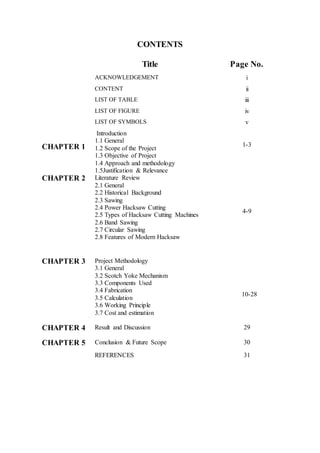
CONTENTS
Title Page No.
ACKNOWLEDGEMENT i
CONTENT ii
LIST OF TABLE iii
LIST OF FIGURE iv
LIST OF SYMBOLS v
CHAPTER 1
Introduction
1.1 General
1.2 Scope of the Project
1.3 Objective of Project
1.4 Approach and methodology
1.5Justification & Relevance
1-3
CHAPTER 2 Literature Review
2.1 General
2.2 Historical Background
2.3 Sawing
2.4 Power Hacksaw Cutting
2.5 Types of Hacksaw Cutting Machines
2.6 Band Sawing
2.7 Circular Sawing
2.8 Features of Modern Hacksaw
4-9
CHAPTER 3 Project Methodology
3.1 General
3.2 Scotch Yoke Mechanism
3.3 Components Used
3.4 Fabrication
3.5 Calculation
3.6 Working Principle
3.7 Cost and estimation
10-28
CHAPTER 4 Result and Discussion 29
CHAPTER 5 Conclusion & Future Scope 30
REFERENCES 31
LIST OF FIGURES
Fig No. Title Page No.
3.1 Solar Power hacksaw 10
3.2 Scotch Yoke Mechanism 11
3.3.1 Flywheel 12
3.3.2(a) Hacksaw Blade 13
3.3.2(b) Classification of tooth 14
3.3.3(a) Fleming’s left hand rule 14
3.3.3(b) D.C. Motor 15
3.3.4 Screw Thread 17
3.3.5(a) Solar Panel 19
3.3.5(b) World’s Insulation Level 21
3.3.6 Rechargeable Battery 23
3.6(a) Vice Bench 27
3.6(b) Teeth standard 27
7
LIST OF ACRONYMS, SYMBOLS AND ABBREVIATIONS
Sr. No. Symbol/Avv./Nom. Description
01 cm Centimeter
02 BS British Standard
03 mm Millimeter
04 ᶲ Diameter
05 rpm Revolution per minute
06 m/min Meter per minute
07 Ft. Feet
8
ABSTRACT
This project is on the design and construction of a solar power hacksaw machine for cutting of
metal to different size and length with the help of solar hacksaw. The objective of this project is
to save manpower and time, energy in cutting metals in order to achieve high productivity. It is a
cutting machine with teeth on its blade used specially for cutting material. The power to the
hacksaw is provided by the Solar Energy. The motor drives the flywheel connected to the shaft
of the motor. The flywheel is connected through a link that transmits the required force for
cutting the work piece. Finally connecting rod is connected to the vertical arm connected to the
horizontal arm. Rotary motion of the shaft is converted into reciprocating motion of the hacksaw
with the help of crank and connecting rod. Work piece of desired length can be cut by feeding it
to hacksaw by holding it into bench vice. The various component of the machine were designed
and constructed. Test was carried out on the machine using different metals.
A solar panel connected to power hacksaw is considered as a solar operated power hacksaw in
which sun’s energy is used to drive the hacksaw in order to cut wood, metal rod etc. A solar
connected to the hacksaw converts the solar energy into electrical energy which is stored in a 12
v battery as a direct current to run the motor connected to the hacksaw .A DC motor is connected
to the hacksaw which is used to give the rotary motion to the flywheel connected to the shaft of
the dc motor .The energy stored in battery is supplied to the dc motor which rotates the flywheel
connected to the shaft of motor.
The rotary motion of the flywheel is converted to reciprocating motion which gives back-forth
motion to blade of the hacksaw by a mechanism known as scotch yoke mechanism. The
reciprocating motion of the hacksaw reciprocates the blade on the work piece which performs the
cutting action. The work piece is clamped in a clamper to fix it. The clamper is made of cast iron
or mild steel. A solar power hacksaw is a cheap and environmental friendly device that is
operated without the consumption of any energy other than the solar energy .Solar energy is
cheap and easily available on the earth. No heavy machines or devices are required for energy
conservation. Solar powered hacksaw can be used in work shop, industries, and many fields
where there is a requirement of hacksaw.
Keyword- Solar Panel, DC Motor, Battery, Flywheel, Mild Steel.
9
CHAPTER 1
INTRODUCTION
1.1. General
A hacksaw is a handheld tool used to cut through materials like plastic tubing and metal
pipes. Its cutting mechanism is provided by removable blades which feature sharp teeth
along their outer edge. In most cases, a hacksaw consists of a metal frame that resembles a
downward-facing. A handle of plastic, wood, or metal is typically affixed to one end of the
frame. The frame’s ends feature adjustable pegs that can be tightened to secure a blade in
place, and loosened to remove it. Hacksaw blades are long, thin strips of hardened steel that
feature a row of teeth along their cutting edge. Each end of the blade is punched with a small
hole that fits onto the saw frame’s pegs. Most blades range in length from ten to 12inches
(25.4 to 30.48 cm), although six-inch (15.24 cm) blades can be purchased to fit smaller
hacksaw models. A device that applies force, changes the directionof a force, or changes the
strength of a force, in order to perform a task, generally involving work done on a load.
Machines are often designed to yield a high mechanical advantage to reduce the effort
needed to do that work. A simple machines a wheel, a lever or an inclined plane. All other
machines can be built using combinations of these simple machines. Example: A drill uses a
combinationof gears (wheels) to drive helical inclinedplanes (the drill bit) to split a material
and carve a hole in it.
1.2. Scope of the project
1. The machine can solve the problem of time consumption.
2. Waste of resources in face of labor cost is reduced.
3. The machine can be used in the industry where it is manufactured, at the packaging
sector.
4. 4 It is used as hardware in large quantity like in fabricationmachine
5. It provide alternative for industries aiming toward reducing human
effort.
6. It generates sustainable and practical solutions for the future industrial development.
1.3 Objectives of the project
1. To cater to the issue of competition in mechanical industry the need for solar energy is
assess by all the industry.
10
CONSTRUCTIONOF BASETABLE
2. Identify the key policy avenues considered to be appropriate to meet the challenge of
sustainable manufacturing and packaging industry for the future.
3. To provide alternative for industries aiming toward reducing human effort.
4. Sustainable and practical solutions for the future industrial environment.
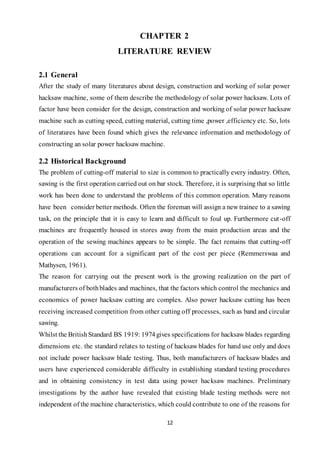
1.4 Approach and Methodology:
MOUNTING OF BASE
FOR HOLDING SHAFT
CONNECTED TO THE
FLYWHEEL, CRANK &
CONNECTING ROD
MOUNTING OF CLAMP &
INSERTING SHAFT INTO
THE CLAMP
MOUNTING OF BENCH
VICE TO THE BASE
TABLE
FIXING OF BACK ARM INTO THE
SHAFT
FIXING OF HORIZONTAL ARM TO
THE BACK ARM
FIXING OF HACKSAW TO THE
HORIZONTAL ARM
MOUNTING OF DC MOTOR ON THE
TABLE
FIXING OF PULLEY TO THE ROTOR
OF MOTOR & CONNECTING
FLYWHEEL TO THE ROD
FINAL ASSAMBLING
SUPPLY OF POWER
WORKING
RESULT & DISCUSSION
11
1.5 Justification & Relevance
We have found a solar power hacksaw to be the most useful for general shop work. Modern
heavy-duty hacksaw machines provide an economical and efficient means of sawing a wide
range of materials and stock sizes. Power hack saws are getting rarer all the time but they do
a good job within their capacity. If you can get one that takes standard hacksaw blades then
you'll have a tremendous range of blades to choose from and will be able to cut most
anything. Solar Hacksaws are more tolerant to tensioning maladjustment and run off. A
major advantage of solar power hacksaw cutting is the relatively low capital investment
required. Tooling and maintenance costs are low. Accuracy and finishes produced, range
from fair to good depending on the material being sawed. Time saving as comparedto simple
hacksaw and comfortable than ordinary hacksaw.
12
CHAPTER 2
LITERATURE REVIEW
2.1 General
After the study of many literatures about design, construction and working of solar power
hacksaw machine, some of them describe the methodology of solar power hacksaw. Lots of
factor have been consider for the design, construction and working of solar power hacksaw
machine such as cutting speed, cutting material, cutting time ,power ,efficiency etc. So, lots
of literatures have been found which gives the relevance information and methodology of
constructing an solar power hacksaw machine.
2.2 Historical Background
The problem of cutting-off material to size is common to practically every industry. Often,
sawing is the first operation carried out on bar stock. Therefore, it is surprising that so little
work has been done to understand the problems of this common operation. Many reasons
have been consider better methods. Often the foreman will assign a new trainee to a sawing
task, on the principle that it is easy to learn and difficult to foul up. Furthermore cut-off
machines are frequently housed in stores away from the main production areas and the
operation of the sewing machines appears to be simple. The fact remains that cutting-off
operations can account for a significant part of the cost per piece (Remmerswaa and
Mathysen, 1961).
The reason for carrying out the present work is the growing realization on the part of
manufacturers of bothblades and machines, that the factors which control the mechanics and
economics of power hacksaw cutting are complex. Also power hacksaw cutting has been
receiving increased competition from other cutting off processes, such as band and circular
sawing.
Whilst the BritishStandard BS 1919: 1974gives specifications for hacksaw blades regarding
dimensions etc. the standard relates to testing of hacksaw blades for hand use only and does
not include power hacksaw blade testing. Thus, both manufacturers of hacksaw blades and
users have experienced considerable difficulty in establishing standard testing procedures
and in obtaining consistency in test data using power hacksaw machines. Preliminary
investigations by the author have revealed that existing blade testing methods were not
independent of the machine characteristics, which could contribute to one of the reasons for
13
the inconsistencyin the test data. Hence, there has been requirement to identify the machine
characteristics under normal working conditions and to investigate the mechanics of the
sawing process and the variables affecting metal removal rate. Most of the early published
work on cutting-off has been primarily concerned with circular and band sawing and cost
comparisons betweenalternative processes. Whilst these alternative processes are frequently,
quicker than power hacksaw cutting, their costs are in many applications higher. Whilst the
impact of these alternative processes on the application of power hacksaw cutting cannot be
denied there remains a significant field of application for power hacksaw cutting which is
likelyto remain unchallenged. A factor of prime interest to manufacturersis that, if the costs
of power hacksaw cutting can be reduced by developing the blade and the saw machine, the
potential field of application will be widened. During the past fifty years very little attention
has been devoted to developing the geometry of the hacksaw blade or the machine, although,
some improvements in the blade material, together with methods of applying the load and
mechanized work handling, have been achieved (Nelson,1965).
2.3 Sawing
If all raw stock was delivered in ready-to-machine shapes and sizes, there would be no need
for sawing machines in a metal working shop. Machine operators couldmerelygo over to the
stock, select the suitable work piece, and perform the necessary finishing operations. Such
situationrarelyexists, due to the fact that the majorityof the stockrequires to be cut in some
way prior to starting a machining schedule. The alternative to this primary operation of
sawing is to buy-in prepared lengths and shapes; this however introduces a service which the
company has to pay for and, in the majority of the cases, it is simpler and more economical
to carry out the basic cutting-to-size operation in house. One of the major advantages of
sawing over all other kinds of machining is the narrowness of cut op. Most sawing machines
perform the cut-off operation, where a piece of stock is cut to a workable length prior to
subsequent machining operations. Machines that accomplish this job include hacksaws, band
saws and circular saw.
2.4 Power Hacksaw Cutting
The simple back-and-forth motion of the blade made the hacksaw one of the first types of
sawing machines designed for power. The simplicity in the blade motion has kept the price
of the saw machine relatively cheaper than other types of sawing machines. The low initial
cost coupled with the flexibility and adaptability, has enabled the hacksaw to remain popular
14
in industry. In hacksaw cutting, a single blade is tensioned in the bow, and reciprocated back
and forth over the work piece. The cutting action is achieved only during half of the cycle of
operation. During the second half of the cycle, the return stroke, the blade is lifted clear of
the work piece, giving a discontinuous cutting action, which is considered to be one of the
drawbacks of the operation. Despite this disadvantage, As compared to the continuous-
cutting action of the band saw, hacksaws remain equally or even more popular alternative
machines. As with many other basic processes, hacksaw cutting is a tried and tested method,
reliable, consistently accurate, quick and easy to repair, is less dependent on correct blade
tension and less likely to run-out. Furthermore power hacksaws can be left unattended for
long periods when cutting large diameter bar and require minimum operator skill. Blade
replacement is relatively cheap and simple.
2.5 Types of Hacksaw Cutting Machines
For a given blade and work piece the material removal rates achieved by hydraulic and
gravity fed machines are controlled solely by the thrust loads developed. Therefore, hack
sawing may be said to be a process in which the material removal rate is force controlled,
unlike most other material removal processes. The machines available can be divided into
two broad categories, according to the method used to develop the load between the blade
and the work piece, namely gravity feed machines and hydraulic machines. A third, but not
common machine is the positive displacement machine. Power hacksaw machines are used
mainly for cutting-off operations.
2.5.1. Gravity Feed Machines
In this type of machine, which is usually of light construction for general duty, the thrust load is
developed by the gravity feed of the saw bow. In many of these machines the magnitude of the
thrust load is fixed, although some machines are provided with adjustable masses on the over
arm for thrust load adjustment. The thrust, load varies throughout the cutting stroke due to the
reciprocating displacement of the over arm mass and the action of the cam operated lift-off
device which acts at the beginning and the end of the stroke. This type of machine generally has
a work piece capacity between 150 - 200 mm (6 and 8 inches) diameter and is ideal for the small
workshop where the cutting requirement is only occasional and the configuration of work pieces
to be cut ranges from mild steel flat complex shaped sections and tubular sections up to 6 inches
diameter. Due to the light construction and gravity feed the applications for this type of machine
are limited.
15
2.5.2. Hydraulic Machines
The thrust force between the blade and the work piece in this type of machine is developed
by a hydraulic device. Pressure may be developed in the load cylinder by either a restricted
back-flow system, or the pressure may be supplied from a separate pump. In some of these
machines, greater flexibilityof control has been introduced by means of an arc cutting action
combined with a universally controlled hydraulic system which allows better performance
from the saw blade. The advanced types of heavy duty electro-hydraulic hacksaws have a
very wide range of operation and are available in semi-automatic or fully automatic form,
with provisions for automatic feeding of bar stock, cutting-off to predetermined sizes and
unloading etc. The feature of power down-feed to the saw bow incorporated in these
machines makes the machine suitable for cutting the tougher steels and alloys. These
machines are the most common and develop greater thrust loads than machines of other type
and have a reputation for sawing without problems and requiring minimum operator skill.
2.5.3. Positive Displacement Machines
Whilst these machines are not as popular as the gravity feed or hydraulic machines, a few
machines are available where the feed rate of the blade and hence, the metal removal rate is
directly controlled by a mechanical screw device, giving a positive feed. This type of
machine can lead to overloading of the blade giving premature blade failure particularly
when the blade is worn. Positive displacement machines are not prone to variation in thrust
loads during the cuttingstroke-since the thrust loads directly arise as a result of the constant
rate of penetration of the blade teeth.
2.6 Band Sawing
Band sawing, unlike hacksaw cutting, is a continuous cutting operation. An endless blade,
the band, is tensioned between two shrouded, rotating wheels, and part of the band is
exposedto carryout the cutting operationof the work piece. The band travels in a continuous
motion, with the teeth fed against the work piece. Whilst earlier metal sawing bands were
wide (over 25 mm), and were used strictly for cut off methods, narrow blades, introduced
about 50 years ago brought contouring capabilities. Furthermore, due to the small throat
clearance of the earlyband saws, theywere limitedin use by the basic design, thus the length
of the work piece could only be as long as the machine throat. However modern machines
have been modified to give adequate throat clearance, by intentionally twisting the blade so
16
that the toothed faces in line with the machine throat. As with hacksaw machines, band saws
can be divided into two broad categories. A general purpose band saw having gravity fed
system, controlled by a dash-pot and using a25 mm (1 inch) deep blade, is the most popular
machine available. This machine is suitable for general fabrication work and accurate cutting
of solid bars. This type of machine is limited to about 175 mm (7 inches) diameter for mild
steel. In order to meet the present day requirements for high-volume production, cutting all
grades of steel and to introduce high accuracy and reliability, it has been necessary for the
band saw machine manufacturers to incorporate in the design not only heavy duty
construction having capacities up to 450 mm (18 inches) diameters but also innovations in
the hydraulic power down-feed, to allow the cutting of difficult alloys .such as mnemonics
and titanium.
2.7 Circular Sawing
Circular saws have a continuous cutting action, use blades having many teeth, and a large
range of rotational speeds. This operation is similar to a milling operation. The machines
available range from the earlier, inexpensive hand loaded models to the very large, power
loaded type and incorporate material handling devices for semi and then fully automatic
operations. Modern production circular saws are built with several alternate basic feed
mechanisms i.e. horizontal, vertical, rocking head and variations of these. The choice of the
most suitable type of machine depends on the particular application and the size and shape of
component. With vertical feed, the rotating blade travels downwards in a straight line to
engage the work piece. On machines designed for horizontal feed the blade is fed into the
work piece from the back. A third basic feeding arrangement is a pivot motion or rocking-
head system, this is as efficient as a vertical feed system and is a rugged arrangement. The
bench or floor mounted manual-feed circular saw, when installed together with a general
duty band saw or hack sawing a small workshop, provides a complete cutting facility for the
small fabricator. Fully automatic circular saws, having features such as dial-in component
length, in process gauging, choice of loading magazines, etc. are widely used where high
quality production is required and often present the production engineer with a difficult
choice to make between circular sawing and band sawing. (Suzuki etc.1998).
2.8 Features of Modern Hacksaw
The simplicity of design and operation, coupled with the low initial cost, has made the hacksaw
grow in popularity. Its limitations are due to its mode of operation, i.e. cutting only on half of the
17
stroke, the slow cutting speed, and the fact that not all the length of the blade is utilized.
Some of the features in a modern hacksaw which achieve improved performance are:
(i) A range of cutting speeds, uniform over the cutting stroke, and a fast return stroke.
(ii) Means to regulate and monitor the cutting pressure.
(iii) Adjustable stroke.
(iv) Automatic relief of the blade on the return stroke.
(v) Some means of indicating and correcting blade tension.
(vi) Automatic stopping device when the cut is complete.
18
CHAPTER 3
PROJECT METHODOLOGY
3.1 General
Solar Power Hacksaws are used to cut large sections of metal or plastic shafts and rods.
Cutting of solidshafts or rods of diameters more than fifteen millimeters is a very hard work
with a normal hand held hacksaw. Therefore solar power hacksaw machine is used to carry
out the difficult and time consuming work. This power hacksaw machine is considered as an
energy saving machine because the operator need not be there to provide the reciprocating
motion and downward force on the work-piece in order to cut it. Once the operator has fed
the work-piece till the required length in to the machine and starts the machine, then the
machine will cut until the work-piece has been completely cut in to two pieces. The Solar
Power hacksaw machine though being able to cut the shaft or rod without requiring any
human effort to cut, it does require a human intervention to feed the work-piece many times

with measurements being taken each time before feeding.
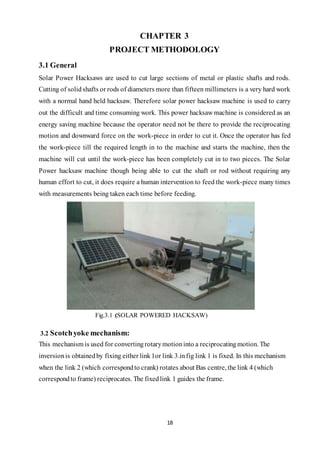
Fig.3.1 (SOLAR POWERED HACKSAW)
3.2 Scotchyoke mechanism:
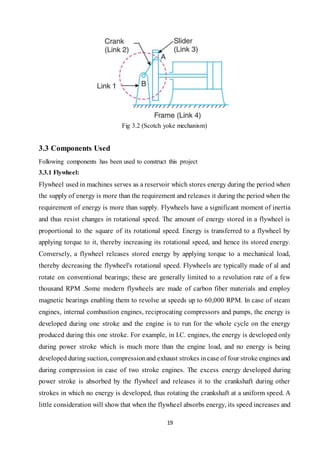
This mechanism is used for convertingrotarymotioninto a reciprocatingmotion. The
inversionis obtainedby fixing either link1or link 3.infig link 1 is fixed. In this mechanism
when the link 2 (which correspondto crank) rotates about Bas centre, the link 4 (which
correspondto frame) reciprocates. The fixedlink 1 guides the frame.
19
Fig 3.2 (Scotch yoke mechanism)
3.3 Components Used
Following components has been used to construct this project
3.3.1 Flywheel:
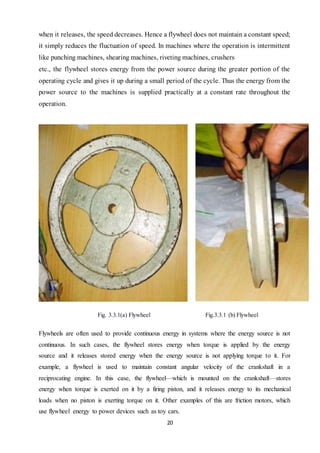
Flywheel used in machines serves as a reservoir which stores energy during the period when
the supply of energy is more than the requirement and releases it during the period when the
requirement of energy is more than supply. Flywheels have a significant moment of inertia
and thus resist changes in rotational speed. The amount of energy stored in a flywheel is
proportional to the square of its rotational speed. Energy is transferred to a flywheel by
applying torque to it, thereby increasing its rotational speed, and hence its stored energy.
Conversely, a flywheel releases stored energy by applying torque to a mechanical load,
thereby decreasing the flywheel's rotational speed. Flywheels are typically made of al and
rotate on conventional bearings; these are generally limited to a revolution rate of a few
thousand RPM .Some modern flywheels are made of carbon fiber materials and employ
magnetic bearings enabling them to revolve at speeds up to 60,000 RPM. In case of steam
engines, internal combustion engines, reciprocating compressors and pumps, the energy is
developed during one stroke and the engine is to run for the whole cycle on the energy
produced during this one stroke. For example, in I.C. engines, the energy is developed only
during power stroke which is much more than the engine load, and no energy is being
developed during suction, compressionand exhaust strokes incase of four stroke engines and
during compression in case of two stroke engines. The excess energy developed during
power stroke is absorbed by the flywheel and releases it to the crankshaft during other
strokes in which no energy is developed, thus rotating the crankshaft at a uniform speed. A
little consideration will show that when the flywheel absorbs energy, its speed increases and
20
when it releases, the speed decreases. Hence a flywheel does not maintain a constant speed;
it simply reduces the fluctuation of speed. In machines where the operation is intermittent
like punching machines, shearing machines, riveting machines, crushers
etc., the flywheel stores energy from the power source during the greater portion of the
operating cycle and gives it up during a small period of the cycle. Thus the energy from the
power source to the machines is supplied practically at a constant rate throughout the
operation.
Fig. 3.3.1(a) Flywheel Fig.3.3.1 (b) Flywheel
Flywheels are often used to provide continuous energy in systems where the energy source is not
continuous. In such cases, the flywheel stores energy when torque is applied by the energy
source and it releases stored energy when the energy source is not applying torque to it. For
example, a flywheel is used to maintain constant angular velocity of the crankshaft in a
reciprocating engine. In this case, the flywheel—which is mounted on the crankshaft—stores
energy when torque is exerted on it by a firing piston, and it releases energy to its mechanical
loads when no piston is exerting torque on it. Other examples of this are friction motors, which
use flywheel energy to power devices such as toy cars.
21
3.3.2 Hacksaw
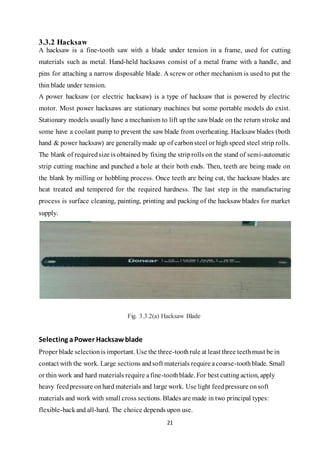
A hacksaw is a fine-tooth saw with a blade under tension in a frame, used for cutting
materials such as metal. Hand-held hacksaws consist of a metal frame with a handle, and
pins for attaching a narrow disposable blade. A screw or other mechanism is used to put the
thin blade under tension.
A power hacksaw (or electric hacksaw) is a type of hacksaw that is powered by electric
motor. Most power hacksaws are stationary machines but some portable models do exist.
Stationary models usually have a mechanism to lift up the saw blade on the return stroke and
some have a coolant pump to prevent the saw blade from overheating. Hacksaw blades (both
hand & power hacksaw) are generallymade up of carbonsteel or high speed steel strip rolls.
The blank of requiredsize is obtained by fixing the striprolls on the stand of semi-automatic
strip cutting machine and punched a hole at their both ends. Then, teeth are being made on
the blank by milling or hobbling process. Once teeth are being cut, the hacksaw blades are
heat treated and tempered for the required hardness. The last step in the manufacturing
process is surface cleaning, painting, printing and packing of the hacksaw blades for market
supply.
Fig. 3.3.2(a) Hacksaw Blade
Selecting aPower Hacksawblade
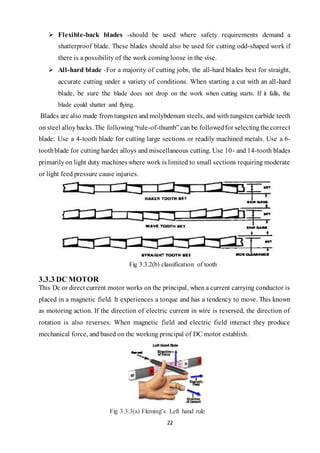
Proper blade selectionis important. Use the three-toothrule at least three teethmust be in
contact with the work. Large sections andsoft materials require acoarse-toothblade. Small
or thin work and hard materials require afine-toothblade. For best cutting action, apply
heavy feedpressure onhard materials and large work. Use light feedpressure onsoft
materials and work with small cross sections. Blades are made in two principal types:
flexible-backand all-hard. The choice depends upon use.
22
 Flexible-back blades -should be used where safety requirements demand a
shatterproof blade. These blades should also be used for cutting odd-shaped work if
there is a possibility of the work coming loose in the vise.
 All-hard blade -For a majority of cutting jobs, the all-hard blades best for straight,
accurate cutting under a variety of conditions. When starting a cut with an all-hard
blade, be sure the blade does not drop on the work when cutting starts. If it falls, the
blade could shatter and flying.
Blades are also made from tungsten and molybdenum steels, and with tungsten carbide teeth
on steel alloybacks. The following“rule-of-thumb” can be followedfor selectingthe correct
blade: Use a 4-tooth blade for cutting large sections or readily machined metals. Use a 6-
toothblade for cutting harder alloys and miscellaneous cutting. Use 10- and 14-tooth blades
primarilyon light duty machines where work is limited to small sections requiring moderate
or light feed pressure cause injuries.
Fig 3.3.2(b) classification of tooth
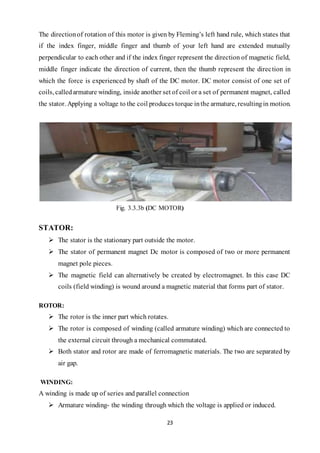
3.3.3 DC MOTOR
This Dc or direct current motor works on the principal, when a current carrying conductor is
placed in a magnetic field. It experiences a torque and has a tendency to move. This known
as motoring action. If the direction of electric current in wire is reversed, the direction of
rotation is also reverses. When magnetic field and electric field interact they produce
mechanical force, and based on the working principal of DC motor establish.
Fig 3.3.3(a) Fleming’s Left hand rule
23
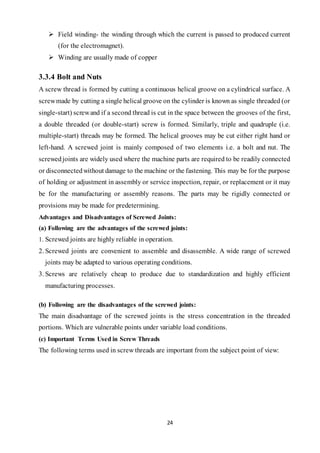
The directionof rotation of this motor is given by Fleming’s left hand rule, which states that
if the index finger, middle finger and thumb of your left hand are extended mutually
perpendicular to each other and if the index finger represent the direction of magnetic field,
middle finger indicate the direction of current, then the thumb represent the direction in
which the force is experienced by shaft of the DC motor. DC motor consist of one set of
coils, calledarmature winding, inside another set of coil or a set of permanent magnet, called
the stator. Applying a voltage to the coil produces torque inthe armature, resultingin motion.
Fig. 3.3.3b (DC MOTOR)
STATOR:
 The stator is the stationary part outside the motor.
 The stator of permanent magnet Dc motor is composed of two or more permanent
magnet pole pieces.
 The magnetic field can alternatively be created by electromagnet. In this case DC
coils (field winding) is wound around a magnetic material that forms part of stator.
ROTOR:
 The rotor is the inner part which rotates.
 The rotor is composed of winding (called armature winding) which are connected to
the external circuit through a mechanical commutated.
 Both stator and rotor are made of ferromagnetic materials. The two are separated by
air gap.
WINDING:
A winding is made up of series and parallel connection
 Armature winding- the winding through which the voltage is applied or induced.
24
 Field winding- the winding through which the current is passed to produced current
(for the electromagnet).
 Winding are usually made of copper
3.3.4 Bolt and Nuts
A screw thread is formed by cutting a continuous helical groove on a cylindrical surface. A
screwmade by cutting a single helical groove on the cylinder is known as single threaded (or
single-start) screwand if a second thread is cut in the space between the grooves of the first,
a double threaded (or double-start) screw is formed. Similarly, triple and quadruple (i.e.
multiple-start) threads may be formed. The helical grooves may be cut either right hand or
left-hand. A screwed joint is mainly composed of two elements i.e. a bolt and nut. The
screwedjoints are widely used where the machine parts are required to be readily connected
or disconnectedwithout damage to the machine or the fastening. This may be for the purpose
of holding or adjustment in assembly or service inspection, repair, or replacement or it may
be for the manufacturing or assembly reasons. The parts may be rigidly connected or
provisions may be made for predetermining.
Advantages and Disadvantages of Screwed Joints:
(a) Following are the advantages of the screwed joints:
1. Screwed joints are highly reliable in operation.
2. Screwed joints are convenient to assemble and disassemble. A wide range of screwed
joints may be adapted to various operating conditions.
3. Screws are relatively cheap to produce due to standardization and highly efficient
manufacturing processes.
(b) Following are the disadvantages of the screwed joints:
The main disadvantage of the screwed joints is the stress concentration in the threaded
portions. Which are vulnerable points under variable load conditions.
(c) Important Terms Used in Screw Threads
The following terms used in screw threads are important from the subject point of view:
25
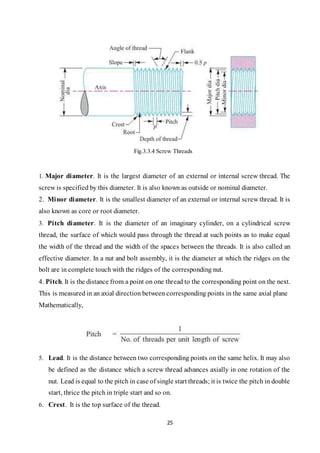
Fig.3.3.4 Screw Threads
1. Major diameter. It is the largest diameter of an external or internal screw thread. The
screw is specified by this diameter. It is also known as outside or nominal diameter.
2. Minor diameter. It is the smallest diameter of an external or internal screw thread. It is
also known as core or root diameter.
3. Pitch diameter. It is the diameter of an imaginary cylinder, on a cylindrical screw
thread, the surface of which would pass through the thread at such points as to make equal
the width of the thread and the width of the spaces between the threads. It is also called an
effective diameter. In a nut and bolt assembly, it is the diameter at which the ridges on the
bolt are in complete touch with the ridges of the corresponding nut.
4. Pitch. It is the distance from a point on one thread to the corresponding point on the next.
This is measured in an axial direction between corresponding points in the same axial plane
Mathematically,
5. Lead. It is the distance between two corresponding points on the same helix. It may also
be defined as the distance which a screw thread advances axially in one rotation of the
nut. Lead is equal to the pitch in case of single start threads; it is twice the pitch in double
start, thrice the pitch in triple start and so on.
6. Crest. It is the top surface of the thread.
26
7. Root. It is the bottom surface created by the two adjacent flanks of the thread.
8. Depth of thread. It is the perpendicular distance between the crest and root.
3.3.5 SOLAR PANEL
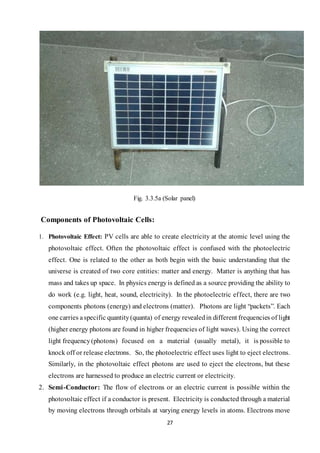
A solar panel designed to absorb the sun's rays as a source of energy for generating
electricity. A photovoltaic (in short PV) module is a packaged, connected assembly of
typically 6×10 solar cells. Solar Photovoltaic panels constitute the solar array of
a photovoltaic system that generates and supplies solar electricity to store in battery and run
motor. Each module is rated by its DC output power under standard test conditions, and
typically ranges from 100 to 365 watts. The efficiency of a module determines the area of a
module given the same rated output – an 8% efficient 230 watt module will have twice the
area of a 16% efficient 230 watt module. There are a few solar panels available that are
exceeding 19% efficiency. A single solar module can produce only a limited amount of
power; most installations containmultiple modules. A photovoltaic system typicallyincludes
a panel or an array of solar modules, a solar inverter, and sometimes a battery and/or solar
tracker and interconnectionwiring. Solar modules use light energy (photons) from the sun to
generate electricity through the photovoltaic effect. The majority of modules use wafer-
based crystalline silicon cells or thin-film cells based on cadmium telluride or silicon. The
structural (load carrying) member of a module can either be the top layer or the back layer.
Cells must also be protectedfrom mechanical damage and moisture. Most solar modules are
rigid, but semi-flexibleones are available, based on thin-film cells. Electrical connections are
made in series to achieve a desired output voltage. Bypass diodes may be incorporated or
used externally, in case of partial module shading, to maximize the output of module
Sections still illuminated.
27
Fig. 3.3.5a (Solar panel)
Components of Photovoltaic Cells:
1. Photovoltaic Effect: PV cells are able to create electricity at the atomic level using the
photovoltaic effect. Often the photovoltaic effect is confused with the photoelectric
effect. One is related to the other as both begin with the basic understanding that the
universe is created of two core entities: matter and energy. Matter is anything that has
mass and takes up space. In physics energyis defined as a source providing the ability to
do work (e.g. light, heat, sound, electricity). In the photoelectric effect, there are two
components photons (energy) and electrons (matter). Photons are light “packets”. Each
one carries aspecific quantity(quanta) of energy revealedin different frequencies of light
(higher energy photons are found in higher frequencies of light waves). Using the correct
light frequency(photons) focused on a material (usually metal), it is possible to
knock off or release electrons. So, the photoelectric effect uses light to eject electrons.
Similarly, in the photovoltaic effect photons are used to eject the electrons, but these
electrons are harnessed to produce an electric current or electricity.
2. Semi-Conductor: The flow of electrons or an electric current is possible within the
photovoltaic effect if a conductor is present. Electricity is conducted through a material
by moving electrons through orbitals at varying energy levels in atoms. Electrons move
28
from lower energy levels (valance band) to higher energy levels (conduction band). The
energy difference between these levels is known as the band gap. Semi-conductors have
an intermediate band gap. Meaning they require more energy to move electrons than a
conductor, but less than an insulator. Once electrons are moved they create electron
“holes” or unoccupied orbital’s in the valance band and easily released electrons in the
conduction band. In PV cells, semi-conductors are often used because they can regulate
conduction band electrons and electron “holes” more readily, especially if the semi-
conductor is “doped” or impurities are added.
3. P-N Junction(Photodiode): The photovoltaic effect within a PV cell is able to produce
an electric current by using a P-N junction. The P-N Junction is made of two kinds of
semi-conductors. The N-type (N for Negative or electron-rich) is doped to have a high
density of electrons and few holes, while the P-type (P for Positive or electron-poor) is
doped to be the opposite. Electrons flow from areas of high to low concentration. The
difference between these concentrated areas is known as voltage. A P-N junction
regulates the voltage, so current only flows in one direction resulting in an electric
current.
Operation of Photovoltaic Cells (Solar Cells):PV Cells are able to convert light
into electricitybyfirst allowing radiant energy from the sun to pass through a transparent
layer (glass). A small portion of the light frequencies (10 – 17% with technology
commercially available in 2011) (photons) are absorbed ejecting electrons from the
doped N-type semiconductor layer. The amount depends on intensity and angle of light
sent and the continuing development of the manufacturing technology. These electrons
are passed to a conductor, which completes a circuit back to the P-type semiconducting
layer. After transporting electrical energy utilized by electrical devices or stored in
batteries, the electrons will fill “holes” in the P-type semiconducting layer. Due to
electrons beingdepositedinP-type semiconductor layer the voltage increases forcing the
electrons to move across the junctioninto the N-type semiconductorallowingthe process
to repeat it. As technology advances, improvements in conversion efficiencies
demonstrated in the laboratory (some approaching 40%) ma become commercially
available, subsequently lowering costs.
Determining Size of Photovoltaic Panel Array: There are several steps involved
in sizing the PV array, determining load power consumption, accounting for losses and
29
dividing by solar insulation levels for deployment region. Determining the Load Power
consumption. The first stepis to determine how much power the total system load will draw.
Power is measured in Watts.
P = V ∗ I (Joule’s Law)
However, the power rating is more useful when lookedat in terms of time;this is indeed how
electriccompanies charge consumers. For example a 200Watt light bulb running for 24 hours
uses 4.8 KWh.
200Watts ∗ 24hrs = 4800Watt-Hoursor 4.8 KW
Determining SolarInsulation Levels:
In order to determine a good approximation of how much power the PV panels will output,
solar insulationlevels needto be considered. Solar insulationis the amount of incomingsolar
radiation incident on a surface, for PV applications the surface of interest is the earth’s
surface. The values of solar insulationare commonly expressed in kWh/m2/day, which is the
amount of solar energy that strikes a square meter of the earth's surface in a single day. This
is commonly referred to as a “Sun-Hour-Day”. The amount of insulation received at the
surface of the Earth is controlled by the angle of the sun, the state of the atmosphere,
altitude, and geographic location.
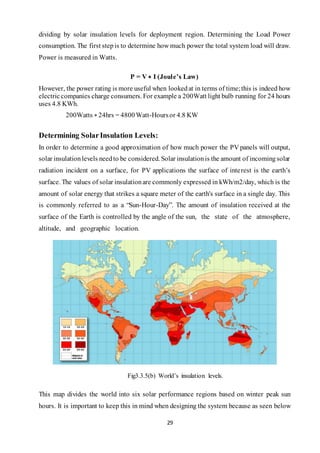
Fig3.3.5(b) World’s insulation levels.
This map divides the world into six solar performance regions based on winter peak sun
hours. It is important to keep this in mind when designing the system because as seen below
30
in Figure, during the winter you have a much smaller ‘Solar Window’. Worst case scenarios
should be calculated as it is better to have extra energy in the summer than not enough in the
winter. Therefore the “Sun-Hour-Day” values for December (since December days are
shortest) are generally used.
3.3.6 Rechargeable Battery
Nearly all large rechargeable batteries in common use are Lead-Acid type,
although there are three variations, flooded, gelled electrolyte (“Gel Cells”) and
absorbedglass matt (“AGM”). Floodedis the oldest and cheapest technologyusedbut can be
dangerous, in case of a malfunction acid can spill. Gel Cells contain acid that has been
"gelled" by the addition of SilicaGel, turning the acid into a solidmass, therefore even if the
batterywhere crackedopen, no acid would spill. Gel batteries need to be charged at a slower
rate (capacity / 20) but this is not a concern in the PV setup as the panels will not be
outputting nearly this much current. AGM batteries are the newest technology and have all
the advantages of Gel Cells without the charging limitations. All deep cycle batteries are
rated in amp-hours. An amp-hour (Amps x Hours) is one amp for one hour, or 10 amps for
1/10 of an hour and so forth. The accepted AH rating time period for batteries used in solar
electric and backup power systems is the "20 hour rate". This means that it is discharged
down to 10.5 volts over a 20 hour period while the total amp-hours it supplies is measured
(Wind sun).
A rechargeable battery, storage battery, secondarycell, or accumulator is a type of electrical
battery which can be charged, discharged into a load, and recharged many times, while a
non-rechargeable or primary battery is supplied fully charged, and discarded once
discharged. It is composed of one or more electrochemical cells. The term "accumulator"is
used as it accumulates and stores energy through a reversible electrochemical reaction.
Rechargeable batteries are produced in many different shapes and sizes, ranging from button
cells to megawatt systems connected to stabilize an electrical distribution network. Several
different combinations of electrode materials and electrolytes are used, including lead–
acid, nickel cadmium (Ni-Cad), nickel metal hydride (Ni-MH), lithium ion (Li-ion), and
lithium ion polymer (Li-ion polymer).Rechargeable batteries initially cost more
than disposable batteries, but have a much lower total cost of ownership and environmental
impact, as they can be rechargedinexpensively many times before theyneedreplacing. Some

rechargeable battery types are available in the same sizes and voltages as disposable types,
and can be used interchangeable with them.
31
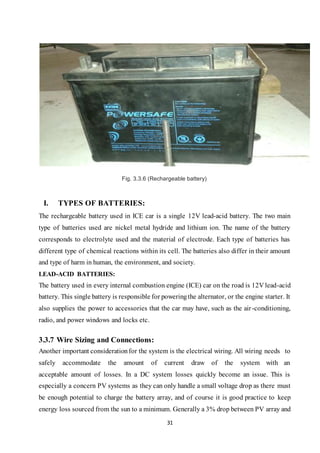
Fig. 3.3.6 (Rechargeable battery)
I. TYPES OF BATTERIES:
The rechargeable battery used in ICE car is a single 12V lead-acid battery. The two main
type of batteries used are nickel metal hydride and lithium ion. The name of the battery
corresponds to electrolyte used and the material of electrode. Each type of batteries has
different type of chemical reactions within its cell. The batteries also differ in their amount
and type of harm in human, the environment, and society.
LEAD-ACID BATTERIES:
The battery used in every internal combustion engine (ICE) car on the road is 12V lead-acid
battery. This single battery is responsible for poweringthe alternator, or the engine starter. It
also supplies the power to accessories that the car may have, such as the air-conditioning,
radio, and power windows and locks etc.
3.3.7 Wire Sizing and Connections:
Another important considerationfor the system is the electrical wiring. All wiring needs to
safely accommodate the amount of current draw of the system with an
acceptable amount of losses. In a DC system losses quickly become an issue. This is
especially a concern PV systems as they can only handle a small voltage drop as there must
be enough potential to charge the battery array, and of course it is good practice to keep
energy loss sourced from the sun to a minimum. Generally a 3% drop between PV array and
32
batteries is acceptable. Also, “any type of connection bigger than AWG 10 should have a
proper compression connector, with appropriate joint compound and preparation. This
does require special toolsanddies. Otherwise you are running the risk of burning up your
connections if you get any kind of heavy current flowing (Solar Forum)”
Losses associatedwithtransmissionof DC power:
CM = (22.2 ∗ A ∗ D)/VD
CM = Circular Mills inCopper
A = current inamps
D = one-way cable distance in feet
VD = Voltage Drop
22.2 = Constant for Copper
For wiring from the PV panels to charge controller the maximum PV short circuit current
specification (from PV data sheet) is used
3.4 Fabrication:
Fabrication means providing a physical shape to the prepared model. Fabrication was mostly
done using the metal parts. The base and the support structures were made using the parts.
The fabrication of each part and mechanism are described in the following section.
Construction of base table:
It was made using wood.
Mounting of motor and flywheel
Motor of 70 RPM and 0.67 HP was placed on the base table. Flywheel of 12 cm diameter
was fixed to the shaft of motor and then flywheel connected with rod.
Mounting of hacksaw to the horizontal arm and mounting of bench vice to the base table:
Hacksaw was mounted to the horizontal arm by two vertical arm of length 7.5 inch and 6 inch
welded to the horizontal arm. After mounting hacksaw to the horizontal arm, bench vice was
mounted to the base table by fixing it with nut and bolt of length 2 inch and diameter 8 mm.
33
3.5 Calculation
The torque of the DC motor must be increased so as to bring about the necessary power for
cutting of work-pieces efficiently. This is achieved by coupling the rotor of the DC motor to a
flywheel. So, this will reduce the rotating speed while increasing the torque. The flywheel is
connected to the reciprocating mechanism.
Driving flywheel diameter = 0.12
Speed of motor, N = 70 rpm
Force =1.146
Power = 0.67 hp = 0.504 kW
Power = 2πNT/60
Torque T = 68.78 N-m
34
3.6 Working Principle:
The aim of our project is to run the machine both DC as well as AC power. First of all we
gain the energy from the solar power. This gained energy is stored in battery. Then we
actuate the motor with the help of this battery power. This project is work under the scotch-
yoke mechanism. The scotch-yoke mechanism converts the rotating motion in the
reciprocating motion. The machine has a prime mover at the bottom of machine. The
flywheel is connected to motor shaft. The clamp is fixed with flywheel. The clamp is fixed
with the shaft at one end this shaft is act as reciprocating motion through the crank. The
hacksaw is connected to the shaft at the end. If the motor is turn-on the flywheel getting
rotatingmotionthat rotationmotionconvert into reciprocatingmotionunder the scotch-yoke
mechanism.
Power Hack sawing:
A power hacksaw machine is designed primarily straight-line sawing. A typical sawing
operation is lined below:
Select a hacksaw blade of proper length for the machine and proper pitch for the material to
be cut. Install the hacksaw blade with the teeth pointing downward and toward the motor end
of the hacksaw machine. Check the alignment of vice and hacksaw blade and mount the
work piece in the vice. Make the vice holds the work piece securely. Check the stroke of
hacksaw machine and adjust if necessary. After adjusting the stroke, move the hacksaw blade
and sewing machine frame through one cycle by hand to check the blade clearance at each
end of the work piece. Readjust the position of vice if necessary. Position the hacksaw blade
about ¼ inches above the work piece and set the feed control to its lightest feed setting. Set
desired speed of hacksaw machine. Start the machine and let the blade feed lightly into the
work piece for about ¼ inch. Readjust the feedto whatever the material will stand for normal
cutting. Permit the hacksaw blade to cut completely through work piece. The blade frame
will trip a switch on sawing machine bed to stop the sewing machine.
Power hacksaw machine are usedto cut large size of metal such as steel. Cutting diameter is
more than 10/15 mm is very hard work with a normal hand held hacksaw. Therefore power
hacksaw developed to carry out the difficult and time consuming work. The heavy arm
moves forwards and backwards, cutting on the backwards stroke.
The metal to be cut held in machine vice which is an integral part of base. Turning the handle
tightens or loses the vice. The vice is very powerful and locks metal in position. When
cutting is takes place, the metal especially blade heats up quickly. Coolant should be fed on
35
to the blade, cooling it down and lubricating it as it cut through the metal. Without coolant
the blade will over heat and break. This can be dangerous as blade can break with powerful
force, shattering.
Fig 3.6(a) Vice Bench
Blades of power hacksaw are graded according to the material they are made from and
number of teeth per inch. Top quality blades are manufactured by High Speed Steel.
Although, there are cheaper alternatives such as Carbon Steel Blades. In general the number
of teethper inch (TPI) range from 14 to 24.the more teeth per inch-the smoother to cut. The
power hacksaw has electric motor that powers the blade through flywheel system. Some have
ratchet system. The flywheel system transferred the rotary power from the motor and
changed to reciprocating motion; allow the blade to cut through material.
Fig 3.6(b) Teeth standard
36
3.7 Cost & Estimation
S.NO COMPONENTS QUANTITY COST
1 D.C MOTOR 1 ₹ 1500
2 SOLARPANEL 1 ₹ 550
3 FLY-WHEEL 1 ₹ 120
4 MILD STEEL FLAT ROD 2m ₹ 200
5 NUTS ANDBOLTS 15 ₹ 50
6 HACK-SAWBLADE 2 ₹ 20
7 Battery 1 ₹ 1800
8 Wire & Switch 2m&1 ₹ 40
Total Cost ₹ 4280
37
CHAPTER 4
RESULT AND DISCUSSION
Solar powered hacksaw machine is operated using solar energy. The battery is charged
using a solar panel. Solar panel is used for conversion of solar energy into electrical
energy which is further stored in the battery D.C. Motor is run using this battery.
Flywheel is attached to the shaft of the D.C. motor. The torque generated by the D.C.
Motor is transmitted through the flywheel to a link attached to the flywheel. This link is
connected to movable link, whose other end is connected to the main link in which
hacksaw blade is fixed. The rotational motion of the flywheel is converted to linear
motion of the main link. It is based on Scotch-yoke mechanism. The self -weight of the
main link and upper link which is moving on the movable link attached to the base
provides the required amount of downward force for cutting. The continuous motion of
fine tooth of hacksaw blade on work-piece leads to the cutting of this work-piece.
Test was carried out on this machine using different metal, PVC pipes &wood. For the
loaded test, a mild steel shaft of diameter 25 mm and length 12 inch was clamped on the
vice and the hacksaw machine was switched on. It took the hacksaw 240 seconds to cut
the entire diameter using a new hacksaw blade .The cut was observed to be neat and
straight with smooth surface of cut.
The total cost of equipment of the machine was 4280 rupees .The total cost of producing
this machine was estimated to be 6000 rupees. Recommendation has been made on the
operation and parameters of the machine .Suggestion have been offered on overall
machine performance optimization and future work on the machine.
38
CHAPTER 5
CONCLUSION AND FUTURE SCOPE
It is the need of time to replace conventional power hacksaw machine by solar powered
hacksaw. Solar powered hacksaw is energy efficient as well as eco-friendly in
comparison to convention hacksaw being used. The major advantage of this machine is
that it requires no exhaustible source of energy for its operation. In this rapid emerging
industrial section the use of power Hacksaw is wide and requires lots of energy for its
operation. This can be overcome by using solar powered hacksaw.
This machine can be made use of at any of the industries like pump manufacturing
industries that involve bulk amount of shafts that have to be cut frequently. Various range
of size of work-piece can be cut. Currently, the machine uses 12 inch blade for cutting of
shafts of various sizes. This machine is light in weight and thus easily portable. An
advancement that can be implemented in solar powered hacksaw is that the user can also
make it automated using required mechanism and sensors. This is possible with the help
of an advanced microcontroller, which should have programmable memory.
This machine has a wider application in remote areas which lacks supply of electricity.
Cutting operation is performed by each and every manufacturing industries. So in near
future if there would be development of micro-batteries which would supply the required
power then this hacksaw machine could be made even more compact.
39
REFERENCES
1. Khurmi,R.S.,&J.K. Gupta (2014).Theory of Machines, S. Chand Publication[page
no.114]
2. Khurmi, R. S., & Gupta, J. K. (2012). Machine Design, S. Chand Publication [page
no.730]
3. Khurmi, R. S., & Gupta, J. K. (2012). Machine Design, S. Chand Publication [page
no.998]
4. Kurvinen, E., Sopanen, J., & Mikkola, A. (2015). Ball bearing model performance on
various sized rotors withand without centrifugal and gyroscopic forces. Mechanism and
Machine Theory, 90, 240-260
5.Naresh,G.Venkatesh,N.S.Vishal,SureshKannan,Thangaprakash,A.Sivasubramanian,
Dr.G.Arunkumar Design and Fabrication of Pedal Operated Hacksaw, 2014 3(11), 197-
198
6. NelsonRE Bandsawing or hacksawing? 1965 109(24), Pages 90-93
7. Raj, K. J. S. D. (2012). Modeling, Controland Prototypingof Alternative Energy
Storage Systems for HybridVehicles (Doctoral dissertation, The Ohio State University).
8. Remmerswaal J Lp Mathysen MJC Economics of the cutting-offof metals
Microtecnic, 196115(4), 140-150
9. Suzuki, A., Miyamoto, K., & Takahashi, S. (1998). U.S. Patent No. 5,791,224.
Washington, DC: U.S. Patent and Trademark Office.
10. Thompson, P. J., & Sarwar, M. (1974, September). Power hacksawing. In Proc. 15th
IMTDR Conf.
11. Usher, A. P. (2013). A History of Mechanical Inventions: Revised Edition. Courier
Corporation.

Solar Powered Hacksaw

  • 1.
    A PROJECT REPORT On SOLARPOWERED HACKSAW Submitted to Dr. A.P.J. Abdul Kalam Technical University, Uttar Pradesh, Lucknow Submitted by ABHIJEET MAURYA 1209040003 ABHISHEK KUMAR 1209040005 ABDUL MOQEEM 1209040001 ASHWANI SINGH 1209040052 ARVIND KUMAR 1209040044 In partial fulfillment for the award of the degree of BACHELOR OF TECHNOLOGY In MECHANICAL ENGINEERING DEPARTMENT OF MECHANICAL ENGINEERING IEC College of Engineering & Technology Greater Noida,UP (INDIA) 201306 2016
  • 2.
    A PROJECT REPORT SOLARPOWERED HACKSAW Under the supervision of Mr. RAMEEZ Assistant Professor Department of Mechanical Engineering Submitted By ABHIJEET MAURYA 1209040003 ABHISEK KUMAR 1209040005 ABDUL MOQEEM 1209040001 ASHWANI SINGH 1209040052 ARVIND KUMAR 1209040044 In partial fulfillment for the award of degree Of BACHELOR OF TECHNOLOGY In MECHANICAL ENGINEERING DEPARTMENT OF MECHANICAL ENGINEERING IEC COLLEGE OF ENGNEERING & TECHNOLOGY Greater Noida (UP),India 201306 2016
  • 3.
    CERTIFICATE Certified that thisproject report entitled “SOLAR POWERED HACKSAW ’’ submitted by ABHIJEET MAURYA (120904003), ABDUL MOQEEM (120904001), ABHISHEK KUMAR (120904005), ARVIND KUMAR (1209040044), ASHWANI SINGH (1209040052) to the Uttar Pradesh Technical University Luck now, India in partial fulfillment for the award of Degree of Bachelor of Technology in Mechanical Engineering is a bona fide record of the project work carried out by him under my supervision during the year 2015-2016. Prof. Nurul Hassan Laskar Mr. Rameez Khan (Head) Assistant Professor Department of Mechanical Engineering Department of Mechanical Engineering IEC-CET GREATER NOIDA IEC-CET GREATER NOIDA
  • 4.
    ACKNOWLEDGEMENT I would liketo place on record my deep sense of gratitude to Prof, Nurul Hassan Laskar HOD- Dept. of Mechanical Engineering, IEC-CET, Greater Noida, India for his encouragement, help and useful suggestions. I express my sincere gratitude to Mr. Amit Kumar Yadav, Dept. of Mechanical Engineering, IEC-CET, Greater Noida, India for his stimulating & continuous encouragement throughout the course of my project work. I also wish to extend my thanks to Mr. Rameez Khan for constructive suggestions, guidance to improve the quality of his project work. I am extremely thankful to teachers and staffs of our workshop for providing requisite tools and equipments without which this project would not be successful. ABHIJEET MAURYA (1209040003) ABHISHEK KUMAR (1209040005) ABDUL MOQEEM (1209040001) ASHWANIKUMAR (1209040052) ARVIND KUMAR (1209040044)
  • 5.
    CONTENTS Title Page No. ACKNOWLEDGEMENTi CONTENT ii LIST OF TABLE iii LIST OF FIGURE iv LIST OF SYMBOLS v CHAPTER 1 Introduction 1.1 General 1.2 Scope of the Project 1.3 Objective of Project 1.4 Approach and methodology 1.5Justification & Relevance 1-3 CHAPTER 2 Literature Review 2.1 General 2.2 Historical Background 2.3 Sawing 2.4 Power Hacksaw Cutting 2.5 Types of Hacksaw Cutting Machines 2.6 Band Sawing 2.7 Circular Sawing 2.8 Features of Modern Hacksaw 4-9 CHAPTER 3 Project Methodology 3.1 General 3.2 Scotch Yoke Mechanism 3.3 Components Used 3.4 Fabrication 3.5 Calculation 3.6 Working Principle 3.7 Cost and estimation 10-28 CHAPTER 4 Result and Discussion 29 CHAPTER 5 Conclusion & Future Scope 30 REFERENCES 31
  • 6.
    LIST OF FIGURES FigNo. Title Page No. 3.1 Solar Power hacksaw 10 3.2 Scotch Yoke Mechanism 11 3.3.1 Flywheel 12 3.3.2(a) Hacksaw Blade 13 3.3.2(b) Classification of tooth 14 3.3.3(a) Fleming’s left hand rule 14 3.3.3(b) D.C. Motor 15 3.3.4 Screw Thread 17 3.3.5(a) Solar Panel 19 3.3.5(b) World’s Insulation Level 21 3.3.6 Rechargeable Battery 23 3.6(a) Vice Bench 27 3.6(b) Teeth standard 27
  • 7.
    7 LIST OF ACRONYMS,SYMBOLS AND ABBREVIATIONS Sr. No. Symbol/Avv./Nom. Description 01 cm Centimeter 02 BS British Standard 03 mm Millimeter 04 ᶲ Diameter 05 rpm Revolution per minute 06 m/min Meter per minute 07 Ft. Feet
  • 8.
    8 ABSTRACT This project ison the design and construction of a solar power hacksaw machine for cutting of metal to different size and length with the help of solar hacksaw. The objective of this project is to save manpower and time, energy in cutting metals in order to achieve high productivity. It is a cutting machine with teeth on its blade used specially for cutting material. The power to the hacksaw is provided by the Solar Energy. The motor drives the flywheel connected to the shaft of the motor. The flywheel is connected through a link that transmits the required force for cutting the work piece. Finally connecting rod is connected to the vertical arm connected to the horizontal arm. Rotary motion of the shaft is converted into reciprocating motion of the hacksaw with the help of crank and connecting rod. Work piece of desired length can be cut by feeding it to hacksaw by holding it into bench vice. The various component of the machine were designed and constructed. Test was carried out on the machine using different metals. A solar panel connected to power hacksaw is considered as a solar operated power hacksaw in which sun’s energy is used to drive the hacksaw in order to cut wood, metal rod etc. A solar connected to the hacksaw converts the solar energy into electrical energy which is stored in a 12 v battery as a direct current to run the motor connected to the hacksaw .A DC motor is connected to the hacksaw which is used to give the rotary motion to the flywheel connected to the shaft of the dc motor .The energy stored in battery is supplied to the dc motor which rotates the flywheel connected to the shaft of motor. The rotary motion of the flywheel is converted to reciprocating motion which gives back-forth motion to blade of the hacksaw by a mechanism known as scotch yoke mechanism. The reciprocating motion of the hacksaw reciprocates the blade on the work piece which performs the cutting action. The work piece is clamped in a clamper to fix it. The clamper is made of cast iron or mild steel. A solar power hacksaw is a cheap and environmental friendly device that is operated without the consumption of any energy other than the solar energy .Solar energy is cheap and easily available on the earth. No heavy machines or devices are required for energy conservation. Solar powered hacksaw can be used in work shop, industries, and many fields where there is a requirement of hacksaw. Keyword- Solar Panel, DC Motor, Battery, Flywheel, Mild Steel.
  • 9.
    9 CHAPTER 1 INTRODUCTION 1.1. General Ahacksaw is a handheld tool used to cut through materials like plastic tubing and metal pipes. Its cutting mechanism is provided by removable blades which feature sharp teeth along their outer edge. In most cases, a hacksaw consists of a metal frame that resembles a downward-facing. A handle of plastic, wood, or metal is typically affixed to one end of the frame. The frame’s ends feature adjustable pegs that can be tightened to secure a blade in place, and loosened to remove it. Hacksaw blades are long, thin strips of hardened steel that feature a row of teeth along their cutting edge. Each end of the blade is punched with a small hole that fits onto the saw frame’s pegs. Most blades range in length from ten to 12inches (25.4 to 30.48 cm), although six-inch (15.24 cm) blades can be purchased to fit smaller hacksaw models. A device that applies force, changes the directionof a force, or changes the strength of a force, in order to perform a task, generally involving work done on a load. Machines are often designed to yield a high mechanical advantage to reduce the effort needed to do that work. A simple machines a wheel, a lever or an inclined plane. All other machines can be built using combinations of these simple machines. Example: A drill uses a combinationof gears (wheels) to drive helical inclinedplanes (the drill bit) to split a material and carve a hole in it. 1.2. Scope of the project 1. The machine can solve the problem of time consumption. 2. Waste of resources in face of labor cost is reduced. 3. The machine can be used in the industry where it is manufactured, at the packaging sector. 4. 4 It is used as hardware in large quantity like in fabricationmachine 5. It provide alternative for industries aiming toward reducing human effort. 6. It generates sustainable and practical solutions for the future industrial development. 1.3 Objectives of the project 1. To cater to the issue of competition in mechanical industry the need for solar energy is assess by all the industry.
  • 10.
    10 CONSTRUCTIONOF BASETABLE 2. Identifythe key policy avenues considered to be appropriate to meet the challenge of sustainable manufacturing and packaging industry for the future. 3. To provide alternative for industries aiming toward reducing human effort. 4. Sustainable and practical solutions for the future industrial environment. 1.4 Approach and Methodology: MOUNTING OF BASE FOR HOLDING SHAFT CONNECTED TO THE FLYWHEEL, CRANK & CONNECTING ROD MOUNTING OF CLAMP & INSERTING SHAFT INTO THE CLAMP MOUNTING OF BENCH VICE TO THE BASE TABLE FIXING OF BACK ARM INTO THE SHAFT FIXING OF HORIZONTAL ARM TO THE BACK ARM FIXING OF HACKSAW TO THE HORIZONTAL ARM MOUNTING OF DC MOTOR ON THE TABLE FIXING OF PULLEY TO THE ROTOR OF MOTOR & CONNECTING FLYWHEEL TO THE ROD FINAL ASSAMBLING SUPPLY OF POWER WORKING RESULT & DISCUSSION
  • 11.
    11 1.5 Justification &Relevance We have found a solar power hacksaw to be the most useful for general shop work. Modern heavy-duty hacksaw machines provide an economical and efficient means of sawing a wide range of materials and stock sizes. Power hack saws are getting rarer all the time but they do a good job within their capacity. If you can get one that takes standard hacksaw blades then you'll have a tremendous range of blades to choose from and will be able to cut most anything. Solar Hacksaws are more tolerant to tensioning maladjustment and run off. A major advantage of solar power hacksaw cutting is the relatively low capital investment required. Tooling and maintenance costs are low. Accuracy and finishes produced, range from fair to good depending on the material being sawed. Time saving as comparedto simple hacksaw and comfortable than ordinary hacksaw.
  • 12.
    12 CHAPTER 2 LITERATURE REVIEW 2.1General After the study of many literatures about design, construction and working of solar power hacksaw machine, some of them describe the methodology of solar power hacksaw. Lots of factor have been consider for the design, construction and working of solar power hacksaw machine such as cutting speed, cutting material, cutting time ,power ,efficiency etc. So, lots of literatures have been found which gives the relevance information and methodology of constructing an solar power hacksaw machine. 2.2 Historical Background The problem of cutting-off material to size is common to practically every industry. Often, sawing is the first operation carried out on bar stock. Therefore, it is surprising that so little work has been done to understand the problems of this common operation. Many reasons have been consider better methods. Often the foreman will assign a new trainee to a sawing task, on the principle that it is easy to learn and difficult to foul up. Furthermore cut-off machines are frequently housed in stores away from the main production areas and the operation of the sewing machines appears to be simple. The fact remains that cutting-off operations can account for a significant part of the cost per piece (Remmerswaa and Mathysen, 1961). The reason for carrying out the present work is the growing realization on the part of manufacturers of bothblades and machines, that the factors which control the mechanics and economics of power hacksaw cutting are complex. Also power hacksaw cutting has been receiving increased competition from other cutting off processes, such as band and circular sawing. Whilst the BritishStandard BS 1919: 1974gives specifications for hacksaw blades regarding dimensions etc. the standard relates to testing of hacksaw blades for hand use only and does not include power hacksaw blade testing. Thus, both manufacturers of hacksaw blades and users have experienced considerable difficulty in establishing standard testing procedures and in obtaining consistency in test data using power hacksaw machines. Preliminary investigations by the author have revealed that existing blade testing methods were not independent of the machine characteristics, which could contribute to one of the reasons for
  • 13.
    13 the inconsistencyin thetest data. Hence, there has been requirement to identify the machine characteristics under normal working conditions and to investigate the mechanics of the sawing process and the variables affecting metal removal rate. Most of the early published work on cutting-off has been primarily concerned with circular and band sawing and cost comparisons betweenalternative processes. Whilst these alternative processes are frequently, quicker than power hacksaw cutting, their costs are in many applications higher. Whilst the impact of these alternative processes on the application of power hacksaw cutting cannot be denied there remains a significant field of application for power hacksaw cutting which is likelyto remain unchallenged. A factor of prime interest to manufacturersis that, if the costs of power hacksaw cutting can be reduced by developing the blade and the saw machine, the potential field of application will be widened. During the past fifty years very little attention has been devoted to developing the geometry of the hacksaw blade or the machine, although, some improvements in the blade material, together with methods of applying the load and mechanized work handling, have been achieved (Nelson,1965). 2.3 Sawing If all raw stock was delivered in ready-to-machine shapes and sizes, there would be no need for sawing machines in a metal working shop. Machine operators couldmerelygo over to the stock, select the suitable work piece, and perform the necessary finishing operations. Such situationrarelyexists, due to the fact that the majorityof the stockrequires to be cut in some way prior to starting a machining schedule. The alternative to this primary operation of sawing is to buy-in prepared lengths and shapes; this however introduces a service which the company has to pay for and, in the majority of the cases, it is simpler and more economical to carry out the basic cutting-to-size operation in house. One of the major advantages of sawing over all other kinds of machining is the narrowness of cut op. Most sawing machines perform the cut-off operation, where a piece of stock is cut to a workable length prior to subsequent machining operations. Machines that accomplish this job include hacksaws, band saws and circular saw. 2.4 Power Hacksaw Cutting The simple back-and-forth motion of the blade made the hacksaw one of the first types of sawing machines designed for power. The simplicity in the blade motion has kept the price of the saw machine relatively cheaper than other types of sawing machines. The low initial cost coupled with the flexibility and adaptability, has enabled the hacksaw to remain popular
  • 14.
    14 in industry. Inhacksaw cutting, a single blade is tensioned in the bow, and reciprocated back and forth over the work piece. The cutting action is achieved only during half of the cycle of operation. During the second half of the cycle, the return stroke, the blade is lifted clear of the work piece, giving a discontinuous cutting action, which is considered to be one of the drawbacks of the operation. Despite this disadvantage, As compared to the continuous- cutting action of the band saw, hacksaws remain equally or even more popular alternative machines. As with many other basic processes, hacksaw cutting is a tried and tested method, reliable, consistently accurate, quick and easy to repair, is less dependent on correct blade tension and less likely to run-out. Furthermore power hacksaws can be left unattended for long periods when cutting large diameter bar and require minimum operator skill. Blade replacement is relatively cheap and simple. 2.5 Types of Hacksaw Cutting Machines For a given blade and work piece the material removal rates achieved by hydraulic and gravity fed machines are controlled solely by the thrust loads developed. Therefore, hack sawing may be said to be a process in which the material removal rate is force controlled, unlike most other material removal processes. The machines available can be divided into two broad categories, according to the method used to develop the load between the blade and the work piece, namely gravity feed machines and hydraulic machines. A third, but not common machine is the positive displacement machine. Power hacksaw machines are used mainly for cutting-off operations. 2.5.1. Gravity Feed Machines In this type of machine, which is usually of light construction for general duty, the thrust load is developed by the gravity feed of the saw bow. In many of these machines the magnitude of the thrust load is fixed, although some machines are provided with adjustable masses on the over arm for thrust load adjustment. The thrust, load varies throughout the cutting stroke due to the reciprocating displacement of the over arm mass and the action of the cam operated lift-off device which acts at the beginning and the end of the stroke. This type of machine generally has a work piece capacity between 150 - 200 mm (6 and 8 inches) diameter and is ideal for the small workshop where the cutting requirement is only occasional and the configuration of work pieces to be cut ranges from mild steel flat complex shaped sections and tubular sections up to 6 inches diameter. Due to the light construction and gravity feed the applications for this type of machine are limited.
  • 15.
    15 2.5.2. Hydraulic Machines Thethrust force between the blade and the work piece in this type of machine is developed by a hydraulic device. Pressure may be developed in the load cylinder by either a restricted back-flow system, or the pressure may be supplied from a separate pump. In some of these machines, greater flexibilityof control has been introduced by means of an arc cutting action combined with a universally controlled hydraulic system which allows better performance from the saw blade. The advanced types of heavy duty electro-hydraulic hacksaws have a very wide range of operation and are available in semi-automatic or fully automatic form, with provisions for automatic feeding of bar stock, cutting-off to predetermined sizes and unloading etc. The feature of power down-feed to the saw bow incorporated in these machines makes the machine suitable for cutting the tougher steels and alloys. These machines are the most common and develop greater thrust loads than machines of other type and have a reputation for sawing without problems and requiring minimum operator skill. 2.5.3. Positive Displacement Machines Whilst these machines are not as popular as the gravity feed or hydraulic machines, a few machines are available where the feed rate of the blade and hence, the metal removal rate is directly controlled by a mechanical screw device, giving a positive feed. This type of machine can lead to overloading of the blade giving premature blade failure particularly when the blade is worn. Positive displacement machines are not prone to variation in thrust loads during the cuttingstroke-since the thrust loads directly arise as a result of the constant rate of penetration of the blade teeth. 2.6 Band Sawing Band sawing, unlike hacksaw cutting, is a continuous cutting operation. An endless blade, the band, is tensioned between two shrouded, rotating wheels, and part of the band is exposedto carryout the cutting operationof the work piece. The band travels in a continuous motion, with the teeth fed against the work piece. Whilst earlier metal sawing bands were wide (over 25 mm), and were used strictly for cut off methods, narrow blades, introduced about 50 years ago brought contouring capabilities. Furthermore, due to the small throat clearance of the earlyband saws, theywere limitedin use by the basic design, thus the length of the work piece could only be as long as the machine throat. However modern machines have been modified to give adequate throat clearance, by intentionally twisting the blade so
  • 16.
    16 that the toothedfaces in line with the machine throat. As with hacksaw machines, band saws can be divided into two broad categories. A general purpose band saw having gravity fed system, controlled by a dash-pot and using a25 mm (1 inch) deep blade, is the most popular machine available. This machine is suitable for general fabrication work and accurate cutting of solid bars. This type of machine is limited to about 175 mm (7 inches) diameter for mild steel. In order to meet the present day requirements for high-volume production, cutting all grades of steel and to introduce high accuracy and reliability, it has been necessary for the band saw machine manufacturers to incorporate in the design not only heavy duty construction having capacities up to 450 mm (18 inches) diameters but also innovations in the hydraulic power down-feed, to allow the cutting of difficult alloys .such as mnemonics and titanium. 2.7 Circular Sawing Circular saws have a continuous cutting action, use blades having many teeth, and a large range of rotational speeds. This operation is similar to a milling operation. The machines available range from the earlier, inexpensive hand loaded models to the very large, power loaded type and incorporate material handling devices for semi and then fully automatic operations. Modern production circular saws are built with several alternate basic feed mechanisms i.e. horizontal, vertical, rocking head and variations of these. The choice of the most suitable type of machine depends on the particular application and the size and shape of component. With vertical feed, the rotating blade travels downwards in a straight line to engage the work piece. On machines designed for horizontal feed the blade is fed into the work piece from the back. A third basic feeding arrangement is a pivot motion or rocking- head system, this is as efficient as a vertical feed system and is a rugged arrangement. The bench or floor mounted manual-feed circular saw, when installed together with a general duty band saw or hack sawing a small workshop, provides a complete cutting facility for the small fabricator. Fully automatic circular saws, having features such as dial-in component length, in process gauging, choice of loading magazines, etc. are widely used where high quality production is required and often present the production engineer with a difficult choice to make between circular sawing and band sawing. (Suzuki etc.1998). 2.8 Features of Modern Hacksaw The simplicity of design and operation, coupled with the low initial cost, has made the hacksaw grow in popularity. Its limitations are due to its mode of operation, i.e. cutting only on half of the
  • 17.
    17 stroke, the slowcutting speed, and the fact that not all the length of the blade is utilized. Some of the features in a modern hacksaw which achieve improved performance are: (i) A range of cutting speeds, uniform over the cutting stroke, and a fast return stroke. (ii) Means to regulate and monitor the cutting pressure. (iii) Adjustable stroke. (iv) Automatic relief of the blade on the return stroke. (v) Some means of indicating and correcting blade tension. (vi) Automatic stopping device when the cut is complete.
  • 18.
    18 CHAPTER 3 PROJECT METHODOLOGY 3.1General Solar Power Hacksaws are used to cut large sections of metal or plastic shafts and rods. Cutting of solidshafts or rods of diameters more than fifteen millimeters is a very hard work with a normal hand held hacksaw. Therefore solar power hacksaw machine is used to carry out the difficult and time consuming work. This power hacksaw machine is considered as an energy saving machine because the operator need not be there to provide the reciprocating motion and downward force on the work-piece in order to cut it. Once the operator has fed the work-piece till the required length in to the machine and starts the machine, then the machine will cut until the work-piece has been completely cut in to two pieces. The Solar Power hacksaw machine though being able to cut the shaft or rod without requiring any human effort to cut, it does require a human intervention to feed the work-piece many times with measurements being taken each time before feeding. Fig.3.1 (SOLAR POWERED HACKSAW) 3.2 Scotchyoke mechanism: This mechanism is used for convertingrotarymotioninto a reciprocatingmotion. The inversionis obtainedby fixing either link1or link 3.infig link 1 is fixed. In this mechanism when the link 2 (which correspondto crank) rotates about Bas centre, the link 4 (which correspondto frame) reciprocates. The fixedlink 1 guides the frame.

  • 19.
    19 Fig 3.2 (Scotchyoke mechanism) 3.3 Components Used Following components has been used to construct this project 3.3.1 Flywheel: Flywheel used in machines serves as a reservoir which stores energy during the period when the supply of energy is more than the requirement and releases it during the period when the requirement of energy is more than supply. Flywheels have a significant moment of inertia and thus resist changes in rotational speed. The amount of energy stored in a flywheel is proportional to the square of its rotational speed. Energy is transferred to a flywheel by applying torque to it, thereby increasing its rotational speed, and hence its stored energy. Conversely, a flywheel releases stored energy by applying torque to a mechanical load, thereby decreasing the flywheel's rotational speed. Flywheels are typically made of al and rotate on conventional bearings; these are generally limited to a revolution rate of a few thousand RPM .Some modern flywheels are made of carbon fiber materials and employ magnetic bearings enabling them to revolve at speeds up to 60,000 RPM. In case of steam engines, internal combustion engines, reciprocating compressors and pumps, the energy is developed during one stroke and the engine is to run for the whole cycle on the energy produced during this one stroke. For example, in I.C. engines, the energy is developed only during power stroke which is much more than the engine load, and no energy is being developed during suction, compressionand exhaust strokes incase of four stroke engines and during compression in case of two stroke engines. The excess energy developed during power stroke is absorbed by the flywheel and releases it to the crankshaft during other strokes in which no energy is developed, thus rotating the crankshaft at a uniform speed. A little consideration will show that when the flywheel absorbs energy, its speed increases and
  • 20.
    20 when it releases,the speed decreases. Hence a flywheel does not maintain a constant speed; it simply reduces the fluctuation of speed. In machines where the operation is intermittent like punching machines, shearing machines, riveting machines, crushers etc., the flywheel stores energy from the power source during the greater portion of the operating cycle and gives it up during a small period of the cycle. Thus the energy from the power source to the machines is supplied practically at a constant rate throughout the operation. Fig. 3.3.1(a) Flywheel Fig.3.3.1 (b) Flywheel Flywheels are often used to provide continuous energy in systems where the energy source is not continuous. In such cases, the flywheel stores energy when torque is applied by the energy source and it releases stored energy when the energy source is not applying torque to it. For example, a flywheel is used to maintain constant angular velocity of the crankshaft in a reciprocating engine. In this case, the flywheel—which is mounted on the crankshaft—stores energy when torque is exerted on it by a firing piston, and it releases energy to its mechanical loads when no piston is exerting torque on it. Other examples of this are friction motors, which use flywheel energy to power devices such as toy cars.
  • 21.
    21 3.3.2 Hacksaw A hacksawis a fine-tooth saw with a blade under tension in a frame, used for cutting materials such as metal. Hand-held hacksaws consist of a metal frame with a handle, and pins for attaching a narrow disposable blade. A screw or other mechanism is used to put the thin blade under tension. A power hacksaw (or electric hacksaw) is a type of hacksaw that is powered by electric motor. Most power hacksaws are stationary machines but some portable models do exist. Stationary models usually have a mechanism to lift up the saw blade on the return stroke and some have a coolant pump to prevent the saw blade from overheating. Hacksaw blades (both hand & power hacksaw) are generallymade up of carbonsteel or high speed steel strip rolls. The blank of requiredsize is obtained by fixing the striprolls on the stand of semi-automatic strip cutting machine and punched a hole at their both ends. Then, teeth are being made on the blank by milling or hobbling process. Once teeth are being cut, the hacksaw blades are heat treated and tempered for the required hardness. The last step in the manufacturing process is surface cleaning, painting, printing and packing of the hacksaw blades for market supply. Fig. 3.3.2(a) Hacksaw Blade Selecting aPower Hacksawblade Proper blade selectionis important. Use the three-toothrule at least three teethmust be in contact with the work. Large sections andsoft materials require acoarse-toothblade. Small or thin work and hard materials require afine-toothblade. For best cutting action, apply heavy feedpressure onhard materials and large work. Use light feedpressure onsoft materials and work with small cross sections. Blades are made in two principal types: flexible-backand all-hard. The choice depends upon use.
  • 22.
    22  Flexible-back blades-should be used where safety requirements demand a shatterproof blade. These blades should also be used for cutting odd-shaped work if there is a possibility of the work coming loose in the vise.  All-hard blade -For a majority of cutting jobs, the all-hard blades best for straight, accurate cutting under a variety of conditions. When starting a cut with an all-hard blade, be sure the blade does not drop on the work when cutting starts. If it falls, the blade could shatter and flying. Blades are also made from tungsten and molybdenum steels, and with tungsten carbide teeth on steel alloybacks. The following“rule-of-thumb” can be followedfor selectingthe correct blade: Use a 4-tooth blade for cutting large sections or readily machined metals. Use a 6- toothblade for cutting harder alloys and miscellaneous cutting. Use 10- and 14-tooth blades primarilyon light duty machines where work is limited to small sections requiring moderate or light feed pressure cause injuries. Fig 3.3.2(b) classification of tooth 3.3.3 DC MOTOR This Dc or direct current motor works on the principal, when a current carrying conductor is placed in a magnetic field. It experiences a torque and has a tendency to move. This known as motoring action. If the direction of electric current in wire is reversed, the direction of rotation is also reverses. When magnetic field and electric field interact they produce mechanical force, and based on the working principal of DC motor establish. Fig 3.3.3(a) Fleming’s Left hand rule
  • 23.
    23 The directionof rotationof this motor is given by Fleming’s left hand rule, which states that if the index finger, middle finger and thumb of your left hand are extended mutually perpendicular to each other and if the index finger represent the direction of magnetic field, middle finger indicate the direction of current, then the thumb represent the direction in which the force is experienced by shaft of the DC motor. DC motor consist of one set of coils, calledarmature winding, inside another set of coil or a set of permanent magnet, called the stator. Applying a voltage to the coil produces torque inthe armature, resultingin motion. Fig. 3.3.3b (DC MOTOR) STATOR:  The stator is the stationary part outside the motor.  The stator of permanent magnet Dc motor is composed of two or more permanent magnet pole pieces.  The magnetic field can alternatively be created by electromagnet. In this case DC coils (field winding) is wound around a magnetic material that forms part of stator. ROTOR:  The rotor is the inner part which rotates.  The rotor is composed of winding (called armature winding) which are connected to the external circuit through a mechanical commutated.  Both stator and rotor are made of ferromagnetic materials. The two are separated by air gap. WINDING: A winding is made up of series and parallel connection  Armature winding- the winding through which the voltage is applied or induced.
  • 24.
    24  Field winding-the winding through which the current is passed to produced current (for the electromagnet).  Winding are usually made of copper 3.3.4 Bolt and Nuts A screw thread is formed by cutting a continuous helical groove on a cylindrical surface. A screwmade by cutting a single helical groove on the cylinder is known as single threaded (or single-start) screwand if a second thread is cut in the space between the grooves of the first, a double threaded (or double-start) screw is formed. Similarly, triple and quadruple (i.e. multiple-start) threads may be formed. The helical grooves may be cut either right hand or left-hand. A screwed joint is mainly composed of two elements i.e. a bolt and nut. The screwedjoints are widely used where the machine parts are required to be readily connected or disconnectedwithout damage to the machine or the fastening. This may be for the purpose of holding or adjustment in assembly or service inspection, repair, or replacement or it may be for the manufacturing or assembly reasons. The parts may be rigidly connected or provisions may be made for predetermining. Advantages and Disadvantages of Screwed Joints: (a) Following are the advantages of the screwed joints: 1. Screwed joints are highly reliable in operation. 2. Screwed joints are convenient to assemble and disassemble. A wide range of screwed joints may be adapted to various operating conditions. 3. Screws are relatively cheap to produce due to standardization and highly efficient manufacturing processes. (b) Following are the disadvantages of the screwed joints: The main disadvantage of the screwed joints is the stress concentration in the threaded portions. Which are vulnerable points under variable load conditions. (c) Important Terms Used in Screw Threads The following terms used in screw threads are important from the subject point of view:
  • 25.
    25 Fig.3.3.4 Screw Threads 1.Major diameter. It is the largest diameter of an external or internal screw thread. The screw is specified by this diameter. It is also known as outside or nominal diameter. 2. Minor diameter. It is the smallest diameter of an external or internal screw thread. It is also known as core or root diameter. 3. Pitch diameter. It is the diameter of an imaginary cylinder, on a cylindrical screw thread, the surface of which would pass through the thread at such points as to make equal the width of the thread and the width of the spaces between the threads. It is also called an effective diameter. In a nut and bolt assembly, it is the diameter at which the ridges on the bolt are in complete touch with the ridges of the corresponding nut. 4. Pitch. It is the distance from a point on one thread to the corresponding point on the next. This is measured in an axial direction between corresponding points in the same axial plane Mathematically, 5. Lead. It is the distance between two corresponding points on the same helix. It may also be defined as the distance which a screw thread advances axially in one rotation of the nut. Lead is equal to the pitch in case of single start threads; it is twice the pitch in double start, thrice the pitch in triple start and so on. 6. Crest. It is the top surface of the thread.
  • 26.
    26 7. Root. Itis the bottom surface created by the two adjacent flanks of the thread. 8. Depth of thread. It is the perpendicular distance between the crest and root. 3.3.5 SOLAR PANEL A solar panel designed to absorb the sun's rays as a source of energy for generating electricity. A photovoltaic (in short PV) module is a packaged, connected assembly of typically 6×10 solar cells. Solar Photovoltaic panels constitute the solar array of a photovoltaic system that generates and supplies solar electricity to store in battery and run motor. Each module is rated by its DC output power under standard test conditions, and typically ranges from 100 to 365 watts. The efficiency of a module determines the area of a module given the same rated output – an 8% efficient 230 watt module will have twice the area of a 16% efficient 230 watt module. There are a few solar panels available that are exceeding 19% efficiency. A single solar module can produce only a limited amount of power; most installations containmultiple modules. A photovoltaic system typicallyincludes a panel or an array of solar modules, a solar inverter, and sometimes a battery and/or solar tracker and interconnectionwiring. Solar modules use light energy (photons) from the sun to generate electricity through the photovoltaic effect. The majority of modules use wafer- based crystalline silicon cells or thin-film cells based on cadmium telluride or silicon. The structural (load carrying) member of a module can either be the top layer or the back layer. Cells must also be protectedfrom mechanical damage and moisture. Most solar modules are rigid, but semi-flexibleones are available, based on thin-film cells. Electrical connections are made in series to achieve a desired output voltage. Bypass diodes may be incorporated or used externally, in case of partial module shading, to maximize the output of module Sections still illuminated.
  • 27.
    27 Fig. 3.3.5a (Solarpanel) Components of Photovoltaic Cells: 1. Photovoltaic Effect: PV cells are able to create electricity at the atomic level using the photovoltaic effect. Often the photovoltaic effect is confused with the photoelectric effect. One is related to the other as both begin with the basic understanding that the universe is created of two core entities: matter and energy. Matter is anything that has mass and takes up space. In physics energyis defined as a source providing the ability to do work (e.g. light, heat, sound, electricity). In the photoelectric effect, there are two components photons (energy) and electrons (matter). Photons are light “packets”. Each one carries aspecific quantity(quanta) of energy revealedin different frequencies of light (higher energy photons are found in higher frequencies of light waves). Using the correct light frequency(photons) focused on a material (usually metal), it is possible to knock off or release electrons. So, the photoelectric effect uses light to eject electrons. Similarly, in the photovoltaic effect photons are used to eject the electrons, but these electrons are harnessed to produce an electric current or electricity. 2. Semi-Conductor: The flow of electrons or an electric current is possible within the photovoltaic effect if a conductor is present. Electricity is conducted through a material by moving electrons through orbitals at varying energy levels in atoms. Electrons move
  • 28.
    28 from lower energylevels (valance band) to higher energy levels (conduction band). The energy difference between these levels is known as the band gap. Semi-conductors have an intermediate band gap. Meaning they require more energy to move electrons than a conductor, but less than an insulator. Once electrons are moved they create electron “holes” or unoccupied orbital’s in the valance band and easily released electrons in the conduction band. In PV cells, semi-conductors are often used because they can regulate conduction band electrons and electron “holes” more readily, especially if the semi- conductor is “doped” or impurities are added. 3. P-N Junction(Photodiode): The photovoltaic effect within a PV cell is able to produce an electric current by using a P-N junction. The P-N Junction is made of two kinds of semi-conductors. The N-type (N for Negative or electron-rich) is doped to have a high density of electrons and few holes, while the P-type (P for Positive or electron-poor) is doped to be the opposite. Electrons flow from areas of high to low concentration. The difference between these concentrated areas is known as voltage. A P-N junction regulates the voltage, so current only flows in one direction resulting in an electric current. Operation of Photovoltaic Cells (Solar Cells):PV Cells are able to convert light into electricitybyfirst allowing radiant energy from the sun to pass through a transparent layer (glass). A small portion of the light frequencies (10 – 17% with technology commercially available in 2011) (photons) are absorbed ejecting electrons from the doped N-type semiconductor layer. The amount depends on intensity and angle of light sent and the continuing development of the manufacturing technology. These electrons are passed to a conductor, which completes a circuit back to the P-type semiconducting layer. After transporting electrical energy utilized by electrical devices or stored in batteries, the electrons will fill “holes” in the P-type semiconducting layer. Due to electrons beingdepositedinP-type semiconductor layer the voltage increases forcing the electrons to move across the junctioninto the N-type semiconductorallowingthe process to repeat it. As technology advances, improvements in conversion efficiencies demonstrated in the laboratory (some approaching 40%) ma become commercially available, subsequently lowering costs. Determining Size of Photovoltaic Panel Array: There are several steps involved in sizing the PV array, determining load power consumption, accounting for losses and
  • 29.
    29 dividing by solarinsulation levels for deployment region. Determining the Load Power consumption. The first stepis to determine how much power the total system load will draw. Power is measured in Watts. P = V ∗ I (Joule’s Law) However, the power rating is more useful when lookedat in terms of time;this is indeed how electriccompanies charge consumers. For example a 200Watt light bulb running for 24 hours uses 4.8 KWh. 200Watts ∗ 24hrs = 4800Watt-Hoursor 4.8 KW Determining SolarInsulation Levels: In order to determine a good approximation of how much power the PV panels will output, solar insulationlevels needto be considered. Solar insulationis the amount of incomingsolar radiation incident on a surface, for PV applications the surface of interest is the earth’s surface. The values of solar insulationare commonly expressed in kWh/m2/day, which is the amount of solar energy that strikes a square meter of the earth's surface in a single day. This is commonly referred to as a “Sun-Hour-Day”. The amount of insulation received at the surface of the Earth is controlled by the angle of the sun, the state of the atmosphere, altitude, and geographic location. Fig3.3.5(b) World’s insulation levels. This map divides the world into six solar performance regions based on winter peak sun hours. It is important to keep this in mind when designing the system because as seen below
  • 30.
    30 in Figure, duringthe winter you have a much smaller ‘Solar Window’. Worst case scenarios should be calculated as it is better to have extra energy in the summer than not enough in the winter. Therefore the “Sun-Hour-Day” values for December (since December days are shortest) are generally used. 3.3.6 Rechargeable Battery Nearly all large rechargeable batteries in common use are Lead-Acid type, although there are three variations, flooded, gelled electrolyte (“Gel Cells”) and absorbedglass matt (“AGM”). Floodedis the oldest and cheapest technologyusedbut can be dangerous, in case of a malfunction acid can spill. Gel Cells contain acid that has been "gelled" by the addition of SilicaGel, turning the acid into a solidmass, therefore even if the batterywhere crackedopen, no acid would spill. Gel batteries need to be charged at a slower rate (capacity / 20) but this is not a concern in the PV setup as the panels will not be outputting nearly this much current. AGM batteries are the newest technology and have all the advantages of Gel Cells without the charging limitations. All deep cycle batteries are rated in amp-hours. An amp-hour (Amps x Hours) is one amp for one hour, or 10 amps for 1/10 of an hour and so forth. The accepted AH rating time period for batteries used in solar electric and backup power systems is the "20 hour rate". This means that it is discharged down to 10.5 volts over a 20 hour period while the total amp-hours it supplies is measured (Wind sun). A rechargeable battery, storage battery, secondarycell, or accumulator is a type of electrical battery which can be charged, discharged into a load, and recharged many times, while a non-rechargeable or primary battery is supplied fully charged, and discarded once discharged. It is composed of one or more electrochemical cells. The term "accumulator"is used as it accumulates and stores energy through a reversible electrochemical reaction. Rechargeable batteries are produced in many different shapes and sizes, ranging from button cells to megawatt systems connected to stabilize an electrical distribution network. Several different combinations of electrode materials and electrolytes are used, including lead– acid, nickel cadmium (Ni-Cad), nickel metal hydride (Ni-MH), lithium ion (Li-ion), and lithium ion polymer (Li-ion polymer).Rechargeable batteries initially cost more than disposable batteries, but have a much lower total cost of ownership and environmental impact, as they can be rechargedinexpensively many times before theyneedreplacing. Some rechargeable battery types are available in the same sizes and voltages as disposable types, and can be used interchangeable with them.
  • 31.
    31 Fig. 3.3.6 (Rechargeablebattery) I. TYPES OF BATTERIES: The rechargeable battery used in ICE car is a single 12V lead-acid battery. The two main type of batteries used are nickel metal hydride and lithium ion. The name of the battery corresponds to electrolyte used and the material of electrode. Each type of batteries has different type of chemical reactions within its cell. The batteries also differ in their amount and type of harm in human, the environment, and society. LEAD-ACID BATTERIES: The battery used in every internal combustion engine (ICE) car on the road is 12V lead-acid battery. This single battery is responsible for poweringthe alternator, or the engine starter. It also supplies the power to accessories that the car may have, such as the air-conditioning, radio, and power windows and locks etc. 3.3.7 Wire Sizing and Connections: Another important considerationfor the system is the electrical wiring. All wiring needs to safely accommodate the amount of current draw of the system with an acceptable amount of losses. In a DC system losses quickly become an issue. This is especially a concern PV systems as they can only handle a small voltage drop as there must be enough potential to charge the battery array, and of course it is good practice to keep energy loss sourced from the sun to a minimum. Generally a 3% drop between PV array and
  • 32.
    32 batteries is acceptable.Also, “any type of connection bigger than AWG 10 should have a proper compression connector, with appropriate joint compound and preparation. This does require special toolsanddies. Otherwise you are running the risk of burning up your connections if you get any kind of heavy current flowing (Solar Forum)” Losses associatedwithtransmissionof DC power: CM = (22.2 ∗ A ∗ D)/VD CM = Circular Mills inCopper A = current inamps D = one-way cable distance in feet VD = Voltage Drop 22.2 = Constant for Copper For wiring from the PV panels to charge controller the maximum PV short circuit current specification (from PV data sheet) is used 3.4 Fabrication: Fabrication means providing a physical shape to the prepared model. Fabrication was mostly done using the metal parts. The base and the support structures were made using the parts. The fabrication of each part and mechanism are described in the following section. Construction of base table: It was made using wood. Mounting of motor and flywheel Motor of 70 RPM and 0.67 HP was placed on the base table. Flywheel of 12 cm diameter was fixed to the shaft of motor and then flywheel connected with rod. Mounting of hacksaw to the horizontal arm and mounting of bench vice to the base table: Hacksaw was mounted to the horizontal arm by two vertical arm of length 7.5 inch and 6 inch welded to the horizontal arm. After mounting hacksaw to the horizontal arm, bench vice was mounted to the base table by fixing it with nut and bolt of length 2 inch and diameter 8 mm.
  • 33.
    33 3.5 Calculation The torqueof the DC motor must be increased so as to bring about the necessary power for cutting of work-pieces efficiently. This is achieved by coupling the rotor of the DC motor to a flywheel. So, this will reduce the rotating speed while increasing the torque. The flywheel is connected to the reciprocating mechanism. Driving flywheel diameter = 0.12 Speed of motor, N = 70 rpm Force =1.146 Power = 0.67 hp = 0.504 kW Power = 2πNT/60 Torque T = 68.78 N-m
  • 34.
    34 3.6 Working Principle: Theaim of our project is to run the machine both DC as well as AC power. First of all we gain the energy from the solar power. This gained energy is stored in battery. Then we actuate the motor with the help of this battery power. This project is work under the scotch- yoke mechanism. The scotch-yoke mechanism converts the rotating motion in the reciprocating motion. The machine has a prime mover at the bottom of machine. The flywheel is connected to motor shaft. The clamp is fixed with flywheel. The clamp is fixed with the shaft at one end this shaft is act as reciprocating motion through the crank. The hacksaw is connected to the shaft at the end. If the motor is turn-on the flywheel getting rotatingmotionthat rotationmotionconvert into reciprocatingmotionunder the scotch-yoke mechanism. Power Hack sawing: A power hacksaw machine is designed primarily straight-line sawing. A typical sawing operation is lined below: Select a hacksaw blade of proper length for the machine and proper pitch for the material to be cut. Install the hacksaw blade with the teeth pointing downward and toward the motor end of the hacksaw machine. Check the alignment of vice and hacksaw blade and mount the work piece in the vice. Make the vice holds the work piece securely. Check the stroke of hacksaw machine and adjust if necessary. After adjusting the stroke, move the hacksaw blade and sewing machine frame through one cycle by hand to check the blade clearance at each end of the work piece. Readjust the position of vice if necessary. Position the hacksaw blade about ¼ inches above the work piece and set the feed control to its lightest feed setting. Set desired speed of hacksaw machine. Start the machine and let the blade feed lightly into the work piece for about ¼ inch. Readjust the feedto whatever the material will stand for normal cutting. Permit the hacksaw blade to cut completely through work piece. The blade frame will trip a switch on sawing machine bed to stop the sewing machine. Power hacksaw machine are usedto cut large size of metal such as steel. Cutting diameter is more than 10/15 mm is very hard work with a normal hand held hacksaw. Therefore power hacksaw developed to carry out the difficult and time consuming work. The heavy arm moves forwards and backwards, cutting on the backwards stroke. The metal to be cut held in machine vice which is an integral part of base. Turning the handle tightens or loses the vice. The vice is very powerful and locks metal in position. When cutting is takes place, the metal especially blade heats up quickly. Coolant should be fed on
  • 35.
    35 to the blade,cooling it down and lubricating it as it cut through the metal. Without coolant the blade will over heat and break. This can be dangerous as blade can break with powerful force, shattering. Fig 3.6(a) Vice Bench Blades of power hacksaw are graded according to the material they are made from and number of teeth per inch. Top quality blades are manufactured by High Speed Steel. Although, there are cheaper alternatives such as Carbon Steel Blades. In general the number of teethper inch (TPI) range from 14 to 24.the more teeth per inch-the smoother to cut. The power hacksaw has electric motor that powers the blade through flywheel system. Some have ratchet system. The flywheel system transferred the rotary power from the motor and changed to reciprocating motion; allow the blade to cut through material. Fig 3.6(b) Teeth standard
  • 36.
    36 3.7 Cost &Estimation S.NO COMPONENTS QUANTITY COST 1 D.C MOTOR 1 ₹ 1500 2 SOLARPANEL 1 ₹ 550 3 FLY-WHEEL 1 ₹ 120 4 MILD STEEL FLAT ROD 2m ₹ 200 5 NUTS ANDBOLTS 15 ₹ 50 6 HACK-SAWBLADE 2 ₹ 20 7 Battery 1 ₹ 1800 8 Wire & Switch 2m&1 ₹ 40 Total Cost ₹ 4280
  • 37.
    37 CHAPTER 4 RESULT ANDDISCUSSION Solar powered hacksaw machine is operated using solar energy. The battery is charged using a solar panel. Solar panel is used for conversion of solar energy into electrical energy which is further stored in the battery D.C. Motor is run using this battery. Flywheel is attached to the shaft of the D.C. motor. The torque generated by the D.C. Motor is transmitted through the flywheel to a link attached to the flywheel. This link is connected to movable link, whose other end is connected to the main link in which hacksaw blade is fixed. The rotational motion of the flywheel is converted to linear motion of the main link. It is based on Scotch-yoke mechanism. The self -weight of the main link and upper link which is moving on the movable link attached to the base provides the required amount of downward force for cutting. The continuous motion of fine tooth of hacksaw blade on work-piece leads to the cutting of this work-piece. Test was carried out on this machine using different metal, PVC pipes &wood. For the loaded test, a mild steel shaft of diameter 25 mm and length 12 inch was clamped on the vice and the hacksaw machine was switched on. It took the hacksaw 240 seconds to cut the entire diameter using a new hacksaw blade .The cut was observed to be neat and straight with smooth surface of cut. The total cost of equipment of the machine was 4280 rupees .The total cost of producing this machine was estimated to be 6000 rupees. Recommendation has been made on the operation and parameters of the machine .Suggestion have been offered on overall machine performance optimization and future work on the machine.
  • 38.
    38 CHAPTER 5 CONCLUSION ANDFUTURE SCOPE It is the need of time to replace conventional power hacksaw machine by solar powered hacksaw. Solar powered hacksaw is energy efficient as well as eco-friendly in comparison to convention hacksaw being used. The major advantage of this machine is that it requires no exhaustible source of energy for its operation. In this rapid emerging industrial section the use of power Hacksaw is wide and requires lots of energy for its operation. This can be overcome by using solar powered hacksaw. This machine can be made use of at any of the industries like pump manufacturing industries that involve bulk amount of shafts that have to be cut frequently. Various range of size of work-piece can be cut. Currently, the machine uses 12 inch blade for cutting of shafts of various sizes. This machine is light in weight and thus easily portable. An advancement that can be implemented in solar powered hacksaw is that the user can also make it automated using required mechanism and sensors. This is possible with the help of an advanced microcontroller, which should have programmable memory. This machine has a wider application in remote areas which lacks supply of electricity. Cutting operation is performed by each and every manufacturing industries. So in near future if there would be development of micro-batteries which would supply the required power then this hacksaw machine could be made even more compact.
  • 39.
    39 REFERENCES 1. Khurmi,R.S.,&J.K. Gupta(2014).Theory of Machines, S. Chand Publication[page no.114] 2. Khurmi, R. S., & Gupta, J. K. (2012). Machine Design, S. Chand Publication [page no.730] 3. Khurmi, R. S., & Gupta, J. K. (2012). Machine Design, S. Chand Publication [page no.998] 4. Kurvinen, E., Sopanen, J., & Mikkola, A. (2015). Ball bearing model performance on various sized rotors withand without centrifugal and gyroscopic forces. Mechanism and Machine Theory, 90, 240-260 5.Naresh,G.Venkatesh,N.S.Vishal,SureshKannan,Thangaprakash,A.Sivasubramanian, Dr.G.Arunkumar Design and Fabrication of Pedal Operated Hacksaw, 2014 3(11), 197- 198 6. NelsonRE Bandsawing or hacksawing? 1965 109(24), Pages 90-93 7. Raj, K. J. S. D. (2012). Modeling, Controland Prototypingof Alternative Energy Storage Systems for HybridVehicles (Doctoral dissertation, The Ohio State University). 8. Remmerswaal J Lp Mathysen MJC Economics of the cutting-offof metals Microtecnic, 196115(4), 140-150 9. Suzuki, A., Miyamoto, K., & Takahashi, S. (1998). U.S. Patent No. 5,791,224. Washington, DC: U.S. Patent and Trademark Office. 10. Thompson, P. J., & Sarwar, M. (1974, September). Power hacksawing. In Proc. 15th IMTDR Conf. 11. Usher, A. P. (2013). A History of Mechanical Inventions: Revised Edition. Courier Corporation.