Solace South East
   21st Century Leadership?
Who are we?


•   Researchers exploring leadership in the 21st
    Century
What is the New
       Reality?
• Is there a new reality?
• At some point we move from a post-
  industrial economy to something else -
  What is it?
• How do we know when it’s a social shift
  and not just incremental change?
• We think there is evidence of social shift
The World Wide Web was born with the
mosaic browser in 1993

Children born the same year are now 19
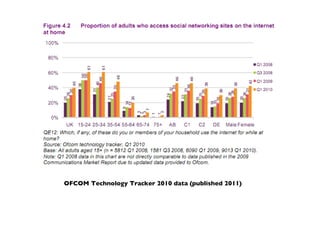
•   This would be someone else’s problem if
    not for the fact we are seeing increases in
    all demographics
•   18-24 years olds are only 12% of the
    active online audience
OFCOM Technology Tracker 2010 data (published 2011)
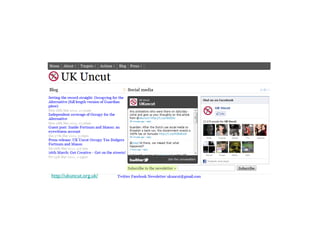
http://ukuncut.org.uk/
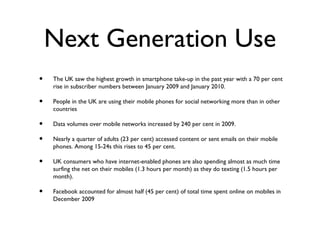
Next Generation Use
•   The UK saw the highest growth in smartphone take-up in the past year with a 70 per cent
    rise in subscriber numbers between January 2009 and January 2010.

•   People in the UK are using their mobile phones for social networking more than in other
    countries

•   Data volumes over mobile networks increased by 240 per cent in 2009.

•   Nearly a quarter of adults (23 per cent) accessed content or sent emails on their mobile
    phones. Among 15-24s this rises to 45 per cent.

•   UK consumers who have internet-enabled phones are also spending almost as much time
    surfing the net on their mobiles (1.3 hours per month) as they do texting (1.5 hours per
    month).

•   Facebook accounted for almost half (45 per cent) of total time spent online on mobiles in
    December 2009
Is this the network
          society?
• Networks as the distinguishing feature
• Blurred boundaries
• Open by default
• Power is not hierarchical
• Relevance is earned
• This is not just about technology
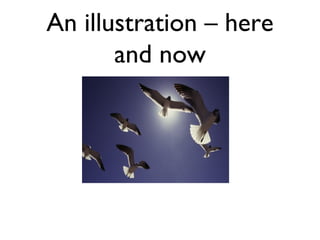
An illustration – here
       and now
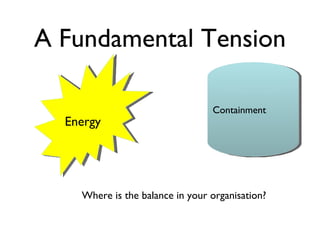
A Fundamental Tension

                                 Containment
  Energy


    Where is the balance in your organisation?
What saved the bank?
• The ability to observe the world from
  30,000ft and analyse at 3 inches
• The ability to inspire and enable followers
• Being there when it counts – willing to
  stand up and be counted
• Pathological collaboration with peers to
  solve problems and get things done
What might it mean to
lead in this new reality?

• To be open and transparent
• To think in public
• To have to understand power in a new way
Being open


• Accepting the new ‘public-ness’
• Recalibrate your privacy machine
Being open


• Its not showing the results - its sharing the
  thought process
• And being open to ideas
New forms of power

• Understand your relevance
• Find your connectors - be a connector
• Blur the boundaries
• In networks it is the actions that show up
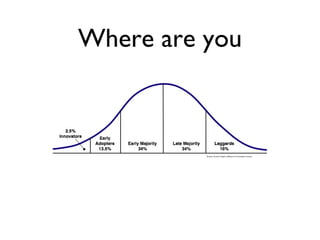
Where are you
Where do you want to
        be?

• Is your ambition to survive or to thrive?
• Do you feel the same pressure to change?
• Is your organisation changing?
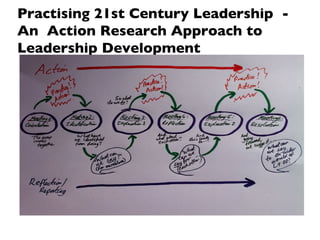
Practising 21st Century Leadership -
An Action Research Approach to
Leadership Development
Get in touch
Martin Saville
martin.saville@mayvin.co.uk
+44 (0)7968 719940
www.mayvin.co.uk


James Traeger
james.traeger@mayvin.co.uk
+44 (0)7778 647712
www.mayvin.co.uk

Catherine Howe
catherine.howe@public-i.info
@curiousc
www.public-i.info


blog.mayvin.co.uk
Let’s Play!
•   Round One – Locate our Connectors:

    •   Find out everyone in the room who:

        •   You have spoken a few words with them – black & white dot

        •   You have had a conversation – pink dot

        •   You know them well enough to lend them money and know
            you’d get it back – red dot

        •   Be honest about it – we need a good picture of our
            connectivity

•   What are the implications and possibilities of the stickers for us?

Solace se draft final

  • 1.
    Solace South East 21st Century Leadership?
  • 2.
    Who are we? • Researchers exploring leadership in the 21st Century
  • 3.
    What is theNew Reality? • Is there a new reality? • At some point we move from a post- industrial economy to something else - What is it? • How do we know when it’s a social shift and not just incremental change?
  • 4.
    • We thinkthere is evidence of social shift
  • 5.
    The World WideWeb was born with the mosaic browser in 1993 Children born the same year are now 19
  • 6.
    This would be someone else’s problem if not for the fact we are seeing increases in all demographics • 18-24 years olds are only 12% of the active online audience
  • 7.
    OFCOM Technology Tracker2010 data (published 2011)
  • 8.
  • 11.
    Next Generation Use • The UK saw the highest growth in smartphone take-up in the past year with a 70 per cent rise in subscriber numbers between January 2009 and January 2010. • People in the UK are using their mobile phones for social networking more than in other countries • Data volumes over mobile networks increased by 240 per cent in 2009. • Nearly a quarter of adults (23 per cent) accessed content or sent emails on their mobile phones. Among 15-24s this rises to 45 per cent. • UK consumers who have internet-enabled phones are also spending almost as much time surfing the net on their mobiles (1.3 hours per month) as they do texting (1.5 hours per month). • Facebook accounted for almost half (45 per cent) of total time spent online on mobiles in December 2009
  • 12.
    Is this thenetwork society? • Networks as the distinguishing feature • Blurred boundaries • Open by default • Power is not hierarchical • Relevance is earned
  • 13.
    • This isnot just about technology
  • 14.
    An illustration –here and now
  • 15.
    A Fundamental Tension Containment Energy Where is the balance in your organisation?
  • 16.
    What saved thebank? • The ability to observe the world from 30,000ft and analyse at 3 inches • The ability to inspire and enable followers • Being there when it counts – willing to stand up and be counted • Pathological collaboration with peers to solve problems and get things done
  • 17.
    What might itmean to lead in this new reality? • To be open and transparent • To think in public • To have to understand power in a new way
  • 18.
    Being open • Acceptingthe new ‘public-ness’ • Recalibrate your privacy machine
  • 19.
    Being open • Itsnot showing the results - its sharing the thought process • And being open to ideas
  • 20.
    New forms ofpower • Understand your relevance • Find your connectors - be a connector • Blur the boundaries • In networks it is the actions that show up
  • 21.
  • 22.
    Where do youwant to be? • Is your ambition to survive or to thrive? • Do you feel the same pressure to change? • Is your organisation changing?
  • 23.
    Practising 21st CenturyLeadership - An Action Research Approach to Leadership Development
  • 24.
    Get in touch MartinSaville martin.saville@mayvin.co.uk +44 (0)7968 719940 www.mayvin.co.uk James Traeger james.traeger@mayvin.co.uk +44 (0)7778 647712 www.mayvin.co.uk Catherine Howe catherine.howe@public-i.info @curiousc www.public-i.info blog.mayvin.co.uk
  • 25.
    Let’s Play! • Round One – Locate our Connectors: • Find out everyone in the room who: • You have spoken a few words with them – black & white dot • You have had a conversation – pink dot • You know them well enough to lend them money and know you’d get it back – red dot • Be honest about it – we need a good picture of our connectivity • What are the implications and possibilities of the stickers for us?

Editor's Notes

  • #15 Use mumuration video and/or flocking
  • #16 Activity - do a line up – conclusion – energy might be less than containment! Consequences of this in your work?
  • #17 1 hour - This may suggest - what is successful – a factor of 3 energy releasing things vs one containment -