THE POWER OF 
OPEN KNOWLEDGE 
PRESENTED BY 
Dr Laura James 
CEO, Open Knowledge Foundation
imagine 
• You’re a parent 
• You’re ill 
• You’re curious. Or sceptical. Or concerned. 
That’s when you need the power to answer 
questions that matter. The power of open 
knowledge.
The power of the internet 
• Sharing information is easy
What is open data? 
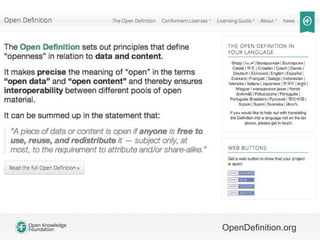
Open Data can be freely used, 
reused, and redistributed, by anyone, 
anywhere, for any purpose 
(we also work with public domain cultural works - 
content - as well as data)
Why open? 
So you can: 
componentise 
remix 
reshare 
Giving you: 
new insights 
better data 
innovation
What is open knowledge? 
Open Knowledge is what Open Data 
becomes when it is made useful - 
accessible, understandable, 
meaningful, and able to 
help someone answer a question that 
matters or solve a real problem
OpenDefinition.org
all kinds of knowledge 
• any kind of knowledge can be open 
• any format: spreadsheets, databases, pictures, 
words… 
• any field: transport, science, products, education, 
sustainability, maps, legislation, libraries, 
economics, culture, development, business, design, 
finance …
all kinds of people 
in all kinds of organisations 
• open data can be published by anyone: government, public sector 
bodies, researchers, corporations, universities, NGOs, startups, charities, 
community groups, individuals…. 
• open data can be used by anyone: government, public sector bodies, 
researchers, corporations, universities, NGOs, startups, charities, 
community groups, individuals…. 
• all kinds of people can get involved with the open knowledge 
movement: as a campaigner, coder, writer, donor, trainer, tweeter, 
meetup organiser, data wrangler, ambassador, analyst, researcher, 
manager…
The Open Knowledge Foundation 
• We build tools to make working with information easier 
• We help people learn the data skills they need 
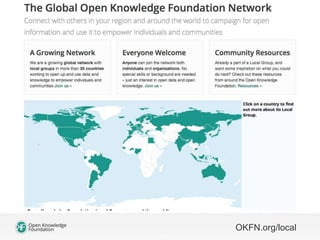
• We connect and support individuals and organisations and 
projects to create collaborations and make things happen
we are makers 
Creating the open infrastructure and tooling 
to power and support the open ecosystem 
and innovation
CKAN.org
OpenSpending.org
WhereDoesMyMoneyGo.org
OKFNLabs.org
Timemapper.org
we bring people together 
& advise & campaign & collaborate 
Meetups and workshops – online and offline 
Key convening events such as the first international Open 
Government Data Camp in 2010 
Direct technical and legal contributions to a large number 
of projects and initiatives in dozens of countries around the 
world, shaping essential policies at the World Bank, US, UK, 
French, Finnish, Brazilian governments
OKFN.org/local
OKFN.org/WG
OKFestival.org
we help people learn 
Learning through doing at datathons & hackathons - 
online and offline 
Open materials 
Partnerships around the world
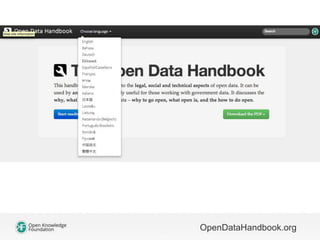
OpenDataHandbook.org
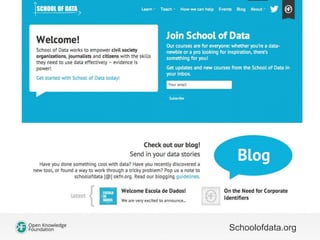
Schoolofdata.org
Why school of data… 
• School of Data is a critical component of the open data ecosystem: 
• provides tools and training to empower people to use open data for 
good - especially to people new to open data; 
• supports outreach and engagement by creating a supportive community 
of learners and mentors - working with Open Knowledge Foundation 
Local Groups; 
• creates opportunities for people and communities to use open data to 
make an impact; 
• works both with governments to open up data and data users such as 
journalists and NGOs.
How school of data 
works 
• Data expeditions - online and offline short gatherings where a group of 
people with different backgrounds tackle a data related problem 
• Data clinics - hands on support working directly with people’s data 
• Mentoring - local mentors working with local communities 
• Online content - tutorial and walkthroughs 
• Offline resources e.g. Data Journalism Handbook 
• And we now have spanish and portugese versions
Data Expeditions 
Data Expeditions are how we explore problems in partnership with others. 
They are about learning and investigating and are a key tool in creating new 
insight. Through insight we understand problems and can create positive 
change. 
• Short gatherings where a group of people with different backgrounds 
tackle a data related problem. 
• Work in small groups with diverse skills: storytellers, data analysts, 
scouts, engineers, designers 
• The focus is on the process (collaborating, understanding data, learning 
from peers) rather than on the outcome 
• Group work flow:
So… 
That’s a lot of things we do. What difference does 
open knowledge really make? 
Opening up the Danish Address Register 
There was a fire at a house. Fire engine could not get there because their GPS did 
not have the road on it leading to the house. That road was in government’s data but 
was not integrated into data on the satnav. Government have now opened up data 
and that worked out really well (so next time fire engine will get there!)
So… 
That’s a lot of things we do. What difference does it 
make? 
Uganda Health 
Providing information about the performance of village health services in Uganda – 
days the nurse visits, immunization services - resulted in reduction of 33% in infant 
mortality and several other significant improvements in health outcomes.
So… 
That’s a lot of things we do. What difference does it 
make? 
Uganda Education 
In 1995, Ugandan schools were receiving only ~25% of the core grant allocated to 
them by the government with more the other 75% being lost to corruption. In 1997 
the Government started a newspaper campaign to inform parents how much their 
schools should be receiving. The result: by 2001 schools were receiving more than 
80% of the core grant (more than 3x more than they had before the campaign). 
Open information making a difference
So… 
We are in at the start of an open data revolution 
• But it’s not a magic bullet. It will be a slow process including 
institutional change. 
• There will be new business models, building value from things 
other than data 
• We need: tools, communities, skills 
• We need access to data! 
• We need to get better at working with data 
• It’s going to be disruptive 
• But it will be a positive change overall
Why open? 
• Open data will help us solve the big global problems 
• Open gives us choice, freedom, transparency & trust 
• Open scales 
• Open is sustainable
Conclusions 
The Open Knowledge Foundation is a global 
network empowering people to answer 
questions that matter. Get involved today! 
The 21st century knowledge society should 
be an open knowledge society 
@OKFN http://OKFN.org

Okf ireland talk

  • 1.
    THE POWER OF OPEN KNOWLEDGE PRESENTED BY Dr Laura James CEO, Open Knowledge Foundation
  • 2.
    imagine • You’rea parent • You’re ill • You’re curious. Or sceptical. Or concerned. That’s when you need the power to answer questions that matter. The power of open knowledge.
  • 3.
    The power ofthe internet • Sharing information is easy
  • 4.
    What is opendata? Open Data can be freely used, reused, and redistributed, by anyone, anywhere, for any purpose (we also work with public domain cultural works - content - as well as data)
  • 5.
    Why open? Soyou can: componentise remix reshare Giving you: new insights better data innovation
  • 6.
    What is openknowledge? Open Knowledge is what Open Data becomes when it is made useful - accessible, understandable, meaningful, and able to help someone answer a question that matters or solve a real problem
  • 7.
  • 8.
    all kinds ofknowledge • any kind of knowledge can be open • any format: spreadsheets, databases, pictures, words… • any field: transport, science, products, education, sustainability, maps, legislation, libraries, economics, culture, development, business, design, finance …
  • 9.
    all kinds ofpeople in all kinds of organisations • open data can be published by anyone: government, public sector bodies, researchers, corporations, universities, NGOs, startups, charities, community groups, individuals…. • open data can be used by anyone: government, public sector bodies, researchers, corporations, universities, NGOs, startups, charities, community groups, individuals…. • all kinds of people can get involved with the open knowledge movement: as a campaigner, coder, writer, donor, trainer, tweeter, meetup organiser, data wrangler, ambassador, analyst, researcher, manager…
  • 10.
    The Open KnowledgeFoundation • We build tools to make working with information easier • We help people learn the data skills they need • We connect and support individuals and organisations and projects to create collaborations and make things happen
  • 11.
    we are makers Creating the open infrastructure and tooling to power and support the open ecosystem and innovation
  • 12.
  • 13.
  • 14.
  • 15.
  • 16.
  • 17.
    we bring peopletogether & advise & campaign & collaborate Meetups and workshops – online and offline Key convening events such as the first international Open Government Data Camp in 2010 Direct technical and legal contributions to a large number of projects and initiatives in dozens of countries around the world, shaping essential policies at the World Bank, US, UK, French, Finnish, Brazilian governments
  • 18.
  • 19.
  • 20.
  • 21.
    we help peoplelearn Learning through doing at datathons & hackathons - online and offline Open materials Partnerships around the world
  • 22.
  • 23.
  • 24.
  • 25.
    Why school ofdata… • School of Data is a critical component of the open data ecosystem: • provides tools and training to empower people to use open data for good - especially to people new to open data; • supports outreach and engagement by creating a supportive community of learners and mentors - working with Open Knowledge Foundation Local Groups; • creates opportunities for people and communities to use open data to make an impact; • works both with governments to open up data and data users such as journalists and NGOs.
  • 26.
    How school ofdata works • Data expeditions - online and offline short gatherings where a group of people with different backgrounds tackle a data related problem • Data clinics - hands on support working directly with people’s data • Mentoring - local mentors working with local communities • Online content - tutorial and walkthroughs • Offline resources e.g. Data Journalism Handbook • And we now have spanish and portugese versions
  • 27.
    Data Expeditions DataExpeditions are how we explore problems in partnership with others. They are about learning and investigating and are a key tool in creating new insight. Through insight we understand problems and can create positive change. • Short gatherings where a group of people with different backgrounds tackle a data related problem. • Work in small groups with diverse skills: storytellers, data analysts, scouts, engineers, designers • The focus is on the process (collaborating, understanding data, learning from peers) rather than on the outcome • Group work flow:
  • 28.
    So… That’s alot of things we do. What difference does open knowledge really make? Opening up the Danish Address Register There was a fire at a house. Fire engine could not get there because their GPS did not have the road on it leading to the house. That road was in government’s data but was not integrated into data on the satnav. Government have now opened up data and that worked out really well (so next time fire engine will get there!)
  • 29.
    So… That’s alot of things we do. What difference does it make? Uganda Health Providing information about the performance of village health services in Uganda – days the nurse visits, immunization services - resulted in reduction of 33% in infant mortality and several other significant improvements in health outcomes.
  • 30.
    So… That’s alot of things we do. What difference does it make? Uganda Education In 1995, Ugandan schools were receiving only ~25% of the core grant allocated to them by the government with more the other 75% being lost to corruption. In 1997 the Government started a newspaper campaign to inform parents how much their schools should be receiving. The result: by 2001 schools were receiving more than 80% of the core grant (more than 3x more than they had before the campaign). Open information making a difference
  • 31.
    So… We arein at the start of an open data revolution • But it’s not a magic bullet. It will be a slow process including institutional change. • There will be new business models, building value from things other than data • We need: tools, communities, skills • We need access to data! • We need to get better at working with data • It’s going to be disruptive • But it will be a positive change overall
  • 32.
    Why open? •Open data will help us solve the big global problems • Open gives us choice, freedom, transparency & trust • Open scales • Open is sustainable
  • 33.
    Conclusions The OpenKnowledge Foundation is a global network empowering people to answer questions that matter. Get involved today! The 21st century knowledge society should be an open knowledge society @OKFN http://OKFN.org