Liquid Scintillation
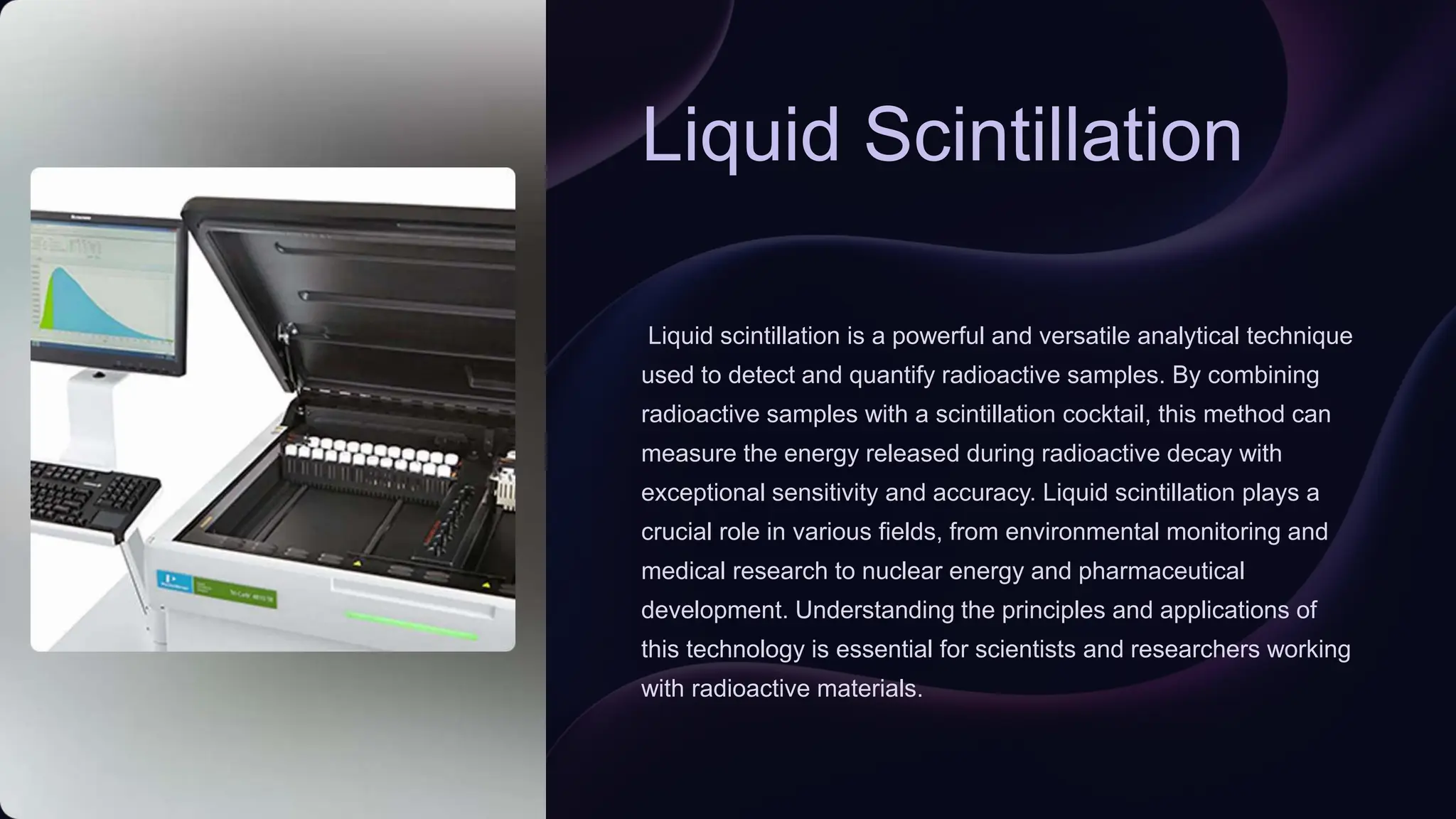
Liquid scintillation is a powerful and versatile analytical technique
used to detect and quantify radioactive samples. By combining
radioactive samples with a scintillation cocktail, this method can
measure the energy released during radioactive decay with
exceptional sensitivity and accuracy. Liquid scintillation plays a
crucial role in various fields, from environmental monitoring and
medical research to nuclear energy and pharmaceutical
development. Understanding the principles and applications of
this technology is essential for scientists and researchers working
with radioactive materials.
Principles of Liquid Scintillation Counting
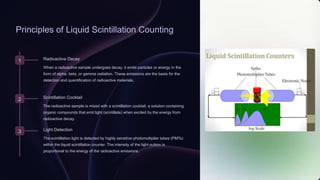
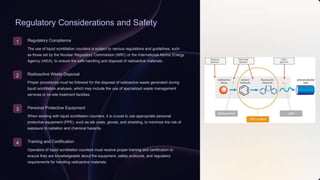
1 Radioactive Decay
When a radioactive sample undergoes decay, it emits particles or energy in the
form of alpha, beta, or gamma radiation. These emissions are the basis for the
detection and quantification of radioactive materials.
2 Scintillation Cocktail
The radioactive sample is mixed with a scintillation cocktail, a solution containing
organic compounds that emit light (scintillate) when excited by the energy from
radioactive decay.
3 Light Detection
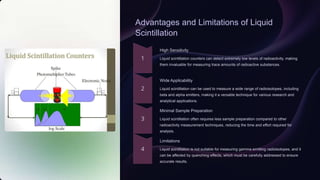
The scintillation light is detected by highly sensitive photomultiplier tubes (PMTs)
within the liquid scintillation counter. The intensity of the light pulses is
proportional to the energy of the radioactive emissions.
Scintillation Cocktails and Sample Preparation
Scintillation Cocktails
Scintillation cocktails are
complex solutions that contain
organic solvents, fluorescent
compounds, and other
additives. The choice of
cocktail depends on the
specific characteristics of the
radioactive sample, such as
the type of radiation and the
sample matrix.
Sample Preparation
Proper sample preparation is
essential for accurate liquid
scintillation counting. This
includes ensuring the sample
is completely mixed with the
scintillation cocktail, removing
any air bubbles, and
minimizing any chemical or
optical quenching effects.
Quenching Correction
Quenching, a phenomenon
that can reduce the scintillation
light output, must be carefully
monitored and corrected to
maintain the accuracy of the
measurements.
Detector Design and Components
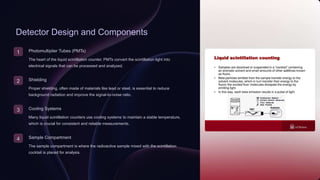
1 Photomultiplier Tubes (PMTs)
The heart of the liquid scintillation counter, PMTs convert the scintillation light into
electrical signals that can be processed and analyzed.
2 Shielding
Proper shielding, often made of materials like lead or steel, is essential to reduce
background radiation and improve the signal-to-noise ratio.
3 Cooling Systems
Many liquid scintillation counters use cooling systems to maintain a stable temperature,
which is crucial for consistent and reliable measurements.
4 Sample Compartment
The sample compartment is where the radioactive sample mixed with the scintillation
cocktail is placed for analysis.
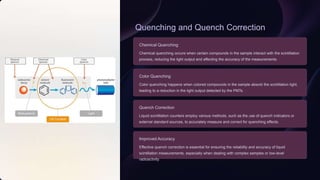
Quenching and Quench Correction
Chemical Quenching
Chemical quenching occurs when certain compounds in the sample interact with the scintillation
process, reducing the light output and affecting the accuracy of the measurements.
Color Quenching
Color quenching happens when colored compounds in the sample absorb the scintillation light,
leading to a reduction in the light output detected by the PMTs.
Quench Correction
Liquid scintillation counters employ various methods, such as the use of quench indicators or
external standard sources, to accurately measure and correct for quenching effects.
Improved Accuracy
Effective quench correction is essential for ensuring the reliability and accuracy of liquid
scintillation measurements, especially when dealing with complex samples or low-level
radioactivity.
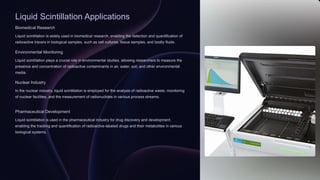
Liquid Scintillation Applications
Biomedical Research
Liquid scintillation is widely used in biomedical research, enabling the detection and quantification of
radioactive tracers in biological samples, such as cell cultures, tissue samples, and bodily fluids.
Environmental Monitoring
Liquid scintillation plays a crucial role in environmental studies, allowing researchers to measure the
presence and concentration of radioactive contaminants in air, water, soil, and other environmental
media.
Nuclear Industry
In the nuclear industry, liquid scintillation is employed for the analysis of radioactive waste, monitoring
of nuclear facilities, and the measurement of radionuclides in various process streams.
Pharmaceutical Development
Liquid scintillation is used in the pharmaceutical industry for drug discovery and development,
enabling the tracking and quantification of radioactive-labeled drugs and their metabolites in various
biological systems.
Advantages and Limitations of Liquid
Scintillation
High Sensitivity
Liquid scintillation counters can detect extremely low levels of radioactivity, making
them invaluable for measuring trace amounts of radioactive substances.
Wide Applicability
Liquid scintillation can be used to measure a wide range of radioisotopes, including
beta and alpha emitters, making it a versatile technique for various research and
analytical applications.
Minimal Sample Preparation
Liquid scintillation often requires less sample preparation compared to other
radioactivity measurement techniques, reducing the time and effort required for
analysis.
Limitations
Liquid scintillation is not suitable for measuring gamma-emitting radioisotopes, and it
can be affected by quenching effects, which must be carefully addressed to ensure
accurate results.
Data Analysis and Interpretation
Counting Efficiency The ratio of the number of detected
scintillation events to the number of
radioactive decays in the sample, expressed
as a percentage.
Background Counts The signal generated by non-sample
radiation sources, such as cosmic rays or
trace radioactive impurities, which must be
subtracted from the sample measurements.
Quench Correction Factor A value used to adjust the counting
efficiency to account for quenching effects,
ensuring accurate quantification of the
radioactive content.
Activity Concentration The amount of radioactivity per unit volume
or mass of the sample, calculated using the
counting efficiency, background counts, and
quench correction factor.
Regulatory Considerations and Safety
1 Regulatory Compliance
The use of liquid scintillation counters is subject to various regulations and guidelines, such
as those set by the Nuclear Regulatory Commission (NRC) or the International Atomic Energy
Agency (IAEA), to ensure the safe handling and disposal of radioactive materials.
2 Radioactive Waste Disposal
Proper procedures must be followed for the disposal of radioactive waste generated during
liquid scintillation analyses, which may include the use of specialized waste management
services or on-site treatment facilities.
3 Personal Protective Equipment
When working with liquid scintillation counters, it is crucial to use appropriate personal
protective equipment (PPE), such as lab coats, gloves, and shielding, to minimize the risk of
exposure to radiation and chemical hazards.
4 Training and Certification
Operators of liquid scintillation counters must receive proper training and certification to
ensure they are knowledgeable about the equipment, safety protocols, and regulatory
requirements for handling radioactive materials.

Biophysics method(Liquid-Scintillation).pptx

  • 1.
    Liquid Scintillation Liquid scintillationis a powerful and versatile analytical technique used to detect and quantify radioactive samples. By combining radioactive samples with a scintillation cocktail, this method can measure the energy released during radioactive decay with exceptional sensitivity and accuracy. Liquid scintillation plays a crucial role in various fields, from environmental monitoring and medical research to nuclear energy and pharmaceutical development. Understanding the principles and applications of this technology is essential for scientists and researchers working with radioactive materials.
  • 2.
    Principles of LiquidScintillation Counting 1 Radioactive Decay When a radioactive sample undergoes decay, it emits particles or energy in the form of alpha, beta, or gamma radiation. These emissions are the basis for the detection and quantification of radioactive materials. 2 Scintillation Cocktail The radioactive sample is mixed with a scintillation cocktail, a solution containing organic compounds that emit light (scintillate) when excited by the energy from radioactive decay. 3 Light Detection The scintillation light is detected by highly sensitive photomultiplier tubes (PMTs) within the liquid scintillation counter. The intensity of the light pulses is proportional to the energy of the radioactive emissions.
  • 3.
    Scintillation Cocktails andSample Preparation Scintillation Cocktails Scintillation cocktails are complex solutions that contain organic solvents, fluorescent compounds, and other additives. The choice of cocktail depends on the specific characteristics of the radioactive sample, such as the type of radiation and the sample matrix. Sample Preparation Proper sample preparation is essential for accurate liquid scintillation counting. This includes ensuring the sample is completely mixed with the scintillation cocktail, removing any air bubbles, and minimizing any chemical or optical quenching effects. Quenching Correction Quenching, a phenomenon that can reduce the scintillation light output, must be carefully monitored and corrected to maintain the accuracy of the measurements.
  • 4.
    Detector Design andComponents 1 Photomultiplier Tubes (PMTs) The heart of the liquid scintillation counter, PMTs convert the scintillation light into electrical signals that can be processed and analyzed. 2 Shielding Proper shielding, often made of materials like lead or steel, is essential to reduce background radiation and improve the signal-to-noise ratio. 3 Cooling Systems Many liquid scintillation counters use cooling systems to maintain a stable temperature, which is crucial for consistent and reliable measurements. 4 Sample Compartment The sample compartment is where the radioactive sample mixed with the scintillation cocktail is placed for analysis.
  • 5.
    Quenching and QuenchCorrection Chemical Quenching Chemical quenching occurs when certain compounds in the sample interact with the scintillation process, reducing the light output and affecting the accuracy of the measurements. Color Quenching Color quenching happens when colored compounds in the sample absorb the scintillation light, leading to a reduction in the light output detected by the PMTs. Quench Correction Liquid scintillation counters employ various methods, such as the use of quench indicators or external standard sources, to accurately measure and correct for quenching effects. Improved Accuracy Effective quench correction is essential for ensuring the reliability and accuracy of liquid scintillation measurements, especially when dealing with complex samples or low-level radioactivity.
  • 6.
    Liquid Scintillation Applications BiomedicalResearch Liquid scintillation is widely used in biomedical research, enabling the detection and quantification of radioactive tracers in biological samples, such as cell cultures, tissue samples, and bodily fluids. Environmental Monitoring Liquid scintillation plays a crucial role in environmental studies, allowing researchers to measure the presence and concentration of radioactive contaminants in air, water, soil, and other environmental media. Nuclear Industry In the nuclear industry, liquid scintillation is employed for the analysis of radioactive waste, monitoring of nuclear facilities, and the measurement of radionuclides in various process streams. Pharmaceutical Development Liquid scintillation is used in the pharmaceutical industry for drug discovery and development, enabling the tracking and quantification of radioactive-labeled drugs and their metabolites in various biological systems.
  • 7.
    Advantages and Limitationsof Liquid Scintillation High Sensitivity Liquid scintillation counters can detect extremely low levels of radioactivity, making them invaluable for measuring trace amounts of radioactive substances. Wide Applicability Liquid scintillation can be used to measure a wide range of radioisotopes, including beta and alpha emitters, making it a versatile technique for various research and analytical applications. Minimal Sample Preparation Liquid scintillation often requires less sample preparation compared to other radioactivity measurement techniques, reducing the time and effort required for analysis. Limitations Liquid scintillation is not suitable for measuring gamma-emitting radioisotopes, and it can be affected by quenching effects, which must be carefully addressed to ensure accurate results.
  • 8.
    Data Analysis andInterpretation Counting Efficiency The ratio of the number of detected scintillation events to the number of radioactive decays in the sample, expressed as a percentage. Background Counts The signal generated by non-sample radiation sources, such as cosmic rays or trace radioactive impurities, which must be subtracted from the sample measurements. Quench Correction Factor A value used to adjust the counting efficiency to account for quenching effects, ensuring accurate quantification of the radioactive content. Activity Concentration The amount of radioactivity per unit volume or mass of the sample, calculated using the counting efficiency, background counts, and quench correction factor.
  • 9.
    Regulatory Considerations andSafety 1 Regulatory Compliance The use of liquid scintillation counters is subject to various regulations and guidelines, such as those set by the Nuclear Regulatory Commission (NRC) or the International Atomic Energy Agency (IAEA), to ensure the safe handling and disposal of radioactive materials. 2 Radioactive Waste Disposal Proper procedures must be followed for the disposal of radioactive waste generated during liquid scintillation analyses, which may include the use of specialized waste management services or on-site treatment facilities. 3 Personal Protective Equipment When working with liquid scintillation counters, it is crucial to use appropriate personal protective equipment (PPE), such as lab coats, gloves, and shielding, to minimize the risk of exposure to radiation and chemical hazards. 4 Training and Certification Operators of liquid scintillation counters must receive proper training and certification to ensure they are knowledgeable about the equipment, safety protocols, and regulatory requirements for handling radioactive materials.