SCINTILLATION COUNTER
BY
MS. APOORVA UDAYASHANKAR
ASSISTANT PROFESSOR
DEPARTMENT OF LIFE SCIENCES
KRISTU JAYANTI AUTONOMOUS COLLEGE, BANGALORE
DEFINATION
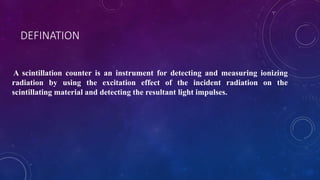
A scintillation counter is an instrument for detecting and measuring ionizing
radiation by using the excitation effect of the incident radiation on the
scintillating material and detecting the resultant light impulses.
PRINCIPLE
 The basic principle of operation involves the radiation reacting with a scintillator, which produces a series
of flashes of light of varying intensity when charged particles pass through them.
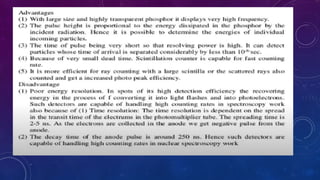
 The intensity of the flashes is proportional to the energy of the radiation
 These counters are suited to measure the energy of gamma radiation and therefore can be used to
identify gamma-emitting isotopes
SCINTILLATION COUNTER –PRINCIPLE OF OPERATION
 Three classes of phosphors is used:
o Inorganic crystal
o Organic crystal
o Plastics phosphors
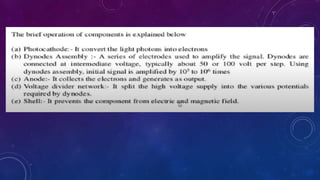
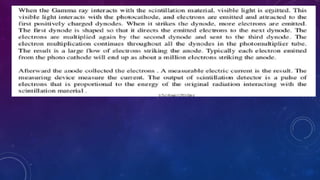
 The light created in the scintillator strikes the photocathode of a
photomultiplier tube , releasing at most one photoelectron per
photon
 Using a voltage potential, this group of primary electrons is
electrostatically accelerated and focused ,so that they strike the first
dynode with enough energy to release additional electrons
DETECTION MATERIALS
 The scintillators consists of a transparent crystal, usually a phosphor, plastic or organic liquid that
fluoresces when struck by ionizing radiation
 Cesium iodide in crystalline form is used as the scintillators for detection of protons and alpha particles
 Sodium iodide containing a small amount of thallium is used as a scintillator for the detection of gamma
waves and zinc sulfide is widely used as a detector of alpha particles
 Zinc sulfide is the material Rutherford used to perform scattering experiment
 Lithium iodide is used in neutron detectors
WORKING
APPLICATIONS
 Scintillation counters are used to measure radiation in a variety of applications including hand held
radiation survey meters, personnel and environmental monitoring for radioactive contamination,
medical imaging, radiometric assay, nuclear security and nuclear plant safety
 These are designed for freight terminals, border security, ports, weight bridge applications, scrap metal
yards and contamination monitoring of nuclear waste
 Several products have been introduced into the market utilizing scintillation counters for detection of
potentially dangerous gamma-emitting materials during transport
 They are mounted on pick up trucks and helicopters for rapid response in case of security situation due
to bombs or radioactive waste

scintilation counter.pptx

  • 1.
    SCINTILLATION COUNTER BY MS. APOORVAUDAYASHANKAR ASSISTANT PROFESSOR DEPARTMENT OF LIFE SCIENCES KRISTU JAYANTI AUTONOMOUS COLLEGE, BANGALORE
  • 2.
    DEFINATION A scintillation counteris an instrument for detecting and measuring ionizing radiation by using the excitation effect of the incident radiation on the scintillating material and detecting the resultant light impulses.
  • 3.
    PRINCIPLE  The basicprinciple of operation involves the radiation reacting with a scintillator, which produces a series of flashes of light of varying intensity when charged particles pass through them.  The intensity of the flashes is proportional to the energy of the radiation  These counters are suited to measure the energy of gamma radiation and therefore can be used to identify gamma-emitting isotopes
  • 4.
    SCINTILLATION COUNTER –PRINCIPLEOF OPERATION  Three classes of phosphors is used: o Inorganic crystal o Organic crystal o Plastics phosphors  The light created in the scintillator strikes the photocathode of a photomultiplier tube , releasing at most one photoelectron per photon  Using a voltage potential, this group of primary electrons is electrostatically accelerated and focused ,so that they strike the first dynode with enough energy to release additional electrons
  • 5.
    DETECTION MATERIALS  Thescintillators consists of a transparent crystal, usually a phosphor, plastic or organic liquid that fluoresces when struck by ionizing radiation  Cesium iodide in crystalline form is used as the scintillators for detection of protons and alpha particles  Sodium iodide containing a small amount of thallium is used as a scintillator for the detection of gamma waves and zinc sulfide is widely used as a detector of alpha particles  Zinc sulfide is the material Rutherford used to perform scattering experiment  Lithium iodide is used in neutron detectors
  • 7.
  • 10.
    APPLICATIONS  Scintillation countersare used to measure radiation in a variety of applications including hand held radiation survey meters, personnel and environmental monitoring for radioactive contamination, medical imaging, radiometric assay, nuclear security and nuclear plant safety  These are designed for freight terminals, border security, ports, weight bridge applications, scrap metal yards and contamination monitoring of nuclear waste  Several products have been introduced into the market utilizing scintillation counters for detection of potentially dangerous gamma-emitting materials during transport  They are mounted on pick up trucks and helicopters for rapid response in case of security situation due to bombs or radioactive waste