LECTURE 1
 Soil Health:
 Definition
 Concept of soil health
 Soil Quality
 Soil Quality vs Soil Health
 Functions of Healthy soil
 Ideal soil quality indicators
 Soil Quality Indices :
 Physical,
 Chemical and
 Biological Indicators
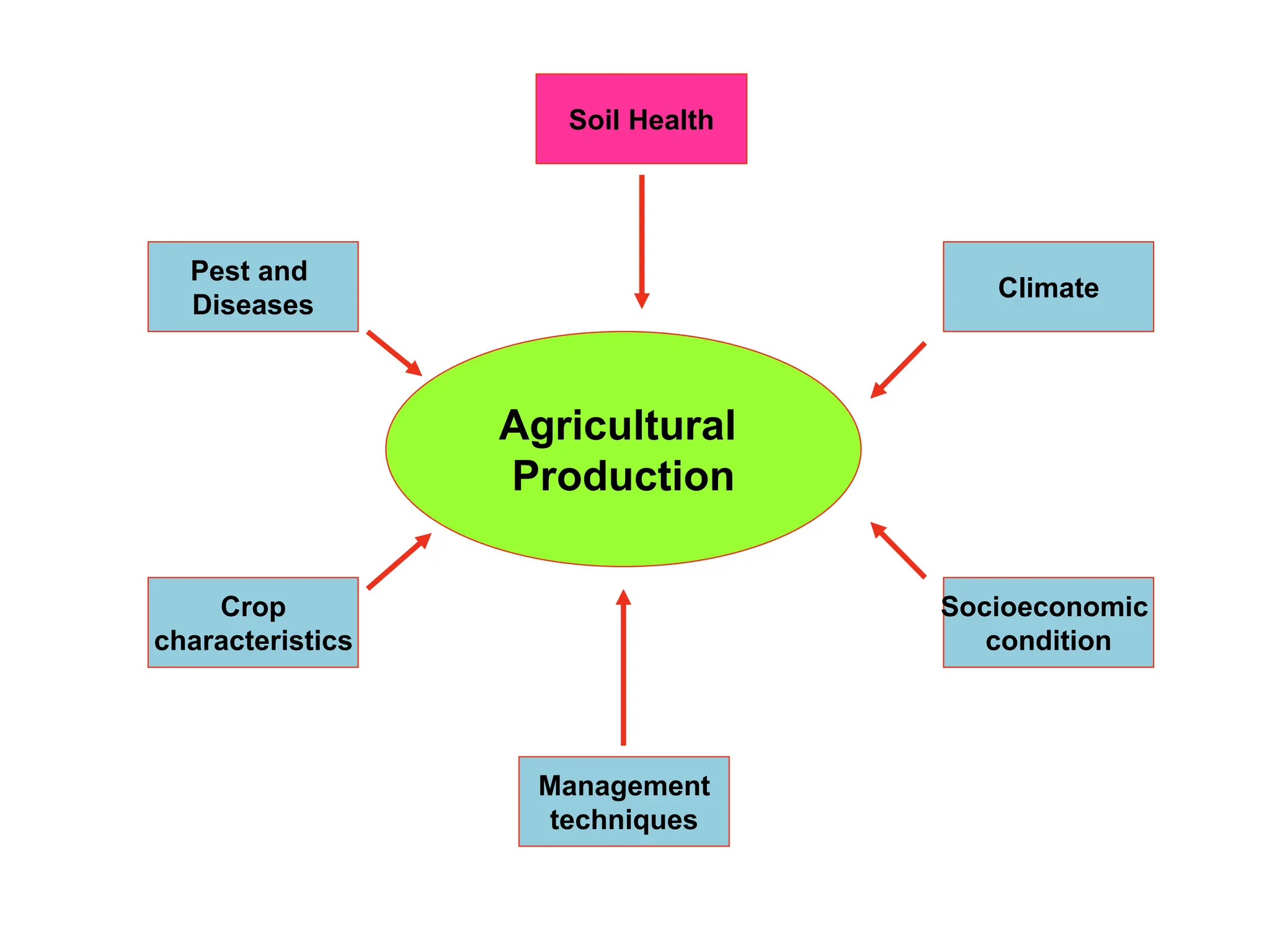
Agricultural
Production
Soil Health
Climate
Socioeconomic
condition
Management
techniques
Crop
characteristics
Pest and
Diseases
Soil Health-Definition
 A healthy soil would ensure proper retention &
release of water & nutrients, promote & sustain
root growth, maintain soil biotic habitat,
respond to management, resist degradation &
act as a buffer for environmental pollution
(Brevik & Sauer 2015).
Concept of soil health
 Healthy soil is an essential component of a
healthy environment,
 It is the foundation upon which sustainable
agriculture is built..
 In simplest terms, soil health or soil quality
can be defined as the ‘fitness of soil for use”.
 Fnctions include biological productivity of
soil, maintaining quality of surrounding air &
water & promote pt, animal & human health.
 It emphasizes the integration of biological
with chemical & physical measures of soil
quality that affect farmers profit & the
environment.
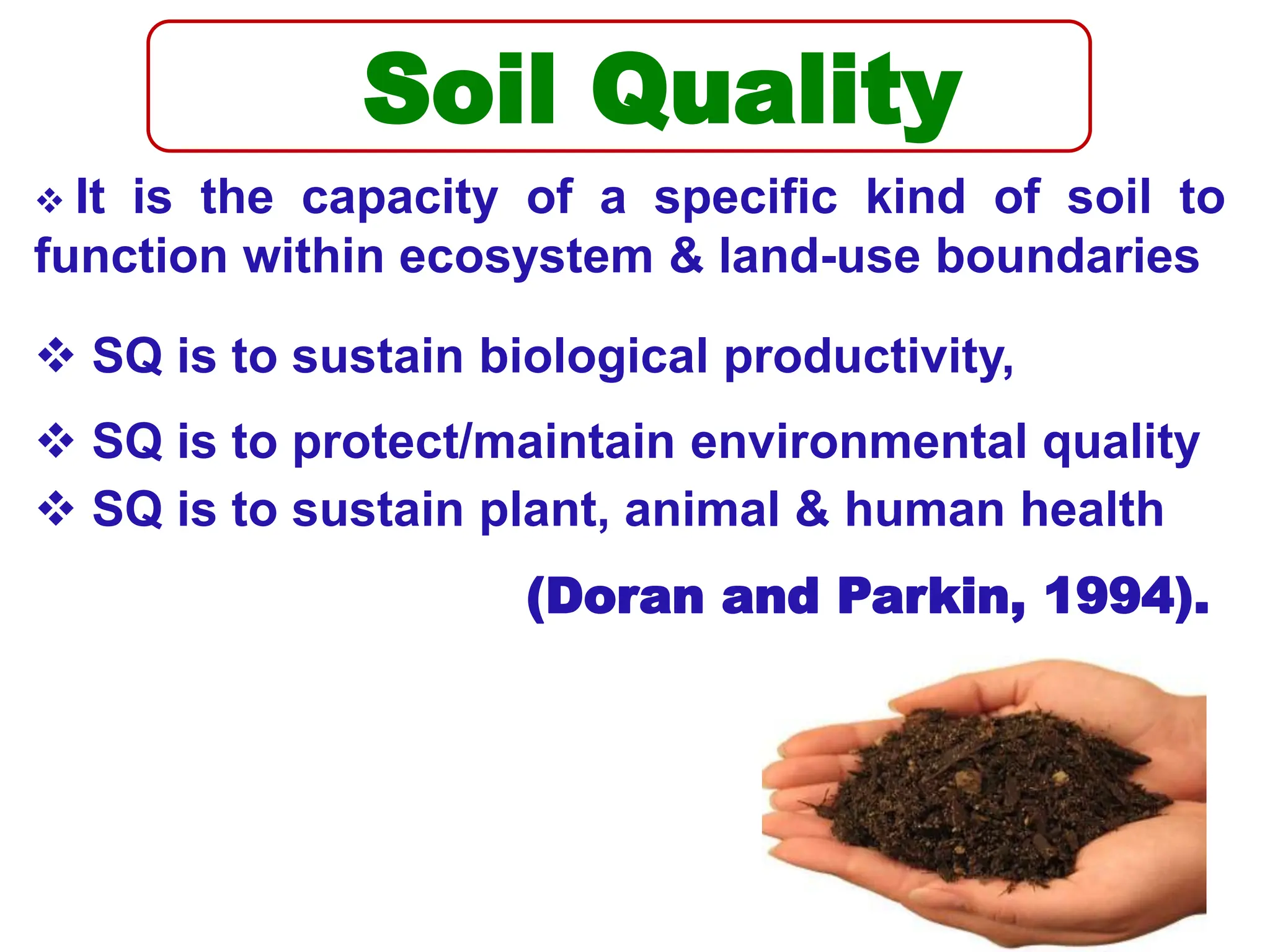
Soil Quality
 It is the capacity of a specific kind of soil to
function within ecosystem & land-use boundaries
 SQ is to sustain biological productivity,
 SQ is to protect/maintain environmental quality
 SQ is to sustain plant, animal & human health
(Doran and Parkin, 1994).
Soil Quality vs Soil Health
 SQ is usefulness for a particular purpose over
a long time scale, equal to static soil quality.
 SQ is related to soil function
 SH as state of a soil at particular time,
equivalent to the dynamic soil properties that
change in short time.
 Sustain biological productivity
 Store & cycle water & nutrients
 Decompose OM
 Inactive toxic compounds
 Suppress pathogens
 Protect water quality
 Production of food & fibre
Functions of Healthy soil
 protect the soil surface & low erosion rates
 high soil OM ; high biological activity &
biological diversity
 high avail. moisture storage capacity
 favourable soil pH; deep root zone
 balanced stores & supply of avail. Nutrients
 resilient & stable soil structure,
 adequate internal drainage
 favourable soil strength and aeration
 favourable soil temp.
Properties of Soil Health
 low levels of soil born pathogens
 low levels of toxic substances;
 good soil tilth; sufficient depth
 large population of beneficial org.
 low weed pressure
 resistant to degradation
Ideal soil quality indicators should be
 well correlate with ecosystem processes
 integrate soil physical, chemical & biological
properties & processes
 accessible to many users;
 sensitive to management & climate
 components of existing databases;
 interpretable
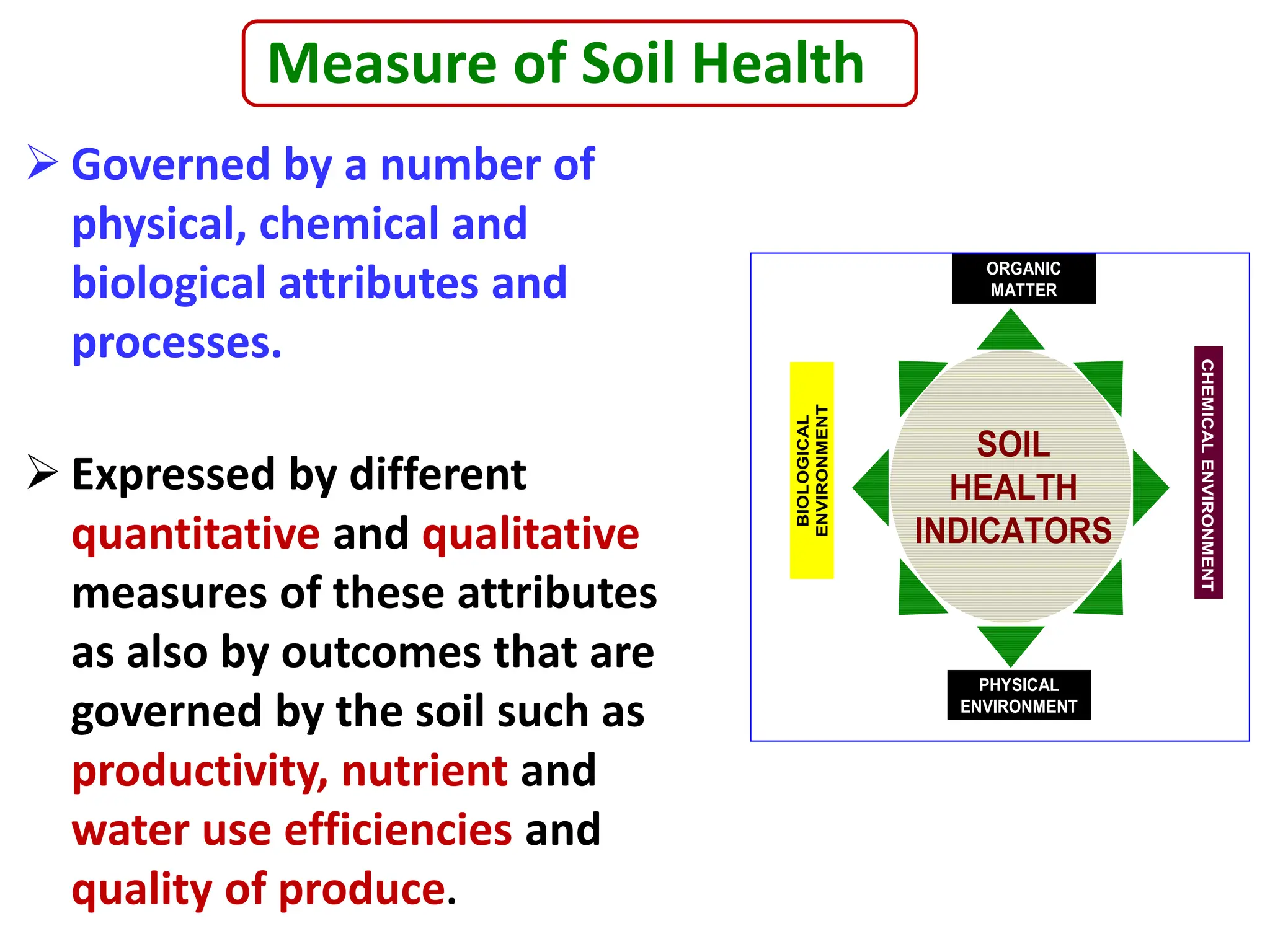
Measure of Soil Health
 Governed by a number of
physical, chemical and
biological attributes and
processes.
 Expressed by different
quantitative and qualitative
measures of these attributes
as also by outcomes that are
governed by the soil such as
productivity, nutrient and
water use efficiencies and
quality of produce.
SOIL
HEALTH
INDICATORS
CHEMICAL
ENVIRONMENT
ORGANIC
MATTER
BIOLOGICAL
ENVIRONMENT
PHYSICAL
ENVIRONMENT
 SQ or its capacity to function, is evaluated
using inherent & dynamic soil properties.
These properties serve as indicators of soil
function because it is difficult to measure
function directly & observations may be
subjective.
Soil Quality Measurement
i. Physical Indicators :
 Physical indicators are related to arrangement of
solid particles & pores. Ex. Soil depth, bulk density,
porosity, aggregate stability, texture, crusting &
compaction.
 They primarily limits the root growth, seedling
emergence, infiltration & affect crop performance
through various soil physical parameters:
BD, Texture, WHC & sub-surface hard pan etc.
 Soil physical properties also influence the soil water
& plant-water relationships.
Physical indicators used for
determining soil health
 Phy. Indi. provide information about soil hydrologic
characteristics, such as water entry & retention, that
influences availability of water to plants.
 Some indi. are related to nutrient availability by
their influence on rooting volume & aeration status.
 Other measures tells us about erosional status.
That indicators include measures of:
 Aggregate Stability
 Available Water Capacity
 Hydraulic conductivity
 Bulk Density
 Infiltration
 Slaking
 Soil Crusts
 Soil Structure and
 Macropores
1. Aggregate stability:
 It refers to the ability of soil aggregates to
resist disintegration when disruptive
forces associated with tillage & water or
wind erosion are applied.
 Wet aggregate stability suggests how well
a soil can resist raindrop impact & water
erosion.
 Dry aggregate stability can be used to
predict resistance to abrasion & wind
erosion.
2. Available water capacity:
 AWC is the water held in soil between its
field capacity & permanent wilting point.
 It is an indicator of a soil’s ability to retain
water & make it sufficiently available for
plant use.
3.Bulk Density :
 It is the dry weight of soil divided by its
volume.
 It is an indicator of soil compaction, ability
to function for structural support, water &
solute movement & soil aeration.
4. Infiltration :
 It is the downward entry of water into the
soil
 It is an indicator of the soil’s ability to allow
water movement into & through the soil
profile.
 Soil temporarily stores water, making it
available for root uptake, plant growth &
habitat for soil organisms.
5. Slaking :
 when the soil aggregates are suddenly immersed in water,
the breakdown of larger sized (>2.5 mm) air-dry soil
aggregates into smaller sized (<0.25 mm) micro-aggregates
is called as ‘Slaking’.
 Slaking indicates the stability of soil aggregates,
resistance to erosion.
6. Soil Crusting :
 A surface crust indicates poor infiltration, a problematical
seedbed and reduced air exchange between the soil and
atmosphere.
 It can also indicate that a soil has a high Na content that
increases soil dispersion when it is wetted by rainfall or
irrigation.
ii. Chemical indicators
 pH, salinity, organic matter, phosphorus concentration,
CEC, nutrient cycling and concentration of elements.
 Decrease in soil pH increases solubility of elements such
as Al, Zn, Cu & Fe. At pH value < 5.5 induces toxicity of
these ions.
 These chemical condition of soil affects soil-plant
relation, water quality, buffering capacity, availability of
nutrients & water to plants & other organisms, mobility
of contaminants & tendency to form crust.
 Soil chemistry & its influence on the availability of
nutrients to plants play a key role in soil quality.
Chemical indicators used for determining soil health
Chemical indicators give information about the equilibrium
between soil solution (soil water, nutrients) & exchange sites (clay
particles, OM);
These indicators include measures of:
 Soil organic carbon
 Soil soluble salts (EC)
 Soil nitrate & other macro & micronutrients
 Soil reaction (pH)

2. SAC 202 Lr 1 14.09.2023 lec 1 sac.ppt

  • 1.
    LECTURE 1  SoilHealth:  Definition  Concept of soil health  Soil Quality  Soil Quality vs Soil Health  Functions of Healthy soil  Ideal soil quality indicators  Soil Quality Indices :  Physical,  Chemical and  Biological Indicators
  • 2.
  • 3.
    Soil Health-Definition  Ahealthy soil would ensure proper retention & release of water & nutrients, promote & sustain root growth, maintain soil biotic habitat, respond to management, resist degradation & act as a buffer for environmental pollution (Brevik & Sauer 2015).
  • 4.
    Concept of soilhealth  Healthy soil is an essential component of a healthy environment,  It is the foundation upon which sustainable agriculture is built..  In simplest terms, soil health or soil quality can be defined as the ‘fitness of soil for use”.  Fnctions include biological productivity of soil, maintaining quality of surrounding air & water & promote pt, animal & human health.  It emphasizes the integration of biological with chemical & physical measures of soil quality that affect farmers profit & the environment.
  • 5.
    Soil Quality  Itis the capacity of a specific kind of soil to function within ecosystem & land-use boundaries  SQ is to sustain biological productivity,  SQ is to protect/maintain environmental quality  SQ is to sustain plant, animal & human health (Doran and Parkin, 1994).
  • 6.
    Soil Quality vsSoil Health  SQ is usefulness for a particular purpose over a long time scale, equal to static soil quality.  SQ is related to soil function  SH as state of a soil at particular time, equivalent to the dynamic soil properties that change in short time.
  • 7.
     Sustain biologicalproductivity  Store & cycle water & nutrients  Decompose OM  Inactive toxic compounds  Suppress pathogens  Protect water quality  Production of food & fibre Functions of Healthy soil
  • 8.
     protect thesoil surface & low erosion rates  high soil OM ; high biological activity & biological diversity  high avail. moisture storage capacity  favourable soil pH; deep root zone  balanced stores & supply of avail. Nutrients  resilient & stable soil structure,  adequate internal drainage  favourable soil strength and aeration  favourable soil temp. Properties of Soil Health
  • 9.
     low levelsof soil born pathogens  low levels of toxic substances;  good soil tilth; sufficient depth  large population of beneficial org.  low weed pressure  resistant to degradation
  • 10.
    Ideal soil qualityindicators should be  well correlate with ecosystem processes  integrate soil physical, chemical & biological properties & processes  accessible to many users;  sensitive to management & climate  components of existing databases;  interpretable
  • 11.
    Measure of SoilHealth  Governed by a number of physical, chemical and biological attributes and processes.  Expressed by different quantitative and qualitative measures of these attributes as also by outcomes that are governed by the soil such as productivity, nutrient and water use efficiencies and quality of produce. SOIL HEALTH INDICATORS CHEMICAL ENVIRONMENT ORGANIC MATTER BIOLOGICAL ENVIRONMENT PHYSICAL ENVIRONMENT
  • 12.
     SQ orits capacity to function, is evaluated using inherent & dynamic soil properties. These properties serve as indicators of soil function because it is difficult to measure function directly & observations may be subjective. Soil Quality Measurement
  • 13.
    i. Physical Indicators:  Physical indicators are related to arrangement of solid particles & pores. Ex. Soil depth, bulk density, porosity, aggregate stability, texture, crusting & compaction.  They primarily limits the root growth, seedling emergence, infiltration & affect crop performance through various soil physical parameters: BD, Texture, WHC & sub-surface hard pan etc.  Soil physical properties also influence the soil water & plant-water relationships.
  • 14.
    Physical indicators usedfor determining soil health  Phy. Indi. provide information about soil hydrologic characteristics, such as water entry & retention, that influences availability of water to plants.  Some indi. are related to nutrient availability by their influence on rooting volume & aeration status.  Other measures tells us about erosional status. That indicators include measures of:
  • 15.
     Aggregate Stability Available Water Capacity  Hydraulic conductivity  Bulk Density  Infiltration  Slaking  Soil Crusts  Soil Structure and  Macropores
  • 16.
    1. Aggregate stability: It refers to the ability of soil aggregates to resist disintegration when disruptive forces associated with tillage & water or wind erosion are applied.  Wet aggregate stability suggests how well a soil can resist raindrop impact & water erosion.  Dry aggregate stability can be used to predict resistance to abrasion & wind erosion.
  • 17.
    2. Available watercapacity:  AWC is the water held in soil between its field capacity & permanent wilting point.  It is an indicator of a soil’s ability to retain water & make it sufficiently available for plant use. 3.Bulk Density :  It is the dry weight of soil divided by its volume.  It is an indicator of soil compaction, ability to function for structural support, water & solute movement & soil aeration.
  • 18.
    4. Infiltration : It is the downward entry of water into the soil  It is an indicator of the soil’s ability to allow water movement into & through the soil profile.  Soil temporarily stores water, making it available for root uptake, plant growth & habitat for soil organisms.
  • 19.
    5. Slaking : when the soil aggregates are suddenly immersed in water, the breakdown of larger sized (>2.5 mm) air-dry soil aggregates into smaller sized (<0.25 mm) micro-aggregates is called as ‘Slaking’.  Slaking indicates the stability of soil aggregates, resistance to erosion. 6. Soil Crusting :  A surface crust indicates poor infiltration, a problematical seedbed and reduced air exchange between the soil and atmosphere.  It can also indicate that a soil has a high Na content that increases soil dispersion when it is wetted by rainfall or irrigation.
  • 20.
  • 21.
    ii. Chemical indicators pH, salinity, organic matter, phosphorus concentration, CEC, nutrient cycling and concentration of elements.  Decrease in soil pH increases solubility of elements such as Al, Zn, Cu & Fe. At pH value < 5.5 induces toxicity of these ions.  These chemical condition of soil affects soil-plant relation, water quality, buffering capacity, availability of nutrients & water to plants & other organisms, mobility of contaminants & tendency to form crust.  Soil chemistry & its influence on the availability of nutrients to plants play a key role in soil quality.
  • 22.
    Chemical indicators usedfor determining soil health Chemical indicators give information about the equilibrium between soil solution (soil water, nutrients) & exchange sites (clay particles, OM); These indicators include measures of:  Soil organic carbon  Soil soluble salts (EC)  Soil nitrate & other macro & micronutrients  Soil reaction (pH)