SOIL MECHANICS – II (UE-403)
Geotechnical investigation report for construction of 2B+G+28 storey Ab-ul-Qasim
Shopping Mall & Residence at plot # 01, 02, 03, 04 & 05 near Jinnah Avenue Bahria
Karachi.
GROUP MEMBERS:
Muhammad Muddasir (UE-16063)
Muhammad Meezan (UE-16058)
Azam Khan (UE-16080)
Abdul Moeed (UE-16056)
Shaharyar Jameel (UE-16050)
Department of Urban and Infrastructure Engineering, NED University of Engineering and Technology,
Karachi
TABLE OF CONTENT
S.No. Contents
1. Drilling, field testing & sampling
2. Sieve analysis & soil classification
3. Atterberg limits test
4. Unconfined compression test
5. Density & moisture test
6. Direct shear test
7. Chemical test
DRILLING, FIELD TESTING & SAMPLING
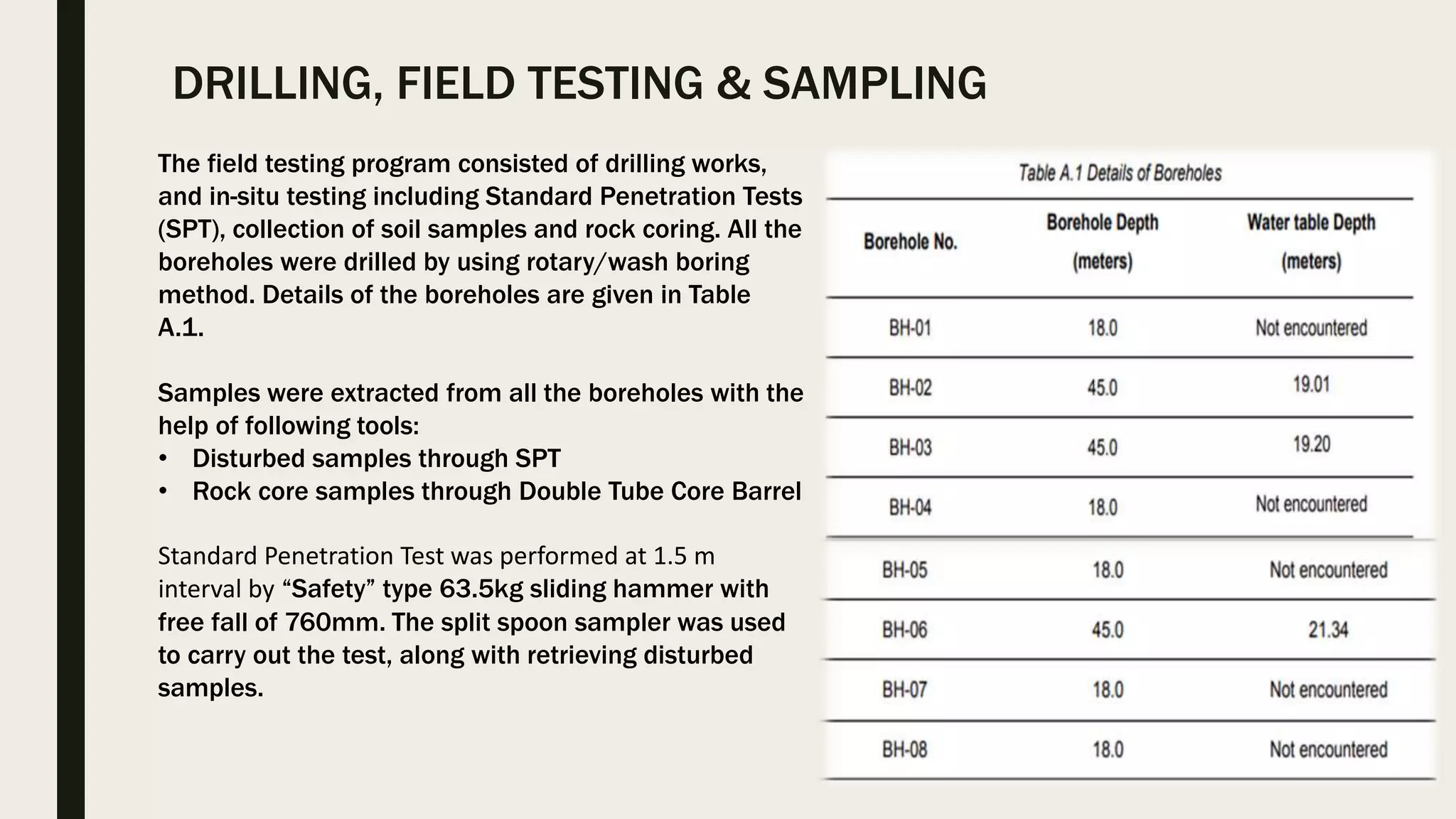
The field testing program consisted of drilling works,
and in-situ testing including Standard Penetration Tests
(SPT), collection of soil samples and rock coring. All the
boreholes were drilled by using rotary/wash boring
method. Details of the boreholes are given in Table
A.1.
Samples were extracted from all the boreholes with the
help of following tools:
• Disturbed samples through SPT
• Rock core samples through Double Tube Core Barrel
Standard Penetration Test was performed at 1.5 m
interval by “Safety” type 63.5kg sliding hammer with
free fall of 760mm. The split spoon sampler was used
to carry out the test, along with retrieving disturbed
samples.
SIEVE ANALYSIS & SOIL CLASSIFICATION
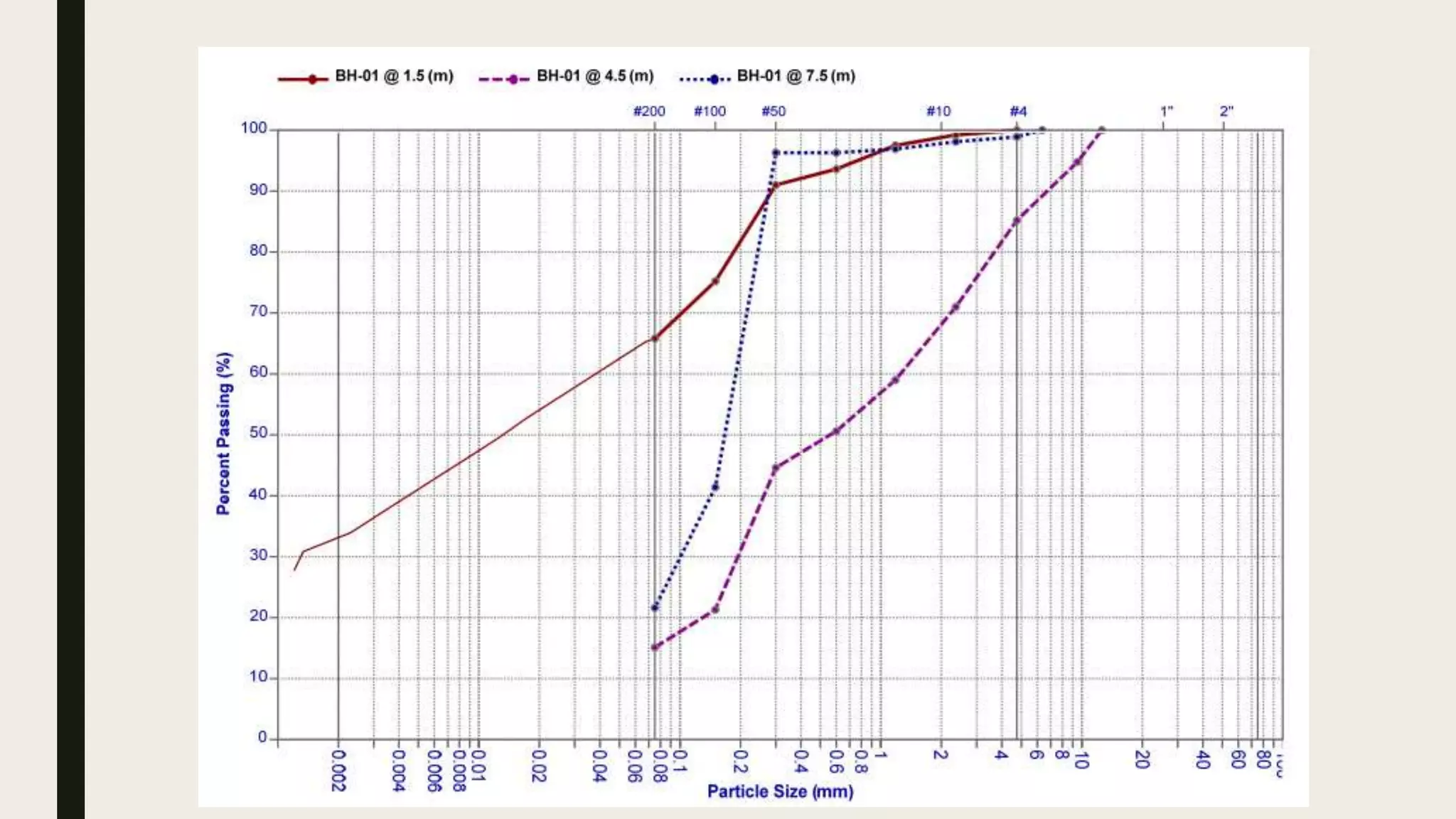
The purpose of grain size analysis is to determine the sizes of the assemblage of
particles that make up the soil. For particles above the “# 200 US sieve”, sieve analysis
is carried out by passing the selected soil sample from various sieves. For particles finer
than the “# 200 US sieve”, hydrometer analysis is carried out. The combined process of
determination of the size of particles is termed as the grain size analysis.
Grain size analysis of thirty six (36) soil samples were carried out as per ASTM C-136 &
ASTM D-6913.
ATTERBERG LIMITS TEST
The liquid and plastic limits of soil define the state of the soil at different water
content.
Liquid Limit: It is the water content above which the soil goes from solid phase
to liquid phase.
Plastic Limit: It is the water content in clay soil below Which it stop to behave
like a plastic material.
Plastic Index: It is a measure of the plasticity of the soil under consideration.
The samples used for determining the limits are finer than the “#40 US sieve”.
The limits were determined in accordance with the ASTM D-4318.
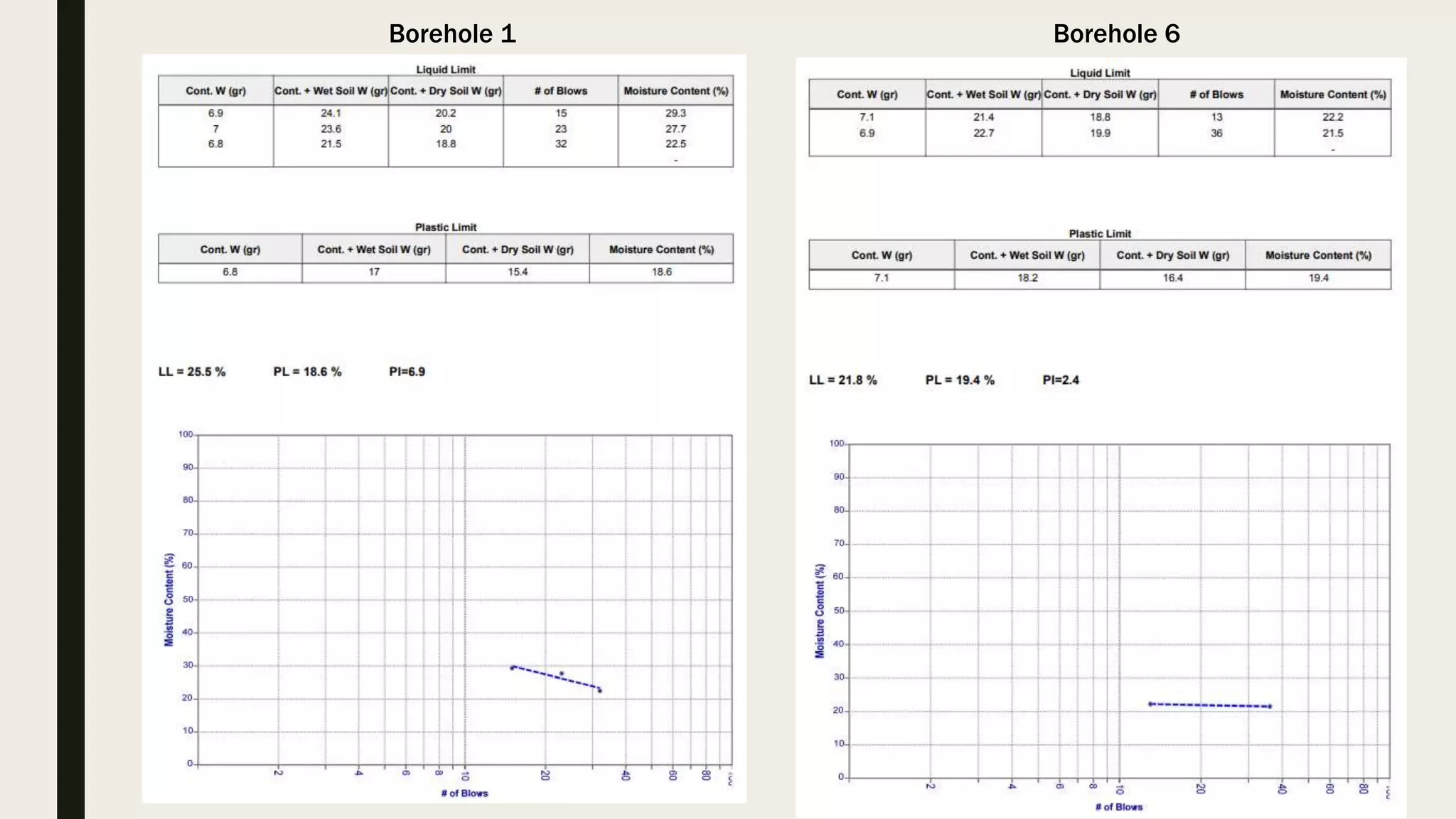
Liquid and plastic limits of two (02) samples extracted from boreholes were
carried out in accordance with the given procedure.
Borehole 1 Borehole 6
UNCONFINED COMPRESSION TEST
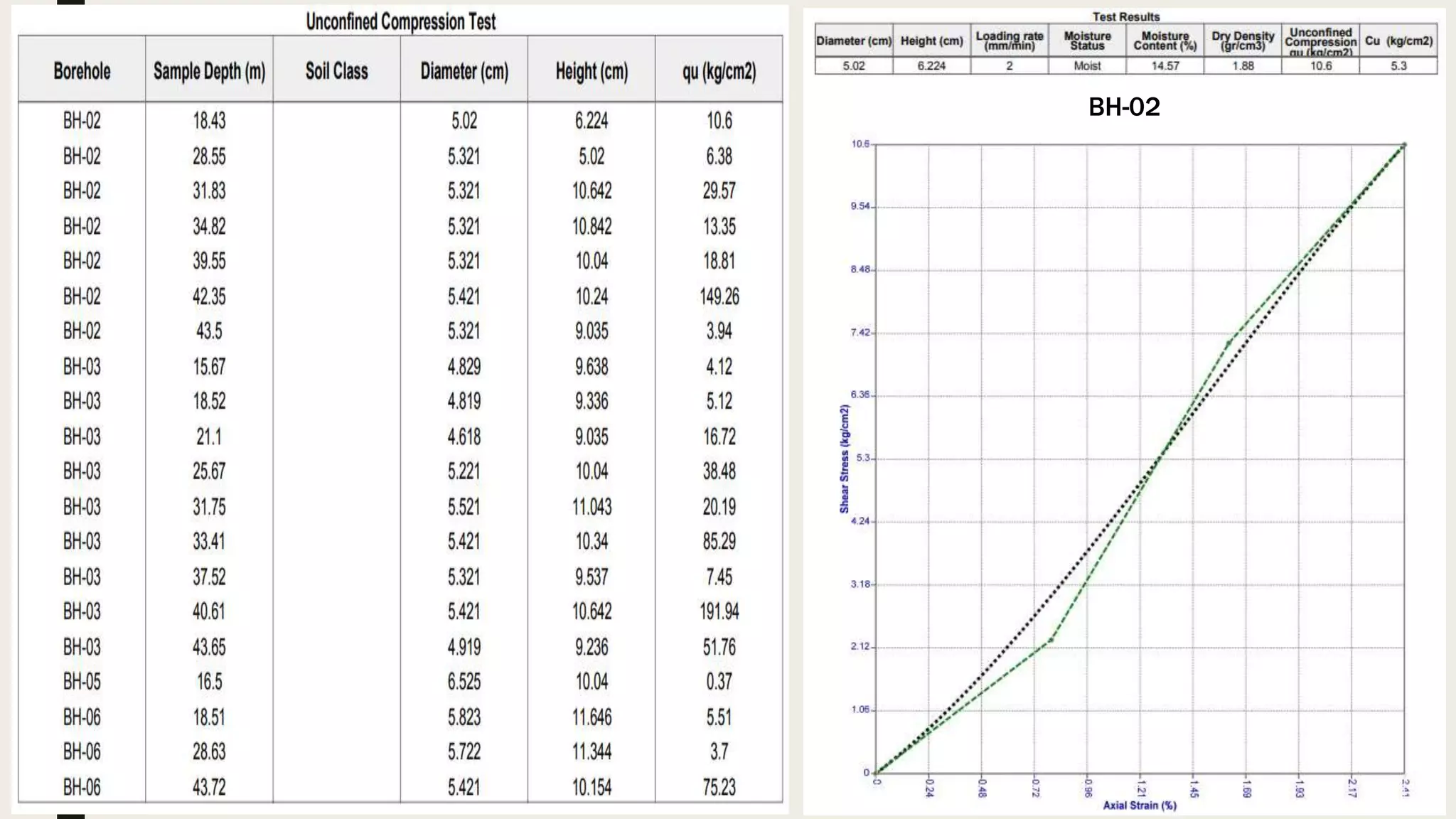
The purpose of this test is to determine the unconfined compressive strength
of a cohesive soil sample. The test involves axially loading a cylindrical rock
core or undisturbed clay sample to failure. The unconfined compressive
strength test was carried out in accordance with ASTM D 2938. The strength
of the retrieved sample tested came out in the range of 0.37 – 191.94
Kg/cm2.
BH-02
DENSITY & MOISTURE TEST
The value of natural moisture is the amount of water present in a sample of soil or rock.
Natural moisture content of fifty six (56) samples was determined in accordance with
ASTM 2216-05.
The weight per unit volume of the solid portion of soil is called particle (dry) density.
Whereas, the oven dry weight of a unit volume of soil inclusive of pore spaces is called
bulk (wet) density. The bulk density of a soil & rock is always smaller than its particle
density. Density of fifty six (56) samples was determined in accordance with the
procedure described in ASTM D 7263-09.
DIRECT SHEAR TEST
The direct shear test involves, placing a test sample in a rectangular box having two
portions, the top portion can move while the lower portion is fixed. The sample is
consolidated under a normal load. Also, porous stones are placed on the top and
bottom of the sample so that the test may be carried out under drained
conditions. The ASTM D 3080-04 was followed for the performance of static direct
simple shear tests.
Borehole Sample Depth Cohesion Angle of
Friction(Φ)
BH 1 1.5 (m) 1.0 12.1
BH 2 4.5 (m) 0.0 32.7
BH 3 1.5 (m) 0.0 27.1
BH 4 4.5 (m) 0.0 36.4
BH 5 1.5 (m) 0.0 30.3
BH 6 1.5 (m) 0.0 29.7
BH 7 1.5 (m) 0.0 31.2
BH 8 1.5 (m) 0.0 26.6
- BH 1
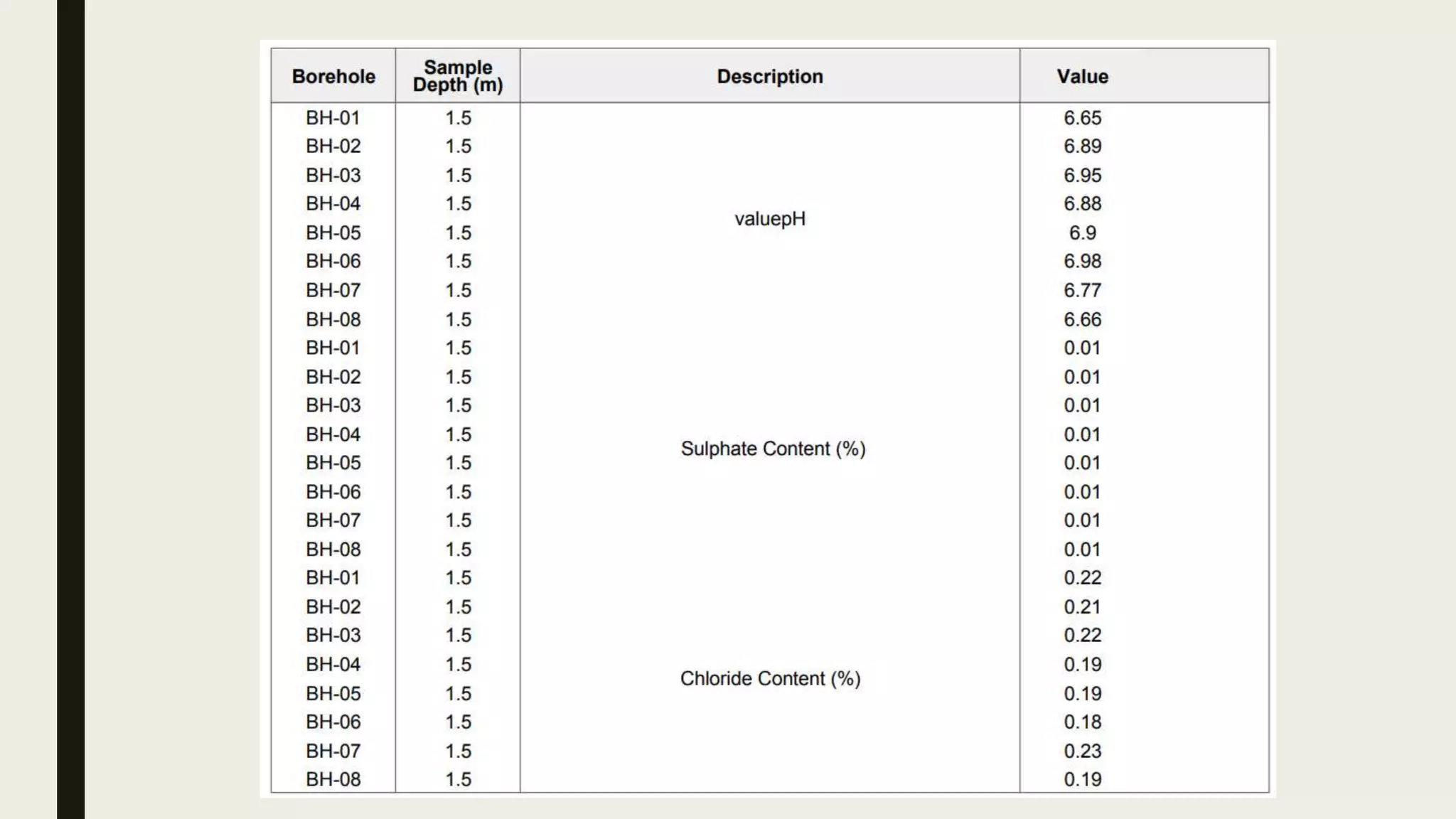
CHEMICAL TEST
It is necessary to perform chemical tests on soil and groundwater due to adverse
effects of sulphates and chlorides on the consistency of concrete. Chemical tests
were carried out in accordance with ASTM C 1580-09, and D 4972-01.
Soil Investigation Report

Soil Investigation Report

  • 1.
    SOIL MECHANICS –II (UE-403) Geotechnical investigation report for construction of 2B+G+28 storey Ab-ul-Qasim Shopping Mall & Residence at plot # 01, 02, 03, 04 & 05 near Jinnah Avenue Bahria Karachi. GROUP MEMBERS: Muhammad Muddasir (UE-16063) Muhammad Meezan (UE-16058) Azam Khan (UE-16080) Abdul Moeed (UE-16056) Shaharyar Jameel (UE-16050) Department of Urban and Infrastructure Engineering, NED University of Engineering and Technology, Karachi
  • 2.
    TABLE OF CONTENT S.No.Contents 1. Drilling, field testing & sampling 2. Sieve analysis & soil classification 3. Atterberg limits test 4. Unconfined compression test 5. Density & moisture test 6. Direct shear test 7. Chemical test
  • 3.
    DRILLING, FIELD TESTING& SAMPLING The field testing program consisted of drilling works, and in-situ testing including Standard Penetration Tests (SPT), collection of soil samples and rock coring. All the boreholes were drilled by using rotary/wash boring method. Details of the boreholes are given in Table A.1. Samples were extracted from all the boreholes with the help of following tools: • Disturbed samples through SPT • Rock core samples through Double Tube Core Barrel Standard Penetration Test was performed at 1.5 m interval by “Safety” type 63.5kg sliding hammer with free fall of 760mm. The split spoon sampler was used to carry out the test, along with retrieving disturbed samples.
  • 4.
    SIEVE ANALYSIS &SOIL CLASSIFICATION The purpose of grain size analysis is to determine the sizes of the assemblage of particles that make up the soil. For particles above the “# 200 US sieve”, sieve analysis is carried out by passing the selected soil sample from various sieves. For particles finer than the “# 200 US sieve”, hydrometer analysis is carried out. The combined process of determination of the size of particles is termed as the grain size analysis. Grain size analysis of thirty six (36) soil samples were carried out as per ASTM C-136 & ASTM D-6913.
  • 7.
    ATTERBERG LIMITS TEST Theliquid and plastic limits of soil define the state of the soil at different water content. Liquid Limit: It is the water content above which the soil goes from solid phase to liquid phase. Plastic Limit: It is the water content in clay soil below Which it stop to behave like a plastic material. Plastic Index: It is a measure of the plasticity of the soil under consideration. The samples used for determining the limits are finer than the “#40 US sieve”. The limits were determined in accordance with the ASTM D-4318. Liquid and plastic limits of two (02) samples extracted from boreholes were carried out in accordance with the given procedure.
  • 8.
  • 9.
    UNCONFINED COMPRESSION TEST Thepurpose of this test is to determine the unconfined compressive strength of a cohesive soil sample. The test involves axially loading a cylindrical rock core or undisturbed clay sample to failure. The unconfined compressive strength test was carried out in accordance with ASTM D 2938. The strength of the retrieved sample tested came out in the range of 0.37 – 191.94 Kg/cm2.
  • 10.
  • 11.
    DENSITY & MOISTURETEST The value of natural moisture is the amount of water present in a sample of soil or rock. Natural moisture content of fifty six (56) samples was determined in accordance with ASTM 2216-05. The weight per unit volume of the solid portion of soil is called particle (dry) density. Whereas, the oven dry weight of a unit volume of soil inclusive of pore spaces is called bulk (wet) density. The bulk density of a soil & rock is always smaller than its particle density. Density of fifty six (56) samples was determined in accordance with the procedure described in ASTM D 7263-09.
  • 13.
    DIRECT SHEAR TEST Thedirect shear test involves, placing a test sample in a rectangular box having two portions, the top portion can move while the lower portion is fixed. The sample is consolidated under a normal load. Also, porous stones are placed on the top and bottom of the sample so that the test may be carried out under drained conditions. The ASTM D 3080-04 was followed for the performance of static direct simple shear tests.
  • 14.
    Borehole Sample DepthCohesion Angle of Friction(Φ) BH 1 1.5 (m) 1.0 12.1 BH 2 4.5 (m) 0.0 32.7 BH 3 1.5 (m) 0.0 27.1 BH 4 4.5 (m) 0.0 36.4 BH 5 1.5 (m) 0.0 30.3 BH 6 1.5 (m) 0.0 29.7 BH 7 1.5 (m) 0.0 31.2 BH 8 1.5 (m) 0.0 26.6 - BH 1
  • 15.
    CHEMICAL TEST It isnecessary to perform chemical tests on soil and groundwater due to adverse effects of sulphates and chlorides on the consistency of concrete. Chemical tests were carried out in accordance with ASTM C 1580-09, and D 4972-01.