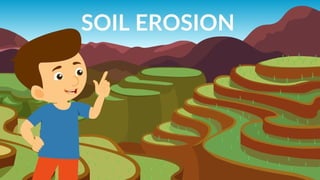
This is a grade five lesson about soil erosion. It talks about the definition of soil erosion, its agents, the reason why it happens most of the time, the methods of preventing it to happen. It comes with different pictures and animations.
OBJECTIVES:
1. Define soilerosion.
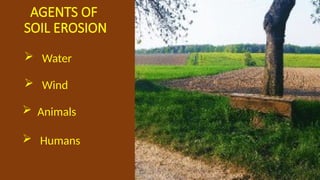
2. Identify the different agents of soil erosion.
3. Explain why soil erosion takes place most of the
time.
4. Give situations on how to prevent soil erosion.
4.
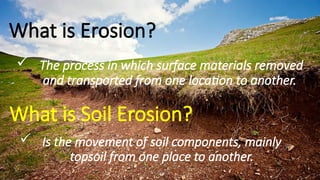
What is Erosion?
The process in which surface materials removed
and transported from one location to another..
What is Soil Erosion?
Is the movement of soil components, mainly
topsoil from one place to another.
How does water
causesoil erosion? Water
Water has force. As water flows, its
force transport rock and soil
particles from one place to another.
The speed of flowing water affects
the rate of erosion, too. The faster
the water flows, the faster and
farther the erosion would be.
Faster movement of water
indicates a great force thus, many
sediments are carried away by the
water.
7.
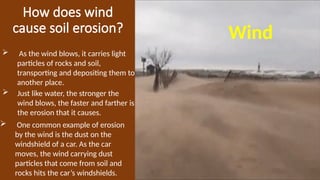
How does wind
causesoil erosion? Wind
As the wind blows, it carries light
particles of rocks and soil,
transporting and depositing them to
another place.
Just like water, the stronger the
wind blows, the faster and farther is
the erosion that it causes.
One common example of erosion
by the wind is the dust on the
windshield of a car. As the car
moves, the wind carrying dust
particles that come from soil and
rocks hits the car’s windshields.
8.
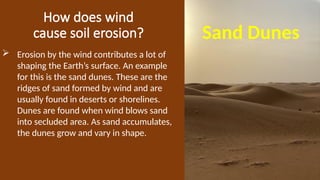
How does wind
causesoil erosion? Sand Dunes
Erosion by the wind contributes a lot of
shaping the Earth’s surface. An example
for this is the sand dunes. These are the
ridges of sand formed by wind and are
usually found in deserts or shorelines.
Dunes are found when wind blows sand
into secluded area. As sand accumulates,
the dunes grow and vary in shape.
9.
How do animals
causesoil erosion? Animals
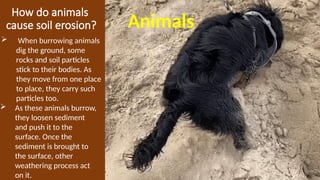
When burrowing animals
dig the ground, some
rocks and soil particles
stick to their bodies. As
they move from one place
to place, they carry such
particles too.
As these animals burrow,
they loosen sediment
and push it to the
surface. Once the
sediment is brought to
the surface, other
weathering process act
on it.
10.
How do humans
causesoil erosion?
Humans
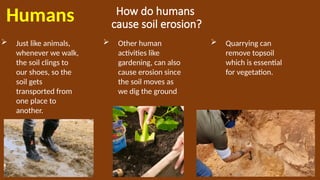
Just like animals,
whenever we walk,
the soil clings to
our shoes, so the
soil gets
transported from
one place to
another.
Quarrying can
remove topsoil
which is essential
for vegetation.
Other human
activities like
gardening, can also
cause erosion since
the soil moves as
we dig the ground
11.
How Land SlopeAffects Erosion?
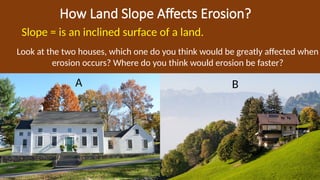
Slope = is an inclined surface of a land.
A B
Look at the two houses, which one do you think would be greatly affected when
erosion occurs? Where do you think would erosion be faster?
12.
How Land SlopeAffects Erosion?
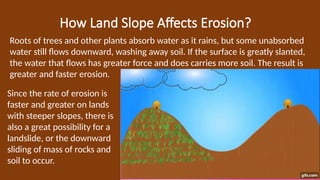
Roots of trees and other plants absorb water as it rains, but some unabsorbed
water still flows downward, washing away soil. If the surface is greatly slanted,
the water that flows has greater force and does carries more soil. The result is
greater and faster erosion.
Since the rate of erosion is
faster and greater on lands
with steeper slopes, there is
also a great possibility for a
landslide, or the downward
sliding of mass of rocks and
soil to occur.
13.
Effects of SoilErosion on LANDFORMS
Appearance and structure take hundred of years to
change.
Sand dunes
Soil erosion can be destructive as large mass of soil is
scratched and worn away.
Can add up to the beauty and wonder of nature.
14.
Effects of SoilErosion on PLANTS
Since topsoil is easily carried away by the wind and water,
the organic materials that serve as nutrient for plants will
also be carried away, as a result, plants will not grow well
due to lack of nutrients.
Sediments that are washed away can clog irrigation
systems, so the plants can’t have enough water supply.
Soil loses the ability to hold and absorb water, so the soil
will be dry which is not suitable for vegetation.
15.
Effects of SoilErosion on ANIMALS and HUMANS
Causes less production, which means less food source.
Less food supply can affect all organisms in the ecosystem.
Farmers have difficulty in sustaining their lives.
Mine tailings (mineral wastes or leftover after mining)
pollutes water sources.
Affects aquatic animals.
Supply of potable or drinking water.
Sickness to animals and humans.
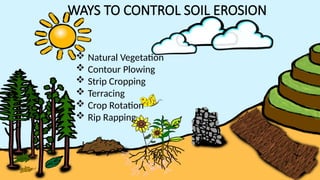
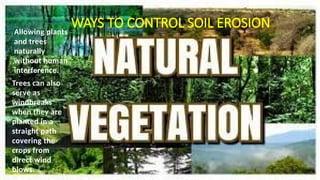
WAYS TO CONTROLSOIL EROSION
Allowing plants
and trees
naturally
without human
interference.
Trees can also
serve as
windbreaks
when they are
planted in a
straight path
covering the
crops from
direct wind
blows.
18.
WAYS TO CONTROLSOIL EROSION
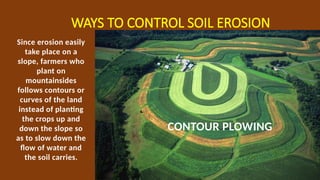
CONTOUR PLOWING
Since erosion easily
take place on a
slope, farmers who
plant on
mountainsides
follows contours or
curves of the land
instead of planting
the crops up and
down the slope so
as to slow down the
flow of water and
the soil carries.
19.
WAYS TO CONTROLSOIL EROSION
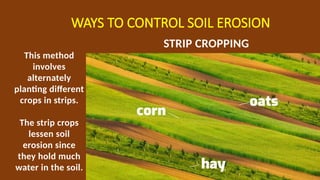
STRIP CROPPING
This method
involves
alternately
planting different
crops in strips.
The strip crops
lessen soil
erosion since
they hold much
water in the soil.
20.
WAYS TO CONTROLSOIL EROSION TERRACING
Planting on
terraces or steps
built on the
slopes of
mountainsides
to act as ridges
to help slow
down the flow
of water that
carries soil.
21.
WAYS TO CONTROLSOIL EROSION CROP ROTATION
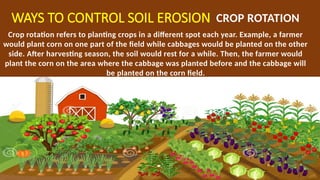
Crop rotation refers to planting crops in a different spot each year. Example, a farmer
would plant corn on one part of the field while cabbages would be planted on the other
side. After harvesting season, the soil would rest for a while. Then, the farmer would
plant the corn on the area where the cabbage was planted before and the cabbage will
be planted on the corn field.
22.
WAYS TO CONTROLSOIL EROSION
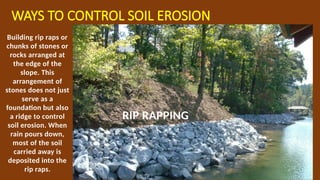
RIP RAPPING
Building rip raps or
chunks of stones or
rocks arranged at
the edge of the
slope. This
arrangement of
stones does not just
serve as a
foundation but also
a ridge to control
soil erosion. When
rain pours down,
most of the soil
carried away is
deposited into the
rip raps.
23.
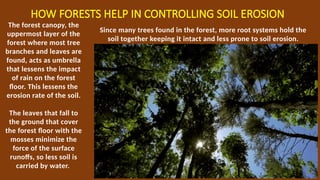
HOW FORESTS HELPIN CONTROLLING SOIL EROSION
The forest canopy, the
uppermost layer of the
forest where most tree
branches and leaves are
found, acts as umbrella
that lessens the impact
of rain on the forest
floor. This lessens the
erosion rate of the soil.
The leaves that fall to
the ground that cover
the forest floor with the
mosses minimize the
force of the surface
runoffs, so less soil is
carried by water.
Since many trees found in the forest, more root systems hold the
soil together keeping it intact and less prone to soil erosion.






![Polymer [ बहुलक ] Chemistry Notes PDF - Irfanullah Mehar - JJ Sir Chemistry.pdf](https://cdn.slidesharecdn.com/ss_thumbnails/polymerchemistrynotespdf-irfanullahmehar-jjsirchemistry-260210172118-3f9b37f7-thumbnail.jpg?width=640&height=640&fit=bounds)


