
Software Testing in a
Distributed Environment
Neil Langmead
Unrestricted
2
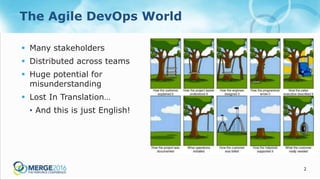
The Agile DevOps World
 Many stakeholders
 Distributed across teams
 Huge potential for
misunderstanding
 Lost In Translation…
• And this is just English!
3
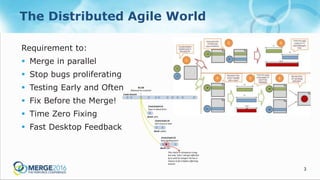
The Distributed Agile World
Requirement to:
 Merge in parallel
 Stop bugs proliferating
 Testing Early and Often
 Fix Before the Merge!
 Time Zero Fixing
 Fast Desktop Feedback
/main branch
BL130
Released to customer
devel: john
/main/task115
New loading form
devel: pat
devel: pablo
/main/task114
Typo in about form
/main/task116
GDI resource leak
This check-in introduces a bug,
but only “john” will get affected
by it until he merges! He has a
chance to fix it before affecting
anyone
4
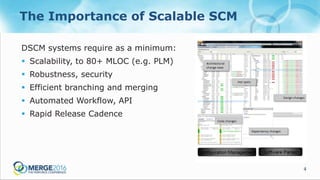
The Importance of Scalable SCM
DSCM systems require as a minimum:
 Scalability, to 80+ MLOC (e.g. PLM)
 Robustness, security
 Efficient branching and merging
 Automated Workflow, API
 Rapid Release Cadence
5
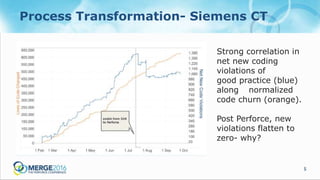
Process Transformation- Siemens CT
Strong correlation in
net new coding
violations of
good practice (blue)
along normalized
code churn (orange).
Post Perforce, new
violations flatten to
zero- why?
6
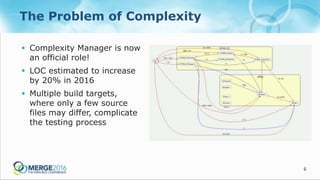
The Problem of Complexity
 Complexity Manager is now
an official role!
 LOC estimated to increase
by 20% in 2016
 Multiple build targets,
where only a few source
files may differ, complicate
the testing process
7
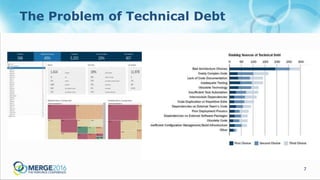
The Problem of Technical Debt
8
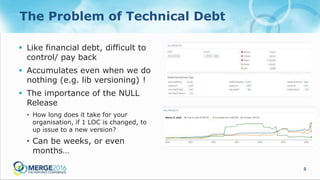
The Problem of Technical Debt
 Like financial debt, difficult to
control/ pay back
 Accumulates even when we do
nothing (e.g. lib versioning) !
 The importance of the NULL
Release
• How long does it take for your
organisation, if 1 LOC is changed, to
up issue to a new version?
• Can be weeks, or even
months…
9
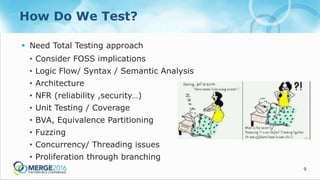
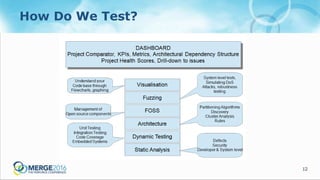
How Do We Test?
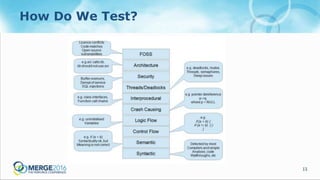
 Need Total Testing approach
• Consider FOSS implications
• Logic Flow/ Syntax / Semantic Analysis
• Architecture
• NFR (reliability ,security…)
• Unit Testing / Coverage
• BVA, Equivalence Partitioning
• Fuzzing
• Concurrency/ Threading issues
• Proliferation through branching
10
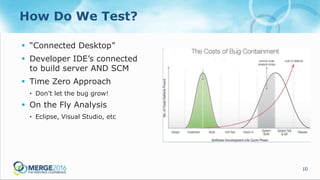
How Do We Test?
 “Connected Desktop”
 Developer IDE’s connected
to build server AND SCM
 Time Zero Approach
• Don’t let the bug grow!
 On the Fly Analysis
• Eclipse, Visual Studio, etc
11
How Do We Test?
12
How Do We Test?
13
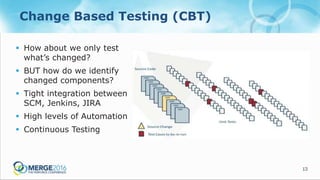
Change Based Testing (CBT)
 How about we only test
what’s changed?
 BUT how do we identify
changed components?
 Tight integration between
SCM, Jenkins, JIRA
 High levels of Automation
 Continuous Testing
14
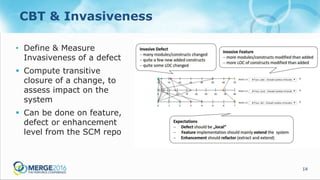
CBT & Invasiveness
• Define & Measure
Invasiveness of a defect
 Compute transitive
closure of a change, to
assess impact on the
system
 Can be done on feature,
defect or enhancement
level from the SCM repo
15
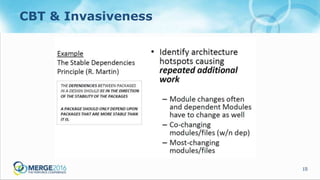
CBT & Invasiveness
16
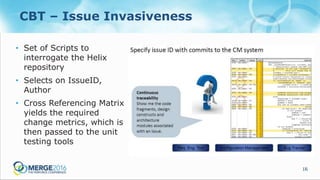
CBT – Issue Invasiveness
• Set of Scripts to
interrogate the Helix
repository
• Selects on IssueID,
Author
• Cross Referencing Matrix
yields the required
change metrics, which is
then passed to the unit
testing tools
17
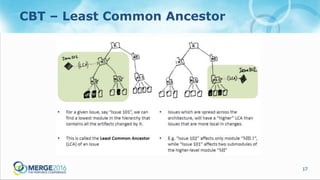
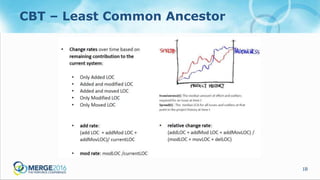
CBT – Least Common Ancestor
18
CBT – Least Common Ancestor
19
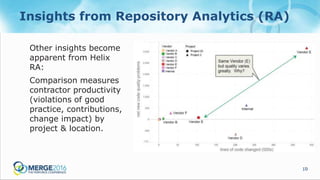
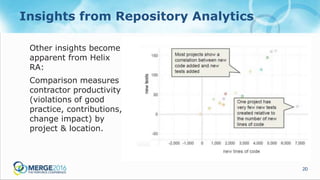
Insights from Repository Analytics (RA)
Other insights become
apparent from Helix
RA:
Comparison measures
contractor productivity
(violations of good
practice, contributions,
change impact) by
project & location.
20
Insights from Repository Analytics
Other insights become
apparent from Helix
RA:
Comparison measures
contractor productivity
(violations of good
practice, contributions,
change impact) by
project & location.
21
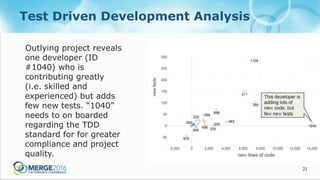
Test Driven Development Analysis
Outlying project reveals
one developer (ID
#1040) who is
contributing greatly
(i.e. skilled and
experienced) but adds
few new tests. “1040”
needs to on boarded
regarding the TDD
standard for for greater
compliance and project
quality.
22
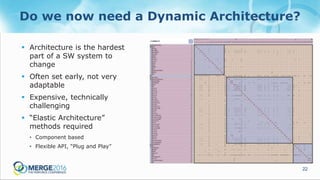
Do we now need a Dynamic Architecture?
 Architecture is the hardest
part of a SW system to
change
 Often set early, not very
adaptable
 Expensive, technically
challenging
 “Elastic Architecture”
methods required
• Component based
• Flexible API, “Plug and Play”
23
Conclusions
 Complexity is here to stay
 Need advanced, efficient methods to reduce test effort
 Use Branch Per Task/ Test Per Task
 Change Based Testing Approach to reduce technical debt
 Time Zero Testing before the Merge
 Advanced Repository Analysis to gain additional insights
 Agility in the Architecture is the Next Frontier (Neil’s opinion…)
 “Continuous Testing” is here to stay
24
Demonstration
demonstration of the Total Testing Platform, in use at Siemens
Thank you for your attention!
Software Testing in a Distributed Environment

Software Testing in a Distributed Environment

  • 1.
    Software Testing ina Distributed Environment Neil Langmead Unrestricted
  • 2.
    2 The Agile DevOpsWorld  Many stakeholders  Distributed across teams  Huge potential for misunderstanding  Lost In Translation… • And this is just English!
  • 3.
    3 The Distributed AgileWorld Requirement to:  Merge in parallel  Stop bugs proliferating  Testing Early and Often  Fix Before the Merge!  Time Zero Fixing  Fast Desktop Feedback /main branch BL130 Released to customer devel: john /main/task115 New loading form devel: pat devel: pablo /main/task114 Typo in about form /main/task116 GDI resource leak This check-in introduces a bug, but only “john” will get affected by it until he merges! He has a chance to fix it before affecting anyone
  • 4.
    4 The Importance ofScalable SCM DSCM systems require as a minimum:  Scalability, to 80+ MLOC (e.g. PLM)  Robustness, security  Efficient branching and merging  Automated Workflow, API  Rapid Release Cadence
  • 5.
    5 Process Transformation- SiemensCT Strong correlation in net new coding violations of good practice (blue) along normalized code churn (orange). Post Perforce, new violations flatten to zero- why?
  • 6.
    6 The Problem ofComplexity  Complexity Manager is now an official role!  LOC estimated to increase by 20% in 2016  Multiple build targets, where only a few source files may differ, complicate the testing process
  • 7.
    7 The Problem ofTechnical Debt
  • 8.
    8 The Problem ofTechnical Debt  Like financial debt, difficult to control/ pay back  Accumulates even when we do nothing (e.g. lib versioning) !  The importance of the NULL Release • How long does it take for your organisation, if 1 LOC is changed, to up issue to a new version? • Can be weeks, or even months…
  • 9.
    9 How Do WeTest?  Need Total Testing approach • Consider FOSS implications • Logic Flow/ Syntax / Semantic Analysis • Architecture • NFR (reliability ,security…) • Unit Testing / Coverage • BVA, Equivalence Partitioning • Fuzzing • Concurrency/ Threading issues • Proliferation through branching
  • 10.
    10 How Do WeTest?  “Connected Desktop”  Developer IDE’s connected to build server AND SCM  Time Zero Approach • Don’t let the bug grow!  On the Fly Analysis • Eclipse, Visual Studio, etc
  • 11.
  • 12.
  • 13.
    13 Change Based Testing(CBT)  How about we only test what’s changed?  BUT how do we identify changed components?  Tight integration between SCM, Jenkins, JIRA  High levels of Automation  Continuous Testing
  • 14.
    14 CBT & Invasiveness •Define & Measure Invasiveness of a defect  Compute transitive closure of a change, to assess impact on the system  Can be done on feature, defect or enhancement level from the SCM repo
  • 15.
  • 16.
    16 CBT – IssueInvasiveness • Set of Scripts to interrogate the Helix repository • Selects on IssueID, Author • Cross Referencing Matrix yields the required change metrics, which is then passed to the unit testing tools
  • 17.
    17 CBT – LeastCommon Ancestor
  • 18.
    18 CBT – LeastCommon Ancestor
  • 19.
    19 Insights from RepositoryAnalytics (RA) Other insights become apparent from Helix RA: Comparison measures contractor productivity (violations of good practice, contributions, change impact) by project & location.
  • 20.
    20 Insights from RepositoryAnalytics Other insights become apparent from Helix RA: Comparison measures contractor productivity (violations of good practice, contributions, change impact) by project & location.
  • 21.
    21 Test Driven DevelopmentAnalysis Outlying project reveals one developer (ID #1040) who is contributing greatly (i.e. skilled and experienced) but adds few new tests. “1040” needs to on boarded regarding the TDD standard for for greater compliance and project quality.
  • 22.
    22 Do we nowneed a Dynamic Architecture?  Architecture is the hardest part of a SW system to change  Often set early, not very adaptable  Expensive, technically challenging  “Elastic Architecture” methods required • Component based • Flexible API, “Plug and Play”
  • 23.
    23 Conclusions  Complexity ishere to stay  Need advanced, efficient methods to reduce test effort  Use Branch Per Task/ Test Per Task  Change Based Testing Approach to reduce technical debt  Time Zero Testing before the Merge  Advanced Repository Analysis to gain additional insights  Agility in the Architecture is the Next Frontier (Neil’s opinion…)  “Continuous Testing” is here to stay
  • 24.
    24 Demonstration demonstration of theTotal Testing Platform, in use at Siemens Thank you for your attention!