DevOps 101
Liran Y. Levy
Product Manager
About Me
2
 Product manager for ALM Octane
 Previously Sr.DevOps Manager for ADM Lifecycle Management portfolio-
 ALM/QC
 AGM
 ALM Octane
 7+ Years in HPHPEMF
 liran.levy@microfocus.com
 Linkedin
The DevOps Notion
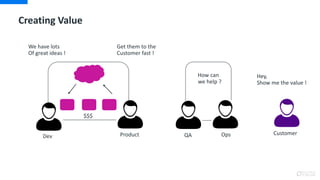
Creating Value
Dev Product Customer
$$$
Hey,
Show me the value !
We have lots
Of great ideas !
Get them to the
Customer fast !
QA Ops
How can
we help ?
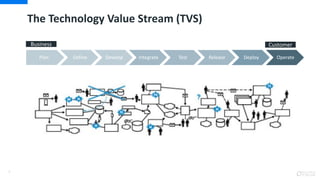
The Technology Value Stream (TVS)
5
Plan Define Develop Integrate Test Release Deploy Operate
Business Customer
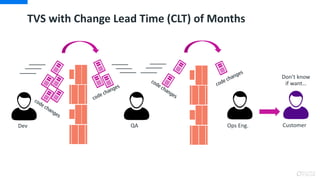
Dev QA Ops Eng. Customer
Don’t know
if want…
TVS with Change Lead Time (CLT) of Months
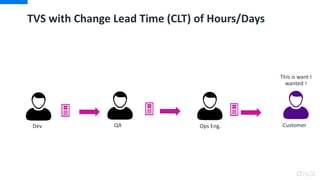
Dev QA Ops Eng. Customer
This is want I
wanted !
TVS with Change Lead Time (CLT) of Hours/Days
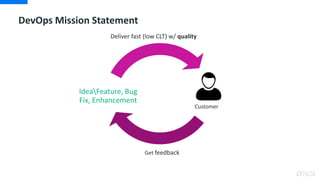
DevOps Mission Statement
IdeaFeature, Bug
Fix, Enhancement
Deliver fast (low CLT) w/ quality
Get feedback
Customer
DevOps In Theory
DevOps is the philosophy of unifying functional teams across culture, processes and
tools to achieve accelerated and more frequent delivery of value to the customer, by
improving quality in order to increase velocity.
DevOps can also be viewed as:
• The outcome of applying lean principles to the technology value stream.
• The response to the interdependence of software development and IT operations.
• The natural continuity of the lean startup movement.
DevOps In Practice
In practical terms DevOps can involve any combination of a wide range of ideas:
• Agile software development
• Cross-functional teams
• Continuous testing's
• Continuous integration
• Continuous delivery
• Continuous deployment
• Continuous Operations
• Test, Build and deployment automation
• Deploy the same to all
• Ops shifts to:
• Infra as a Code
• Configuration as a Code
• Dev shifts to:
• Fixing production problems
• Plan for security, resilience and scalability
• Data driven lifecycle management
• ….
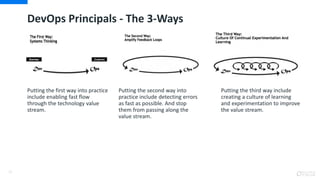
DevOps Principals - The 3-Ways
Putting the first way into practice
include enabling fast flow
through the technology value
stream.
Putting the second way into
practice include detecting errors
as fast as possible. And stop
them from passing along the
value stream.
11
Putting the third way include
creating a culture of learning
and experimentation to improve
the value stream.
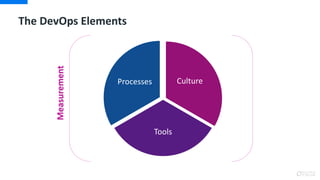
The DevOps Elements
The DevOps Elements
Culture
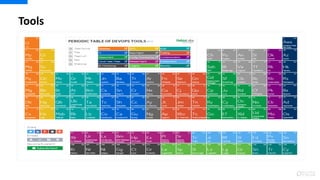
Tools
Processes
Measurement
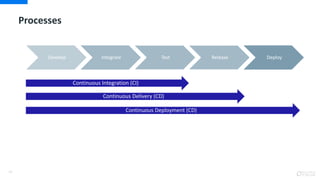
Processes
14
Continuous Integration (CI)
Continuous Delivery (CD)
Continuous Deployment (CD)
Develop Integrate Test Release Deploy
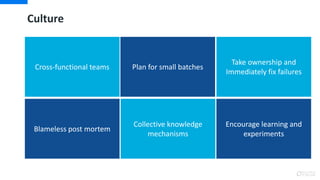
Culture
Plan for small batchesCross-functional teams
Take ownership and
Immediately fix failures
Blameless post mortem
Encourage learning and
experiments
Collective knowledge
mechanisms
Tools
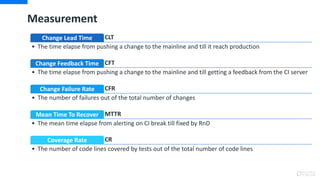
Measurement
CLTChange Lead Time
• The time elapse from pushing a change to the mainline and till it reach production
CFTChange Feedback Time
• The time elapse from pushing a change to the mainline and till getting a feedback from the CI server
CFRChange Failure Rate
• The number of failures out of the total number of changes
MTTRMean Time To Recover
• The mean time elapse from alerting on CI break till fixed by RnD
CRCoverage Rate
• The number of code lines covered by tests out of the total number of code lines
Examples: Enabling Flow
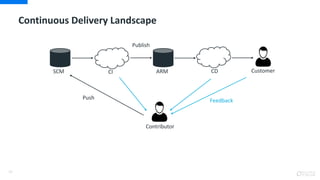
Continuous Delivery Landscape
19
Contributor
SCM CI CD CustomerARM
FeedbackPush
Publish
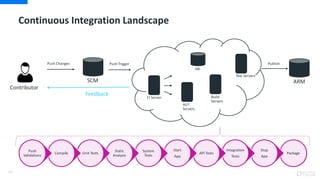
Continuous Integration Landscape
20
Contributor
Push Changes
SCM
Push Trigger
Feedback
ARM
Publish
DB
CI Server Build
Servers
Test Servers
AUT
Servers
Package
Stop
App
Integration
Tests
API Tests
Start
App
System
Tests
Static
Analysis
Unit TestsCompile
Push
Validations
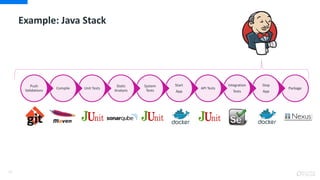
Example: Java Stack
21
Package
Stop
App
Integration
Tests
API Tests
Start
App
System
Tests
Static
Analysis
Unit TestsCompile
Push
Validations
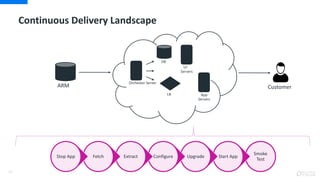
Continuous Delivery Landscape
22
DB
Orchestor Server
LB App
Servers
Customer
UI
Servers
ARM
Smoke
Test
Start AppUpgradeConfigureExtractFetchStop App
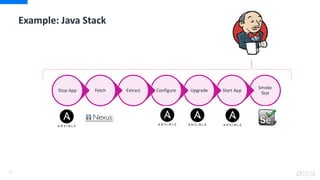
Example: Java Stack
23
Smoke
Test
Start AppUpgradeConfigureExtractFetchStop App
24
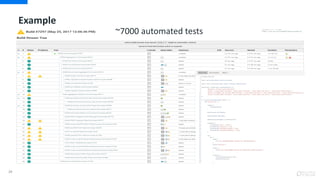
~7000 automated tests
Example
Examples:
Enabling Feedback Loops
26
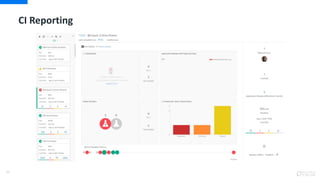
CI Reporting
27
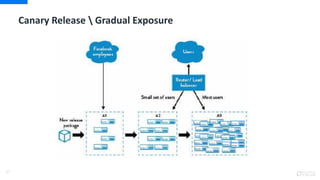
Canary Release  Gradual Exposure
28
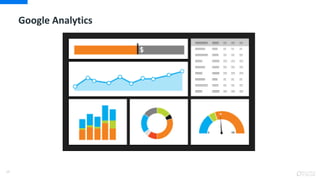
Google Analytics
Examples:
Enabling Continuous Improvement
30
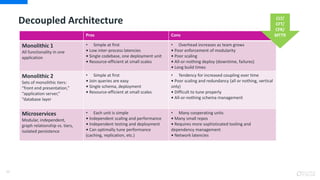
Decoupled Architecture
Pros Cons
Monolithic 1
All functionality in one
application
• Simple at first
• Low inter-process latencies
• Single codebase, one deployment unit
• Resource-efficient at small scales
• Overhead increases as team grows
• Poor enforcement of modularity
• Poor scaling
• All-or-nothing deploy (downtime, failures)
• Long build times
Monolithic 2
Sets of monolithic tiers:
“front end presentation,”
“application server,”
“database layer
• Simple at first
• Join queries are easy
• Single schema, deployment
• Resource-efficient at small scales
• Tendency for increased coupling over time
• Poor scaling and redundancy (all or nothing, vertical
only)
• Difficult to tune properly
• All-or-nothing schema management
Microservices
Modular, independent,
graph relationship vs. tiers,
isolated persistence
• Each unit is simple
• Independent scaling and performance
• Independent testing and deployment
• Can optimally tune performance
(caching, replication, etc.)
• Many cooperating units
• Many small repos
• Requires more sophisticated tooling and
dependency management
• Network latencies
CLT/
CFT/
CFR/
MTTR
31
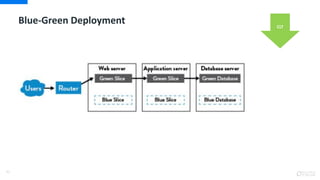
Blue-Green Deployment CLT
32
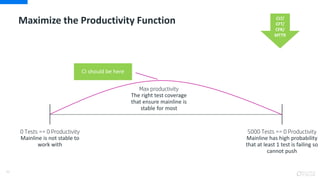
0 Tests == 0 Productivity
Mainline is not stable to
work with
5000 Tests == 0 Productivity
Mainline has high probability
that at least 1 test is failing so
cannot push
Max productivity
The right test coverage
that ensure mainline is
stable for most
CI should be here
Maximize the Productivity Function CLT/
CFT/
CFR/
MTTR
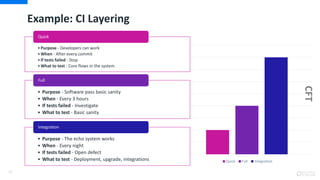
Quick Full Integration
Example: CI Layering
33
•Purpose - Developers can work
•When - After every commit
•If tests failed - Stop
•What to test - Core flows in the system
Quick
• Purpose - Software pass basic sanity
• When - Every 3 hours
• If tests failed - Investigate
• What to test - Basic sanity
Full
• Purpose - The echo system works
• When - Every night
• If tests failed - Open defect
• What to test - Deployment, upgrade, integrations
Integration
CFT
Thank You !

DevOps 101

  • 1.
    DevOps 101 Liran Y.Levy Product Manager
  • 2.
    About Me 2  Productmanager for ALM Octane  Previously Sr.DevOps Manager for ADM Lifecycle Management portfolio-  ALM/QC  AGM  ALM Octane  7+ Years in HPHPEMF  liran.levy@microfocus.com  Linkedin
  • 3.
  • 4.
    Creating Value Dev ProductCustomer $$$ Hey, Show me the value ! We have lots Of great ideas ! Get them to the Customer fast ! QA Ops How can we help ?
  • 5.
    The Technology ValueStream (TVS) 5 Plan Define Develop Integrate Test Release Deploy Operate Business Customer
  • 6.
    Dev QA OpsEng. Customer Don’t know if want… TVS with Change Lead Time (CLT) of Months
  • 7.
    Dev QA OpsEng. Customer This is want I wanted ! TVS with Change Lead Time (CLT) of Hours/Days
  • 8.
    DevOps Mission Statement IdeaFeature,Bug Fix, Enhancement Deliver fast (low CLT) w/ quality Get feedback Customer
  • 9.
    DevOps In Theory DevOpsis the philosophy of unifying functional teams across culture, processes and tools to achieve accelerated and more frequent delivery of value to the customer, by improving quality in order to increase velocity. DevOps can also be viewed as: • The outcome of applying lean principles to the technology value stream. • The response to the interdependence of software development and IT operations. • The natural continuity of the lean startup movement.
  • 10.
    DevOps In Practice Inpractical terms DevOps can involve any combination of a wide range of ideas: • Agile software development • Cross-functional teams • Continuous testing's • Continuous integration • Continuous delivery • Continuous deployment • Continuous Operations • Test, Build and deployment automation • Deploy the same to all • Ops shifts to: • Infra as a Code • Configuration as a Code • Dev shifts to: • Fixing production problems • Plan for security, resilience and scalability • Data driven lifecycle management • ….
  • 11.
    DevOps Principals -The 3-Ways Putting the first way into practice include enabling fast flow through the technology value stream. Putting the second way into practice include detecting errors as fast as possible. And stop them from passing along the value stream. 11 Putting the third way include creating a culture of learning and experimentation to improve the value stream.
  • 12.
  • 13.
  • 14.
    Processes 14 Continuous Integration (CI) ContinuousDelivery (CD) Continuous Deployment (CD) Develop Integrate Test Release Deploy
  • 15.
    Culture Plan for smallbatchesCross-functional teams Take ownership and Immediately fix failures Blameless post mortem Encourage learning and experiments Collective knowledge mechanisms
  • 16.
  • 17.
    Measurement CLTChange Lead Time •The time elapse from pushing a change to the mainline and till it reach production CFTChange Feedback Time • The time elapse from pushing a change to the mainline and till getting a feedback from the CI server CFRChange Failure Rate • The number of failures out of the total number of changes MTTRMean Time To Recover • The mean time elapse from alerting on CI break till fixed by RnD CRCoverage Rate • The number of code lines covered by tests out of the total number of code lines
  • 18.
  • 19.
    Continuous Delivery Landscape 19 Contributor SCMCI CD CustomerARM FeedbackPush Publish
  • 20.
    Continuous Integration Landscape 20 Contributor PushChanges SCM Push Trigger Feedback ARM Publish DB CI Server Build Servers Test Servers AUT Servers Package Stop App Integration Tests API Tests Start App System Tests Static Analysis Unit TestsCompile Push Validations
  • 21.
    Example: Java Stack 21 Package Stop App Integration Tests APITests Start App System Tests Static Analysis Unit TestsCompile Push Validations
  • 22.
    Continuous Delivery Landscape 22 DB OrchestorServer LB App Servers Customer UI Servers ARM Smoke Test Start AppUpgradeConfigureExtractFetchStop App
  • 23.
    Example: Java Stack 23 Smoke Test StartAppUpgradeConfigureExtractFetchStop App
  • 24.
  • 25.
  • 26.
  • 27.
    27 Canary Release Gradual Exposure
  • 28.
  • 29.
  • 30.
    30 Decoupled Architecture Pros Cons Monolithic1 All functionality in one application • Simple at first • Low inter-process latencies • Single codebase, one deployment unit • Resource-efficient at small scales • Overhead increases as team grows • Poor enforcement of modularity • Poor scaling • All-or-nothing deploy (downtime, failures) • Long build times Monolithic 2 Sets of monolithic tiers: “front end presentation,” “application server,” “database layer • Simple at first • Join queries are easy • Single schema, deployment • Resource-efficient at small scales • Tendency for increased coupling over time • Poor scaling and redundancy (all or nothing, vertical only) • Difficult to tune properly • All-or-nothing schema management Microservices Modular, independent, graph relationship vs. tiers, isolated persistence • Each unit is simple • Independent scaling and performance • Independent testing and deployment • Can optimally tune performance (caching, replication, etc.) • Many cooperating units • Many small repos • Requires more sophisticated tooling and dependency management • Network latencies CLT/ CFT/ CFR/ MTTR
  • 31.
  • 32.
    32 0 Tests ==0 Productivity Mainline is not stable to work with 5000 Tests == 0 Productivity Mainline has high probability that at least 1 test is failing so cannot push Max productivity The right test coverage that ensure mainline is stable for most CI should be here Maximize the Productivity Function CLT/ CFT/ CFR/ MTTR
  • 33.
    Quick Full Integration Example:CI Layering 33 •Purpose - Developers can work •When - After every commit •If tests failed - Stop •What to test - Core flows in the system Quick • Purpose - Software pass basic sanity • When - Every 3 hours • If tests failed - Investigate • What to test - Basic sanity Full • Purpose - The echo system works • When - Every night • If tests failed - Open defect • What to test - Deployment, upgrade, integrations Integration CFT
  • 34.