System Development Life Cycle
(SDLC)
Kavindu Chethiya Yakupitiya
BSc (Hons) IT [KDU] , PGD In Cyber Security [SLIIT] , MSc (Hons) in Cyber Security - Reading [SLIIT]
What is a SDLC?
❑ The systems development life cycle (SDLC) is the process of
determining how an information system (IS) can support business
needs, designing the system, building it, and delivering it to users.
• The key person in the SDLC is the systems analyst, who analyzes the business
situation, identifies the opportunities for improvements, and designs an IS to
implement the improvements.
• It is also called as Software Development Process.
Key Steps of SDLC.
Overview of SDLC.
 The SDLC is composed of Six fundamental phases:
• Planning
• Analysis
• Design
• Development/Implementation
• Testing & Integration
• Maintenance.
❑Each of the phases is composed of steps, which rely on techniques that produce
deliverables (specific documents that explain various elements of the system).
Step 01 – Planning.
▪ Planning address main two questions?
✓Why?
✓How?
• This phase is the fundamental process of understanding why an information
system should be built, and determining how the project team will go about
building it.
• This is the phase where Business analyst gather all the requirements in order to
build the system. (Requirement Gathering)
• The new system requirements are defined. In particular, the deficiencies in the
existing system must be addressed with specific proposals for improvement.
Other factors defined include needed features, functions and capabilities.
Step 02 – Analysis.
• Analysis address four main questions?
✓Who?
✓What?
✓Where?
✓When?
• The analysis phase answers the questions of who will use the system, what the
system will do, and where and when it will be used.
• During this phase the project team investigates any current system(s), identifies
improvement opportunities, and develops a concept for the new system.
Step 03 – Design.
• Design phase address one main question?
✓How
• The design phase decides how the system will operate, in terms of the
hardware, software, and network infrastructure; the user interface,
forms, and reports that will be used; and the specific programs,
diagrams, databases, and files that will be needed.
Step 04 – Development/Implementation.
• During the implementation phase, the system is either developed or
purchased (in the case of packaged software) and installed.
• This phase is usually the longest and most expensive part of the process.
• The new system is developed. The new components and programs must
be obtained and installed. Users of the system must be trained in its use.
Step 05 – Testing & Integration.
• System Integration Testing is defined as a type of software
testing carried out in an integrated hardware and software environment
to verify the behavior of the complete system.
• It also verifies a software system's coexistence with others and tests the
interface between modules of the software application.
• This is the stage where we check our final output/final system is working
error free and developed according to the given requirements.
Step 06 – Maintenance.
• The maintenance phase of the SDLC occurs after the product is in full
operation. Maintenance of software can include software upgrades,
repairs, and fixes of the software if it breaks.
• During the maintenance phase, errors or defects may exist, which would
require repairs during additional testing of the software.
Advantages of SDLC.
• Gives a defined view of the entire system, resources, timeline, and goals
• Design reviews help to ensure the reliability and quality of the final
product
• Enhanced control over large or complex projects
• Involves comprehensive and explicit steps
• Provide goals and deliverables that meet the standards of each party
involved in the project, requires keeping detailed documentation
throughout the entire process
• Easy evaluation of costs and growth of the developed system
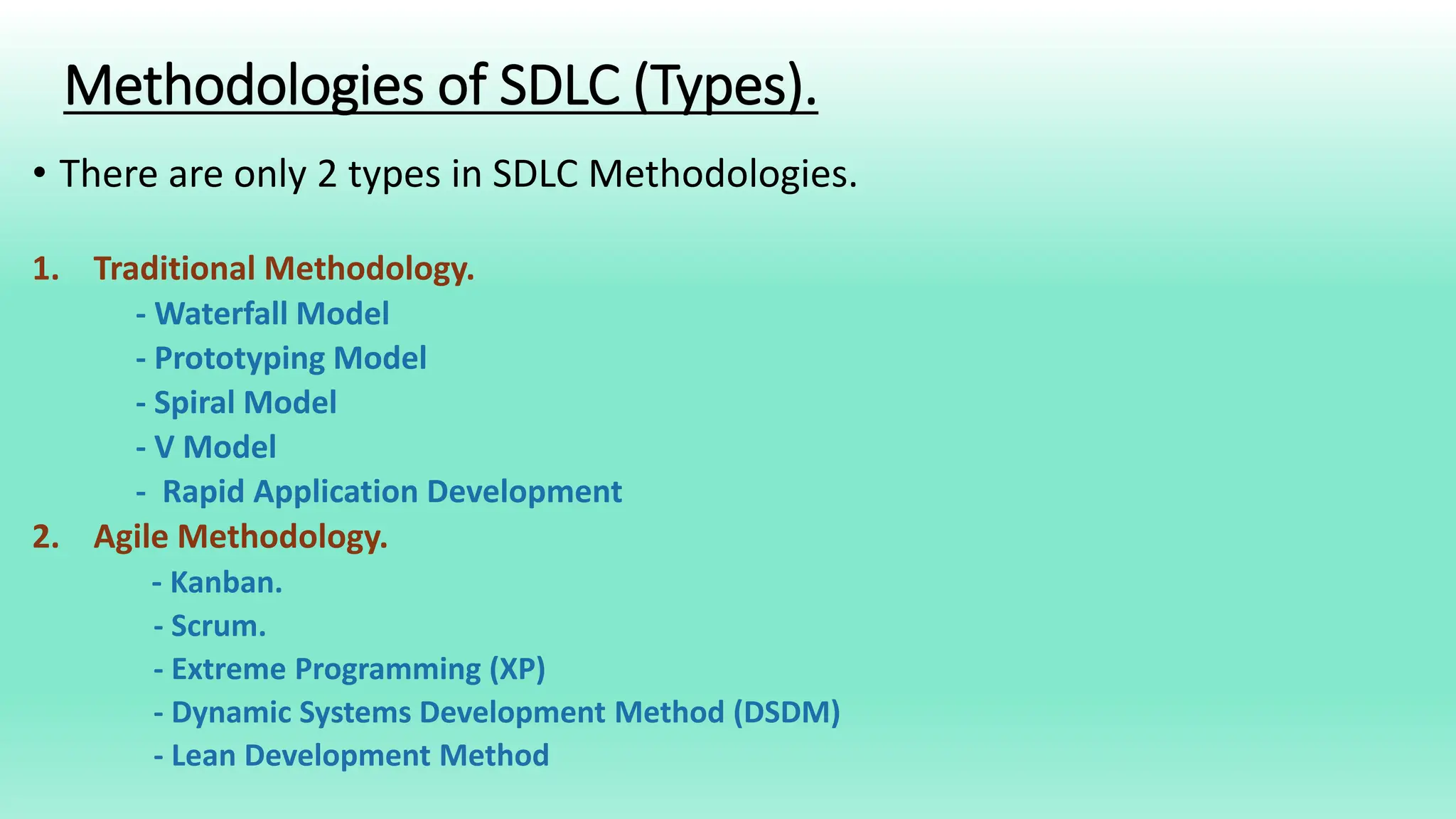
Methodologies of SDLC (Types).
• There are only 2 types in SDLC Methodologies.
1. Traditional Methodology.
- Waterfall Model
- Prototyping Model
- Spiral Model
- V Model
- Rapid Application Development
2. Agile Methodology.
- Kanban.
- Scrum.
- Extreme Programming (XP)
- Dynamic Systems Development Method (DSDM)
- Lean Development Method
Thank You!!!

System development life cycle(SDLC) .pdf

  • 1.
    System Development LifeCycle (SDLC) Kavindu Chethiya Yakupitiya BSc (Hons) IT [KDU] , PGD In Cyber Security [SLIIT] , MSc (Hons) in Cyber Security - Reading [SLIIT]
  • 2.
    What is aSDLC? ❑ The systems development life cycle (SDLC) is the process of determining how an information system (IS) can support business needs, designing the system, building it, and delivering it to users. • The key person in the SDLC is the systems analyst, who analyzes the business situation, identifies the opportunities for improvements, and designs an IS to implement the improvements. • It is also called as Software Development Process.
  • 3.
  • 4.
    Overview of SDLC. The SDLC is composed of Six fundamental phases: • Planning • Analysis • Design • Development/Implementation • Testing & Integration • Maintenance. ❑Each of the phases is composed of steps, which rely on techniques that produce deliverables (specific documents that explain various elements of the system).
  • 5.
    Step 01 –Planning. ▪ Planning address main two questions? ✓Why? ✓How? • This phase is the fundamental process of understanding why an information system should be built, and determining how the project team will go about building it. • This is the phase where Business analyst gather all the requirements in order to build the system. (Requirement Gathering) • The new system requirements are defined. In particular, the deficiencies in the existing system must be addressed with specific proposals for improvement. Other factors defined include needed features, functions and capabilities.
  • 6.
    Step 02 –Analysis. • Analysis address four main questions? ✓Who? ✓What? ✓Where? ✓When? • The analysis phase answers the questions of who will use the system, what the system will do, and where and when it will be used. • During this phase the project team investigates any current system(s), identifies improvement opportunities, and develops a concept for the new system.
  • 7.
    Step 03 –Design. • Design phase address one main question? ✓How • The design phase decides how the system will operate, in terms of the hardware, software, and network infrastructure; the user interface, forms, and reports that will be used; and the specific programs, diagrams, databases, and files that will be needed.
  • 8.
    Step 04 –Development/Implementation. • During the implementation phase, the system is either developed or purchased (in the case of packaged software) and installed. • This phase is usually the longest and most expensive part of the process. • The new system is developed. The new components and programs must be obtained and installed. Users of the system must be trained in its use.
  • 9.
    Step 05 –Testing & Integration. • System Integration Testing is defined as a type of software testing carried out in an integrated hardware and software environment to verify the behavior of the complete system. • It also verifies a software system's coexistence with others and tests the interface between modules of the software application. • This is the stage where we check our final output/final system is working error free and developed according to the given requirements.
  • 10.
    Step 06 –Maintenance. • The maintenance phase of the SDLC occurs after the product is in full operation. Maintenance of software can include software upgrades, repairs, and fixes of the software if it breaks. • During the maintenance phase, errors or defects may exist, which would require repairs during additional testing of the software.
  • 11.
    Advantages of SDLC. •Gives a defined view of the entire system, resources, timeline, and goals • Design reviews help to ensure the reliability and quality of the final product • Enhanced control over large or complex projects • Involves comprehensive and explicit steps • Provide goals and deliverables that meet the standards of each party involved in the project, requires keeping detailed documentation throughout the entire process • Easy evaluation of costs and growth of the developed system
  • 12.
    Methodologies of SDLC(Types). • There are only 2 types in SDLC Methodologies. 1. Traditional Methodology. - Waterfall Model - Prototyping Model - Spiral Model - V Model - Rapid Application Development 2. Agile Methodology. - Kanban. - Scrum. - Extreme Programming (XP) - Dynamic Systems Development Method (DSDM) - Lean Development Method
  • 13.