CROWDSENSIN
G
Eng: Ahmed Ayman Fahmy
OUTLINE
 Introduction
 Crowdsensing
 Mobile crowdsensing applications
 Challenges of Crowdsourcing
 Future research direction
 Conclusion
 references
INTRODUCTION
 In recent years, there is a lot of sensing devices emerged in our life and creating IOT
( internet of things).
 IOT has drown a great attention, it is expected to create a world where all objects
around us are connected to the internet.
CROWDSENSING
 Today approximately all humans
have mobile phones capable of
sensing and computing so
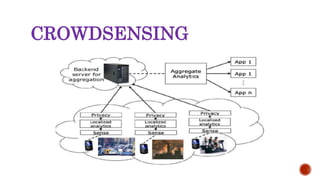
crowdsensing is a new model which
allow to uses these phones extract
information and share data between
their users to measure, analyze, map
and predict phenomena of common
interest.
 Types of devices
Smartphones.
Wearable devices.
 in-vehicle sensor devices (GPS).
CROWDSENSING
CROWDSENSING (CONT.)
 Devices is equipped with various
sensors, most smart phones can sense
Noise (microphone)
Location (GPS)
Movement (accelerometer)
Temperature more and more
CROWDSENSING (CONT.)
 Types of crowdsensing
Participatory crowdsensing :- users of the sensing devices manually
sending data to the servers.
Opportunistic crowdsensing:- collected data is sent automatically to
the servers without user intervention.
CROWDSENSING (CONT.)
Mobile crowdsensing procedures:
Data collection.
Data storage.
Data upload.
 There are three main strategies for collecting data:
The user of device collect data manually (Taking photos)
Data collection is partially controlled by the user.
A device begins to collect data when the user is in a particular place
at a particular time.
CROWDSENSING (CONT.)
Deduplication
 It is used to eliminate the redundant data when we are in the
collection phase to improve the QoS, reduce cost of implementation
and save resources.
 It perform filtering and compressing function to the data that has
been collected before it gets uploaded.
 Types of data deduplication
Real-time deduplication
Post process deduplication
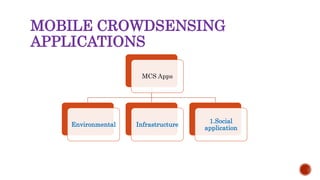
MOBILE CROWDSENSING
APPLICATIONS
MCS Apps
Environmental Infrastructure
1.Social
application
MOBILE CROWDSENSING
APPLICATIONS
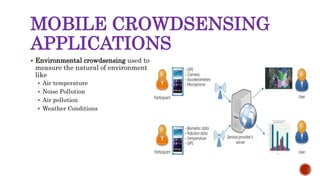
 Environmental crowdsensing used to
measure the natural of environment
like
 Air temperature
 Noise Pollution
 Air pollution
 Weather Conditions
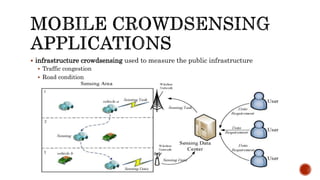
 infrastructure crowdsensing used to measure the public infrastructure
 Traffic congestion
 Road condition
MOBILE CROWDSENSING
APPLICATIONS
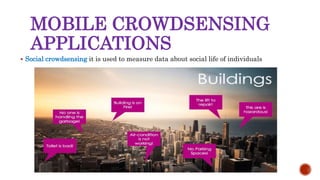
 Social crowdsensing it is used to measure data about social life of individuals
CHALLENGES OF
CROWDSENSING
 Automated configuration of sensors.
 Resource limitations (Energy consumption, bandwidth )
 Privacy, security and integrity.
FUTURE RESEARCH
DIRECTION
 Optimization of multiple factors like localization, prediction and energy
budget.
 Privacy protection
 Social internet of things.
CONCLUSION
 Mobile crowdsensing plays an important role in the IoT .
 Crowdsensing can provide a lot of information to the community about the area of
interest.
 Sensors continuously generate a lot of data, which consumes much resource, such as
storage resource for storing data and bandwidth resource for data transfer.
 Redundancy elimination of sensor data is important to reduce the storage and
bandwidth and increase quality of service (QoS).
‫هريرة‬ ‫أبي‬ ‫عن‬-‫عنه‬ ‫هللا‬ ‫رضي‬-‫هللا‬ ‫رسول‬ ‫أن‬-‫عليه‬ ‫هللا‬ ‫صلى‬
‫وسلم‬-‫قال‬" :‫ثالث‬ ‫من‬ ‫إال‬ ‫عمله‬ ‫انقطع‬ ‫آدم‬ ‫ابن‬ ‫مات‬ ‫إذا‬:‫صدقة‬
‫أو‬ ،‫جارية‬‫به‬ ‫ينتفع‬ ‫علم‬‫له‬ ‫يدعو‬ ‫صالح‬ ‫ولد‬ ‫أو‬ ،"
 Jinwei Liu, Haiying Shen, Xiang Zhang “A Survey of Mobile Crowdsensing
Techniques: A Critical Component for The Internet of Things “
 R.K. Ganti, F. Ye, and H. Lei. Mobile crowdsensing: Current state and
future challenges. IEEE Comm. Mag., 49(11):32–39, November 2011.
 C. C. Aggarwal, Y. Xie, and P. S. Yu. On dynamic data-driven selection
of sensor streams. In Proc. of KDD, pages 1226–1234, 2011.

Crowdsensing

  • 1.
  • 3.
    OUTLINE  Introduction  Crowdsensing Mobile crowdsensing applications  Challenges of Crowdsourcing  Future research direction  Conclusion  references
  • 4.
    INTRODUCTION  In recentyears, there is a lot of sensing devices emerged in our life and creating IOT ( internet of things).  IOT has drown a great attention, it is expected to create a world where all objects around us are connected to the internet.
  • 5.
    CROWDSENSING  Today approximatelyall humans have mobile phones capable of sensing and computing so crowdsensing is a new model which allow to uses these phones extract information and share data between their users to measure, analyze, map and predict phenomena of common interest.  Types of devices Smartphones. Wearable devices.  in-vehicle sensor devices (GPS).
  • 6.
  • 7.
    CROWDSENSING (CONT.)  Devicesis equipped with various sensors, most smart phones can sense Noise (microphone) Location (GPS) Movement (accelerometer) Temperature more and more
  • 8.
    CROWDSENSING (CONT.)  Typesof crowdsensing Participatory crowdsensing :- users of the sensing devices manually sending data to the servers. Opportunistic crowdsensing:- collected data is sent automatically to the servers without user intervention.
  • 9.
    CROWDSENSING (CONT.) Mobile crowdsensingprocedures: Data collection. Data storage. Data upload.  There are three main strategies for collecting data: The user of device collect data manually (Taking photos) Data collection is partially controlled by the user. A device begins to collect data when the user is in a particular place at a particular time.
  • 10.
    CROWDSENSING (CONT.) Deduplication  Itis used to eliminate the redundant data when we are in the collection phase to improve the QoS, reduce cost of implementation and save resources.  It perform filtering and compressing function to the data that has been collected before it gets uploaded.  Types of data deduplication Real-time deduplication Post process deduplication
  • 11.
  • 12.
    MOBILE CROWDSENSING APPLICATIONS  Environmentalcrowdsensing used to measure the natural of environment like  Air temperature  Noise Pollution  Air pollution  Weather Conditions
  • 13.
     infrastructure crowdsensingused to measure the public infrastructure  Traffic congestion  Road condition
  • 14.
    MOBILE CROWDSENSING APPLICATIONS  Socialcrowdsensing it is used to measure data about social life of individuals
  • 15.
    CHALLENGES OF CROWDSENSING  Automatedconfiguration of sensors.  Resource limitations (Energy consumption, bandwidth )  Privacy, security and integrity.
  • 16.
    FUTURE RESEARCH DIRECTION  Optimizationof multiple factors like localization, prediction and energy budget.  Privacy protection  Social internet of things.
  • 17.
    CONCLUSION  Mobile crowdsensingplays an important role in the IoT .  Crowdsensing can provide a lot of information to the community about the area of interest.  Sensors continuously generate a lot of data, which consumes much resource, such as storage resource for storing data and bandwidth resource for data transfer.  Redundancy elimination of sensor data is important to reduce the storage and bandwidth and increase quality of service (QoS).
  • 18.
    ‫هريرة‬ ‫أبي‬ ‫عن‬-‫عنه‬‫هللا‬ ‫رضي‬-‫هللا‬ ‫رسول‬ ‫أن‬-‫عليه‬ ‫هللا‬ ‫صلى‬ ‫وسلم‬-‫قال‬" :‫ثالث‬ ‫من‬ ‫إال‬ ‫عمله‬ ‫انقطع‬ ‫آدم‬ ‫ابن‬ ‫مات‬ ‫إذا‬:‫صدقة‬ ‫أو‬ ،‫جارية‬‫به‬ ‫ينتفع‬ ‫علم‬‫له‬ ‫يدعو‬ ‫صالح‬ ‫ولد‬ ‫أو‬ ،"
  • 20.
     Jinwei Liu,Haiying Shen, Xiang Zhang “A Survey of Mobile Crowdsensing Techniques: A Critical Component for The Internet of Things “  R.K. Ganti, F. Ye, and H. Lei. Mobile crowdsensing: Current state and future challenges. IEEE Comm. Mag., 49(11):32–39, November 2011.  C. C. Aggarwal, Y. Xie, and P. S. Yu. On dynamic data-driven selection of sensor streams. In Proc. of KDD, pages 1226–1234, 2011.

Editor's Notes

  • #12 Env:- level of water, air pollution infra: measuring the public infrastructure (e.g., traffic congestion and road conditions social : measuring data about the social life of individuals (e.g., the cinemas visited by an individual)