• Man was living in groups
• Scattered groups – dangers, insecurities
• Realized need of social awareness
 Various stages of growth
 Theological ideas
 Faith in divine phenomena
First Phase (Aristotle, Plato)
◦ Studies of Family type
◦ Customs
◦ Problems of these times
Second Phase (6th to 14th century AD)
◦ Philosophical analysis of social life
◦ Shift from religion to logic
Third Phase (15th to 18th AD)
◦ Evolution of Sociology as a Discipline
◦ Hobbes, Locke, Rousseau
◦ Evolution of Society- Social Contract
Fourth Phase (Auguste Comte, 1798-1857)
◦ Scientific development
◦ Sociology as a science
◦ Differentiated social philosophy- Sociology
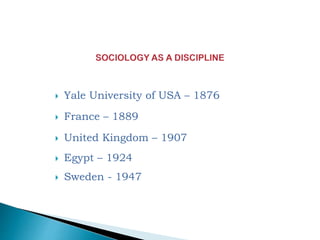
 Yale University of USA – 1876
 France – 1889
 United Kingdom – 1907
 Egypt – 1924
 Sweden - 1947
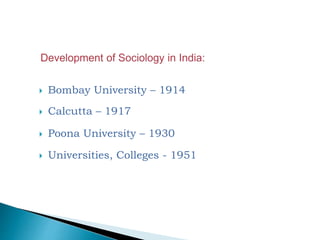
 Bombay University – 1914
 Calcutta – 1917
 Poona University – 1930
 Universities, Colleges - 1951
 Trends with Western Influence
 Trends with Traditional Influence
 Trends with Synthetic western and Traditional
Influence
• Sociology – scientific in nature
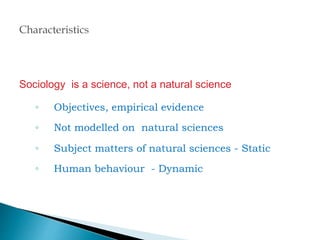
• Characteristics of Sociology
Sociology is a science, not a natural science
◦ Objectives, empirical evidence
◦ Not modelled on natural sciences
◦ Subject matters of natural sciences - Static
◦ Human behaviour - Dynamic
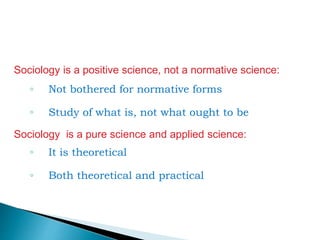
Sociology is a positive science, not a normative science:
◦ Not bothered for normative forms
◦ Study of what is, not what ought to be
Sociology is a pure science and applied science:
◦ It is theoretical
◦ Both theoretical and practical
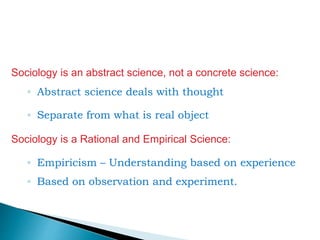
Sociology is an abstract science, not a concrete science:
◦ Abstract science deals with thought
◦ Separate from what is real object
Sociology is a Rational and Empirical Science:
◦ Empiricism – Understanding based on experience
◦ Based on observation and experiment.
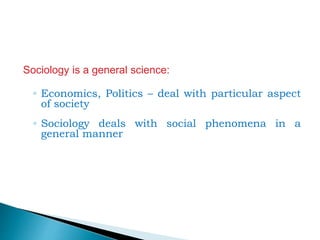
Sociology is a general science:
◦ Economics, Politics – deal with particular aspect
of society
◦ Sociology deals with social phenomena in a
general manner
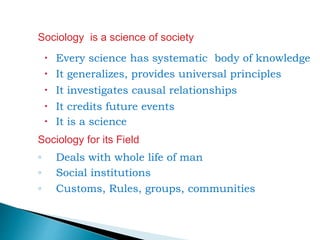
Sociology is a science of society
 Every science has systematic body of knowledge
 It generalizes, provides universal principles
 It investigates causal relationships
 It credits future events
 It is a science
Sociology for its Field
◦ Deals with whole life of man
◦ Social institutions
◦ Customs, Rules, groups, communities
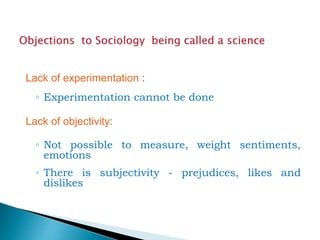
Lack of experimentation :
◦ Experimentation cannot be done
Lack of objectivity:
◦ Not possible to measure, weight sentiments,
emotions
◦ There is subjectivity - prejudices, likes and
dislikes
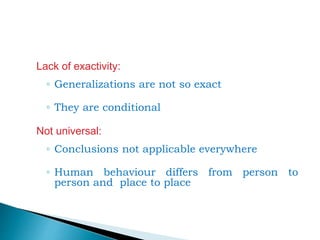
Lack of exactivity:
◦ Generalizations are not so exact
◦ They are conditional
Not universal:
◦ Conclusions not applicable everywhere
◦ Human behaviour differs from person to
person and place to place
Role of Law :
 Means of Social control
 Controlling a balanced social system
 To determine mutual relationship
 To control social conflicts, tensions
 To protect properties
 Role to promote developmental activities
 To promote life and liberty
 To help smooth social change
Law and Social Change:
 Law to suit to new situations
 Law will allow for peaceful change
 Laws to undergo change to meet societal needs
Law as an instrument of social change:
 Law is a powerful instrument of social change
 It induces new pattern of behaviour
 Evil customs eliminated by law
Legislation to bring about social change:
 Legislation to sustain social structure
 Law as an agency of social control and social
change
 Legal code to be in conformity with social values
 Law to lay emphasis on humanistic values
 Prohibition of Sati Act, 1829
 Widow Remarriage Act, 1856
 Prevention of Female Infanticide Act, 1870
 Child Marriage Restraint Act, 1929
 Social Change Envisaged with Constitution
 Constitution guarantees equality before law
 Article, 19- abolished untouchability
 Article, 24 -Child Labour Prohibited.
Relation between sociology and Law
◦ Law: a set of rules, regulations enacted by state
◦ W.B. Scot- Dictionary of Sociology
◦ System of standardized norms
◦ Regulating human conduct and social control
◦ Law enforced by formal public authority
Law and sociology
◦ Law and sociology related to each other.
◦ Sociology’s concern to maintain social solidarity
◦ Law to control the social system
 Deals with study of legal institutions in
sociological concepts
 Study of social norms – central to sociology
 Sociological analysis of legal codes is long
standing concern
 Analysis of social roles of lawyer, judge, how they
relate to structure of society in major aspect of
sociology of law
 Study of legal system functionally as a social
instrument.
 As part of social control, study of legal
institutions, doctrines, precepts.
 Law is specialized agency of social control.
 Task of social control-to achieve optimum
production least waste.
 Functional approach to the study of law described
as science of social engineering.
 Based on existence of human society
◦ Durkheim
 Solidarity of society depends on system of laws
 He explained concepts of mechanical solidarity
and organic solidarity
 Laws of society are backbone of a nation.
Norms and values
Norms – meaning
◦ Norms – rules and regulations
◦ Norm is a social expectation
◦ It is a standard expected to conform
◦ Standards of group behaviours called Norms
Norms incorporate value judgment
◦ Buckman :
 Members exhibit certain regularities
 Such regularities are social norms
◦ Brown and Selznic:
 Expected behavior, ideal behaviour
 Model practices
 Violation attracts punishment
 Norm-prescriptive proscriptive
 Prescriptive- require certain actions
 Proscriptive – prohibit certain actions
Characteristics
 They control social behavior
 They change from group to group
 Norms – relevance to sex, occupation, status
Functions and importance
 They regulate behavior
 They give cohesion to society
 They uphold values of society
 They influence thinking, attitudes
Individuals conformity to Norms:
 By conformity, one gets cooperation
 Receives rewards, praise
 Punishments, reward promote conformity
Other reasons for conformity:
Robert Bierstadt
 Indoctrination - The child taught in the family:
◦ Process of socialization- believing norms the
right way
 Habituation:
◦ What is customary becomes habitual
 Utility:
◦ Norms, useful to all members – to the best
interests
 Group Identification:
◦ By conformity, we identify with the group
 Prescriptive
◦ Rules to be followed
 Proscriptive
◦ Norms tell us what we should not do
The ideal norms and practical norms
◦ Ideal norms-these should be accepted
◦ Practical norms – norms to be strictly followed
Folkways :
◦ Recognized or accepted ways of behaving,
conventions, forms of etiquette
Customs:
◦ Practices accepted as appropriate modes of
behavior
◦ Religious holidays, rituals
Mores:
◦ They are moral rules which society accepts for
social well-being
Status:
◦ Social position
◦ Prestige, respect
◦ High or low
◦ Social evaluation
Relationship of office with status:
◦ Status attached to office
◦ Not to individuals
Determinants of Status: 6 factors
Parsons
 Birth, possessions, personal qualities, Personal
achievement, power, authority
No permanency
 Changes with time, place
 Changes with office
 States relative, not absolute
Kinds or Types of status
Ascribed
◦ Based on sex, age, birth, heredity
◦ Cannot be changed
Achieved
◦ Education, vocation and profession
Distinction between ascribed and achieved status
◦ Ascribed – gift from society, by birth
◦ Achieved – personal efforts, capacities
Importance of advantages
◦ Respect, privileges
◦ Promotes responsibility
◦ Society develops
ROLE
◦ Behavior expected of an individual
◦ Socialization – role attitude
 Ascribed Role
◦ One acquires it automatically
◦ By birth
◦ No choice
 Achieved Role
◦ One has choice
◦ Occupational roles
 Role conflict:
◦ When two or more roles
◦ Incompatible roles
◦ Many roles in different groups
 Distinction between status and Role:
◦ Status – A position
◦ Role – behavioral aspect
Institution :
◦ Men live in society
◦ To satisfy wants
◦ Form an organization
◦ Frame rules of procedure
 Six features of institution
 Core values, functions, norms and standard,
Abstract, procedures, symbolic- wedding,flag.
Other characteristics:
 Fulfils needs
 Controls individuals
 Means of social work
 evolutionary
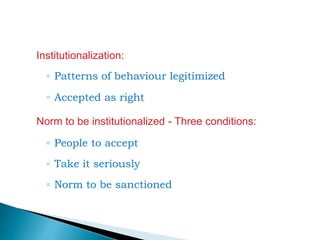
Institutionalization:
◦ Patterns of behaviour legitimized
◦ Accepted as right
Norm to be institutionalized - Three conditions:
◦ People to accept
◦ Take it seriously
◦ Norm to be sanctioned
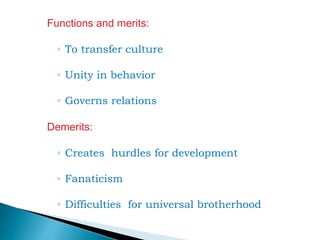
Functions and merits:
◦ To transfer culture
◦ Unity in behavior
◦ Governs relations
Demerits:
◦ Creates hurdles for development
◦ Fanaticism
◦ Difficulties for universal brotherhood
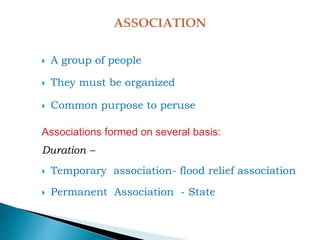
 A group of people
 They must be organized
 Common purpose to peruse
Associations formed on several basis:
Duration –
 Temporary association- flood relief association
 Permanent Association - State
On the basis of power:
 Sovereign association – State
 Semi-sovereign association - University
 Non-sovereign association – Clubs
On the basis of functions:
 Biological functions – Family
 Vocational functions – Teachers association
 Recreation functions – Tennis club
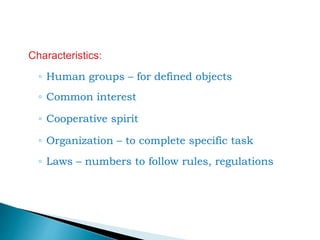
Characteristics:
◦ Human groups – for defined objects
◦ Common interest
◦ Cooperative spirit
◦ Organization – to complete specific task
◦ Laws – numbers to follow rules, regulations
Difference between Institution and Association:
◦ Structure - No structure
◦ Abstract - Concrete
◦ Evolutionary - Formed

Sociology and law unit 1 (Sociology)

  • 2.
    • Man wasliving in groups • Scattered groups – dangers, insecurities • Realized need of social awareness
  • 3.
     Various stagesof growth  Theological ideas  Faith in divine phenomena
  • 4.
    First Phase (Aristotle,Plato) ◦ Studies of Family type ◦ Customs ◦ Problems of these times Second Phase (6th to 14th century AD) ◦ Philosophical analysis of social life ◦ Shift from religion to logic
  • 5.
    Third Phase (15thto 18th AD) ◦ Evolution of Sociology as a Discipline ◦ Hobbes, Locke, Rousseau ◦ Evolution of Society- Social Contract Fourth Phase (Auguste Comte, 1798-1857) ◦ Scientific development ◦ Sociology as a science ◦ Differentiated social philosophy- Sociology
  • 7.
     Yale Universityof USA – 1876  France – 1889  United Kingdom – 1907  Egypt – 1924  Sweden - 1947
  • 8.
     Bombay University– 1914  Calcutta – 1917  Poona University – 1930  Universities, Colleges - 1951
  • 9.
     Trends withWestern Influence  Trends with Traditional Influence  Trends with Synthetic western and Traditional Influence
  • 11.
    • Sociology –scientific in nature • Characteristics of Sociology
  • 12.
    Sociology is ascience, not a natural science ◦ Objectives, empirical evidence ◦ Not modelled on natural sciences ◦ Subject matters of natural sciences - Static ◦ Human behaviour - Dynamic
  • 13.
    Sociology is apositive science, not a normative science: ◦ Not bothered for normative forms ◦ Study of what is, not what ought to be Sociology is a pure science and applied science: ◦ It is theoretical ◦ Both theoretical and practical
  • 14.
    Sociology is anabstract science, not a concrete science: ◦ Abstract science deals with thought ◦ Separate from what is real object Sociology is a Rational and Empirical Science: ◦ Empiricism – Understanding based on experience ◦ Based on observation and experiment.
  • 15.
    Sociology is ageneral science: ◦ Economics, Politics – deal with particular aspect of society ◦ Sociology deals with social phenomena in a general manner
  • 16.
    Sociology is ascience of society  Every science has systematic body of knowledge  It generalizes, provides universal principles  It investigates causal relationships  It credits future events  It is a science Sociology for its Field ◦ Deals with whole life of man ◦ Social institutions ◦ Customs, Rules, groups, communities
  • 17.
    Lack of experimentation: ◦ Experimentation cannot be done Lack of objectivity: ◦ Not possible to measure, weight sentiments, emotions ◦ There is subjectivity - prejudices, likes and dislikes
  • 18.
    Lack of exactivity: ◦Generalizations are not so exact ◦ They are conditional Not universal: ◦ Conclusions not applicable everywhere ◦ Human behaviour differs from person to person and place to place
  • 20.
    Role of Law:  Means of Social control  Controlling a balanced social system  To determine mutual relationship  To control social conflicts, tensions  To protect properties  Role to promote developmental activities  To promote life and liberty  To help smooth social change
  • 21.
    Law and SocialChange:  Law to suit to new situations  Law will allow for peaceful change  Laws to undergo change to meet societal needs
  • 22.
    Law as aninstrument of social change:  Law is a powerful instrument of social change  It induces new pattern of behaviour  Evil customs eliminated by law
  • 23.
    Legislation to bringabout social change:  Legislation to sustain social structure  Law as an agency of social control and social change  Legal code to be in conformity with social values
  • 24.
     Law tolay emphasis on humanistic values  Prohibition of Sati Act, 1829  Widow Remarriage Act, 1856  Prevention of Female Infanticide Act, 1870  Child Marriage Restraint Act, 1929  Social Change Envisaged with Constitution  Constitution guarantees equality before law  Article, 19- abolished untouchability  Article, 24 -Child Labour Prohibited.
  • 25.
    Relation between sociologyand Law ◦ Law: a set of rules, regulations enacted by state ◦ W.B. Scot- Dictionary of Sociology ◦ System of standardized norms ◦ Regulating human conduct and social control ◦ Law enforced by formal public authority Law and sociology ◦ Law and sociology related to each other. ◦ Sociology’s concern to maintain social solidarity ◦ Law to control the social system
  • 26.
     Deals withstudy of legal institutions in sociological concepts  Study of social norms – central to sociology  Sociological analysis of legal codes is long standing concern  Analysis of social roles of lawyer, judge, how they relate to structure of society in major aspect of sociology of law
  • 27.
     Study oflegal system functionally as a social instrument.  As part of social control, study of legal institutions, doctrines, precepts.  Law is specialized agency of social control.  Task of social control-to achieve optimum production least waste.  Functional approach to the study of law described as science of social engineering.
  • 28.
     Based onexistence of human society ◦ Durkheim  Solidarity of society depends on system of laws  He explained concepts of mechanical solidarity and organic solidarity  Laws of society are backbone of a nation.
  • 30.
    Norms and values Norms– meaning ◦ Norms – rules and regulations ◦ Norm is a social expectation ◦ It is a standard expected to conform ◦ Standards of group behaviours called Norms
  • 31.
    Norms incorporate valuejudgment ◦ Buckman :  Members exhibit certain regularities  Such regularities are social norms ◦ Brown and Selznic:  Expected behavior, ideal behaviour  Model practices
  • 32.
     Violation attractspunishment  Norm-prescriptive proscriptive  Prescriptive- require certain actions  Proscriptive – prohibit certain actions
  • 33.
    Characteristics  They controlsocial behavior  They change from group to group  Norms – relevance to sex, occupation, status
  • 34.
    Functions and importance They regulate behavior  They give cohesion to society  They uphold values of society  They influence thinking, attitudes
  • 35.
    Individuals conformity toNorms:  By conformity, one gets cooperation  Receives rewards, praise  Punishments, reward promote conformity
  • 36.
    Other reasons forconformity: Robert Bierstadt  Indoctrination - The child taught in the family: ◦ Process of socialization- believing norms the right way  Habituation: ◦ What is customary becomes habitual
  • 37.
     Utility: ◦ Norms,useful to all members – to the best interests  Group Identification: ◦ By conformity, we identify with the group
  • 38.
     Prescriptive ◦ Rulesto be followed  Proscriptive ◦ Norms tell us what we should not do The ideal norms and practical norms ◦ Ideal norms-these should be accepted ◦ Practical norms – norms to be strictly followed
  • 39.
    Folkways : ◦ Recognizedor accepted ways of behaving, conventions, forms of etiquette Customs: ◦ Practices accepted as appropriate modes of behavior ◦ Religious holidays, rituals Mores: ◦ They are moral rules which society accepts for social well-being
  • 41.
    Status: ◦ Social position ◦Prestige, respect ◦ High or low ◦ Social evaluation Relationship of office with status: ◦ Status attached to office ◦ Not to individuals
  • 42.
    Determinants of Status:6 factors Parsons  Birth, possessions, personal qualities, Personal achievement, power, authority No permanency  Changes with time, place  Changes with office  States relative, not absolute
  • 43.
    Kinds or Typesof status Ascribed ◦ Based on sex, age, birth, heredity ◦ Cannot be changed Achieved ◦ Education, vocation and profession
  • 44.
    Distinction between ascribedand achieved status ◦ Ascribed – gift from society, by birth ◦ Achieved – personal efforts, capacities Importance of advantages ◦ Respect, privileges ◦ Promotes responsibility ◦ Society develops
  • 45.
    ROLE ◦ Behavior expectedof an individual ◦ Socialization – role attitude  Ascribed Role ◦ One acquires it automatically ◦ By birth ◦ No choice  Achieved Role ◦ One has choice ◦ Occupational roles
  • 46.
     Role conflict: ◦When two or more roles ◦ Incompatible roles ◦ Many roles in different groups  Distinction between status and Role: ◦ Status – A position ◦ Role – behavioral aspect
  • 48.
    Institution : ◦ Menlive in society ◦ To satisfy wants ◦ Form an organization ◦ Frame rules of procedure
  • 49.
     Six featuresof institution  Core values, functions, norms and standard, Abstract, procedures, symbolic- wedding,flag. Other characteristics:  Fulfils needs  Controls individuals  Means of social work  evolutionary
  • 50.
    Institutionalization: ◦ Patterns ofbehaviour legitimized ◦ Accepted as right Norm to be institutionalized - Three conditions: ◦ People to accept ◦ Take it seriously ◦ Norm to be sanctioned
  • 51.
    Functions and merits: ◦To transfer culture ◦ Unity in behavior ◦ Governs relations Demerits: ◦ Creates hurdles for development ◦ Fanaticism ◦ Difficulties for universal brotherhood
  • 52.
     A groupof people  They must be organized  Common purpose to peruse Associations formed on several basis: Duration –  Temporary association- flood relief association  Permanent Association - State
  • 53.
    On the basisof power:  Sovereign association – State  Semi-sovereign association - University  Non-sovereign association – Clubs On the basis of functions:  Biological functions – Family  Vocational functions – Teachers association  Recreation functions – Tennis club
  • 54.
    Characteristics: ◦ Human groups– for defined objects ◦ Common interest ◦ Cooperative spirit ◦ Organization – to complete specific task ◦ Laws – numbers to follow rules, regulations
  • 55.
    Difference between Institutionand Association: ◦ Structure - No structure ◦ Abstract - Concrete ◦ Evolutionary - Formed