THE 20TH CENTURY, WITNESSED A
REVIVAL OF NATURAL LAW AND VALUE
ORIENTED JURISPRUDENCE.
HARMANI SINGH JOLLY
NATURAL LAW
 Natural law has been envisaged as a mere law
of self preservation, or as an operative law of
nature, constraining individuals to a certain
pattern of behavior.
 Prof. Dias has written that natural law theory
has a history reaching back centuries BC and
the vigor with which it flourishes is a tribute to its
validity.
 Dr. W. Friedman points out that the history of
natural law is a tale of the search of mankind for
absolute justice and its failure
 Natural law defends individual freedom
against absolutism.
 The important and lasting idea of natural law
has been inspired by the ideal of a universal
order governing all men and the inalienable
rights of the individual
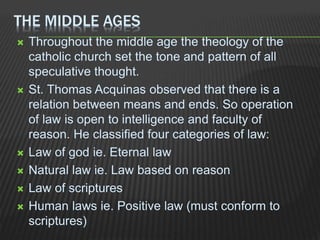
THE MIDDLE AGES
 Throughout the middle age the theology of the
catholic church set the tone and pattern of all
speculative thought.
 St. Thomas Acquinas observed that there is a
relation between means and ends. So operation
of law is open to intelligence and faculty of
reason. He classified four categories of law:
 Law of god ie. Eternal law
 Natural law ie. Law based on reason
 Law of scriptures
 Human laws ie. Positive law (must conform to
scriptures)
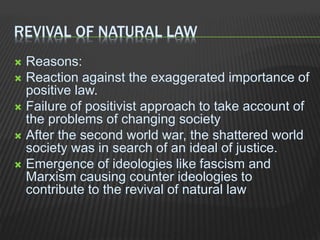
REVIVAL OF NATURAL LAW
 Reasons:
 Reaction against the exaggerated importance of
positive law.
 Failure of positivist approach to take account of
the problems of changing society
 After the second world war, the shattered world
society was in search of an ideal of justice.
 Emergence of ideologies like fascism and
Marxism causing counter ideologies to
contribute to the revival of natural law
VALUE-ORIENTED JURISPRUDENCE
1.Neo-Kantian Natural Law
 From the middle of the nineteenth century to the
beginning of the twentieth the theory of natural
law was at a low ebb in most of the countries of
Western civilization
 Legal positivists, especially the analytical jurists,
sought to discourage philosophical speculation
about the nature and purposes of the law and
set out to limit the province of jurisprudence to a
technical analysis of the positive law laid down
and enforced by the state.
 A pioneering attempt to create a modernized natural
law philosophy based on a priori reasoning was made
in Germany by Rudolf Stammler (1856-1938).
 Stammler was an exponent of ‘ natural law with
variable content’.
 He distinguished between technical legal science and
theoretical legal science. The former deals with the
content of law and the later with ultimate principles. In
this he distinguished between law and justice.
 John Rawls, Geny, Kohler and LL Fuller are other
important thinkers of this branch
2. Neo-scholastic Natural Law
 Neo-Scholasticism is a modern philosophical
movement of Catholic origin In this field, neo-
Scholastic thought has in the last few decades been
particularly active in France, Germany and the United
States.
 Although neo-Scholastic jurists have developed legal
theories with differing emphases and implications
 The most important of these convictions is the belief
in a natural law which exists prior in positive law and
is superior to it
 The natural law is no longer the law of nature It
draws its inspiration from medieval Catholic
Scholastic thought and particularly from the
legal philosophy of St. Thomas Aquinas
 The chief difference between the classical and
the Thomist natural law may be sought in the
fact that the Thomist consists of very broad and
general principles, while many of the classical
thinkers developed very specific and detailed
systems of natural law. Neo Scholasticism in
this respect definitely follows the Thomist
tradition
3.Duguit’s Legal Philosophy.
 A natural-law theory with strongly sociological overtones was
propounded by the French jurist Leon Duguit (1859 – 1928). This
doctrine was diametrically opposed to the natural law doctrines of the
age of enlightenment in that Duguit repudiated any natural or inalienable
system of legal rights by a system which would recognize only legal
duties. Every individual has a certain task to perform in society, and his
obligation to perform this function may be enforced by the law.
 The social function of law, according to Duguit, is the realization of social
solidarity. This is the central concept in Duguit’s theory of law, “The fact
of social solidarity is not disputed and in truth cannot be disputed, it is a
fact of observation which cannot be the object of controversy…..
Solidarity is a permanent fact, always identical in itself, the irreducible
constitutive element of every social group.” Thus duguit regarded social
solidarity not as a rule of conduct, but as a fundamental fact of human
coexistence.
4.The Policy
 Science of Harold Lasswell (b. 1902) and Myres McDougal (b. 1906),
two American writers develop a policy-science of the law with Leon
Duguit the objective of building an empirical legal theory free from
metaphysical speculation their approach to the law represents a theory
of values rather than a mere description of social facts.
 The Lasswell-McDougal assumption that a value is a “desired event”
Thus, inasmuch as men want power, wealth, well-being or bodily and
psychic integrity; enlightenment, or the finding and dissemination of
knowledge; skill or the acquiring of dexterities and development of
talents; affection, or the cultivation of friendship and intimate relations;
rectitude or moral responsibility and integrity; and respect, or recognition
of merit without discrimination on grounds irrelevant to capacity
 Although both of these authors hold that their legal “policy-science”
should not be classified as natural-law doctrine
5.Other Recent Value Oriented Philosophies of Law
 Although the revival of natural law or justice-oriented
approaches to the law has not in this country reached the
degree and intensity of Western European developments
, the trend is at the present still gaining in momentum and
strength.
 Edmond Cahn (1906 – 1964) is in many important
aspects of his thought connected with the realist
movement in American jurisprudence. Although Cahn
realizes the importance of the rational element in the
administration of justice, he views legal processes to a
far-reaching extent as intuitive ethical responses to
concrete and particular fact situations.
 Lon fuller (b. 1902) has turned a critical
searchlight on both juridical positivism and
legal realism.
 According to FullerThe “morality that makes
law possible” requires the satisfaction of
eight conditions which may be summarized
as follows:
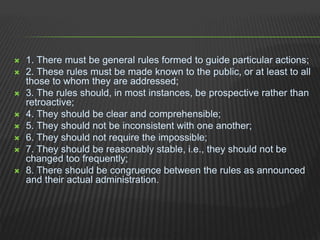
 1. There must be general rules formed to guide particular actions;
 2. These rules must be made known to the public, or at least to all
those to whom they are addressed;
 3. The rules should, in most instances, be prospective rather than
retroactive;
 4. They should be clear and comprehensible;
 5. They should not be inconsistent with one another;
 6. They should not require the impossible;
 7. They should be reasonably stable, i.e., they should not be
changed too frequently;
 8. There should be congruence between the rules as announced
and their actual administration.
CONCLUDING OBSERVATION
 The law is a large mansion with many halls,
rooms, nooks, and corners. It is extremely
hard to illuminate with a searchlight every
room, nook and corner at the same time, and
his especially true when the system of
illumination, because of limitations of
technological knowledge and experience, is
inadequate, or at least imperfect

Natural law and value oriented juris.

  • 1.
    THE 20TH CENTURY,WITNESSED A REVIVAL OF NATURAL LAW AND VALUE ORIENTED JURISPRUDENCE. HARMANI SINGH JOLLY
  • 2.
    NATURAL LAW  Naturallaw has been envisaged as a mere law of self preservation, or as an operative law of nature, constraining individuals to a certain pattern of behavior.  Prof. Dias has written that natural law theory has a history reaching back centuries BC and the vigor with which it flourishes is a tribute to its validity.  Dr. W. Friedman points out that the history of natural law is a tale of the search of mankind for absolute justice and its failure
  • 3.
     Natural lawdefends individual freedom against absolutism.  The important and lasting idea of natural law has been inspired by the ideal of a universal order governing all men and the inalienable rights of the individual
  • 4.
    THE MIDDLE AGES Throughout the middle age the theology of the catholic church set the tone and pattern of all speculative thought.  St. Thomas Acquinas observed that there is a relation between means and ends. So operation of law is open to intelligence and faculty of reason. He classified four categories of law:  Law of god ie. Eternal law  Natural law ie. Law based on reason  Law of scriptures  Human laws ie. Positive law (must conform to scriptures)
  • 5.
    REVIVAL OF NATURALLAW  Reasons:  Reaction against the exaggerated importance of positive law.  Failure of positivist approach to take account of the problems of changing society  After the second world war, the shattered world society was in search of an ideal of justice.  Emergence of ideologies like fascism and Marxism causing counter ideologies to contribute to the revival of natural law
  • 6.
    VALUE-ORIENTED JURISPRUDENCE 1.Neo-Kantian NaturalLaw  From the middle of the nineteenth century to the beginning of the twentieth the theory of natural law was at a low ebb in most of the countries of Western civilization  Legal positivists, especially the analytical jurists, sought to discourage philosophical speculation about the nature and purposes of the law and set out to limit the province of jurisprudence to a technical analysis of the positive law laid down and enforced by the state.
  • 7.
     A pioneeringattempt to create a modernized natural law philosophy based on a priori reasoning was made in Germany by Rudolf Stammler (1856-1938).  Stammler was an exponent of ‘ natural law with variable content’.  He distinguished between technical legal science and theoretical legal science. The former deals with the content of law and the later with ultimate principles. In this he distinguished between law and justice.  John Rawls, Geny, Kohler and LL Fuller are other important thinkers of this branch
  • 8.
    2. Neo-scholastic NaturalLaw  Neo-Scholasticism is a modern philosophical movement of Catholic origin In this field, neo- Scholastic thought has in the last few decades been particularly active in France, Germany and the United States.  Although neo-Scholastic jurists have developed legal theories with differing emphases and implications  The most important of these convictions is the belief in a natural law which exists prior in positive law and is superior to it
  • 9.
     The naturallaw is no longer the law of nature It draws its inspiration from medieval Catholic Scholastic thought and particularly from the legal philosophy of St. Thomas Aquinas  The chief difference between the classical and the Thomist natural law may be sought in the fact that the Thomist consists of very broad and general principles, while many of the classical thinkers developed very specific and detailed systems of natural law. Neo Scholasticism in this respect definitely follows the Thomist tradition
  • 10.
    3.Duguit’s Legal Philosophy. A natural-law theory with strongly sociological overtones was propounded by the French jurist Leon Duguit (1859 – 1928). This doctrine was diametrically opposed to the natural law doctrines of the age of enlightenment in that Duguit repudiated any natural or inalienable system of legal rights by a system which would recognize only legal duties. Every individual has a certain task to perform in society, and his obligation to perform this function may be enforced by the law.  The social function of law, according to Duguit, is the realization of social solidarity. This is the central concept in Duguit’s theory of law, “The fact of social solidarity is not disputed and in truth cannot be disputed, it is a fact of observation which cannot be the object of controversy….. Solidarity is a permanent fact, always identical in itself, the irreducible constitutive element of every social group.” Thus duguit regarded social solidarity not as a rule of conduct, but as a fundamental fact of human coexistence.
  • 11.
    4.The Policy  Scienceof Harold Lasswell (b. 1902) and Myres McDougal (b. 1906), two American writers develop a policy-science of the law with Leon Duguit the objective of building an empirical legal theory free from metaphysical speculation their approach to the law represents a theory of values rather than a mere description of social facts.  The Lasswell-McDougal assumption that a value is a “desired event” Thus, inasmuch as men want power, wealth, well-being or bodily and psychic integrity; enlightenment, or the finding and dissemination of knowledge; skill or the acquiring of dexterities and development of talents; affection, or the cultivation of friendship and intimate relations; rectitude or moral responsibility and integrity; and respect, or recognition of merit without discrimination on grounds irrelevant to capacity  Although both of these authors hold that their legal “policy-science” should not be classified as natural-law doctrine
  • 12.
    5.Other Recent ValueOriented Philosophies of Law  Although the revival of natural law or justice-oriented approaches to the law has not in this country reached the degree and intensity of Western European developments , the trend is at the present still gaining in momentum and strength.  Edmond Cahn (1906 – 1964) is in many important aspects of his thought connected with the realist movement in American jurisprudence. Although Cahn realizes the importance of the rational element in the administration of justice, he views legal processes to a far-reaching extent as intuitive ethical responses to concrete and particular fact situations.
  • 13.
     Lon fuller(b. 1902) has turned a critical searchlight on both juridical positivism and legal realism.  According to FullerThe “morality that makes law possible” requires the satisfaction of eight conditions which may be summarized as follows:
  • 14.
     1. Theremust be general rules formed to guide particular actions;  2. These rules must be made known to the public, or at least to all those to whom they are addressed;  3. The rules should, in most instances, be prospective rather than retroactive;  4. They should be clear and comprehensible;  5. They should not be inconsistent with one another;  6. They should not require the impossible;  7. They should be reasonably stable, i.e., they should not be changed too frequently;  8. There should be congruence between the rules as announced and their actual administration.
  • 15.
    CONCLUDING OBSERVATION  Thelaw is a large mansion with many halls, rooms, nooks, and corners. It is extremely hard to illuminate with a searchlight every room, nook and corner at the same time, and his especially true when the system of illumination, because of limitations of technological knowledge and experience, is inadequate, or at least imperfect