STATUS OF TRIBAL WOMEN:
• In India -635 Tribes (8.2%)
• Tribal women – most vulnerable group
• Gender based violence, domestic violence high
among Tribals, girl child
• Tribal more vulnerable to violence
• Dropout and illiteracy rates high.
• Early marriage, trafficking, forced prostitution,
exploitation high
• Women face violence- killing, torture, rape,
inhuman treatment
• By law enforcement personnel, opposition
groups, non-tribal group
NCRB :
• Reported 627 cases of rape in 2007
• Tribal children-victims of killings, sexual
violence, arbitrary arrest, illegal detention by
security forces.
ECONOMIC SCENARIO OF TRIBAL
SOCIETY
• Poverty levels of ST’S persistent
• Deprived of formal education
• Little occurs to capital
• Casual employment, agricultural labour,
plantation labour, industrial labour
• Poverty gap between ST’S and others widened
• More than half the tribals below poverty line
• Little change in poverty of tribals
ENVIRONMENT:
• Forest conservation laws not supporting
tribals
• Unnatural intruders in their when land.
• Tribal’s rights violated in the name of
development
HEALTH CARE FACILITIES:
• Mortality, mobility, malnutrition rates high.
• Remote villages-indifference of medical
personnel, limited manpower
• Lack of awareness of medical facilities
• Medical facilities hardly used by them
• Women nearing delivery date to travel 50 to
60 K.M to the hospital
TRIBAL DISPLACEMENT:
• 85.39 lakh tribals displaced since 1990 for
mega projects
• Illiteracy, malnourishment- 50 to 60 percent
• Consumption of food grains fallen by 10 to 15
percent
• Not much improvement in food and nutrition
VIOLATION OF FOREST LAWS:
• Corporate companies violating forest laws
destroying community rights
• Government decided to stop bauxite mining in
Niyamgiri hills, Aruku
LAND ALIENATION:
• Degradation of tribal life, alienation of tribal land ,
indebtedness, alcoholism are the problems
• Acquisition of land for public purpose affecting tribals
• Extremist violence in tribal districts impedes their
development
• Mining activities for raw materials
• Industrial units causing pollution- weather, water, air,
soil
• Besides reservation of ST’S
• To improve quality of life
• Create employment oppurtunities
• FEMALE SEX RATIO:
• ST’S sex ratio
• More towards females
• (972 per 2000 males), 2001 census
• FEMALE LITERACY RATE AMONG TRIBALS:
• It is far lower (34.76) as compared to overall
female literacy for the country (53.67%), 2001
census
• DEVELOPMENT POLICIES:
• Present policy is to bring tribals into mainstream.
CONSTITUTIONAL PROVISIONS:
• There are 20 articles and two schedules in
constitution concerning welfare of tribals
• Articles 15(4),16(4),46,243m,243 2c,
244,334,335,338A,339(1),in fifth and sixth
schedules
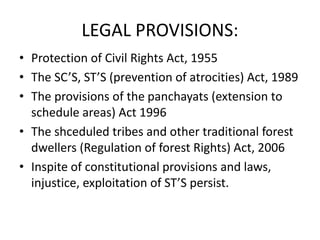
LEGAL PROVISIONS:
• Protection of Civil Rights Act, 1955
• The SC’S, ST’S (prevention of atrocities) Act, 1989
• The provisions of the panchayats (extension to
schedule areas) Act 1996
• The shceduled tribes and other traditional forest
dwellers (Regulation of forest Rights) Act, 2006
• Inspite of constitutional provisions and laws,
injustice, exploitation of ST’S persist.
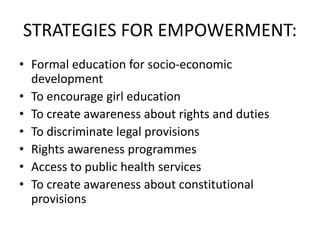
STRATEGIES FOR EMPOWERMENT:
• Formal education for socio-economic
development
• To encourage girl education
• To create awareness about rights and duties
• To discriminate legal provisions
• Rights awareness programmes
• Access to public health services
• To create awareness about constitutional
provisions
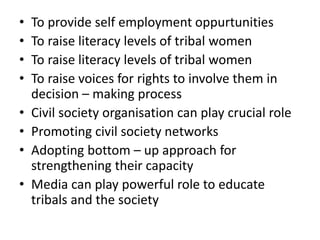
• To provide self employment oppurtunities
• To raise literacy levels of tribal women
• To raise voices for rights to involve them in
decision – making process
• Civil society organisation can play crucial role
• Promoting civil society networks
• Adopting bottom – up approach for
strengthening their capacity
• Media can play powerful role to educate
tribals and the society
• To form pressure groups from the tribals.
• Radical social work intervention
• Social work intervention

Tribals (Sociology)

  • 1.
  • 2.
    • In India-635 Tribes (8.2%) • Tribal women – most vulnerable group • Gender based violence, domestic violence high among Tribals, girl child • Tribal more vulnerable to violence • Dropout and illiteracy rates high. • Early marriage, trafficking, forced prostitution, exploitation high • Women face violence- killing, torture, rape, inhuman treatment • By law enforcement personnel, opposition groups, non-tribal group
  • 3.
    NCRB : • Reported627 cases of rape in 2007 • Tribal children-victims of killings, sexual violence, arbitrary arrest, illegal detention by security forces.
  • 4.
    ECONOMIC SCENARIO OFTRIBAL SOCIETY • Poverty levels of ST’S persistent • Deprived of formal education • Little occurs to capital • Casual employment, agricultural labour, plantation labour, industrial labour • Poverty gap between ST’S and others widened • More than half the tribals below poverty line • Little change in poverty of tribals
  • 5.
    ENVIRONMENT: • Forest conservationlaws not supporting tribals • Unnatural intruders in their when land. • Tribal’s rights violated in the name of development
  • 6.
    HEALTH CARE FACILITIES: •Mortality, mobility, malnutrition rates high. • Remote villages-indifference of medical personnel, limited manpower • Lack of awareness of medical facilities • Medical facilities hardly used by them • Women nearing delivery date to travel 50 to 60 K.M to the hospital
  • 7.
    TRIBAL DISPLACEMENT: • 85.39lakh tribals displaced since 1990 for mega projects • Illiteracy, malnourishment- 50 to 60 percent • Consumption of food grains fallen by 10 to 15 percent • Not much improvement in food and nutrition
  • 8.
    VIOLATION OF FORESTLAWS: • Corporate companies violating forest laws destroying community rights • Government decided to stop bauxite mining in Niyamgiri hills, Aruku
  • 9.
    LAND ALIENATION: • Degradationof tribal life, alienation of tribal land , indebtedness, alcoholism are the problems • Acquisition of land for public purpose affecting tribals • Extremist violence in tribal districts impedes their development • Mining activities for raw materials • Industrial units causing pollution- weather, water, air, soil • Besides reservation of ST’S • To improve quality of life • Create employment oppurtunities
  • 10.
    • FEMALE SEXRATIO: • ST’S sex ratio • More towards females • (972 per 2000 males), 2001 census • FEMALE LITERACY RATE AMONG TRIBALS: • It is far lower (34.76) as compared to overall female literacy for the country (53.67%), 2001 census • DEVELOPMENT POLICIES: • Present policy is to bring tribals into mainstream.
  • 11.
    CONSTITUTIONAL PROVISIONS: • Thereare 20 articles and two schedules in constitution concerning welfare of tribals • Articles 15(4),16(4),46,243m,243 2c, 244,334,335,338A,339(1),in fifth and sixth schedules
  • 12.
    LEGAL PROVISIONS: • Protectionof Civil Rights Act, 1955 • The SC’S, ST’S (prevention of atrocities) Act, 1989 • The provisions of the panchayats (extension to schedule areas) Act 1996 • The shceduled tribes and other traditional forest dwellers (Regulation of forest Rights) Act, 2006 • Inspite of constitutional provisions and laws, injustice, exploitation of ST’S persist.
  • 13.
    STRATEGIES FOR EMPOWERMENT: •Formal education for socio-economic development • To encourage girl education • To create awareness about rights and duties • To discriminate legal provisions • Rights awareness programmes • Access to public health services • To create awareness about constitutional provisions
  • 14.
    • To provideself employment oppurtunities • To raise literacy levels of tribal women • To raise literacy levels of tribal women • To raise voices for rights to involve them in decision – making process • Civil society organisation can play crucial role • Promoting civil society networks • Adopting bottom – up approach for strengthening their capacity • Media can play powerful role to educate tribals and the society
  • 15.
    • To formpressure groups from the tribals. • Radical social work intervention • Social work intervention