Chapter 7
• Between 2000 BC and 1500 BC, a group of simple herders called the Hebrews appeared in
Mesopotamia. Over time, they established a great kingdom called Israel. The Hebrew people
practiced the religion of Judaism. Judaism was the first major monotheistic religion.
• Founding of Judaism
• According to the Hebrew Bible, God (called Yahweh by Hebrews) told Abraham to take his family and
leave his home in Mesopotamia. Yahweh promised to lead Abraham to a new land and give him and
his descendants the land of Canaan. Abraham settled in Canaan and his descendants (the Hebrew
people) lived there for many years. Abraham is the known as the “Father of the Hebrews.”
• Later, some Hebrews moved to Egypt. The Egyptian pharaoh feared that the Hebrews might take over
Egypt as their population grew. The pharaoh turned them into slaves. In the 1200s BC, Yahweh told
Moses to demand that the pharaoh free the enslaved Hebrews. After a series of plagues struck Egypt,
the pharaoh agreed. Moses led his people out of Egypt in a journey called the Exodus.
• According to the Bible, on their journey back to Canaan, Yahweh gave Moses two stone tablets with
the Ten Commandments on them. By accepting them, the Hebrews agreed to worship only one God.
Once the Hebrews settled in Canaan, they became known as Israelites. Jerusalem became the capital
of Israel. A great temple, named Solomon’s Temple, was built in Jerusalem and became the center of
the Israelites’ religious life and a symbol of their faith.
• Beliefs Central beliefs are the belief in Yahweh, education, justice, and obedience There is only one
God and he is all-knowing, all-powerful, merciful, and just They are Yahweh’s chosen people and
have a special relationship with him Ten Commandments are the most important of their laws
Mosaic law (the laws given to Moses by Yahweh) should govern daily life One day there will be a
Messiah (savior) who will restore the nation of Israel There is an afterlife, but little emphasis is
placed on this
• Sacred Writings
• The laws and principles of Judaism are described in several Hebrew writings. The most important of
these is the Torah. The Torah is made up of 5 books written by ancient Jews describing Jewish laws
and history through the time of Moses. It teaches that Yahweh will reward people according to their
deeds (actions).
• The Hebrew Bible (called the Tanach) includes the Torah, 8 books with messages from prophets, and
11 books with poetry, songs, lessons, and stories.
• Diffusion
• Jewish communities developed all over the world as a result of the conquering of Jewish lands. Over
many centuries, more Jews were forced to move to new locations as a result of discrimination against
them. Judaism is not a religion that tries to actively convert others. Local synagogues and rabbis
became very important in guiding Jews as they moved out of Jerusalem and around the world. Today,
the United States has a larger population of Jewish people than any other country in the world.
Chapter 7
• Vocabulary
Judaism – the religion of the Hebrews
Abraham – the biblical father of the Hebrew people
Moses – Hebrew prophet who led the Jews from
slavery in Egypt
Ten Commandments – moral code of laws that God
handed down to Moses
Monotheism – belief in only one god
Torah – the sacred text of Judaism
Synagogue – Jewish house of worship
Prophets – people said to receive messages from
God to be taught to others
rabbis – teachers who guide Jews in their religious
lives
• Chapter 8: Ancient Greece
• Section 1 – Geography and the Early Greeks 1. Greece is a rocky,
mountainous land surrounded on 3 sides by water. This makes it a
large peninsula. There are few small areas with flat land for farming
and villages.
• 2. Explain how geography helped shape early Greek civilization.
City-states were isolated from each other so they developed
independently and created their own governments and ways of life.
The Greeks became expert sailors and shipbuilders because travel
by land is difficult. Traded with other cultures along the seas for
food and products they needed.
• 3. The first group of people considered to be Greek are the
Myceneans. They lived on the island of Crete. According to legend,
the Mycenaeans attacked the city of Troy, starting the Trojan War.
• 4. About 300 years after Mycenaean civilization ended, small
groups of Greeks began joining together and set up independent
city-states. This started the classical age of Greece.
• 5. City-states in Greece usually had a fortress on top of the
acropolis. Walls around the city-state were built for protection. The
marketplace, or agora, was used for trading of goods and crafts and
as a political and religious meeting place.
• 6. List 2 reasons the city-state is considered to be the foundation of
Greek civilization. o Provided a sense of security for its people o
Gave the people an identity – they did not consider themselves to
be Greeks but to be citizens of their city-state.
• 7. The Greeks began to establish colonies around the
Mediterranean Sea. These colonies became new polises and some
became great centers of trade. By 550 BC, the Greeks were the
greatest traders in the Aegean region.
• Section 2 – Government in Athens
• 1. Greece is the birthplace of democracy. What is a democracy? In
Greek, democracy means “rule of the people.” It is a type of
government in which people rule themselves.
• 2. Government in Athens started out as an oligarchy (rule by a small
group of aristocrats). In 546 BC, Athens became a tyranny, meaning
one strong leader, or tyrant, held power. Finally, around 500 BC,
Athens developed the world’s first democracy. For the first time in
history, a government was based on the votes of its free citizens.
• 3. The democracy of Athens had limited citizenship. Only free
males born in Athens were citizen in Athens.
• 4. Describe Athenian Democracy under Cleisthenes. All citizens
had the right to participate in the assembly. Assembly met outside
so everyone could attend. Every citizen had the right to speak and
debate the issues. Citizens voted by a show of hands or by secret
ballot Citizens were selected to serve on smaller councils.
• 5. What changes did Pericles make to encourage people to
participate in government? Pericles began to pay people who
served in public offices and on juries.
• 6. Athenian democracy ended when Macedonia conquered the
city-state in the mid-330s BC.
• 7. How are a direct democracy and a representative democracy
different? In a direct democracy (like in Athens), each citizen
participates directly in the government.
• In a representative democracy (like in the USA), elected officials
represent the citizens in government and make laws.
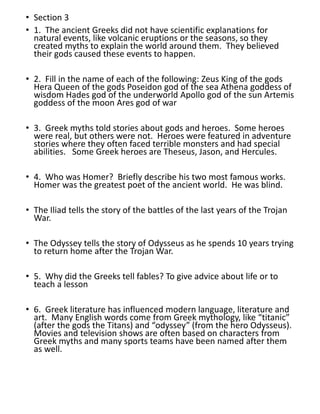
• Section 3
• 1. The ancient Greeks did not have scientific explanations for
natural events, like volcanic eruptions or the seasons, so they
created myths to explain the world around them. They believed
their gods caused these events to happen.
• 2. Fill in the name of each of the following: Zeus King of the gods
Hera Queen of the gods Poseidon god of the sea Athena goddess of
wisdom Hades god of the underworld Apollo god of the sun Artemis
goddess of the moon Ares god of war
• 3. Greek myths told stories about gods and heroes. Some heroes
were real, but others were not. Heroes were featured in adventure
stories where they often faced terrible monsters and had special
abilities. Some Greek heroes are Theseus, Jason, and Hercules.
• 4. Who was Homer? Briefly describe his two most famous works.
Homer was the greatest poet of the ancient world. He was blind.
• The Iliad tells the story of the battles of the last years of the Trojan
War.
• The Odyssey tells the story of Odysseus as he spends 10 years trying
to return home after the Trojan War.
• 5. Why did the Greeks tell fables? To give advice about life or to
teach a lesson
• 6. Greek literature has influenced modern language, literature and
art. Many English words come from Greek mythology, like “titanic”
(after the gods the Titans) and “odyssey” (from the hero Odysseus).
Movies and television shows are often based on characters from
Greek myths and many sports teams have been named after them
as well.
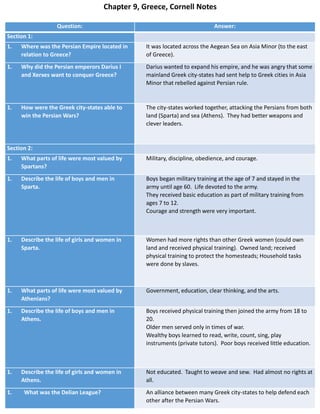
Chapter 9
Question: Answer:
Section 1:
1. Where was the Persian Empire located in
relation to Greece?
It was located across the Aegean Sea on Asia Minor (to the east
of Greece).
1. Why did the Persian emperors Darius I
and Xerxes want to conquer Greece?
Darius wanted to expand his empire, and he was angry that some
mainland Greek city-states had sent help to Greek cities in Asia
Minor that rebelled against Persian rule.
1. How were the Greek city-states able to
win the Persian Wars?
The city-states worked together, attacking the Persians from both
land (Sparta) and sea (Athens). They had better weapons and
clever leaders.
Section 2:
1. What parts of life were most valued by
Spartans?
Military, discipline, obedience, and courage.
1. Describe the life of boys and men in
Sparta.
Boys began military training at the age of 7 and stayed in the
army until age 60. Life devoted to the army.
They received basic education as part of military training from
ages 7 to 12.
Courage and strength were very important.
1. Describe the life of girls and women in
Sparta.
Women had more rights than other Greek women (could own
land and received physical training). Owned land; received
physical training to protect the homesteads; Household tasks
were done by slaves.
1. What parts of life were most valued by
Athenians?
Government, education, clear thinking, and the arts.
1. Describe the life of boys and men in
Athens.
Boys received physical training then joined the army from 18 to
20.
Older men served only in times of war.
Wealthy boys learned to read, write, count, sing, play
instruments (private tutors). Poor boys received little education.
1. Describe the life of girls and women in
Athens.
Not educated. Taught to weave and sew. Had almost no rights at
all.
1. What was the Delian League? An alliance between many Greek city-states to help defend each
other after the Persian Wars.
Chapter 9, Greece, Cornell Notes
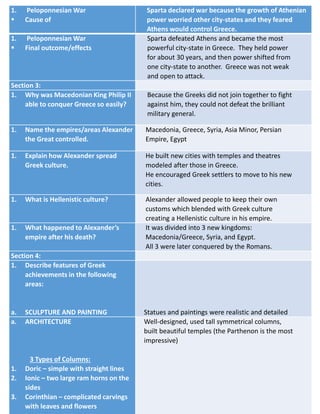
1. Peloponnesian War
 Cause of
Sparta declared war because the growth of Athenian
power worried other city-states and they feared
Athens would control Greece.
1. Peloponnesian War
 Final outcome/effects
Sparta defeated Athens and became the most
powerful city-state in Greece. They held power
for about 30 years, and then power shifted from
one city-state to another. Greece was not weak
and open to attack.
Section 3:
1. Why was Macedonian King Philip II
able to conquer Greece so easily?
Because the Greeks did not join together to fight
against him, they could not defeat the brilliant
military general.
1. Name the empires/areas Alexander
the Great controlled.
Macedonia, Greece, Syria, Asia Minor, Persian
Empire, Egypt
1. Explain how Alexander spread
Greek culture.
He built new cities with temples and theatres
modeled after those in Greece.
He encouraged Greek settlers to move to his new
cities.
1. What is Hellenistic culture? Alexander allowed people to keep their own
customs which blended with Greek culture
creating a Hellenistic culture in his empire.
1. What happened to Alexander’s
empire after his death?
It was divided into 3 new kingdoms:
Macedonia/Greece, Syria, and Egypt.
All 3 were later conquered by the Romans.
Section 4:
1. Describe features of Greek
achievements in the following
areas:
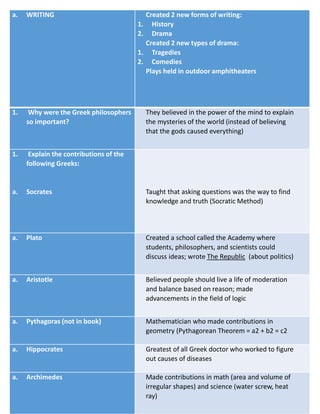
a. SCULPTURE AND PAINTING Statues and paintings were realistic and detailed
a. ARCHITECTURE
3 Types of Columns:
1. Doric – simple with straight lines
2. Ionic – two large ram horns on the
sides
3. Corinthian – complicated carvings
with leaves and flowers
Well-designed, used tall symmetrical columns,
built beautiful temples (the Parthenon is the most
impressive)
a. WRITING Created 2 new forms of writing:
1. History
2. Drama
Created 2 new types of drama:
1. Tragedies
2. Comedies
Plays held in outdoor amphitheaters
1. Why were the Greek philosophers
so important?
They believed in the power of the mind to explain
the mysteries of the world (instead of believing
that the gods caused everything)
1. Explain the contributions of the
following Greeks:
a. Socrates Taught that asking questions was the way to find
knowledge and truth (Socratic Method)
a. Plato Created a school called the Academy where
students, philosophers, and scientists could
discuss ideas; wrote The Republic (about politics)
a. Aristotle Believed people should live a life of moderation
and balance based on reason; made
advancements in the field of logic
a. Pythagoras (not in book) Mathematician who made contributions in
geometry (Pythagorean Theorem = a2 + b2 = c2
a. Hippocrates Greatest of all Greek doctor who worked to figure
out causes of diseases
a. Archimedes Made contributions in math (area and volume of
irregular shapes) and science (water screw, heat
ray)
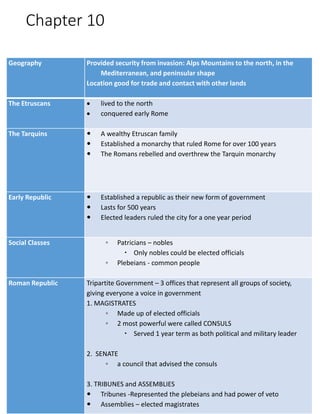
Geography Provided security from invasion: Alps Mountains to the north, in the
Mediterranean, and peninsular shape
Location good for trade and contact with other lands
The Etruscans  lived to the north
 conquered early Rome
The Tarquins  A wealthy Etruscan family
 Established a monarchy that ruled Rome for over 100 years
 The Romans rebelled and overthrew the Tarquin monarchy
Early Republic  Established a republic as their new form of government
 Lasts for 500 years
 Elected leaders ruled the city for a one year period
Social Classes ◦ Patricians – nobles
 Only nobles could be elected officials
◦ Plebeians - common people
Roman Republic Tripartite Government – 3 offices that represent all groups of society,
giving everyone a voice in government
1. MAGISTRATES
◦ Made up of elected officials
◦ 2 most powerful were called CONSULS
 Served 1 year term as both political and military leader
2. SENATE
◦ a council that advised the consuls
3. TRIBUNES and ASSEMBLIES
 Tribunes -Represented the plebeians and had power of veto
 Assemblies – elected magistrates
Chapter 10
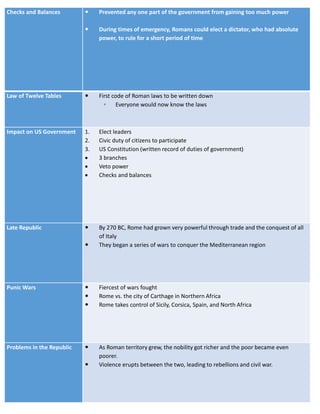
Checks and Balances  Prevented any one part of the government from gaining too much power
 During times of emergency, Romans could elect a dictator, who had absolute
power, to rule for a short period of time
Law of Twelve Tables  First code of Roman laws to be written down
◦ Everyone would now know the laws
Impact on US Government 1. Elect leaders
2. Civic duty of citizens to participate
3. US Constitution (written record of duties of government)
 3 branches
 Veto power
 Checks and balances
Late Republic  By 270 BC, Rome had grown very powerful through trade and the conquest of all
of Italy
 They began a series of wars to conquer the Mediterranean region
Punic Wars  Fiercest of wars fought
 Rome vs. the city of Carthage in Northern Africa
 Rome takes control of Sicily, Corsica, Spain, and North Africa
Problems in the Republic  As Roman territory grew, the nobility got richer and the poor became even
poorer.
 Violence erupts between the two, leading to rebellions and civil war.
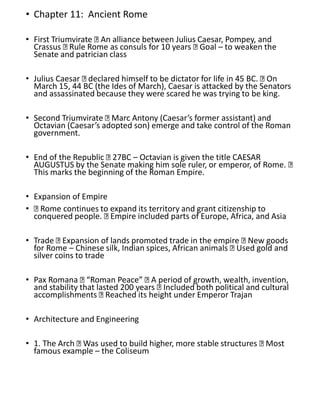
• Chapter 11: Ancient Rome
• First Triumvirate An alliance between Julius Caesar, Pompey, and
Crassus Rule Rome as consuls for 10 years Goal – to weaken the
Senate and patrician class
• Julius Caesar declared himself to be dictator for life in 45 BC. On
March 15, 44 BC (the Ides of March), Caesar is attacked by the Senators
and assassinated because they were scared he was trying to be king.
• Second Triumvirate Marc Antony (Caesar’s former assistant) and
Octavian (Caesar’s adopted son) emerge and take control of the Roman
government.
• End of the Republic 27BC – Octavian is given the title CAESAR
AUGUSTUS by the Senate making him sole ruler, or emperor, of Rome.
This marks the beginning of the Roman Empire.
• Expansion of Empire
• Rome continues to expand its territory and grant citizenship to
conquered people. Empire included parts of Europe, Africa, and Asia
• Trade Expansion of lands promoted trade in the empire New goods
for Rome – Chinese silk, Indian spices, African animals Used gold and
silver coins to trade
• Pax Romana “Roman Peace” A period of growth, wealth, invention,
and stability that lasted 200 years Included both political and cultural
accomplishments Reached its height under Emperor Trajan
• Architecture and Engineering
• 1. The Arch Was used to build higher, more stable structures Most
famous example – the Coliseum
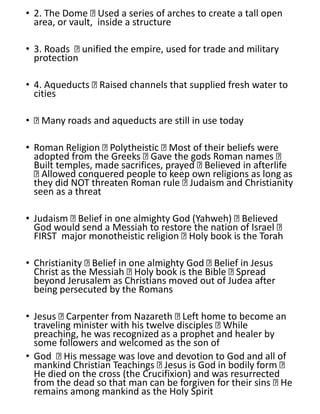
• 2. The Dome Used a series of arches to create a tall open
area, or vault, inside a structure
• 3. Roads unified the empire, used for trade and military
protection
• 4. Aqueducts Raised channels that supplied fresh water to
cities
• Many roads and aqueducts are still in use today
• Roman Religion Polytheistic Most of their beliefs were
adopted from the Greeks Gave the gods Roman names
Built temples, made sacrifices, prayed Believed in afterlife
Allowed conquered people to keep own religions as long as
they did NOT threaten Roman rule Judaism and Christianity
seen as a threat
• Judaism Belief in one almighty God (Yahweh) Believed
God would send a Messiah to restore the nation of Israel
FIRST major monotheistic religion Holy book is the Torah
• Christianity Belief in one almighty God Belief in Jesus
Christ as the Messiah Holy book is the Bible Spread
beyond Jerusalem as Christians moved out of Judea after
being persecuted by the Romans
• Jesus Carpenter from Nazareth Left home to become an
traveling minister with his twelve disciples While
preaching, he was recognized as a prophet and healer by
some followers and welcomed as the son of
• God His message was love and devotion to God and all of
mankind Christian Teachings Jesus is God in bodily form
He died on the cross (the Crucifixion) and was resurrected
from the dead so that man can be forgiven for their sins He
remains among mankind as the Holy Spirit
• Spread of Christianity
• After the death of Jesus, his followers (Peter, John the Apostle, and Paul)
continued to spread Christianity by teaching throughout the Middle East and
Mediterranean
• Decline of the Empire
• 1. Expensive to maintain the empire Keeping military in distant lands
Protecting traders on land and seas Taxes were continuously raised Angered
the people because they couldn’t pay the taxes and began to lose their lands
• 2. Division into eastern and western empires led to civil wars between competing
groups
• 3. Corruption and immorality amongst Roman citizens and government officials
• 4. Invasions and attacks from groups such as the Vandals, Angles, Saxons, Huns,
and Visigoths
• End of the Western Empire
• 476 AD – Western Roman Empire fell to Germanic invaders
• Byzantine Empire The eastern portion of the Roman Empire Lasts another
1,000 years after the fall of the Western Empire Preserved and spread the
accomplishments of the Greeks and Romans Constantinople Center of the
Byzantine Empire
• Became the greatest city of the western world Straddled the Bosporus Strait,
so it was located on 2 continents – Asia and Europe Was the crossroads for
international trade Justinian Byzantine emperor Organized and simplified the
Roman laws into a legal system called the Justinian Code Educated scholars and
government officials so they could better help the citizens
• Byzantine Accomplishments
• Enhanced Roman artistic style of making mosaics from marble by adding
brightly colored glass Built highly decorated Christian churches Most famous
is the Hagia Sophia
• Chapter 12 – The Islamic World Guided Notes
• Section 1: “The Roots of Islam”
• Arabia is located in the southwest corner of Asia. It lies near the intersection
of Africa, Europe, and Asia. (“Crossroads Location”)
• This climate has created a band of deserts across Arabia and Northern Africa.
• People developed two ways of life. Nomads lived in tents and raised herds of
sheep, goats, and camels. What did those animals provide? Milk, meat,
wool, and leather
• Others lived a sedentary lifestyle. These people made their homes in oases
where they could farm. These settlements became towns.
• A New Religion
• Mohammad was born into an important family in the city of Mecca around
570 AD. At age 25, Muhammad married Khadijah. As Muhammad was
growing up, many rich merchants began to ignore the needy.
• Muhammad began to pray and meditate. One day when he was about 40
years old, he went to a cave and began to meditate.
• Muslims believe that God had spoken to Mohammad through the angel
(Gabriel) and had made him a prophet, a person who tells of messaged from
God.
• What forms the basis of the religion called Islam? The messages Mohammad
received
• What does ISLAM mean? “To submit to God” (in Arabic)
• A follower of Islam is called a Muslim. Muslims believe that Muhammad
continued to receive message from God for the rest of his life.
• These messages were collected in the Qur’an (Koran), the holy book of Islam.
• **”ALLAH” is the Arabic word for GOD
• Muhammad’s Teachings
• How many gods did Muhammad teach there were? ONE. Islam is
monotheistic, like Judaism and Christianity. They had many shrines, or
special places they worshipped their God. A very important shrine, the
Kaaba, was in Mecca.
• Section 2 “Islamic Beliefs and Practices”
• Muslims consider the Qur’an to be the exact word of God as it was told to
Muhammad.
• The central teaching in the Qur’an is that there is only one God, Allah, and
that Muhammad is his prophet.
• Muslims also recognize Abraham, Moses, and Jesus as prophets.
• What 3 things does the Qur’an describe?
• Acts of worship
• Guidelines for moral behavior
• Rules for social life
• What does jihad mean? To make an effort or to struggle
• Jihad refers to the inner struggle people go through in their effort to obey God and behave according to Islamic
ways.
• The Sunnah refers to the way Muhammad lived and guides Muslims’ behavior.
• The first duties of a Muslim are known as the Five Pillars of Islam.
• 1st – FAITH (A statement of belief in no God but Allah and Mohammed as his prophet.)
• 2nd – PRAYER (5 times a day facing Mecca)
• 3rd – ALMS (give yearly donations to charity)
• 4th – FASTING (fast from sunrise to sunset during the month of Ramadan – this is when Mohammed received his
messages)
• 5th – PILGRIMAGE – (make one trip to Mecca in your lifetime if economically and physically able)
• Section 3: “Islamic Empires”
• Trade Helps Islam Spread
• Islam spread through areas Muslims conquered. Within 100 years of Mohammed’s death, Muslims had
conquered the Middle East, Persia, the Arabian Peninsula, and northern Africa.
• Trade also helped Islam spread. Along with their goods, Arabian merchants took Islamic beliefs to India, Africa,
and Southeast Asia.
• What did the Arabs learn from the Chinese? Papermaking, gunpowder
• What crops came from India, China, and Southeast Asia? Cotton, rice, oranges
• In the mid-600s, Islam split into 2 groups. They disagreed over the line of succession to the Muslim empire after
Mohammed died. What are the two groups called? Shia and Sunni
• The Shia were Muslims who thought that only Mohammad’s descendants could become caliphs.
• The Sunni did not think caliphs had to be related to Muhammad.
• Section 4 “Cultural Achievements”
• Muslim scholars made advancements in astronomy, geography, math, and science.
• Many Muslim cities had observatories, where people could study the sun, moon, and stars.
• In the 800s, what two math systems did Muslim scholars combine? Indian and Greek
• Muslim doctors started the first pharmacy school to teach people how to make medicine.
• Literature and the Arts
• Patrons built beautiful mosques to honor God and inspire religious followers. The main part of a mosque is a
huge wall where people pray. Many mosques also have a large dome and a minaret, or narrow tower from where
Muslims are called to prayer.
• Muslims believe only Allah can create humans and animals or their images. Muslim artists turned to calligraphy,
or decorative writing for their art. They made sayings from the Qur’an into works of art and used them to
decorate mosques and other buildings.
• Chapter 13: Early African Civilizations
• Section 1: Geography
• What are the four regions that stretch across the northern and western parts of the African
continent? **You should be able to identify these regions on a map of Africa!
• Sahel (shores on either side of the desert that receive very little rainfall)
• Sahara Desert
• Savannah (grasslands)
• Rain Forest
• What natural resources are found in West Africa?
• Good farmland = dates, grains, medicinal kola nuts
• GOLD from the forests
• SALT from the Sahara Desert
• Briefly describe trade in West Africa.
• Traders crossed the Sahara Desert on camels to trade their goods with North Africa and the
Islamic world. They traded gold, salt, cloth, and human slaves. GOLD and SALT were their
most important trade goods. Salt was so valuable because people needed it in their diets
to survive.
• Section 2: The Empire of Ghana
• Where was Ghana located?
• Ghana was between the Niger River and the Senegal River in West Africa.
• It was in the area between the desert and the rainforests.
• Ghana profited from trade after they took control of the SALT and GOLD trade routes.
• What allowed Ghana to grow in power and size?
• Control of trade routes meant more wealth and power. Ghana conquered neighboring
tribes to add land to their empire.
• Name the 3 factors that contributed to the fall of the Ghana Empire.
• Invasion – Muslim Berbers invaded and cut off trade routes
• Overgrazing – Berber animals ruined the farmland
• Internal Rebellions – weakened Ghana to more attacks from their neighbors
• Section 3: Mali and Songhai
• Mali
• Mali was located along the Niger River in Western Africa.
• How did Mali become rich and powerful?
• Mali controlled trade along the Niger River
• Describe how the Islamic religion spread in Mali.
• Mansa Musa, Muslim leader of Mali, helped to spread Islam by taking a pilgrimage to
Mecca, stressing learning Arabic to read the Qu’ran, and by building Muslim mosques
and schools.
• Why did Mali decline in power?
• After Mansa Musa’s death, invaders destroyed schools and mosques. Then they took
control of the important trade city of Timbuktu.
• Songhai
• Where was Songhai located?
• Along the Niger River, within the empire of Mali. As Mali declined, the Songhai
people broke free and created their own empire.
• Describe the influence of the Islamic religion in Songhai.
• Most of the Songhai people were Muslims. They overthrew a non-Muslim leader and
replaced him with a Muslim leader named Askia the Great. Under his rule, Muslim
education and culture flourished.
• What led to the end of the Songhai Empire?
• Morocco invaded and destroyed the important trade cities of Gao and Timbuktu.
• Section 4: History and Art
• How did West Africans preserve their history? Why might it be inaccurate?
• Arabic was the only written language, so griots memorized their history and spread it
orally. Sometimes, the griots forgot events, names, or dates. They also sometimes
added details to make their stories more entertaining.
• How do we know about West African empires?
• Most of our knowledge comes from Muslim scholars and travelers from Spain and
Arabia who wrote of their travels.
• List the art forms native to West Africa.
• storytelling, ivory and wood sculpture, mask making, textiles (kente cloth), singing,
dancing, drumming
Chapter 14: China (589 – 1644)
The Tang and Song Dyansties - For a period of about 700 years, China
was strong and unified. Many accomplishments were made, including:
• Trade - The Grand Canal was built to link northern and southern China.
Major trading cities were connected and crops and goods were shipped all
over the country. Trade also increased with other lands, like Korea, Japan,
and India. Ports opened along the Pacific Ocean. Silk was China’s most
important export, but they also exported tea, rice, spices, and jade. Arts –
poetry, porcelain, calligraphy, and painting flourished
• Religion - Buddhist temples and statues were created as the religion
spread throughout China
• Agriculture – farming techniques greatly improved. Because food was
plentiful, the population grew quickly. “The Four Great Inventions of
Ancient China” 1. Gunpowder – used for fireworks and signals 2. Paper- A
cheap and easy way of keeping records and making printing possible. The
Song used it to invent the world’s first paper money. 3. Woodblock Printing-
A type of printing in which an entire page is carved into a block of wood. It
allowed them to copy and print more texts very quickly. 4. Magnetic
Compass – allowed sailors and merchants to travel farther Government –
The ideas of Confucius began to affect the government. A bureaucracy was
created and people had to pass a series of written exams to work in civil
service. The exam tested students’ knowledge of Confucianism and related
ideas. If they passed the exam, it meant LIFE as a scholar-official.-
• Section 4 – The Yuan and Ming Dynasties
• The Yuan Dynasty – a period of time in which the Mongols invaded and
controlled China.
• Marco Polo was a merchant from Italy who traveled along the Silk Road into
Mongolia and China from 1271 to 1295. After returning to Europe, a book
was published about his travels. His book taught Europeans about Chinese
goods and ideas and made them interested in trading with the Chinese.
Many Europeans also became interested in looking for a quicker path to
China as they realized China was a highly civilized nation.
• The Ming Dynasty defeated the Mongols and ruled for almost 300 years.
They: Expanded knowledge of China overseas and created huge building
projects. Built the “Forbidden City” – the emperor’s palace complex in the
city of Beijing, the common people were not allowed to enter
• The Ming began a period of isolationism where they avoided contact and
trade with other countries. This led to China becoming behind in
technologies, weak, and the Ming dynasty being overthrown.
• Ch. 15 Japan
• Geography
• Because they lived on islands, the Japanese were separated from the other people of Asia. As a
result, they developed their own culture. Since it is small in size and most of Japan is
mountainous, land is highly valued. They turned to the seas for food and usually lived near the
coastlines.
• Influence of the Chinese
• Japanese and Chinese language and writing are very similar.
• Religion and Philosophy – Prince Shotoku was one of the most influential people in bringing
Chinese ideas to Japan. Under his rule, Buddhism and Confucianism spread across Japan and
were worshipped along with Shintoism.
• Japan had a choice between staying isolated or having contact with other cultures, just like the
Chinese. Japan chose isolationism for much of their history.
• The Religion of Shinto
• According to Shinto teachings, everything in nature has kami (a spirit).
• Shintoists believed that some kami help people live and keep them from harm.
• They build shrines to kami and perform ceremonies asking the kami to bless them.
Social Hierarchy
•
Emperor (a figurehead who appeared to rule, but actually had no real power)
• Shogun (a military general who ruled in the emperor’s name; held the most power)
• Daimyo, Samurai (Daimyo are land owners who led armies of samurai warriors)
• Peasant (farmed the land for the samurai and daimyo)
• Feudalism
• In the late 1100s, powerful nobles began to fight each other for land and power. Large
landowners (daimyo lords) knew they needed to protect their land.
• They hired samurai to defend them and their property. Because the lords could not afford to
pay the samurai, they paid them in food and land. Individual lords and clan leaders took over,
marking the beginning of feudalism.
Rule of the Shogun Weakens
• The emperor began to fight the shogun for control of the country and
• small wars broke out over Japan. Afterwards, each daimyo controlled his own territory as if it
were a small kingdom.
• Samurai Warriors
• The main duty of a samurai was to defend his daimyo and his daimyo’s property.
• Bushido means “the way of the warrior” and is the code of rules the samurai and their families
were expected to live by. Bushido values such as loyalty, honor, and discipline are still greatly
admired in Japan.
• Chapter 16: The Early Americas
• The Mayans, Aztecs, and Incas
• The MAYA
• Geography
• Mayan Civilization was located on the Yucatan Peninsula in Central America.
• Settled an area known as the Pet’en (the Mayan word for “flat region”)
• The Pet’en was a rainforest area with swamps and sinkholes.
• The Maya used the swamps and sinkholes as a source of freshwater.
• Agriculture and Trade
• The Maya started out as farmers around 1000 BC.
• They used slash and burn methods to clear the forests for farming.
• Soon, they began trading crops (beans, squash, maize, avocados) and natural resources (wood, obsidian,
jade), leading to a more advanced civilization
• Government
• They operated as a network of city states, each with a king and military.
• Believed their kings were descendants of the sun god
• The king held political and religious authority
• Social Classes
• King
• Priests, Merchants, and Warriors (Upper Class)
• Farming Families (Lower Class)
• Religion
• The Maya were polytheistic.
• Believed their gods needed blood to prevent disasters and the end of the world.
• Every person offered blood by piercing their tongue or skin.
• Human sacrifices (usually war prisoners)
• Architecture
• The Mayan cities of Chichen Itza and Tikal have taught us much about Mayan engineering.
• Step pyramids were topped with temples to honor the gods
• Palaces built for the kings
• Canals for irrigation
• Plazas – open squares for public gatherings
• Ball courts
• Writing
• Used symbols to represent objects and sounds (similar to hieroglyphics)
• Used to record dates of important religious festivals, plantings, and harvests
• Science and Math
• Built observatories so priests could study the sky
• Priests watched the heavens to determine the plans of the gods and to know when to plant crops
• Developed a 365-day calendar
• Created a base-20 number system that used zero
• The End of the Maya
• Between 750 and 900 AD, city-states began to be abandoned and much of the population disappeared
• Possible reasons include:
• Invasions from other groups
• Climate changes brought about droughts
• Could not produce enough food
• THE AZTECS
• Geography
• The Aztecs lived in central Mexico. They were surrounded by mountains, with lakes and swampland. This
area became known as the Valley of Mexico. Even though the area was swampy, they got wild plants, fish,
frogs, and ducks to eat from the swamps.
• Agriculture
• To add to their farming lands, they used chinampas, or floating gardens, to grow food on in the canals they
built. They grew corn, avocados, beans, chili peppers, squash, and tomatoes on the chinampas.
• Government
• They built a new capital city named Tenochtitlan in the middle of a giant lake. It was connected to the
mainland by the chinampas and causeways. This is present day Mexico City. Aztecs were led by strong
emperors who also claimed to be descendants of the gods.
• Social Classes
• Emperor
• The Four Classes:
• Nobles
• Commoners
• Unskilled laborers
• Enslaved people
• Religion
• The Aztecs were polytheistic.
• They built the Great Temple in Tenochtitlan to honor their gods
• Thousands of people were sacrificed at the top of this temple
• Sacrificed around 10,000 per year
• Achievements
• Studied astronomy
• Created 2 calendars:
• Sacred calendar used for worship and religious ceremonies
• Solar calendar used for farming purposes
• The End of the Aztecs
• In 1519, a group of conquistadors (Spanish conquerors) arrived in Mexico led by Hernán Cortés. Cortés
wanted to claim land, find gold, and convert the natives to Catholicism.
• The Aztec Empire came to an end when Hernán Cortés defeated the Aztec emperor in June, 1521 AD.
• The Spanish were able to conquer the Aztecs because of:
• Better weapons (armor, cannons, swords)
• Horses (the Aztecs had never seen them before and were scared of them)
• Diseases they brought with them (Smallpox killed over 90% of the natives)
• THE INCAS
• Geography
• The Incas Began as a small tribe in the Andes Mountains along the coast line of South America (modern-day
Peru). By the 16th century, the Incan Empire stretched from modern day Ecuador to northern Chile.
Eventually, the population grew to 1 million. The Incas controlled more territory than any other group of
people in South American history.
• Agriculture
• The steep Andes Mountains were a difficult place to farm. They terraced the mountains to make farmland.
• Grew corn and potatoes
• Raised llamas and alpacas (for food and labor)
• Government
• Had a very strong emperor called the Inca. He held absolute power.
• The Inca ruled by proxy, allowing the local tribe and clan leaders to remain in power.
• Told each household what jobs to do. People gave their goods to the government, who distributed them back
out to all families. This guaranteed there would be enough for everyone.
• Social Classes
• Emperor
• Royal family (worked as government officials)
• Tribal leaders
• Clan leaders
• Common people
• **The social structure was inflexible. There was no way to advance classes in the system.
• Religion
• The Inca were polytheistic.
• The most important god was the sun-god, Inti. (All temples were built for him.)
• Believed the sun god was the father of the royal family.
• Human sacrifices were routinely made to please the gods.
• Achievements
• Skilled engineers known for expert masonry (stonework)
• cut stones so precisely they did not need mortar to hold them together
• examples: massive forts, Machu Picchu (retreat built for the kings)
• Made advancements in medicine and surgery
• In order to keep rule over their large empire, the Inca developed a complex system of roads, tunnels, and
bridges.
• Similar to the Romans, the Incas used aqueducts as a way to supply water to their cities.
• Language
• Oral language of Quecha is still spoken in the Andes today because the Incas forced all people to learn it
• No writing system – kept records using knotted cord system called quipus.
• The End of the Inca
• In 1533, Francisco Pizarro arrived with 180 Spanish conquistadors. Pizarro convinced the Inca ruler,
Atahualpa, to meet in the city of Cajamarca. When he arrived, they captured Atahualpa and killed hundreds
of his family members and soldiers. Atahualpa tried to buy his freedom, but the Spanish executed him. By the
1560s, Spain took control of the entire Inca Empire. Spain ruled the area for the next 300 years.
• Chapter 17&18
• 1. What were Charlemagne’s major accomplishments? • In the 700s, creates a huge
empire by defeating neighboring kingdoms in a series of battles • Built schools
across Europe that were taught by greatest religious scholars of the time
• 2. Why did the system of feudalism develop during the Middle Ages? The feudal
system developed after the death of Charlemagne. Armies of the Frankish kings
were not able to defend against the Viking, Magyar, and Muslim invasions, so nobles
had to defend their own lands
• 3. Label the social hierarchy of feudal society.
Monarchs (Kings and Queens) Lords Vassals Peasants/Serfs
• 4. What is the difference between the feudal system and the manor system? The
feudal system is the exchange of land for military protection and loyalty between
monarchs, lords, and vassals. The manor system is the exchange of land for labor
between lords/knight and peasants/serfs on the manor.
• 5. In 1215, a group of nobles forced King John to sign the Magna Carta. This
document severely limited (weakened) the power of the king. It also gave the
English people basic rights such as: Trial by jury Habeas Corpus (one cannot be
jailed without reason) Representative assemblies
• 6. What was the job of the Great Council? What is Parliament? Great Council’s job
was to advise the King according to the people’s interests. It eventually becomes
Parliament, which governs England today and was the 1st democratic legislative
body in Europe.
• 7. Why were the Crusades fought? Christians were trying to recapture the recently
seized Holy Land (Jerusalem) from the Turks (who were Muslim) and stop them from
capturing the Byzantine Empire.
• 8. List 5 results of the Crusades. Christianity spread into new regions outside of
Europe Weakened feudalism as nobles lost their lives or fortunes after years of
war Kings became more powerful and begin to challenge the authority of the
Church Increased trade between Europe and Asia and interest in exploring new
lands Major split occurs between Christians, Jews, and Muslims
• 9. What was the Reconquista? The retaking of Spain from the Moors (who were
Muslims) by the Christian armies. As a result of the Reconquista and the Crusades,
the Muslims lost control in Europe.
• 10. The Bubonic Plague, or Black Death, spread from Asia into China. Merchants
entered Mediterranean ports carrying infected rats. People caught the disease after
fleas from the infected rats bit them. The disease spread quickly throughout Europe
due to a lack of medical and scientific knowledge.
• 11. What result did the plague have on: The population of Europe? reduced by 25
million (33%). The world population? reduced by 100-125 million (25%).
• 12. List all of the factors led to the decline of feudalism. Circle the one that was
feudalisms ultimate downfall. 1. Magna Carta 2. Crusades 3. Bubonic Plague **
• Chapter 19 Notes
• The Italian Renaissance
• The period of “rebirth” following Europe’s Middle Ages
• Origins of the Renaissance
• 1. Italian cities increased trade with Asia
• 2. Increase in Wealth
• 3. Italian merchant families became very wealthy and used this money to support education and
cultural activities.
• Florence, Italy
• • The Medici family, who were bankers, ruled Florence.
• • Cosimo de Medici wanted Florence to be the most beautiful city in the world:
• • Hired artists and architects
• • Built libraries and collected to books to improve education
• • Florence became the center of Italian art, literature, and culture
• Key Features of the Renaissance:
• • Love of art and education
• • Interest in classical cultures of the ancient Greeks and Romans
• • Importance of people as individuals
• Humanism
• • Effects of Humanism:
• • Education: began to study the humanities (poetry, history, art, Greek and Latin languages)
• • Art: looked to the Greek and Roman ruins and statues for inspiration
• • Religion: began to question if the Christian Church was corrupt and emphasize devotion to
God and Jesus rather than Church ritual
• • Science: Scientists such as Copernicus, Kepler, Galileo, and Newton began to reexamine the
physical world. From their reexamination, new scientific fields and principles developed.
• Political Realism
• • An important political book was written that discussed the relationship between the ruled
and the ruler. It was called The Prince and was written by Machiavelli.
• Contributions:
• 1. Art
• • studied anatomy (the structure of the human body) and drew humans realistically
• • Used new technique called perspective, which used light and shading to show depth and
distance on flat surfaces
• 2. Education
• • Studied math and science to improve architecture and learned the earth revolves around the
sun
• 3. Literature
• • Wrote in language of own country so everyone could read it
• Great Artists from the Renaissance
• 1. Michelangelo -
• • Designed buildings, wrote poetry, carved sculptures, and painted magnificent pictures
• • Most famous work is the SISTINE CHAPEL in St. Peter’s Cathedral
• 2. Leonardo da Vinci -
• • Expert painter, sculptor, architect, inventor, engineer, town planner, and mapmaker
• • Most famous works are the MONA LISA and THE LAST SUPPER
• • Is considered to be the classic example of a Renaissance Man
• Spread of the Renaissance:
• 1. Papermaking spread from China to Europe.
• 2. Johann Gutenberg developed a printing press that used movable type.
• 3. Books became more available and people learned to read, became educated, and
wanted to learn more. The first books printed by the printing press were about Christianity, but
later others were printed.
• 4. Europeans came to study in Italy’s universities and took ideas back home with them.
• The Reformation
• • Causes:
• • People thought the Catholic Church had become corrupt. They felt:
• • The church was too rich.
• • The priests were not religious.
• • The church’s sale of indulgences (a document signed by the Pope excusing people from
penalties for their sins) was immoral.
• • Humanist ideas also helped to bring about Reformation in the church.
• • Due to the printing press making books more available, more people were able to read
and interpret the Bible for themselves.
• Key Events of the Reformation
• • MARTIN LUTHER called for reform of the Roman Catholic Church and started the
Reformation
• • Luther disagreed with the church’s teachings on the following topics:
• • Individuals need an intermediate (such as a priest) to communicate with God.
• • People could buy indulgences to excuse them of the consequences of their sins.
• • The Pope could excommunicate people from the Church.
• • The Pope excommunicated Luther leading to a split in the church.
• • Protestantism was created by reformers who supported Luther and his protest against
the Catholic Church.
• • JOHN CALVIN began to protest as well. He taught that common people should have a
say in church policy. As a result of the teachings of John Calvin, several denominations were
formed. They include Puritans, Huguenots, and Presbyterians. Each of these groups rejected
the teachings of the Catholic Church.
• The Counter Reformation
• The Catholic Church tried to prevent the spread of
Protestantism by reforming their church from within.
•
• Effects of the Reformation
• Division in Europe between the Protestants and Catholics –
Northern Europe became mostly Protestant while Southern
Europe remained Catholic.
• Political Changes - a new interest in self-government
developed.
• People became more curious about science and the natural
world.
• People continued to disagree over the Catholic/Protestant
issue for decades, this includes the fighting of several wars.

Social Studies Review

  • 1.
    Chapter 7 • Between2000 BC and 1500 BC, a group of simple herders called the Hebrews appeared in Mesopotamia. Over time, they established a great kingdom called Israel. The Hebrew people practiced the religion of Judaism. Judaism was the first major monotheistic religion. • Founding of Judaism • According to the Hebrew Bible, God (called Yahweh by Hebrews) told Abraham to take his family and leave his home in Mesopotamia. Yahweh promised to lead Abraham to a new land and give him and his descendants the land of Canaan. Abraham settled in Canaan and his descendants (the Hebrew people) lived there for many years. Abraham is the known as the “Father of the Hebrews.” • Later, some Hebrews moved to Egypt. The Egyptian pharaoh feared that the Hebrews might take over Egypt as their population grew. The pharaoh turned them into slaves. In the 1200s BC, Yahweh told Moses to demand that the pharaoh free the enslaved Hebrews. After a series of plagues struck Egypt, the pharaoh agreed. Moses led his people out of Egypt in a journey called the Exodus. • According to the Bible, on their journey back to Canaan, Yahweh gave Moses two stone tablets with the Ten Commandments on them. By accepting them, the Hebrews agreed to worship only one God. Once the Hebrews settled in Canaan, they became known as Israelites. Jerusalem became the capital of Israel. A great temple, named Solomon’s Temple, was built in Jerusalem and became the center of the Israelites’ religious life and a symbol of their faith. • Beliefs Central beliefs are the belief in Yahweh, education, justice, and obedience There is only one God and he is all-knowing, all-powerful, merciful, and just They are Yahweh’s chosen people and have a special relationship with him Ten Commandments are the most important of their laws Mosaic law (the laws given to Moses by Yahweh) should govern daily life One day there will be a Messiah (savior) who will restore the nation of Israel There is an afterlife, but little emphasis is placed on this • Sacred Writings • The laws and principles of Judaism are described in several Hebrew writings. The most important of these is the Torah. The Torah is made up of 5 books written by ancient Jews describing Jewish laws and history through the time of Moses. It teaches that Yahweh will reward people according to their deeds (actions). • The Hebrew Bible (called the Tanach) includes the Torah, 8 books with messages from prophets, and 11 books with poetry, songs, lessons, and stories. • Diffusion • Jewish communities developed all over the world as a result of the conquering of Jewish lands. Over many centuries, more Jews were forced to move to new locations as a result of discrimination against them. Judaism is not a religion that tries to actively convert others. Local synagogues and rabbis became very important in guiding Jews as they moved out of Jerusalem and around the world. Today, the United States has a larger population of Jewish people than any other country in the world.
  • 2.
    Chapter 7 • Vocabulary Judaism– the religion of the Hebrews Abraham – the biblical father of the Hebrew people Moses – Hebrew prophet who led the Jews from slavery in Egypt Ten Commandments – moral code of laws that God handed down to Moses Monotheism – belief in only one god Torah – the sacred text of Judaism Synagogue – Jewish house of worship Prophets – people said to receive messages from God to be taught to others rabbis – teachers who guide Jews in their religious lives
  • 3.
    • Chapter 8:Ancient Greece • Section 1 – Geography and the Early Greeks 1. Greece is a rocky, mountainous land surrounded on 3 sides by water. This makes it a large peninsula. There are few small areas with flat land for farming and villages. • 2. Explain how geography helped shape early Greek civilization. City-states were isolated from each other so they developed independently and created their own governments and ways of life. The Greeks became expert sailors and shipbuilders because travel by land is difficult. Traded with other cultures along the seas for food and products they needed. • 3. The first group of people considered to be Greek are the Myceneans. They lived on the island of Crete. According to legend, the Mycenaeans attacked the city of Troy, starting the Trojan War. • 4. About 300 years after Mycenaean civilization ended, small groups of Greeks began joining together and set up independent city-states. This started the classical age of Greece. • 5. City-states in Greece usually had a fortress on top of the acropolis. Walls around the city-state were built for protection. The marketplace, or agora, was used for trading of goods and crafts and as a political and religious meeting place. • 6. List 2 reasons the city-state is considered to be the foundation of Greek civilization. o Provided a sense of security for its people o Gave the people an identity – they did not consider themselves to be Greeks but to be citizens of their city-state. • 7. The Greeks began to establish colonies around the Mediterranean Sea. These colonies became new polises and some became great centers of trade. By 550 BC, the Greeks were the greatest traders in the Aegean region.
  • 4.
    • Section 2– Government in Athens • 1. Greece is the birthplace of democracy. What is a democracy? In Greek, democracy means “rule of the people.” It is a type of government in which people rule themselves. • 2. Government in Athens started out as an oligarchy (rule by a small group of aristocrats). In 546 BC, Athens became a tyranny, meaning one strong leader, or tyrant, held power. Finally, around 500 BC, Athens developed the world’s first democracy. For the first time in history, a government was based on the votes of its free citizens. • 3. The democracy of Athens had limited citizenship. Only free males born in Athens were citizen in Athens. • 4. Describe Athenian Democracy under Cleisthenes. All citizens had the right to participate in the assembly. Assembly met outside so everyone could attend. Every citizen had the right to speak and debate the issues. Citizens voted by a show of hands or by secret ballot Citizens were selected to serve on smaller councils. • 5. What changes did Pericles make to encourage people to participate in government? Pericles began to pay people who served in public offices and on juries. • 6. Athenian democracy ended when Macedonia conquered the city-state in the mid-330s BC. • 7. How are a direct democracy and a representative democracy different? In a direct democracy (like in Athens), each citizen participates directly in the government. • In a representative democracy (like in the USA), elected officials represent the citizens in government and make laws.
  • 5.
    • Section 3 •1. The ancient Greeks did not have scientific explanations for natural events, like volcanic eruptions or the seasons, so they created myths to explain the world around them. They believed their gods caused these events to happen. • 2. Fill in the name of each of the following: Zeus King of the gods Hera Queen of the gods Poseidon god of the sea Athena goddess of wisdom Hades god of the underworld Apollo god of the sun Artemis goddess of the moon Ares god of war • 3. Greek myths told stories about gods and heroes. Some heroes were real, but others were not. Heroes were featured in adventure stories where they often faced terrible monsters and had special abilities. Some Greek heroes are Theseus, Jason, and Hercules. • 4. Who was Homer? Briefly describe his two most famous works. Homer was the greatest poet of the ancient world. He was blind. • The Iliad tells the story of the battles of the last years of the Trojan War. • The Odyssey tells the story of Odysseus as he spends 10 years trying to return home after the Trojan War. • 5. Why did the Greeks tell fables? To give advice about life or to teach a lesson • 6. Greek literature has influenced modern language, literature and art. Many English words come from Greek mythology, like “titanic” (after the gods the Titans) and “odyssey” (from the hero Odysseus). Movies and television shows are often based on characters from Greek myths and many sports teams have been named after them as well.
  • 6.
    Chapter 9 Question: Answer: Section1: 1. Where was the Persian Empire located in relation to Greece? It was located across the Aegean Sea on Asia Minor (to the east of Greece). 1. Why did the Persian emperors Darius I and Xerxes want to conquer Greece? Darius wanted to expand his empire, and he was angry that some mainland Greek city-states had sent help to Greek cities in Asia Minor that rebelled against Persian rule. 1. How were the Greek city-states able to win the Persian Wars? The city-states worked together, attacking the Persians from both land (Sparta) and sea (Athens). They had better weapons and clever leaders. Section 2: 1. What parts of life were most valued by Spartans? Military, discipline, obedience, and courage. 1. Describe the life of boys and men in Sparta. Boys began military training at the age of 7 and stayed in the army until age 60. Life devoted to the army. They received basic education as part of military training from ages 7 to 12. Courage and strength were very important. 1. Describe the life of girls and women in Sparta. Women had more rights than other Greek women (could own land and received physical training). Owned land; received physical training to protect the homesteads; Household tasks were done by slaves. 1. What parts of life were most valued by Athenians? Government, education, clear thinking, and the arts. 1. Describe the life of boys and men in Athens. Boys received physical training then joined the army from 18 to 20. Older men served only in times of war. Wealthy boys learned to read, write, count, sing, play instruments (private tutors). Poor boys received little education. 1. Describe the life of girls and women in Athens. Not educated. Taught to weave and sew. Had almost no rights at all. 1. What was the Delian League? An alliance between many Greek city-states to help defend each other after the Persian Wars. Chapter 9, Greece, Cornell Notes
  • 7.
    1. Peloponnesian War Cause of Sparta declared war because the growth of Athenian power worried other city-states and they feared Athens would control Greece. 1. Peloponnesian War  Final outcome/effects Sparta defeated Athens and became the most powerful city-state in Greece. They held power for about 30 years, and then power shifted from one city-state to another. Greece was not weak and open to attack. Section 3: 1. Why was Macedonian King Philip II able to conquer Greece so easily? Because the Greeks did not join together to fight against him, they could not defeat the brilliant military general. 1. Name the empires/areas Alexander the Great controlled. Macedonia, Greece, Syria, Asia Minor, Persian Empire, Egypt 1. Explain how Alexander spread Greek culture. He built new cities with temples and theatres modeled after those in Greece. He encouraged Greek settlers to move to his new cities. 1. What is Hellenistic culture? Alexander allowed people to keep their own customs which blended with Greek culture creating a Hellenistic culture in his empire. 1. What happened to Alexander’s empire after his death? It was divided into 3 new kingdoms: Macedonia/Greece, Syria, and Egypt. All 3 were later conquered by the Romans. Section 4: 1. Describe features of Greek achievements in the following areas: a. SCULPTURE AND PAINTING Statues and paintings were realistic and detailed a. ARCHITECTURE 3 Types of Columns: 1. Doric – simple with straight lines 2. Ionic – two large ram horns on the sides 3. Corinthian – complicated carvings with leaves and flowers Well-designed, used tall symmetrical columns, built beautiful temples (the Parthenon is the most impressive)
  • 8.
    a. WRITING Created2 new forms of writing: 1. History 2. Drama Created 2 new types of drama: 1. Tragedies 2. Comedies Plays held in outdoor amphitheaters 1. Why were the Greek philosophers so important? They believed in the power of the mind to explain the mysteries of the world (instead of believing that the gods caused everything) 1. Explain the contributions of the following Greeks: a. Socrates Taught that asking questions was the way to find knowledge and truth (Socratic Method) a. Plato Created a school called the Academy where students, philosophers, and scientists could discuss ideas; wrote The Republic (about politics) a. Aristotle Believed people should live a life of moderation and balance based on reason; made advancements in the field of logic a. Pythagoras (not in book) Mathematician who made contributions in geometry (Pythagorean Theorem = a2 + b2 = c2 a. Hippocrates Greatest of all Greek doctor who worked to figure out causes of diseases a. Archimedes Made contributions in math (area and volume of irregular shapes) and science (water screw, heat ray)
  • 9.
    Geography Provided securityfrom invasion: Alps Mountains to the north, in the Mediterranean, and peninsular shape Location good for trade and contact with other lands The Etruscans  lived to the north  conquered early Rome The Tarquins  A wealthy Etruscan family  Established a monarchy that ruled Rome for over 100 years  The Romans rebelled and overthrew the Tarquin monarchy Early Republic  Established a republic as their new form of government  Lasts for 500 years  Elected leaders ruled the city for a one year period Social Classes ◦ Patricians – nobles  Only nobles could be elected officials ◦ Plebeians - common people Roman Republic Tripartite Government – 3 offices that represent all groups of society, giving everyone a voice in government 1. MAGISTRATES ◦ Made up of elected officials ◦ 2 most powerful were called CONSULS  Served 1 year term as both political and military leader 2. SENATE ◦ a council that advised the consuls 3. TRIBUNES and ASSEMBLIES  Tribunes -Represented the plebeians and had power of veto  Assemblies – elected magistrates Chapter 10
  • 10.
    Checks and Balances Prevented any one part of the government from gaining too much power  During times of emergency, Romans could elect a dictator, who had absolute power, to rule for a short period of time Law of Twelve Tables  First code of Roman laws to be written down ◦ Everyone would now know the laws Impact on US Government 1. Elect leaders 2. Civic duty of citizens to participate 3. US Constitution (written record of duties of government)  3 branches  Veto power  Checks and balances Late Republic  By 270 BC, Rome had grown very powerful through trade and the conquest of all of Italy  They began a series of wars to conquer the Mediterranean region Punic Wars  Fiercest of wars fought  Rome vs. the city of Carthage in Northern Africa  Rome takes control of Sicily, Corsica, Spain, and North Africa Problems in the Republic  As Roman territory grew, the nobility got richer and the poor became even poorer.  Violence erupts between the two, leading to rebellions and civil war.
  • 11.
    • Chapter 11:Ancient Rome • First Triumvirate An alliance between Julius Caesar, Pompey, and Crassus Rule Rome as consuls for 10 years Goal – to weaken the Senate and patrician class • Julius Caesar declared himself to be dictator for life in 45 BC. On March 15, 44 BC (the Ides of March), Caesar is attacked by the Senators and assassinated because they were scared he was trying to be king. • Second Triumvirate Marc Antony (Caesar’s former assistant) and Octavian (Caesar’s adopted son) emerge and take control of the Roman government. • End of the Republic 27BC – Octavian is given the title CAESAR AUGUSTUS by the Senate making him sole ruler, or emperor, of Rome. This marks the beginning of the Roman Empire. • Expansion of Empire • Rome continues to expand its territory and grant citizenship to conquered people. Empire included parts of Europe, Africa, and Asia • Trade Expansion of lands promoted trade in the empire New goods for Rome – Chinese silk, Indian spices, African animals Used gold and silver coins to trade • Pax Romana “Roman Peace” A period of growth, wealth, invention, and stability that lasted 200 years Included both political and cultural accomplishments Reached its height under Emperor Trajan • Architecture and Engineering • 1. The Arch Was used to build higher, more stable structures Most famous example – the Coliseum
  • 12.
    • 2. TheDome Used a series of arches to create a tall open area, or vault, inside a structure • 3. Roads unified the empire, used for trade and military protection • 4. Aqueducts Raised channels that supplied fresh water to cities • Many roads and aqueducts are still in use today • Roman Religion Polytheistic Most of their beliefs were adopted from the Greeks Gave the gods Roman names Built temples, made sacrifices, prayed Believed in afterlife Allowed conquered people to keep own religions as long as they did NOT threaten Roman rule Judaism and Christianity seen as a threat • Judaism Belief in one almighty God (Yahweh) Believed God would send a Messiah to restore the nation of Israel FIRST major monotheistic religion Holy book is the Torah • Christianity Belief in one almighty God Belief in Jesus Christ as the Messiah Holy book is the Bible Spread beyond Jerusalem as Christians moved out of Judea after being persecuted by the Romans • Jesus Carpenter from Nazareth Left home to become an traveling minister with his twelve disciples While preaching, he was recognized as a prophet and healer by some followers and welcomed as the son of • God His message was love and devotion to God and all of mankind Christian Teachings Jesus is God in bodily form He died on the cross (the Crucifixion) and was resurrected from the dead so that man can be forgiven for their sins He remains among mankind as the Holy Spirit
  • 13.
    • Spread ofChristianity • After the death of Jesus, his followers (Peter, John the Apostle, and Paul) continued to spread Christianity by teaching throughout the Middle East and Mediterranean • Decline of the Empire • 1. Expensive to maintain the empire Keeping military in distant lands Protecting traders on land and seas Taxes were continuously raised Angered the people because they couldn’t pay the taxes and began to lose their lands • 2. Division into eastern and western empires led to civil wars between competing groups • 3. Corruption and immorality amongst Roman citizens and government officials • 4. Invasions and attacks from groups such as the Vandals, Angles, Saxons, Huns, and Visigoths • End of the Western Empire • 476 AD – Western Roman Empire fell to Germanic invaders • Byzantine Empire The eastern portion of the Roman Empire Lasts another 1,000 years after the fall of the Western Empire Preserved and spread the accomplishments of the Greeks and Romans Constantinople Center of the Byzantine Empire • Became the greatest city of the western world Straddled the Bosporus Strait, so it was located on 2 continents – Asia and Europe Was the crossroads for international trade Justinian Byzantine emperor Organized and simplified the Roman laws into a legal system called the Justinian Code Educated scholars and government officials so they could better help the citizens • Byzantine Accomplishments • Enhanced Roman artistic style of making mosaics from marble by adding brightly colored glass Built highly decorated Christian churches Most famous is the Hagia Sophia
  • 14.
    • Chapter 12– The Islamic World Guided Notes • Section 1: “The Roots of Islam” • Arabia is located in the southwest corner of Asia. It lies near the intersection of Africa, Europe, and Asia. (“Crossroads Location”) • This climate has created a band of deserts across Arabia and Northern Africa. • People developed two ways of life. Nomads lived in tents and raised herds of sheep, goats, and camels. What did those animals provide? Milk, meat, wool, and leather • Others lived a sedentary lifestyle. These people made their homes in oases where they could farm. These settlements became towns. • A New Religion • Mohammad was born into an important family in the city of Mecca around 570 AD. At age 25, Muhammad married Khadijah. As Muhammad was growing up, many rich merchants began to ignore the needy. • Muhammad began to pray and meditate. One day when he was about 40 years old, he went to a cave and began to meditate. • Muslims believe that God had spoken to Mohammad through the angel (Gabriel) and had made him a prophet, a person who tells of messaged from God. • What forms the basis of the religion called Islam? The messages Mohammad received • What does ISLAM mean? “To submit to God” (in Arabic) • A follower of Islam is called a Muslim. Muslims believe that Muhammad continued to receive message from God for the rest of his life. • These messages were collected in the Qur’an (Koran), the holy book of Islam. • **”ALLAH” is the Arabic word for GOD • Muhammad’s Teachings • How many gods did Muhammad teach there were? ONE. Islam is monotheistic, like Judaism and Christianity. They had many shrines, or special places they worshipped their God. A very important shrine, the Kaaba, was in Mecca. • Section 2 “Islamic Beliefs and Practices” • Muslims consider the Qur’an to be the exact word of God as it was told to Muhammad. • The central teaching in the Qur’an is that there is only one God, Allah, and that Muhammad is his prophet. • Muslims also recognize Abraham, Moses, and Jesus as prophets.
  • 15.
    • What 3things does the Qur’an describe? • Acts of worship • Guidelines for moral behavior • Rules for social life • What does jihad mean? To make an effort or to struggle • Jihad refers to the inner struggle people go through in their effort to obey God and behave according to Islamic ways. • The Sunnah refers to the way Muhammad lived and guides Muslims’ behavior. • The first duties of a Muslim are known as the Five Pillars of Islam. • 1st – FAITH (A statement of belief in no God but Allah and Mohammed as his prophet.) • 2nd – PRAYER (5 times a day facing Mecca) • 3rd – ALMS (give yearly donations to charity) • 4th – FASTING (fast from sunrise to sunset during the month of Ramadan – this is when Mohammed received his messages) • 5th – PILGRIMAGE – (make one trip to Mecca in your lifetime if economically and physically able) • Section 3: “Islamic Empires” • Trade Helps Islam Spread • Islam spread through areas Muslims conquered. Within 100 years of Mohammed’s death, Muslims had conquered the Middle East, Persia, the Arabian Peninsula, and northern Africa. • Trade also helped Islam spread. Along with their goods, Arabian merchants took Islamic beliefs to India, Africa, and Southeast Asia. • What did the Arabs learn from the Chinese? Papermaking, gunpowder • What crops came from India, China, and Southeast Asia? Cotton, rice, oranges • In the mid-600s, Islam split into 2 groups. They disagreed over the line of succession to the Muslim empire after Mohammed died. What are the two groups called? Shia and Sunni • The Shia were Muslims who thought that only Mohammad’s descendants could become caliphs. • The Sunni did not think caliphs had to be related to Muhammad. • Section 4 “Cultural Achievements” • Muslim scholars made advancements in astronomy, geography, math, and science. • Many Muslim cities had observatories, where people could study the sun, moon, and stars. • In the 800s, what two math systems did Muslim scholars combine? Indian and Greek • Muslim doctors started the first pharmacy school to teach people how to make medicine. • Literature and the Arts • Patrons built beautiful mosques to honor God and inspire religious followers. The main part of a mosque is a huge wall where people pray. Many mosques also have a large dome and a minaret, or narrow tower from where Muslims are called to prayer. • Muslims believe only Allah can create humans and animals or their images. Muslim artists turned to calligraphy, or decorative writing for their art. They made sayings from the Qur’an into works of art and used them to decorate mosques and other buildings.
  • 16.
    • Chapter 13:Early African Civilizations • Section 1: Geography • What are the four regions that stretch across the northern and western parts of the African continent? **You should be able to identify these regions on a map of Africa! • Sahel (shores on either side of the desert that receive very little rainfall) • Sahara Desert • Savannah (grasslands) • Rain Forest • What natural resources are found in West Africa? • Good farmland = dates, grains, medicinal kola nuts • GOLD from the forests • SALT from the Sahara Desert • Briefly describe trade in West Africa. • Traders crossed the Sahara Desert on camels to trade their goods with North Africa and the Islamic world. They traded gold, salt, cloth, and human slaves. GOLD and SALT were their most important trade goods. Salt was so valuable because people needed it in their diets to survive. • Section 2: The Empire of Ghana • Where was Ghana located? • Ghana was between the Niger River and the Senegal River in West Africa. • It was in the area between the desert and the rainforests. • Ghana profited from trade after they took control of the SALT and GOLD trade routes. • What allowed Ghana to grow in power and size? • Control of trade routes meant more wealth and power. Ghana conquered neighboring tribes to add land to their empire. • Name the 3 factors that contributed to the fall of the Ghana Empire. • Invasion – Muslim Berbers invaded and cut off trade routes • Overgrazing – Berber animals ruined the farmland • Internal Rebellions – weakened Ghana to more attacks from their neighbors
  • 17.
    • Section 3:Mali and Songhai • Mali • Mali was located along the Niger River in Western Africa. • How did Mali become rich and powerful? • Mali controlled trade along the Niger River • Describe how the Islamic religion spread in Mali. • Mansa Musa, Muslim leader of Mali, helped to spread Islam by taking a pilgrimage to Mecca, stressing learning Arabic to read the Qu’ran, and by building Muslim mosques and schools. • Why did Mali decline in power? • After Mansa Musa’s death, invaders destroyed schools and mosques. Then they took control of the important trade city of Timbuktu. • Songhai • Where was Songhai located? • Along the Niger River, within the empire of Mali. As Mali declined, the Songhai people broke free and created their own empire. • Describe the influence of the Islamic religion in Songhai. • Most of the Songhai people were Muslims. They overthrew a non-Muslim leader and replaced him with a Muslim leader named Askia the Great. Under his rule, Muslim education and culture flourished. • What led to the end of the Songhai Empire? • Morocco invaded and destroyed the important trade cities of Gao and Timbuktu. • Section 4: History and Art • How did West Africans preserve their history? Why might it be inaccurate? • Arabic was the only written language, so griots memorized their history and spread it orally. Sometimes, the griots forgot events, names, or dates. They also sometimes added details to make their stories more entertaining. • How do we know about West African empires? • Most of our knowledge comes from Muslim scholars and travelers from Spain and Arabia who wrote of their travels. • List the art forms native to West Africa. • storytelling, ivory and wood sculpture, mask making, textiles (kente cloth), singing, dancing, drumming
  • 18.
    Chapter 14: China(589 – 1644) The Tang and Song Dyansties - For a period of about 700 years, China was strong and unified. Many accomplishments were made, including: • Trade - The Grand Canal was built to link northern and southern China. Major trading cities were connected and crops and goods were shipped all over the country. Trade also increased with other lands, like Korea, Japan, and India. Ports opened along the Pacific Ocean. Silk was China’s most important export, but they also exported tea, rice, spices, and jade. Arts – poetry, porcelain, calligraphy, and painting flourished • Religion - Buddhist temples and statues were created as the religion spread throughout China • Agriculture – farming techniques greatly improved. Because food was plentiful, the population grew quickly. “The Four Great Inventions of Ancient China” 1. Gunpowder – used for fireworks and signals 2. Paper- A cheap and easy way of keeping records and making printing possible. The Song used it to invent the world’s first paper money. 3. Woodblock Printing- A type of printing in which an entire page is carved into a block of wood. It allowed them to copy and print more texts very quickly. 4. Magnetic Compass – allowed sailors and merchants to travel farther Government – The ideas of Confucius began to affect the government. A bureaucracy was created and people had to pass a series of written exams to work in civil service. The exam tested students’ knowledge of Confucianism and related ideas. If they passed the exam, it meant LIFE as a scholar-official.- • Section 4 – The Yuan and Ming Dynasties • The Yuan Dynasty – a period of time in which the Mongols invaded and controlled China. • Marco Polo was a merchant from Italy who traveled along the Silk Road into Mongolia and China from 1271 to 1295. After returning to Europe, a book was published about his travels. His book taught Europeans about Chinese goods and ideas and made them interested in trading with the Chinese. Many Europeans also became interested in looking for a quicker path to China as they realized China was a highly civilized nation. • The Ming Dynasty defeated the Mongols and ruled for almost 300 years. They: Expanded knowledge of China overseas and created huge building projects. Built the “Forbidden City” – the emperor’s palace complex in the city of Beijing, the common people were not allowed to enter • The Ming began a period of isolationism where they avoided contact and trade with other countries. This led to China becoming behind in technologies, weak, and the Ming dynasty being overthrown.
  • 19.
    • Ch. 15Japan • Geography • Because they lived on islands, the Japanese were separated from the other people of Asia. As a result, they developed their own culture. Since it is small in size and most of Japan is mountainous, land is highly valued. They turned to the seas for food and usually lived near the coastlines. • Influence of the Chinese • Japanese and Chinese language and writing are very similar. • Religion and Philosophy – Prince Shotoku was one of the most influential people in bringing Chinese ideas to Japan. Under his rule, Buddhism and Confucianism spread across Japan and were worshipped along with Shintoism. • Japan had a choice between staying isolated or having contact with other cultures, just like the Chinese. Japan chose isolationism for much of their history. • The Religion of Shinto • According to Shinto teachings, everything in nature has kami (a spirit). • Shintoists believed that some kami help people live and keep them from harm. • They build shrines to kami and perform ceremonies asking the kami to bless them. Social Hierarchy • Emperor (a figurehead who appeared to rule, but actually had no real power) • Shogun (a military general who ruled in the emperor’s name; held the most power) • Daimyo, Samurai (Daimyo are land owners who led armies of samurai warriors) • Peasant (farmed the land for the samurai and daimyo) • Feudalism • In the late 1100s, powerful nobles began to fight each other for land and power. Large landowners (daimyo lords) knew they needed to protect their land. • They hired samurai to defend them and their property. Because the lords could not afford to pay the samurai, they paid them in food and land. Individual lords and clan leaders took over, marking the beginning of feudalism. Rule of the Shogun Weakens • The emperor began to fight the shogun for control of the country and • small wars broke out over Japan. Afterwards, each daimyo controlled his own territory as if it were a small kingdom. • Samurai Warriors • The main duty of a samurai was to defend his daimyo and his daimyo’s property. • Bushido means “the way of the warrior” and is the code of rules the samurai and their families were expected to live by. Bushido values such as loyalty, honor, and discipline are still greatly admired in Japan.
  • 20.
    • Chapter 16:The Early Americas • The Mayans, Aztecs, and Incas • The MAYA • Geography • Mayan Civilization was located on the Yucatan Peninsula in Central America. • Settled an area known as the Pet’en (the Mayan word for “flat region”) • The Pet’en was a rainforest area with swamps and sinkholes. • The Maya used the swamps and sinkholes as a source of freshwater. • Agriculture and Trade • The Maya started out as farmers around 1000 BC. • They used slash and burn methods to clear the forests for farming. • Soon, they began trading crops (beans, squash, maize, avocados) and natural resources (wood, obsidian, jade), leading to a more advanced civilization • Government • They operated as a network of city states, each with a king and military. • Believed their kings were descendants of the sun god • The king held political and religious authority • Social Classes • King • Priests, Merchants, and Warriors (Upper Class) • Farming Families (Lower Class) • Religion • The Maya were polytheistic. • Believed their gods needed blood to prevent disasters and the end of the world. • Every person offered blood by piercing their tongue or skin. • Human sacrifices (usually war prisoners) • Architecture • The Mayan cities of Chichen Itza and Tikal have taught us much about Mayan engineering. • Step pyramids were topped with temples to honor the gods • Palaces built for the kings • Canals for irrigation • Plazas – open squares for public gatherings • Ball courts • Writing • Used symbols to represent objects and sounds (similar to hieroglyphics) • Used to record dates of important religious festivals, plantings, and harvests • Science and Math • Built observatories so priests could study the sky • Priests watched the heavens to determine the plans of the gods and to know when to plant crops • Developed a 365-day calendar • Created a base-20 number system that used zero
  • 21.
    • The Endof the Maya • Between 750 and 900 AD, city-states began to be abandoned and much of the population disappeared • Possible reasons include: • Invasions from other groups • Climate changes brought about droughts • Could not produce enough food • THE AZTECS • Geography • The Aztecs lived in central Mexico. They were surrounded by mountains, with lakes and swampland. This area became known as the Valley of Mexico. Even though the area was swampy, they got wild plants, fish, frogs, and ducks to eat from the swamps. • Agriculture • To add to their farming lands, they used chinampas, or floating gardens, to grow food on in the canals they built. They grew corn, avocados, beans, chili peppers, squash, and tomatoes on the chinampas. • Government • They built a new capital city named Tenochtitlan in the middle of a giant lake. It was connected to the mainland by the chinampas and causeways. This is present day Mexico City. Aztecs were led by strong emperors who also claimed to be descendants of the gods. • Social Classes • Emperor • The Four Classes: • Nobles • Commoners • Unskilled laborers • Enslaved people • Religion • The Aztecs were polytheistic. • They built the Great Temple in Tenochtitlan to honor their gods • Thousands of people were sacrificed at the top of this temple • Sacrificed around 10,000 per year • Achievements • Studied astronomy • Created 2 calendars: • Sacred calendar used for worship and religious ceremonies • Solar calendar used for farming purposes • The End of the Aztecs • In 1519, a group of conquistadors (Spanish conquerors) arrived in Mexico led by Hernán Cortés. Cortés wanted to claim land, find gold, and convert the natives to Catholicism. • The Aztec Empire came to an end when Hernán Cortés defeated the Aztec emperor in June, 1521 AD. • The Spanish were able to conquer the Aztecs because of: • Better weapons (armor, cannons, swords) • Horses (the Aztecs had never seen them before and were scared of them) • Diseases they brought with them (Smallpox killed over 90% of the natives)
  • 22.
    • THE INCAS •Geography • The Incas Began as a small tribe in the Andes Mountains along the coast line of South America (modern-day Peru). By the 16th century, the Incan Empire stretched from modern day Ecuador to northern Chile. Eventually, the population grew to 1 million. The Incas controlled more territory than any other group of people in South American history. • Agriculture • The steep Andes Mountains were a difficult place to farm. They terraced the mountains to make farmland. • Grew corn and potatoes • Raised llamas and alpacas (for food and labor) • Government • Had a very strong emperor called the Inca. He held absolute power. • The Inca ruled by proxy, allowing the local tribe and clan leaders to remain in power. • Told each household what jobs to do. People gave their goods to the government, who distributed them back out to all families. This guaranteed there would be enough for everyone. • Social Classes • Emperor • Royal family (worked as government officials) • Tribal leaders • Clan leaders • Common people • **The social structure was inflexible. There was no way to advance classes in the system. • Religion • The Inca were polytheistic. • The most important god was the sun-god, Inti. (All temples were built for him.) • Believed the sun god was the father of the royal family. • Human sacrifices were routinely made to please the gods. • Achievements • Skilled engineers known for expert masonry (stonework) • cut stones so precisely they did not need mortar to hold them together • examples: massive forts, Machu Picchu (retreat built for the kings) • Made advancements in medicine and surgery • In order to keep rule over their large empire, the Inca developed a complex system of roads, tunnels, and bridges. • Similar to the Romans, the Incas used aqueducts as a way to supply water to their cities. • Language • Oral language of Quecha is still spoken in the Andes today because the Incas forced all people to learn it • No writing system – kept records using knotted cord system called quipus. • The End of the Inca • In 1533, Francisco Pizarro arrived with 180 Spanish conquistadors. Pizarro convinced the Inca ruler, Atahualpa, to meet in the city of Cajamarca. When he arrived, they captured Atahualpa and killed hundreds of his family members and soldiers. Atahualpa tried to buy his freedom, but the Spanish executed him. By the 1560s, Spain took control of the entire Inca Empire. Spain ruled the area for the next 300 years.
  • 23.
    • Chapter 17&18 •1. What were Charlemagne’s major accomplishments? • In the 700s, creates a huge empire by defeating neighboring kingdoms in a series of battles • Built schools across Europe that were taught by greatest religious scholars of the time • 2. Why did the system of feudalism develop during the Middle Ages? The feudal system developed after the death of Charlemagne. Armies of the Frankish kings were not able to defend against the Viking, Magyar, and Muslim invasions, so nobles had to defend their own lands • 3. Label the social hierarchy of feudal society. Monarchs (Kings and Queens) Lords Vassals Peasants/Serfs • 4. What is the difference between the feudal system and the manor system? The feudal system is the exchange of land for military protection and loyalty between monarchs, lords, and vassals. The manor system is the exchange of land for labor between lords/knight and peasants/serfs on the manor. • 5. In 1215, a group of nobles forced King John to sign the Magna Carta. This document severely limited (weakened) the power of the king. It also gave the English people basic rights such as: Trial by jury Habeas Corpus (one cannot be jailed without reason) Representative assemblies • 6. What was the job of the Great Council? What is Parliament? Great Council’s job was to advise the King according to the people’s interests. It eventually becomes Parliament, which governs England today and was the 1st democratic legislative body in Europe. • 7. Why were the Crusades fought? Christians were trying to recapture the recently seized Holy Land (Jerusalem) from the Turks (who were Muslim) and stop them from capturing the Byzantine Empire. • 8. List 5 results of the Crusades. Christianity spread into new regions outside of Europe Weakened feudalism as nobles lost their lives or fortunes after years of war Kings became more powerful and begin to challenge the authority of the Church Increased trade between Europe and Asia and interest in exploring new lands Major split occurs between Christians, Jews, and Muslims • 9. What was the Reconquista? The retaking of Spain from the Moors (who were Muslims) by the Christian armies. As a result of the Reconquista and the Crusades, the Muslims lost control in Europe. • 10. The Bubonic Plague, or Black Death, spread from Asia into China. Merchants entered Mediterranean ports carrying infected rats. People caught the disease after fleas from the infected rats bit them. The disease spread quickly throughout Europe due to a lack of medical and scientific knowledge. • 11. What result did the plague have on: The population of Europe? reduced by 25 million (33%). The world population? reduced by 100-125 million (25%). • 12. List all of the factors led to the decline of feudalism. Circle the one that was feudalisms ultimate downfall. 1. Magna Carta 2. Crusades 3. Bubonic Plague **
  • 24.
    • Chapter 19Notes • The Italian Renaissance • The period of “rebirth” following Europe’s Middle Ages • Origins of the Renaissance • 1. Italian cities increased trade with Asia • 2. Increase in Wealth • 3. Italian merchant families became very wealthy and used this money to support education and cultural activities. • Florence, Italy • • The Medici family, who were bankers, ruled Florence. • • Cosimo de Medici wanted Florence to be the most beautiful city in the world: • • Hired artists and architects • • Built libraries and collected to books to improve education • • Florence became the center of Italian art, literature, and culture • Key Features of the Renaissance: • • Love of art and education • • Interest in classical cultures of the ancient Greeks and Romans • • Importance of people as individuals • Humanism • • Effects of Humanism: • • Education: began to study the humanities (poetry, history, art, Greek and Latin languages) • • Art: looked to the Greek and Roman ruins and statues for inspiration • • Religion: began to question if the Christian Church was corrupt and emphasize devotion to God and Jesus rather than Church ritual • • Science: Scientists such as Copernicus, Kepler, Galileo, and Newton began to reexamine the physical world. From their reexamination, new scientific fields and principles developed. • Political Realism • • An important political book was written that discussed the relationship between the ruled and the ruler. It was called The Prince and was written by Machiavelli. • Contributions: • 1. Art • • studied anatomy (the structure of the human body) and drew humans realistically • • Used new technique called perspective, which used light and shading to show depth and distance on flat surfaces • 2. Education • • Studied math and science to improve architecture and learned the earth revolves around the sun • 3. Literature • • Wrote in language of own country so everyone could read it
  • 25.
    • Great Artistsfrom the Renaissance • 1. Michelangelo - • • Designed buildings, wrote poetry, carved sculptures, and painted magnificent pictures • • Most famous work is the SISTINE CHAPEL in St. Peter’s Cathedral • 2. Leonardo da Vinci - • • Expert painter, sculptor, architect, inventor, engineer, town planner, and mapmaker • • Most famous works are the MONA LISA and THE LAST SUPPER • • Is considered to be the classic example of a Renaissance Man • Spread of the Renaissance: • 1. Papermaking spread from China to Europe. • 2. Johann Gutenberg developed a printing press that used movable type. • 3. Books became more available and people learned to read, became educated, and wanted to learn more. The first books printed by the printing press were about Christianity, but later others were printed. • 4. Europeans came to study in Italy’s universities and took ideas back home with them. • The Reformation • • Causes: • • People thought the Catholic Church had become corrupt. They felt: • • The church was too rich. • • The priests were not religious. • • The church’s sale of indulgences (a document signed by the Pope excusing people from penalties for their sins) was immoral. • • Humanist ideas also helped to bring about Reformation in the church. • • Due to the printing press making books more available, more people were able to read and interpret the Bible for themselves. • Key Events of the Reformation • • MARTIN LUTHER called for reform of the Roman Catholic Church and started the Reformation • • Luther disagreed with the church’s teachings on the following topics: • • Individuals need an intermediate (such as a priest) to communicate with God. • • People could buy indulgences to excuse them of the consequences of their sins. • • The Pope could excommunicate people from the Church. • • The Pope excommunicated Luther leading to a split in the church. • • Protestantism was created by reformers who supported Luther and his protest against the Catholic Church. • • JOHN CALVIN began to protest as well. He taught that common people should have a say in church policy. As a result of the teachings of John Calvin, several denominations were formed. They include Puritans, Huguenots, and Presbyterians. Each of these groups rejected the teachings of the Catholic Church.
  • 26.
    • The CounterReformation • The Catholic Church tried to prevent the spread of Protestantism by reforming their church from within. • • Effects of the Reformation • Division in Europe between the Protestants and Catholics – Northern Europe became mostly Protestant while Southern Europe remained Catholic. • Political Changes - a new interest in self-government developed. • People became more curious about science and the natural world. • People continued to disagree over the Catholic/Protestant issue for decades, this includes the fighting of several wars.