Presented by Cynthia Zera
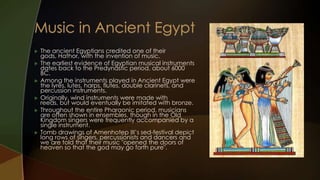
   The ancient Egyptians credited one of their
    gods, Hathor, with the invention of music.
   The earliest evidence of Egyptian musical instruments
    dates back to the Predynastic period, about 6000
    BC.
   Among the instruments played in Ancient Egypt were
    the lyres, lutes, harps, flutes, double clarinets, and
    percussion instruments.
   Originally, wind instruments were made with
    reeds, but would eventually be imitated with bronze.
   Throughout the entire Pharaonic period, musicians
    are often shown in ensembles, though in the Old
    Kingdom singers were frequently accompanied by a
    single instrument.
   Tomb drawings of Amenhotep III’s sed-festival depict
    long rows of singers, percussionists and dancers and
    we are told that their music "opened the doors of
    heaven so that the god may go forth pure".
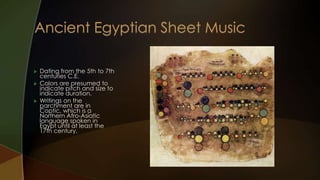
   Dating from the 5th to 7th
    centuries C.E.
   Colors are presumed to
    indicate pitch and size to
    indicate duration.
   Writings on the
    parchment are in
    Coptic, which is a
    Northern Afro-Asiatic
    language spoken in
    Egypt until at least the
    17th century.
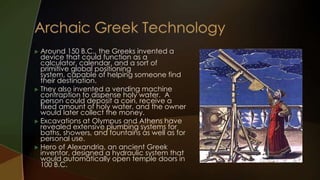
 Around 150 B.C., the Greeks invented a
  device that could function as a
  calculator, calendar, and a sort of
  primitive global positioning
  system, capable of helping someone find
  their destination.
 They also invented a vending machine
  contraption to dispense holy water. A
  person could deposit a coin, receive a
  fixed amount of holy water, and the owner
  would later collect the money.
 Excavations at Olympus and Athens have
  revealed extensive plumbing systems for
  baths, showers, and fountains as well as for
  personal use.
 Hero of Alexandria, an ancient Greek
  inventor, designed a hydraulic system that
  would automatically open temple doors in
  100 B.C.
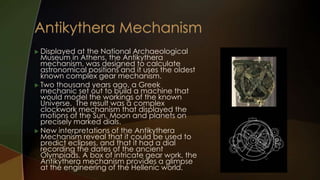
 Displayed  at the National Archaeological
  Museum in Athens, the Antikythera
  mechanism, was designed to calculate
  astronomical positions and it uses the oldest
  known complex gear mechanism.
 Two thousand years ago, a Greek
  mechanic set out to build a machine that
  would model the workings of the known
  Universe. The result was a complex
  clockwork mechanism that displayed the
  motions of the Sun, Moon and planets on
  precisely marked dials.
 New interpretations of the Antikythera
  Mechanism reveal that it could be used to
  predict eclipses, and that it had a dial
  recording the dates of the ancient
  Olympiads. A box of intricate gear work, the
  Antikythera mechanism provides a glimpse
  at the engineering of the Hellenic world.
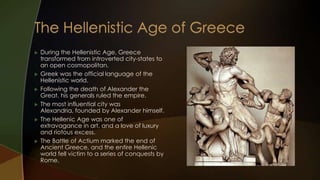
   During the Hellenistic Age, Greece
    transformed from introverted city-states to
    an open cosmopolitan.
   Greek was the official language of the
    Hellenistic world.
   Following the death of Alexander the
    Great, his generals ruled the empire.
   The most influential city was
    Alexandria, founded by Alexander himself.
   The Hellenic Age was one of
    extravagance in art, and a love of luxury
    and riotous excess.
   The Battle of Actium marked the end of
    Ancient Greece, and the entire Hellenic
    world fell victim to a series of conquests by
    Rome.
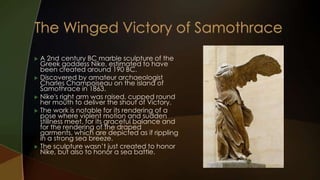
 A 2nd century BC marble sculpture of the
  Greek goddess Nike, estimated to have
  been created around 190 BC.
 Discovered by amateur archaeologist
  Charles Champoiseau on the island of
  Samothrace in 1863.
 Nike's right arm was raised, cupped round
  her mouth to deliver the shout of Victory.
 The work is notable for its rendering of a
  pose where violent motion and sudden
  stillness meet, for its graceful balance and
  for the rendering of the draped
  garments, which are depicted as if rippling
  in a strong sea breeze.
 The sculpture wasn’t just created to honor
  Nike, but also to honor a sea battle.
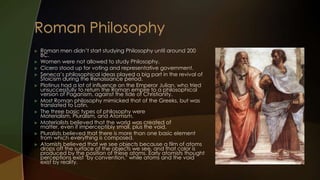
   Roman men didn’t start studying Philosophy until around 200
    BC.
   Women were not allowed to study Philosophy.
   Cicero stood up for voting and representative government.
   Seneca’s philosophical ideas played a big part in the revival of
    Stoicism during the Renaissance period.
   Plotinus had a lot of influence on the Emperor Julian, who tried
    unsuccessfully to return the Roman empire to a philosophical
    version of Paganism, against the tide of Christianity.
   Most Roman philosophy mimicked that of the Greeks, but was
    translated to Latin.
   The three basic types of philosophy were
    Materialism, Pluralism, and Atomism.
   Materialists believed that the world was created of
    matter, even if imperceptibly small, plus the void.
   Pluralists believed that there is more than one basic element
    from which everything is composed.
   Atomists believed that we see objects because a film of atoms
    drops off the surface of the objects we see, and that color is
    produced by the position of these atoms. Early atomists thought
    perceptions exist "by convention," while atoms and the void
    exist by reality.
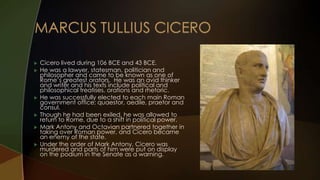
   Cicero lived during 106 BCE and 43 BCE.
   He was a lawyer, statesman, politician and
    philosopher and came to be known as one of
    Rome’s greatest orators. He was an avid thinker
    and writer and his texts include political and
    philosophical treatises, orations and rhetoric.
   He was successfully elected to each main Roman
    government office; quaestor, aedile, praetor and
    consul.
   Though he had been exiled, he was allowed to
    return to Rome, due to a shift in political power.
   Mark Antony and Octavian partnered together in
    taking over Roman power, and Cicero became
    an enemy of the state.
   Under the order of Mark Antony, Cicero was
    murdered and parts of him were put on display
    on the podium in the Senate as a warning.
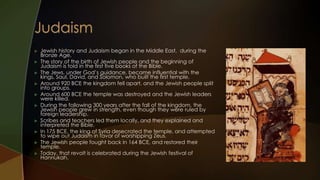
   Jewish history and Judaism began in the Middle East, during the
    Bronze Age.
   The story of the birth of Jewish people and the beginning of
    Judaism is told in the first five books of the Bible.
   The Jews, under God’s guidance, became influential with the
    kings, Saul, David, and Solomon, who built the first temple.
   Around 920 BCE the kingdom fell apart, and the Jewish people split
    into groups.
   Around 600 BCE the temple was destroyed and the Jewish leaders
    were killed.
   During the following 300 years after the fall of the kingdom, the
    Jewish people grew in strength, even though they were ruled by
    foreign leadership.
   Scribes and teachers led them locally, and they explained and
    interpreted the Bible.
   In 175 BCE, the king of Syria desecrated the temple, and attempted
    to wipe out Judaism in favor of worshipping Zeus.
   The Jewish people fought back in 164 BCE, and restored their
    temple.
   Today, that revolt is celebrated during the Jewish festival of
    Hannukah.
   1 CE - 70 CE
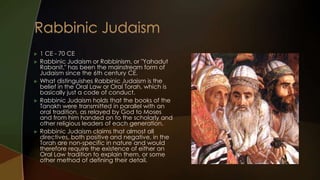
   Rabbinic Judaism or Rabbinism, or "Yahadut
    Rabanit," has been the mainstream form of
    Judaism since the 6th century CE.
   What distinguishes Rabbinic Judaism is the
    belief in the Oral Law or Oral Torah, which is
    basically just a code of conduct.
   Rabbinic Judaism holds that the books of the
    Tanakh were transmitted in parallel with an
    oral tradition, as relayed by God to Moses
    and from him handed on to the scholarly and
    other religious leaders of each generation.
   Rabbinic Judaism claims that almost all
    directives, both positive and negative, in the
    Torah are non-specific in nature and would
    therefore require the existence of either an
    Oral Law tradition to explain them, or some
    other method of defining their detail.
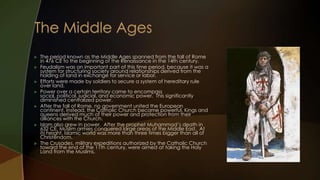
   The period known as the Middle Ages spanned from the fall of Rome
    in 476 CE to the beginning of the Renaissance in the 14th century.
   Feudalism was an important part of this time period, because it was a
    system for structuring society around relationships derived from the
    holding of land in exchange for service or labor.
   Efforts were made by soldiers to secure a system of hereditary rule
    over land.
   Power over a certain territory came to encompass
    social, political, judicial, and economic power. This significantly
    diminished centralized power.
   After the fall of Rome, no government united the European
    continent. Instead, the Catholic Church became powerful. Kings and
    queens derived much of their power and protection from their
    alliances with the Church.
   Islam also grew in power. After the prophet Muhammad’s death in
    632 CE, Muslim armies conquered large areas of the Middle East. At
    its height, Islamic world was more than three times bigger than all of
    Christendom.
   The Crusades, military expeditions authorized by the Catholic Church
    toward the end of the 11th century, were aimed at taking the Holy
    Land from the Muslims.
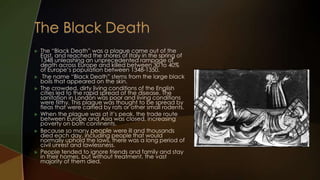
   The “Black Death” was a plague came out of the
    East, and reached the shores of Italy in the spring of
    1348 unleashing an unprecedented rampage of
    death across Europe and killed between 30 to 40%
    of Europe’s population between 1348-1350.
    The name “Black Death” stems from the large black
    boils that appeared on the skin.
   The crowded, dirty living conditions of the English
    cities led to the rapid spread of the disease. The
    sanitation in London was poor and living conditions
    were filthy. This plague was thought to be spread by
    fleas that were carried by rats or other small rodents.
   When the plague was at it’s peak, the trade route
    between Europe and Asia was closed, increasing
    poverty on both continents.
   Because so many people were ill and thousands
    died each day, including people that would
    normally uphold the laws, there was a long period of
    civil unrest and lawlessness.
   People tended to ignore friends and family and stay
    in their homes, but without treatment, the vast
    majority of them died.
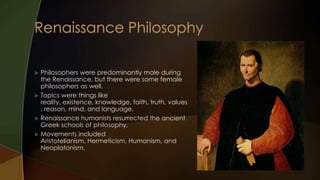
   Philosophers were predominantly male during
    the Renaissance, but there were some female
    philosophers as well.
   Topics were things like
    reality, existence, knowledge, faith, truth, values
    , reason, mind, and language.
   Renaissance humanists resurrected the ancient
    Greek schools of philosophy.
   Movements included
    Aristotelianism, Hermeticism, Humanism, and
    Neoplatonism.
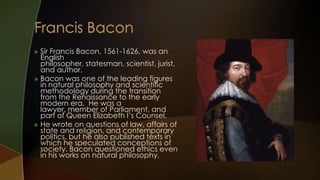
 SirFrancis Bacon, 1561-1626, was an
  English
  philosopher, statesman, scientist, jurist,
  and author.
 Bacon was one of the leading figures
  in natural philosophy and scientific
  methodology during the transition
  from the Renaissance to the early
  modern era. He was a
  lawyer, member of Parliament, and
  part of Queen Elizabeth I’s Counsel.
 He wrote on questions of law, affairs of
  state and religion, and contemporary
  politics, but he also published texts in
  which he speculated conceptions of
  society. Bacon questioned ethics even
  in his works on natural philosophy.
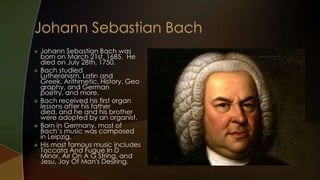
 Johann Sebastian Bach was
  born on March 21st, 1685. He
  died on July 28th, 1750.
 Bach studied
  Lutheranism, Latin and
  Greek, Arithmetic, History, Geo
  graphy, and German
  poetry, and more.
 Bach received his first organ
  lessons after his father
  died, and he and his brother
  were adopted by an organist.
 Born in Germany, most of
  Bach’s music was composed
  in Leipzig.
 His most famous music includes
  Toccata And Fugue In D
  Minor, Air On A G String, and
  Jesu, Joy Of Man's Desiring.
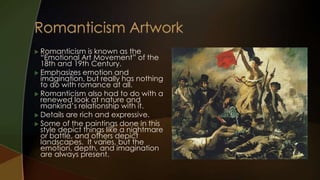
 Romanticism    is known as the
  “Emotional Art Movement” of the
  18th and 19th Century.
 Emphasizes emotion and
  imagination, but really has nothing
  to do with romance at all.
 Romanticism also had to do with a
  renewed look at nature and
  mankind’s relationship with it.
 Details are rich and expressive.
 Some of the paintings done in this
  style depict things like a nightmare
  or battle, and others depict
  landscapes. It varies, but the
  emotion, depth, and imagination
  are always present.
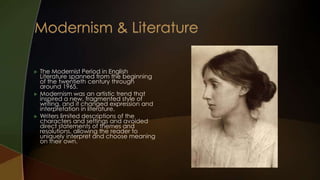
   The Modernist Period in English
    Literature spanned from the beginning
    of the twentieth century through
    around 1965.
   Modernism was an artistic trend that
    inspired a new, fragmented style of
    writing, and it changed expression and
    interpretation in literature.
   Writers limited descriptions of the
    characters and settings and avoided
    direct statements of themes and
    resolutions, allowing the reader to
    uniquely interpret and choose meaning
    on their own.
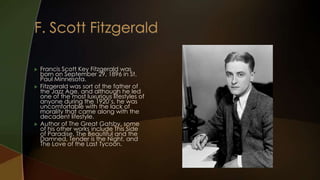
   Francis Scott Key Fitzgerald was
    born on September 29, 1896 in St.
    Paul Minnesota.
   Fitzgerald was sort of the father of
    the Jazz Age, and although he led
    one of the most luxurious lifestyles of
    anyone during the 1920’s, he was
    uncomfortable with the lack of
    morality that came along with the
    decadent lifestyle.
   Author of The Great Gatsby, some
    of his other works include This Side
    of Paradise, The Beautiful and the
    Damned, Tender is the Night, and
    The Love of the Last Tycoon.
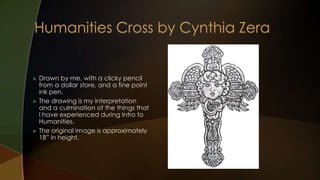
   Drawn by me, with a clicky pencil
    from a dollar store, and a fine point
    ink pen.
   The drawing is my interpretation
    and a culmination of the things that
    I have experienced during Intro to
    Humanities.
   The original image is approximately
    18” in height.
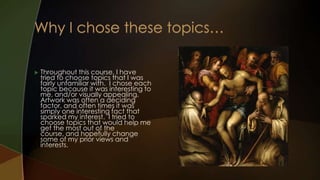
   Throughout this course, I have
    tried to choose topics that I was
    fairly unfamiliar with. I chose each
    topic because it was interesting to
    me, and/or visually appealing.
    Artwork was often a deciding
    factor, and often times it was
    simply one interesting fact that
    sparked my interest. I tried to
    choose topics that would help me
    get the most out of the
    course, and hopefully change
    some of my prior views and
    interests.
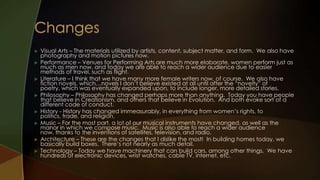
   Visual Arts – The materials utilized by artists, content, subject matter, and form. We also have
    photography and motion pictures now.
   Performance – Venues for Performing Arts are much more elaborate, women perform just as
    much as men now, and today we are able to reach a wider audience due to easier
    methods of travel, such as flight.
   Literature – I think that we have many more female writers now, of course. We also have
    fiction novels, which…novels I don’t believe existed at all until after the “novelty” of
    poetry, which was eventually expanded upon, to include longer, more detailed stories.
   Philosophy – Philosophy has changed perhaps more than anything. Today you have people
    that believe in Creationism, and others that believe in Evolution. And both evoke sort of a
    different code of conduct.
   History - History has changed immeasurably, in everything from women’s rights, to
    politics, trade, and religion.
   Music – For the most part, a lot of our musical instruments have changed, as well as the
    manor in which we compose music. Music is also able to reach a wider audience
    now, thanks to the inventions of satellites, television, and radio.
   Architecture – These are the changes that I dislike the most! In building homes today, we
    basically build boxes. There’s not nearly as much detail.
   Technology – Today we have machinery that can build cars, among other things. We have
    hundreds of electronic devices, wrist watches, cable TV, internet, etc.
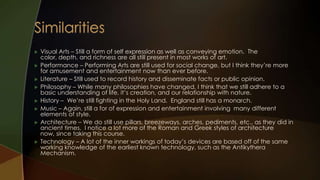
   Visual Arts – Still a form of self expression as well as conveying emotion. The
    color, depth, and richness are all still present in most works of art.
   Performance – Performing Arts are still used for social change, but I think they’re more
    for amusement and entertainment now than ever before.
   Literature – Still used to record history and disseminate facts or public opinion.
   Philosophy – While many philosophies have changed, I think that we still adhere to a
    basic understanding of life, it’s creation, and our relationship with nature.
   History – We’re still fighting in the Holy Land. England still has a monarch.
   Music – Again, still a for of expression and entertainment involving many different
    elements of style.
   Architecture – We do still use pillars, breezeways, arches, pediments, etc., as they did in
    ancient times. I notice a lot more of the Roman and Greek styles of architecture
    now, since taking this course.
   Technology – A lot of the inner workings of today’s devices are based off of the same
    working knowledge of the earliest known technology, such as the Antikythera
    Mechanism.
   http://continuo-docs.tumblr.com/post/35045558160/ancient-egyptian-music-notation-
    from-a-set-of-6
   http://pubsub.com/Lego-Antikythera-Mechanism_historic-technology-
    3XCpwoLDcqD,bVb8LJfO37QE
   http://en.wikipedia.org/wiki/Winged_Victory_of_Samothrace
   http://www.egs.edu/library/cicero/biography/
   http://s1032.beta.photobucket.com/user/AraMaxima/media/June%2029-
    30/IMG_3398.jpg.html
   http://www.egs.edu/library/cicero/biography/
   http://www.bbc.co.uk/religion/religions/judaism/history/history_1.shtml
   http://en.wikipedia.org/wiki/Rabbinic_Judaism
   http://char.txa.cornell.edu/art/fineart/change/change.htm
   http://www.slc.edu/catalogue/creative-and-performing-arts/theatre/courses/2012-
    2013/primary/using-the-performing-arts-for-social-change.html
   http://webspace.ship.edu/cgboer/romanempire.html
   http://en.wikipedia.org/wiki/Cicero
   http://www.historyforkids.org/learn/romans/philosophy/
   http://www.middle-ages.org.uk/black-death.htm
   http://en.wikipedia.org/wiki/F._Scott_Fitzgerald
   http://www.online-literature.com/periods/modernism.php
   http://www.123helpme.com/modernism-in-the-great-gatsby-view.asp?id=161927
   http://voices.yahoo.com/5-amazing-technologies-invented-ancient-greece-
    7483038.html?cat=37
   http://en.wikipedia.org/wiki/Ancient_Greek_technology
   http://www.scientificamerican.com/article.cfm?id=unique-marvel-of-ancient
   http://www.greek-thesaurus.gr/hellenistic-period.html
   http://www.ancient-greece.org/history/helleninstic.html
   http://highered.mcgraw-
    hill.com/sites/dl/free/0073136190/513721/Matthews6e_ch03.pdf
   http://www.fsmitha.com/h1/phil16.htm
   http://www.iep.utm.edu/romanphi/
   http://plato.stanford.edu/entries/seneca/
   http://www.bbc.co.uk/history/british/middle_ages/
   http://www.history.com/topics/middle-ages
   http://en.wikipedia.org/wiki/Feudalism
   http://www.academia.edu/1636051/Renaissance_Philosophy
   http://en.wikipedia.org/wiki/Renaissance_philosophy
   http://en.wikipedia.org/wiki/Francis_Bacon
   http://classicalmusic.about.com/od/classicalcomposers/p/bach.htm
   http://answers.yahoo.com/question/index?qid=20080917183116AASQ52U
   http://en.wikipedia.org/wiki/Johann_Sebastian_Bach
   http://www.baroquemusic.org/bqxjsbach.html
   http://en.wikipedia.org/wiki/The_Last_Day_of_Pompeii
   http://emptyeasel.com/2007/11/20/romanticism-the-emotional-art-movement-of-the-
    18th-and-19th-century/
   https://www.mtholyoke.edu/courses/rschwart/hist255/la/delacroix.html
   http://artofmanliness.com/2011/03/03/the-basics-of-art-the-romantic-period/

Humanities by Cynthia Zera

  • 1.
  • 2.
    The ancient Egyptians credited one of their gods, Hathor, with the invention of music.  The earliest evidence of Egyptian musical instruments dates back to the Predynastic period, about 6000 BC.  Among the instruments played in Ancient Egypt were the lyres, lutes, harps, flutes, double clarinets, and percussion instruments.  Originally, wind instruments were made with reeds, but would eventually be imitated with bronze.  Throughout the entire Pharaonic period, musicians are often shown in ensembles, though in the Old Kingdom singers were frequently accompanied by a single instrument.  Tomb drawings of Amenhotep III’s sed-festival depict long rows of singers, percussionists and dancers and we are told that their music "opened the doors of heaven so that the god may go forth pure".
  • 3.
    Dating from the 5th to 7th centuries C.E.  Colors are presumed to indicate pitch and size to indicate duration.  Writings on the parchment are in Coptic, which is a Northern Afro-Asiatic language spoken in Egypt until at least the 17th century.
  • 4.
     Around 150B.C., the Greeks invented a device that could function as a calculator, calendar, and a sort of primitive global positioning system, capable of helping someone find their destination.  They also invented a vending machine contraption to dispense holy water. A person could deposit a coin, receive a fixed amount of holy water, and the owner would later collect the money.  Excavations at Olympus and Athens have revealed extensive plumbing systems for baths, showers, and fountains as well as for personal use.  Hero of Alexandria, an ancient Greek inventor, designed a hydraulic system that would automatically open temple doors in 100 B.C.
  • 5.
     Displayed at the National Archaeological Museum in Athens, the Antikythera mechanism, was designed to calculate astronomical positions and it uses the oldest known complex gear mechanism.  Two thousand years ago, a Greek mechanic set out to build a machine that would model the workings of the known Universe. The result was a complex clockwork mechanism that displayed the motions of the Sun, Moon and planets on precisely marked dials.  New interpretations of the Antikythera Mechanism reveal that it could be used to predict eclipses, and that it had a dial recording the dates of the ancient Olympiads. A box of intricate gear work, the Antikythera mechanism provides a glimpse at the engineering of the Hellenic world.
  • 6.
    During the Hellenistic Age, Greece transformed from introverted city-states to an open cosmopolitan.  Greek was the official language of the Hellenistic world.  Following the death of Alexander the Great, his generals ruled the empire.  The most influential city was Alexandria, founded by Alexander himself.  The Hellenic Age was one of extravagance in art, and a love of luxury and riotous excess.  The Battle of Actium marked the end of Ancient Greece, and the entire Hellenic world fell victim to a series of conquests by Rome.
  • 7.
     A 2ndcentury BC marble sculpture of the Greek goddess Nike, estimated to have been created around 190 BC.  Discovered by amateur archaeologist Charles Champoiseau on the island of Samothrace in 1863.  Nike's right arm was raised, cupped round her mouth to deliver the shout of Victory.  The work is notable for its rendering of a pose where violent motion and sudden stillness meet, for its graceful balance and for the rendering of the draped garments, which are depicted as if rippling in a strong sea breeze.  The sculpture wasn’t just created to honor Nike, but also to honor a sea battle.
  • 8.
    Roman men didn’t start studying Philosophy until around 200 BC.  Women were not allowed to study Philosophy.  Cicero stood up for voting and representative government.  Seneca’s philosophical ideas played a big part in the revival of Stoicism during the Renaissance period.  Plotinus had a lot of influence on the Emperor Julian, who tried unsuccessfully to return the Roman empire to a philosophical version of Paganism, against the tide of Christianity.  Most Roman philosophy mimicked that of the Greeks, but was translated to Latin.  The three basic types of philosophy were Materialism, Pluralism, and Atomism.  Materialists believed that the world was created of matter, even if imperceptibly small, plus the void.  Pluralists believed that there is more than one basic element from which everything is composed.  Atomists believed that we see objects because a film of atoms drops off the surface of the objects we see, and that color is produced by the position of these atoms. Early atomists thought perceptions exist "by convention," while atoms and the void exist by reality.
  • 9.
    Cicero lived during 106 BCE and 43 BCE.  He was a lawyer, statesman, politician and philosopher and came to be known as one of Rome’s greatest orators. He was an avid thinker and writer and his texts include political and philosophical treatises, orations and rhetoric.  He was successfully elected to each main Roman government office; quaestor, aedile, praetor and consul.  Though he had been exiled, he was allowed to return to Rome, due to a shift in political power.  Mark Antony and Octavian partnered together in taking over Roman power, and Cicero became an enemy of the state.  Under the order of Mark Antony, Cicero was murdered and parts of him were put on display on the podium in the Senate as a warning.
  • 10.
    Jewish history and Judaism began in the Middle East, during the Bronze Age.  The story of the birth of Jewish people and the beginning of Judaism is told in the first five books of the Bible.  The Jews, under God’s guidance, became influential with the kings, Saul, David, and Solomon, who built the first temple.  Around 920 BCE the kingdom fell apart, and the Jewish people split into groups.  Around 600 BCE the temple was destroyed and the Jewish leaders were killed.  During the following 300 years after the fall of the kingdom, the Jewish people grew in strength, even though they were ruled by foreign leadership.  Scribes and teachers led them locally, and they explained and interpreted the Bible.  In 175 BCE, the king of Syria desecrated the temple, and attempted to wipe out Judaism in favor of worshipping Zeus.  The Jewish people fought back in 164 BCE, and restored their temple.  Today, that revolt is celebrated during the Jewish festival of Hannukah.
  • 11.
    1 CE - 70 CE  Rabbinic Judaism or Rabbinism, or "Yahadut Rabanit," has been the mainstream form of Judaism since the 6th century CE.  What distinguishes Rabbinic Judaism is the belief in the Oral Law or Oral Torah, which is basically just a code of conduct.  Rabbinic Judaism holds that the books of the Tanakh were transmitted in parallel with an oral tradition, as relayed by God to Moses and from him handed on to the scholarly and other religious leaders of each generation.  Rabbinic Judaism claims that almost all directives, both positive and negative, in the Torah are non-specific in nature and would therefore require the existence of either an Oral Law tradition to explain them, or some other method of defining their detail.
  • 12.
    The period known as the Middle Ages spanned from the fall of Rome in 476 CE to the beginning of the Renaissance in the 14th century.  Feudalism was an important part of this time period, because it was a system for structuring society around relationships derived from the holding of land in exchange for service or labor.  Efforts were made by soldiers to secure a system of hereditary rule over land.  Power over a certain territory came to encompass social, political, judicial, and economic power. This significantly diminished centralized power.  After the fall of Rome, no government united the European continent. Instead, the Catholic Church became powerful. Kings and queens derived much of their power and protection from their alliances with the Church.  Islam also grew in power. After the prophet Muhammad’s death in 632 CE, Muslim armies conquered large areas of the Middle East. At its height, Islamic world was more than three times bigger than all of Christendom.  The Crusades, military expeditions authorized by the Catholic Church toward the end of the 11th century, were aimed at taking the Holy Land from the Muslims.
  • 13.
    The “Black Death” was a plague came out of the East, and reached the shores of Italy in the spring of 1348 unleashing an unprecedented rampage of death across Europe and killed between 30 to 40% of Europe’s population between 1348-1350.  The name “Black Death” stems from the large black boils that appeared on the skin.  The crowded, dirty living conditions of the English cities led to the rapid spread of the disease. The sanitation in London was poor and living conditions were filthy. This plague was thought to be spread by fleas that were carried by rats or other small rodents.  When the plague was at it’s peak, the trade route between Europe and Asia was closed, increasing poverty on both continents.  Because so many people were ill and thousands died each day, including people that would normally uphold the laws, there was a long period of civil unrest and lawlessness.  People tended to ignore friends and family and stay in their homes, but without treatment, the vast majority of them died.
  • 14.
    Philosophers were predominantly male during the Renaissance, but there were some female philosophers as well.  Topics were things like reality, existence, knowledge, faith, truth, values , reason, mind, and language.  Renaissance humanists resurrected the ancient Greek schools of philosophy.  Movements included Aristotelianism, Hermeticism, Humanism, and Neoplatonism.
  • 15.
     SirFrancis Bacon,1561-1626, was an English philosopher, statesman, scientist, jurist, and author.  Bacon was one of the leading figures in natural philosophy and scientific methodology during the transition from the Renaissance to the early modern era. He was a lawyer, member of Parliament, and part of Queen Elizabeth I’s Counsel.  He wrote on questions of law, affairs of state and religion, and contemporary politics, but he also published texts in which he speculated conceptions of society. Bacon questioned ethics even in his works on natural philosophy.
  • 16.
     Johann SebastianBach was born on March 21st, 1685. He died on July 28th, 1750.  Bach studied Lutheranism, Latin and Greek, Arithmetic, History, Geo graphy, and German poetry, and more.  Bach received his first organ lessons after his father died, and he and his brother were adopted by an organist.  Born in Germany, most of Bach’s music was composed in Leipzig.  His most famous music includes Toccata And Fugue In D Minor, Air On A G String, and Jesu, Joy Of Man's Desiring.
  • 18.
     Romanticism is known as the “Emotional Art Movement” of the 18th and 19th Century.  Emphasizes emotion and imagination, but really has nothing to do with romance at all.  Romanticism also had to do with a renewed look at nature and mankind’s relationship with it.  Details are rich and expressive.  Some of the paintings done in this style depict things like a nightmare or battle, and others depict landscapes. It varies, but the emotion, depth, and imagination are always present.
  • 20.
    The Modernist Period in English Literature spanned from the beginning of the twentieth century through around 1965.  Modernism was an artistic trend that inspired a new, fragmented style of writing, and it changed expression and interpretation in literature.  Writers limited descriptions of the characters and settings and avoided direct statements of themes and resolutions, allowing the reader to uniquely interpret and choose meaning on their own.
  • 21.
    Francis Scott Key Fitzgerald was born on September 29, 1896 in St. Paul Minnesota.  Fitzgerald was sort of the father of the Jazz Age, and although he led one of the most luxurious lifestyles of anyone during the 1920’s, he was uncomfortable with the lack of morality that came along with the decadent lifestyle.  Author of The Great Gatsby, some of his other works include This Side of Paradise, The Beautiful and the Damned, Tender is the Night, and The Love of the Last Tycoon.
  • 22.
    Drawn by me, with a clicky pencil from a dollar store, and a fine point ink pen.  The drawing is my interpretation and a culmination of the things that I have experienced during Intro to Humanities.  The original image is approximately 18” in height.
  • 23.
    Throughout this course, I have tried to choose topics that I was fairly unfamiliar with. I chose each topic because it was interesting to me, and/or visually appealing. Artwork was often a deciding factor, and often times it was simply one interesting fact that sparked my interest. I tried to choose topics that would help me get the most out of the course, and hopefully change some of my prior views and interests.
  • 24.
    Visual Arts – The materials utilized by artists, content, subject matter, and form. We also have photography and motion pictures now.  Performance – Venues for Performing Arts are much more elaborate, women perform just as much as men now, and today we are able to reach a wider audience due to easier methods of travel, such as flight.  Literature – I think that we have many more female writers now, of course. We also have fiction novels, which…novels I don’t believe existed at all until after the “novelty” of poetry, which was eventually expanded upon, to include longer, more detailed stories.  Philosophy – Philosophy has changed perhaps more than anything. Today you have people that believe in Creationism, and others that believe in Evolution. And both evoke sort of a different code of conduct.  History - History has changed immeasurably, in everything from women’s rights, to politics, trade, and religion.  Music – For the most part, a lot of our musical instruments have changed, as well as the manor in which we compose music. Music is also able to reach a wider audience now, thanks to the inventions of satellites, television, and radio.  Architecture – These are the changes that I dislike the most! In building homes today, we basically build boxes. There’s not nearly as much detail.  Technology – Today we have machinery that can build cars, among other things. We have hundreds of electronic devices, wrist watches, cable TV, internet, etc.
  • 25.
    Visual Arts – Still a form of self expression as well as conveying emotion. The color, depth, and richness are all still present in most works of art.  Performance – Performing Arts are still used for social change, but I think they’re more for amusement and entertainment now than ever before.  Literature – Still used to record history and disseminate facts or public opinion.  Philosophy – While many philosophies have changed, I think that we still adhere to a basic understanding of life, it’s creation, and our relationship with nature.  History – We’re still fighting in the Holy Land. England still has a monarch.  Music – Again, still a for of expression and entertainment involving many different elements of style.  Architecture – We do still use pillars, breezeways, arches, pediments, etc., as they did in ancient times. I notice a lot more of the Roman and Greek styles of architecture now, since taking this course.  Technology – A lot of the inner workings of today’s devices are based off of the same working knowledge of the earliest known technology, such as the Antikythera Mechanism.
  • 26.
    http://continuo-docs.tumblr.com/post/35045558160/ancient-egyptian-music-notation- from-a-set-of-6  http://pubsub.com/Lego-Antikythera-Mechanism_historic-technology- 3XCpwoLDcqD,bVb8LJfO37QE  http://en.wikipedia.org/wiki/Winged_Victory_of_Samothrace  http://www.egs.edu/library/cicero/biography/  http://s1032.beta.photobucket.com/user/AraMaxima/media/June%2029- 30/IMG_3398.jpg.html  http://www.egs.edu/library/cicero/biography/  http://www.bbc.co.uk/religion/religions/judaism/history/history_1.shtml  http://en.wikipedia.org/wiki/Rabbinic_Judaism  http://char.txa.cornell.edu/art/fineart/change/change.htm  http://www.slc.edu/catalogue/creative-and-performing-arts/theatre/courses/2012- 2013/primary/using-the-performing-arts-for-social-change.html  http://webspace.ship.edu/cgboer/romanempire.html  http://en.wikipedia.org/wiki/Cicero  http://www.historyforkids.org/learn/romans/philosophy/
  • 27.
    http://www.middle-ages.org.uk/black-death.htm  http://en.wikipedia.org/wiki/F._Scott_Fitzgerald  http://www.online-literature.com/periods/modernism.php  http://www.123helpme.com/modernism-in-the-great-gatsby-view.asp?id=161927  http://voices.yahoo.com/5-amazing-technologies-invented-ancient-greece- 7483038.html?cat=37  http://en.wikipedia.org/wiki/Ancient_Greek_technology  http://www.scientificamerican.com/article.cfm?id=unique-marvel-of-ancient  http://www.greek-thesaurus.gr/hellenistic-period.html  http://www.ancient-greece.org/history/helleninstic.html  http://highered.mcgraw- hill.com/sites/dl/free/0073136190/513721/Matthews6e_ch03.pdf  http://www.fsmitha.com/h1/phil16.htm  http://www.iep.utm.edu/romanphi/  http://plato.stanford.edu/entries/seneca/
  • 28.
    http://www.bbc.co.uk/history/british/middle_ages/  http://www.history.com/topics/middle-ages  http://en.wikipedia.org/wiki/Feudalism  http://www.academia.edu/1636051/Renaissance_Philosophy  http://en.wikipedia.org/wiki/Renaissance_philosophy  http://en.wikipedia.org/wiki/Francis_Bacon  http://classicalmusic.about.com/od/classicalcomposers/p/bach.htm  http://answers.yahoo.com/question/index?qid=20080917183116AASQ52U  http://en.wikipedia.org/wiki/Johann_Sebastian_Bach  http://www.baroquemusic.org/bqxjsbach.html  http://en.wikipedia.org/wiki/The_Last_Day_of_Pompeii  http://emptyeasel.com/2007/11/20/romanticism-the-emotional-art-movement-of-the- 18th-and-19th-century/  https://www.mtholyoke.edu/courses/rschwart/hist255/la/delacroix.html  http://artofmanliness.com/2011/03/03/the-basics-of-art-the-romantic-period/