Social Research
Nature, Types
and
Scientific Method
Nature of Social Research
❖ Research that draws on the social sciences for conceptual
and theoretical inspiration
❖ Motivated by development and change in society (such as
rise in worries about security or binge-drinking)
❖ It employs social scientific ideas to illuminate those changes
❖ Unlike natural sciences, social sciences lack the power of
exact prediction- irregular nature of human behaviour
❖ Cause and effect are difficult to be segregated
Types of Social Research
Descriptive Vs Analytical
❖ Descriptive research- surveys and fact finding studies; to
describe the state of affairs as it exists at present; also
called Ex post facto research; researcher has no control
over the variables, he/she can only report what is
happening; cause and effect
❖ Analytical research- researcher has to use facts or
information already available, analyse these facts to
make critical evaluation of the material
Types
Applied Vs Fundamental
❖ Applied Research- finding a solution for an immediate
problem
❖ Fundamental Research- pure or basic type; concerned
with generalisations and with the formulation of a
theory; gathering knowledge for knowledge sake
Types
Qualitative Vs Quantitative
❖ Qualitative- concerned with phenomena relating to
quality; discovering the underlying motives and desires;
understanding why it happens- explaining in words
❖ Quantitative- based on the measurement of quantity or
amount; applicable to phenomena that can be expressed
in terms of quantity- numbers
Types
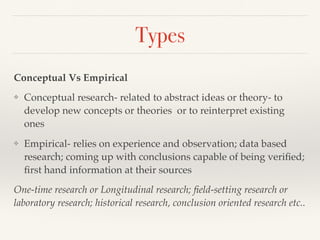
Conceptual Vs Empirical
❖ Conceptual research- related to abstract ideas or theory- to
develop new concepts or theories or to reinterpret existing
ones
❖ Empirical- relies on experience and observation; data based
research; coming up with conclusions capable of being verified;
first hand information at their sources
One-time research or Longitudinal research; field-setting research or
laboratory research; historical research, conclusion oriented research etc..
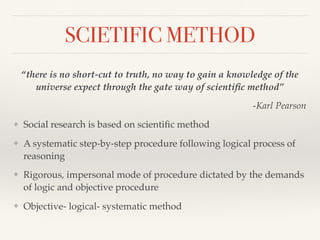
SCIETIFIC METHOD
“there is no short-cut to truth, no way to gain a knowledge of the
universe expect through the gate way of scientific method”
-Karl Pearson
❖ Social research is based on scientific method
❖ A systematic step-by-step procedure following logical process of
reasoning
❖ Rigorous, impersonal mode of procedure dictated by the demands
of logic and objective procedure
❖ Objective- logical- systematic method
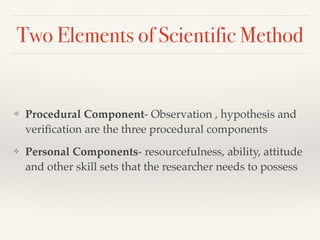
Two Elements of Scientific Method
❖ Procedural Component- Observation , hypothesis and
verification are the three procedural components
❖ Personal Components- resourcefulness, ability, attitude
and other skill sets that the researcher needs to possess
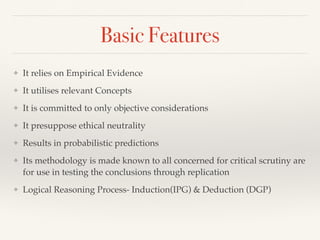
Basic Features
❖ It relies on Empirical Evidence
❖ It utilises relevant Concepts
❖ It is committed to only objective considerations
❖ It presuppose ethical neutrality
❖ Results in probabilistic predictions
❖ Its methodology is made known to all concerned for critical scrutiny are
for use in testing the conclusions through replication
❖ Logical Reasoning Process- Induction(IPG) & Deduction (DGP)
However, whether human behaviour can be
categorised, studied and analysed scientifically is
highly debatable!!!

Social Research: nature, types and scientific method

  • 1.
  • 2.
    Nature of SocialResearch ❖ Research that draws on the social sciences for conceptual and theoretical inspiration ❖ Motivated by development and change in society (such as rise in worries about security or binge-drinking) ❖ It employs social scientific ideas to illuminate those changes ❖ Unlike natural sciences, social sciences lack the power of exact prediction- irregular nature of human behaviour ❖ Cause and effect are difficult to be segregated
  • 3.
    Types of SocialResearch Descriptive Vs Analytical ❖ Descriptive research- surveys and fact finding studies; to describe the state of affairs as it exists at present; also called Ex post facto research; researcher has no control over the variables, he/she can only report what is happening; cause and effect ❖ Analytical research- researcher has to use facts or information already available, analyse these facts to make critical evaluation of the material
  • 4.
    Types Applied Vs Fundamental ❖Applied Research- finding a solution for an immediate problem ❖ Fundamental Research- pure or basic type; concerned with generalisations and with the formulation of a theory; gathering knowledge for knowledge sake
  • 5.
    Types Qualitative Vs Quantitative ❖Qualitative- concerned with phenomena relating to quality; discovering the underlying motives and desires; understanding why it happens- explaining in words ❖ Quantitative- based on the measurement of quantity or amount; applicable to phenomena that can be expressed in terms of quantity- numbers
  • 6.
    Types Conceptual Vs Empirical ❖Conceptual research- related to abstract ideas or theory- to develop new concepts or theories or to reinterpret existing ones ❖ Empirical- relies on experience and observation; data based research; coming up with conclusions capable of being verified; first hand information at their sources One-time research or Longitudinal research; field-setting research or laboratory research; historical research, conclusion oriented research etc..
  • 7.
    SCIETIFIC METHOD “there isno short-cut to truth, no way to gain a knowledge of the universe expect through the gate way of scientific method” -Karl Pearson ❖ Social research is based on scientific method ❖ A systematic step-by-step procedure following logical process of reasoning ❖ Rigorous, impersonal mode of procedure dictated by the demands of logic and objective procedure ❖ Objective- logical- systematic method
  • 8.
    Two Elements ofScientific Method ❖ Procedural Component- Observation , hypothesis and verification are the three procedural components ❖ Personal Components- resourcefulness, ability, attitude and other skill sets that the researcher needs to possess
  • 9.
    Basic Features ❖ Itrelies on Empirical Evidence ❖ It utilises relevant Concepts ❖ It is committed to only objective considerations ❖ It presuppose ethical neutrality ❖ Results in probabilistic predictions ❖ Its methodology is made known to all concerned for critical scrutiny are for use in testing the conclusions through replication ❖ Logical Reasoning Process- Induction(IPG) & Deduction (DGP)
  • 10.
    However, whether humanbehaviour can be categorised, studied and analysed scientifically is highly debatable!!!