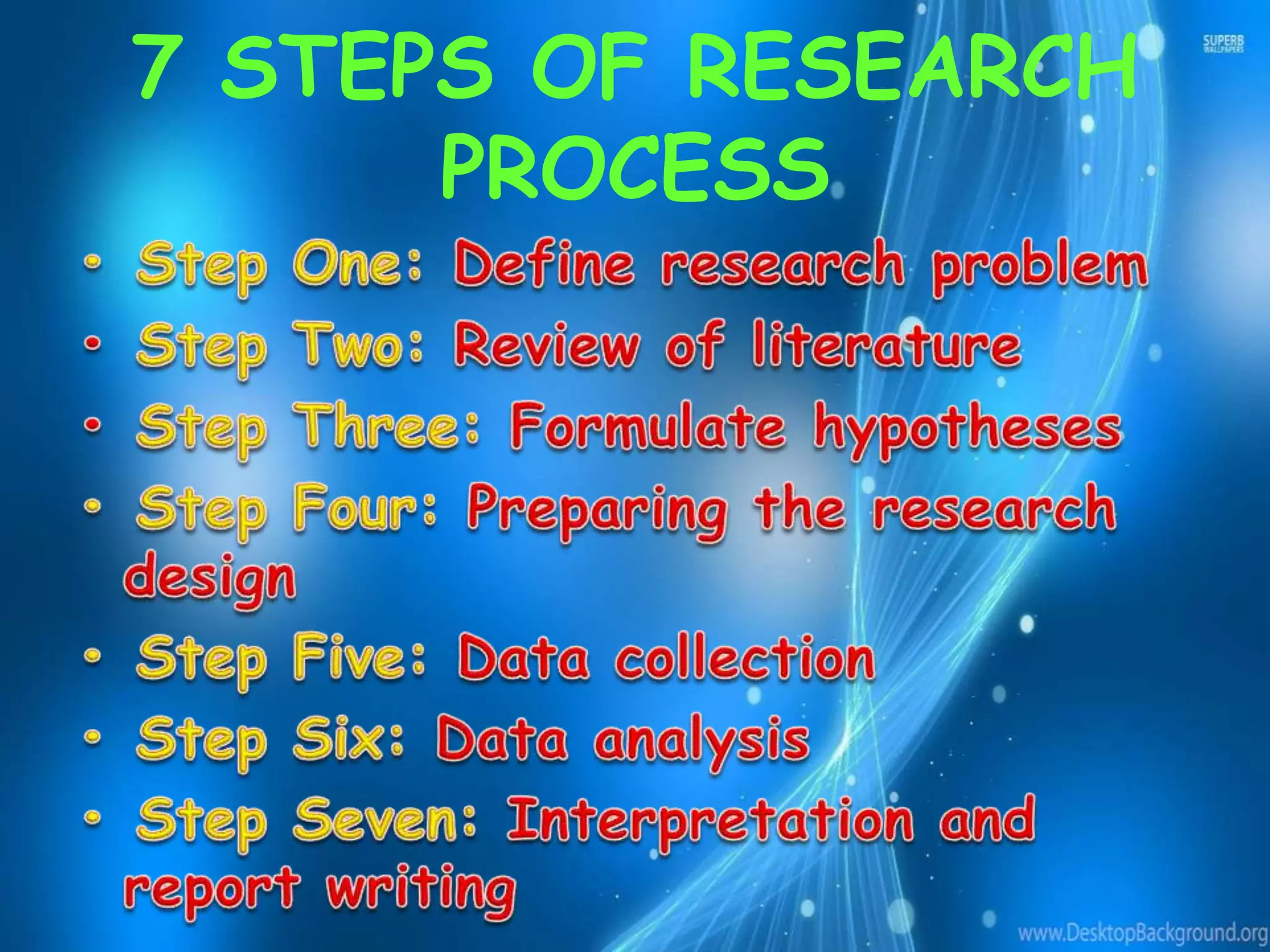
Research is defined as a systematic investigation aimed at discovering facts or solving problems, with methods including the scientific and historical approaches. It involves a seven-step process including problem definition, hypothesis formulation, research design, data collection, analysis, and report writing, aimed at advancing human knowledge. Good quality research requires adherence to scientific methods and careful selection of research designs and data collection techniques.
What Is Research?
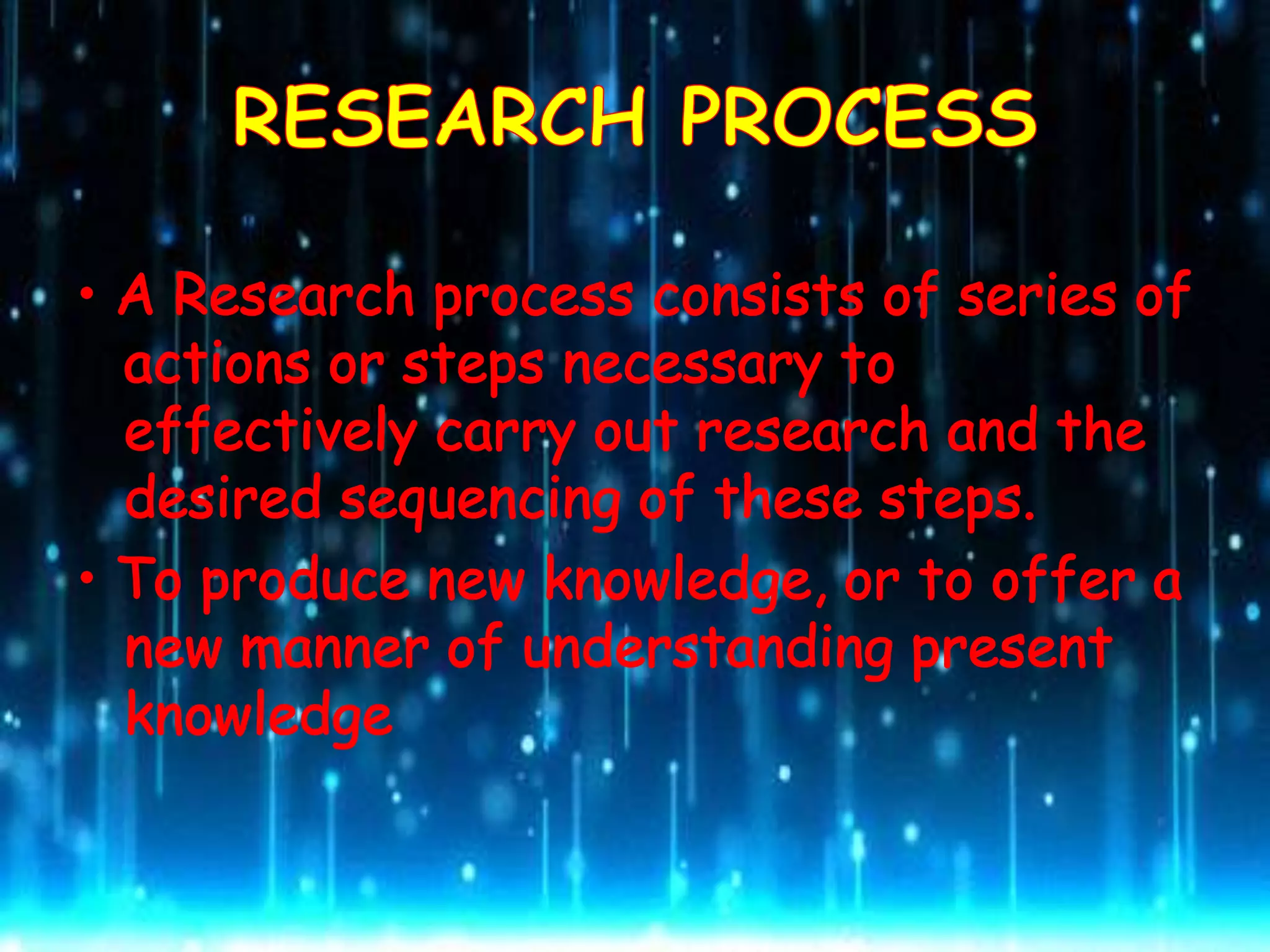
•Research can be defined as the search
for knowledge, or as any systematic
investigation, with an open mind, to
establish novel facts, solve new or existing
problems, prove new ideas, or develop new
theories. The primary purposes of basic
research (as opposed to applied research)
documentation, discovery, interpretation,
or the research and development of
methods and systems for the advancement
of human knowledge.
5.
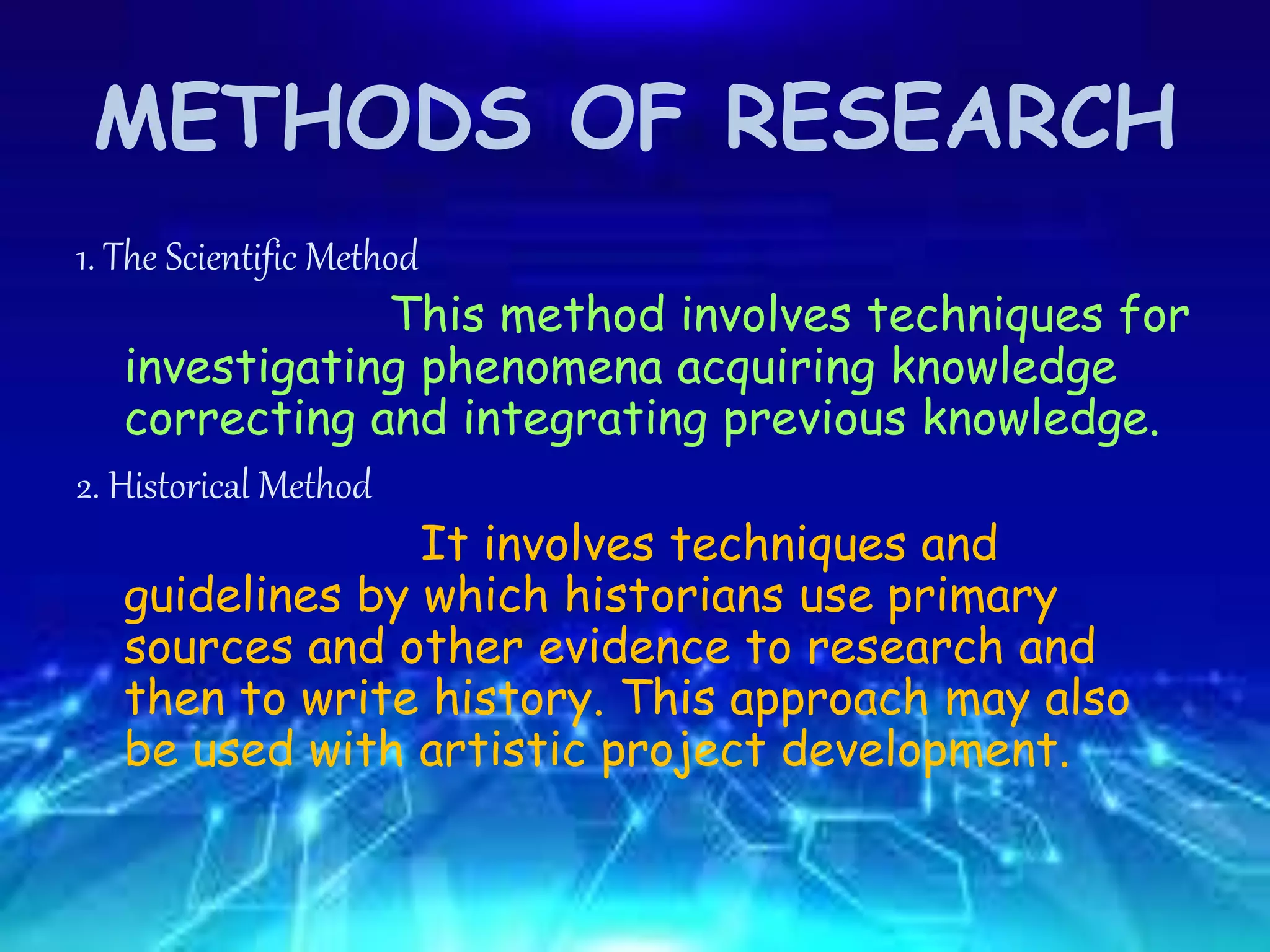
METHODS OF RESEARCH
1.The Scientific Method
This method involves techniques for
investigating phenomena acquiring knowledge
correcting and integrating previous knowledge.
2. Historical Method
It involves techniques and
guidelines by which historians use primary
sources and other evidence to research and
then to write history. This approach may also
be used with artistic project development.
6.
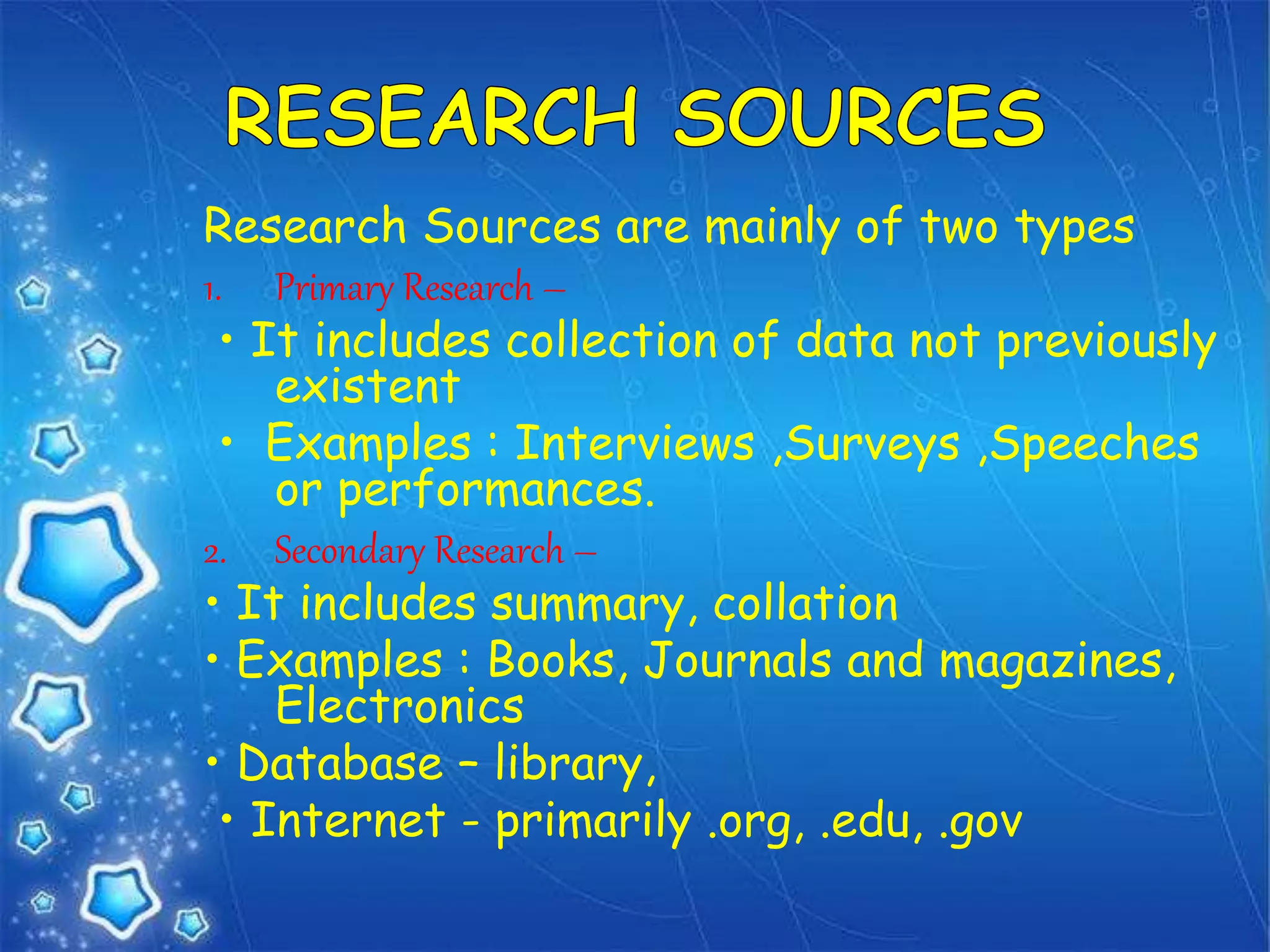
Research Sources aremainly of two types
1. Primary Research –
• It includes collection of data not previously
existent
• Examples : Interviews ,Surveys ,Speeches
or performances.
2. Secondary Research –
• It includes summary, collation
• Examples : Books, Journals and magazines,
Electronics
• Database – library,
• Internet - primarily .org, .edu, .gov
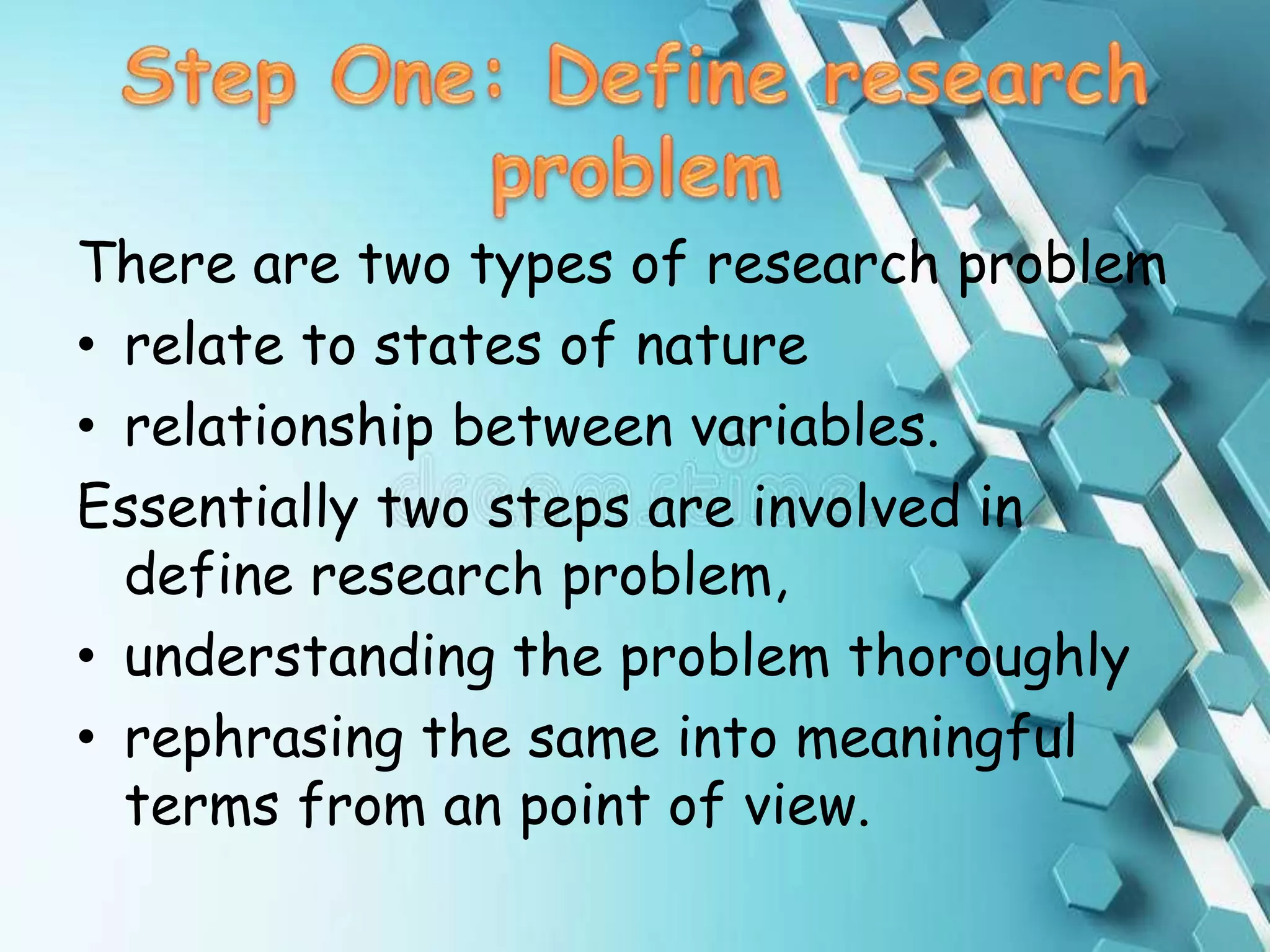
There are twotypes of research problem
• relate to states of nature
• relationship between variables.
Essentially two steps are involved in
define research problem,
• understanding the problem thoroughly
• rephrasing the same into meaningful
terms from an point of view.
11.
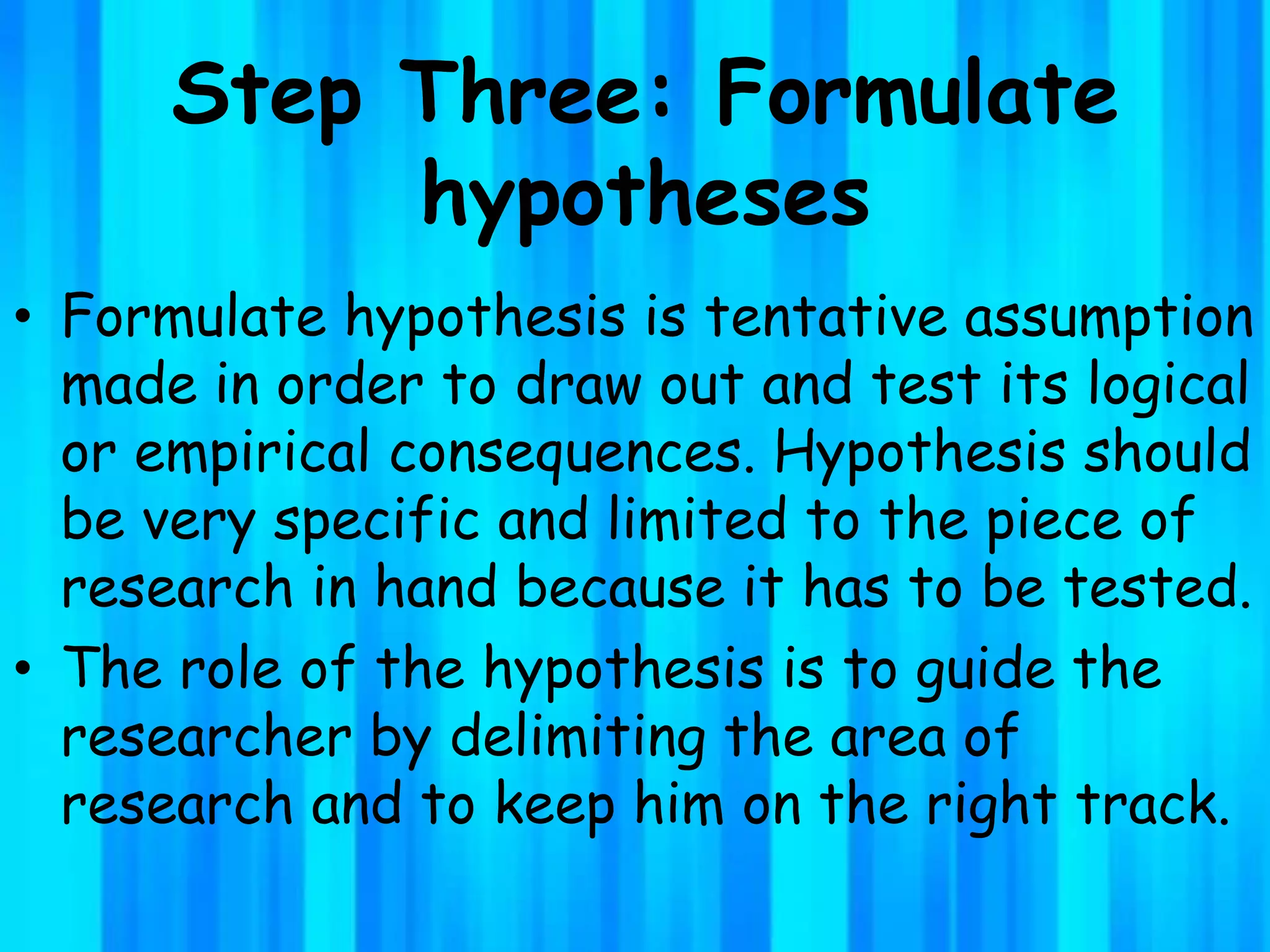
Step Three: Formulate
hypotheses
•Formulate hypothesis is tentative assumption
made in order to draw out and test its logical
or empirical consequences. Hypothesis should
be very specific and limited to the piece of
research in hand because it has to be tested.
• The role of the hypothesis is to guide the
researcher by delimiting the area of
research and to keep him on the right track.
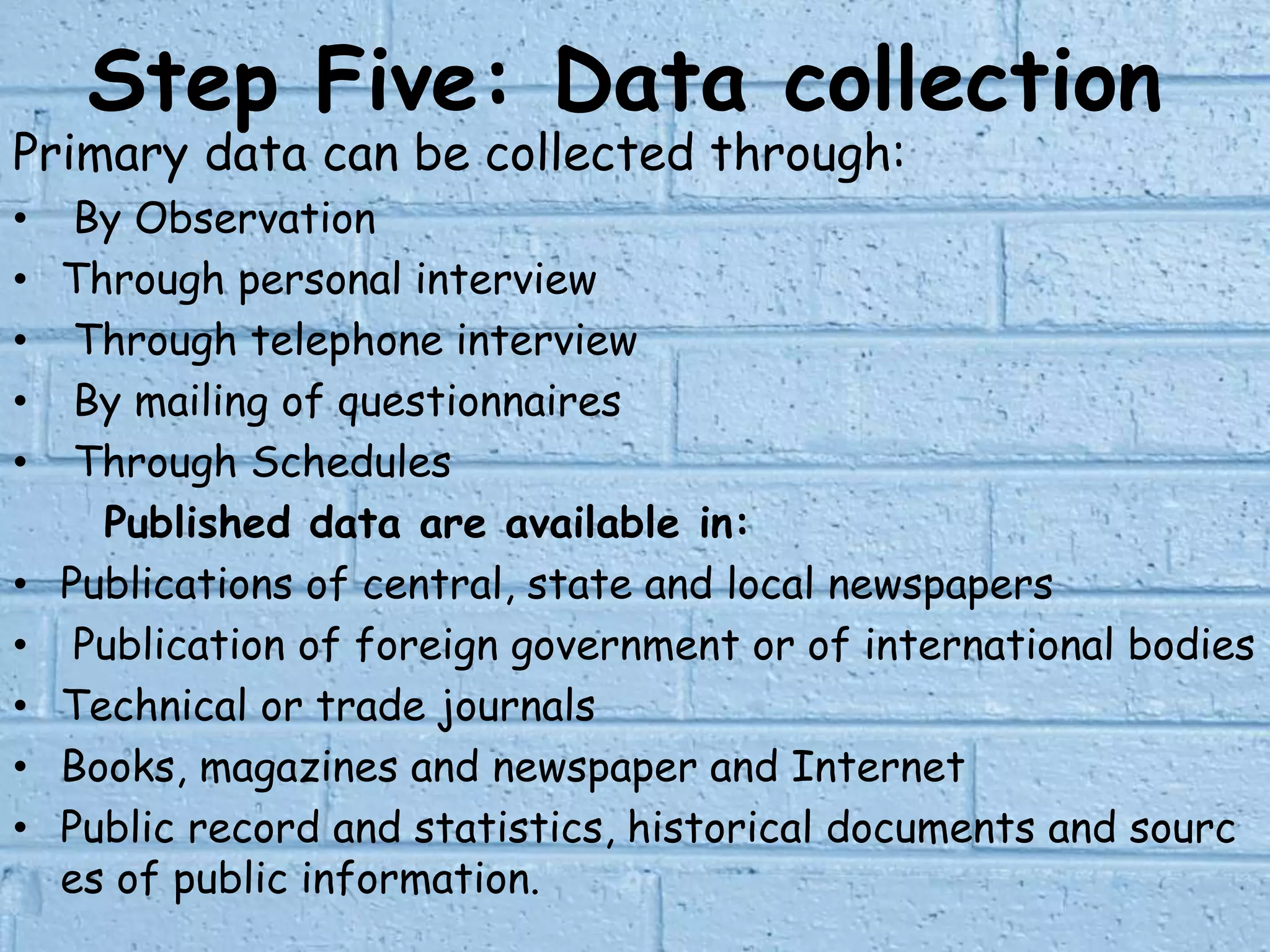
Step Five: Datacollection
Primary data can be collected through:
• By Observation
• Through personal interview
• Through telephone interview
• By mailing of questionnaires
• Through Schedules
Published data are available in:
• Publications of central, state and local newspapers
• Publication of foreign government or of international bodies
• Technical or trade journals
• Books, magazines and newspaper and Internet
• Public record and statistics, historical documents and sourc
es of public information.
14.
Step Six: Dataanalysis
• The analysis of data requires a number
of closely related operations such as
establishment of categories.
• The Analyses of data can of two types:
Quantitative analysis & Qualitative
analysis
This stage mainly include :
1. Coding
2. Editing
3. Tabulation
15.
Step Seven: Interpretation
andreport writing
• Researcher has to prepare the
report of what has been done by him.
Writing of report includes:
1. the preliminary pages
2. the main text
3. the end matter.
16.
CONCLUSION
• Good qualityresearch requires a researcher to
follow scientific approach. Researcher must
follow scientific method in conducting literature
review, identifying research gaps, writing
problem statement & outlining research
questions and research objectives.
• Researcher must carefully select among
different research designs, the selection of
which depends on specific research questions
and the overall objectives of the study.
Decisions like choosing among data collection
methods and sampling techniques require
researcher to exercise logical reasoning.
17.
REFRENCES
• Dawson, Catherine,2002, Practical
Research Methods, New Delhi, UBS
• https://www.slideshare.net
• Kothari, C.R.,1985, Research
Methodology-Methods and Techniques,
New
• http://www.uky.edu
• Kumar, Ranjit, 2005, Research
Methodology
• https://www.studyandexam.com