Tell me, and I forget;
  Show me, and I remember;
 Let me do, and I understand.


Development & Features of Social Pedagogic Theory
                          Implications for Practice
                                       Sylvia Holthoff
                                    Gabriel Eichsteller

                         ThemPra Social Pedagogy CIC
“Children are a key to understanding a nation,
        not only to comprehend the habits of a society
    but also its collective intelligence and sustainability”
         (Donata Elschenbroich, German sociologist)

Social pedagogy is a „function of society‟ (Mollenhauer) – it
describes how society thinks about children, their education
and upbringing.
Therefore, social pedagogy is closely related to society at a
given time and place, it is context specific.
The Development of Pedagogic Thought
         “We should not teach children the sciences,
              but give them a taste for them”
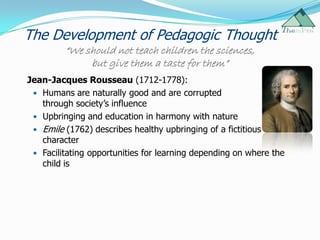
Jean-Jacques Rousseau (1712-1778):
  Humans are naturally good and are corrupted
   through society‟s influence
  Upbringing and education in harmony with nature
  Emile (1762) describes healthy upbringing of a fictitious
   character
  Facilitating opportunities for learning depending on where the
   child is
The Development of Pedagogic Thought
              “I seek education for humanity,
            and this only emanates through love”
Johann Heinrich Pestalozzi (1746-1827):
  Developed Rousseau‟s core ideas
  Education as a holistic process addressing
   head, heart, and hands
  Head: not imposing knowledge, but stimulate curiosity
  Heart: moral education, “without it, the other types would lose
   their sense of direction”
  Hands: learning through physical activities, grasping the world
  Head, heart, and hands are inseparable and corresponding with
   each other
  Importance of observation and reflective practice
  Role of pedagogue is to take care that “no untoward influence
   shall disturb nature‟s march of development”
The Development of Pedagogic Thought
   The children have been vested with unknown powers
        that could lead the way to a better future”
                   (Maria Montessori)
New Education Movement:
  Applied these thoughts into school context (Montessori, Steiner,
   Fröbel, Hahn)
  Refined concept of children as competent (“A child has a
   hundred languages” - Malaguzzi) and as equals (“Children don‟t
   become humans, they already are” - Korczak)
  Development of child participation and children‟s rights in
   pedagogic concepts of Montessori and Korczak
  Mainstreamed pedagogic thinking beyond educational
   institutions  social pedagogy to address wider social issues
   and tackle disadvantage / social exclusion
“I prefer the word pedagogue to teacher. A teacher is someone
  paid by the hour to drill something into the child, while a
     pedagogue draws something out. If you want to be a
 pedagogue you have to learn to talk with children instead
  of to them. You have to learn to trust their capacities and
                         possibilities.”

    Janusz Korczak (1878 – 1942), Polish pedagogue,
               paediatrician and author
What is Social Pedagogy?
Origin: Pedagogy – Greek pais (child), and agein (to lead, bring up)
Basis:
  Humanistic value base, e.g. respect, trust, unconditional
   appreciation
  Fundamental concept of children as equal human beings with rich
   and extraordinary potential, as competent, resourceful and active
   agents
  Inter-disciplinary theory combining concepts and models from
   sociology, psychology, education, philosophy, medical sciences and
   social work
Aims:
  Holistic education – education of head (cognitive knowledge), heart
   (emotional and spiritual learning), and hands (practical and physical skills)
  Holistic well-being – strengthening health-sustaining factors
  To enable children to grow up as self-responsible persons who
   take responsibility for their society
  To promote human welfare and prevent or ease social problems
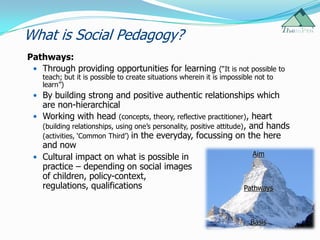
What is Social Pedagogy?
Pathways:
  Through providing opportunities for learning                  (“It is not possible to
    teach; but it is possible to create situations wherein it is impossible not to
    learn”)
  By building strong and positive authentic relationships which
   are non-hierarchical
  Working with head (concepts, theory, reflective practitioner), heart
   (building relationships, using one‟s personality, positive attitude) , and hands
   (activities, „Common Third‟) in the everyday, focussing on the here
   and now
  Cultural impact on what is possible in                                  Aim
   practice – depending on social images
   of children, policy-context,
   regulations, qualifications                                          Pathways


                                                                            Basis
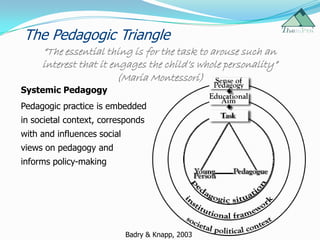
The Pedagogic Triangle
     “The essential thing is for the task to arouse such an
     interest that it engages the child‟s whole personality”
                        (Maria Montessori)
Systemic Pedagogy
Pedagogic practice is embedded
in societal context, corresponds
with and influences social
views on pedagogy and
informs policy-making


                             Badry & Knapp, 2003
“Social pedagogy is a theory of all the personal, social and
      moral education in a given society, including the
        description of what has happened in practice.”

   Karl Mager (1810 – 1858), German „founding father‟ of
                      social pedagogy

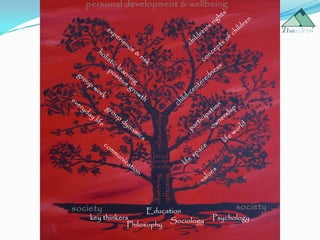
Social pedagogy is deeply rooted in society and has grown
organically into a coherent system, wherein theory meets
practice.
Pedagogy – Theory meets Practice
         “The whole is greater than the sum of its parts.”
                           (Fritz Perls)
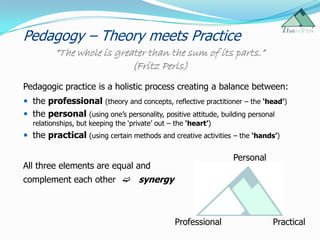
Pedagogic practice is a holistic process creating a balance between:
 the professional (theory and concepts, reflective practitioner – the ‘head’)
 the personal (using one‟s personality, positive attitude, building personal
  relationships, but keeping the „private‟ out – the ‘heart’)
 the practical (using certain methods and creative activities – the ‘hands’)

                                                                Personal
All three elements are equal and
complement each other synergy


                                                 Professional               Practical
„The pedagogical approach rests on an image of a child as a
complex social being with rich and extraordinary potential,
 rather than as an adult-in-waiting who needs to be given
     the right ingredients for optimal development. […]
     For pedagogues there is no universal solution, each
  situation requires a response based on a combination of
    information, emotions, self-knowledge and theory.‟

    Children‟s Workforce Development Council, 2006
Pedagogic Concepts
3P’s:
  professional pedagogue
   knowing theories, explaining behaviour, reflectivity
  personal pedagogue
   relational contact, authenticity, using personality
  private pedagogue
   personal boundaries of what is not shared
Pedagogic Concepts
Vygotsky’s Zone of Proximal Development:
  Learning and development are embedded in and dependent on
   the cultural and social context, on interaction with our
   environment
  Through interaction with others we can develop further than
   we could by being on our own
  Zone of Proximal Development is the distance between what
   we can actually achieve on our own and what we can
   potentially achieve with help from others (others can be adults
   or children!)
Pedagogic Concepts
4 development situations to extend the Zone of Proximal
Development:
  Starting from the child‟s motivation to learn

  Starting from where the pedagogue thinks the child „is‟

  Mutual process of learning together, e.g. Common Third

  Necessary development, things that need to be learned
Pedagogic Concepts
    “It is not possible to teach. But it is possible to create
       situations wherein it is impossible not to learn”
The Common Third:
  Creating a commonly shared situation or activity as something
   third between pedagogue and child
  Development of relationship around this activity, e.g. building
   a kite, cooking, football
  Sharing and having something in common implies to be in an
   equal relationship with full participation of both
  Both show a genuine interest in activity and are authentic -
   use of personality as a resource
  Holistic education - common potential for learning
“Good judgment comes from experience.
              And often experience comes from bad judgment”
                            (Rita Mae Brown)


contact:                                            further information:
sylvia@thempra.co.uk                                www.socialpedagogy.co.uk

gabriel@thempra.co.uk                               www.socialpedagogyuk.com


©   by ThemPra, 2008

Social Pedagogy Induction Them Pra Presentation

  • 1.
    Tell me, andI forget; Show me, and I remember; Let me do, and I understand. Development & Features of Social Pedagogic Theory Implications for Practice Sylvia Holthoff Gabriel Eichsteller ThemPra Social Pedagogy CIC
  • 2.
    “Children are akey to understanding a nation, not only to comprehend the habits of a society but also its collective intelligence and sustainability” (Donata Elschenbroich, German sociologist) Social pedagogy is a „function of society‟ (Mollenhauer) – it describes how society thinks about children, their education and upbringing. Therefore, social pedagogy is closely related to society at a given time and place, it is context specific.
  • 3.
    The Development ofPedagogic Thought “We should not teach children the sciences, but give them a taste for them” Jean-Jacques Rousseau (1712-1778):  Humans are naturally good and are corrupted through society‟s influence  Upbringing and education in harmony with nature  Emile (1762) describes healthy upbringing of a fictitious character  Facilitating opportunities for learning depending on where the child is
  • 4.
    The Development ofPedagogic Thought “I seek education for humanity, and this only emanates through love” Johann Heinrich Pestalozzi (1746-1827):  Developed Rousseau‟s core ideas  Education as a holistic process addressing head, heart, and hands  Head: not imposing knowledge, but stimulate curiosity  Heart: moral education, “without it, the other types would lose their sense of direction”  Hands: learning through physical activities, grasping the world  Head, heart, and hands are inseparable and corresponding with each other  Importance of observation and reflective practice  Role of pedagogue is to take care that “no untoward influence shall disturb nature‟s march of development”
  • 5.
    The Development ofPedagogic Thought The children have been vested with unknown powers that could lead the way to a better future” (Maria Montessori) New Education Movement:  Applied these thoughts into school context (Montessori, Steiner, Fröbel, Hahn)  Refined concept of children as competent (“A child has a hundred languages” - Malaguzzi) and as equals (“Children don‟t become humans, they already are” - Korczak)  Development of child participation and children‟s rights in pedagogic concepts of Montessori and Korczak  Mainstreamed pedagogic thinking beyond educational institutions  social pedagogy to address wider social issues and tackle disadvantage / social exclusion
  • 6.
    “I prefer theword pedagogue to teacher. A teacher is someone paid by the hour to drill something into the child, while a pedagogue draws something out. If you want to be a pedagogue you have to learn to talk with children instead of to them. You have to learn to trust their capacities and possibilities.” Janusz Korczak (1878 – 1942), Polish pedagogue, paediatrician and author
  • 7.
    What is SocialPedagogy? Origin: Pedagogy – Greek pais (child), and agein (to lead, bring up) Basis:  Humanistic value base, e.g. respect, trust, unconditional appreciation  Fundamental concept of children as equal human beings with rich and extraordinary potential, as competent, resourceful and active agents  Inter-disciplinary theory combining concepts and models from sociology, psychology, education, philosophy, medical sciences and social work Aims:  Holistic education – education of head (cognitive knowledge), heart (emotional and spiritual learning), and hands (practical and physical skills)  Holistic well-being – strengthening health-sustaining factors  To enable children to grow up as self-responsible persons who take responsibility for their society  To promote human welfare and prevent or ease social problems
  • 8.
    What is SocialPedagogy? Pathways:  Through providing opportunities for learning (“It is not possible to teach; but it is possible to create situations wherein it is impossible not to learn”)  By building strong and positive authentic relationships which are non-hierarchical  Working with head (concepts, theory, reflective practitioner), heart (building relationships, using one‟s personality, positive attitude) , and hands (activities, „Common Third‟) in the everyday, focussing on the here and now  Cultural impact on what is possible in Aim practice – depending on social images of children, policy-context, regulations, qualifications Pathways Basis
  • 9.
    The Pedagogic Triangle “The essential thing is for the task to arouse such an interest that it engages the child‟s whole personality” (Maria Montessori) Systemic Pedagogy Pedagogic practice is embedded in societal context, corresponds with and influences social views on pedagogy and informs policy-making Badry & Knapp, 2003
  • 10.
    “Social pedagogy isa theory of all the personal, social and moral education in a given society, including the description of what has happened in practice.” Karl Mager (1810 – 1858), German „founding father‟ of social pedagogy Social pedagogy is deeply rooted in society and has grown organically into a coherent system, wherein theory meets practice.
  • 12.
    Pedagogy – Theorymeets Practice “The whole is greater than the sum of its parts.” (Fritz Perls) Pedagogic practice is a holistic process creating a balance between:  the professional (theory and concepts, reflective practitioner – the ‘head’)  the personal (using one‟s personality, positive attitude, building personal relationships, but keeping the „private‟ out – the ‘heart’)  the practical (using certain methods and creative activities – the ‘hands’) Personal All three elements are equal and complement each other synergy Professional Practical
  • 13.
    „The pedagogical approachrests on an image of a child as a complex social being with rich and extraordinary potential, rather than as an adult-in-waiting who needs to be given the right ingredients for optimal development. […] For pedagogues there is no universal solution, each situation requires a response based on a combination of information, emotions, self-knowledge and theory.‟ Children‟s Workforce Development Council, 2006
  • 14.
    Pedagogic Concepts 3P’s: professional pedagogue knowing theories, explaining behaviour, reflectivity  personal pedagogue relational contact, authenticity, using personality  private pedagogue personal boundaries of what is not shared
  • 15.
    Pedagogic Concepts Vygotsky’s Zoneof Proximal Development:  Learning and development are embedded in and dependent on the cultural and social context, on interaction with our environment  Through interaction with others we can develop further than we could by being on our own  Zone of Proximal Development is the distance between what we can actually achieve on our own and what we can potentially achieve with help from others (others can be adults or children!)
  • 16.
    Pedagogic Concepts 4 developmentsituations to extend the Zone of Proximal Development:  Starting from the child‟s motivation to learn  Starting from where the pedagogue thinks the child „is‟  Mutual process of learning together, e.g. Common Third  Necessary development, things that need to be learned
  • 17.
    Pedagogic Concepts “It is not possible to teach. But it is possible to create situations wherein it is impossible not to learn” The Common Third:  Creating a commonly shared situation or activity as something third between pedagogue and child  Development of relationship around this activity, e.g. building a kite, cooking, football  Sharing and having something in common implies to be in an equal relationship with full participation of both  Both show a genuine interest in activity and are authentic - use of personality as a resource  Holistic education - common potential for learning
  • 18.
    “Good judgment comesfrom experience. And often experience comes from bad judgment” (Rita Mae Brown) contact: further information: sylvia@thempra.co.uk www.socialpedagogy.co.uk gabriel@thempra.co.uk www.socialpedagogyuk.com © by ThemPra, 2008