Personal Communication Passports as a way of consulting and
representing children with communication disabilities, to ensure
consistent care
Sally Millar & Stuart Aitken, Communication Aids for Language and Learning (CALL)
Centre, University of Edinburgh (and in collaboration with Sense Scotland)(1997)
Some communication difficulties in children may be easily identified because they are
accompanied by physical or sensory disabilities, or second language learning issues, while
others are more ‘invisible’ (for example, delayed/disordered speech and language
development, language comprehension difficulties, dyspraxia, dyslexia, social interaction
difficulties etc). All have profound effects on learning and education, self-esteem and
personal/social relationships. Communication disabilities and their implications can easily
be missed in children in disrupted circumstances.
Personal Communication Passports
Personal Communication Passports provide a practical and child-centred approach to
passing on key information (rather than it being locked away in a cabinet in ‘confidential
records’). A Passport is a way of supporting a vulnerable young person with communication
difficulties across transitions, drawing together complex information (including the child’s
own views, as much as possible) and distilling it into a clear, positive and accessible format.
This helps staff and conversation partners to get to know the child with communication
disabilities and to interact/respond consistently in order to help the child make sense of
events and to ‘get the best’ out of what communication abilities they do have. A Passport is
a vital tool in ‘joined–up’ inter-agency planning and working, partnership with families, and
is an excellent a way of implementing and recording consultation with, and participation of,
the young person. Passports aim to support children with complex communication
difficulties who cannot easily speak for themselves, by:
• presenting them positively as individuals, not as a set of ‘problems’ or disabilities
• drawing together information from past and
    present, from many people who know the
    child, and from different contexts
• describing the child’s most effective means of
    communication
• presenting information in an attractive easy to
    understand way
• describing the child’s most effective means of
    communication, so that others can be better
    communication partners.
Passport booklets (or cards, folding pockets, wall charts etc) present information about the
child in an accessible way that assumes no prior knowledge and is simple, clear, direct,
honest, specific and detailed (and, hopefully, fun). Passports are a special way of sorting
information. They don’t contain all the information about a child but a synthesis of key
information to help other people to help the child to ‘be the best he/she can be’, on a day-to-
day basis.
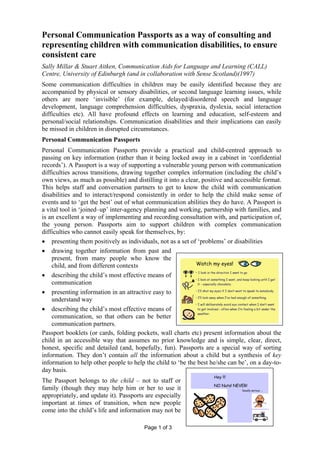
                                                                    Hey !!!
The Passport belongs to the child – not to staff or
                                                                    NO Nuts! NEVER!
family (though they may help him or her to use it                               Deadly serious …

appropriately, and update it). Passports are especially
important at times of transition, when new people
come into the child’s life and information may not be

                                        Page 1 of 3
passed on. They are also helpful when new or temporary staff/volunteers meet the child,
helping them quickly to acquire key information, or for introducing a child to a new foster
family. The process of creating a Passport can help in the process of assessing children and
their needs (and in identifying gaps in assessment).
Evaluation at Sense Scotland
At Sense Scotland, Passports were found to be valuable in many service settings: residential
short breaks (respite); holidays; summer activities; day activities; and support. Residential
care and support staff are often young and inexperienced in specialist work with children
with communication difficulties and complex support needs. There can be a comparatively
high turnover of staff. There are both high
demands on staff and little time for staff training
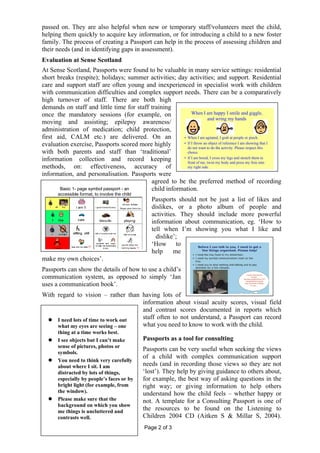
once the mandatory sessions (for example, on                When I am happy I smile and giggle,
                                                                      and wring my hands
moving and assisting; epilepsy awareness/
administration of medication; child protection,
first aid, CALM etc.) are delivered. On an             • When I am agitated, I grab at people or pinch.
evaluation exercise, Passports scored more highly      • If I throw an object of reference I am showing that I
                                                         do not want to do the activity. Please respect this
with both parents and staff than ‘traditional’           choice.
information collection and record keeping              • If I am bored, I cross my legs and stretch them in
                                                         front of me, twist my body and press my fists into
methods, on: effectiveness, accuracy of                  my right side.
information, and personalisation. Passports were
                                           agreed to be the preferred method of recording
       Basic 1- page symbol passport - an  child information.
       accessible format, to involve the child
                                                    Passports should not be just a list of likes and
                                                    dislikes, or a photo album of people and
                                                    activities. They should include more powerful
                                                    information about communication, eg. ‘How to
                                                    tell when I’m showing you what I like and
                                                      dislike’;
                                                    ‘How to
                                                    help     me
make my own choices’.
Passports can show the details of how to use a child’s
communication system, as opposed to simply ‘Jan
uses a communication book’.
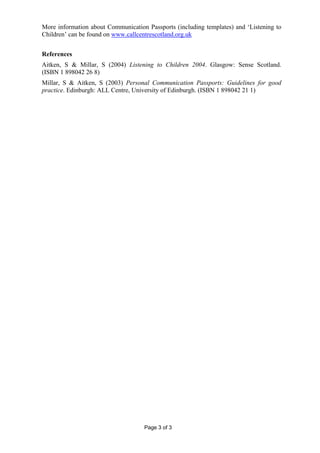
With regard to vision – rather than having lots of
                                     information about visual acuity scores, visual field
                                     and contrast scores documented in reports which
     I need lots of time to work out staff often to not understand, a Passport can record
     what my eyes are seeing – one   what you need to know to work with the child.
       thing at a time works best.
       I see objects but I can’t make            Passports as a tool for consulting
       sense of pictures, photos or
       symbols.
                                                 Passports can be very useful when seeking the views
                                                 of a child with complex communication support
       You need to think very carefully
       about where I sit. I am                   needs (and in recording those views so they are not
       distracted by lots of things,             ‘lost’). They help by giving guidance to others about,
       especially by people’s faces or by        for example, the best way of asking questions in the
       bright light (for example, from           right way; or giving information to help others
       the window).                              understand how the child feels – whether happy or
       Please make sure that the                 not. A template for a Consulting Passport is one of
       background on which you show
       me things is uncluttered and
                                                 the resources to be found on the Listening to
       contrasts well.                           Children 2004 CD (Aitken S & Millar S, 2004).
                                                 Page 2 of 3
More information about Communication Passports (including templates) and ‘Listening to
Children’ can be found on www.callcentrescotland.org.uk


References
Aitken, S & Millar, S (2004) Listening to Children 2004. Glasgow: Sense Scotland.
(ISBN 1 898042 26 8)
Millar, S & Aitken, S (2003) Personal Communication Passports: Guidelines for good
practice. Edinburgh: ALL Centre, University of Edinburgh. (ISBN 1 898042 21 1)


                                    Page 3 of 3

Cwc Handout4 Passports

  • 1.
    Personal Communication Passportsas a way of consulting and representing children with communication disabilities, to ensure consistent care Sally Millar & Stuart Aitken, Communication Aids for Language and Learning (CALL) Centre, University of Edinburgh (and in collaboration with Sense Scotland)(1997) Some communication difficulties in children may be easily identified because they are accompanied by physical or sensory disabilities, or second language learning issues, while others are more ‘invisible’ (for example, delayed/disordered speech and language development, language comprehension difficulties, dyspraxia, dyslexia, social interaction difficulties etc). All have profound effects on learning and education, self-esteem and personal/social relationships. Communication disabilities and their implications can easily be missed in children in disrupted circumstances. Personal Communication Passports Personal Communication Passports provide a practical and child-centred approach to passing on key information (rather than it being locked away in a cabinet in ‘confidential records’). A Passport is a way of supporting a vulnerable young person with communication difficulties across transitions, drawing together complex information (including the child’s own views, as much as possible) and distilling it into a clear, positive and accessible format. This helps staff and conversation partners to get to know the child with communication disabilities and to interact/respond consistently in order to help the child make sense of events and to ‘get the best’ out of what communication abilities they do have. A Passport is a vital tool in ‘joined–up’ inter-agency planning and working, partnership with families, and is an excellent a way of implementing and recording consultation with, and participation of, the young person. Passports aim to support children with complex communication difficulties who cannot easily speak for themselves, by: • presenting them positively as individuals, not as a set of ‘problems’ or disabilities • drawing together information from past and present, from many people who know the child, and from different contexts • describing the child’s most effective means of communication • presenting information in an attractive easy to understand way • describing the child’s most effective means of communication, so that others can be better communication partners. Passport booklets (or cards, folding pockets, wall charts etc) present information about the child in an accessible way that assumes no prior knowledge and is simple, clear, direct, honest, specific and detailed (and, hopefully, fun). Passports are a special way of sorting information. They don’t contain all the information about a child but a synthesis of key information to help other people to help the child to ‘be the best he/she can be’, on a day-to- day basis. Hey !!! The Passport belongs to the child – not to staff or NO Nuts! NEVER! family (though they may help him or her to use it Deadly serious … appropriately, and update it). Passports are especially important at times of transition, when new people come into the child’s life and information may not be Page 1 of 3
  • 2.
    passed on. Theyare also helpful when new or temporary staff/volunteers meet the child, helping them quickly to acquire key information, or for introducing a child to a new foster family. The process of creating a Passport can help in the process of assessing children and their needs (and in identifying gaps in assessment). Evaluation at Sense Scotland At Sense Scotland, Passports were found to be valuable in many service settings: residential short breaks (respite); holidays; summer activities; day activities; and support. Residential care and support staff are often young and inexperienced in specialist work with children with communication difficulties and complex support needs. There can be a comparatively high turnover of staff. There are both high demands on staff and little time for staff training once the mandatory sessions (for example, on When I am happy I smile and giggle, and wring my hands moving and assisting; epilepsy awareness/ administration of medication; child protection, first aid, CALM etc.) are delivered. On an • When I am agitated, I grab at people or pinch. evaluation exercise, Passports scored more highly • If I throw an object of reference I am showing that I do not want to do the activity. Please respect this with both parents and staff than ‘traditional’ choice. information collection and record keeping • If I am bored, I cross my legs and stretch them in front of me, twist my body and press my fists into methods, on: effectiveness, accuracy of my right side. information, and personalisation. Passports were agreed to be the preferred method of recording Basic 1- page symbol passport - an child information. accessible format, to involve the child Passports should not be just a list of likes and dislikes, or a photo album of people and activities. They should include more powerful information about communication, eg. ‘How to tell when I’m showing you what I like and dislike’; ‘How to help me make my own choices’. Passports can show the details of how to use a child’s communication system, as opposed to simply ‘Jan uses a communication book’. With regard to vision – rather than having lots of information about visual acuity scores, visual field and contrast scores documented in reports which I need lots of time to work out staff often to not understand, a Passport can record what my eyes are seeing – one what you need to know to work with the child. thing at a time works best. I see objects but I can’t make Passports as a tool for consulting sense of pictures, photos or symbols. Passports can be very useful when seeking the views of a child with complex communication support You need to think very carefully about where I sit. I am needs (and in recording those views so they are not distracted by lots of things, ‘lost’). They help by giving guidance to others about, especially by people’s faces or by for example, the best way of asking questions in the bright light (for example, from right way; or giving information to help others the window). understand how the child feels – whether happy or Please make sure that the not. A template for a Consulting Passport is one of background on which you show me things is uncluttered and the resources to be found on the Listening to contrasts well. Children 2004 CD (Aitken S & Millar S, 2004). Page 2 of 3
  • 3.
    More information aboutCommunication Passports (including templates) and ‘Listening to Children’ can be found on www.callcentrescotland.org.uk References Aitken, S & Millar, S (2004) Listening to Children 2004. Glasgow: Sense Scotland. (ISBN 1 898042 26 8) Millar, S & Aitken, S (2003) Personal Communication Passports: Guidelines for good practice. Edinburgh: ALL Centre, University of Edinburgh. (ISBN 1 898042 21 1) Page 3 of 3