Attachment Attachment in the context of involving children in assessment
What is attachment? Theory of personality development in the context of close relationships (Howe 1999) An affectionate bond between two individuals that endures through time and space  and serves to join them emotionally (Kennel 1976)
What does it provide? Safe base Balance between trust and autonomy Psychological development Physical development Cognitive development Conscience development Identity
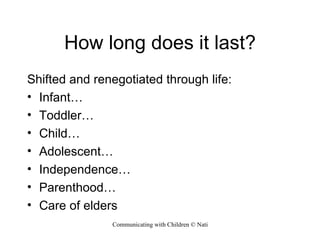
How long does it last? Shifted and renegotiated through life: Infant… Toddler… Child… Adolescent… Independence… Parenthood… Care of elders
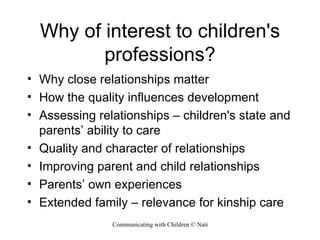
Why of interest to children's professions? Why close relationships matter How the quality influences development Assessing relationships – children's state and parents’ ability to care Quality and character of relationships  Improving parent and child relationships Parents’ own experiences Extended family – relevance for kinship care
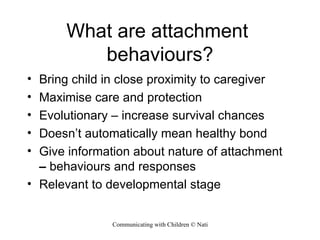
What are attachment  behaviours? Bring child in close proximity to caregiver Maximise care and protection Evolutionary – increase survival chances Doesn’t automatically mean healthy bond Give information about nature of attachment  –  behaviours and responses Relevant to developmental stage
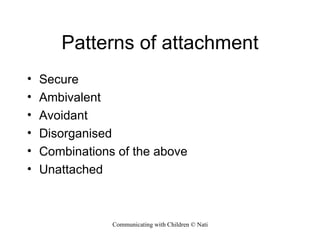
Patterns of attachment Secure Ambivalent Avoidant Disorganised Combinations of the above Unattached
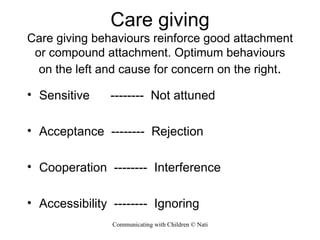
Care giving Care giving behaviours reinforce good attachment or compound attachment. Optimum behaviours on the left and cause for concern on the right . Sensitive  --------  Not attuned Acceptance  --------  Rejection Cooperation  --------  Interference Accessibility  --------  Ignoring
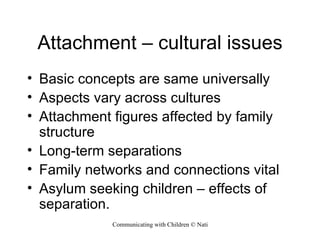
Attachment – cultural issues Basic concepts are same universally Aspects vary across cultures Attachment figures affected by family structure Long-term separations Family networks and connections vital Asylum seeking children – effects of separation.
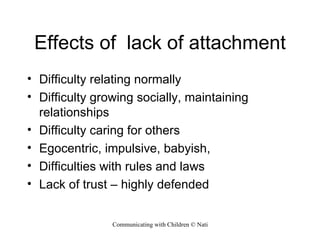
Effects of  lack of attachment Difficulty relating normally Difficulty growing socially, maintaining relationships Difficulty caring for others Egocentric, impulsive, babyish, Difficulties with rules and laws Lack of trust – highly defended
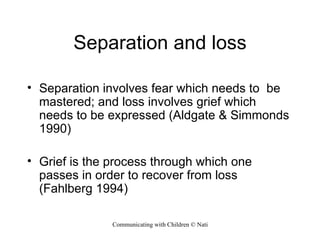
Separation and loss Separation involves fear which needs to  be mastered; and loss involves grief which needs to be expressed (Aldgate & Simmonds 1990) Grief is the process through which one passes in order to recover from loss (Fahlberg 1994)
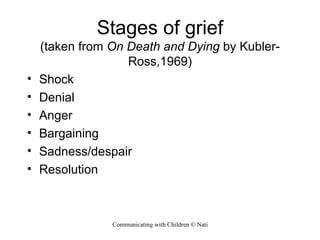
Stages of grief (taken from  On Death and Dying  by Kubler-Ross,1969) Shock Denial Anger Bargaining Sadness/despair Resolution
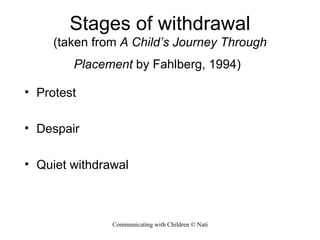
Stages of withdrawal (taken from  A Child’s Journey Through Placement  by Fahlberg, 1994)   Protest Despair Quiet withdrawal

Cwc Children200612 5

  • 1.
    Attachment Attachment inthe context of involving children in assessment
  • 2.
    What is attachment?Theory of personality development in the context of close relationships (Howe 1999) An affectionate bond between two individuals that endures through time and space and serves to join them emotionally (Kennel 1976)
  • 3.
    What does itprovide? Safe base Balance between trust and autonomy Psychological development Physical development Cognitive development Conscience development Identity
  • 4.
    How long doesit last? Shifted and renegotiated through life: Infant… Toddler… Child… Adolescent… Independence… Parenthood… Care of elders
  • 5.
    Why of interestto children's professions? Why close relationships matter How the quality influences development Assessing relationships – children's state and parents’ ability to care Quality and character of relationships Improving parent and child relationships Parents’ own experiences Extended family – relevance for kinship care
  • 6.
    What are attachment behaviours? Bring child in close proximity to caregiver Maximise care and protection Evolutionary – increase survival chances Doesn’t automatically mean healthy bond Give information about nature of attachment – behaviours and responses Relevant to developmental stage
  • 7.
    Patterns of attachmentSecure Ambivalent Avoidant Disorganised Combinations of the above Unattached
  • 8.
    Care giving Caregiving behaviours reinforce good attachment or compound attachment. Optimum behaviours on the left and cause for concern on the right . Sensitive -------- Not attuned Acceptance -------- Rejection Cooperation -------- Interference Accessibility -------- Ignoring
  • 9.
    Attachment – culturalissues Basic concepts are same universally Aspects vary across cultures Attachment figures affected by family structure Long-term separations Family networks and connections vital Asylum seeking children – effects of separation.
  • 10.
    Effects of lack of attachment Difficulty relating normally Difficulty growing socially, maintaining relationships Difficulty caring for others Egocentric, impulsive, babyish, Difficulties with rules and laws Lack of trust – highly defended
  • 11.
    Separation and lossSeparation involves fear which needs to be mastered; and loss involves grief which needs to be expressed (Aldgate & Simmonds 1990) Grief is the process through which one passes in order to recover from loss (Fahlberg 1994)
  • 12.
    Stages of grief(taken from On Death and Dying by Kubler-Ross,1969) Shock Denial Anger Bargaining Sadness/despair Resolution
  • 13.
    Stages of withdrawal(taken from A Child’s Journey Through Placement by Fahlberg, 1994) Protest Despair Quiet withdrawal