SOCIAL PEDAGOGY SEMINARS
           Building a Pedagogic Workforce in
                 Residential Child Care


               SEMINAR PORTFOLIO

Facilitation:          Sylvia      Holthoff     &     Gabriel
Eichsteller
contact:          syl-hol@web.de        gabriel@eichsteller.com


                          CHEADLE
                    May 22 & 23, 2007
                    June 27 & 28, 2007
                    July 24 & 25, 2007
Social Pedagogy Seminars


                                                       Table of Content

Mount ...................................................................................................................................................3
Pedagogy...............................................................................................................................................3
What is (social) pedagogy?..................................................................................................................4
Pedagogic Thinkers..............................................................................................................................6
Salutogenesis......................................................................................................................................16
Sense of Coherence............................................................................................................................16
The 4 Pedagogic Styles.......................................................................................................................19
Feedback.............................................................................................................................................25
Active Listening..................................................................................................................................26
Children’s Rights...............................................................................................................................45
Empowerment.....................................................................................................................................71
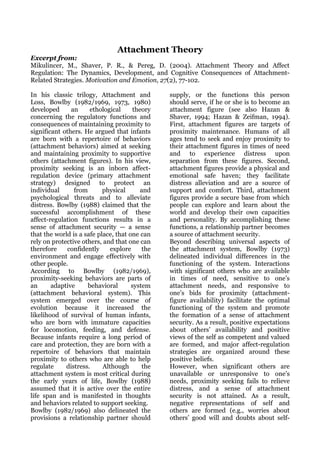
Attachment Theory.............................................................................................................................74
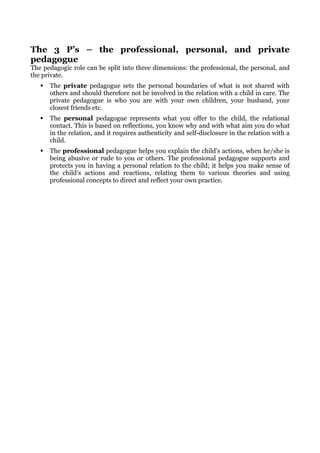
The 3 P’s – the professional, personal, and private pedagogue.......................................................76
The Zone of Proximal Development..................................................................................................85
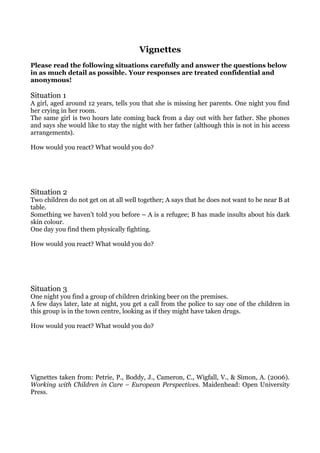
Vignettes.............................................................................................................................................88
Achieving Emotional Well-Being....................................................................................................102
Happiness and Flow.........................................................................................................................102
Excerpt from:...................................................................................................................................102
Csikszentmihalyi, M. (1999). If we are so rich, why aren’t we happy? American Psychologist,
54(10). 821-827.................................................................................................................................102
SMTTE model..................................................................................................................................108
Context..............................................................................................................................................109
Aims..................................................................................................................................................109
Initiative............................................................................................................................................109
Signs..................................................................................................................................................109
Evaluation........................................................................................................................................109
The Common Third..........................................................................................................................110
The Pedagogic Triangle...................................................................................................................111


May – July 2007                                                                               Sylvia Holthoff & Gabriel Eichsteller
Social Pedagogy Seminars


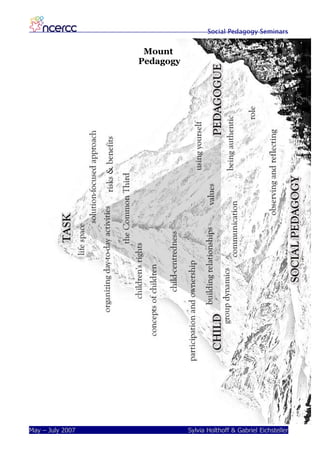
                   Mount
                  Pedagogy


May – July 2007              Sylvia Holthoff & Gabriel Eichsteller
Social Pedagogy Seminars


                         What is (social) pedagogy?
Etymology:
The word pedagogy stems from the Greek pais: child, and agein: to lead, bring up.


British interpretations:
Children’s Workforce Development Council (CWDC)
 ‘The pedagogical approach rests on an image of a child as a complex social being with rich
 and extraordinary potential, rather than as an adult-in-waiting who needs to be given the
 right ingredients for optimal development. […] For pedagogues there is no universal
 solution, each situation requires a response based on a combination of information,
 emotions, self-knowledge and theory.’

Petrie et al. (2006, p22) found nine principles of a pedagogic approach:
• ‘A focus on the child as a whole person, and support for the child’s overall development;
• The practitioner seeing herself/himself as a person, in relationship with the child or
  young person;
• Children and staff are seen as inhabiting the same life space, not as existing in separate
  hierarchical domains;
• As professionals, pedagogues are encouraged constantly to reflect on their practice and
  to apply both theoretical understandings and self-knowledge to the sometimes
  challenging demands with which they are confronted;
• Pedagogues are also practical, so their training prepares them to share in many aspects
  of children’s daily lives and activities;
• Children’s associative life is seen as an important resource: workers should foster and
  make use of the group;
• Pedagogy builds on an understanding of children’s rights that is not limited to
  procedural matters or legislated requirements;
• There is an emphasis on team work and on valuing the contribution of others in
  “bringing up” children: other professionals, members of the local community and,
  especially, parents;
• The centrality of relationship and, allied to this, the importance of listening and
  communicating.’

Cannan et al. (1992, pp73) defined social pedagogy as ‘a perspective, including social action
which aims to promote human welfare through child-rearing and education practices; and
to prevent or ease social problems by providing people with the means to manage their own
lives, and make changes in their circumstances’.


May – July 2007                                         Sylvia Holthoff & Gabriel Eichsteller
Social Pedagogy Seminars

Explanations by key thinkers in (social) pedagogy:
John Amos Comenius (1592 – 1670), Czech philosopher
 The pedagogue as a gardener providing the nurturing conditions for the child’s nature
 to unfold – as opposed to a sculptor who would form the child according to a certain
 image.

Friedrich Diesterweg (1790 – 1866), Prussian educational thinker
 Social pedagogy is ‘educational action by which one aims to help the poor in society’.
 The educational principle of natural evolution demands in the educational field: respect
 for human nature and of the individual; its stimulation to full development, expression,
 activity and initiative; natural, hence joyful, experience of life; stimulation to develop the
 senses, strengthening the body, to explore, to be lucid and to discover things; providing
 the minds with suitable nourishment; constant progress.
 It forbids: arbitrary assumptions and manipulations of human nature; any
 encouragement to act blindly and mechanically; any kind of drill; rote learning;
 uniformity; force-feeding with subject matter that is not understood etc.

Karl Mager (1810 – 1858), German ‘founding father’ of social pedagogy
 Social pedagogy as a theory of all the personal, social and moral education in a given
 society, including the description of what has happened in practice.

Paul Natorp (1854 – 1924), German philosopher
 Social pedagogy as an educational endeavour that sees the individual and society as being
 in relation to each other, as referring to each other. Social pedagogy aims at encouraging a
 strong sense of community and fighting to close the gap between rich and poor. It
 attempts to influence the social system and to optimise it.

Gertrud Bäumer (1873 – 1953), German women’s rights advocate
 The term social pedagogy does not indicate a principle which underpins pedagogy as a
 whole but a specific sector: everything that is education but neither takes place at school
 nor in families.

Janusz Korczak (1878 – 1942), Polish pedagogue and paediatrician
 ‘I prefer the word pedagogue to teacher. A teacher is someone paid by the hour to drill
 something into the child, while a pedagogue draws something out. If you want to be a
 pedagogue you have to learn to talk with children instead of to them. You have to learn to
 trust their capacities and possibilities.’

Klaus Mollenhauer (1928 – 1998), German social pedagogue
 Social pedagogy includes an element of social criticism.


May – July 2007                                          Sylvia Holthoff & Gabriel Eichsteller
Social Pedagogy Seminars


                               Pedagogic Thinkers
Johann Heinrich Pestalozzi (1746-1827)

  ‘I wish to wrest education from the outworn order of doddering old teaching hacks as
 well as from the new-fangled order of cheap, artificial teaching tricks, and entrust it to
 the eternal powers of the hearts of fathers and mothers, to the interests of parents who
              desire their children grow up in favour with God and with men’

                      Johann Heinrich Pestalozzi was born in 1746 in Zurich, Switzerland.
                      He was one of the first and most important pedagogic philosophers
                      who described education as a holistic process. His emphasis was not
                      on teaching children ready-made answers, but on educating them in a
                      way that they are able to arrive at answers themselves. This means
                      more than intellectual education, which was for Pestalozzi only part of
                      a wider plan – it means ‘cultivating’ the children’s own powers of
                      seeing, judging and reasoning and encouraging their self-activity and
                      spontaneity.

Pestalozzi’s father died when he was five. From then on he was brought up by his mother
and a maid. With both he experienced a close and loving relationship. At the University of
Zurich he associated himself with the party of reform. His earliest years were spent in
schemes in improving the conditions of people in general. The death of a friend turned him
from politics and induced him to devote himself to education. His initial influence on the
development of thinking about pedagogy owes much to the book ‘How Gertrude teaches
her children’, which he published in 1801, and the fact that he carried his proposals through
into practice.
He founded orphanages in Neuhof, Stans and Clindy where neglected and poor children
were educated and instructed how to work, for example weaving and spinning. Because of
various reasons these ‘projects’ unfortunately never existed for a long period of time. In the
years between running the orphanages he started publishing stories in which he expressed
his views of society. Later he turned to teaching and founded the ‘Pestalozzi Institute’ in
Yverdon. This existed for twenty years and at last Pestalozzi was able to put his approach in
to practice and prove its worth. But unfortunately also this project came to an end while he
was still alive. Due to quarrels among the teachers the good reputation was spoilt and the
institute was closed two years prior his death in 1827.

Pedagogic ideas:
It was Pestalozzi’s aim to establish a ‘psychological method of instruction’ that was in line
with the ‘laws of human nature’: ‘where nature has influence and the child is well and truly
guided by her, she develops the child’s heart, mind and body in harmonious unity’.
Pestalozzi saw it as one of the key roles of the pedagogue to keep the three elements of the
‘head, heart, and hands’ in equilibrium. Today this holistic approach is known as the
‘Pestalozzi Method’.
Education of the ‘head’, or intellectual education, did for Pestalozzi not consist of ‘teaching
pupils about thought, but to forming their capacity to think’. Instead of imposing
knowledge on the children, pedagogues should stimulate the children and arouse their
curiosity of world around them. The ‘heart’ and its moral education were for Pestalozzi of
the highest importance, ‘for, without it, the other types would lose their sense of direction’.
Pestalozzi saw the education of the heart as the basic aim of education: ‘the elevation of

May – July 2007                                          Sylvia Holthoff & Gabriel Eichsteller
Social Pedagogy Seminars
ourselves to a sense of the inner dignity of our nature, and of the pure, higher, godly being,
which lies within us. This sense is not developed by the power of our mind in thought, but
is developed by the power of our heart in love.’ For Pestalozzi, moral education aimed to
convey Christian values to the children, which meant that the pedagogue had to live these
values. Consequently, Pestalozzi abolished caning in his institution. Pestalozzi also realised
that children learn through physical activities, as ‘physical experiences give rise to mental
and spiritual ones’. Consequently, his method paid special attention to the ‘hands’ – or
more exactly the whole body – as understanding the world, being in direct contact with the
world and grasping things. He emphasized the importance of tactile perception and pointed
out that physical education also contributed to a healthy development.

The three elements ‘head, heart, and hands’ are inseparable from each other in Pestalozzi’s
method. ‘Nature forms the child as an indivisible whole, as a vital organic unity with many
sided moral, mental, and physical capacities. Each of these capacities is developed through
and by means of the others,’ Pestalozzi stated.
To be educative in a holistic sense, Pestalozzi demanded that learning be based on the
individual child’s understanding, on ‘close observation of children and on deep insight into
the way a child’s mind works and develops’. This form of reflective practice is stated in his
doctrine of Anschauung, of direct observation. Through observation, the pedagogue aims
to ‘find out the capacities of each individual child’ and to support him in his unique natural
development. Hence observation is needed, because it is not the pedagogue who forms the
child; the potentiality of each child is implemented by nature as ‘a little seed contains the
design of a tree’. And the pedagogue’s role is to take care ‘that no untoward influence shall
disturb nature’s march of developments’.

Pestalozzi’s child-centred approach especially emphasises the relationship between the
pedagogue and child. Describing love as ‘the sole, the everlasting foundation’ for education
without which ‘neither the physical not the intellectual powers [would] develop naturally’,
Pestalozzi assumed that without a satisfying, especially emotional, acceptance of the child
all pedagogy would fail – something we would nowadays call ‘openness’, ‘empathy’, and
‘affection’.

Nearly two centuries after the death of Pestalozzi his formulated method of the ‘head, heart
and hands’ can be found in other definitions of holistic education. Studies with Danish and
German pedagogues show that these terms are still key words used to describe a pedagogic
working style – and they also demand that pedagogues work with ‘head, heart, and hands’,
use their cognitive, physical and emotional skills.
Pestalozzi is also relevant for current practice, because he fought for social justice and was
committed to working ‘with those who have suffered within society. He saw education as
central to the improvement of social conditions’. This shows that there is much brilliance
and relevance to be found in Pestalozzi’s thought. Pedagogues, and among them youth
workers, must not forget his initiative; moreover they should cherish his ideas by applying
them in everyday-practice. Surely, these ideas cannot be put into the contemporary context
of pedagogy without reflection – but then, it was Pestalozzi himself who demanded
reflective practice.

Further readings:
The key text is the ‘classic’ Pestalozzi text on education
Pestalozzi, J.H. (1894): How Gertrude teaches her children, translated by Lucy, E. Holland
and Frances C. Turner. Edited with an introduction by Ebenezer Cooke.
London: Swan Sonnenschein


May – July 2007                                          Sylvia Holthoff & Gabriel Eichsteller
Social Pedagogy Seminars
The standard English language treatment is:
Silber, K. (1965). Pestalozzi: The man and his work
London: Routledge and Kegan Paul


May – July 2007                                       Sylvia Holthoff & Gabriel Eichsteller
Social Pedagogy Seminars

                                Pedagogic Thinkers
Maria Montessori (1870 – 1952)

          ‘The essential thing is for the task to arouse such an interest
                  that it engages the child's whole personality’
                   (Maria Montessori in ‘The Absorbent Mind’, p206)


                                  The figure of Maria Montessori stands out above most of
                                  those who were involved in the New Education movement,
                                  and her pedagogic method is still being followed today. Born
                                  in Chiaravalle, Italy, Maria Montessori was the first woman
                                  to obtain a degree in medicine at the University of Rome.
                                  During her work for the University’s Psychiatric Clinic,
                                  where she was responsible for the care of mentally disabled
                                  children – the ‘ineducable’ – she developed a coherent
                                  method in order to educate them. A main source of her
                                  inspiration was Itard, who famously tried to civilize the
                                  savage boy found in the forests of Aveyron in France by
                                  stimulating and developing his senses. Her principle for
                                  educating mentally disabled children – first the education of
                                  the senses, then the education of the intellect – also informed
her general educational programme, which she developed and tried while running the Casa
dei Bambini, the first Children’s Home, built as part of the development of a Roman slum
quarter, San Lorenzo to educate the neighbourhood’s children. This house in San Lorenzo
was the beginning of a kind of renaissance movement that served to renew belief in the
betterment of mankind by means of education. The home and those that followed were
designed to provide a good environment for children to live and learn, where everything
was adapted to the children and their specific attitudes and perspectives: cupboards, tables
and chairs, but also colour, sound and architecture.
With Rousseau, who had strongly argued for educating in harmony with nature,
Montessori shared his criticism of education and the general treatment of children by
stating: ‘It is essential to let nature have its own way as far as possible; the more freedom
children are allowed to develop, the quicker and more perfectly they will attain higher
forms and functions’.

Pedagogic Concept:
Maria Montessori built her pedagogic concept upon the idea that children develop and
think differently to adults; that they are not merely ‘adults in small bodies’. In her eyes they
were competent beings capable of self-directed learning. She considered infancy as the
sensitive phase and thus as a unique opportunity to encourage positive development, as
children under six possessed an ‘absorbent mind’ – limitless motivation to achieve
competence within their environment and to perfect skills and understandings.
Montessori understood that internally motivated learning required other than traditional
measurements of achievement, such as grades or tests – negative competition that is
damaging to the inner growth of children. Feedback and qualitative analysis of a child’s
performance were generally provided otherwise – in the form of a list of skills, activities
and critical points, and sometimes a narrative of the child’s achievements, strengths and
weaknesses, with emphasis on the improvement of those weaknesses.


May – July 2007                                            Sylvia Holthoff & Gabriel Eichsteller
Social Pedagogy Seminars
The basic concept behind Montessori’s method was that of providing children with a
suitable environment in which they would gain self-determination and self-realization. Her
hands-on approach to learning encouraged children to develop their observation skills by
doing many types of activities, including use of the five senses, kinetic movement, spatial
refinement, small and large motor skill coordination, and concrete knowledge that lead to
later abstraction. Important part for the self-directed learning at a child’s individual pace
were didactic materials which allowed for the activities to be methodically coordinated so
that the children could easily see their success.
Montessori designed her method to encourage independence and freedom within limits
and responsibility. Freedom and discipline interacted, and the basic tenet was that neither
one could be achieved without the other. In her view, discipline was not something imposed
from the outside, but a constant intrinsic challenge to become worthy of freedom. She
systematically developed exercises in patience, exactness and repetition that were aimed to
strengthen the powers of concentration. It was important that these exercises be done each
day within the context of some real ‘task’ and not as mere games or busy work. They were
rounded out by practice in being still and meditating, so that they would serve the
development of attitudes instead of just practical abilities.
The Montessori Method states that satisfaction, contentment and joy result from the child
feeling like a full participant in daily activities. As a children’s right adcovate, Montessori
had her children participate actively in the shaping of their environment as well as of its
rules and principles of order, and in this way justice was thoroughly done to the idea of
moral autonomy.

Montessori was among the first to try and establish a true science of education. Her
approach was to introduce the ‘science of observation’, of observing the natural
phenomenon of development. Montessori’s faith in man’s potential, which is increased by
means of the ‘absorbent mind’ when the correct educational methods are employed, is one
of the cornerstones of her theory of education. The second important aspect is the attempt
to mould this process in a spirit of scientific responsibility and to discover the weaknesses
and turning points of human development in order to direct it better. This ‘development is
a series of successive births’, as Montessori wrote.
She sought to influence the world in a controlled way through the harmonious combination
of theory and practice; she looked for the confirmation of her theories in practice and
shaped her practice according to scientific principles, thus achieving perfection.

Montessori’s method has been criticised as being too restrictive and not adequately
emphasising social interaction and development. John Dewey believed that the Montessori
Method stifled creativity. However, current science has proven many assumptions and
beliefs of Maria Montessori right, and her method is still highly successfully practiced in
schools around the world.


further readings:
Lillard, A. S. (2005). Montessori : the science behind the genius. Oxford: University Press.
Röhrs, H. (1994). Maria Montessori. In Z. Morsy (ed.). Thinkers on Education, Vol. 3.
Paris: UNESCO. Available online: http://www.ibe.unesco.org/publications/ThinkersPdf/
montesse.pdf
Smith,       M.       K.    (1997).       Maria       Montessori.      Available      online:
http://www.infed.org/thinkers/et-mont.htm

May – July 2007                                          Sylvia Holthoff & Gabriel Eichsteller
Social Pedagogy Seminars

Pedagogic Thinkers
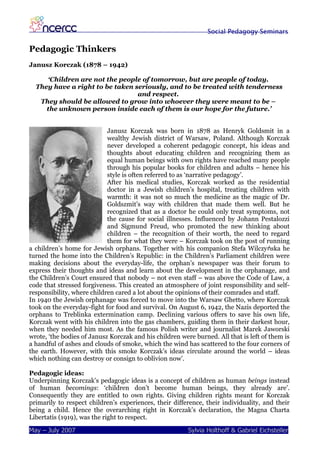
Janusz Korczak (1878 – 1942)

     ‘Children are not the people of tomorrow, but are people of today.
  They have a right to be taken seriously, and to be treated with tenderness
                                 and respect.
   They should be allowed to grow into whoever they were meant to be –
     the unknown person inside each of them is our hope for the future.’


                            Janusz Korczak was born in 1878 as Henryk Goldsmit in a
                            wealthy Jewish district of Warsaw, Poland. Although Korczak
                            never developed a coherent pedagogic concept, his ideas and
                            thoughts about educating children and recognizing them as
                            equal human beings with own rights have reached many people
                            through his popular books for children and adults – hence his
                            style is often referred to as ‘narrative pedagogy’.
                            After his medical studies, Korczak worked as the residential
                            doctor in a Jewish children’s hospital, treating children with
                            warmth: it was not so much the medicine as the magic of Dr.
                            Goldszmit’s way with children that made them well. But he
                            recognized that as a doctor he could only treat symptoms, not
                            the cause for social illnesses. Influenced by Johann Pestalozzi
                            and Sigmund Freud, who promoted the new thinking about
                            children – the recognition of their worth, the need to regard
                            them for what they were – Korczak took on the post of running
a children’s home for Jewish orphans. Together with his companion Stefa Wilczyńska he
turned the home into the Children’s Republic: in the Children’s Parliament children were
making decisions about the everyday-life, the orphan’s newspaper was their forum to
express their thoughts and ideas and learn about the development in the orphanage, and
the Children’s Court ensured that nobody – not even staff – was above the Code of Law, a
code that stressed forgiveness. This created an atmosphere of joint responsibility and self-
responsibility, where children cared a lot about the opinions of their comrades and staff.
In 1940 the Jewish orphanage was forced to move into the Warsaw Ghetto, where Korczak
took on the everyday-fight for food and survival. On August 6, 1942, the Nazis deported the
orphans to Treblinka extermination camp. Declining various offers to save his own life,
Korczak went with his children into the gas chambers, guiding them in their darkest hour,
when they needed him most. As the famous Polish writer and journalist Marek Jaworski
wrote, ‘the bodies of Janusz Korczak and his children were burned. All that is left of them is
a handful of ashes and clouds of smoke, which the wind has scattered to the four corners of
the earth. However, with this smoke Korczak’s ideas circulate around the world – ideas
which nothing can destroy or consign to oblivion now’.

Pedagogic ideas:
Underpinning Korczak’s pedagogic ideas is a concept of children as human beings instead
of human becomings: ‘children don’t become human beings, they already are’.
Consequently they are entitled to own rights. Giving children rights meant for Korczak
primarily to respect children’s experiences, their difference, their individuality, and their
being a child. Hence the overarching right in Korczak’s declaration, the Magna Charta
Libertatis (1919), was the right to respect.

May – July 2007                                          Sylvia Holthoff & Gabriel Eichsteller
Social Pedagogy Seminars
Under this frame, he formulated three key rights – ‘perhaps there are more, but I have
found these to be the principle rights’:
 1) The right of the child to die.
 2) The right of the child to live for today.
 3) The right of the child to be what she or he is.
As Korczak said, out of fear that death could snatch away our child, we deprive him of life;
to avert his death we don’t really let him live. In this sense, the right to die puts the right to
a self-determined life, with all its risks and hazards, out of adults’ hands and in the hands of
the child. He pointed out that overprotection disregards the children’s right to freedom,
self-experience and self-determination; hence the right to die is ultimately the right to take
responsibility for one’s own life and death.
Korczak’s formulation of the child’s right to the present day means that ‘we should also
respect the present hour. How can we assure a child’s life in the future, if we have not yet
learned how to live consciously and responsibly in the present?’ It is not the pedagogue’s
task to influence the future fate of the child, but to ensure that the present day is ‘full of
happy efforts, child-like, carefree without a responsibility that exceeds the age and the
powers’.
Korczak’s demand that children be allowed to be who they are is also linked with this
concept of children as full persons, and his notion that we cannot expect from children to
be perfect. This right also calls for a relational approach, as it is our responsibility to get to
know the child.

A little later Korczak added that ‘the primary and indisputable right of the child is to
pronounce his thoughts and to take actively part in our considerations and decisions about
his person’. Characteristic for Korczak’s pedagogic approach is the radical involvement of
children: self-governing structures are at the heart of his education system, ensuring that
the basis for a discourse between child and adult is independent from the adult’s
humanistic attitude.

Korczak’s pedagogic ideas were based on his high interest in everything children did; he
was a practitioner-researcher with his whole heart. He emphasised how studying, observing
and asking children can lead to a better understanding of them. His constant observations
and reflections also enabled him to experiment with new structures and to analyse where
they needed improvement. ‘Thanks to theory, I know. Thanks to practice, I feel. Theory
enriches intellect, practice deepens feeling, trains the will’.

Korczak always emphasised the individuality of each child, stating that there is no recipe
for rearing children: ‘it is impossible to tell parents unknown to me how to rear a child also
unknown to me under conditions unknown to me […] There are insights that can be born
only of your own pain, and they are the most precious.’


further readings:
Korczak, J. (2007). Loving every Child – Wisdom for Parents. Edited by S. Joseph. Chapel
Hill: Algonquin Books.
Lewowicki, T. (1997). Janusz Korczak. In E. Morsy-Zaghloul (ed.). Thinkers on Education.
Vol.            3.          Paris:          UNESCO.            Available          online:
http://www.ibe.unesco.org/publications/ThinkersPdf/
korczaks.PDF
Lifton, B.J. (1988). The King of Children: A Biography of Janusz Korczak. London: Chatto
& Windus. Available online: http://korczak.com/Biography/kap-0.htm

May – July 2007                                            Sylvia Holthoff & Gabriel Eichsteller
Social Pedagogy Seminars

Pedagogic Thinkers
Kurt Hahn ( 1886 – 1974)

     ‘I regard it as the foremost task of education to ensure
                   the survival of these qualities:
  an enterprising curiosity, an undefeatable spirit, tenacity in
                              pursuit,
  readiness for sensible self denial, and above all, compassion’

Kurt Hahn was born in 1886 into a cultured Jewish industrialist family in Berlin, Germany.
Here he was educated at the stately ‘Wilhelm Gymnasium’ (private college) where he
experienced an education – typical for this time – with a very strong focus on learning facts
and being diligent. Hahn saw this mainly cognitive orientated method of education as
inefficient in preparing the pupils for life after school and the demands of society. He
himself developed a pedagogic concept of learning which emphasized on the forming of a
personality as a whole, instead on learning strictly by and with books. Furthermore, he was
convinced that education be designed to develop the deepest qualities of character and
compassion. He believed in the need for real, hands-on, practical challenges for the
development of character. Another aspect he wanted to promote with his concept was to
enable pupils to become responsible, thinking and acting human beings who reflected
themselves and their social environment.

Hahn decided early to become a school master and studied at the Universities of Göttingen,
Germany and at Christ Church, Oxford. During his studies in Oxford he learnt more about
the English schools and in particular the boarding schools. Here he found an educational
concept which saw pupils as persons who will take over responsibilities and leading roles in
their later life. The task of gaining knowledge of facts seemed to be seen as equivalent to
being enabled to cope with crises and emergencies.
In 1918 he worked as private secretary in Germany for Prince Max von Baden, a scholar and
humanist. Both shared the passion for education and upbringing. In 1920 they co-founded
their first boarding school at the castle of the Prince of Baden, the ‘Schule Schloss Salem’,
near Lake Constance. This initiative and being the headmaster of this school was the first
significant involvement of Kurt Hahn as an innovative educator in a school.
Due to his opposition to the rising Hitler regime, Hahn fled to England, where he was asked
to open a school similar to the one at Salem in the Scottish Gordonstoun. The ‘New Salem’
opened its doors in 1934 with the support of his English friends. Out of Hahn’s
Gordonstoun activities grew also the ‘Outward bound trust’ and its ‘expeditionary learning’.
For this the first Outward bound school was opened in Aberdovey, Wales in 1941. The
background for this initiative was the recognition that, during the sea war, older seamen
survived the sinking of their ship, rather than the young, physically fit. Hahn related this to
the advanced experience the older men had already gained in dealing with crises
throughout their working life. To even out the lack of experience, self confidence, strength
of character and endurance, Hahn developed a concept which was based on expeditionary
orientated activities.
Apart from this and the founding of many other schools with the same approach and idea
across Europe and even the USA, he developed the ‘County badge’, which later in 1940
became the ‘Duke of Edinburgh’s Award’. He retired from the headmastership at
Gordonstoun in 1953 after a severe illness and returned to his home at Hermannsberg in
Germany. In 1974, Kurt Hahn died in Ravensburg, Germany and lies buried in Salem.


May – July 2007                                          Sylvia Holthoff & Gabriel Eichsteller
Social Pedagogy Seminars
Pedagogic ideas:
Hahn believed that every child is born with innate spiritual powers and the ability to make
correct judgments about moral issues. However, in the progression through adolescence,
the child loses these spiritual powers and the ability to make moral judgments due to the
‘diseased society’ and the impulses of adolescence. Hahn summed this up in the ‘Six
declines of Modern Youth’:
1. Decline of fitness due to modern methods of locomotion (moving about);
2. Decline of initiative and enterprise due to the widespread disease of ‘spectatoritis’;
3. Decline of memory and imagination;
4. Decline of skills and care due to the weakened tradition of craftsmanship;
5. Decline of self-discipline due to the ever-present availability of stimulants and
   tranquilizers;
6. Decline of compassion due to the unseemly haste with which modern life is conducted
   or, as William Temple called it, ‘spiritual death’.
To ameliorate the social declines/diseases, Hahn prescribed 4 antidotes and developed the
‘Seven Laws of Salem’ in 1929, on which everyday life was and still is structured in his
schools. With these approaches he wanted to promote a pedagogic concept and learning
which would lead pupils to become persons who would be able to act kindly, righteously
and take over responsibility for themselves and the community. In this sense the four
antidotes can be understood as the four areas in which the main activities and ‘new
learning’ take place. All four elements should be seen under the motive of experiencing, as
Hahn suspected a subconscious effect of these experiences on the behaviour, the attitude
and the values of the concerning person:
•    Fitness training (e.g., to compete with one’s self in physical fitness; in so doing, train the
     discipline and determination of the mind through the body)
•    Expeditions (e.g., via sea or land, to engage in long, challenging endurance tasks)
•    Projects (e.g., involving crafts and manual skills)
•    Rescue Service (e.g., surf lifesaving, fire fighting, first aid)
The ‘Seven Laws of Salem’ on the other hand describe the approach in which these
activities should be put into practice:
1. Give the children opportunities for self-discovery.
2. Make the children meet with triumph and defeat.
3. Give the children the opportunity of self-effacement in the common cause.
   (See to it that they get the chance to forget themselves in the pursuit of a common
   cause)
4. Provide periods of silence.
5. Train the imagination.
6. Make games important, but not predominant.
7. Free the sons of the wealthy and powerful from the enervating sense of privilege.
Hahn did not consider his schools as new. He claimed that his educational philosophy was
simply a pastiche from a variety of other sources. Hahn’s argument was that he preferred
‘material’ that was already proven to work rather than to experiment. The secret of success,
however, lay in the unique selection and combination of the principles that Hahn had
decided to borrow, combined with Hahn’s charismatic energy and persuasive ability to put
his ideas into action. One phrase used to sum up the philosophy of his educational
programmes was that ‘there is more in you than you think’. Today strong traces of Hahn’s
holistic and society-oriented educational approach can be found in many fields of social
work as it has outgrown the schooling system a long time ago.


May – July 2007                                             Sylvia Holthoff & Gabriel Eichsteller
Social Pedagogy Seminars
Further readings:
www.kurthahn.org    Archive of Kurt Hahn: www.salemcollege.de


May – July 2007             Sylvia Holthoff & Gabriel Eichsteller
Social Pedagogy Seminars
Salutogenesis
Salutogenesis is an alternative medicine concept that focuses on factors that support
human health and well-being rather than on factors that cause disease. The term
salutogenesis comes from the Latin salus: health, and genesis: origin. The term was first
used by Aaron Antonovsky in 1979, who studied the influence of a variety of sources of
stress on health and was able to show that relatively unstressed people had much more
resistance to illness than those who were more stressed. Antonovsky argued that the
experience of well-being constitutes a Sense of Coherence (SOC). Though modern medicine
has increasingly come to ask about the origin of illness, Antonovsky suggested that an
equally important question to pose is: ‘what is the origin of health?’

The salutogenic perspective focuses on three aspects. Firstly, the focus is on problem
solving/finding solutions. Secondly, it identifies generalised resistance resources that help
people to move in the direction of positive health. Thirdly, it identifies a global and
pervasive sense in individuals, groups, populations, or systems that serves as the overall
mechanism or capacity for this process, the sense of coherence (SOC).

For social pedagogues, salutogenesis means to concentrate on and strengthen children’s
health in a holistic understanding of the term – including emotional and physical well-
being. This positivist focus can effectively help overcome problems and weaknesses by
developing salutogenic factors, such as the sense of coherence, a positive self-concept,
confidence, trust, emotional stability, social inclusion, being cared for, optimism, fantasy,
etc.


Sense of Coherence
Antonovsky defined Sense of Coherence as:
  ‘a global orientation that expresses the extent to which one has a pervasive, enduring
  though dynamic feeling of confidence that one's internal and external environments are
  predictable and that there is a high probability that things will work out as well as can
  reasonably be expected.’
This Sense of Coherence, developed through the feeling that we can make sense of and
influence what is happening around us, is essential for staying healthy, and makes the
difference in enduring stress situations physically and emotionally healthy. Play,
experiences and dialogue are important in developing this feeling.
DF Smith identifies three inherent prerequisites that determine a person’s abilities to cope
as:
• Meaningfulness: The profound emotive experience of life as making sense and thus
  coping being desirable.
• Manageability: The recognition of the resources required to meet the demands and a
  willingness to search them out – being able to solve problems.
• Comprehensibility: The conceptual perception of the world being understandable,
  meaningful, orderly and consistent rather than chaotic, random and unpredictable.


May – July 2007                                         Sylvia Holthoff & Gabriel Eichsteller
Social Pedagogy Seminars


    Self-Concept
    The self-concept is the sum total of a person’s beliefs about their own personal attributes.
    These beliefs can be about affect, behaviour, cognitions, motives, etc.

    Shavelson, Bolus & Stanton (1976) came up with a model of self-concept that they defined
    as ‘a person's perceptions of him/herself. It is formed through experience with and
    interpretations of one's environment. It is especially influenced by evaluations by
    ‘significant others’ (e.g. parents, teachers, youth workers), reinforcements, and attributions
    for one's own behaviour.

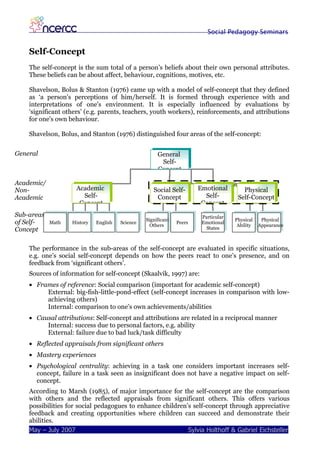
    Shavelson, Bolus, and Stanton (1976) distinguished four areas of the self-concept:


General                                               General
                                                       Self-
                                                      Concept

Academic/                                                              Non-Academic Self-
Non-                 Academic                       Social Self-        Emotional    Physical
                                                                       Concept
Academic               Self-                         Concept              Self-    Self-Concept
                      Concept                                            Concept
Sub-areas                                                               Particular
                                                 Significant                         Physical    Physical
of Self-    Math   History   English   Science
                                                   Others
                                                               Peers    Emotional
                                                                                      Ability   Appearance
Concept                                                                   States


    The performance in the sub-areas of the self-concept are evaluated in specific situations,
    e.g. one’s social self-concept depends on how the peers react to one’s presence, and on
    feedback from ‘significant others’.
    Sources of information for self-concept (Skaalvik, 1997) are:
    • Frames of reference: Social comparison (important for academic self-concept)
         External: big-fish-little-pond-effect (self-concept increases in comparison with low-
         achieving others)
         Internal: comparison to one’s own achievements/abilities
    • Causal attributions: Self-concept and attributions are related in a reciprocal manner
         Internal: success due to personal factors, e.g. ability
         External: failure due to bad luck/task difficulty
    • Reflected appraisals from significant others
    • Mastery experiences
    • Psychological centrality: achieving in a task one considers important increases self-
      concept, failure in a task seen as insignificant does not have a negative impact on self-
      concept.
    According to Marsh (1985), of major importance for the self-concept are the comparison
    with others and the reflected appraisals from significant others. This offers various
    possibilities for social pedagogues to enhance children’s self-concept through appreciative
    feedback and creating opportunities where children can succeed and demonstrate their
    abilities.
    May – July 2007                                         Sylvia Holthoff & Gabriel Eichsteller
Social Pedagogy Seminars
Developing a Self-Structure
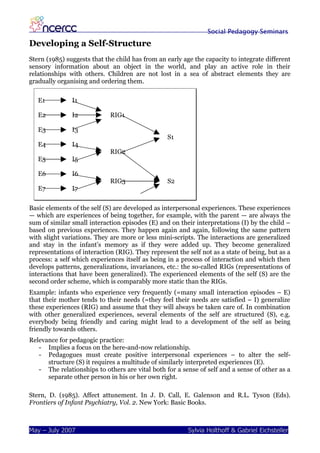
Stern (1985) suggests that the child has from an early age the capacity to integrate different
sensory information about an object in the world, and play an active role in their
relationships with others. Children are not lost in a sea of abstract elements they are
gradually organising and ordering them.

   E1          I1

   E2          I2            RIG1

   E3          I3
                                                  S1
   E4          I4
                             RIG2
   E5          I5

   E6          I6
                             RIG3                 S2
   E7          I7


Basic elements of the self (S) are developed as interpersonal experiences. These experiences
— which are experiences of being together, for example, with the parent — are always the
sum of similar small interaction episodes (E) and on their interpretations (I) by the child –
based on previous experiences. They happen again and again, following the same pattern
with slight variations. They are more or less mini-scripts. The interactions are generalized
and stay in the infant’s memory as if they were added up. They become generalized
representations of interaction (RIG). They represent the self not as a state of being, but as a
process: a self which experiences itself as being in a process of interaction and which then
develops patterns, generalizations, invariances, etc.: the so-called RIGs (representations of
interactions that have been generalized). The experienced elements of the self (S) are the
second order scheme, which is comparably more static than the RIGs.
Example: infants who experience very frequently (=many small interaction episodes – E)
that their mother tends to their needs (=they feel their needs are satisfied – I) generalize
these experiences (RIG) and assume that they will always be taken care of. In combination
with other generalized experiences, several elements of the self are structured (S), e.g.
everybody being friendly and caring might lead to a development of the self as being
friendly towards others.
Relevance for pedagogic practice:
   - Implies a focus on the here-and-now relationship.
   - Pedagogues must create positive interpersonal experiences – to alter the self-
      structure (S) it requires a multitude of similarly interpreted experiences (E).
   - The relationships to others are vital both for a sense of self and a sense of other as a
      separate other person in his or her own right.

Stern, D. (1985). Affect attunement. In J. D. Call, E. Galenson and R.L. Tyson (Eds).
Frontiers of Infant Psychiatry, Vol. 2. New York: Basic Books.


May – July 2007                                          Sylvia Holthoff & Gabriel Eichsteller
Social Pedagogy Seminars
The 4 Pedagogic Styles
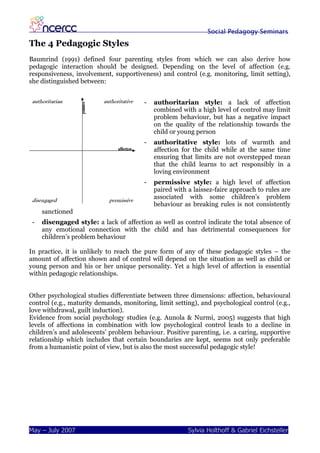
Baumrind (1991) defined four parenting styles from which we can also derive how
pedagogic interaction should be designed. Depending on the level of affection (e.g.
responsiveness, involvement, supportiveness) and control (e.g. monitoring, limit setting),
she distinguished between:


                                        -   authoritarian style: a lack of affection
                                            combined with a high level of control may limit
                                            problem behaviour, but has a negative impact
                                            on the quality of the relationship towards the
                                            child or young person
                                        -   authoritative style: lots of warmth and
                                            affection for the child while at the same time
                                            ensuring that limits are not overstepped mean
                                            that the child learns to act responsibly in a
                                            loving environment
                                        -   permissive style: a high level of affection
                                            paired with a laissez-faire approach to rules are
                                            associated with some children’s problem
                                            behaviour as breaking rules is not consistently
     sanctioned
 -   disengaged style: a lack of affection as well as control indicate the total absence of
     any emotional connection with the child and has detrimental consequences for
     children’s problem behaviour

In practice, it is unlikely to reach the pure form of any of these pedagogic styles – the
amount of affection shown and of control will depend on the situation as well as child or
young person and his or her unique personality. Yet a high level of affection is essential
within pedagogic relationships.


Other psychological studies differentiate between three dimensions: affection, behavioural
control (e.g., maturity demands, monitoring, limit setting), and psychological control (e.g.,
love withdrawal, guilt induction).
Evidence from social psychology studies (e.g. Aunola & Nurmi, 2005) suggests that high
levels of affections in combination with low psychological control leads to a decline in
children’s and adolescents’ problem behaviour. Positive parenting, i.e. a caring, supportive
relationship which includes that certain boundaries are kept, seems not only preferable
from a humanistic point of view, but is also the most successful pedagogic style!


May – July 2007                                         Sylvia Holthoff & Gabriel Eichsteller
Social Pedagogy Seminars


Communication Axioms
Watzlawick defines 5 basic axioms in his theory on communication that are necessary to
have a functioning communication between two individuals.

• ONE CANNOT NOT COMMUNICATE
  Every behaviour is a kind of communication. Because behaviour does not have a
  counterpart (there is no anti-behaviour), it is not possible not to communicate.
• EVERY   COMMUNICATION HAS A CONTENT AND RELATIONSHIP ASPECT SUCH THAT THE LATTER
  CLASSIFIES THE FORMER AND IS THEREFORE A META-COMMUNICATION

  This means that all communication includes, apart from what is said, more information
  – information on how the talker says something suggests how he himself sees his
  relation to the receiver of information. The relationship is the framework of the content.
• THE   NATURE OF A RELATIONSHIP IS DEPENDENT ON THE PUNCTUATION OF THE PARTNER ’S
  COMMUNICATION PROCEDURES

  Both the talker and the receiver of information structure the communication flow
  differently and therefore interpret their own behaviour during communicating as merely
  a reaction on the other’s behaviour (i.e. every partner thinks the other one is the cause of
  a specific behaviour). Human communication cannot be dissolved into plain causation
  and reaction strings, communication rather appears to be cyclic.
• HUMAN COMMUNICATION INVOLVES BOTH DIGITAL AND ANALOGUE MODALITIES
  Communication does not merely involve spoken language (digital communication), but
  non-verbal, analogue communication as well, e.g. facial expression, gestures, body
  language.
• INTER-HUMAN COMMUNICATION PROCEDURES ARE EITHER SYMMETRICAL OR COMPLEMENTARY
  Symmetrical communication is based on equal power while complementary
  communication is based on differences in power relations. A healthy relationship will
  have both types of power. Too much of one type of power can lead to possible conflicts.


Watzlawick, P. (1967). Pragmatics of Human Communication. New York: WW Norton &
Co.


May – July 2007                                         Sylvia Holthoff & Gabriel Eichsteller
Social Pedagogy Seminars


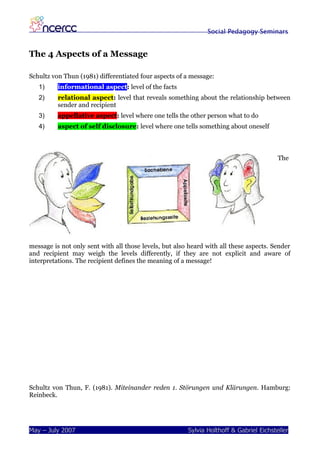
The 4 Aspects of a Message

Schultz von Thun (1981) differentiated four aspects of a message:
   1)     informational aspect: level of the facts
   2)     relational aspect: level that reveals something about the relationship between
          sender and recipient
   3)     appellative aspect: level where one tells the other person what to do
   4)     aspect of self disclosure: level where one tells something about oneself


                                                                                         The


message is not only sent with all those levels, but also heard with all these aspects. Sender
and recipient may weigh the levels differently, if they are not explicit and aware of
interpretations. The recipient defines the meaning of a message!


Schultz von Thun, F. (1981). Miteinander reden 1. Störungen und Klärungen. Hamburg:
Reinbeck.


May – July 2007                                         Sylvia Holthoff & Gabriel Eichsteller
Social Pedagogy Seminars


Theme-Centered Interaction (TCI)
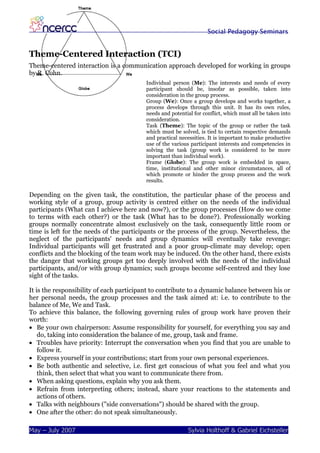
Theme-centered interaction is a communication approach developed for working in groups
by R. Cohn.
                                          Individual person (Me): The interests and needs of every
                                          participant should be, insofar as possible, taken into
                                          consideration in the group process.
                                          Group (We): Once a group develops and works together, a
                                          process develops through this unit. It has its own rules,
                                          needs and potential for conflict, which must all be taken into
                                          consideration.
                                          Task (Theme): The topic of the group or rather the task
                                          which must be solved, is tied to certain respective demands
                                          and practical necessities. It is important to make productive
                                          use of the various participant interests and competencies in
                                          solving the task (group work is considered to be more
                                          important than individual work).
                                          Frame (Globe): The group work is embedded in space,
                                          time, institutional and other minor circumstances, all of
                                          which promote or hinder the group process and the work
                                          results.

Depending on the given task, the constitution, the particular phase of the process and
working style of a group, group activity is centred either on the needs of the individual
participants (What can I achieve here and now?), or the group processes (How do we come
to terms with each other?) or the task (What has to be done?). Professionally working
groups normally concentrate almost exclusively on the task, consequently little room or
time is left for the needs of the participants or the process of the group. Nevertheless, the
neglect of the participants' needs and group dynamics will eventually take revenge:
Individual participants will get frustrated and a poor group-climate may develop; open
conflicts and the blocking of the team work may be induced. On the other hand, there exists
the danger that working groups get too deeply involved with the needs of the individual
participants, and/or with group dynamics; such groups become self-centred and they lose
sight of the tasks.

It is the responsibility of each participant to contribute to a dynamic balance between his or
her personal needs, the group processes and the task aimed at: i.e. to contribute to the
balance of Me, We and Task.
To achieve this balance, the following governing rules of group work have proven their
worth:
• Be your own chairperson: Assume responsibility for yourself, for everything you say and
    do, taking into consideration the balance of me, group, task and frame.
• Troubles have priority: Interrupt the conversation when you find that you are unable to
    follow it.
• Express yourself in your contributions; start from your own personal experiences.
• Be both authentic and selective, i.e. first get conscious of what you feel and what you
    think, then select that what you want to communicate there from.
• When asking questions, explain why you ask them.
• Refrain from interpreting others; instead, share your reactions to the statements and
    actions of others.
• Talks with neighbours ("side conversations") should be shared with the group.
• One after the other: do not speak simultaneously.

May – July 2007                                            Sylvia Holthoff & Gabriel Eichsteller
Social Pedagogy Seminars
• Speak about one single topic - and not too long.


May – July 2007                                      Sylvia Holthoff & Gabriel Eichsteller
Social Pedagogy Seminars


Johari Window
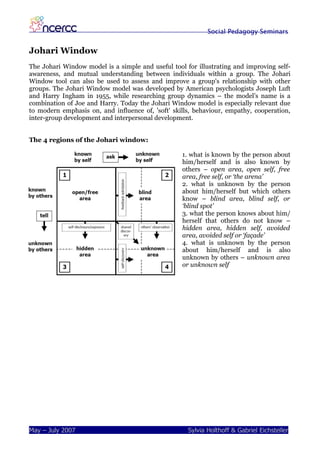
The Johari Window model is a simple and useful tool for illustrating and improving self-
awareness, and mutual understanding between individuals within a group. The Johari
Window tool can also be used to assess and improve a group's relationship with other
groups. The Johari Window model was developed by American psychologists Joseph Luft
and Harry Ingham in 1955, while researching group dynamics – the model’s name is a
combination of Joe and Harry. Today the Johari Window model is especially relevant due
to modern emphasis on, and influence of, 'soft' skills, behaviour, empathy, cooperation,
inter-group development and interpersonal development.


The 4 regions of the Johari window:

                                                   1. what is known by the person about
                                                   him/herself and is also known by
                                                   others – open area, open self, free
                                                   area, free self, or ‘the arena’
                                                   2. what is unknown by the person
                                                   about him/herself but which others
                                                   know – blind area, blind self, or
                                                   ‘blind spot’
                                                   3. what the person knows about him/
                                                   herself that others do not know –
                                                   hidden area, hidden self, avoided
                                                   area, avoided self or ‘façade’
                                                   4. what is unknown by the person
                                                   about him/herself and is also
                                                   unknown by others – unknown area
                                                   or unknown self


May – July 2007                                      Sylvia Holthoff & Gabriel Eichsteller
Social Pedagogy Seminars

Feedback
For giving and taking a feedback to enlarge your knowledge of yourself and the knowledge
of others of you it is useful to apply some rules for the actual process. The suggested rules
are to promote a constructive communication atmosphere in which the two or more
participating parties can exchange there thoughts and impressions.

As the person giving the feedback...
•   Ask if the person wants to have feedback and is prepared for it.
•   Be authentic in what you say and select which aspects have priority.
•   If you are referring to a specific incident try to offer the feedback as immediate as
    possible.
•   Start with the positive things and be conscious to value the person’s achievements.
•   Don’t use the feedback as an opportunity to ‘get back’ at someone.
•   Describe your perception of the actual incident, your personal feelings towards this and
    what you assume. Speak only for yourself and that by using the first person.
•   Try to avoid interpretations, accusations, judgments, lectures and speculations.

As the person receiving...
•   Listen patiently, don’t interrupt and try not to justify yourself.
•   Ask questions for understanding and study whether you have understood what the other
    person has said to you. Now you can give feedback to the feedback-giving person on how
    you feel with what has been said and after this – only after and not before – you can
    discuss what has been said.
•   Thank the other person for giving you feedback. You yourself decide which aspects you
    want to accept out of what has been said to you and how this will influence your future
    behaviour.


May – July 2007                                             Sylvia Holthoff & Gabriel Eichsteller
Social Pedagogy Seminars


Active Listening
Active listening is a way of listening and responding to another person that improves
mutual understanding. Often when people talk to each other they don’t listen attentively.
They are rather distracted, half-listening, half-thinking about something else. When people
are engaged in a conflict, they are often busy formulating a response to what is being said.
They assume that they have heard many times before what their opponent is saying, so
rather than paying attention they focus on how they can respond to win the argument.

Active listening is a structured form of listening and responding that focuses the attention
on the speaker. The listener must take care to attend to the speaker fully, and then repeats,
in the listener’s own words, what he or she thinks the speaker has said. The listener does
not have to agree with the speaker. He or she must simply state what they think the speaker
said. This enables the speaker to find out whether the listener has really understood. If this
is not the case, the speaker can explain some more.

Often the listener is encouraged to interpret the speaker’s words in terms of feelings. Thus,
instead of just repeating what happened, the active listener might add that you felt angry or
frustrated or confused when a particular event happened. Then the speaker can go beyond
confirming that the listener understood what happened, but can indicate that he or she also
understood the speaker’s psychological response to it.

Three types of responses in active listening
Active listening is about focusing on the person who is speaking. An active listener needs to
focus full attention on the person who is speaking. The way the listener can show he or she
is actively listening is to do the following
   • ask good questions,
   • listen non-judgmentally,
   • paraphrase, and
   • empathize with their young person.
First you train yourself to ask questions in a way that allows your young person to feel
comfortable about answering truthfully, and about using his or her own words. Second,
you restate what you heard to make sure that you understood what your young person was
saying. Finally, you need to take the time to see things through your young person’s eyes
and get some understanding of how your adolescent is experiencing a given situation.

Asking questions
Often questions can seem accusing or blaming to the person asked. A question may make
the person feel pushed into a corner. For example, if a parent asks his or her teenage child,
‘You didn't like the movie, did you?’ it is clear that the parent does not approve of the movie
and, if the young person did like the movie, he or she ends up feeling the need to defend his
or her position. Consider how much easier it would have been to respond to the question
‘What did you think of the movie?’ And once your young person has expressed an opinion,
rather than giving yours, ask more questions to encourage your young person’s further
thinking.
Active listening requires the speaker to look at the hidden meaning behind the question.
People often ask questions that might make others feel pressured into coming up with the
correct response. For example, you might feel pressured when someone close to you asks,
‘Do you think I have gained weight?’ These types of questions tend to put the person being


May – July 2007                                          Sylvia Holthoff & Gabriel Eichsteller
Social Pedagogy Seminars
asked on the defensive. Often the person may shut off communication in order to protect
him or herself.
In order to be a good active listener, you need to make sure that you ask questions honestly
and sincerely. And that the intent behind questioning is to understand rather than advise,
criticise, or pry (the prosecuting attorney approach). Through this process, young people
will also understand their own thinking by fostering decision-making and planning skills.
Active-listening questions intend to:
   • Clarify meanings: ‘I hear you saying you are frustrated with Johnny, is that right?’
   • Learn about others’ thoughts, feelings, and wants: ‘Tell me more about your
       ideas for the project.’
   • Encourage elaboration: ‘What happened next?’ or ‘How did that make you feel?’
   • Encourage discovery: ‘What do you feel your options are at this point?’
   • Gather more facts and details: ‘What happened before this fight took place?’

Asking questions: a self-evaluation
You can be fairly sure you are using active listening effectively if you:
  •  Do not assume you know what your young person means; don't try to
     complete the young person’s statements or say, ‘I know just how you feel.’
  •  Ask for clarification with questions such as: ‘What did you mean when you said
     I have been unfair to you?’ or ‘You said she's crazy what do you mean by crazy? What
     does she do that is crazy?’
  •  Check your tone for sincerity. As you are talking to your young person, check
     that your tone of voice matches your feelings and body language. For example, a
     parent may sound angry when in reality he or she is concerned for his or her child.
     However, because the child hears anger he or she becomes more defensive and shuts
     the parent out.
  •  Ask open-ended questions that allow for a variety of responses. If you ask closed-
     ended questions, you limit the range of responses and suggest that you already know
     what is going to be said.
  •  Show interest in the speaker and the conversation by saying, ‘Tell me more
     about that’ or ‘Keep going, I'm following you.’
  •  Don't give advice until after you have asked for the young person’s opinions on
     the situation, as in ‘What are some possible solutions to this problem?’ or ‘What do
     you think should happen?’

Paraphrasing (re-stating)
Paraphrasing is a tool a you can use to make sure that you understand the message that you
think your young person is sending. It is restating the information you just received to
make sure you understand it. For example, your child says, ‘I hate math and the teacher,
because she never lets us do anything cool!’ You might say, ‘It sounds like you’re having a
hard time with math and that makes you feel frustrated and bored.’ This technique helps to
communicate in several ways.

  •   First, it helps make sure they understood the message correctly.
  •   Second, by restating or paraphrasing, the listening person draws further
      information from their teenage son or daughter.
  •   Third, paraphrasing allows the talking person to know that the listening person has
      heard what has been said and is interested in what he or she has to say.
  •   Fourth, it gives the young person an opportunity to correct any misunderstanding
      immediately.

Empathizing

May – July 2007                                        Sylvia Holthoff & Gabriel Eichsteller
Social Pedagogy Seminars
Empathizing means that you (as an adult) have the ability to put yourself in your young
person’s shoes. To empathize, you must ignore your own, adult perception of the situation
for the moment and accept your young person’s feelings, thoughts, and ideas of the
situation as yours. See it through a young person’s eyes – during your discussion.
Empathizing does not mean you need to agree with your young
person.
Empathizing does not mean you need to give in to your young person, or allow
her or him to set her or his own rules to avoid confrontation.
Empathizing means you do not dismiss what your young person says as
ridiculous or silly. Your acceptance of your teenager’s thoughts, ideas, and feelings
increases the chance that your young person will talk to you about the problems and issues
that he or she is facing.

It is easy to know when you are being empathic because:
1. Your body language and tone match
2. Your tone and your feelings match
3. You are focused on what your young person is saying and meaning. You are trying to see
    things from your young person’s point of view which requires that:
    •  You do not impose your feelings, thoughts, and ideas throughout the conversation
    •  You refrain from immediately giving advice
    •  You are tired after listening because it takes a great deal of energy
    •  You ask yourself if you would make that same statement to an adult. If not, then think
       twice about making it.

Benefits

Active listening has several benefits. First, it forces people to listen attentively to others.
Second, it avoids misunderstandings, as people have to confirm that they do really
understand what another person has said. Third, it tends to open people up, to get them to
say more. When people are in conflict, they often contradict each other, denying the
opponents description of a situation. This tends to make people defensive, and they will
either lash out, or withdraw and say nothing more. However, if they feel that their opponent
is really attuned to their concerns and wants to listen, they are likely to explain in detail
what they feel and why. If both parties to a conflict do this, the chances of being able to
develop a solution to their mutual problem becomes much greater.


May – July 2007                                          Sylvia Holthoff & Gabriel Eichsteller
Social Pedagogy Seminars


The Professional Role of the Pedagogue – Combining
Personality with Competence
The social pedagogue’s role is determined by two factors, partly the social education society
related function, and partly by the person who fulfils the role. The process of formation that
the education initiates in the student represents vocational and personal challenges. It’s all
about a life-long formation where, according to Bent Madsen, for the individual social
pedagogue or social educator student it concerns: “Complicated clarification and
recognition processes in connection with goal performance, ability to analyse and formulate
problems, situations involving choices full of conflict when applied to content and activities
and often unclear practise opportunities when applied to managing the professional role –
altogether something that places particular demands on the social educator’s
qualifications”.

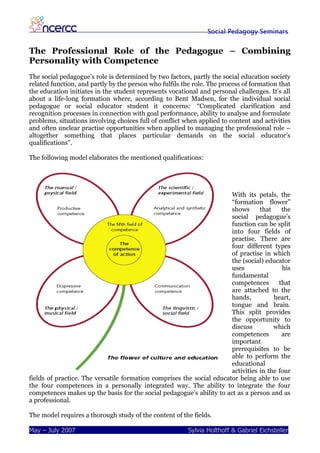
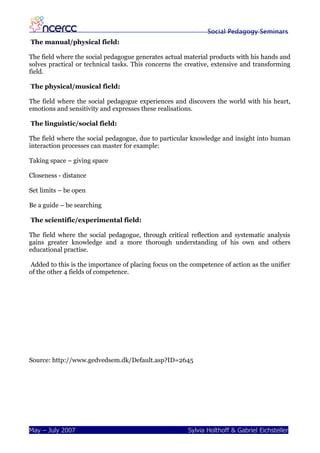
The following model elaborates the mentioned qualifications:


                                                                       With its petals, the
                                                                       “formation flower”
                                                                       shows      that    the
                                                                       social pedagogue’s
                                                                       function can be split
                                                                       into four fields of
                                                                       practise. There are
                                                                       four different types
                                                                       of practise in which
                                                                       the (social) educator
                                                                       uses               his
                                                                       fundamental
                                                                       competences       that
                                                                       are attached to the
                                                                       hands,          heart,
                                                                       tongue and brain.
                                                                       This split provides
                                                                       the opportunity to
                                                                       discuss         which
                                                                       competences        are
                                                                       important
                                                                       prerequisites to be
                                                                       able to perform the
                                                                       educational
                                                                       activities in the four
fields of practice. The versatile formation comprises the social educator being able to use
the four competences in a personally integrated way. The ability to integrate the four
competences makes up the basis for the social pedagogue’s ability to act as a person and as
a professional.

The model requires a thorough study of the content of the fields.

May – July 2007                                          Sylvia Holthoff & Gabriel Eichsteller
Social Pedagogy Seminars
The manual/physical field:

The field where the social pedagogue generates actual material products with his hands and
solves practical or technical tasks. This concerns the creative, extensive and transforming
field.

The physical/musical field:

The field where the social pedagogue experiences and discovers the world with his heart,
emotions and sensitivity and expresses these realisations.

The linguistic/social field:

The field where the social pedagogue, due to particular knowledge and insight into human
interaction processes can master for example:

Taking space – giving space

Closeness - distance

Set limits – be open

Be a guide – be searching

The scientific/experimental field:

The field where the social pedagogue, through critical reflection and systematic analysis
gains greater knowledge and a more thorough understanding of his own and others
educational practise.

Added to this is the importance of placing focus on the competence of action as the unifier
of the other 4 fields of competence.


Source: http://www.gedvedsem.dk/Default.asp?ID=2645


May – July 2007                                        Sylvia Holthoff & Gabriel Eichsteller
Social Pedagogy Seminars


Expeditionary                Learning               –    Outward            Bound          Design
Principles
Overview:
Expeditionary Learning is built on ten design principles that reflect the educational values and
beliefs of Outward Bound. These principles also reflect the design’s connection to related thinking
about teaching, learning, and the culture of schools.

1. The Primacy of Self-Discovery                        their failures, to persevere when things are
Learning happens best with emotion,                     hard, and to learn to turn disabilities into
challenge and the requisite support. People             opportunities.
discover their abilities, values, passions, and
responsibilities in situations that offer               6. Collaboration and Competition
adventure      and     the    unexpected.    In         Individual     development       and      group
Expeditionary Learning schools, students                development are integrated so that the value of
undertake tasks that require perseverance,              friendship, trust, and group action is clear.
fitness, craftsmanship, imagination, self-              Students are encouraged to compete not
discipline, and significant achievement. A              against each other but with their own personal
teacher’s primary task is to help students              best and with rigorous standards of excellence.
overcome their fears and discover they can do
more than they think they can.                          7. Diversity and Inclusion
                                                        Both diversity and inclusion increase the
2. The Having of Wonderful Ideas                        richness of ideas, creative power, problem-
Teaching in Expeditionary Learning schools              solving ability, and respect for others. In
fosters curiosity about the world by creating           Expeditionary Learning schools, students
learning situations that provide something              investigate and value their different histories
important to think about, time to experiment,           and talents as well as those of other
and time to make sense of what is observed.             communities and cultures. Schools and
                                                        learning groups are heterogeneous.
3. The Responsibility for Learning
Learning is both a personal process of                  8. The Natural World
discovery and a social activity. Everyone learns        A direct and respectful relationship with the
both individually and as part of a group. Every         natural world refreshes the human spirit and
aspect of an Expeditionary Learning school              teaches the important ideas of recurring cycles
encourages both children and adults to become           and cause and effect. Students learn to become
increasingly responsible for directing their            stewards of the earth and of future
own personal and collective learning.                   generations.

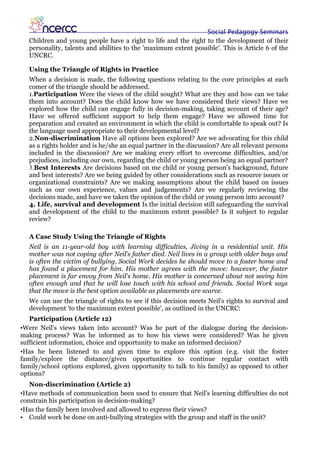
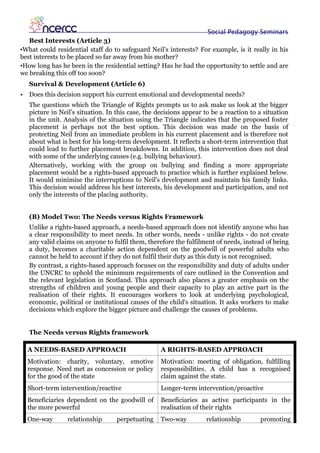
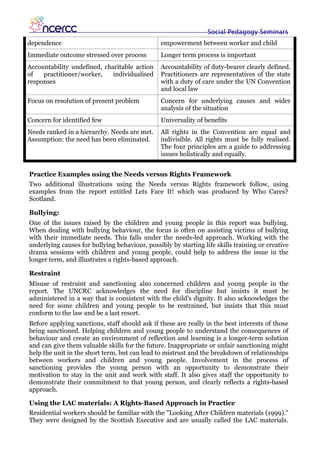
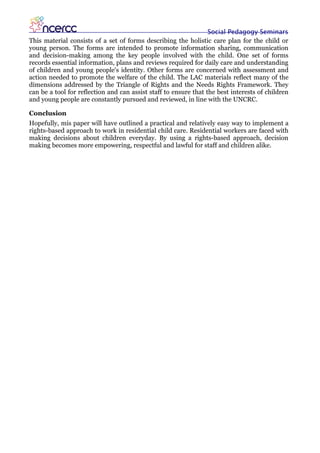
4. Empathy and Caring                                   9. Solitude and Reflection
Learning is fostered best in communities                Students and teachers need time alone to
where students’ and teachers’ ideas are                 explore their own thoughts, make their own
respected and where there is mutual trust.              connections, and create their own ideas. They
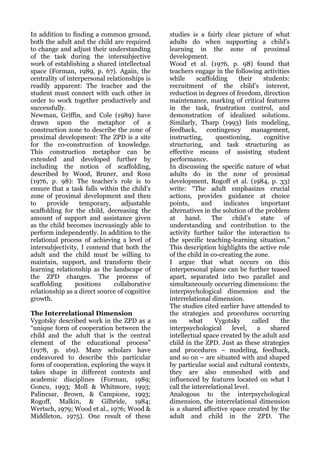
Learning groups are small in Expeditionary              also need time to exchange their reflections
Learning schools, with a caring adult looking           with others.
after the progress and acting as an advocate for
each child. Older students mentor younger               10.      Service and Compassion
ones, and students feel physically and                  We are crew, not passengers. Students and
emotionally safe.                                       teachers are strengthened by acts of
                                                        consequential service to others, and one of an
5. Success and Failure                                  Expeditionary Learning school’s primary
All students need to be successful if they are to       functions is to prepare students with the
build the confidence and capacity to take risks         attitudes and skills to learn from and be of
and meet increasingly difficult challenges. But         service to others.
it is also important for students to learn from

May – July 2007                                                Sylvia Holthoff & Gabriel Eichsteller
Social Pedagogy Seminars
Source: Outward Bound


May – July 2007         Sylvia Holthoff & Gabriel Eichsteller
The Learning Zone
                                ‘If you want to feel secure
                        Do what you already know how to do.
                               But if you want to grow …
                       Go to the cutting edge of your competence,
                       Which means a temporary loss of security.
                           So, whenever you don’t quite know
                                    What you are doing
                                          Know
                                 That you are growing …’
                                      (Viscott, 2003)


In order to learn we have to explore: we already know our environment we feel comfortable
in, where we don’t have to take any risks. To get to know the unknown, we have to leave
this Comfort Zone and discover the Learning Zone, which lies just outside of our secure
environment. Only in the Learning Zone can we grow and learn, and thus slowly expand
our Comfort Zone. Going into the Learning Zone is a borderline experience – we feel we’re
exploring the edge of our abilities, our limits, how far we dare to leave our Comfort Zone.
However, beyond the Learning Zone lies the Anxiety Zone, wherein learning is impossible,
as it is blocked by a feeling of fear. In the transition from Comfort Zone to Learning Zone
we need to be careful when taking risks that we don’t go too far out of our Comfort Zone –
beyond the Learning Zone – into the Anxiety Zone, where all our energy is used for
managing/controlling the anxiety.

For each person this Circle Model differs – each of us has their own Comfort Zone –
Learning Zone – Anxiety Zone. The key is to know when to stay in our Comfort Zone – to
choose when to explore our Learning Zone – and to be aware of when we are in our Anxiety
Zone.
Creative Reviewing


             The Debriefing Funnel

 Experiences


        Filter #1:
  Review. Recall &
  Remember
                           Can you RECALL an example of...?
                           Do you REMEMBER a time when...?


                           What was the EFFECT of that occurrence?
                           How did that make you feel effectively?


                     Can you SUM up what you have learned from this?


                     Do you see a connection between this learning and your "real"
                     life & can you APPLY this new learning in any way?


                     What will you do differently next time at home, work or play
                     & how will you COMMIT to making a change for a better
                     future


Change
Creative Reviewing


Recall


Effect


Summation


Application


Commitment
Social Pedagogy Seminars


                              Research Question

Please ask some of your young people to answer the following question in writing:
– What is important to you in the relationship with your key worker?


Please state, without knowing the young people’s answers, what you think is
important to young people in the relationship with you?
Social Pedagogy Seminars


                Scottish Institute for Residential Child Care
                       In Residence, No 3, April 2006

           Children's Rights: How to Implement a
       Rights-Based Approach in Residential Child Care
                               Evelyn Vrouwenfelder
                        Training Co-ordinator, Save the Children

Evelyn Vrouwenfelder is responsible for the external training programme at
Save the Children Scotland, A Dutch--trained social worker, Evelyn worked in
residential child care for four years in Holland before working in such diverse
areas as Liberia and East Timor. She carried out a range of tasks such as work
with separated children and street children, raising awareness about child
protection, training police, social workers and legal officers, and carrying out
research in these countries before taking up her post in Scotland in 2002. She has
been heavily involved with SIRCC in designing and delivering children's rights
training to residential workers.
Introduction
Children's rights are often spoken about and discussed in residential units, but how
do we use children's rights as a tool to do our work? This paper suggests some
answers. It starts with basic information about the United Nations Convention on
the Rights of the Child (UNCRC) and answers some common questions on
children's rights. It introduces two models for implementing a rights-based
approach, and provides illustrations of their use. Residential workers might
wonder why we need another method of working with children and young people.
Taking a rights-based approach is not meant to be just another method, but is an
overarching framework, which complements existing ways of working in child care.
Discussions and reflections on the models presented in this paper will hopefully
provide a better way to make decisions about children and young people in
residential care.
Where did the UNCRC come from?
The UNCRC was developed by the United Nations, following a decade of work
devoted to discussing why a separate statement about children's rights was needed.
The final document was adopted by the UN General Assembly in November 1989
and ratified by the UK in 1991, Ratification means that legislation such as The
Children (Scotland) Act 1995, the Regulation of Care (Scotland) Act 2001 and the
Care Standards should incorporate the UNCRC. By doing this, the Government
makes sure that children's rights are upheld by those who provide services for
children and young people and that adults working with them, such as residential
workers and other professionals, are accountable.
Relating Rights to Practice: what's the relationship between adults and
children?
Everyone has human rights, including adults and children. Children's rights are
simply specific human rights for all children and young people from birth to 18
years of age. They are needed because they reflect the special status of childhood -
a period of rapid change and development during which this group experiences
Social Pedagogy Seminars
different vulnerabilities (e.g. physical weakness or lack of knowledge) and therefore
has different entitlements from adults.
Our explanation of what childhood is and recognition of this special status has been
developed over a long period time. Aries (1962), and other theorists who have come
after him, tells us that the idea of childhood is socially constructed. This means
that people in western society tend to see children and young people either as
potential victims who need looking after, or as potential threats who need to be
controlled. One of the consequences of our current thinking is that children and
young people are seen as passive and helpless and adults must 'do something' to
help. This has been translated into the understanding that children and young
people in need of care should be 'taken away', 'be properly educated' or 'get the right
kind of treatment.' This thinking focuses on children and young people's
weaknesses and not their strengths. The UNCRC emphasises strengths and asks
adults to see children and young people as active and not passive objects. Through
the UNCRC, children are rights-holders. This point is important because unless
the residential worker sees the child as a rights-holder and not a helpless object, any
degree of participation will be, at best, tokenistic and at worst, meaningless.
Residential workers are in one of the most important positions to promote
children's rights, and therefore are also among the key groups of duty bearers.
The tasks of the residential worker are complex, requiring many skills. Taking a
rights-based approach to work is an important way to apply those skills in a
proactive way. A rights-based approach is one where the worker has examined
children's rights and tries to put them at the centre of their practice; however,
applying a rights-based approach has been met with some suspicion. Some would
argue that the
promotion of children's rights has added to tensions in residential care, and
undermined practitioner morale.
The Scottish Commissioner for Children and YoungPeople, Kathleen Marshall,
comments on a fear that our culture is becoming too 'rights-based.' She explains
that there is a fear among practitioners that an over-emphasis on the rights of
children and young people will create expectations that are both unhealthy and
unrealisable in a democracy. Adults also sometimes comment that "children and
young people know too much about their rights already.' The truth is, however, as
Marshall acknowledges, that children and young people know very little about their
rights. What they believe they know is often only a fragment or even a caricature of
the actual content of the UNCRC Some studies about children have shown this to be
the case. For example, in an interview with the Scottish Child Law Centre carried
out by Save the Children, concern was expressed about how little children and
young people in residential care attending children's panels know about their rights.
Informing children and young people is a key responsibility for residential workers;
however, given the fact that residential workers meet many problems on a daily
basis, including verbal and physical abuse, they may have real concerns about their
own rights. Some residential workers may feel that their rights are over-ridden by
children's rights, or that they have more important matters to deal with than the
promotion of children's rights. It is the intention of this paper to demonstrate that it
is possible to implement a rights-based approach which makes both staff and
children feel valued.

How Do Rights and Responsibilities Relate To Each Other?
Kathleen Marshall emphasises mat in any society, rights and responsibilities must
go together. Sometimes, however, this is wrongly interpreted. For example, some
Social Pedagogy Seminars
people may say that unless a person takes responsibility, they cannot have rights.
Marshall would say that a person can only be regarded as having a right if someone
else has a responsibility to respect it; however, rights do not have to be earned by
the exercise of responsibility. For example, most of us would acknowledge that
babies have rights as have people with severe learning difficulties. Yet both these
groups cannot exercise this right without help from others and are very vulnerable
to harm or exploitation. It is the same with children and young people in care.
Marshall suggests that the more appropriate link should be responsibility and
power, not responsibility and rights. Anyone exercising power of any description
must do so responsibly. Our responsibility consists of knowing and being aware that
in situations where we could have the power and moral capacity to jeopardise the
rights of others, we have the responsibility to treat others with respect within a
context of human rights.


       Two Models for Implementing a Rights-Based Approach to Practice
(A)     Model One: The Triangle of Rights
The 54 articles in the UNCRC are clustered around four core principles which help with
interpreting the UNCRC as a whole and offer a holistic way of making decisions regarding
children and young people. Save the Children, which developed the models described in
this paper, says that one way to picture these principles is as a triangle, in which three of the
core principles form the corners of the triangle. When the triangle is out of balance, it poses
a risk of jeopardising the right to life, survival and development, which is the fourth core
principle, and lies at the heart of our work with children and young people.


The       three     core                                                     child should be a
principles forming the                                                       primary
three corners of the                                                         consideration. This
triangle are:                                                                is Article 3 of the
►                 Non-                                                       UNCRC.
discrimination                                                               ► Participation
All rights in the                                                            of the child
UNCRC apply to all                                                           Children        and
children and young                                                           young         people
people. Children and                                                         should be free to
young people have a                                                          express opinions in
right to be protected                                                        all          matters
from     discrimination.                                                     affecting them, and
This is Article 2 of the                                                     those views should
UNCRC.                                                                       be     given    due
► Best interests of                                                          weight           ‘in
the child                                                                    accordance      with
In       all     actions                                                     the     age     and
concerning      children                                                     maturity of the
and young people the best interests of the         child’. This is Article 12 of the UNCRC.

The Fourth core principle in the heart of the triangle is:
► The right to life, survival and development
Social Pedagogy Seminars
   Children and young people have a right to life and the right to the development of their
   personality, talents and abilities to the 'maximum extent possible'. This is Article 6 of the
   UNCRC.

   Using the Triangle of Rights in Practice
   When a decision is made, the following questions relating to the core principles at each
   comer of the triangle should be addressed.
   1.Participation Were the views of the child sought? What are they and how can we take
   them into account? Does the child know how we have considered their views? Have we
   explored how the child can engage fully in decision-making, taking account of their age?
   Have we offered sufficient support to help them engage? Have we allowed time for
   preparation and created an environment in which the child is comfortable to speak out? Is
   the language used appropriate to their developmental level?
   2.Non-discrimination Have all options been explored? Are we advocating for this child
   as a rights holder and is he/she an equal partner in the discussion? Are all relevant persons
   included in the discussion? Are we making every effort to overcome difficulties, and/or
   prejudices, including our own, regarding the child or young person being an equal partner?
   3.Best Interests Are decisions based on me child or young person's background, future
   and best interests? Are we being guided by other considerations such as resource issues or
   organizational constraints? Are we making assumptions about the child based on issues
   such as our own experience, values and judgements? Are we regularly reviewing the
   decisions made, and have we taken the opinion of the child or young person into account?
   4. Life, survival and development Is the initial decision still safeguarding the survival
   and development of the child to the maximum extent possible? Is it subject to regular
   review?

   A Case Study Using the Triangle of Rights
   Neil is an 11-year-old boy with learning difficulties, Jiving in a residential unit. His
   mother was not coping after Neil's father died. Neil lives in a group with older boys and
   is often the victim of bullying. Social Work decides he should move to a foster home and
   has found a placement for him. His mother agrees with the move: however, the foster
   placement is far envoy from Neil's home. His mother is concerned about not seeing him
   often enough and that he will lose touch with his school and friends. Social Work says
   that the move is the best option available as placements are scarce.
   We can use the triangle of rights to see if this decision meets Neil's rights to survival and
   development 'to the maximum extent possible', as outlined in the UNCRC:
   Participation (Article 12)
•Were Neil's views taken into account? Was he part of the dialogue during the decision-
making process? Was he informed as to how his views were considered? Was he given
sufficient information, choice and opportunity to make an informed decision?
•Has he been listened to and given time to explore this option (e.g. visit the foster
family/explore the distance/given opportunities to continue regular contact with
family/school options explored, given opportunity to talk to his family) as opposed to other
options?
   Non-discrimination (Article 2)
•Have methods of communication been used to ensure that Neil's learning difficulties do not
constrain his participation in decision-making?
•Has the family been involved and allowed to express their views?
• Could work be done on anti-bullying strategies with the group and staff in the unit?
Social Pedagogy Seminars
   Best Interests (Article 3)
•What could residential staff do to safeguard Neil's interests? For example, is it really in his
best interests to be placed so far away from his mother?
•How long has he been in the residential setting? Has he had the opportunity to settle and are
we breaking this off too soon?
   Survival & Development (Article 6)
• Does this decision support his current emotional and developmental needs?
   The questions which the Triangle of Rights prompts us to ask make us look at the bigger
   picture in Neil's situation. In this case, the decisions appear to be a reaction to a situation
   in the unit. Analysis of the situation using the Triangle indicates that the proposed foster
   placement is perhaps not the best option. This decision was made on the basis of
   protecting Neil from an immediate problem in his current placement and is therefore not
   about what is best for his long-term development. It reflects a short-term intervention that
   could lead to further placement breakdowns. In addition, this intervention does not deal
   with some of the underlying causes (e.g. bullying behaviour).
   Alternatively, working with the group on bullying and finding a more appropriate
   placement would be a rights-based approach to practice which is further explained below.
   It would minimise the interruptions to Neil's development and maintain his family links.
   This decision would address his best interests, his development and participation, and not
   only the interests of the placing authority.


   (B) Model Two: The Needs versus Rights Framework
   Unlike a rights-based approach, a needs-based approach does not identify anyone who has
   a clear responsibility to meet needs. In other words, needs - unlike rights - do not create
   any valid claims on anyone to fulfil them, therefore the fulfilment of needs, instead of being
   a duty, becomes a charitable action dependent on the goodwill of powerful adults who
   cannot be held to account if they do not fulfil their duty as this duty is not recognised.
   By contrast, a rights-based approach focuses on the responsibility and duty of adults under
   the UNCRC to uphold the minimum requirements of care outlined in the Convention and
   the relevant legislation in Scotland. This approach also places a greater emphasis on the
   strengths of children and young people and their capacity to play an active part in the
   realisation of their rights. It encourages workers to look at underlying psychological,
   economic, political or institutional causes of the child's situation. It asks workers to make
   decisions which explore the bigger picture and challenge the causes of problems.


   The Needs versus Rights framework

  A NEEDS-BASED APPROACH                           A RIGHTS-BASED APPROACH
  Motivation: charity, voluntary, emotive          Motivation: meeting of obligation, fulfilling
  response. Need met as concession or policy       responsibilities. A child has a recognised
  for the good of the state                        claim against the state.
  Short-term intervention/reactive                 Longer-term intervention/proactive
  Beneficiaries dependent on the goodwill of       Beneficiaries as active participants in the
  the more powerful                                realisation of their rights
  One-way        relationship      perpetuating    Two-way         relationship        promoting
Social Pedagogy Seminars
dependence                                      empowerment between worker and child
Immediate outcome stressed over process         Longer term process is important
Accountability undefined, charitable action     Accountability of duty-bearer clearly defined.
of   practitioner/worker,    individualised     Practitioners are representatives of the state
responses                                       with a duty of care under the UN Convention
                                                and local law
Focus on resolution of present problem          Concern for underlying causes and wider
                                                analysis of the situation
Concern for identified few                      Universality of benefits
Needs ranked in a hierarchy. Needs are met.     All rights in the Convention are equal and
Assumption: the need has been eliminated.       indivisible. All rights must be fully realised.
                                                The four principles are a guide to addressing
                                                issues holistically and equally.


Practice Examples using the Needs versus Rights Framework
Two additional illustrations using the Needs versus Rights framework follow, using
examples from the report entitled Lets Face It! which was produced by Who Cares?
Scotland.

Bullying:
One of the issues raised by the children and young people in this report was bullying.
When dealing with bullying behaviour, the focus is often on assisting victims of bullying
with their immediate needs. This falls under the needs-led approach. Working with the
underlying causes for bullying behaviour, possibly by starting life skills training or creative
drama sessions with children and young people, could help to address the issue in the
longer term, and illustrates a rights-based approach.

Restraint
Misuse of restraint and sanctioning also concerned children and young people in the
report. The UNCRC acknowledges the need for discipline but insists it must be
administered in a way that is consistent with the child's dignity. It also acknowledges the
need for some children and young people to be restrained, but insists that this must
conform to the law and be a last resort.
Before applying sanctions, staff should ask if these are really in the best interests of those
being sanctioned. Helping children and young people to understand the consequences of
behaviour and create an environment of reflection and learning is a longer-term solution
and can give them valuable skills for the future. Inappropriate or unfair sanctioning might
help the unit in the short term, but can lead to mistrust and the breakdown of relationships
between workers and children and young people. Involvement in the process of
sanctioning provides the young person with an opportunity to demonstrate their
motivation to stay in the unit and work with staff. It also gives staff the opportunity to
demonstrate their commitment to that young person, and clearly reflects a rights-based
approach.

Using the LAC materials: A Rights-Based Approach in Practice
Residential workers should be familiar with the "Looking After Children materials (1999)."
They were designed by the Scottish Executive and are usually called the LAC materials.
Social Pedagogy Seminars
This material consists of a set of forms describing the holistic care plan for the child or
young person. The forms are intended to promote information sharing, communication
and decision-making among the key people involved with the child. One set of forms
records essential information, plans and reviews required for daily care and understanding
of children and young people's identity. Other forms are concerned with assessment and
action needed to promote the welfare of the child. The LAC materials reflect many of the
dimensions addressed by the Triangle of Rights and the Needs Rights Framework. They
can be a tool for reflection and can assist staff to ensure that the best interests of children
and young people are constantly pursued and reviewed, in line with the UNCRC.

Conclusion
Hopefully, mis paper will have outlined a practical and relatively easy way to implement a
rights-based approach to work in residential child care. Residential workers are faced with
making decisions about children everyday. By using a rights-based approach, decision
making becomes more empowering, respectful and lawful for staff and children alike.
Social Pedagogy Seminars


References
For the full text of the UNCRC please go to www.unicef.com.
Other interesting websites are www.savethechildren and young people.org.uk/Scotland,
www.whocaresscotland.org and www.sclc. org.uk.
Aries, P. (1962). Centuries of Childhood. Harmondsworth, Penguin.
Heron, G. & Chakrabarti, M. (2002). Examining the perceptions and attitudes of staff
working in community based children and young people's homes: are their needs being
met? Qualitative Social Work, 1(3), 341-358.
Kearney, B. (2000). Children and young people's rights and children and young people's
welfare in Scotland. In N. Baldwin (Ed.) Protecting Children and Young People:
Promoting Tlieir Rights, (pp. 37-50) London: Whiting & Birch Ltd.
Marshall, K. (2001). Education and the Rights of the Child: Yes, but..., some responses to
common questions. Media Services, University of Glasgow.
Social Work Services Inspectorate (1999). Looking After Children in Scotland: Good
parenting, good outcomes. Implementing the Looking After Children in Scotland system.
Edinburgh: The Scottish Office.
WhitefordJ., Watson.D. andPaterson.S. (2003). Let's Face It! WhoCares? Scotland,
Glasgow.
Scott, J., and Hill. M. (2004). The Looking After Children and Young People in Scotland
Materials. Scottish Journal of Residential Child Care, February/March 2004, p. 17- 30.
Miller, F. (2005). Save the Children report: external training mapping exercise.
Edinburgh: Scottish Child Law Centre.
Social Pedagogy Seminars

                                 Children’s Rights
Excerpt from:
Flekkøy, M. G., & Kaufman, N. H. (1997). The Participation Rights of the Child – Rights
and Responssibilities in Family and Society. London: Jessica Kingsley Publishers.

HUMAN RIGHTS                                   shelter. This applies particularly to
A BASIS FOR DEMOCRACY                          children, who can hardly be expected to
As long as he was alone on his desert          provide for themselves and to learn to
island, Robinson Crusoe did not need           respect and obey the laws of a society
rights. He had liberty and autonomy, but       which does not provide the barest
did not need to exercise the rules of social   necessities for survival.
interaction. He had responsibility only for
himself, did not have any reason to listen     CHILDREN’S RIGHTS
to or scrutinize opinions of others and        Children have probably always had some
had no reason to consider the needs,           moral, ethical and ‘natural’ rights, based
desires, feelings or rights of any other       on the idea that human offspring have the
person – until Friday turned up.               right to basic care and the right to learn
There need be no discussion of rights for      basic skills necessary for survival in their
an isolated individual on a desert island.     culture.
Rights are always and only relevant in a       The idea of some formalized rights for
social context. Freeman (1992, p.28) puts      children is not new. Two centuries ago the
it strongly: ‘Rights are relationships; they   Czech educationist Comenius and the
are institutionally defined rules specifying   German theologian Martin Luther both
what people can do in relation to one          declared – in vain – that schooling should
another.’ In so saying, Freeman also           be the right of every child. John Locke
points out that having rights in itself will   discussed the relationship between the
not improve conditions or people. Rights       rights of parents and the rights of the
are     about    doing,     acting    within   child. In 1900 the Swedish writer Ellen
relationships, and are only as useful as       Key in Barnets Århundre (The Century of
their implementation permits.                  the Child) even demanded that children
The ethical, moral and psychological           should have the right to choose their
reasons for establishing human rights are      parents, an idea re-proposed by Ulla
interpreted into legal rights through          Jacobsson in the 1980s (Eide 1988).
national law and international conven-         Going back in history the picture is more
tions.    Thereby     nations     and    the   varied. Several hundred years ago
international community acknowledge            children could have the same rights as
that there are advantages to societies in      adults in limited areas, for example the
establishing and implementing human            English child’s right to possess (but not
rights. Human rights encompass more            dispose of) property. Children could also
than the legal rights adopted in each          have rights that adults did not have, such
country. In addition to legal rights,          as the right to go to school or the right to
human rights can be based on moral,            special protection in cases of child abuse
ethical and ‘natural’ reasoning. According     or neglect.
to this reasoning, not upholding these         Acceptance of the concept of formalized
rights would be wrong in any case,             human rights for children was made
regardless of whether or not these rights      possible by converging historical trends.
have also been translated into law.            One trend was the advancement of
Although not stated in all national law,       legislation concerning children, the
individuals should, for instance, be           second      the   emergence      of    child
entitled to protection against gross harm,     development as a social science and the
such as starvation and lack of necessary       third the evolution of human rights.
Social Pedagogy Seminars
When these three trends converged,             normally understood to also include basic
beginning in the 1920s to 1930s and            survival needs such as health (Article 24)
gaining strength particularly after World      and adequate standard of living (Article
War II, a unique basis for the emergence       27). Clearly, survival could also include
of the concept of rights for children was      most of the protective provisions, since
established. Changing public attitudes         without them the life of the child, and
toward children, as distinguished from         certainly the quality of life, would be
parental conceptions of children and           endangered. But children are most likely
childhood,     had    some     importance,     to thrive when societies respect the
although attitudes of today are not            interrelated nature of their rights;
entirely different from attitudes which        isolating physical survival as a goal
seemed to prevail 200 years ago. Also, the     constitutes a fundamentally flawed
attitudes of long ago can surface again        approach.
under different circumstances today.           Development rights stress the importance
Such changes can influence views on            of fostering and nurturing the many
whether or not children should have            dimensions of the child. The same article
rights and how, when and where children        that states the right to survival includes
should exercise whatever rights they may       the right to development (Article 6).
have. In spite of possible negative            These rights include, among others, the
reactions, a large majority of the nations     child's right to ‘the highest attainable
of the world have now ratified the UN          standard of health’ and ‘to benefit from
Convention, signifying that they subscribe     social insurance’ (Article 26), ‘to
to and will defend the rights of the child.    education’ (Articles 28 and 29) and ‘the
                                               enjoyment of one’s culture, language and
                                               religion’ (Article 30). The standard of
THE UN CONVENTION ON THE                       living required by the convention is
RIGHTS OF THE CHILD                            defined as one which is adequate for
MAIN ARTICLES AND ISSUES                       ‘physical, mental, spiritual, moral and
The rights elaborated in the Convention        social development’ (Article 27), thus
are normally discussed in four categories:     pointing to the many aspects of child
survival, protection, development and          development.       The     concern     about
participation. The groupings do not imply      development is also reflected in Article
that the rights are mutually exclusive; on     23, which provides for development
the contrary, the rights in the Convention,    rights for the mentally or physically
as in most rights contexts, are interrelated   disabled child.
and mutually reinforcing. It is difficult to   Protection rights stem from the
imagine how one might plan the                 convention’s core of human dignity.
implementation of participation rights in      These rights include, among others, ‘the
disregard     of    survival    rights    or   right to be protected from economic
development rights. Also, certain guiding      exploitation’ (Article 32), ‘from the illicit
principles, for example, the best interest     use of ... drugs’ (Article 33), ‘from sexual
of the child, are most reasonably              exploitation and sexual abuse’ (Article
understood as applying across categories       34), from torture (Article 37), from
and throughout the treaty.                     abduction (Article 3 5) and from denial of
Survival rights are easily considered to be    due process or other criminal and judicial
a prerequisite of other rights. The            safeguards (Article 40).
Convention addresses survival explicitly       Reviewing the provisions of the
in Article 6, paragraph 2, requiring states    Convention focusing solely on participa-
parties to ‘ensure to the maximum extent       tion, one discovers that most of the
possible the survival ... of the child’.       operative articles shed some light on our
Article 6 also explicitly states the child’s   endeavour to explicate the full range of
‘inherent right to life’. Survival is          possible interpretations of the child's
Social Pedagogy Seminars
right of participation. As a preliminary        neglects the importance of the social
caveat, one needs to place in context the       group when pursuing individual rights. As
very notion of a ‘right’ for several reasons.   we look at the constellation of rights
First, the treaty acknowledges rights for       which describe the child’s participation
people other than the child – for example,      right, we will also place this right in a
parents, legal guardians, third parties.        context of the relevant groups necessary
Second, children themselves may have            to genuinely fulfil a right of participation
competing rights – for example, siblings,       — the family, neighborhood, ethnic,
children of blended families, children of       religious, educational, national, racial,
particular ethnic and racial groups. Third,     and other collective units which are at the
the objectives of the treaty, for example,      core of any meaningful conceptualization
the support of the family as the natural        of participation.
and fundamental group in society because
that environment is considered most
conducive to the growth and well-being of
the child, acknowledge group rights and
the need for community development.
The rights discourse often denies or


                         The Sociology of Childhood
Excerpt from:
Mayall, B. (2004). Sociologies of childhood. In M. Holborn (Ed.), Developments in
Sociology, Vol 20. Ormskirk: Causeway Press.

In the last quarter of a century; the           but also to differing ideas about children’s
sociology of childhood has developed fast.      relations with adults and with the social
We can suggest a range of interlocking          order more generally (eg Bettelheim 1971;
processes which have enabled it to              Bronfenbrenner 1974; New and David
emerge and develop.                             1985: Chapter 1). This work has served to
Theorists have always tried ‘to constitute      problematise any single approach to
a view of the child that is compatible with     childhood and to challenge universalising
their particular visions of social life’        tendencies among some psychologists.
(fenks 1982: 9) and have pointed to             A second – and key – challenge has come
variations in how childhood has been            from thinkers who were dissatisfied with
conceptualised across time and place. In        the ways childhood was understood
recent years, this tradition has continued:     within sociology; and in particular with
historians, sociologists and psychologists      the way children were subsumed under
have assembled books of readings by such        the family, as socialisation projects. An
thinkers as Locke, Rousseau, Darwin,            important scholar in this has been Jens
Freud and Piaget (Kessen 1965; Jenks            Qvortrup (eg 1985), who has argued that
1982) and carried out analyses of visions       there is inconsistency between children's
of childhood across time (Bradley 1989;         economic importance as contributors to
Hendrick 1990; Cunningham 1991). Work           societal well-being, and their low social
has also been carried out across societies,     status since their contributions are not
pointing not just to differing social and       recognised. He points out that whereas in
institutional arrangements for children,        the past children contributed to
Social Pedagogy Seminars
households and the economy through           interwoven strands inherent in the
their paid work, now they contribute         definition of some people as children.
through their school work.                   And the concept of vulnerability runs
It can also be argued that the rise of the   through and across both. Firstly, there is
women’s          movement,         through   the area of inherent vulnerability,
problematising ideas about the family and    physical weakness, lack of knowledge and
about adult-child relations, including the   experience, though these diminish rapidly
gendered distribution of childcare           as, from birth onwards - very small
responsibilities and through proposing       children engage with the social and
state    responsibility    for    adequate   physical world around them. It is these
standards of daycare services, has,          biological vulnerabilities that demand
inadvertently, raised issues about the       adult provision and protection. Secondly,
social status of childhood and about what    there is socially constructed vulnerability,
constitutes a good childhood. Therborn       the ideas, policies and practices that
(1996) argues that feminist work has         adults put into place which confirm
made children more visible and has           children in social inferiority and
encouraged re-thinking childhood.            dependence. Children are vulnerable
(See also some further comments on links     because adults do not have respect for
between feminism and childhood studies,      their rights: they lack political, social and
on p. 52.)                                   economic power. A serious problem is
Finally we may point to the interlocking     that adults commonly collapse and
of another set of concerns with the above    confuse the two kinds of vulnerability,
ones. The children’s rights movement has     with the aim of naturalising childhood.
grown in strength since World War Two,       Children      may     be     perceived     as
and was strengthened by the Convention       developmentally incompetent, when it is
of the Rights of the Child in 1989           social structures and social policies that
(Franklin 2002). This has been an            deny them the opportunities to develop
important lever for reconsidering the        competence (Lansdown 1994: 34-5). The
social and political status of childhood,    social position of women provides a clear
and the responsibilities of governments      analogy (Oakley 1994). In the UN
and adults to respect children’s             Convention on the Rights of the Child the
protection, provision and participation      emphasis on protection, provision and
rights (Freeman 2000).                       participation rights arises from the
                                             perception that the interactions of
The sociology of childhood and the           biological and socially constructed
children’s rights movement have drawn        vulnerabilities indicate the need for
attention (broadly speaking) to two          special efforts to respect those rights.
Social Pedagogy Seminars

  Psychology and the Cultural Construction of Children's
                         Needs
Excerpt from:
Woodhead, M. (2006). Psychology and the Cultural Construction of Children’s Needs. In A.
James, & A. Prout (Eds.), Constructing and Reconstructing Childhood (2nd ed.). London:
Routledge Falmer.

       Introduction
Children's psychological 'needs' are at the heart of contemporary public concern, part of
the everyday vocabulary of countless numbers of social welfare workers and teachers,
policy-makers and parents. Conceptualizing childhood in terms of 'needs' reflects the
distinctive status accorded to young humanity in twentieth century western societies. It
is widely regarded as a progressive and enlightened framework for working with
children. It gives priority to protecting and promoting their psychological welfare, by
contrast with former times and other societies, where adult priorities have centred more
on children's economic utility, their duties and obligations, rather than their needs,
(Newson and Newson, 1974; Hoffman, 1987).
    It may seem somewhat presumptuous to challenge the ubiquity of this way of
thinking about children. But by systematically analyzing the concept of 'need', I hope to
show that this seemingly innocuous and benign four-letter word conceals in practice a
complex of latent assumptions and judgments about children. Once revealed, these tell
us as much about the cultural location and personal values of the user as about the
nature of childhood. My conclusion, provocatively, is that our understanding and respect
for childhood might be better served if 'children's needs' were outlawed from future
professional discourse, policy recommendations, and popular psychology.

    Clearly it is possible to view the concept of 'need' merely as shorthand, an
economical way of conveying the author's conclusions about the requirements of
childhood. There are certainly virtues in condensed prose! But arguably such
expressions may also be serving as a very credible veil for uncertainty and even
disagreement about what is 'in the best interests of children'. Philosophers have
frequently drawn attention to complexities in the concept of 'need' that are rarely
recognized in everyday use, (e.g., Taylor, 1959). Its use in social welfare policy has been
analyzed by Walton (1969), Smith (1971), and Bradshaw (1972). Applications in educational
thinking have been considered by Hirst and Peters (1970), Dearden (1972), Wilson (1973),
and Wringe (1981).
    One way of beginning to understand the latent meaning in 'need' statements is by
substituting other expressions for 'need'. Thus, while 'want' would convey the idea of a
child's demands, 'should have' implies that an observer is judging what is desirable for
the child. But 'need' is endowed with a more complex meaning structure. And it also
makes a more powerful impact on the reader than either 'want' or 'should have'.

    In part this is because the extracts quoted earlier appear to be describing qualities of
childhood which are timeless and universal. Identification of needs appears to be a matter
of empirical study by the psychologist, or close observation by professional or parent. This
apparently 'factual' basis of needs is signalled in the extracts themselves. Caring adults
are described as able 'to recognize and adapt to' the child's needs, or become 'aware of
the needs of the child', or respond to the needs 'which children display at this age'. In
each case there is a strong implication that, provided the adult is sufficiently astute,
needs can be identified mainly or solely through observing children themselves.
Social Pedagogy Seminars
     But the authority of 'need' statements does not only come from their apparently
straightforward descriptive quality. They also convey considerable emotive force, inducing
a sense of responsibility, and even feelings of guilt if they are not heeded. This power
comes partly from the connotation of helplessness and passivity of any individual who is
'in need', and partly from the implication that dire consequences will follow if the need is
not met through appropriate intervention. This combination of descriptive and
imperative authority provides a persuasive basis for defining policy. But are 'need'
statements quite so robust as they seem? To find out, we need to look more closely at
their formal structure.
      Where Are Children's Needs?

      Needs in Children's Nature

As noted above, much of the authority of statements about children's needs comes from
assuming that the needs are a property of children themselves, something that they
possess, endowed by nature, and detectable in their behaviour. Needs are most literally
identified with children's nature when used in the noun form, 'X has a need for Y'.
     Kellmer-Pringle's four basic needs (for love and security, for new experiences, for
praise and recognition, and for responsibility) come into this category. They are
identified with the biological/psychological make-up of young humanity — their instincts,
drives, motives, wants. This is clear from the analogy between the need for new
experiences and the need for food; which seems to imply that there are regulatory
processes within the organism for monitoring the level of need and initiating behaviour,
in accordance with basic homeostatic principles (Mace, 1953).
      On this model, 'need' is complementary to 'want', provided we can assume that
 the organism's actions are congruent with its needs. Where children are concerned we
 can as a rule say that the need for food is an intrinsic drive signalled in infancy by
 rooting for the breast, as well as a distinctive pattern of crying, which is differentiated by
 care-givers from other types of cry (Thoman, 1975).
      But what of the need for love, new experiences, praise and recognition, and
 responsibility? Can these be literally identified with the psychological make-up of the
 individual such that in some sense (to follow the formal proposition given earlier) X has
 a drive to seek out Y in order to achieve the state of Z? To focus on the 'need for love and
 security', the most influential theorist, John Bowlby was careful to avoid referring to
 'needs' or 'drives'. But he did view children's attachment behaviour as closely analogous
 to patterns of imprinting observed in non-human species (Bowlby, 1969: 224, 272-3). It
 is certainly true that young infants are predisposed to pay attention to the human face
 and seek proximity, comfort and nutrition from care-givers (Schaffer, 1984). They also
 protest vigorously if they are separated from attachment figures, at least after about 7 or
 8 months of age (Schaffer and Emerson, 1964) and this is not greatly modified by the
 cultural setting in which they have been brought up (Kagan et al, 1978).
      On this evidence, it seems reasonable to conclude that a general predisposition to
 seek out enduring human relationships is a feature of the infant. But it is much less
 clear to what degree this is linked to specific features of early nurturing environments,
 as in '. . . a stable, continuous, loving and mutually enjoyable relationship with his mother
 or mother figure' (Kellmer-Pringle) or '. . . a "special" and continuous person or people
 and . . . daily lives based on somewhere they know as home' (Leach). Specification of
 these particularities of 'need' and ways in which they can be met seem to have a rather
 different kind of knowledge base. They are for the most part based on an inference from
 beliefs and evidence about the undesirable consequences of deprivations.


       Needs and Psychological Health
Social Pedagogy Seminars
Whereas in the first model the need Y is identified as lying within the child, the
emphasis of the second model is on the outcome Z, as a universal quality of
psychological well-being in children. Giving children sufficient of Y is seen as a
prerequisite for Z, but without presuming that they have any intrinsic drive to achieve it.
This is a pathological approach to defining children's needs, analogous to a doctor
diagnosing that a child needs a heart operation. The diagnosis is based on a judgment
about the desirability of a particular outcome, i.e., physical health, and a prescription of
how to achieve it. There is no sense in which the doctor's diagnosis is referring to the
drive structure of the child. This is essentially a telelogical basis for defining need, which
in this case is most commonly associated with pathological models of children's welfare.
Particular experiences in early childhood are being judged according to their consistency
with later mental health, and projected on to children as their 'needs'.
     This model has been widely applied in child welfare work, again very largely through
 the influence of John Bowlby. Indeed, several of the extracts quoted at the beginning of
 this chapter are derivative from his famous statement about maternal deprivation:
    What is believed to be essential for mental health is that an infant and young
    child should experience a warm, intimate, and continuous relationship with his
    mother (or permanent mother substitute — one person who steadily 'mothers'
    him) in which both find satisfaction and enjoyment (Bowlby, 1953: 13).
     'Need' here does not presume qualities that are intrinsic to children; it is an
 inference from the relationship between certain qualities of mothering and a valued
 consequence for children. In many respects this is a powerful basis for prescribing for
 childhood, which acknowledges the relative helplessness and dependency of the infant
 and the important role of care-givers who (whether by native instinct, social learning or
 parent education courses) have the disposition to give love and affection.
     Much research has centred on the validity of the claim that particular qualities in
early relationships have repercussions for mental health. Studies have focused on the
numbers of adults that fulfil a caring role, the patterns of care, and the reversibility of
early deprivations. For example, Tizard et al. (1974, 1978) conducted a long-term follow-
up study of children who had spent much of their infancy (up to four and a half years)
in institutions and were then placed either with adoptive parents, with their natural
parents, or remained in an institution. Despite the very different life experiences of
these children, and the evidence that in some respects the effects of early deprivation
were reversible, consistent long-term effects of institutionalization were found right
through to the age of 16 (Hodges and Tizard 1989a, 1989b). Some of the most consistent
results were based on teachers' reports of behaviour problems. Reporting on the data
when children were 8 years old, Tizard concluded:
   . . . it seemed to us possible that all the children's problems at school stemmed not
   from a conduct disorder of the usual kind, but from two basic characteristics,
   both concerned with their social behaviour — an almost insatiable desire for
   adult attention, and a difficulty in forming good relationships with their peer
   group, although often they got along much better with younger and older
   children (Tizard and Hodges, 1978: 114).
     It is an easy step to infer from such evidence that children 'need' the loving care of
which these institutional children are deprived. After all, such statements have a sound
foundation in systematic research. The problem is that global inferences neglect the
cultural context of particular child care arrangements in which the children's
development was embedded, and the cultural definitions of mental health and psycho-
logical adjustment that the research presumed. These can be variable even within one
social setting, as cross-generational research has shown. For example, Wadsworth (1986)
has argued that differences in cultural attitudes toward the consequences of divorce
during different epochs may modify the impact of that trauma on children. Wadsworth
cites evidence from a 1946 cohort for which an association was found between the
Social Pedagogy Seminars
experience of parental separation or divorce during children's first five years and the
incidence of criminal convictions among boys by the age of 21. He postulates a series of
transmission pathways that might account for this relationship, including the social
stigma associated with divorce at that time, which may have altered the relationship of
children to significant adults with whom they came into contact. Most important, he
recognizes that the effect of this transmission pathway might be specific to the era in
which these children grew up, during which professionals were encouraged to hold
strong expectations that children would be severely adversely affected by the
experience.
     Psychologists are only beginning to tease out the complex social processes that can
 modify, amplify, or alleviate the impact of early childhood experiences (e.g., Woodhead
 1988, Rutter 1989). But the inadequacy of making simplistic inferences about children's
 needs from such complex and often context-specific processes is already abundantly
 clear.
Needs and Social Adjustment

Despite the utility as well as persuasive power of applying a pathological paradigm to
child welfare judgments, normative relationships are all too readily interpreted as if they
were universally valid prescriptions for childhood. The clearest example concerns the
number of adults who take care of children. On the evidence available to him at
the time Bowlby (1953) argued that children have a predisposition to become
attached to one major figure (the theory of 'monotropism'). This is reflected in the
claims quoted earlier. Monotropism has certainly been the normal pattern in western
society although it does underestimate the role of fathers and other members of the
family as primary care-givers (Osborn et al, 1984). Monotropism is also adaptive in a
society which emphasizes maternal care in a nuclear family. But for other cultures
other patterns are equally adaptive, and so in their terms, equally consistent with
mental health. For example, on the basis of cross-cultural evidence, one reviewer
concluded that infants generally seem able to form strong and secure relationships
with up to five, possibly ten, 'caretakers' (Smith, 1979: 504; Smith, 1980). And
Weisner and Gallimore (1977) have described the special place of sibling care in
traditional African societies. Clearly multiple caretaking may orient children to
patterns of relationships in adult life other than monotropism (Zukow, 1989). But
there is little justification for translating the observation that normative patterns of
early rearing are culturally adaptive into a judgment that these patterns are necessary
prerequisites of mental health. The point has been made most clearly by analogy with
two species of monkey, (Schaffer, 1977). Bonnets are gregarious creatures, and share care
of infants widely within the group. By contrast, pigtails live in closely-knit family
units and are exclusive in their patterns of care. Each pattern is in its own terms
adaptive, though an individual brought up in one pattern might find it difficult to
adapt to the other:
   A bonnet-reared child is unlikely to become an effective pigtail parent; any
   particular cultural tradition rests on continuity between child rearing, personality
   development, and social setting. Yet that is very different from equating any one
   such tradition with mental health and all other traditions with ill health (Schaffer,
   1977: 110).
    Of course, there is no direct parallel within the cultural complexities of human
society. But the general perspective certainly applies (e.g., Super and Harkness, 1983).
    Within this perspective, models of children's welfare based on a concept of need
could still have some validity, but they would be relative, not absolute. Thus within a
particular cultural framework, X1 might be said to need Y1 for Z1 to follow. But within
another cultural framework a different need might be equally vociferously argued for;
hence X2 might be said to need Y2 for Z2 to follow; X3 need Y3 for Z3, and so on. This is
similar to a pathological model, but it recognizes that determination of need depends as
much on appreciation of the particular constellation of relationships in the social
environment (past, present and future) as it does on knowledge of universal qualities of
human nature. So when it comes to making statements of policy or offering professional
advice, personal and cultural values are much more strongly implied. A statement about
children's needs would depend on value-judgments, stated or implied, about which
patterns of early relationship are considered desirable, what the child should grow up to
become, and indeed what makes for the 'good society'.
    By way of illustration, consider Kellmer-Pringle's fourth basic children's need — for
responsibility. This is a highly valued attribute amongst western nations where
individualism, independent thinking, flexibility and assertiveness are the routes to
personal achievement. Thus in a cross-national study of parents' attitudes to children
Hoffman (1987) found that parents in the USA laid stress on the importance of a child
'becoming a good person', being 'independent and self-reliant'. By contrast in
countries, (such as Turkey, the Philippines and Indonesia) where children's economic
contribution is highly valued, parents placed much greater stress on 'deference to elders'
and 'obedience'. Presumably parents in the two societies would view their children's
'needs' quite differently.
    In short, while in certain very general respects, 'need' statements may have
universal validity, detailed prescriptions about children's needs are normative, and depend
on a judgment about processes of cultural adaptation and social adjustment. This
conclusion could have important implications for any inter-cultural generalizations. For
instance, it could be argued that the emphasis in the United Nations Declaration (quoted
at the outset) on the need for maternal care, which was informed by western family
arrangements and research, risks being ethnocentric.

      Needs and Cultural Prescriptions
There is one other common usage of the concept of children's needs which is even
further removed from an understanding of children's nature, their mental health, or
their social adjustment. It is most clearly illustrated by the policy statements on early
education quoted at the outset. Take the conclusions of the House of Commons Select
Committee in 1988. In what sense do children 'need to be with adults who are
interesting,. . . need to have natural objects . . . to handle, need . . . to communicate
through music and imaginative play? Such educational needs are largely a cultural
construction. They are illustrated in even more extreme form by such claims as 'children
need to learn physics, pottery and parent craft'. These needs are certainly not a part of
the psychological make up of individual children, nor even a prerequisite for their
psychological well-being, either in absolute or relative terms. There is a weak sense in
which children in western society deprived of educational opportunities may be
culturally maladapted, but there is plenty of room for argument about the appropriate
criteria for judging that.
     To understand the ubiquity of such 'need' statements we have to consider the
relationship between experts who make such authoritative pronouncements (in this case
educators) and clients who receive them (usually parents on behalf of their children).
Framing professional judgments in terms of 'children's needs' serves to direct attention
away from the particular adult value-position from which they are made. Projected onto
children themselves, they acquire spurious objectivity. In this way, cultural prescriptions
for childhood are presented as if they were intrinsic qualities of children's own
psychological make-up.

      Human Nature or Cultural Construction?
When policy recommendations and professional advice are expressed in terms of
children's needs, they give an impression of universal objectivity. It is tempting to
accept them at face value as authoritative statements of fact. But beneath the veneer of
certainty I have argued there lies a complicated array of personal and cultural values
alongside empirical claims about childhood.
    Framing prescriptions in terms of children's needs may serve important functions for
those who make them, notably the greater authority that comes from projecting their
decision-making criteria onto the child. But as a consequence they fail to differentiate
several quite distinct bases for making prescriptions about what is in the best interests
of children. Four categories of usage have been distinguished: 'need' as a description of
children's psychological nature; 'need' as an inference from what is known about the
pathological consequences of particular childhood experiences; 'need' as a judgment
about which childhood experiences are most culturally adaptive; and 'need' as a
prescription about which childhood experiences are most highly valued in society. These
are not just matters of emphasis. The different usages have quite different statuses, which
become merged and confused when rendered into apparently unproblematic
generalizations about children's 'needs'.
    In a homogeneous society, where the findings of psychological research derive from
and feed back into a shared normative framework of cultural values and practices, these
distinctions might not seem too important. But when the reference point is a culturally
diverse society like Britain, and especially when it is a group of societies as diverse as the
United Nations, simple generalizations about children's needs are much more
problematic. In these circumstances, it becomes imperative to disentangle the scientific
from the evaluative, the natural from the cultural.
     How much better it might be to abandon this problematic way of construing
childhood altogether? This would help break down the mystifications that are locked in
much professional language, forcing those who make judgments about what is and is
not in children's interests to make explicit and justify their decision-criteria, and unveil
their assumptions for external scrutiny.
     In drawing these conclusions, I want to emphasize that I am not suggesting that
judgments about the adequacy of children's care, education and welfare are to be
avoided — on the contrary. Despite the diversity of cultural arrangements for child
rearing, it is clearly imperative to establish consensus on the boundaries of minimal
adequacy; although even this task may be problematic, as comparative studies of child
abuse have discovered (Korbin, 1981). Neither am I arguing that the perspectives on
childhood that inform these judgments are a purely cultural construction. Children
inherit a distinctively human nature as well as being brought up in a particular culture.
Their dependency on others to protect their interests during the long period of human
immaturity known as childhood means that judgments must continually be made by
those responsible for them; although the length of their dependency and the cultural
articulation of what is in their best interests will vary from society to society and from
time to time.
     The challenge is not to shy away from developing a perspective on childhood, but to
recognize the plurality of pathways to maturity within that perspective. This is all the
more important at a time when the influence of child psychology is extending well
beyond the societies (notably North America and Europe) from which dominant theories
and research data have been derived. For example a 'Handbook of Asian Child
Development and Child Rearing Practices' has been prepared by mainly Thai child
development experts explicitly to assimilate western child development theory into
Third World contexts. The following brief extract vividly illustrates the profound but
largely unacknowledged issues that are raised by the enterprise:
        Asian parents have a long history of well developed cultures behind them.
   They are mostly agriculturalists who are submissive to the earth's physical nature.
   Thus many of their traditional beliefs and practices prevent them from seeking and
   using the new scientific knowledge in child-rearing.
        The Handbook of Child Rearing may require parents to change many of their
   beliefs, attitudes, values, habits and behaviours. Therefore, many necessary changes
   will be met with some resistance. For example, giving the child more of the
   independence the child needs and making less use of power and authority during
   adolescence will shake the very roots of those Asian families where authoritarian
   attitudes and practice are emphasized. (Suvannathat et al, 1985: 4-5, my
   emphasis).
    Cross-cultural research has always held a respectable, albeit marginal role in
psychological work, (e.g., Warren, 1980). But it is only in the last ten years or so that
consideration of cultural and social context has begun to occupy centre-stage as an
integral element in mainstream theory and research, (e.g., in the USA: Bronfenbrenner,
1979; Kessen, 1979; Kessel and Siegel, 1983; in the UK: Richards, 1974; Richards and
Light, 1986). Whether the emerging 'cultural constructivist' perspective on child
development will make sufficient impact to modify the assumptions in the extract above
remains to be seen. If it does not, as seems likely, and western culture and values
continue to be promoted in the guise of science, then a gradual process of
homogenization of child-rearing patterns seems inevitable. In the long term, such
trends could have important implications for the concept of 'children's needs'. The
arguments in this chapter in favour of a more explicit, culturally sensitive, perspective on
childhood will lose much of their force. Children's needs will become universal.
Group Phases – Team Development Model
The Forming – Storming – Norming – Performing model of team development was
first proposed by Bruce Tuckman in 1965, who maintained that these phases are all
necessary and inevitable - in order for the team to grow, to face up to challenges, to tackle
problems, to find solutions, to plan work, and to deliver results. This model has become
the basis for subsequent models of team dynamics and frequently used management
theory to describe the behaviour of existing teams. It has also taken a firm hold in the field
of experiential education, in outdoor education centres and organizations such as Outward
Bound® and NOLS, where teambuilding and leadership development are key goals.

Forming
In the first stages of team building, the forming of the team takes place. The team meets
and learns about the opportunity, challenges, agrees on goals and begins to tackle the
tasks. Team members tend to behave quite independently. They may be motivated but are
usually relatively uninformed of the issues and objectives of the team. Team members are
usually on their best behaviour but very focused on self. Mature team members begin to
model appropriate behaviour even at this early phase. Sharing the knowledge of the
concept of “Teams - Forming, Storming, Norming, Performing” is extremely helpful to the
team.
Supervisors of the team during this phase tend to need to be directive.

Storming
Every group will then enter the storming stage in which different ideas compete for
consideration. The team addresses issues such as what problems they are really supposed
to solve, how they will function independently and together and what leadership model
they will accept. Team members open out to each other and confront each other's ideas
and perspectives.
In some cases storming can be resolved quickly. In others, the team never leaves this stage.
The maturity of some team members usually determines whether the team will ever move
out of this stage. Immature team members will begin acting out to demonstrate how much
they know and convince others that their ideas are correct. Some team members will focus
on minutiae to evade real issues.
The storming stage is necessary to the growth of the team. It can be contentious,
unpleasant and even painful to members of the team who are averse to conflict. Tolerance
of each team member and their differences needs to be emphasized. Without tolerance and
patience the team will fail. This phase can become destructive to the team and will lower
motivation if allowed to get out of control.
Supervisors of the team during this phase may be more accessible but tend to still need to
be directive in their guidance of decision-making and professional behaviour.

Norming
At some point, the team may enter the norming stage. Team members adjust their
behaviour to each other as they develop work habits that make teamwork seem more
natural and fluid. Team members often work through this stage by agreeing on rules,
values, professional behaviour, shared methods, working tools and even taboos. During
this phase, team members begin to trust each other. Motivation increases as the team gets
more acquainted with the project.
Teams in this phase may lose their creativity if the norming behaviours become too strong
and begin to stifle healthy dissent and the team begins to exhibit groupthink.
Supervisors of the team during this phase tend to be participative more than in the earlier
stages. The team members can be expected to take more responsibility for making
decisions and for their professional behaviour.

Performing
Some teams will reach the performing stage. These high-performing teams are able to
function as a unit as they find ways to get the job done smoothly and effectively without
inappropriate conflict or the need for external supervision. Team members have become
interdependent. By this time they are motivated and knowledgeable. The team members
are now competent, autonomous and able to handle the decision-making process without
supervision. Dissent is expected and allowed as long as it is channelled through means
acceptable to the team.
Supervisors of the team during this phase are almost always participative. The team will
make most of the necessary decisions.

Even the most high-performing teams will revert to earlier stages in certain circumstances.
Many long-standing teams will go through these cycles many times as they react to
changing circumstances. For example, a change in leadership may cause the team to revert
to storming as the new people challenge the existing norms and dynamics of the team.

Adjourning and Transforming
Tuckman later added a fifth phase, adjourning, that involves completing the task and
breaking up the team. Others call it the phase for mourning.

A team that lasts may transcend to a transforming phase of achievement. Transformational
management can produce major changes in performance through synergy and is
considered to be more far-reaching than transactional management.

Further Developments
It has also been suggested, most notably by Timothy Biggs, that an additional stage be
added of Norming after Forming and renaming the traditional Norming stage Re-
Norming. This addition is designed to reflect that there is a period after Forming where the
performance of a team gradually improves and the interference of a leader content with
that level of performance will prevent a team progressing through the Storming stage to
true performance.
This puts the emphasis back on the team and leader as the Storming stage must be actively
engaged in to succeed too many ‘diplomats’ or ‘peacemakers’ especially in a leadership role
may prevent the team from reaching their full potential.


Sources:
Wikipedia (http://en.wikipedia.org/wiki/Forming-storming-norming-performing)
Teamwork                                   &                              Teamplay
(http://www.teamworkandteamplay.com/resources/resource_5stages.pdf)
Tuckman, B. (1965). Developmental Sequence of Small Groups. Psychological Bulletin,
63(6), 384-399.

                      Exploring The Five Stages of Group
                     Formation Using Adventure-Based and
                         Active-Learning Techniques

       From the Teamwork & Teamplay Website at www.teamworkandteamplay.com

    Forming             Storming           Norming            Performing         Transforming


        During a new corporate project, your project team is likely to encounter most if not all of
the stages of group formation, commonly referred to as forming, storming, norming, performing
and finally, transforming. While entire graduate dissertations, college and management classes
and seminars, and numerous journal articles have been written on this subject, this brief article
'opens the door' to explaining and experiencing the stages of group formation, and building some
of the skills necessary to successfully navigate each stage. This introduction to the stages of group
formation is suitable for a two to three hour staff training program. Additional resources and
references are provided at the end of the article for those interested in a more detailed explanation
of these stages, and techniques for exploring them with your business community.


                 The stages of group development come from research by Tuckman
                  and Jenson. For more information about this work, review the
                                    following historical articles:
         Tuckman, Bruce, 1965, "Developmental sequence of small groups, " Psychological
         Bulletin,
                              Volume 63, Number 6, p384-399.
         Tuckman, Bruce & Jenson, Mary Ann, 1977, "Stages of small group development
                      revisited, " Group and Organizational Studies, Number 2, p419-427.

  Tuckman, Bruce, 2001, "Developmental Sequence in Small Groups, " Group Facilitation,
  Number 3, Spring,
                    p66-81. A review of the original work, 35 years later.
    You can find additional information related to the stages of group formation and group
      learning, in the Johnson & Johnson book, Joining Together, on page 469. See
      references at the end of this article.

   A downloadable version of this article is available in PDF format from the Teamwork &
   Teamplay website at: www.teamworkandteamplay.com and also appeared in the May/June
   2003 issue of Camping Magazine (www.acacamps.org) and the Spring 2003 issue of
   Horizons Magazine (UK) (www.outdoor-learning.org).
         Consider the five stages of group formation shown above. The following information
details how a typical corporate project team might progress through these stages, and provides
activities for exploring each stage of group formation with the members of your team.


                                       The Forming Stage
This is the polite, opening, get acquainted, ice breaking stage of group formation. This
process begins at the moment new project team members begin to assemble for the first time. The
opening meeting, the general welcome comments from the manager, the facility orientation
session, and even the informal discussions after the initial gathering are all part of the forming
stage. At this point, members of the group are just trying to identify who's who, and possibly
where they fit into that plan. This stage includes forming an atmosphere of safety and
acceptance, avoiding controversy, and is filled with guidance and direction from the project team
leader or manager.


                               Activities for the Forming Stage
       Get acquainted and community building activities are used here to form the atmosphere of
safety and acceptance. There are a few more activities suggested in this stage because it is
important to build a strong foundation if the rest of the stages are to be successfully navigated.

Believe it or Knot
         Thanks to Mike Anderson of Learning Works for this excellent get acquainted activity.
With the entire group holding a Raccoon Circle (a 15 foot long section of tubular climbing
webbing tied with a knot, or, if webbing is not available, a 15 foot long rope knotted to form a
circle), the knot is used as a pointer to identify the person talking. Begin by passing the knot to
the right around the group. Someone in the group says "Stop!" the knot stops, and the person
nearest to it has the opportunity to disclose some interesting fact about themselves, such as, "I
can write computer programs in 4 different languages!" It is now the discussion and responsibility
of the rest of the participants to decide whether they believe that this information is true or false.
After some discussion, the group gives their opinion of the validity or falseness of the disclosure,
and the person providing the comment can tell the real story. After a person has revealed the
true nature of their comments (true or false), they say "left" or "right" and then "Stop!" and a
new person has the opportunity to disclose something interesting or unusual to the group.
         The level of disclosure to the group is often a measure of the closeness, unity and respect
within the group. For example, a disclosure such as, "I have been with this company for 3
years," is a lower level of disclosure than "I need to be better at my job for this project to
succeed." Depending on the group setting, and the purpose of this activity for your group,
different levels of information or disclosure are appropriate. As the group becomes more unified,
this activity can bring out greater disclosure between members of the project team ("I'm not sure if
I have enough resources to complete my part of the project on time.")
Commonalities
         Begin with partners for this activity. This conversational activity has the goal of identifying
unique and sometimes unusual events, activities and life experiences that we have in common
with other members of our group. The two partners need to identify three unique items that they
have in common. Encourage participants to dig deep for these items. For example, they may
discover that they both like dogs, but under closer examination, they may also discover that
they like the same breed of dog. Additionally, they may discover that they both enjoy reading, but
by digging a bit deeper, they may discover that they have read the same book in the past 6 months
or perhaps enjoy the same author.
         After identifying three attributes that they have in common, these two partners raise
their hands, and find another group of two ready to form a group of four. Now the challenge is to
identify 2 items that they have in common. Again, look deep, and no fair using any of the
attributes already identified.
         Finally, after this group of four finds out what they have in common, they raise their
hands and join another group of four, for a total of eight. The goal for these eight is to find ONE
unusual event, interest or activity that they have in common. Have each of these groups of eight
tell the other groups what they have in common. Again, the more unique and unusual, the better
(or at least the more interesting!)
Which Side of the Road are You On?
Possibly one of the greatest needs within a group is to identify what unites the members
of the group. To this end, the goal here is to identify some commonalities shared by various
members of the group. In this case, the more job related, the better.
        Which Side of the Road are You On requires a central gathering place, and two boundary
lines, which can be made using masking tape, string, rope, a hallway or sidewalk. Have
participants begin by 'standing in the middle of the road.' As the first company truck comes
barreling down the road, loaded with information for your project, team members must decide
which side of the road they should be on. Some of the following decisions are fairly easy and the
information content doesn't have severe consequences. Others may make or break the entire
project. After choosing sides, give project team members a minute to see who is on the same side
of the road with them, and to discuss why they chose this particular side.
PC                  Macintosh
                                     Loud                  Quiet
                                  Running         the      Walking
                               Save Money       middle     Spend Money
                            Fixed Schedule      of the     Flex Time
                                Sky Diving       road      Deep Sea Diving
                            Problem Solver                 Problem Maker
                            Hamburgers or                  Chicken or Salad
                                  Hotdogs


        The object here is to find interests, activities, choices and decisions that project team
members have in common. Obviously team members can be on 'different sides of the road,' but
don't focus on what is different, but rather who is on the same side with you. Alliances can be
important. Be careful to choose topics appropriately for the audience that you are serving. This
activity can be used with even large project teams, provided the folks in the middle of the road can
hear when the truck is coming!

        This activity also provides the opportunity for a bit of group discussion throughout the
process. For example, were some folks left 'in the middle of the road' and only saved by another
person pulling them to safety as the information truck came speeding towards them? Or did
they become 'corporate roadkill?' Did some folks change their minds during a particular decision,
and then change sides? Is there always a right and wrong side of the road, or more appropriately,
two possible choices, both of which have merit? Does the entire project team need to be on the
same side of a particular issue for the team to move forward successfully? How would you go about
trying to get everyone on the team on the same side of the road for a key project decision?
        In the book Good to Great, Collins talks about 'getting the right people on the bus and the
wrong people off the bus,' and then 'getting the right people into the right seats.' This activity be
used to explore where some members of your project team choose to be on specific team or
management issues, but you might want to wait for the 'storming' stage of group formation to
bring this up, rather then here in the safe environment of the 'forming' stage.


                                    The Storming Stage
       This second stage of group formation introduces conflict and competition into the
formerly safe and pleasant work environment. In many corporate settings, this stage typically is
encountered around week two. Why week two? Because that is when most project team members
have had the weekend to think about the resources and requirements of the job ahead.
Suddenly those things which didn't seem to matter, begin to matter, and conflicts arise. Staff
behavior ranges from silence to domination in this environment, and a project leader or manager
needs to demonstrate coaching to successfully move through this stage.
                                 Activities for the Storming Stage
        While some project team members would rather avoid the conflict of this stage, it is
important to build skills and show them how to cope and deal with the storming stage. The
activities in this section, therefore, contain just a bit of stress (so that the door may be 'opened' to
discuss what is really going on). The following activities are very challenging, and need to have a
suitable amount of time after each one for discussion within the group.
Photo Finish
        Thanks to Sam Sikes for this seemingly simple but yet complex activity. You can find this
and other activities in his book, Executive Marbles (1-888-622-4203).
        Photo Finish (or the Finish Line) requires a straight line, made from masking tape or
string. The task is for the ALL project team members to cross the line at exactly the same time. You
can additionally "stress" the group by minimizing the available space that they have to plan prior
to crossing the finish line. For example, if you place the masking tape finish line 3 feet away from a
wall or fence, then the project team will have minimal space to work and communicate effectively
- which in itself will lead to more mistakes by team members breaking the boundary.
        Tell the group that they have 15 minutes to make 5 attempts to cross the finish line at
exactly the same time. This is a great opportunity to use a digital camera for instant feedback.
Every time someone breaks the plane of the finish line, the facilitator yells, "Click!" even for the
occasionally careless mistake.
                                    This activity involves planning, communication, timing and
                            occasionally the ability to deal with frustration. Discussion topics after
                            the completion of this activity include: What was difficult about the
                            work environment? What could have been done to improve this
                            situation? Who is in charge here that could have made the decision to
                            improve the work environment? How did the group treat the team
                            members that made unplanned mistakes? Could this task have been
                            completed with zero mistakes? What do we as a project team need to do
to cut down on the number of mistakes we make in the future on this project? In the end, the task
was completed, but how do the members of the team feel about their participation?
        Conventional corporate wisdom says that in order for a team to be successful, they need a
combination of three components: a worthwhile task, an opportunity for growth and
advancement, and a chance to form working relationships with the members of the team. In this
activity, would you say that the team completed a worthy task? How about having an opportunity
to learn, grow or advanced? How about improving the working relationships between team
members? If any of these components was less than satisfactory, what could be done to improve
them?
Cross the Line
         This activity requires a single straight line. With half of the group on one side of the line
and standing about 6 feet (2 meters) behind the line, and the other half of the team on the other
side, the scene is set for a moment of conflict (of "us" vs. "them"). Make no mistake, this activity is
a bit higher level than most, but it is excellent for setting the stage to talk about conflict,
negotiation and win/win, win/lose, and lose/lose scenarios.
         Tom Heck calls this activity, "Their Ain't No Flies On Me!", and begins this activity by
having one side say, "There ain't no flies on me, there ain't no flies on me, there might be flies on
you (point to folks on the other side), but there ain't no flies on me!", and then boldly taking a
step towards the line (with just the right amount of attitude). The other side now replies, "there
ain't no flies on me, there ain't no flies on me, there might be flies on you (pointing at the other
folks), but there ain't no flies on me!", and takes a step towards the line. The first side now
repeats with twice the attitude, and moves to the line, followed by the second side repeating their
lines, and stepping face to face with the other side.
         The facilitator now says, "you have 3 seconds to get the person across the line from you
onto your side of the line. GO!"
         Typically, this phrasing results in a rather quick tug of war
between partners, and usually a physical solution (for one person at
least) to the challenge. This provides an excellent opportunity to open
the door for discussion on conflict, challenges, attitude, negotiation, and
how to resolve differences between people. For example, you can ask,
"how many partner teams ended up in a win/lose scenario, where one
member obtained what they wanted (getting their partner to their
side), but the other member did not?" "What about a lose/lose
scenario, where both members struggled, but neither one obtained
their goal?" And finally, "were there any teams that achieved a
win/win solution, where both partners changed sides?" "What is it
about our corporate culture that so many members of our team end up
in win/lose or lose/lose scenarios, rather than a win/win solution?"
"How can we fix this situation?" The next time you are in a 'cross the
line' situation, what is the first thing you will do to avoid a win/lose or
lose/lose scenario?

Blind Square
In a safe environment (large open carpeted room with no obstacles, or perhaps a flat
grassy outdoor space) blindfold the entire group, and allow them to search as a group and find a
nearby piece of rope (about 100 feet long). After finding the rope, instruct the group that their
goal, while still blindfolded, is to create a perfect square with the rope. You might continue and
remind the group that a square geometrically consists of a closed shape with four equal length
sides, and four 90 degree corners. Participants are allowed to slide along the length of the rope, but
cannot let go, change sides, or move around another participant.
        This simple to explain but extremely difficult and time consuming to complete activity
works best with a group of about a 10-15 participants. You can choose to invite one person to
'observe' the group, but not assist them in the completion of their task, and then to share their
observations when the group has finished. The storming stage of this activity will be very
obvious. Communication breakdowns, leadership abilities, directions, power issues and
resource constraints all contribute to team member frustration and often make what appears to be
a simple task infinitely more difficult. If establishing realistic scheduling goals is appropriate for
this project team, then ask them to estimate a 'time till completion' for creating this rope square.
If establishing quality standards, or work performance standards is realistic, then ask them to
establish (while blindfolded), the performance criteria on how they will measure the outcome of
this rope square project.. If team members are likely to encounter limitations in technology, wrong
or misleading information, or confusion during their project work, consider tying one end of the
rope permanently to a tree, fence, car or other non-moving object. Or tie a knot or two in the rope
(but not at a distance that is likely to correspond with a corner).
        After the group has reached the end (notice, I didn't say 'completed' the activity), here are
a few ideas to discuss: Was the time estimate reasonable given the task? What was most of the
time spent doing? What was the 'breakthrough' point in this activity? Were all members of the
group equally engaged in the activity? Did some members of the group have more 'power' than
others? If the group was asked to create another shape blindfolded, do you think you could be
more efficient? Quicker? Accurate? This stage of group formation is called the Storming stage.
What types of team behaviors did you notice during this activity that tells you the group was
storming? What skills do you have now that you can use in the workplace when tasks become
frustrating or difficult?


                                      The Norming Stage
       This third stage of group formation is typically a welcome breath of fresh air after the
storming stage. Although the project team is not yet at the high performing stage, some of the
bugs are beginning to be worked out within the group, and good things are beginning to
happen. This stage of group formation includes cohesion, sharing and trust building, creativity
and skill acquisition. The project leader or program manager demonstrates support during this
stage.
                               Activities for the Norming Stage
        Sharing, trust building, and skill building activities are used in the Norming stage. In
addition to those shown here, check out additional activities in the '52 Staff Meetings' section of
this book.

Inside Out
       This is a great initial problem solving activity. Begin
       with a
Raccoon Circle (15 foot long rope, tied into a circle) on the floor.
Have
the entire group step inside the circle. The task now is for the
entire
group to go from the inside of the circle to the outside, by
going
underneath the Raccoon Circle, without anyone in the group using their
arms, shoulders, or hands.
       What is important in this activity, is to stress the group problem
solving process. In order for other members of the group to assist in the
completion of the task, they need to know the plan, and what their part is
in the solution.
        To this end, encourage the group to "plan their work" and then "work their plan." This
means that prior to ANY action, the group will need to plan their approach to solving this
problem, and making sure that everyone in the group knows their part of the plan. After
completing the task, debriefing questions include asking the group if they had a plan, and did they
change the plan during the completion of the activity, and if so, why? As a second part to this
activity, you can also ask the group to go Outside In, again without using their hands, arms or
shoulders.... and see if they "plan their work" before "working their plan."
                                        Finally, Inside Out can be used to explore ethical behavior
                                in the workplace. At a time when corporate responsibility and
                                financial accounting irregularities both make the business
                                headlines, ethical behavior is certainly important. Once the group
                                has returned into the circle, ask if they 'followed the rules." Most
                                will likely nod their heads yes. Then ask if anyone used their
                                arms, shoulders or hands to complete the task. For example, to
                                crawl on their hands and knees (see picture). Or to assist another
                                member of their group, by holding them up. Suddenly some folks
                                will realize that they interpreted the rules to mean, "not to touch
                                the Raccoon Circle with our arms, shoulders or hands." This is an
                                excellent opportunity to discuss the publics perception of this
                                groups ability to follow rules, corporate guidelines, policies,
                                civil ordinances or federate mandates.


Not Knots
        In this activity, which can be accomplished with only a single piece of webbing (in a
straight line, without a water knot), a "doodle" is constructed (see example below) and the
group is given the choice of whether this doodle will create a KNOT or NOT A KNOT, when the
ends of the webbing are pulled.
        The object here is to provide the group with some tools to use when they cannot easily
form a consensus. Typically, upon analysis, about half of the group thinks the doodle will form a
knot, and the other half a straight line. If this is the case, ask participants to partner with
another person that has a different viewpoint (i.e. one partner from the KNOT side, and one
partner from the NOT A KNOT side). By learning how to listen to a person with a different
viewpoint, group members learn how to cooperate. After this discussion, ask participants to
choose sides, with the KNOT decision folks on one side of the knot doodle, and the NOT A KNOT
folks on the other side.
        At this point, it is likely that there will still not be a
complete consensus within the group. Prior to slowly
pulling the ends of the knot doodle, let the members of the
group know that you will pull the knot doodle slowly, and
that they can change sides at any time during the unraveling
of the knot doodle (this illustrates the ability to make an
initial decision, but still be flexible as more information
becomes available). This is also a good time to discuss 'risk
taking' on the job, and what the risk is of choosing what
might be the wrong side.

The Blind Trust Drive
        Participants are asked to choose a partner for this activity that is approximately the same
height. This activity should be conducted in a flat open space with no obstacles. One person
stands in front, arms extended like they are holding onto the steering wheel of a car (the driver).
Their partner stands behind them, with their hands on the shoulders of the person in front (the
backseat driver). The 'blind' driver now closes their eyes, while the sighted 'backseat' driver
safely steers them around the playing area. Remember, this is not a demolition derby or
bumper cars, and a facilitator may act as the local law enforcement officer if necessary! Halfway
through the activity, partners switch roles, and continue. At the completion of the activity, partners
can provide feedback to their backseat drivers, and tell them what they liked about working
with their partner, or what they would change about the guidance offered during the activity.


                                  The Performing Stage
       The fourth stage of group formation provides a feeling of unity, group identity,
interdependence and independence. It is the most highly productive stage. Leadership from the
project leader or program manager comes in the form of delegation. The team has all the skills,
resources and talent needed to complete the task.


                             Activities for the Performing Stage
                                     This stage is best explored using challenging activities that
                              require advanced skills, but which can be successfully
                              accomplished by the group. Activities that build enthusiasm are
                              also helpful here. Large group projects such as tower building
                              (using Tinkertoys©, uncooked spaghetti and marshmallows,
                              newspaper and masking tape, or even PVC tubing), and
                              challenge courses (low and high ropes activities) are useful. In the
                              photograph, a group is completing a PVC tubing network which has
                              plenty of connections, but no holes for anything to 'leak' out of the
                              network. These Teamplay Tubes and other teambuilding props are
                              available from Training Wheels Inc. at 1-888-553-0147 or
                              www.training-wheels.com.
Grand Prix Racing
        Turn the Raccoon Circle into a complete circle or loop using a water knot, and you are
ready for the ultimate in sport racing. Thanks to Tom Heck for not only the idea for this activity,
but also the enthusiasm to lead it effectively. This activity will boost the enthusiasm of your
audience, and provide some moderate competition in the process.
        Begin by spreading several Raccoon Circles around the available space, in close
proximity to each other. Ask participants to join one of the "racing teams", picking their favorite
color team in the process. Approximately 5 to 10 participants per Raccoon Circle. Have
participants hold the Raccoon Circle with both hands in front of them.
        "Ladies and Gentlemen! It is summertime, and that means one thing in this part of the
world - Grand Prix Racing ! Now I know that you are such die-hard race fans that just the
thought of a race makes your heart beat faster. So this race comes in three parts. First, when I
say that "we're going to have a race", your response is loud, "Yahoo!!!!!" Next I'll say, start your
engines! and I want to hear your best race car sounds (audience practices making race car
revving engine, shifting gears and braking sounds).
        Finally, with so many cars on the track today, it will be difficult to see just which group
finishes their race first, so we'll need a sign indicating when your group is finished. That sign is to
raise your hands (and the Raccoon Circle) above your heads and yell "Yessssssssss!""
        Logistically, Grand Prix involves having the group transfer the knot around the group as
quickly as possible, using only their hands. This activity can even be performed for a seated
audience. To begin, you'll need a "start / finish" line, which can be the person that was born the
farthest distance away from the present location. The race begins at this location, and ends when
the knot is passed around the circle, and returns to this same location (Yessssssss!)
        Typically in Raccoon Circle Grand Prix racing, there are three qualifying rounds or races.
The first race is a single lap race to the right, with the knot traveling once around the inside of
the circle to the right (counterclockwise). The second race is a multi-lap race (two or three laps)
to the left (clockwise) around the circle. And the final race of the series, is a "winner take all"
championship race, with one lap to the right (counterclockwise) followed by one lap to the left
(clockwise).
        Incidentally, after this activity, the group will not only be energized, but perhaps in a
slightly competitive mood. From a sequencing standpoint, you can either continue this
atmosphere (with more competitive challenges - such as a volleyball game, or corporate
Olympics) or introduce a bit of counterpoint, by following this activity with one that requires the
group working together in a collaborative manner.


                                  The Transforming Stage
       The final stage of group formation is the other bookend to the initial forming stage. The
Transforming stage allows the group to regroup, thank the participants and move on at the
completion of the project or task. This stage is marked by recognition by the project leader,
conclusion and disengagement by the team members.
                            Activities for the Transforming Stage
        Allow for the completion and conclusion of the group process. Feelings of celebration and
affirmation are suitable. Different team members may experience this final stage at different
rates. Don't rush for closure. For some team members, this project may have been the highlight
of their career to date. The first activity, A Circle of Kindness, involves appropriate contact
between team members, and for many teams (nurses, primary care givers, teachers and other
'hands-on' professionals) this style is fine. The second activity, Virtual Slideshow, has no
contact between team members, is largely verbal, and may be used in settings where less contact
is desired.
A Circle of Kindness
         Form a double circle with all group members, with one partner facing the center of the
circle, and their partner behind them (also facing the center, with their hands on the shoulders of
the inner circle person). The inner circle is asked to close their eyes, and only reply 'thank you' or
keep silent. The outer circle is asked to quietly talk into the ear of the inner circle participants,
mentioning something important that they learned from them or appreciated about them during
the project, or a pleasant memory, or any other positive comment. The outer group then moves
one person to the right, and continues. When the outer group has completed the circle, they are
asked to become the center group, and the process begins again for a second round.
Virtual Slideshow
        With all participants seated in a close space, an imaginary slide projector 'clicker' is passed
around the group. Group members are asked to 'show' an imaginary slide or photograph from
the project, illustrating a perfect moment, or perhaps a moment from the future, that will be
different because that person had the opportunity to work as part of this team. If you would like
a non-imaginary virtual slideshow clicker, you can order one from Training Wheels at
888-553-0147 or www.training-wheels.com. This company carries a variety of conversation,
group discussion & debriefing aids that help bring all the voices to your corporate discussions.


                                   References and Resources
Teamwork & Teamplay, by Jim Cain and Barry Jolliff, 1998, Kendall Hunt Publishers,
Dubuque, IA Phone (800) 228-0810 ISBN 0-7872-4532-1 417 pages of activities, like those
shown in this article.
The Book on Raccoon Circles, by Jim Cain and Tom Smith, 2002, Learning Unlimited,
Tulsa, OK, USA Phone (888) 622-4203 www.learningunlimited.com ISBN 0-9646541-6-4
Hundreds of activities for creating community, that you can present with minimal props. 272
pages of ideas.
A Teachable Moment - A Facilitator's Guide to Activities for Processing,
Debriefing, Reviewing and Reflection, by Jim Cain, Michelle Cummings and Jennifer
Stanchfield, Kendall Hunt Publishers, Dubuque, IA Phone (800) 228-0810 ISBN 0-7575-1782-X
Over 130 different ways to review with a group.
Teambuilding Puzzles by Jim Cain, Mike Anderson, Chris Cavet and Tom Heck. FUNDoing
Publications. ISBN 0-9746442-0-X Over 100 puzzles and challenges for teams. Available from
ACA, 1-800-428-CAMP.
Developmental Sequence of Small Groups, by B. Tuckman, 1965, Psychological Bulletin,
Number 63, pages 384-399. The 'original' article on the stages of group formation.
Stages of Small Group Development Revisited, B. Tuckman and M. Jensen, 1977, Group
and Organizational Studies, Number 2, pages 419-427. The revised and updated article.
Good to Great - Why Some Companies Make the Leap...and Others Don't, Jim
Collins, 2001, Harper Collins, New York, NY USA ISBN 0-0666-2099-6
Exploring the Five Stages of Group Formation Using Adventure-Based Activities, by
Jim Cain, 2003, from the Teamwork & Teamplay website at: www.teamworkandteamplay.com
Joining Together - Group Theory and Group Skills by David W. Johnson and Frank P.
Johnson, 1994, Allyn and Bacon, Boston, MA ISBN 0-205-15846-3. Although set in the
business world, this book is applicable to academic fields, social organizations and camping
programs as well.


      You can download a collection of adventure-based team building activities using simple
                      props at:
                      www.teamworkandteamplay.com/raccooncircles.html
Normality and Deviance
Deviance
In general, deviance is defined as “behavior, ideas, or attributes of an individual which
some, though not necessarily all, people in a society find wrong, bad, crazy, disgusting,
strange, or immoral – in other words offensive”( Higgins & Butler 1982, p2). If the way a
person behaves, thinks or appears is disturbing, this person is deviating from what is
normal and respectable. Therefore “deviance and respectability are ‘flip sides’ of the same
coin” ( Higgins & Butler 1982, p8). To get a clear understanding of what is normal and
respectable, we contrast it to what seems deviant to us. In this way, deviance is important,
even necessary, for a society to establish and be aware of commonly accepted,
institutionalized norms and rules. On the other hand, in order to name deviance, it is
necessary to know what the normality is from which is being deviated in such cases.


The Concept of Normality
Normality is according to the Danish sociologist Jesper Holst socially constructed. For
him, during development of society, what was abnormal in the past has become normal, as
society actually changes its definition of normality. For example, children of unmarried
parents were stigmatized as “bastards” by society in the past, but nowadays the perception
is changed, this is not abnormal anymore.
Holst and Madsen (1998) describe this concept of normality in five ways:
• The statistical way – in which the person acts in a different way from what is described
    as normal; normality is based on how many people are behaving in a certain way.
• The formally legal way – where the behavior is seen as a violation of law or as
    criminality.
• The preventive criminal way – wherein the person’s behavior is threatened to turn into
    a criminal career.
• The medical way – the behavior shows some symptoms of a disease and can be
    medically proven to be abnormal.
• The socio-cultural way – where the behavior is morally wrong, because it offends
    cultural and social norms; this is becoming weak as it is losing clarity.

Holst argues that the socio-cultural way of constructing normality is decreasing; what is
normal is less defined by what is agreed to be moral, but rather by what is scientific.
Normality is consequently dependent on what can be scientifically proven, giving more
definition power to medical and psychological sciences. Moving the moral perspective from
the surroundings to the individual and trying to find the problem at the social level
inside the medical way, instead of focusing on the sociological level, gives the society a
meaning about what is normal. We just trust doctors because they can deliver scientific
proof, so we automatically cut the democratic debate (Holst & Madsen 1998).

In the social construction of normality, deviance has also to do with social power and the
influence of social class. “When we look at deviance from or conformity to social rules or
norms, we always have to bear in mind the question, whose rules” (Giddens 1997, p173).
This can be regarded for instance at school, where the rules are made by the person with
the most power, the teacher.
On a micro-cultural level, normality and deviance are also defined in peer groups. Their
definitions might, however, differ from the concept of normality that society has created.
Consequently, society might perceive a group as deviant, although its behavior seems
normal to the group members.
What normal and adequate behavior is, however, highly depends on the setting. One
behavior can be quite normal in one context, but the same behavior might be inappropriate
and thus deviant in a different context. Physical activity for instance would be a normal,
even desirable behavior during sports lessons, whereas this very kind of activity during
history lessons would violate the expected code of behavior and be deviant.

According to Durkheim, “a society can neither create nor recreate itself without at the
same time creating an ideal” (cited in Timimi 2005, p2). What is defined by society as
normal and desired behavior is a reflection of the ideal in society. The way children are
expected to behave gives answers to the question which ideal of childhood exists in society,
what children are supposed to become (Timimi 2005). The question is therefore, what the
ideal of childhood is and if this stands in contradiction to the living conditions we provide
children with?

The Labeling Model
Labeling theorists see deviance not as a set of characteristics of individuals or groups, but
as a process of interaction between deviants and non-deviants.
The US sociologist Erving Goffman (1974) uses ‘stigma’ as a term. If somebody is
stigmatized, it means that s/he is different in an unwelcome way from what s/he is
supposed to be. By being labeled the identity of that person can be pressed, hurt or in
extreme cases even damaged. The person feels that the stigma ascribed is not
corresponding to her/his self-concept, and among “normal people” her/his identity is split
and her/his self-esteem is increasingly affected. Non-acceptance and lack of respect often
lead to compensatory conspicuous behavior, as particularly shown by young people labeled
as anti-social. However, recent research indicates that although society stigmatizes people,
this does not necessarily mean that they look at themselves in the same way (Goodley
2000; Walmsley & Johnson 2003).
The labeling concept assumes that conspicuous behavior on itself or as an attitude of a
person does not exist. Instead conspicuous behavior should be only identified in relation to
certain prescriptions where valid behavior codes are taken into consideration.
Consequently that conspicuous behavior tells us more about behavior rules
which are based on stigmatizing and the labeling process, than about the
behavior on itself and the behavior of the person (Thommon 1985).

According to the labeling perspective, conspicuous behavior is primarily the result of an
interaction process which could not be defined objectively, rather an observation outcome
which is just valid in a specific context. That becomes clear in the following study, where
socially conspicuous behavior of children was judged by parents, teachers and doctors.
While 13% of the children were described as disturbed either by the parents, doctors or
teachers, only 1,3% of the children were rated by the entire group of adults in that way.
Accordingly this result tells us more about the judging adults and their concept of deviance
and normality than about these children (Lambert 1978).

So far we can think that every system, be it society as a whole, school, a children’s home,
the family or (peer) groups, produces conspicuous behavior by setting rules which can lead
to disturbing or conspicuous behavior (Brandau 2004).
Empowerment
Excerpt from:
Thompson, N, & Thompson, S. (2001). Empowering Older People: Beyond the Care Model.
Journal of Social Work, 1, 61-76.

Care Versus Empowerment?                       is what older people need. Whilst it
It has to be recognized that a great deal of   cannot be denied that there is a
social work practice and related service       correlation between advancing age and
provision is still influenced by medical       illness and disability (Walker and Maltby,
discourse, particularly the assumption         1997), this model assumes that all older
that old age necessarily equates with          people will inevitably be frail, dependent
physical and intellectual decline. This        and incapable of making decisions in
discourse has a long and influential           their own self-interest.
history (Tinker, 1992) and it is therefore     It is not without significance that the term
not to be expected that the concept of         ‘the elderly’ is used here. This term has
empowerment will be immediately and            been criticized for its depersonalizing
wholeheartedly accepted by either social       connotations and its tendency to imply a
work professionals or older people             homogeneous group of (needy) people
themselves (Jack, 1995). However, we           (Fennell et al., 1988). The terms, ‘older
would argue that unless the medical            people’ or ‘elders’, by contrast can be seen
model is challenged, older people will         as far less deprecatory. The choice of
continue to be conceptualized by service       language forms we use is not coincidental,
providers and policy-makers as recipients      but rather reflects the underlying model
of care, rather than as adults with the        or discourse which informs our thinking
same range of problems and strengths as        and therefore our practice. The quality
their younger peers, and will continue to      and appropriateness of our practice
be a marginalized group, separated not         therefore owe much to the language we
only from mainstream society, but also         use (Hastings, 1996). For the social
from other groups within the emerging          worker, this model identifies him or her
paradigm of user involvement (S.               as the gatekeeper of scarce resources and
Thompson, 1997). Their citizenship will        therefore the major power-holder in the
continue to be undermined.                     relationship between professional and
The impact of medical discourse and the        service user. It marks him or her out as
potential for challenging its influence can    the knowledgeable and experienced party
be highlighted by exploring the basic          in the relationship, thereby potentially or
tenets of two competing models of social       actually devaluing what the older person
work theory: policy and practice. We shall     could bring to the encounter.
begin by exploring a model based on an         According to this model, the social
ethos of care and consider its                 worker’s expertise lies in determining the
implications. We shall then outline an         older person’s needs and developing a
alternative approach based on an ethos of      care package to meet them as far as
empowerment and consider the different         reasonably possible within resource and
set of implications for social work with       policy constraints. It is in this respect that
older people that this model brings.           the model can rightly be described as
                                               medicalized, as it mirrors the doctor–
The ‘Care of the Elderly’ Model                patient relationship in which both the
In this model the social worker is taken to    power and the knowledge lie in the hands
have a role which is closely akin to the       of the doctor, while the patient is in the
medical and allied professions. That is to     relatively passive and powerless position
say, the emphasis is on providing care         of someone who is subject to an expert
and comfort, on the assumption that this       ‘diagnosis’ and ‘treatment plan’.
to the client’s perspective on the situation
The Empowerment Model                            (their lived experience), and, on the other,
In contrast to the ‘care of the elderly’         simply leaving the older person to express
model,      the    empowerment        model      what they want in an unsupported way.
identifies the social worker as a facilitator    This latter extreme is problematic
and enabler, rather than an expert having        because the person concerned may not be
a legitimate role in promoting the right of      in a position to voice his or her needs.
older people to have a say in how the            What the worker should be able to
welfare state responds to their needs.           contribute to partnership, then, is:
Bounds and Hepburn (1996) make the                 1. a set of interpersonal and problem-
important point: ‘Individuals cannot be               solving skills geared towards helping
empowered by others, but can be enabled               older people go beyond internalized
to empower themselves’ (p. 15). This                  oppression, for example by raising
means that the task of the social worker is           confidence and self-esteem where
not simply to give power to the client or             necessary        and/or       elegantly
service user, as power is not a simple                challenging such ageist assumptions;
commodity to be given by one person to             2. an understanding of the services,
another. Power is a far more complex                  resources and other problem-solving
phenomenon than this (Thompson,                       opportunities that are likely to be
1998). Rather, the social worker is called            available in principle, if not always
upon to use his or her skills to help people          accessible in practice;
empower themselves, both individually              3. the ability to analyse complex social
and collectively. In this respect, there is a         and personal circumstances and
close parallel with approaches to teaching            identify a number of possible
and learning in terms of the distinction to           constructive ways forward.
be drawn between the traditional model           Thus, the essence of partnership is, as the
of teaching in a direct, didactic sense and      term implies, all relevant parties working
the more modern educational philosophy           together to identify what needs to be done
which involves facilitating learning, in the     and how best to do it. Another important
sense of supporting learners in taking           feature of this approach is an emphasis on
responsibility for their learning and            rights. This has a parallel with the
relating it to the broader socio-political       disabled people’s movement, which has
context; see, for example, the work of           provided a major impetus for a primary
Freire (1972a, 1972b).                           focus on rights, rather than care (Barton,
We should also recognize that working            1996; Campbell and Oliver, 1996; Oliver,
towards empowerment is not to be                 1990, 1996). Adopting the slogan ‘Rights
equated with the abandonment of                  not charity’, the disabled people’s
professional duties by simply leaving            movement has sought to impress upon
older people to solve their own problems         health and welfare professionals that a
under the euphemistic label of self-help.        care-focused model places them in a
That would be a gross distortion of the          position of dependency and social
concept of empowerment as it is used in          exclusion, whereas a focus on rights (the
social work.                                     right to participate in mainstream society,
One of the fundamental building blocks of        for example) produces a degree of social
empowering practice is partnership. As           inclusion and lays the foundations for
Biehal (1993) comments: ‘Genuine                 empowerment. The same argument could
participation    is    only    possible     if   be extended to social work with older
professionals make their assessments in          people. If we regard an older person as
partnership with users, not on their             someone who has the right to as ‘normal’
behalf’ (p. 449). Such partnership               a life as possible, the focus switches from
involves     avoiding     the    destructive     care and dependency to a much more
extremes of, on the one hand, being the          positive ethos of rights, participation,
expert definer of need without reference         empowerment and interdependency.
Please discuss parallels between issues
presented in the context of care for older
people and your own practice.
Attachment Theory
Excerpt from:
Mikulincer, M., Shaver, P. R., & Pereg, D. (2004). Attachment Theory and Affect
Regulation: The Dynamics, Development, and Cognitive Consequences of Attachment-
Related Strategies. Motivation and Emotion, 27(2), 77-102.

In his classic trilogy, Attachment and           supply, or the functions this person
Loss, Bowlby (1982/1969, 1973, 1980)             should serve, if he or she is to become an
developed      an     ethological      theory    attachment figure (see also Hazan &
concerning the regulatory functions and          Shaver, 1994; Hazan & Zeifman, 1994).
consequences of maintaining proximity to         First, attachment figures are targets of
significant others. He argued that infants       proximity maintenance. Humans of all
are born with a repertoire of behaviors          ages tend to seek and enjoy proximity to
(attachment behaviors) aimed at seeking          their attachment figures in times of need
and maintaining proximity to supportive          and to experience distress upon
others (attachment figures). In his view,        separation from these figures. Second,
proximity seeking is an inborn affect-           attachment figures provide a physical and
regulation device (primary attachment            emotional safe haven; they facilitate
strategy) designed to protect an                 distress alleviation and are a source of
individual      from       physical       and    support and comfort. Third, attachment
psychological threats and to alleviate           figures provide a secure base from which
distress. Bowlby (1988) claimed that the         people can explore and learn about the
successful accomplishment of these               world and develop their own capacities
affect-regulation functions results in a         and personality. By accomplishing these
sense of attachment security — a sense           functions, a relationship partner becomes
that the world is a safe place, that one can     a source of attachment security.
rely on protective others, and that one can      Beyond describing universal aspects of
therefore     confidently     explore      the   the attachment system, Bowlby (1973)
environment and engage effectively with          delineated individual differences in the
other people.                                    functioning of the system. Interactions
According to Bowlby (1982/1969),                 with significant others who are available
proximity-seeking behaviors are parts of         in times of need, sensitive to one’s
an      adaptive     behavioral       system     attachment needs, and responsive to
(attachment behavioral system). This             one’s bids for proximity (attachment-
system emerged over the course of                figure availability) facilitate the optimal
evolution because it increased the               functioning of the system and promote
likelihood of survival of human infants,         the formation of a sense of attachment
who are born with immature capacities            security. As a result, positive expectations
for locomotion, feeding, and defense.            about others’ availability and positive
Because infants require a long period of         views of the self as competent and valued
care and protection, they are born with a        are formed, and major affect-regulation
repertoire of behaviors that maintain            strategies are organized around these
proximity to others who are able to help         positive beliefs.
regulate     distress.     Although       the    However, when significant others are
attachment system is most critical during        unavailable or unresponsive to one’s
the early years of life, Bowlby (1988)           needs, proximity seeking fails to relieve
assumed that it is active over the entire        distress, and a sense of attachment
life span and is manifested in thoughts          security is not attained. As a result,
and behaviors related to support seeking.        negative representations of self and
Bowlby (1982/1969) also delineated the           others are formed (e.g., worries about
provisions a relationship partner should         others’ good will and doubts about self-
worth), and strategies of affect regulation    need for closeness, worries about
other than proximity seeking are               relationships, and fear of being rejected.
developed       (secondary      attachment     What was called the “avoidant style”
strategies). In other words, attachment-       refers to a region in which avoidance is
figure availability is one of the major        high. This region is defined by a lack of
sources of variation in strategies of affect   attachment security, compulsive self-
regulation.                                    reliance, and preference for emotional
Most empirical tests of these theoretical      distance from others. Both the anxious
ideas have focused on a person’s               and avoidant styles are characterized by
attachment style — the systematic pattern      the failure of proximity seeking to relieve
of relational expectations, emotions, and      distress and the consequent adoption of
behavior that results from internalization     secondary attachment strategies. In
of a particular history of attachment          Ainsworth et al.’s original diagram of the
experiences and consequent reliance on a       two-dimensional space (Ainsworth et al.,
particular attachment-related strategy of      1978), avoidant infants occupied mainly
affect regulation (Fraley & Shaver, 2000;      the region where avoidance was high and
Shaver & Mikulincer, 2002). Initially,         anxiety was low. In adult attachment
research was based on Ainsworth, Blehar,       research, Bartholomew and Horowitz
Waters,     and     Wall’s   typology     of   (1991) drew a distinction between
attachment styles (Ainsworth, Blehar,          “dismissing avoidants” (who are high on
Waters, & Wall, 1978) in infancy —             avoidance and low on anxiety) and
secure, anxious, and avoidant — and            “fearful avoidants” (who are high on both
Hazan and Shaver’s conceptualization of        avoidance and anxiety).
parallel adult styles in the romantic          In summary, Bowlby (1982/1969, 1973)
relationship (adult pair-bonding) domain       viewed proximity seeking as a primary
(Hazan & Shaver, 1987). However,               inborn strategy for regulating affect.
subsequent studies (e.g., Bartholomew &        Moreover, he proposed that the
Horowitz, 1991; Brennan, Clark, &              interaction of the attachment system with
Shaver, 1998) revealed that attachment         a particular history of attachment
styles are best conceptualized as regions      experiences results in the development of
in a two-dimensional space. The                other strategies of affect regulation.
dimensions       defining    this    space,
attachment anxiety and attachment              Please critically discuss Bowlby’s
avoidance, can be measured with reliable       theory reflecting on his notion of what
and valid self-report scales (Brennan et       children need and consider the
al., 1998) and are, in line with Bowlby’s      implications of attachment theory for
theory (Bowlby, 1982/1969), associated         building relationships with children
with relationship functioning and affect       looked after.
regulation (see Mikulincer & Shaver,
2003; Shaver & Clark, 1994; Shaver &
Hazan, 1993, for reviews).
In this two-dimensional space, what was
formerly called the “secure style” is a
region where both anxiety and avoidance
are low. This region is defined by a sense
of attachment security, comfort with
closeness and interdependence, and
reliance on support seeking and other
constructive means of coping with stress.
What was called the “anxious style” refers
to a region in which anxiety is high and
avoidance is low. This region is defined by
a lack of attachment security, a strong
The 3 P’s – the professional, personal, and private
pedagogue
The pedagogic role can be split into three dimensions: the professional, the personal, and
the private.
      The private pedagogue sets the personal boundaries of what is not shared with
       others and should therefore not be involved in the relation with a child in care. The
       private pedagogue is who you are with your own children, your husband, your
       closest friends etc.
      The personal pedagogue represents what you offer to the child, the relational
       contact. This is based on reflections, you know why and with what aim you do what
       in the relation, and it requires authenticity and self-disclosure in the relation with a
       child.
      The professional pedagogue helps you explain the child’s actions, when he/she is
       being abusive or rude to you or others. The professional pedagogue supports and
       protects you in having a personal relation to the child; it helps you make sense of
       the child’s actions and reactions, relating them to various theories and using
       professional concepts to direct and reflect your own practice.
Participation of Children and Youth in Residential Care

                   Recommendations based on the project
"Participation - Quality Standard for Children and Youth in Residential Care"
                            www.quality4children.info

                     Mechthild Wolff and Sabine Hartig
            Fachhochschule Landshut University of Applied Sciences

Preface
The recommendations concerning participation that are presented below are based on the
experiences and insights that we gained from the project "Participation - Quality Standard
for Children and Youth in Residential Care". The recently finished project, which was
carried out over the course of approximately one year, was conducted by the Department
of Social Work at the University of Applied Sciences Landshut, Germany. SOS-Kinderdorf
e.V. Germany and the Internationale Gesellschaft fur Erzieherische Hilfen e.V. (IGfH), the
German branch of the Federation Internationale des Communautes Educatives - Europe
(FICE) initiated the project. It was undertaken by Sabine Hartig under the leadership of
Prof. Dr. Mechthild Wolff from the Department of Social Work at the University of Applied
Sciences Landshut. An advisory group comprising Josef Koch (IGfH), Reinhard Rudeck
and Reiner Romer (both SOS-Kinderdorf e.V.) monitored the project.
The project's goals were to determine the quality of participation in residential care from
the users' perspective, and to jointly develop with the youth an understanding of what, in
their view, comprises successful participation in residential care on an everyday basis.
First, we conducted a literature review focusing on "blind spots" in current debates
regarding participation in the German education system. Our systematic bibliography is
available at http://people.fh-landshut.de/~hartig/ergebnisse/index.html.
The main finding was that participation receives a lot of attention and is widely accepted
by many adults. However, in the course of daily action and interaction with children and
youth, there is a lot of room for improvement. The review part of the project also revealed
that there is little empirical evidence about practical applications of participation in
residential care, that there are only few "best practice" examples of successful participation
in day-to-day residential care, and that the perspective of children and youth and their
definitions of good participation have little or no relevance to actual practice. Our Interim
report documenting our survey findings can also be found under the above mentioned
internet address.
To obtain the subjective views of young people on this topic we conducted a weekend
workshop with fifteen youth and their care takers from six German residential care
facilities, which we selected on the basis of their being good-practice facilities with regard
to participation. The details of this workshop, as well as another workshop comprising only
management personnel from these six facilities, are documented on the following website:
http://people.fh-landshut.de/~hartig/jugendseite/workshop/.
After brainstorming rounds with the youth, thematic clusters and rankings were formed,
and focus groups were conducted. Also, the youth produced video clips and other creative
visualizations on participation, summarizing the results of their discussions. In the course
of the workshop with these young people it became apparent that their ideas on
participation mainly pertain to concrete situations in their daily lives. For them it is crucial
as to how openly and honestly the professional care takers interact with them, and how
authentic they perceive the professionals' attitude towards their participation. We have
documented the procedure, results and insights of the workshop in a final report, which
will soon be available under the project website mentioned earlier (second paragraph of
this document).
Based on the results of the workshop with the youth, their care takers and senior personnel
of the six residential care facilities, our literature review and our examination of
participation projects and models in Germany, we developed the recommendations
presented later in this document. We have provided these recommendations to the
network of the European initiative "Quality4Children", which deals with the development
of quality standards in the care of externally placed children. Information concerning this
Europe-wide project can be found at http://www.quality4children.info.
We have also provided the recommendations to the discussion process concerning the
development of the "Unitod Nations Guidelines for the Protection of Children without
Parental Care". Since participation will be part of the agenda at the "Day of General
Discussion" of the United Notions In September 2006, we feel that the recommendations
from this project also should be considered and reviewed. Further information on the Day
of General Discussion is available at the following web page:
http://www.ohchr.org/english/bodies/crc/discussion.htm.
As a next step, to empirically underline this project's findings, we are currently preparing a
follow-up project, a German-wide representative survey among youth in residential care
facilities.


Recommendations
Based on the results, experiences, and analyses from this project important aspects for the
improvement of participation in residential care can be derived.


Recommendations for professionals in residential care
1
Professionals let children and youth define participation themselves and
acknowledge their being addressees and users, hence, recognize them as
being experts In Judging child and youth services.
Since the perceptions and expectations of children and youth and those of the
professionals are not always identical, professionals must firstly examine how children and
youth understand participation and what their respective wishes are. Children and youth
are experts regarding residential care just as much as they ore regarding their own lives,
and thus they can best judge the quality of care services.
This can, for example, be realized through
    -     Future Workshops with children and youth,
    -     regular inquiries among children and youth.


2
Professionals adopt an attitude supportive to participation.
Since the participation of children and youth varies - from forms of heteronomy to almost
complete autonomy - professionals have to have a basic understanding regarding
democratic values, as well as the professional and personal aptitude to foster participation
and to ultimately practice it in everyday situations. Children and youth need adults for
whom participation is a personal matter, and who approach children and youth as partners
in an authentic, empathic and friendly way.
This can, for example, be realized through
    -     the creation of job profiles with regards to putting participation into practice,
    -     making participation the regular topic of professional development seminars and
          workshops,
    -     providing the resources so that professional standpoints and personal attitudes
          regarding participation can be reflected.


3
Professionals demonstrate pedagogical principals of action supportive of
participation.
Since participation should be perceptible, tangible and prevalent in a "climate of
participation" for children, youth, and professionals alike, professionals have to agree on
the necessity of participation as an underlying guiding principle of pedagogical action.


This can, for example, be realized through
    -     agreeing on participation as a quality criterion,
    -     collectively adopting pedagogical competences that foster participation,
    -     reviewing all pedagogical approaches and measures under the aspect of
          participation.


4
Professionals enable and empower children and youth to seek participation.
Since participation in residential care means a new opportunity for many children and
youth, it is a learning process for the professionals, the children, youth and their parents,
as well as for the institutions involved. Participation requires communicative and social
competences. Therefore, children and youth have to develop or strengthen these
competences. Participation requires empowerment: children and youth have to be
motivated and encouraged through consistent action on the part of the professionals, and
they have to be inspired and supported through an environment supportive of
participation.
This can, for example, be realized through
    -     opportunities for children and youth to practice participation,
    -     specific support to experience and learn different forms of participation,
    -     delegating age-appropriate responsibilities,
    -     peer-education approaches like the mentor principle,
    -     statewide and nationwide exchange and networking between children and youth.
5
Professionals inform children and youth about their rights and other issues
pertaining to them.
Since information and knowledge about one's rights and opportunities to participate
constitute a central prerequisite for participation, children and youth in residential care
should be informed thoroughly and appropriate to their age and ability. The right to
information also implies free access to the Internet.
This can, for example, be realized through
    -     information brochures and leaflets appropriate for children and youth as well as
          discussions with them,
    -     internet access for children and youth,
    -     informational events,
    -     postings on the bulletin board.


Recommendations for residential care institutions
1
Residential care institutions develop a culture of participation.
Since participation and its realization in everyday practice can only be initiated and
sustained through long-term processes, the development of a participation culture is a
necessary prerequisite. A culture of participation is encouraged through actual measures of
participation; opportunities to "live" participation open up for staff members as well as for
the children and youth.
This can, for example, be realized through
    -     formulating participation into quality handbooks,
    -     translating participation into pedagogical concepts,
    -     working out guidelines on how to put participation into action,
    -     other measures of organizational development.


2
Residential care institutions develop a climate of participation.
Since participation is also expressed in the quality of social relationships and in an
atmosphere in which feedback and change are welcome, In the long run, institutions have
to nuture a climate of participation.
This can, for example, be realized through
    -     open conversation rounds for children, youth, and professionals,
    -     working jointly on development processes and projects,
    -     practicing acceptance and forms of constructive criticism,
    -     learning together based on democratic rules,
-     specific measures of quality development and human resource development.


3
Residential care institutions develop a mission statement on participation.
Since participation requires a continuous and long-term negotiation process among all
professionals in the institution, measures of organizational and human resource
development should advance this process. Once a consensus to pursue participation can be
reached in the course of developing a mission statement, and it has been absorbed by all
involved, the institution can start establishing a participation culture and a climate of
participation.
This can, for example, be realized through
    -     a mission statement on participation,
    -     a catalogue on children's rights.


4
Residential care institutions translate              their   mission     statement      on
participation into a participation concept.
Since participation needs dependable organizational conditions, institutionally binding
regulations and arrangements should be negotiated and implemented. The resulting
concept should be in line with the U.N. Convention on the Rights of the Child and the basic
fundamental, human and social rights.
This can, for example, be realized through
    -     binding rules of procedure and by-laws for participation bodies,
    -     a concept of how to practice participation in the help planning process according
          to paragraph 36 SGB VIII (Social Code Book VIII: The Child and Youth Services
          Act).


5
Residential care institutions implement participation through committees
and forums.
Since a culture and climate of participation have to be translated into action, appropriate
measures, concepts and opportunities for a thriving participation should be established. To
serve this purpose, bodies for children and youth should be founded in which they can
articulate their wishes and needs and collective interests. Further, communication forums
should be set up in which the children and youth can converse with professionals and other
adults.
This can, for example, be realized through
    -     group meetings,
    -     institution boards,
    -     general meetings.
6
Residential care institutions implement participation through established
procedures.
Since children and youth have to have the opportunity to assert their individual rights, and
to influence and to improve the quality of care, a culture and climate for participation have
to be sustained through established procedures. For this purpose, children and youth
should be able to influence the decision about the choice of care service in compliance with
the law (§ 36 a SGB VIII, Social Code Book VIII: The Child and Youth Services Act).
Furthermore, they should have the right to file complaints regarding all matters that
concern them, and hence be able to regularly evaluate whether or not they are satisfied
with their care.
This can, for example, be realized through
-       complaint management procedures for children and youth,
-       user inquiries regarding their satisfaction with the care service.


7
Residential care institutions provide resources to implement participation.
Since the implementation of participation in everyday practice of residential care
demonstrates and is part of the professional quality of a care service, time, personnel and
financial resources should be provided for all relevant measures of organizational and
human resource development (like mission statement and concept, committees and
working groups, professional development, and personnel evaluations).
This can, for example, be realized through
    -      letting personnel work on committees and projects concerned with participation,
    -      designating participation coordinators,
    -      allocating an operational budget for the children and youth.


8
Residential care institutions support an attitude supportive of participation
through the participation of employees.
Since participation requires employees who are open towards this concept, they
themselves also have to have opportunities for participation in the organization. The
facility's participation culture should therefore be developed and "lived" regardless of
status and hierarchies. If a climate supportive of participation exists among all staff, it will
also be beneficial to their interactions with the children and youth in the facility.
This can, for example, be realized through
    -      a participatory style of leadership among senior personnel,
    -      general meetings and other codetermination procedures and committees.
9
Residential care institutions promote an attitude supportive of participation
among staff members through measures of human resource development.
Since the realization of participation requires an attitude in favor of participation,
participation topics should be considered when recruiting personnel, as well as in
professional development seminars. In addition, the children and youth should have a say
in personnel recruitment decisions, as they directly experience the quality of the care
service.
This can, for example, be realized through
     -    making participation a topic in recruitment interviews and personnel
          evaluations,
     -    implementing the participation concept in professional development curricula
          and supervision sessions,
     -    granting youth the right to influence the selection of their primary care persons.


10
Institutions recognize that the implementation of participation as a principle
of action is a quality criterion and provides benefits.
Since participation can not be prescribed, the institution's leadership should foster a
positive attitude and promote participation internally so that the implementation of
participation becomes a measure of the facility's quality of care. "Good practice" of
participation should prove to be a benefit for the institution; this means that it should be
"worth it" to put participation into practice on a daily basis.
This can, for example, be realized through
     -    an accreditation process of institutions supportive of participation (for example,
          coupling participation measures with a facility's operating license),
     -    awards and honors for measures especially supportive of participation,
     -    acknowledging participation as a quality criterion that deserves special support.


Implications
In our view, based on the findings illustrated above, a number of desirable measures on
different levels evolve that would help to systematically support and sustain participation
as a professional standard.


Implications for research
     -    The status of implementation of participation in child and youth residential care
          facilities should be monitored through regular representative surveys among the
          users of these services.
     -    Research studies, especially evaluation studies, should address questions of
          effective implementation and the effects of participation in day-to-day care
          practice.


Implications for the advancement of professional practice
     -    Long-term and on-going processes of organizational and human resource
          development should be implemented in order to put participation into practice.
-     Professional development for staff members as well as work shops and seminars
        for the children and youth should be developed and carried out.
  -     Information material on participation in the daily practice of residential care
        facilities, appropriate for children and youth, should be developed.


Implications for professional development
  -     Theory and practice of participation should become part of curricula in order to
        foster or reinforce an attitude supportive of participation in professionals of
        social work and related professions.
  -     Indicators should be developed to help understand to what extent a professional
        staff member is prepared to put participation into practice.
  -     An attitude supportive of participation should become an ideal and be
        formulated into mission statements and by-laws of care facilities, their parent
        organizations, as well as professional associations in the field of social work.


Implications for professional policies
  -     Children and youth should have the right to apply themselves for welfare
        services according to the Social Code Book VIII: The Child and Youth Services
        Act, and, consequently, the enforcement of this right should be ardently
        advocated for.
  -     Last, but not least, a national-level discussion forum to advance participation of
        children and youth in residential care should be initiated and sustained.
The Zone of Proximal Development
Excerpt from:
Goldstein, L S. (1999). The Relational Zone: The Role of Caring Relationships in the Co-
Construction of Mind. American Educational Research Journal, 36(3), 647-673

Elements of the Zone                           more capable peers” – suggests that the
Vygotsky (1978, p. 57) saw the process of      ZPD is formed through relationships.1
learning as socially mediated: Every           The boundaries of the zone – determined
function     in   the     child's   cultural   by the child’s level of independent
development appears twice: first, on the       performance and the child’s level of
social level, and later, on the individual     assisted performance – are personal,
level;      first      between       people    flexible, and constantly changing. The
(interpsychological), and then inside the      teacher and the learner interact to create
child (intrapsychological). This applies       the zone through a process known as
equally to voluntary attention, to logical     intersubjectivity (Newson & Newson,
memory, and to the formation of                1975): Each participant begins any given
concepts. All the higher functions             task with different understandings of the
originate as actual relations between          task, and, through a process of
human individuals.                             negotiation, conversation, compromise,
As Wertsch (1991, p. 90) puts it, for          and shared experience, each comes to a
Vygotsky, “the mind extends beyond the         new, mutually held understanding. Rogoff
skin” into a socially shared space. Human      (1986, pp. 32-33) writes:
thought, then, must always be considered           In order to communicate successfully,
within the specific cultural and social            the adult and child must find a
contexts in which it occurs. The                   common ground of knowledge and
development of children’s higher mental            skills. Otherwise the two people would
processes is directly shaped both by the           be unable to share a common
knowledge systems, tools, structures, and          reference point, and understanding
practices of the sociocultural milieu in           would not occur. This effort toward
which they are learning and growing and            understanding ... draws the child into
by the immediate interactions occurring            a model of the problem that is more
in their zone of proximal development              mature yet understandable through
(ZPD), the interpersonal space where               links with what the child already
learning and development take place                knows.
(Berk & Winsler, 1995; Martin, 1992;
Moll, 1990; Moll & Greenberg, 1990).
Vygotsky defines the zone of proximal          1

development as “the distance between the          This definition of the zone of proximal
actual developmental level as determined       development, focused on the guided assistance of
by independent problem solving and the         a learner by an adult teacher or more capable
                                               peer, is one widely researched and discussed
level of potential development as              aspect of Vygotsky’s work and is the central focus
determined through problem solving             of this article. However, this type of one-on-one
under adult guidance or in collaboration       interaction IS not the only route to the creation of
with more capable peers” (1978, p. 86).        zones of proximal development. Play, for example,
This particular definition’s emphasis on       allows children to scaffold themselves and create a
                                               zone of proximal development without the direct
the ZPD as a socially mediated space – a       assistance of others (Bodrova & Leong, 1996).
learner’s level of assisted performance,       Similarly, children can scaffold themselves
one boundary of the zone, is set with          through the use of internalized private speech
“adult guidance or in collaboration with       (Berk & Winsler, 1995). Materials such as videos
                                               and books can also serve to mediate and create
                                               zones of proximal development for children
                                               (Martin, 1990).
In addition to finding a common ground,        studies is a fairly clear picture of what
both the adult and the child are required      adults do when supporting a child’s
to change and adjust their understanding       learning in the zone of proximal
of the task during the intersubjective         development.
work of establishing a shared intellectual     Wood et al. (1976, p. 98) found that
space (Forman, 1989, p. 67). Again, the        teachers engage in the following activities
centrality of interpersonal relationships is   while      scaffolding     their     students:
readily apparent: The teacher and the          recruitment of the child’s interest,
student must connect with each other in        reduction in degrees of freedom, direction
order to work together productively and        maintenance, marking of critical features
successfully.                                  in the task, frustration control, and
Newman, Griffin, and Cole (1989) have          demonstration of idealized solutions.
drawn upon the metaphor of a                   Similarly, Tharp (1993) lists modeling,
construction zone to describe the zone of      feedback,      contingency      management,
proximal development: The ZPD is a site        instructing,      questioning,       cognitive
for the co-construction of knowledge.          structuring, and task structuring as
This construction metaphor can be              effective means of assisting student
extended and developed further by              performance.
including the notion of scaffolding,           In discussing the specific nature of what
described by Wood, Bruner, and Ross            adults do in the zone of proximal
(1976, p. 98): The teacher’s role is to        development, Rogoff et al. (1984, p. 33)
ensure that a task falls within the child’s    write: “The adult emphasizes crucial
zone of proximal development and then          actions, provides guidance at choice
to    provide     temporary,      adjustable   points,      and     indicates      important
scaffolding for the child, decreasing the      alternatives in the solution of the problem
amount of support and assistance given         at    hand.      The    child’s     state   of
as the child becomes increasingly able to      understanding and contribution to the
perform independently. In addition to the      activity further tailor the interaction to
relational process of achieving a level of     the specific teaching-learning situation.”
intersubjectivity, I contend that both the     This description highlights the active role
adult and the child must be willing to         of the child in co-creating the zone.
maintain, support, and transform their         I argue that what occurs on this
learning relationship as the landscape of      interpersonal plane can be further teased
the ZPD changes. The process of                apart, separated into two parallel and
scaffolding      positions     collaborative   simultaneously occurring dimensions: the
relationship as a direct source of cognitive   interpsychological dimension and the
growth.                                        interrelational dimension.
                                               The studies cited earlier have attended to
The Interrelational Dimension                  the strategies and procedures occurring
Vygotsky described work in the ZPD as a        on      what      Vygotsky      called     the
“unique form of cooperation between the        interpsychological      level,    a     shared
child and the adult that is the central        intellectual space created by the adult and
element of the educational process”            child in the ZPD. Just as these strategies
(1978, p. 169). Many scholars have             and procedures – modeling, feedback,
endeavored to describe this particular         and so on – are situated with and shaped
form of cooperation, exploring the ways it     by particular social and cultural contexts,
takes shape in different contexts and          they are also enmeshed with and
academic disciplines (Forman, 1989;            influenced by features located on what I
Goncu, 1993; Moll & Whitmore, 1993;            call the interrelational level.
Palincsar, Brown, & Campione, 1993;            Analogous to the interpsychological
Rogoff, Malkin, & Gilbride, 1984;              dimension, the interrelational dimension
Wertsch, 1979; Wood et al., 1976; Wood &       is a shared affective space created by the
Middleton, 1975). One result of these          adult and child in the ZPD. The
interrelational aspect of the teaching-
learning relationship begins before any
strategies can be chosen or developed.
The interrelational dimension facilitates
entry into the zone of proximal
development, continues during the pair's
experience in the zone, and emerges after
the learning experience in a transformed
and deepened form.

Please discuss Vygotsky’s Zone of
Proximal Development in relation to
your practice. Also think about the role
of participation in the ZPD.
Vignettes
Please read the following situations carefully and answer the questions below
in as much detail as possible. Your responses are treated confidential and
anonymous!

Situation 1
A girl, aged around 12 years, tells you that she is missing her parents. One night you find
her crying in her room.
The same girl is two hours late coming back from a day out with her father. She phones
and says she would like to stay the night with her father (although this is not in his access
arrangements).

How would you react? What would you do?


Situation 2
Two children do not get on at all well together; A says that he does not want to be near B at
table.
Something we haven’t told you before – A is a refugee; B has made insults about his dark
skin colour.
One day you find them physically fighting.

How would you react? What would you do?


Situation 3
One night you find a group of children drinking beer on the premises.
A few days later, late at night, you get a call from the police to say one of the children in
this group is in the town centre, looking as if they might have taken drugs.

How would you react? What would you do?


Vignettes taken from: Petrie, P., Boddy, J., Cameron, C., Wigfall, V., & Simon, A. (2006).
Working with Children in Care – European Perspectives. Maidenhead: Open University
Press.
The Dederdians

The main aim of this cooperation task is to raise awareness for different cultures and
habits of communication and behaviour of different groups (youths, adults, elderly) of a
community. It can be used within a unit to bring up or work on the subject of different
values and respect and tolerance for others. The minimum of participants should be 7.
And you have to plan in some time for the reflection afterwards, so that the experience
can be broken down and compared to the situation in their own living environment.

How to start:
You divide the group into two groups of about 1/3 to 2/3. Like for example you have
9 participants, then one group would be of 3 and one would be of 6. The small group will
be the group of engineers and the bigger group the DERDERDIANS. And to start
you tell this story (maybe even draw a map):

Far away in the woods lived a small community called the DEDERDIANS. They are very
proud people and in and around their village they produce most of the things they need
for their everyday life. But to be able to buy some things they are not able to produce
themselves they have to get to the market in town. Unfortunately their village is
separated from the town through a big gorge and to get to there they have to take a long
walk of 1,5 days. This is a long time, especially during the harvest season. The only other
way would be to build a bridge over the gorge. The DEDERDIANS had already thought
about this for along time and after years and years have now finally decided to build this
bridge so it would only take them 0,5 day to get to the town. The only two problems are
that the DEDERDIANS are very good farmers but have no abilities to construct and
build bridges and that they are very proud and don’t like to ask others for help. So they
sent a letter a short letter to the town and asked them for help. The town agreed and
choose some constructers to start the planning on the bridge. To plan the bridge at the
right place and in the right way the constructers have to meet the DEDERDIANS in their
village and discuss their plans.

Rules for the two groups to be handed out when groups already in two separate rooms.
Constructors & builders:
     • You have one pre-planning meeting with some representers of your group and the
        DEDERDIANS before you all meet for the real planning.
     • There are some planning utensils at the village you can use (ruler, paper, pencil,
        scissors, rubber and glue) for the planning
     • your task is to plan and build a bridge

DEDERDIANS:
  •You only talk to people after greeting them with a kiss on their right shoulder, a kiss
  on their left shoulder and a kiss on their right shoulder while holding hands. If you
don’t greet yourself properly or don’t hold hands you can’t talk. Men can only speak if
   they are holding hands to a woman. As the DEDERDIANS are very proud they start
   screaming loudly if these rules are not obeyed. Furthermore n the law of their village
   some items are only allowed to be touched by women some only by men and some are
   neutral. So for example pencils are only to be touched by women. Paper, scissors and
   rulers only by men and rubbers and glue are neutral. Like with the greeting and
   talking if these rules are not obeyed they scream.
   •You know you need the help of the constructers and builders but when they come you
   are friendly but reserved and of course very proud.


Reflection with the focus on their perception in this activity and what it can mean for their
situation and everyday life.
Balancing Rights and Risk
                The Impact of Health and Safety Regulations
                 on the Lives of Children in Residential Care
                          IAN MILLIGAN AND IRENE STEVENS
Scottish Institute for Residential Childcare, Glasgow School of Social Work, Scotland, UK


Introduction                                   homes. By its very nature residential child
‘Someone said could we stop and play           care takes place within the context of
football in this field, it was on the way      organizations where the child’s home is
back from an outing somewhere – it was         also the staff member’s workplace. Thus
in the summer – then someone pointed           organizations which manage residential
out that we hadn’t done a risk                 units also have to take cognizance of the
assessment. It’s stupid I know but that’s      Health and Safety at Work Act (HSWA)
the policy and you can’t do anything           (1974), and its various sets of regulations.
about it. (Residential child care worker)      In addition, the local authority has a duty
                                               of care in relation to young people under
Outdoor activities such as picnics, visits     the Social Work (Scotland) Act (1968) as
to the beach, swimming and playing             amended by the Children (Scotland) Act
games are a normal part of life for most       (1995), as do authorities in England and
children and young people. In the context      Wales under the Children Act 1989. In
of the non-institutional and child-centred     addition, specific policies adopted by
approach which has shaped residential          individual agencies may have come about
care in the last 25 years, it would be         in the aftermath of serious, and even
expected that young people in residential      fatal, accidents involving children on
care would also have such opportunities.       school trips and other activities.
However, the comment quoted above              The original Health and Safety at Work
demonstrates that children in residential      Act (1974) was designed to ensure that
care may be denied the range of activities     everybody in a workplace – employees,
available to children who are not in care.     customers and the general public – would
This paper reports on a small-scale study      be safe. Since 1974, regulations have
to ascertain the views of residential staff    provided organizations with extensive
and young people about outdoor                 guidance which they must comply with,
recreational activities, and starts by         and taken together, health and safety
locating the issue in the context of legal     obligations plus the duty of care make the
requirements, child development theory         safety of children a high priority for all
and good residential child care practice.      responsible authorities. In general, health
                                               and safety regulations are drafted to suit
Legal and Organizational Context               all workplaces, and then tend to be
The sample for the study was generated         interpreted locally in the form of health
using the database of residential child        and safety policies and procedures within
care units held by the Scottish Institute      organizations. If organizations do not give
for Residential Child Care. The database       proper cognizance to health and safety,
defines units by the type of residential       they may be liable to legal action. Indeed
provision that they offer. For example,        the number of cases of litigation against
many units offer only respite provision        organizations including local authorities
while others are residential schools. The      has increased greatly, particularly over
current study focussed on residential          the past 10 years. Recently, teaching
child care units of the type which are still   unions in England have advised their
commonly referred to as children’s             members not to undertake school trips
because of a fear that their members           arrangements. The hope has also been
could be exposed to court action should        that smaller units mean fewer staff for
something go wrong. In response the            young people to relate to. The keyworker
Minister for Education has recently            system described by Berridge and Brodie
announced that she intends to publish an       (1998) has been adopted to try to
‘outdoor      learning    manifesto’    that   individualize care even further.
promises every child (in England) a            Though the term normalization has only
residential trip and aims to tackle these      been coined relatively recently in
concerns (Guardian, 15 February 2005).         connection       with    disability     work
As explored below, research on child           (Wolfensberger, 1996) the concept of
development and resilience would               normalization has had a major impact on
indicate that residential child care           approaches to residential work with
workers should ensure that children in         children for a long time and has become
their care experience as wide a range of       almost implicit as the standard by which
activities as possible, some of which may      care practice should be judged. Indeed
carry a degree of risk. This paper is only     the origin of normalization in child care
concerned       with    ‘routine’   outdoor    can be traced back to the 1948 Children
activities such as visits to the beach or a    Act, which required authorities to act in
trip to the countryside and not to any         the ‘best interests’ of the child. As Nigel
high-risk activities such as hang-gliding!     Parton has noted, the Act was based on
However, the present situation with            the work of the Curtis Committee, whose
regard to children in residential care (who    remit was to investigate the care of
form a small percentage of the total           children ‘deprived of a normal home life’
number of children for whom a local            (Parton, 1999: 4), and which required
authority is responsible) is that health       authorities to provide care in a manner
and safety policies, usually developed in      similar to that available to ‘children in the
the context of school outings, may be          care of their own parents’ (p. 5).
applied inappropriately. This could result     The principle of providing a normal life
in residential workers being hindered in       for children in residential care is also
carrying out their core tasks. This study      emphasized in contemporary practice,
sets out to investigate this view.             and has been recently codified in the
                                               National Care Standards (Scottish
‘Homely’ Care and Normal Living                Executive, 2002) and the National
The nature and function of residential         Minimum Standards (Department of
child care has changed greatly over the        Health, 2002). The Scottish standards
past 30 years, as units have become            were devised by the Scottish Commission
smaller and care has been more                 for the Regulation of Care, and are the
individually planned and reviewed. One         benchmark by which residential child
of the major changes has been that the         care units are registered and inspected.
size of units has reduced dramatically.        The standards state that ‘your daily life in
The five- or six-bed unit has become the       the care home should be as similar as
norm and some organizations are moving         possible to that of other children and
to even smaller-scale provision. The           young people’ (2002: 25). In relation to
extensive critiques of institutionalization    ‘activities’, Standard 15 is most relevant.
which began in the 1960s, illustrated by       Section 2 of this standard states that
writers such as Goffman (1961) and Laing       children should be encouraged and
(1965), and the more contemporary              supported to take part in activities, while
analyses of residential child care such as     Section 1 states that children should be
Berridge and Brodie (1998) gave further        encouraged and supported to take part in
impetus to this view. The change to small-     sporting, leisure and outdoor activities.
scale units has helped to counter
criticisms that residential care was           Activities and Child Development
compromised by large-scale living
One of the features of a normal life is
access to varied life experiences, some of     Risk and Resilience
which may present low-level risks that are     In recent years the concept of resilience
managed by adults and are done so on a         has attracted attention. A resilience
daily basis by most parents. This feature      approach helps child care professionals to
of life is illustrated in the Skinner Report   understand why some children and adults
(1992). This report was the government-        seem to cope better with adverse family
commissioned review of residential child       and social circumstances than others, and
care in Scotland. Under the Skinner            leads workers to focus on identifying
principle        of    individuality    and    those protective factors which may
development, young people who are              sustain the child. A number of writers
looked after should expect ‘to have new,       have begun to suggest ways in which
varied and positive experiences’ (1992:        residential staff can use these insights to
20).                                           work with young people in their care.
One of the main ways in which residential      Gilligan defines resilience as ‘a set of
child care staff establish relationships       qualities that helps a person to withstand
with young people is through taking part       many of the negative effects of adversity’
in activities with them, and introducing       (2001: 15). Furthermore, Jackson and
them to new experiences. Most children         Martin state that: some children who face
in residential care are teenagers, and the     stressful, high risk situations fare well in
benefits that participation in outdoor         life, but their chances of doing so depend
trips and activities can bring are             on the extent to which the risk factors in
numerous. The onset of adolescence             their lives are balanced by positive
marks the end of childhood and the start       factors,        both      individual     and
of entry rituals into adult life. Erikson      environmental. (1998: 573) Research
identifies the establishment of identity as    studies have identified a number of
a key task of adolescence (Bee and Boyd,       ‘protective factors’ which are associated
2002). Adolescents may try out various         with resilience. Among these are elements
different roles at this time, and              such as participation in a range of extra-
competence in indoor or outdoor games          curricular activities that promote self-
and sports may well enhance the self-          esteem. For example, a recent review of
esteem that is so often lacking among          research into resilience highlighted the
young people in care. They require a           need for high-quality and varied
range of different role models for             experiences but acknowledged that ‘child
behaviour, whether it is the successful        welfare services are under increasing
sportsman or woman or the relative who         pressure to avoid exposing children to
enjoys fishing. Adolescence is a time of       any manifestation of risk’ (Newman and
major change and adjustment, a time            Blackburn, 2002: 7).
when rules, values and role models are         In a residential context one of the key
questioned. Adolescents are developing         ways to encourage resilience in a young
the physical, cognitive and emotional          person is to introduce them to new
capacities to engage in risky behaviours,      activities. If carefully supported the young
which makes this a particularly worrying       person will not only get some intrinsic
time for carers, although it is important to   enjoyment from the activity but may also
remember that a degree of risk-taking is a     develop a degree of competence and
normal part of adolescence (Daniel et al.,     expertise. From these, they may gain a
1999). VanderVen (1999) goes further,          sense of pride, which can contribute to a
saying that activities engaged in by           greater sense of self-esteem and self-
children and young people mediate the          efficacy which are key building blocks of a
development of relationships with others,      more secure and pro-social identity.
encourage the development of a positive        There is a growing body of research which
self-concept, and are developmentally          shows that participation in activities and
productive.                                    hobbies       promotes      resilience.  For
instance, Mahoney (2000) found that            participate fully in cultural and artistic
young people who participated in extra-        life and shall encourage the provision of
curricular activities at school were less      appropriate and equal opportunities for
likely to drop out of school early and less    cultural, artistic, recreational and leisure
likely to be arrested for crimes than their    activity.
fellow-students who did not participate in
activities.                                    The Research Study
                                               Having      established      the      central
Safety and Children’s Rights                   importance of recreational activities in a
The Human Rights Act (1998), which             child care context and the way that the
incorporates the European Convention on        right to recreation is underpinned in law
Human Rights into British law, provides        and care regulations, we now go on to
another perspective from which to              explain how our research sought to
consider the provision of positive life        examine the effect of health and safety
experiences for young people in                regulations on this area of practice.
residential child care. Articles 2 to 12 of
the convention, and the protocols, contain
the core human rights adopted by the Act.
Some of these have direct relevance to         Background
residential child care, and Williams           The Scottish Institute for Residential
(2001) summarizes the principal rights.        Child Care (SIRCC) develops and delivers
In particular, he cites Article 8 (the right   in-service training and consultancy to
to respect for private and family life) as     Scottish residential units and staff. It
having implications for residential care:      currently has a portfolio of over 50 short
the Human Rights Act (1998) redresses          courses which cover a wide range of
the balance between the powers of the          topics, enabling workers to develop
state and the citizen. It provides a           knowledge and skill in specific areas and
framework of rights that can be used as a      to improve practice. The quotation at the
benchmark for reviewing the actions of         start of this paper is an example of the
social services . . . These rights will be     kind of comment that SIRCC lecturers
enforceable by law, through courts and         had heard frequently while delivering
tribunals. (2001: 843) Part of the right to    training to residential child care staff. It
a family life could be interpreted as          was decided to investigate this issue more
having the opportunity to experience           fully by undertaking a small-scale
everyday, ordinary activities like visiting    research study.
the beach or hillwalking. By unreasonably
restricting or denying these opportunities     Methodology
residential care may be denying some of        The study took the form of a survey of a
the human rights of its young people.          sample of units in five local authorities
Another benchmark for residential child        across Scotland, representing a mixture of
care workers is the United Nations             large urban and small rural agencies. In
Convention on the Rights of the Child,         each area two residential units were
both in its own right and because it           identified, and data were sought both
informed the most recent Children Acts         from unit managers and from basic grade
(UNICEF, 1989). Article 31 has particular      staff. A questionnaire was devised and
relevance in this area. It states that:        completed by the unit managers. The
1. States Parties recognize the right of the   responses were analysed and an interview
child to rest and leisure, to engage in play   schedule for basic grade workers was
and recreational activities appropriate to     devised, drawing on issues raised by the
the age of the child and to participate        unit managers. One basic grade worker in
freely in cultural life and the arts;          each of the units was identified and
2. States Parties shall respect and            interviewed. Copies of the ‘Policies and
promote the right of the child to              Procedures’ document from one of the
authorities were also analysed. Finally,           appropriate, such as normal individual
focus group discussions involving 24               play. The guidelines analysed for this
children and young people from units all           study have at least attempted to address
over Scotland was carried out to ascertain         this issue by acknowledging that there are
their views about activities and the impact        outdoor activities to which they do not
of health and safety guidance. In Scotland         apply. As noted above, the guidelines
the National Standards have been written           being referred to here had their origin in
in a way that is intended to be user-              school groups. The groups that
centred, so the focus group discussion             residential workers will usually take out
used the National Care Standards as the            are not usually more than three or four
context for exploring this issue.                  and thus are much smaller than the
                                                   numbers for which the guidelines were
Findings                                           originally devised.
Analysis of outdoor activity policies and          However,      although     the     guidelines
procedures for residential units                   examined for this study did try to identify
The researchers examined the ‘Outdoor              normal routine activities which are
Activity Guidelines’ of one large local            exempt from the procedures, many other
authority. They contain many of the                normal family activities were specifically
elements typical of policies across the            covered. An example of this was the
country. In this case the guidelines were          section on ‘Bathing in Natural Waters’,
originally drawn up for schools taking             which included guidance on going to the
parties of children on organized outdoor           beach. The guidelines explained what was
activities. The guidelines included                expected of the Leader in Charge:
separate sections on a number of                   Information must be given to parents,
activities     including     abseiling      and    guardians, young people and all the
climbing, ‘wild’ camping, canoeing and             participants of the proposed activity. This
bathing in natural waters. Two pages had           information must be in written form and
been added to the front of the guidelines          must incorporate a statement of the
specifically for residential unit staff.           experience,        qualifications        and
These sections were entitled ‘Philosophy           competencies of the activity leader and
of Participation’ and ‘Role of Leader in           staff.
Charge’. The philosophy section was very           The guidelines stated that planning and
positive and included the comment:                 the associated paperwork, including a risk
Outdoor activities can improve the quality         assessment form, should normally be
of life for young people being looked after        completed seven days before the activity.
in Residential Houses through making               In relation to the section on ‘Bathing in
use of the outdoors in an educative and            Natural Waters’, the guidance said that
fun way.                                           there must be an adult present with either
The range of activities that the guidelines        a Life Saving Certificate (Bronze
(which       throughout       speak       about    Medallion) or a lifeguard qualification.
‘organized groups’) applied to was                 The group also needed a ‘long pole or
covered in one brief section under ‘Role of        floating throw line’ with them. The
Leader in Charge’:                                 guidelines were explicit that these
Some activities are not and should not be          conditions applied to ‘outdoor activity
included in the Outdoor Activities                 groups occasionally using beaches, river
Guidelines. These include activities such          pools and lakes for casual bathing and
as children playing outside on bicycles,           paddling’(emphasis added).
going on picnics, walk along a riverside or        These are very stringent conditions to
town park etc.                                     apply to a unit context; they inhibit any
This latter point is a vital one, as it is clear   spontaneity by virtue of the seven-day
that many residential workers feel they            rule. Further, there is no policy of
are expected to apply outdoor activity             recruiting only staff who hold lifeguard
guidance in situations where it is not             qualifications.     Nor        are      there
arrangements to train all the staff so that     Seven out of ten unit managers responded
they will be able to comply with this           to the questionnaire. In addition, the unit
requirement. This is a clear example of         managers were asked for their comments
the problems with these procedures.             on any other elements of the policy which
Residential child care was not the context      had an impact on residential practice (see
for which these guidelines were originally      Table 3).
drawn up, yet they are applied in a             The following list outlines their
blanket fashion to all residential services.    responses:
If schools are arranging such activities, it    1. Residential staff cannot viably be
is likely that they will be planned well in         trained in these activities.
advance, that large numbers will be             2. Paperwork prevents spontaneous trips.
involved, and that funds will be available          Some staff find the paperwork time-
to make sure there are suitably qualified           consuming and will use activities that
personnel present. Yet they are now being           are familiar. This prevents staff from
applied to small residential units where            introducing young people to new
the authority neither requires staff to             experiences.
have such life saving training nor              3. Planning requires time, so spontaneity
arranges for them to be so trained. This            is very difficult.
means that in practice children in              4. Some contact sports and motorized
residential units may rarely or never get           sports (e.g. go-karting) aren’t allowed.
taken to the beach.                             5. At times, the policy prevents young
It is also instructive to note that these           people in residential care doing what
particular guidelines did not apply to              they could do living in the community.
foster carers, thus introducing a degree of     Unit managers were asked if they had any
discrimination concerning children who          other comments to make about health
are      often     ‘looked     after    and     and safety regulations and their impact
accommodated’ on the basis of the same          on residential practice. Some of their
legislation regardless of whether they are      responses were:
in residential or foster care.                  1. ‘This takes away from residential
                                                    workers doing things on an ad-hoc
The views of unit managers                          basis.’
This paper was born out of a concern            2. ‘Whilst recognition must be given to
reported by many workers that health and            staff looking after other people’s
safety regulations have become so rigid             children, we feel that training for
and bureaucratically applied that they are          many staff can’t be provided. Thus
curtailing the lives of the young people in         looked after children can’t take part in
residential care. In order to investigate           activities that young people at home
the dimensions of this problem it was               can.’
important to explore whether there were         3. ‘Health and safety regulations have a
actually written guidelines that applied to         severe impact on the activities we can
residential units and what these                    involve young people in.’
guidelines actually said. It was important      4. ‘(I) feel that fear of litigation is
to check whether it was possible that, in           restricting us enabling young people
order to protect themselves from possible           to take “acceptable risks”. This leads,
criticism, residential workers were ‘mis-           at times, to extreme risk-taking by
applying’ guidelines. For this reason, unit         young people when they choose to
managers were questioned to see if there            risk-take in an unsupervised setting.’
were written guidelines in their authority      5. ‘I have some concern that the
and whether they did, in fact, restrict staff       emphasis on risk assessments may
from undertaking activities.                        impact on practice as they try to
Tables 1 and 2 represent the results of the         minimize the risks on activities. Part
questionnaire sent to unit managers.                of the development and excitement of
                                                    most activities is the element of risk.’
6. ‘Young people can feel restricted if           were happy that the guidelines existed
    peers who are not looked after are            and were applied.
    permitted by parents to take part in          They thought that the rules and
    activities denied to looked after             guidelines which existed were necessary
    [children].’                                  and      valid,    even     though     they
The findings from the unit managers’              acknowledged that this had an effect on
questionnaire indicate a real concern             the spontaneity of activities. As members
from this group about the practices in            of staff, they felt safeguarded as long as
relation to health and safety guidelines.         they followed the guidance. There was a
Although concern about safety in the              sense that if guidelines were not followed,
countryside or at the beach is valid, the         this could lead to disciplinary action
way     such     regulations    are    being      against the staff member. The responses
interpreted cuts across the principles of         from basic grade staff were different from
normalization        and     respect     for      the responses of unit managers, and
individuality, and may infringe the               different concerns were apparent between
human rights of the young person in               the groups.
residential care. They represent a real and
damaging set of practices that have               Focus group discussion with young
emerged in the last few years. They are           people
damaging not only because they restrict           Four separate focus group discussions
the possibilities for normal living, and the      were held in locations around Scotland.
simple physical and emotional health              The young people who took part were
benefits of fun and exercise, but also            between the ages of 15 and 19 years, and
because they undermine the confidence of          they were all in residential care. The task
residential child care staff and contribute       of the focus groups was to discuss
to a culture of dis-empowerment.                  Standards 9 and 15 of the National Care
                                                  Standards: Care Homes for Children and
Interviews with basic grade residential           Young People (Scottish Executive, 2002).
staff                                             Standard 9 is concerned with making
The interviews with the basic grade               choices. The standard says that the young
residential staff to an extent painted a          person should live in a place where
different picture from that of the unit           everyone respects and supports their
managers. A total of seven basic grade            personal choices, and the seven elements
staff were interviewed by telephone. Staff        relate the principle of choice to a range of
felt that there were restrictions on              practices, from participating in care
activities but seemed content with this.          decisions to deciding how to spend pocket
Although unit managers reported that              money or be consulted about décor. Over
children and young people did have                half of the young people felt that they
access to outdoor recreational activities,        were able to choose what they wanted to
basic grade staff reported that they rarely       do but that this sometimes depended on
took young people on outdoor activities           which staff members were on duty. The
such as fishing, walking in the country or        responses from young people gave a sense
going to the beach. Only one of the staff         that some degree of negotiation went on
had a qualification (pool lifeguard). If          with staff to ensure that safe and
outdoor activities were being undertaken,         appropriate choices were being made.
risk assessments had to be completed,             Choices about outdoor activities were
and permissions had to be obtained either         constrained by staff availability.
from parents or from social workers.              Standard 15 is about daily life. This
Although staff reported that there were           standard states that young people should
restrictions on activities, they felt that this   be made to feel a part of their unit and
was acceptable as the young people                community. Only one young person
needed to be kept safe. In general, they          reported that they were never encouraged
                                                  to have and maintain hobbies and
interests. Staff were generally perceived       care for them can be balanced with the
as supportive in helping young people to        requirement to meet children’s needs and
take part in activities outside the unit.       rights     to     high-quality    care    in
However, most of these activities were          contemporary residential settings.
sedentary activities like the cinema,           Apart from the question of what might
bowling or visits to fast-food restaurants      constitute normal living and how
and cafés, and the young people reported        residential practitioners can properly
that they rarely took part in more active       exercise their duty of care, the research
or outdoor activities such as fishing, trips    indicates that current health and safety
to the beach, hillwalking or even visits to     policies are impinging on the rights of
country parks. In terms of taking them to       children and young people to experience a
indoor (and usually paid for) outings, the      full range of activities which might
staff themselves were usually viewed as         otherwise contribute positively to their
willing to organize such events. However,       development. Currently, procedures, such
sometimes staffing or budget levels meant       as the one examined for this study, may
that trips which had been talked about          have been implemented on the basis that
didn’t happen. Some young people were           they will remove the risk of authorities
concerned about the cost of some trips          being sued by children and parents ‘if
and they were very aware that activities        something goes wrong’. However, while
could be costly.                                authorities may currently feel that they
Others were concerned at the reasons why        have to protect themselves from the risk
only certain types of activities, using the     of litigation in the case of accidents, it
same venues, seemed to happen, such as          may be necessary for agencies to consider
going tenpin bowling, or playing pool in a      if there is a balance that needs to be
local community centre. Some young              drawn between the current risk and
people had a clear impression that              possible future risks. For, unless this
activities like these were often undertaken     issue is addressed, it may be that young
on a ‘reactive’ basis, as a response to a       people who feel they have been deprived
problem in the home, and sometimes              of normal opportunities while in care
appeared to be for the benefit of staff and     could explore the possibility of litigation
not the young people.                           to gain compensation for having being
                                                cared for in a manner which restricts
Discussion                                      their right to take reasonable risks. The
There is no doubt that policies and             child or young person may have a case
procedures are required in many aspects         under the Human Rights Act, given that
of care practice in order to both guide and     they have never been taken to the
support staff so that they are able to          countryside because that required a risk
maintain high standards of care.                assessment, prior consent from every
However, all policies should meet the           parent or guardian, and perhaps a staff
‘best interests of the children’ test, and no   member with a hillwalking qualification.
policies should be adopted which are            Residential units usually have budgets for
about protecting staff or agencies at the       the promotion of recreational activities.
expense of the children’s needs and             However, in spite of this, the children and
rights. It is widely noted, and lamented,       young people in this study were clearly
that staff and organizations operate in an      not      experiencing      a    range     of
increasingly litigious society, and agencies    straightforward, physical activity which
are entitled to seek protection from the        would be the norm for other young people
charge that they have been negligent if an      in     their     community.      From      a
accident occurs. However, this study            developmental          and      educational
illustrates that there are serious questions    perspective the scope and relevance of the
about how this has been tackled to date         activities described by the young people
and how the requirements for appropriate        raised        questions      about       the
protection for children and those who           professionalism of the care providers at
both unit and agency level. The ‘activities’    In terms of children’s needs and rights,
that were offered most commonly seemed          this research indicates there is a need to
to be ones that could be organized with         at least review current health and safety
the least need to fill in lengthy paperwork     policies in each authority to examine how
and demanded the least staff skill. The         well they align with good care practice.
developmental needs of the young person         Such good care practice undoubtedly
and therapeutic qualities of the activities     includes a clear commitment to safety
did not appear to be a significant factor in    and a balanced approach to appropriate
the decisions about what was offered.           risks. However, there are dangers in
The residential staff questioned for this       adopting      an    excessively    cautious
study appeared to feel that they could not      approach in this area, as has been
spontaneously undertake any outdoor             recognized in the National Care
activities because they were defined as         Standards (Scottish Executive, 2002)
potentially risky adventures and were           themselves. Under the heading of ‘Main
contrary to procedures, any deviation           Principles’, in the section on ‘Safety’, it is
from which might put their jobs at risk. It     stated that ‘children and young people
could be conjectured that staff might           have the right to enjoy safety but not be
experience a conflict between good              over-protected’ (2002: 7, emphasis
practice principles and these procedural        added). While the infringement of this
constraints, generating a kind of cognitive     principle seems to be of concern to the
dissonance (Festinger et al., 1956) in the      unit managers in this study, this concern
worker. Cognitive dissonance is the             is not shared by the basic grade workers.
psychological process         whereby an        This difference in attitude could be
individual resolves two conflicting             considered surprising. However, in a
thoughts by developing a belief which           climate marked by fear of litigation it may
somehow incorporates both. In this              simply be that the workers are prioritizing
context the staff member may convince           their needs for protection (from blame or
themselves that they are working in the         even litigation) over the young people’s
child’s best interests by imposing the          needs. This over-cautious approach may
health and safety guidance, although the        be exacerbated by a lack of knowledge
result is that the child is denied a range of   about the developmental needs of young
normal experiences which it would be            people and the benefits of activities in
considered good practice to organize.           their lives. There exists a substantial body
Staff may therefore convince themselves         of theory and research which suggests
that they are doing the right thing             that a range of physical and recreational
because they are working to guidelines in       activities can be used pro-actively with
the best interests of the child’s safety.       therapeutic intent and benefit in a child
Another factor which may make many of           care context. It could be argued that the
the blanket restrictions imposed in the         way in which residential staff are
name of safety policies so dis-                 interpreting and implementing guidance
empowering is that they may prevent             on health and safety may mitigate against
residential care staff exercising the           the development of resilience in young
discretion and judgement that parents           people in residential care. The study
exercise on a daily basis. This kind of         highlighted examples of policies which
inner rationalizing may help staff deal         may contribute to the creation of a sterile
with some of the tensions inherent in           and ‘institutional’ world in which care
their work but produces a kind of care          workers and children’s lives are
which is far from the homely and                constrained by rules which staff are
normalizing intentions of the National          meant to follow despite their negative
Care Standards.                                 impact on the quality of care. As one of
                                                the unit managers said in the survey, ‘The
Conclusion                                      policy prevents staff from introducing
                                                children to new experiences. And at
times, policy prevents looked after young             Festinger, L., Riecken, H. and Schachter, S. (1956)
people from doing what they could do                  When Prophecy Fails. New York: Harper and
                                                      Row.
living in the community.’                             Gilligan, R. (2001) Promoting Resilience: A
The evidence presented in this paper                  Resource Guide on Working with Children in the
suggests that children and young people               Care System. London: BAAF.
in residential care are being denied                  Goffman, E. (1961) Asylums. London: Pelican.
inexpensive and normal activities such as             Jackson, S. and Martin, P (1998) ‘Surviving the
                                                      Care System: Education and Resilience’, Journal
countryside walks, visits to the beach or             of Adolescence 21(5): 569–83.
even trips to the local swimming pool                 Laing, R. D. (1965) The Divided Self. London:
because of the excessive scope or                     Penguin.
unhelpful interpretation of health and                Mahoney, J. (2000) ‘School Extracurricular
safety policies, which may well have been             Activity Participation as a Moderator in the
                                                      Development of Anti-social Patterns’, Child
originally devised for schools. It is                 Development 71(2): 502–16.
suggested that many of these normal                   Newman,T.       and     Blackburn,     S.   (2002)
activities should lie outwith the scope of            Interchange 78: Transitions in the Lives of
health and safety policies and should                 Children and Young People: Resilience Factors.
instead be placed within the discretion of            Edinburgh:      Scottish    Executive     Education
                                                      Department.
the professional staff in the unit.                   Parton, N. (1999) ‘Ideology, Politics and Policy’, in
However, if these activities are to remain            O. Stevenson (ed.) Child Welfare in the UK, pp. 3–
subject to detailed prescription, then                21. Oxford: Blackwell Science.
procedures must be reviewed in the light              Scottish Executive (2002) National Care
of the National Care Standards.                       Standards: Care Homes for Children and Young
                                                      People. Edinburgh: HMSO.
                                                      Skinner, A. (1992) Another Kind of Home: A
References                                            Review of Residential Child Care. Edinburgh:
Bee, H. and Boyd,D. (2002) Lifespan                   HMSO.
Development, 3rd edn. London: Allyn and Bacon.        VanderVen, K. (1999) ‘You Are What You Do and
Berridge,D. and Brodie, I. (1998) Children’s          You Become What You’ve Done’ Journal of Child
Homes Revisited. London: Jessica Kingsley.            and Youth Care 13(2): 133–47.
Daniel B.,Wassell, S. and Gilligan, R. (1999) Child   Williams, J. (2001) ‘1998 Human Rights Act:
Development for Child Care and Protection             Social Work’s New Benchmark’, British Journal
Workers. London: Jessica Kingsley.                    of Social Work 31(6): 831–44.
Department of Health (2002) National Minimum          Wolfensberger,W. (1996) The Principle of
Standards: Children’s Home Regulations.               Normalisation in Human Services. London:
London: HMSO.                                         Fitzhenry and Whiteside.
Achieving Emotional Well-Being
                          Happiness and Flow
Excerpt from:
Csikszentmihalyi, M. (1999). If we are so rich, why aren’t we happy? American
Psychologist, 54(10). 821-827.

Psychological         Approaches          to    unhappy. Some religions have done it by
Happiness                                       promising an eternal life of happiness
                                                follows our earthly existence. Others, on
If people are wrong about the relation          realizing that most unhappiness is the
between material conditions and how             result of frustrated goals and thwarted
happy they are, then what does matter?          desires, teach people to give up desires
The alternative to the materialist              altogether       and      thus        avoid
approach has always been something that         disappointment. Still others, such as Yoga
used to be called a “spiritual” and             and Zen, have developed complex
nowadays we may call a “psychological”          techniques for controlling the stream of
solution. This approach is based on the         thoughts and feelings, thereby providing
premise that if happiness is a mental           the means for shutting out negative
state, people should be able to control it      content from consciousness. Some of the
through cognitive means. Of course, it is       most radical and sophisticated disciplines
also possible to control the mind               for self-control of the mind were those
pharmacologically. Every culture has            developed in India, culminating in the
developed drugs ranging from peyote to          Buddhist teachings 25 centuries ago.
heroin to alcohol in an effort to improve       Regardless of its truth content, faith in a
the quality of experience by direct             supernatural order seems to enhance
chemical means. In my opinion, however,         subjective well-being: Surveys generally
chemically induced well-being lacks a vital     show a low but consistent correlation
ingredient of happiness: the knowledge          between     religiosity  and     happiness
that one is responsible for having              (Csikszentmihalyi & Patton, 1997; Myers,
achieved it. Happiness is not something         1993).
that happens to people but something that
they make happen.                               Contemporary psychology has developed
                                                several solutions that share some of the
In some cultures, drugs ingested in a           premises of these ancient traditions but
ritual, ceremonial context appear to have       differ drastically in content and detail.
lasting beneficial effects, but in such cases   What is common to them is the
the benefits most likely result primarily       assumption that cognitive techniques,
from performing the ritual, rather than         attributions, attitudes, and perceptual
from the chemicals per se. Thus, in             styles can change the effects of material
discussing psychological approaches to          conditions    on    consciousness, help
happiness, I focus exclusively on               restructure an individual's goals, and
processes in which human consciousness          consequently improve the quality of
uses its self-organizing ability to achieve a   experience. Maslow's (1968, 1971) self-
positive internal state through its own         actualization, Block and Block's (1980)
efforts, with minimal reliance on external      ego-resiliency, Diener's (1984, in press)
manipulation of the nervous system.             positive    emotionality,   Antonovsky's
                                                (1979) salutogenic approach, Seeman's
There have been many very different ways        (1996) personality integration, Deci and
to program the mind to increase                 Ryan's (1985; Ryan & Deci, in press)
happiness or at least to avoid being            autonomy, Scheier and Carver's (1985)
dispositional optimism, and Seligman's           You are in an ecstatic state to such a point
(1991) learned optimism are only a few of        that you feel as though you almost don't
the theoretical concepts developed               exist. I have experienced this time and
recently, many with their own preventive         time again. My hand seems devoid of
and therapeutic implications.                    myself, and I have nothing to do with
                                                 what is happening. I just sit there
                                                 watching in a state of awe and
The Experience of Flow                           wonderment. And the music just flows out
                                                 by itself. (Csikszentmihalyi, 1975, p. 44)
My own addition to this list is the concept
of the autotelic experience, or flow, and of     This response is quite typical of most
the autotelic personality. The concept           descriptions of how people feel when they
describes a particular kind of experience        are thoroughly involved in something that
that is so engrossing and enjoyable that it      is enjoyable and meaningful to the person.
becomes autotelic, that is, worth doing for      First of all, the experience is described as
its own sake even though it may have no          “ecstatic”: in other words, as being
consequence outside itself. Creative             somehow separate from the routines of
activities, music, sports, games, and            everyday life. This sense of having stepped
religious rituals are typical sources for this   into a different reality can be induced by
kind of experience. Autotelic persons are        environmental cues, such as walking into
those who have such flow experiences             a sport event, a religious ceremony, or a
relatively often, regardless of what they        musical performance, or the feeling can be
are doing.                                       produced internally, by focusing attention
                                                 on a set of stimuli with their own rules,
Of course, we never do anything purely for       such as the composition of music.
its own sake. Our motives are always a
mixture of intrinsic and extrinsic               Next, the composer claims that “you feel
considerations. For instance, composers          as though you almost don't exist.” This
may write music because they hope to sell        dimension of the experience refers to
it and pay the bills, because they want to       involvement in the activity being so
become famous, because their self-images         demanding that no surplus attention is
depends on writing songs—all of these            left to monitor any stimuli irrelevant to
being extrinsic motives. But if the              the task at hand. Thus, chess players
composers are motivated only by these            might stand up after a game and realize
extrinsic rewards, they are missing an           that they have splitting headaches and
essential ingredient. In addition to these       must run to the bathroom, whereas for
rewards, they could also enjoy writing           many hours during the game they had
music for its own sake—in which case, the        excluded all information about their
activity would become autotelic. My              bodily states from consciousness.
studies (e.g., Csikszentmihalyi, 1975,
1996, 1997) have suggested that happiness        The composer also refers to the felt
depends on whether a person is able to           spontaneity of the experience: “My hand
derive flow from whatever he or she does.        seems devoid of myself … I have nothing
                                                 to do with what is happening.” Of course,
A brief selection from one of the more           this sense of effortless performance is
than 10,000 interviews collected from            only possible because the skills and
around the world might provide a sense of        techniques have been learned and
what the flow experience is like. Asked          practiced so well that they have become
how it felt when writing music was going         automatic. This brings up one of the
well, a composer responded,                      paradoxes of flow: One has to be in
                                                 control of the activity to experience it, yet
one should not try to consciously control      report knowing very clearly what they
what one is doing.                             have to do moment by moment, either
                                               because the activity requires it (as when
As the composer stated, when the               the score of a musical composition
conditions are right, action “just flows out   specifies what notes to play next), or
by itself.” It is because so many              because the person sets clear goals every
respondents used the analogy of                step of the way (as when a rock climber
spontaneous, effortless flow to describe       decides which hold to try for next).
how it felt when what they were doing was      Second, they are able to get immediate
going well that I used the term flow to        feedback on what they are doing. Again,
describe the autotelic experience. Here is     this might be because the activity provides
what a well-know lyricist, a former poet       information about the performance (as
laureate of the United States, said about      when one is playing tennis and after each
his writing:                                   shot one knows whether the ball went
                                               where it was supposed to go), or it might
You lose your sense of time, you're            be because the person has an internalized
completely      enraptured,     you     are    standard that makes it possible to know
completely caught up in what you're            whether one's actions meet the standard
doing, and you are sort of swayed by the       (as when a poet reads the last word or the
possibilities you see in this work. If that    last sentence written and judges it to be
becomes too powerful, then you get up,         right or in need of revision).
because the excitement is too great …. The
idea is to be so, so saturated with it that    Another universal condition for the flow
there's no future or past, it's just an        experience is that the person feels his or
extended present in which you are …            her abilities to act match the
making meaning. And dismantling                opportunities for action. If the challenges
meaning,        and       remaking       it.   are too great for the person's skill, anxiety
(Csikszentmihalyi, 1996, p. 121)               is likely to ensue; if the skills are greater
                                               than the challenges, one feels bored.
This kind of intense experience is not         When challenges are in balance with
limited to creative endeavors. It is           skills, one becomes lost in the activity and
reported by teenagers who love studying,       flow is likely to result (Csikszentmihalyi,
by workers who like their jobs, by drivers     1975, 1997).
who enjoy driving. Here is what one
woman said about her sources of deepest        Even this greatly compressed summary of
enjoyment:                                     the flow experience should make it clear
                                               that it has little to do with the widespread
[It happens when] I am working with my         cultural trope of “going with the flow.” To
daughter,    when      she's     discovered    go with the flow means to abandon
something new. A new cookie recipe that        oneself to a situation that feels good,
she has accomplished, that she has made        natural, and spontaneous. The flow
herself, an artistic work that she's done      experience that I have been studying is
and she is proud of. Her reading is            something         that     requires    skills,
something that she is really into, and we      concentration,         and      perseverance.
read together. She reads to me and I read      However, the evidence suggests that it is
to her, and that's a time when I sort of       the second form of flow that leads to
lose touch with the rest of the world. I am    subjective well-being.
totally absorbed in what I am doing.
(Allison & Duncan, 1988, p. 129)               The relationship between flow and
                                               happiness is not entirely self-evident.
This kind of experience has a number of        Strictly speaking, during the experience
common characteristics. First, people          people are not necessarily happy because
they are too involved in the task to have       compared with less well-to-do teenagers,
the luxury to reflect on their subjective       they tend to be more bored, less involved,
states. Being happy would be a                  less enthusiastic, less excited.
distraction, an interruption of the flow.
But afterward, when the experience is           At the same time, it would be a mistake to
over, people report having been in as           think that each person should be left to
positive a state as it is possible to feel.     find enjoyment wherever he or she can
Autotelic persons, those who are often in       find it or to give up efforts for improving
flow, tend also to report more positive         collective conditions. There is so much
states overall and to feel that their lives     that could be done to introduce more flow
are more purposeful and meaningful              in schools, in family life, in the planning
(Adlai-Gail, 1994; Hektner, 1996).              of communities, in jobs, in the way we
                                                commute to work and eat our meals—in
The phenomenon of flow helps explain            short, in almost every aspect of life. This is
the contradictory and confusing causes of       especially important with respect to young
what we usually call happiness. It explains     people. Our research suggests, for
why it is possible to achieve states of         instance, that more affluent teenagers
subjective well-being by so many different      experience flow less often because,
routes: either by achieving wealth and          although they dispose of more material
power or by relinquishing them; by              possessions, they spend less time with
cherishing either solitude or close             their parents, and they do fewer
relationships; through ambition or              interesting things with them (Hunter,
through its opposite, contentment;              1998). Creating conditions that make flow
through the pursuit of objective science or     experiences possible is one aspect of that
through religious practice. People are          “pursuit of happiness” for which the social
happy not because of what they do, but          and political community should be
because of how they do it. If they can          responsible.
experience flow working on the assembly
line, chances are they will be happy,           Nevertheless, flow alone does not
whereas if they don't have flow while           guarantee a happy life. It is also necessary
lounging at a luxury resort, they are not       to find flow in activities that are complex,
going to be happy. The same is true of the      namely, activities that provide a potential
various psychological techniques for            for growth over an entire life span, allow
achieving positive mental health: If the        for the emergence of new opportunities
process of becoming resilient or self-          for action, and stimulate the development
efficacious is felt to be boring or an          of new skills. A person who never learns
external imposition, the technique is           to enjoy the company of others and who
unlikely to lead to happiness, even if it is    finds few opportunities within a
mastered to the letter. You have to enjoy       meaningful social context is unlikely to
mental health to benefit from it.               achieve inner harmony (Csikszentmihalyi,
                                                1993; Csikszentmihalyi & Rathunde,
Making Flow Possible                            1998; Inghilleri, 1999), but when flow
                                                comes from active physical, mental, or
The prerequisite for happiness is the           emotional      involvement—from        work,
ability to get fully involved in life. If the   sports,     hobbies,     meditation,    and
material conditions are abundant, so            interpersonal relationships—then the
much the better, but lack of wealth or          chances for a complex life that leads to
health need not prevent one from finding        happiness improve.
flow in whatever circumstances one finds
at hand. In fact, our studies suggest that
children from the most affluent families        The Limits of Flow
find it more difficult to be in flow—
There is at least one more important issue      helpless. If everyone strives for such self-
left to consider. In reviewing the history of   limiting rewards, most people will
materialism, I have discussed John              necessarily remain frustrated, resulting in
Locke's warnings about the necessity of         personal      unhappiness     and     social
pursuing happiness with prudence and            instability. By contrast, the rewards of
about the importance of distinguishing          flow are open-ended and inexaustible: If I
real from imaginary happiness. Are              get my joy from cooking Mediterranean
similar caveats applicable to flow? Indeed,     food, or from surfing, or from coaching
flow is necessary to happiness, but it is       Little League, this will not decrease
not sufficient. This is because people can      anyone else's happiness.
experience flow in activities that are
enjoyable at the moment but will detract        Unfortunately, too many institutions have
from enjoyment in the long run. For             a vested interest in making people believe
instance, when a person finds few               that buying the right car, the right soft
meaningful opportunities for action in the      drink, the right watch, the right education
environment, he or she will often resort to     will vastly improve their chances of being
finding flow in activities that are             happy, even if doing so will mortgage
destructive, addictive, or at the very least    their lives. In fact, societies are usually
wasteful (Csikszentmihalyi & Larson,            structured so that the majority is led to
1978; Sato, 1988). Juvenile crime is rarely     believe that their well-being depends on
a direct consequence of deprivation but         being passive and contented. Whether the
rather is caused by boredom or the              leadership is in the hands of a priesthood,
frustration teenagers experience when           of a warrior caste, of merchants, or of
other opportunities for flow are blocked.       financiers, their interest is to have the rest
Vandalism, gang fights, promiscuous sex,        of the population depend on whatever
and experimenting with psychotropic             rewards they have to offer—be it eternal
drugs might provide flow at first, but such     life, security, or material comfort. But if
experiences are rarely enjoyable for long.      one puts one's faith in being a passive
                                                consumer—of products, ideas, or mind-
Another limitation of flow as a path to         altering drugs—one is likely to be
happiness is that a person might learn to       disappointed.       However,       materialist
enjoy an activity so much that everything       propaganda is clever and convincing. It is
else pales by comparison, and he or she         not so easy, especially for young people, to
then becomes dependent on a very narrow         tell what is truly in their interest from
range of opportunities for action while         what will only harm them in the long run.
neglecting to develop skills that would         This is why John Locke cautioned people
open up a much broader arena for                not to mistake imaginary happiness for
enjoyment later. A chess master who can         real happiness and why 25 centuries ago
enjoy only the game and a workaholic who        Plato wrote that the most urgent task for
feels alive only while on the job are in        educators is to teach young people to find
danger of stunting their full development       pleasure in the right things. Now this task
as persons and thus of forfeiting future        falls partly on our shoulders. The job
opportunities for happiness.                    description for psychologists should
                                                encompass discovering what promotes
In one respect, the negative impact on the      happiness, and the calling of psychologists
social environment of an addiction to flow      should include bringing this knowledge to
is less severe than that of an addiction to     public awareness.
material rewards. Material rewards are
zero–sum: To be rich means that others
must be poor; to be famous means that           As social pedagogues, the job description
others must be anonymous; to be                 for residential child care workers should
powerful means that others must be              probably encompass this as well. We
have a personal and professional interest
in young people’s happiness and in their
ability to find happiness after leaving
care.
SMTTE model
    An aim-directed method. In Denmark it is known as the SMTTE model.

Context: Where are we?
Background, conditions and settings, which we have to consider when we set goals.
  • What is most important to be focused on now?
  • What resources are already there that can help us with further development?
  • What is most important to use time and effort on when looking at the focus area?

Aims: What do we want to achieve?
The aim has to be seen in the light of the context.
  • What do we, very specifically, want to achieve?
Express yourself realistically, relevantly, understandably – written in present time.

Initiative: What is going to create changes?
Initiative is what we actually do to pursue our aim
Plan initiative and action towards our aim
   • What we do must have power and be appropriate
   • What does this require from us?
   • Who takes responsibility and when?
Answer the questions: Who does what? – How? – When?

Signs: What do we see?
The impressions which most likely indicate that the work is on schedule.
The discussions and descriptions of signs will make the aims more specific. They also
intensify one’s attention and create expectations towards the aims.
The signs will come from the initiatives that have been taken and can be measured.
   • What signs will appear while working towards our aim?
   • What do we see when we reach our aim?

Evaluation: How do we want to evaluate?
What needs evaluating? The process? The aim?
Again be very specific in deciding what to evaluate
1. What is the intention of the evaluation?
2. Who takes part in the evaluation?
3. How do you want to do the evaluation?
   • Which method is going to be used?
   • When will the evaluation take place?
   • Who is going to analyze and assess the result?
   • Who needs to know the result of the evaluation?
Context   Aims   Initiative   Signs   Evaluation
The Common Third
                   “It is not possible to teach.
             But it is possible to create situations,
              Wherein it is impossible not to learn.”

Central to the Danish understanding of pedagogy is the concept of the ‘Common Third’.
This means that, within pedagogic settings, the pedagogue and the young person create a
commonly shared situation as something third in between themselves: they are sharing an
activity, wherein they meet and around which they can develop their relationship. As
Husen points out, ‘to be sharing something, to have something in common, implies in
principle to be equal, to be two (or more) individuals on equal terms, with equal rights and
dignity’ (Husen, cited in Hatton 2006: 116). This form of a subject-subject relationship
further implies that the pedagogue appears authentically, as a self-reflective person, and
brings in their own personality as a resource.
Being an activity in which pedagogue and young person are both genuinely interested, the
Common Third challenges the pedagogue ‘to realise activities which don’t reflect the
interests and needs of only one part, but instead seek to establish a common and
productive activity’ (Aabro, cited in Hatton 2006: 116). In this way, the Common Third
suggests the idea of a child-centred approach and full participation. As Borghill (2004: 16)
points out, the young person has to be involved on equal terms in all project phases, from
the beginning to the end. What makes the Common Third especially likeable is an
understanding of holistic education that also includes the pedagogue themselves. An equal
relationship means that both share also ‘a common potential of learning, on a basis of
activity and action’ (Lihme 2004, cited in Hatton 2006: 116).

The Common Third reflects basic philosophic ideas of Søren Kierkegaard (1813 - 1855),
who emphasised the holistic view of the human being. ‘People should be understood as
individuals, consisting of the physical body, emotions, intellect and spirituality, who at the
same time are influenced by their surroundings’, as Hatton (2001: 271) describes his
philosophy. Kierkegaard emphasised self-reflection, an awareness of our own feelings,
thoughts and actions as quintessential for empathy and an understanding of others and ‘as
a precondition for developing our understanding of the whole individual and social
situation’ (Hatton 2001: 274).
The Common Third shows also similarities with Kierkegaard’s understanding that it is
crucial to build a relationship characterised by dialogue, equality and a respectful view
towards the personal resources of the person pedagogy is focused on – otherwise pedagogy
would fail (Hatton 2001:271).
The Pedagogic Triangle


The                                                                             pedagogic
triangle                                                                        (Badry     &
Knapp 2003: 36) is one model to show the relationship between pedagogue and young
person, who are connected through the task. A good relationship between them is
necessary, though not sufficient, for the success of education. According to Badry & Knapp
(2003: 36), an educative relationship is neither a relationship between friends nor parents,
but bound to the educational task for the young person’s sake. As educational efforts aim to
support the young person, to give them the best starting chances for a successful life, the
pedagogue’s genuine interest must be that the adolescent can develop all their abilities and
use their opportunities for development. Helping the young person in this is only possible
through tasks, as we only learn in situations requiring certain skills, abilities and
knowledge if we possess them or not and how we can develop, differentiate, and deepen
them. For the pedagogue this means creating task-based situations, wherein the young
person can experience and understand their stage of development and which they can
master. What the pedagogue considers an educational aim becomes a task for the young
person. As it is the young person’s decision to approach a certain task, both parts are
involved.
As the triangle shows, this personal pedagogic situation is embedded into two further
circles. The educational aim is often defined by the institution and its culture, while the
intention, the sense how to use pedagogy varies in different societies or different political
contexts and determines national policies and the structural framework (Badry & Knapp
2003: 38).
            Scottish Institute for Residential Child Care
                  In Residence, No 2, August 2005
Working in the ‘Lifespace’
                                    Mark Smith, smcc

Introduction                                   difficulties experienced by the children
The term 'lifespace' is one that many          in his care were so extreme that they
residential child care workers in Scotland     required          a        round-the-clock
may not have heard. Some will have             psychotherapeutic       environment      or
heard of the 'lifespace interview,' a          'milieu'. Bettelheim's ideas are subject to
component        of    Therapeutic    Crisis   some criticism nowadays on account of
Intervention (TCI). In this context,           their psychoanalytic orientation. This can
'lifespace' is likely to be associated with    make it difficult for workers to practice
issues of care and control. The term           within the rarefied theoretical base
however has a much wider applicability.        demanded by his approach. However,
Working in the 'lifespace' is what workers     many of his ideas provide insights into
in residential child care do, on a day by      residential child care that remain relevant
day, shift by shift, minute by minute          today.
basis. It involves the conscious use of        The idea of treatment happening
everyday events to promote the growth,         alongside care was further developed by
development and learning of children and       Redl and Wineman in 'Children Who
young people. An appreciation of the           Hate' (1951) and 'Controls from Within'
importance of the 'lifespace' offers           (1957). They were interested in the
practitioners a means through which they       potential of the group as a medium for
might articulate the way they think about      changing delinquent behaviour.
and describe their jobs. It offers an
opportunity to develop a coherent theory       In the 1960s, a classic text on the
and practice base for work in residential      lifespace called 'The Other 23 Hours'
child care settings. "Life-space work is       (Trieschman, Whittaker and Brendtro,
neither individual casework nor group          1969) was written. This book conveyed
work, nor even individual casework             the relative importance of what happens
conducted in a group context, but a            in the hours of the day when children
therapeutic discipline of its own" (Keenan     and young people are not involved in
2002). The distinctiveness of 'lifespace'      formal therapy or treatment. The use of
work is well developed in other traditions     the term 'treatment' derives from a North
of practice and in a North American            American tradition and reflects a pre-
context, it forms the core of the              eminence of medical models of practice.
professional discipline known as Child         In a Scottish context, rather than think
and Youth Care. This paper outlines some       about 'treatment', we might consider
of the literature on 'lifespace.'              events like review meetings, keyworker
                                               meetings or the time spent on individual
A history of the lifespace                     programmes        around        particular
                                               behavioural difficulties. While such
intervention                                   planned interventions have their place,
Historically, in residential work with         they are not the only times that we are
children and young people, treatment           'working' with young people. Lifespace
was conceived as being distinct from care.     theory suggests that everyday life events,
Those encountering particular emotional        from getting children up in the morning
or behavioural difficulties would receive      to putting them to bed at night offer
counselling from outside experts such as       opportunities which can be as powerful
psychologists or social workers. The job of    as more formal interventions to enhance
residential workers was to provide             children's development.
everyday care, a task that was viewed as a
parenting one. As such, it was not
professionally valued.                         So what is lifespace?
                                               Residential child care is a unique
Bruno Bettelheim challenged this               environment in which "practitioners take
separation of care from treatment in the       as the theatre for their work the actual
1940s. Bettelheim, a survivor of the           living situations as shared with and
concentration camps, believed that the
experienced by the child" (Ainsworth            sense of calm. The 'feel' of a unit is
1981). They share the lifespace. Lifespace      fundamental to how it is perceived, and
can be described as "the therapeutic use        will have a profound impact on the
of daily life events in residential settings.   experiences of the children and young
It    recognises       the    potential   for   people placed there.
communication with troubled young
people that is provided by shared life          Practitioners need to identify the elements
experiences. Daily life events, which are       involved in shaping the milieu, in order
shared by care staff and young people in        that they can influence it for the benefit of
residential settings, are exploited by the      children and young people. A range of
care team to help the young people gain an      variables will impact on the milieu;
understanding of their life experiences.        organisational design and culture,
This understanding then becomes the             including that of the wider organisation,
foundation from which support is given to       physical     environment         and     the
the young person to help him/her gain           composition of resident and staff groups.
control over his/her daily environment"         The importance of physical environment
(Murphy and Graham 2002). Working in            is highlighted by Maier, who claims that
the lifespace then, involves the conscious      "the space we create controls us." He goes
use of the everyday opportunities that          on to suggest, quoting Redl and Wineman
present themselves in residential work, to      (1957), that the layout of a building
engage meaningfully with children and
young people about what is happening in         should be arranged to ensure, "an area
their lives. It requires that workers connect   which smiles, with props that invite, and
immediate behaviour with the overall            space which allows" (Maier 1982).
situations in which they are involved.          Healthy milieux are likely to promote
Thus, a child's seeming misbehaviour in         positive growth for those who live and
the here and now may reflect emotions or        work in them. A sense of wanting to be
responses that have their roots in past         there will be apparent in the fabric and
experience. Workers therefore need to try       furnishings, through the construction of
and build up a knowledge and
understanding of children's personal            the rhythms, rituals and routines and
histories in order to make sense of their       through the attitudes of staff and young
behaviours in the present. They also need       people. Conversely, if these aspects of a
to maintain an appropriate balance              unit are not given adequate attention and
between understanding where particular          are not functioning effectively, the quality
behaviours might be coming from in terms        of care will be inadequate.
of past experiences and presenting an
authoritative adult response in the here        2.Developmental Group Care
and now, in order to set appropriate
behavioural limits. (Anglin, 2001)              Developmental care has become a
                                                significant theme in residential child care
                                                and is synonymous with the work of
  Terms and ideas associated with               Maier. In a key paper, 'The Core of Care:
      lifespace approaches                      Essential       Ingredients      for     the
                                                Development of Children at Home and
1. Milieu                                       Away from Home,' (1979) Maier
"The life-space is a mini society in its own    identifies seven essential components of
                                                care; bodily comfort, differentiation,
right.. .it has a cultural life of its own."    rhythmic      interaction,    predictability,
(Keenan 2002)                                   dependability,       and       personalised
The milieu is the overall environment of a      behavioural training. Caregiving in this
home. It encapsulates what a place 'feels'      model is rooted in the developing,
like. The term is not particularly tangible.    individualised and reciprocal interactions
It has been described as the 'particles in      between children and young people and
the air' (Euroarc 2002) However, anyone         their caregivers. Developing a common
who has set foot in a residential unit picks    rhythm or 'fit' and a sense of predictability
up very quickly on its atmosphere. They         and trust, facilitates the formation of
can detect whether there is a tension, or a     enduring personal relationships between
workers and young people, which in turn        What a worker does in response to a
provide a platform from which to address       particular behaviour or event is called the
problematic behaviours. Behavioural            lifespace intervention. The vehicle for the
goals therefore need to be located within      lifespace intervention is 'lifespace' or 'on
the ongoing relationships young people         the hoof counselling. This should proceed
have with workers rather than in               from the basis of helping a young person
depersonalised books of house rules. The       make the connection between past,
seventh and final component in Maier's         present       and      future.    Lifespace
Core of Care, care for the caregiver,          interventions need to be goal oriented
acknowledges the need to support and           and related to the wider context of what
nurture those who provide care, if they in     is going on for a young person. They
turn are to be able to nurture the young       should be considered within the overall
                                               care plan. Care planning goals should be
people in their care.                          clearly     identified     and     everyday
                                               opportunities within the lifespace used to
3.Rhythms and Rituals                          reinforce these. Such an orientation
                                               dictates that working with young people
The Core of Care introduces terms such as      on issues of anger management for
rhythm and ritual that have become             instance, will be best undertaken in real
central to child and youth care practice.      life situations, For example, disputes
Rhythm is the process through which            may arise over carrying out chores such
worker and young person find a common          as washing the dishes. This opportunity
and comfortable way of being together.         can be used to help the young person use
The idea of rhythm can also be applied at      anger management strategies. Similarly,
an organisational level, to convey the         important messages of support and
sense of order and predictability in the       security can be offered to children who
patterns of daily living in a home. Rhythm     have been abused, through the ways in
is less rigid or prescribed than the kind of   which workers deal with everyday aspects
routine that might emerge from                 of practice such as settling them at night
procedural attempts to impose order.           or in how they engage in physical touch.
                                               Getting this sort of intervention right
Rituals are those practices that become        provides opportunities to enter into
embedded in the fabric of a unit and           meaningful dialogue with young people
which have a significance and special          and to help them make the appropriate
meaning to the workers and young people        connections from feelings to behaviours.
who engage in them. Examples of the            In this sense, the adult becomes the
kind of rituals that can develop between       mediator between young people and their
workers and children and young people          environments.
might be behaviours like gentle nudging
                                               To maximise the opportunities provided
or 'high fives' on passing one another in      through the lifespace intervention,
the corridor. At another level, workers        workers need to recognise and take
may be able to think of behaviours which       advantage of the 'interventive moment.'
are idiosyncratic to young people and          They need to think through scenarios and
which, on the face of it, the worker may       identify possible opportunities in the
consider to be insignificant. Particular       everyday situations they face, to take a
ways and sequences of settling at bedtime      moment to consider the various
for instance might appear to workers only      dynamics involved and to prepare how
as irritating habits, but may carry a          they might respond. As part of this they
particular significance and sense of           need to 'check in with self (Garfat 2003),
meaning for the child concerned. An            to reflect on how their own personal
appreciation by the worker of such             circumstances may evoke particular
seemingly mundane aspects of everyday          emotions or lead them to react in a
life speak of connections and a sense of       particular way.
care toward the young people with whom
they work.                                     In reality this preparation is often
                                               distilled into the moment and may seem
                                               to happen almost subconsciously.
The Lifespace Intervention                     Ongoing reflection on situations and on
their wider contexts may allow a worker         instrumental in allowing the young
to internalise what they have learned           person to experience the possible value of
from past interventions and apply these         the intervention." This observation may
to any new situations which they may            help explain how some relationships in
meet. An appropriate balance needs to be        care settings seem to 'click.' Conversely,
maintained between reflection and               we can all probably identify workers who
introspection. A strength of lifespace          on the surface appear to do everything
approaches is that they de-emphasise the        right, but just don't make the right
professional distance between workers           connection with a young person. The
and young people. Spontaneity and               answer may lie in their failure to get into
naturalness are hallmarks of the good           a shared rhythm or 'fit.' Personal style is
practitioner. The dynamics of a situation       fundamental to good practice in
or relationship should not become subject       residential child care.
to 'analysis paralysis,' but practitioners do   This being the case, the values and
need to maintain a background awareness         beliefs which workers bring and the way
of these important factors.                     they interpret these will be vital in
                                                determining the type of care they
The importance of relationships                 provide. Caring isn't merely an
and use of self                                 instrumental task but is what Phelan
                                                (2001) calls a 'self in action' task. The
The most powerful moments in residential        way that workers carry out their tasks in
child care are when a personal connection       residential child care will depend on
is made between a worker and a young            their own experiences of care, and on
person. One of the most commonly                the views they attach to children and
referred to quotes in child care practice is    childhood. Ricks (1989) puts self
that "every kid needs at least one adult        awareness at the heart of residential
who's crazy about him" (Bronfenbrenner          child care practice, emphasising the need
1977).                                          to     consider     workers'    individual
                                                characteristics and ways of experiencing,
However relationships cannot afford to          as essential determinants of the quality
be indiscriminate. Fewster (1990) has           of the care experience.
suggested       that    the     personalised
relationship is the greatest challenge in       Putting' self at the centre of residential
residential child care. He refers to the        child care carries with it the inevitability
difficulty that workers sometimes seem to       that a powerful range of emotions and
have in developing a relationship with a        psychodynamic processes enter into the
young person in which the experience of         worker's relationships with young people.
intimacy and connectedness can be               Supervision, debriefing and a culture of
present, while appropriate boundaries are       openness      and    dialogue     amongst
maintained. However, he goes on to assert       colleagues are important in ensuring that
that, in the absence of relationship, the       workers have the necessary support to
worker's ability to affect a young person's     carry out their jobs. The complexity of
values, beliefs, attitudes, or behaviours is    these psychodynamic processes must be
extremely limited.                              appreciated in wider organisational
                                                structures.
Residential child care is all about 'self in
relationship.' This poses questions about
the personal qualities and characteristics      Characteristics of the effective
of workers, as these inevitably have an         interventions in residential child
impact on the nature and quality of any         care
intervention. Aspects of personal style         Garfat (1998) explored workers and
become central to determining the               young peoples' views of what was
appropriateness of an intervention. Garfat      meaningful in their experience of
(1998), in his study of the effective           particular lifespace interventions. He
interventions with children and young           identifies several themes in his study of
people, claims that "the style of the child     what constitutes an effective intervention.
and youth care worker in intervention           These include adults having a high degree
should fit with that of the young person. It    of care for, and commitment to, the young
seems that this fit may have been               people with whom they work. The study
also identified high levels of self-           Conclusion
confidence and responsibility, and a
general and immediate awareness of             'Lifespace,' offers workers in residential
themselves as workers. Good practitioners      childcare a coherent theory base through
also possess an awareness of the wider         which they might understand and explain
context, an understanding of the               the work they do. Through stressing the
individual young person, and an intimate       importance of everyday events, activities
familiarity with the issues facing that        and relationships, lifespace allows them to
young person. The latter is promoted by        put a framework around what they do and
the ongoing process of sharing and             gives them a language with which they
working together in the lifespace. The         can 'name' and hence validate this.
ability of residential child care workers to
prepare for an intervention and connect
with the individual young person in a          References
manner that 'fits' is also important.          Ainsworth F. (1981) The training of
Effective interventions were related to the    personnel for group care with children in
immediate circumstances of each young
person. They enabled the young person to       Ainsworth, R, & Fulcher, L. (Eds.).
see their responsibility related to their      (1981). Group Care for Children. New
situations,     and     challenged     their   York: Tavistock.
perceptions     and     expectations.   The
importance of a young person's continuity      Anglin, J (2001) Child and Youth Care: A
in the relationship with the worker            Unique Profession, cyc-online Issue 35
emerged as a final theme in the study.         Dec 2001
                                               Bronfenbrenner, U. (1977, October 5).
Experiential Counselling                       The fracturing of the American family.
Phelan (2001) offers an interesting            Washington University Daily, p. 5.
perspective on working with troubled
young people. He suggests that the task        EUROARC (2002) Ready Steady Care: A
should not focus on counselling them on        Recipe Book for Child and Youth Care:
past problems as this can merely serve to      www.euroarc.net
reinforce the negative experiences of the      Fewster, G. (1990). Being in Child Care: A
young person. He suggests that workers
should become 'experience arrangers'           journey into self. New York: Haworth.
offering a range of activities and             Garfat, T (1998) The Effective Child and
experiences, which encourage young             Youth       Care    Intervention:      A
people to reframe how they perceive their      Phenomenological Inquiry, Journal of
circumstances in more optimistic ways. In
this way, activities become more than just     Child and Youth Care special edition Vol.
ways to fill the day. If purposefully          12, Number 1-2,
planned, they become arenas for growth         Garfat, T. (1999) 'On hanging out (and
and re-learning. Workers need to be able
to 'be with' and 'do with' young people in a   hanging in)' eye-online editorial No 8
range of ways, rather than simply feeling      Sept 1999
that they have to enter into counselling       Garfat T (2003) Working with Families:
type relationships with them. This idea is     Using Daily Life Events to Facilitate
best summed up by Trieschman (1982)
who claimed, "When we do things to             Change: A Child and Youth Care
young people and not with them, it's not       Approach, forthcoming book chapter
going to work so well." A similar sentiment    Keenan, C. (2002) Working Within the
is expressed by Garfat (1999) who              Life-Space in Lishman (ed) (2002)
describes the job of the residential child
care worker as 'hanging out and hanging        Handbook of Theory for Practice
in.' By 'hanging out' he means simply          Teachers in Social Work London: Jessica
being with young people and by 'hanging        Kingsley Publishers
in', he means sticking by them through
difficult times.                               Maier, H. (1979). The core of care:
                                               Essential ingredients for the development
of children at home and away from home.
Child Care Quarterly, 8(4), 161-173.
Maier H (1982) 'The Space We Create
Controls Us' Residential Group Care and
Treatment Vol 1 (1).
Murphy Z and Graham G. (2002) Life
Space Intervention Training Video and
Manual for Residential Care Dublin
Institute of Technology
Phelan, J. (2001) Experiential Counselling
and the CYC Practitioner. Journal of
Child and Youth Care Work, 15 and 16
special edition, 256-263.
Redl, F., & Wineman, D. (1951). Children
who Hate. Glencoe, IL: Free Press.
Redl, F., & Wineman, D. (1957). Controls
from within: Techniques for treatment of
the aggressive child. New York: Free Press.
Ricks, F. (1989) Self-awareness model for
training and application in child and youth
care. Journal of Child and Youth Care,
8(3), 17-34
Trieschman, A., Whittaker, J., & Brendtro,
L. (1969). The other twenty three hours.
New York: Aldine.
Trieschman, A. (1982). The anger within.
[Videotape interview.] Washington, DC:
NAK Productions.
In addition, access to a range of literature
and ideas on working with children and
young people can be found on the web
site: cyc-net.org
Challenging Behaviour

‘Knowing when to push, when to let go, what to listen to, and what to ignore – all these
skills are based on the profound respect for human dignity and working to restore a sense
of who they are and what they want to be.’
                       Insoo Kim Berg


Challenging behaviour = there is not just one answer to it


Top Tips:
Evaluation of the situation
   • When did it start?
   • In which situation does it occur?
   • Has anything changed for the child? (e.g. getting into puberty, structure of the group,
     relationship to parents)
   • Personal relationship to the young person
   • How is the team coping?


Or putting this aside and using a solution-focused approach…


Some possible practical approaches …
… challenging the behaviour and not the person
… challenge by choice
… empowerment
… self-judgement
… strong valuation of strengths
… ignoring negative behaviour and highlighting positive behaviour (reinforcement)


Last but not least …
… reflecting the dose of change in managing challenging behaviour
… taking into consideration different group roles (the ‘black sheep’)
… taking care of yourself
Solution-Focused Approach

Excerpt from:
Lethem, J. (2002). Brief Solution Focused Therapy. Child and Adolescent Mental Health,
7(4), 189-192.


Assumptions         underlying         the    idea of the issues on which she and the
approach                                      teacher agreed concerning the boy’s
                                              behaviour.
George, Iveson and Ratner (2000)
summarise assumptions it is helpful for       Problem free talk represents an
solution focused therapists to hold:          opportunity for the therapist and client to
                                              converse about other aspects of the
• Attempting to understand the cause of a
                                              client’s life, aside from the issue that has
  problem is not a necessary step toward
                                              led to help being sought. The therapist
  its resolution;
                                              explores the aspects of life that the client
• Successful therapy depends on knowing       would wish to continue and develop
  where the client wants to get to;           regardless of the problem. It enables a
                                              better-rounded picture of clients and their
• However fixed the problem pattern
                                              situations to emerge.
  seems to be, there are always times
  when the client is already doing some       SFT is goal directed at every stage. It is
  solution building;                          usual to inquire about a client’s goals for
                                              the session by asking
• Problems do not represent underlying
  pathology or deficits;                      ‘What do we need to talk over today to
                                              enable you to feel this meeting has been
• Sometimes only the smallest of changes      worthwhile?’ Problems and their history
  is needed to set in motion a solution to    are not explored in detail in SFT.
  the problem;                                However, acknowledgement of problems
• It is the task of therapists to discover    and of resulting distress is important for
  the ways in which clients are able to       many clients. It may be vital in the
  cooperate with therapy. The concept of      process of building rapport and enabling
  resistance is considered unhelpful.         the client to feel that the therapist, who
                                              will be focusing for much of the meeting
                                              on strengths and on goals, has really
The main elements of SFT                      understood how serious the situation has
                                              been.
Clients are asked about any pre-session
change to enable the therapist to begin a     One of the key skills of SFT is asking
conversation about existing signs of          questions to elicit examples of exceptions
solution building and to encourage clients    to the problem, that is
to notice evidence that change is possible.   times when a particular difficulty is less,
For example, asking a mother ‘What            absent or easier to cope with. For
changes have there been in the time           example:
between receiving your appointment and
bringing your son here today?’ enabled her    ‘When did you last manage to get to
to share information about a meeting she      school?’
had initiated with her son’s teacher. The     ‘What’s different about the times your
meeting had given the mother a clearer        child does listen to what you say?’
‘When are the times it’s easier to resist the   change wished for. When working with a
temptation to lose your temper?’                family, a network of professionals or some
                                                other group, it is usually helpful to ask
‘When did you last have a holiday from
                                                each participant for a rating. Differences
OCD?’
                                                between ratings should be explored as
‘When does the hyperactivity show itself        they often highlight important clues to
less?’                                          maintaining and developing progress. For
‘What makes the sad feelings easier to          example, in a consultation with a family,
cope with at times?’                            each parent gave a different rating of their
                                                10-year-old son’s behaviour. The father’s
The form of the question always implies         reason for giving a higher score, and the
that there will be an exception to be           mother’s for giving a lower score, were
remembered, rather than asking whether          discussed. It emerged that the father had
there have been exceptions. The latter          had the opportunity to observe the son
form of inquiry is more likely to produce a     making more of an effort. An exploration
negative response from someone feeling          of the situation in which this had occurred
overwhelmed by a problem.                       helped the family to plan some ways to
To find out where the client wants to get       sustain progress, as well as letting the son
to, the therapist needs to build up a           know that his efforts had been
picture of a preferred future, without the      appreciated.
problem that has led them to seek help or       It is unusual, although not unknown, for
to have help sought on their behalf. The        individuals to answer ‘0’ to a rating
miracle question was devised with this in       question and so a further exploration of
mind. ‘Suppose that tonight, while you are      the path to a solution can be made. For
sleeping, a miracle happens and the             example, if a parent replies ‘3’ in relation
problem that has been troubling you sorts       to a child’s sleep problems one may ask
itself out overnight… what would you see        ‘What got you from 0 to 3?… What would
the next morning that would let you know        you need to go on doing to maintain
the miracle had happened? What would            things at 3?… What would you take as a
you find yourself doing the day after the       sign that your rating had moved up the
miracle, what would others notice you           scale to 4?..What would you be doing
doing?’ The question may be adapted for         then?…What would your child be doing?’
children or for any client for whom a           Usually it is possible to observe, ‘So there
‘miracle’ might prove unsuitable.               are times when it seems some of the
Another way to ask about a problem-free         miracle (or future you would prefer) has
future is to say ‘how would you describe        already happened’.
yourself, at your best, on a really good        Toward the end of a meeting it is helpful,
day?’ Miracles are not always the well          when possible, to take a break, for the
formed, realistic and concrete goals the        therapist to collect his or her thoughts or
therapist is aiming to identify, rather they    to consult with colleagues if any have
point the way. Scaling questions provide a      been present, before giving the client
useful technique for moving from miracle        some feedback. This has several elements,
to goal. For example, ‘on a 0 to 10 scale,      of which compliments, about the client’s
where 0 represents the worst things             strengths, resources, solution building
have been and 10 is after the miracle (or at    activities and related personal qualities
your best on a really good day), where          are highlighted. An attempt is made to
would you say you are today?’ Scaling can       acknowledge the problem in a non-
be represented pictorially for children, for    blaming and non-pathologising way.
example    using     degrees     of   facial    Tasks may be given, usually in the form of
expressions from ‘frowny’ to ‘smiley’, or       a suggestion to notice what is already
numbered stepping stones leading to the         helping to move the client toward a
solution, to carry on and to build on           meetings. Their wishes for the future are
partial successes. Subsequent sessions          respected, even when challenging the
follow up what is working for the client,       views of adults who have actively sought
for example, what is helping the process of     help. Questions like ‘What would be going
moving up the scale toward a preferred          on in school when the teachers get off
future. There is an emphasis on questions       your case? What do you think they would
about exceptions, scales and coping.            need to see that would encourage them to
                                                back off?’ or ‘What will you be doing
                                                differently when your mum is no longer
SFT with children                               picking on you?’ help to clarify, in
Some features of SFT are particularly child     concrete language, what it is that the child
friendly (Lethem, 1994). Children are           or young person wants. Ironically, the
frequently apprehensive about meetings          process of clarification often reveals
that have arisen because of problems            wished for changes that the teacher or
involving them. They may expect to be           parent in the examples would also
criticised or punished and be reluctant to      welcome, despite views of the problem
say anything lest they draw unwanted            differing markedly.
attention to themselves. Parents and
teachers may have reached a stage of
blaming both the child and themselves for
the difficulty, and may be unable to take a
constructive approach without assistance.
SFT’s non-blaming attitude, together with
problem free talk and exception gathering,
serves to widen the perspective, reminding
all concerned that there is more to the
child, parents and teachers than the
problem.
The language of SFT is concrete and
relatively easy for even young children to
grasp; therapists ask participants to clarify
abstract concepts. For example, ‘How
would you like to see greater respect
shown to you?’ ‘What counts as an
example of good attitude ?’ or ‘What will
greater self-esteem look like?’ Solution
focused therapists rarely ask ‘Why’
questions. Children usually cannot answer
questions about the reasons for their
actions and their failure to do so tends to
be a source of frustration for concerned
adults. SFT concentrates instead on the
‘how, when, what and where’ of solutions.
The approach utilises the imaginations of
children, through the miracle question
and other techniques for visualising the
future. Rating scales can be transformed
into stepping stones, rungs of a ladder or
the distance from the bottom to the top of
a hill, enabling individual work with
children or their participation in family

Social Pedagogy Training Pack

  • 1.
    SOCIAL PEDAGOGY SEMINARS Building a Pedagogic Workforce in Residential Child Care SEMINAR PORTFOLIO Facilitation: Sylvia Holthoff & Gabriel Eichsteller contact: syl-hol@web.de gabriel@eichsteller.com CHEADLE May 22 & 23, 2007 June 27 & 28, 2007 July 24 & 25, 2007
  • 2.
    Social Pedagogy Seminars Table of Content Mount ...................................................................................................................................................3 Pedagogy...............................................................................................................................................3 What is (social) pedagogy?..................................................................................................................4 Pedagogic Thinkers..............................................................................................................................6 Salutogenesis......................................................................................................................................16 Sense of Coherence............................................................................................................................16 The 4 Pedagogic Styles.......................................................................................................................19 Feedback.............................................................................................................................................25 Active Listening..................................................................................................................................26 Children’s Rights...............................................................................................................................45 Empowerment.....................................................................................................................................71 Attachment Theory.............................................................................................................................74 The 3 P’s – the professional, personal, and private pedagogue.......................................................76 The Zone of Proximal Development..................................................................................................85 Vignettes.............................................................................................................................................88 Achieving Emotional Well-Being....................................................................................................102 Happiness and Flow.........................................................................................................................102 Excerpt from:...................................................................................................................................102 Csikszentmihalyi, M. (1999). If we are so rich, why aren’t we happy? American Psychologist, 54(10). 821-827.................................................................................................................................102 SMTTE model..................................................................................................................................108 Context..............................................................................................................................................109 Aims..................................................................................................................................................109 Initiative............................................................................................................................................109 Signs..................................................................................................................................................109 Evaluation........................................................................................................................................109 The Common Third..........................................................................................................................110 The Pedagogic Triangle...................................................................................................................111 May – July 2007 Sylvia Holthoff & Gabriel Eichsteller
  • 3.
    Social Pedagogy Seminars Mount Pedagogy May – July 2007 Sylvia Holthoff & Gabriel Eichsteller
  • 4.
    Social Pedagogy Seminars What is (social) pedagogy? Etymology: The word pedagogy stems from the Greek pais: child, and agein: to lead, bring up. British interpretations: Children’s Workforce Development Council (CWDC) ‘The pedagogical approach rests on an image of a child as a complex social being with rich and extraordinary potential, rather than as an adult-in-waiting who needs to be given the right ingredients for optimal development. […] For pedagogues there is no universal solution, each situation requires a response based on a combination of information, emotions, self-knowledge and theory.’ Petrie et al. (2006, p22) found nine principles of a pedagogic approach: • ‘A focus on the child as a whole person, and support for the child’s overall development; • The practitioner seeing herself/himself as a person, in relationship with the child or young person; • Children and staff are seen as inhabiting the same life space, not as existing in separate hierarchical domains; • As professionals, pedagogues are encouraged constantly to reflect on their practice and to apply both theoretical understandings and self-knowledge to the sometimes challenging demands with which they are confronted; • Pedagogues are also practical, so their training prepares them to share in many aspects of children’s daily lives and activities; • Children’s associative life is seen as an important resource: workers should foster and make use of the group; • Pedagogy builds on an understanding of children’s rights that is not limited to procedural matters or legislated requirements; • There is an emphasis on team work and on valuing the contribution of others in “bringing up” children: other professionals, members of the local community and, especially, parents; • The centrality of relationship and, allied to this, the importance of listening and communicating.’ Cannan et al. (1992, pp73) defined social pedagogy as ‘a perspective, including social action which aims to promote human welfare through child-rearing and education practices; and to prevent or ease social problems by providing people with the means to manage their own lives, and make changes in their circumstances’. May – July 2007 Sylvia Holthoff & Gabriel Eichsteller
  • 5.
    Social Pedagogy Seminars Explanationsby key thinkers in (social) pedagogy: John Amos Comenius (1592 – 1670), Czech philosopher The pedagogue as a gardener providing the nurturing conditions for the child’s nature to unfold – as opposed to a sculptor who would form the child according to a certain image. Friedrich Diesterweg (1790 – 1866), Prussian educational thinker Social pedagogy is ‘educational action by which one aims to help the poor in society’. The educational principle of natural evolution demands in the educational field: respect for human nature and of the individual; its stimulation to full development, expression, activity and initiative; natural, hence joyful, experience of life; stimulation to develop the senses, strengthening the body, to explore, to be lucid and to discover things; providing the minds with suitable nourishment; constant progress. It forbids: arbitrary assumptions and manipulations of human nature; any encouragement to act blindly and mechanically; any kind of drill; rote learning; uniformity; force-feeding with subject matter that is not understood etc. Karl Mager (1810 – 1858), German ‘founding father’ of social pedagogy Social pedagogy as a theory of all the personal, social and moral education in a given society, including the description of what has happened in practice. Paul Natorp (1854 – 1924), German philosopher Social pedagogy as an educational endeavour that sees the individual and society as being in relation to each other, as referring to each other. Social pedagogy aims at encouraging a strong sense of community and fighting to close the gap between rich and poor. It attempts to influence the social system and to optimise it. Gertrud Bäumer (1873 – 1953), German women’s rights advocate The term social pedagogy does not indicate a principle which underpins pedagogy as a whole but a specific sector: everything that is education but neither takes place at school nor in families. Janusz Korczak (1878 – 1942), Polish pedagogue and paediatrician ‘I prefer the word pedagogue to teacher. A teacher is someone paid by the hour to drill something into the child, while a pedagogue draws something out. If you want to be a pedagogue you have to learn to talk with children instead of to them. You have to learn to trust their capacities and possibilities.’ Klaus Mollenhauer (1928 – 1998), German social pedagogue Social pedagogy includes an element of social criticism. May – July 2007 Sylvia Holthoff & Gabriel Eichsteller
  • 6.
    Social Pedagogy Seminars Pedagogic Thinkers Johann Heinrich Pestalozzi (1746-1827) ‘I wish to wrest education from the outworn order of doddering old teaching hacks as well as from the new-fangled order of cheap, artificial teaching tricks, and entrust it to the eternal powers of the hearts of fathers and mothers, to the interests of parents who desire their children grow up in favour with God and with men’ Johann Heinrich Pestalozzi was born in 1746 in Zurich, Switzerland. He was one of the first and most important pedagogic philosophers who described education as a holistic process. His emphasis was not on teaching children ready-made answers, but on educating them in a way that they are able to arrive at answers themselves. This means more than intellectual education, which was for Pestalozzi only part of a wider plan – it means ‘cultivating’ the children’s own powers of seeing, judging and reasoning and encouraging their self-activity and spontaneity. Pestalozzi’s father died when he was five. From then on he was brought up by his mother and a maid. With both he experienced a close and loving relationship. At the University of Zurich he associated himself with the party of reform. His earliest years were spent in schemes in improving the conditions of people in general. The death of a friend turned him from politics and induced him to devote himself to education. His initial influence on the development of thinking about pedagogy owes much to the book ‘How Gertrude teaches her children’, which he published in 1801, and the fact that he carried his proposals through into practice. He founded orphanages in Neuhof, Stans and Clindy where neglected and poor children were educated and instructed how to work, for example weaving and spinning. Because of various reasons these ‘projects’ unfortunately never existed for a long period of time. In the years between running the orphanages he started publishing stories in which he expressed his views of society. Later he turned to teaching and founded the ‘Pestalozzi Institute’ in Yverdon. This existed for twenty years and at last Pestalozzi was able to put his approach in to practice and prove its worth. But unfortunately also this project came to an end while he was still alive. Due to quarrels among the teachers the good reputation was spoilt and the institute was closed two years prior his death in 1827. Pedagogic ideas: It was Pestalozzi’s aim to establish a ‘psychological method of instruction’ that was in line with the ‘laws of human nature’: ‘where nature has influence and the child is well and truly guided by her, she develops the child’s heart, mind and body in harmonious unity’. Pestalozzi saw it as one of the key roles of the pedagogue to keep the three elements of the ‘head, heart, and hands’ in equilibrium. Today this holistic approach is known as the ‘Pestalozzi Method’. Education of the ‘head’, or intellectual education, did for Pestalozzi not consist of ‘teaching pupils about thought, but to forming their capacity to think’. Instead of imposing knowledge on the children, pedagogues should stimulate the children and arouse their curiosity of world around them. The ‘heart’ and its moral education were for Pestalozzi of the highest importance, ‘for, without it, the other types would lose their sense of direction’. Pestalozzi saw the education of the heart as the basic aim of education: ‘the elevation of May – July 2007 Sylvia Holthoff & Gabriel Eichsteller
  • 7.
    Social Pedagogy Seminars ourselvesto a sense of the inner dignity of our nature, and of the pure, higher, godly being, which lies within us. This sense is not developed by the power of our mind in thought, but is developed by the power of our heart in love.’ For Pestalozzi, moral education aimed to convey Christian values to the children, which meant that the pedagogue had to live these values. Consequently, Pestalozzi abolished caning in his institution. Pestalozzi also realised that children learn through physical activities, as ‘physical experiences give rise to mental and spiritual ones’. Consequently, his method paid special attention to the ‘hands’ – or more exactly the whole body – as understanding the world, being in direct contact with the world and grasping things. He emphasized the importance of tactile perception and pointed out that physical education also contributed to a healthy development. The three elements ‘head, heart, and hands’ are inseparable from each other in Pestalozzi’s method. ‘Nature forms the child as an indivisible whole, as a vital organic unity with many sided moral, mental, and physical capacities. Each of these capacities is developed through and by means of the others,’ Pestalozzi stated. To be educative in a holistic sense, Pestalozzi demanded that learning be based on the individual child’s understanding, on ‘close observation of children and on deep insight into the way a child’s mind works and develops’. This form of reflective practice is stated in his doctrine of Anschauung, of direct observation. Through observation, the pedagogue aims to ‘find out the capacities of each individual child’ and to support him in his unique natural development. Hence observation is needed, because it is not the pedagogue who forms the child; the potentiality of each child is implemented by nature as ‘a little seed contains the design of a tree’. And the pedagogue’s role is to take care ‘that no untoward influence shall disturb nature’s march of developments’. Pestalozzi’s child-centred approach especially emphasises the relationship between the pedagogue and child. Describing love as ‘the sole, the everlasting foundation’ for education without which ‘neither the physical not the intellectual powers [would] develop naturally’, Pestalozzi assumed that without a satisfying, especially emotional, acceptance of the child all pedagogy would fail – something we would nowadays call ‘openness’, ‘empathy’, and ‘affection’. Nearly two centuries after the death of Pestalozzi his formulated method of the ‘head, heart and hands’ can be found in other definitions of holistic education. Studies with Danish and German pedagogues show that these terms are still key words used to describe a pedagogic working style – and they also demand that pedagogues work with ‘head, heart, and hands’, use their cognitive, physical and emotional skills. Pestalozzi is also relevant for current practice, because he fought for social justice and was committed to working ‘with those who have suffered within society. He saw education as central to the improvement of social conditions’. This shows that there is much brilliance and relevance to be found in Pestalozzi’s thought. Pedagogues, and among them youth workers, must not forget his initiative; moreover they should cherish his ideas by applying them in everyday-practice. Surely, these ideas cannot be put into the contemporary context of pedagogy without reflection – but then, it was Pestalozzi himself who demanded reflective practice. Further readings: The key text is the ‘classic’ Pestalozzi text on education Pestalozzi, J.H. (1894): How Gertrude teaches her children, translated by Lucy, E. Holland and Frances C. Turner. Edited with an introduction by Ebenezer Cooke. London: Swan Sonnenschein May – July 2007 Sylvia Holthoff & Gabriel Eichsteller
  • 8.
    Social Pedagogy Seminars Thestandard English language treatment is: Silber, K. (1965). Pestalozzi: The man and his work London: Routledge and Kegan Paul May – July 2007 Sylvia Holthoff & Gabriel Eichsteller
  • 9.
    Social Pedagogy Seminars Pedagogic Thinkers Maria Montessori (1870 – 1952) ‘The essential thing is for the task to arouse such an interest that it engages the child's whole personality’ (Maria Montessori in ‘The Absorbent Mind’, p206) The figure of Maria Montessori stands out above most of those who were involved in the New Education movement, and her pedagogic method is still being followed today. Born in Chiaravalle, Italy, Maria Montessori was the first woman to obtain a degree in medicine at the University of Rome. During her work for the University’s Psychiatric Clinic, where she was responsible for the care of mentally disabled children – the ‘ineducable’ – she developed a coherent method in order to educate them. A main source of her inspiration was Itard, who famously tried to civilize the savage boy found in the forests of Aveyron in France by stimulating and developing his senses. Her principle for educating mentally disabled children – first the education of the senses, then the education of the intellect – also informed her general educational programme, which she developed and tried while running the Casa dei Bambini, the first Children’s Home, built as part of the development of a Roman slum quarter, San Lorenzo to educate the neighbourhood’s children. This house in San Lorenzo was the beginning of a kind of renaissance movement that served to renew belief in the betterment of mankind by means of education. The home and those that followed were designed to provide a good environment for children to live and learn, where everything was adapted to the children and their specific attitudes and perspectives: cupboards, tables and chairs, but also colour, sound and architecture. With Rousseau, who had strongly argued for educating in harmony with nature, Montessori shared his criticism of education and the general treatment of children by stating: ‘It is essential to let nature have its own way as far as possible; the more freedom children are allowed to develop, the quicker and more perfectly they will attain higher forms and functions’. Pedagogic Concept: Maria Montessori built her pedagogic concept upon the idea that children develop and think differently to adults; that they are not merely ‘adults in small bodies’. In her eyes they were competent beings capable of self-directed learning. She considered infancy as the sensitive phase and thus as a unique opportunity to encourage positive development, as children under six possessed an ‘absorbent mind’ – limitless motivation to achieve competence within their environment and to perfect skills and understandings. Montessori understood that internally motivated learning required other than traditional measurements of achievement, such as grades or tests – negative competition that is damaging to the inner growth of children. Feedback and qualitative analysis of a child’s performance were generally provided otherwise – in the form of a list of skills, activities and critical points, and sometimes a narrative of the child’s achievements, strengths and weaknesses, with emphasis on the improvement of those weaknesses. May – July 2007 Sylvia Holthoff & Gabriel Eichsteller
  • 10.
    Social Pedagogy Seminars Thebasic concept behind Montessori’s method was that of providing children with a suitable environment in which they would gain self-determination and self-realization. Her hands-on approach to learning encouraged children to develop their observation skills by doing many types of activities, including use of the five senses, kinetic movement, spatial refinement, small and large motor skill coordination, and concrete knowledge that lead to later abstraction. Important part for the self-directed learning at a child’s individual pace were didactic materials which allowed for the activities to be methodically coordinated so that the children could easily see their success. Montessori designed her method to encourage independence and freedom within limits and responsibility. Freedom and discipline interacted, and the basic tenet was that neither one could be achieved without the other. In her view, discipline was not something imposed from the outside, but a constant intrinsic challenge to become worthy of freedom. She systematically developed exercises in patience, exactness and repetition that were aimed to strengthen the powers of concentration. It was important that these exercises be done each day within the context of some real ‘task’ and not as mere games or busy work. They were rounded out by practice in being still and meditating, so that they would serve the development of attitudes instead of just practical abilities. The Montessori Method states that satisfaction, contentment and joy result from the child feeling like a full participant in daily activities. As a children’s right adcovate, Montessori had her children participate actively in the shaping of their environment as well as of its rules and principles of order, and in this way justice was thoroughly done to the idea of moral autonomy. Montessori was among the first to try and establish a true science of education. Her approach was to introduce the ‘science of observation’, of observing the natural phenomenon of development. Montessori’s faith in man’s potential, which is increased by means of the ‘absorbent mind’ when the correct educational methods are employed, is one of the cornerstones of her theory of education. The second important aspect is the attempt to mould this process in a spirit of scientific responsibility and to discover the weaknesses and turning points of human development in order to direct it better. This ‘development is a series of successive births’, as Montessori wrote. She sought to influence the world in a controlled way through the harmonious combination of theory and practice; she looked for the confirmation of her theories in practice and shaped her practice according to scientific principles, thus achieving perfection. Montessori’s method has been criticised as being too restrictive and not adequately emphasising social interaction and development. John Dewey believed that the Montessori Method stifled creativity. However, current science has proven many assumptions and beliefs of Maria Montessori right, and her method is still highly successfully practiced in schools around the world. further readings: Lillard, A. S. (2005). Montessori : the science behind the genius. Oxford: University Press. Röhrs, H. (1994). Maria Montessori. In Z. Morsy (ed.). Thinkers on Education, Vol. 3. Paris: UNESCO. Available online: http://www.ibe.unesco.org/publications/ThinkersPdf/ montesse.pdf Smith, M. K. (1997). Maria Montessori. Available online: http://www.infed.org/thinkers/et-mont.htm May – July 2007 Sylvia Holthoff & Gabriel Eichsteller
  • 11.
    Social Pedagogy Seminars PedagogicThinkers Janusz Korczak (1878 – 1942) ‘Children are not the people of tomorrow, but are people of today. They have a right to be taken seriously, and to be treated with tenderness and respect. They should be allowed to grow into whoever they were meant to be – the unknown person inside each of them is our hope for the future.’ Janusz Korczak was born in 1878 as Henryk Goldsmit in a wealthy Jewish district of Warsaw, Poland. Although Korczak never developed a coherent pedagogic concept, his ideas and thoughts about educating children and recognizing them as equal human beings with own rights have reached many people through his popular books for children and adults – hence his style is often referred to as ‘narrative pedagogy’. After his medical studies, Korczak worked as the residential doctor in a Jewish children’s hospital, treating children with warmth: it was not so much the medicine as the magic of Dr. Goldszmit’s way with children that made them well. But he recognized that as a doctor he could only treat symptoms, not the cause for social illnesses. Influenced by Johann Pestalozzi and Sigmund Freud, who promoted the new thinking about children – the recognition of their worth, the need to regard them for what they were – Korczak took on the post of running a children’s home for Jewish orphans. Together with his companion Stefa Wilczyńska he turned the home into the Children’s Republic: in the Children’s Parliament children were making decisions about the everyday-life, the orphan’s newspaper was their forum to express their thoughts and ideas and learn about the development in the orphanage, and the Children’s Court ensured that nobody – not even staff – was above the Code of Law, a code that stressed forgiveness. This created an atmosphere of joint responsibility and self- responsibility, where children cared a lot about the opinions of their comrades and staff. In 1940 the Jewish orphanage was forced to move into the Warsaw Ghetto, where Korczak took on the everyday-fight for food and survival. On August 6, 1942, the Nazis deported the orphans to Treblinka extermination camp. Declining various offers to save his own life, Korczak went with his children into the gas chambers, guiding them in their darkest hour, when they needed him most. As the famous Polish writer and journalist Marek Jaworski wrote, ‘the bodies of Janusz Korczak and his children were burned. All that is left of them is a handful of ashes and clouds of smoke, which the wind has scattered to the four corners of the earth. However, with this smoke Korczak’s ideas circulate around the world – ideas which nothing can destroy or consign to oblivion now’. Pedagogic ideas: Underpinning Korczak’s pedagogic ideas is a concept of children as human beings instead of human becomings: ‘children don’t become human beings, they already are’. Consequently they are entitled to own rights. Giving children rights meant for Korczak primarily to respect children’s experiences, their difference, their individuality, and their being a child. Hence the overarching right in Korczak’s declaration, the Magna Charta Libertatis (1919), was the right to respect. May – July 2007 Sylvia Holthoff & Gabriel Eichsteller
  • 12.
    Social Pedagogy Seminars Underthis frame, he formulated three key rights – ‘perhaps there are more, but I have found these to be the principle rights’: 1) The right of the child to die. 2) The right of the child to live for today. 3) The right of the child to be what she or he is. As Korczak said, out of fear that death could snatch away our child, we deprive him of life; to avert his death we don’t really let him live. In this sense, the right to die puts the right to a self-determined life, with all its risks and hazards, out of adults’ hands and in the hands of the child. He pointed out that overprotection disregards the children’s right to freedom, self-experience and self-determination; hence the right to die is ultimately the right to take responsibility for one’s own life and death. Korczak’s formulation of the child’s right to the present day means that ‘we should also respect the present hour. How can we assure a child’s life in the future, if we have not yet learned how to live consciously and responsibly in the present?’ It is not the pedagogue’s task to influence the future fate of the child, but to ensure that the present day is ‘full of happy efforts, child-like, carefree without a responsibility that exceeds the age and the powers’. Korczak’s demand that children be allowed to be who they are is also linked with this concept of children as full persons, and his notion that we cannot expect from children to be perfect. This right also calls for a relational approach, as it is our responsibility to get to know the child. A little later Korczak added that ‘the primary and indisputable right of the child is to pronounce his thoughts and to take actively part in our considerations and decisions about his person’. Characteristic for Korczak’s pedagogic approach is the radical involvement of children: self-governing structures are at the heart of his education system, ensuring that the basis for a discourse between child and adult is independent from the adult’s humanistic attitude. Korczak’s pedagogic ideas were based on his high interest in everything children did; he was a practitioner-researcher with his whole heart. He emphasised how studying, observing and asking children can lead to a better understanding of them. His constant observations and reflections also enabled him to experiment with new structures and to analyse where they needed improvement. ‘Thanks to theory, I know. Thanks to practice, I feel. Theory enriches intellect, practice deepens feeling, trains the will’. Korczak always emphasised the individuality of each child, stating that there is no recipe for rearing children: ‘it is impossible to tell parents unknown to me how to rear a child also unknown to me under conditions unknown to me […] There are insights that can be born only of your own pain, and they are the most precious.’ further readings: Korczak, J. (2007). Loving every Child – Wisdom for Parents. Edited by S. Joseph. Chapel Hill: Algonquin Books. Lewowicki, T. (1997). Janusz Korczak. In E. Morsy-Zaghloul (ed.). Thinkers on Education. Vol. 3. Paris: UNESCO. Available online: http://www.ibe.unesco.org/publications/ThinkersPdf/ korczaks.PDF Lifton, B.J. (1988). The King of Children: A Biography of Janusz Korczak. London: Chatto & Windus. Available online: http://korczak.com/Biography/kap-0.htm May – July 2007 Sylvia Holthoff & Gabriel Eichsteller
  • 13.
    Social Pedagogy Seminars PedagogicThinkers Kurt Hahn ( 1886 – 1974) ‘I regard it as the foremost task of education to ensure the survival of these qualities: an enterprising curiosity, an undefeatable spirit, tenacity in pursuit, readiness for sensible self denial, and above all, compassion’ Kurt Hahn was born in 1886 into a cultured Jewish industrialist family in Berlin, Germany. Here he was educated at the stately ‘Wilhelm Gymnasium’ (private college) where he experienced an education – typical for this time – with a very strong focus on learning facts and being diligent. Hahn saw this mainly cognitive orientated method of education as inefficient in preparing the pupils for life after school and the demands of society. He himself developed a pedagogic concept of learning which emphasized on the forming of a personality as a whole, instead on learning strictly by and with books. Furthermore, he was convinced that education be designed to develop the deepest qualities of character and compassion. He believed in the need for real, hands-on, practical challenges for the development of character. Another aspect he wanted to promote with his concept was to enable pupils to become responsible, thinking and acting human beings who reflected themselves and their social environment. Hahn decided early to become a school master and studied at the Universities of Göttingen, Germany and at Christ Church, Oxford. During his studies in Oxford he learnt more about the English schools and in particular the boarding schools. Here he found an educational concept which saw pupils as persons who will take over responsibilities and leading roles in their later life. The task of gaining knowledge of facts seemed to be seen as equivalent to being enabled to cope with crises and emergencies. In 1918 he worked as private secretary in Germany for Prince Max von Baden, a scholar and humanist. Both shared the passion for education and upbringing. In 1920 they co-founded their first boarding school at the castle of the Prince of Baden, the ‘Schule Schloss Salem’, near Lake Constance. This initiative and being the headmaster of this school was the first significant involvement of Kurt Hahn as an innovative educator in a school. Due to his opposition to the rising Hitler regime, Hahn fled to England, where he was asked to open a school similar to the one at Salem in the Scottish Gordonstoun. The ‘New Salem’ opened its doors in 1934 with the support of his English friends. Out of Hahn’s Gordonstoun activities grew also the ‘Outward bound trust’ and its ‘expeditionary learning’. For this the first Outward bound school was opened in Aberdovey, Wales in 1941. The background for this initiative was the recognition that, during the sea war, older seamen survived the sinking of their ship, rather than the young, physically fit. Hahn related this to the advanced experience the older men had already gained in dealing with crises throughout their working life. To even out the lack of experience, self confidence, strength of character and endurance, Hahn developed a concept which was based on expeditionary orientated activities. Apart from this and the founding of many other schools with the same approach and idea across Europe and even the USA, he developed the ‘County badge’, which later in 1940 became the ‘Duke of Edinburgh’s Award’. He retired from the headmastership at Gordonstoun in 1953 after a severe illness and returned to his home at Hermannsberg in Germany. In 1974, Kurt Hahn died in Ravensburg, Germany and lies buried in Salem. May – July 2007 Sylvia Holthoff & Gabriel Eichsteller
  • 14.
    Social Pedagogy Seminars Pedagogicideas: Hahn believed that every child is born with innate spiritual powers and the ability to make correct judgments about moral issues. However, in the progression through adolescence, the child loses these spiritual powers and the ability to make moral judgments due to the ‘diseased society’ and the impulses of adolescence. Hahn summed this up in the ‘Six declines of Modern Youth’: 1. Decline of fitness due to modern methods of locomotion (moving about); 2. Decline of initiative and enterprise due to the widespread disease of ‘spectatoritis’; 3. Decline of memory and imagination; 4. Decline of skills and care due to the weakened tradition of craftsmanship; 5. Decline of self-discipline due to the ever-present availability of stimulants and tranquilizers; 6. Decline of compassion due to the unseemly haste with which modern life is conducted or, as William Temple called it, ‘spiritual death’. To ameliorate the social declines/diseases, Hahn prescribed 4 antidotes and developed the ‘Seven Laws of Salem’ in 1929, on which everyday life was and still is structured in his schools. With these approaches he wanted to promote a pedagogic concept and learning which would lead pupils to become persons who would be able to act kindly, righteously and take over responsibility for themselves and the community. In this sense the four antidotes can be understood as the four areas in which the main activities and ‘new learning’ take place. All four elements should be seen under the motive of experiencing, as Hahn suspected a subconscious effect of these experiences on the behaviour, the attitude and the values of the concerning person: • Fitness training (e.g., to compete with one’s self in physical fitness; in so doing, train the discipline and determination of the mind through the body) • Expeditions (e.g., via sea or land, to engage in long, challenging endurance tasks) • Projects (e.g., involving crafts and manual skills) • Rescue Service (e.g., surf lifesaving, fire fighting, first aid) The ‘Seven Laws of Salem’ on the other hand describe the approach in which these activities should be put into practice: 1. Give the children opportunities for self-discovery. 2. Make the children meet with triumph and defeat. 3. Give the children the opportunity of self-effacement in the common cause. (See to it that they get the chance to forget themselves in the pursuit of a common cause) 4. Provide periods of silence. 5. Train the imagination. 6. Make games important, but not predominant. 7. Free the sons of the wealthy and powerful from the enervating sense of privilege. Hahn did not consider his schools as new. He claimed that his educational philosophy was simply a pastiche from a variety of other sources. Hahn’s argument was that he preferred ‘material’ that was already proven to work rather than to experiment. The secret of success, however, lay in the unique selection and combination of the principles that Hahn had decided to borrow, combined with Hahn’s charismatic energy and persuasive ability to put his ideas into action. One phrase used to sum up the philosophy of his educational programmes was that ‘there is more in you than you think’. Today strong traces of Hahn’s holistic and society-oriented educational approach can be found in many fields of social work as it has outgrown the schooling system a long time ago. May – July 2007 Sylvia Holthoff & Gabriel Eichsteller
  • 15.
    Social Pedagogy Seminars Furtherreadings: www.kurthahn.org Archive of Kurt Hahn: www.salemcollege.de May – July 2007 Sylvia Holthoff & Gabriel Eichsteller
  • 16.
    Social Pedagogy Seminars Salutogenesis Salutogenesisis an alternative medicine concept that focuses on factors that support human health and well-being rather than on factors that cause disease. The term salutogenesis comes from the Latin salus: health, and genesis: origin. The term was first used by Aaron Antonovsky in 1979, who studied the influence of a variety of sources of stress on health and was able to show that relatively unstressed people had much more resistance to illness than those who were more stressed. Antonovsky argued that the experience of well-being constitutes a Sense of Coherence (SOC). Though modern medicine has increasingly come to ask about the origin of illness, Antonovsky suggested that an equally important question to pose is: ‘what is the origin of health?’ The salutogenic perspective focuses on three aspects. Firstly, the focus is on problem solving/finding solutions. Secondly, it identifies generalised resistance resources that help people to move in the direction of positive health. Thirdly, it identifies a global and pervasive sense in individuals, groups, populations, or systems that serves as the overall mechanism or capacity for this process, the sense of coherence (SOC). For social pedagogues, salutogenesis means to concentrate on and strengthen children’s health in a holistic understanding of the term – including emotional and physical well- being. This positivist focus can effectively help overcome problems and weaknesses by developing salutogenic factors, such as the sense of coherence, a positive self-concept, confidence, trust, emotional stability, social inclusion, being cared for, optimism, fantasy, etc. Sense of Coherence Antonovsky defined Sense of Coherence as: ‘a global orientation that expresses the extent to which one has a pervasive, enduring though dynamic feeling of confidence that one's internal and external environments are predictable and that there is a high probability that things will work out as well as can reasonably be expected.’ This Sense of Coherence, developed through the feeling that we can make sense of and influence what is happening around us, is essential for staying healthy, and makes the difference in enduring stress situations physically and emotionally healthy. Play, experiences and dialogue are important in developing this feeling. DF Smith identifies three inherent prerequisites that determine a person’s abilities to cope as: • Meaningfulness: The profound emotive experience of life as making sense and thus coping being desirable. • Manageability: The recognition of the resources required to meet the demands and a willingness to search them out – being able to solve problems. • Comprehensibility: The conceptual perception of the world being understandable, meaningful, orderly and consistent rather than chaotic, random and unpredictable. May – July 2007 Sylvia Holthoff & Gabriel Eichsteller
  • 17.
    Social Pedagogy Seminars Self-Concept The self-concept is the sum total of a person’s beliefs about their own personal attributes. These beliefs can be about affect, behaviour, cognitions, motives, etc. Shavelson, Bolus & Stanton (1976) came up with a model of self-concept that they defined as ‘a person's perceptions of him/herself. It is formed through experience with and interpretations of one's environment. It is especially influenced by evaluations by ‘significant others’ (e.g. parents, teachers, youth workers), reinforcements, and attributions for one's own behaviour. Shavelson, Bolus, and Stanton (1976) distinguished four areas of the self-concept: General General Self- Concept Academic/ Non-Academic Self- Non- Academic Social Self- Emotional Physical Concept Academic Self- Concept Self- Self-Concept Concept Concept Sub-areas Particular Significant Physical Physical of Self- Math History English Science Others Peers Emotional Ability Appearance Concept States The performance in the sub-areas of the self-concept are evaluated in specific situations, e.g. one’s social self-concept depends on how the peers react to one’s presence, and on feedback from ‘significant others’. Sources of information for self-concept (Skaalvik, 1997) are: • Frames of reference: Social comparison (important for academic self-concept) External: big-fish-little-pond-effect (self-concept increases in comparison with low- achieving others) Internal: comparison to one’s own achievements/abilities • Causal attributions: Self-concept and attributions are related in a reciprocal manner Internal: success due to personal factors, e.g. ability External: failure due to bad luck/task difficulty • Reflected appraisals from significant others • Mastery experiences • Psychological centrality: achieving in a task one considers important increases self- concept, failure in a task seen as insignificant does not have a negative impact on self- concept. According to Marsh (1985), of major importance for the self-concept are the comparison with others and the reflected appraisals from significant others. This offers various possibilities for social pedagogues to enhance children’s self-concept through appreciative feedback and creating opportunities where children can succeed and demonstrate their abilities. May – July 2007 Sylvia Holthoff & Gabriel Eichsteller
  • 18.
    Social Pedagogy Seminars Developinga Self-Structure Stern (1985) suggests that the child has from an early age the capacity to integrate different sensory information about an object in the world, and play an active role in their relationships with others. Children are not lost in a sea of abstract elements they are gradually organising and ordering them. E1 I1 E2 I2 RIG1 E3 I3 S1 E4 I4 RIG2 E5 I5 E6 I6 RIG3 S2 E7 I7 Basic elements of the self (S) are developed as interpersonal experiences. These experiences — which are experiences of being together, for example, with the parent — are always the sum of similar small interaction episodes (E) and on their interpretations (I) by the child – based on previous experiences. They happen again and again, following the same pattern with slight variations. They are more or less mini-scripts. The interactions are generalized and stay in the infant’s memory as if they were added up. They become generalized representations of interaction (RIG). They represent the self not as a state of being, but as a process: a self which experiences itself as being in a process of interaction and which then develops patterns, generalizations, invariances, etc.: the so-called RIGs (representations of interactions that have been generalized). The experienced elements of the self (S) are the second order scheme, which is comparably more static than the RIGs. Example: infants who experience very frequently (=many small interaction episodes – E) that their mother tends to their needs (=they feel their needs are satisfied – I) generalize these experiences (RIG) and assume that they will always be taken care of. In combination with other generalized experiences, several elements of the self are structured (S), e.g. everybody being friendly and caring might lead to a development of the self as being friendly towards others. Relevance for pedagogic practice: - Implies a focus on the here-and-now relationship. - Pedagogues must create positive interpersonal experiences – to alter the self- structure (S) it requires a multitude of similarly interpreted experiences (E). - The relationships to others are vital both for a sense of self and a sense of other as a separate other person in his or her own right. Stern, D. (1985). Affect attunement. In J. D. Call, E. Galenson and R.L. Tyson (Eds). Frontiers of Infant Psychiatry, Vol. 2. New York: Basic Books. May – July 2007 Sylvia Holthoff & Gabriel Eichsteller
  • 19.
    Social Pedagogy Seminars The4 Pedagogic Styles Baumrind (1991) defined four parenting styles from which we can also derive how pedagogic interaction should be designed. Depending on the level of affection (e.g. responsiveness, involvement, supportiveness) and control (e.g. monitoring, limit setting), she distinguished between: - authoritarian style: a lack of affection combined with a high level of control may limit problem behaviour, but has a negative impact on the quality of the relationship towards the child or young person - authoritative style: lots of warmth and affection for the child while at the same time ensuring that limits are not overstepped mean that the child learns to act responsibly in a loving environment - permissive style: a high level of affection paired with a laissez-faire approach to rules are associated with some children’s problem behaviour as breaking rules is not consistently sanctioned - disengaged style: a lack of affection as well as control indicate the total absence of any emotional connection with the child and has detrimental consequences for children’s problem behaviour In practice, it is unlikely to reach the pure form of any of these pedagogic styles – the amount of affection shown and of control will depend on the situation as well as child or young person and his or her unique personality. Yet a high level of affection is essential within pedagogic relationships. Other psychological studies differentiate between three dimensions: affection, behavioural control (e.g., maturity demands, monitoring, limit setting), and psychological control (e.g., love withdrawal, guilt induction). Evidence from social psychology studies (e.g. Aunola & Nurmi, 2005) suggests that high levels of affections in combination with low psychological control leads to a decline in children’s and adolescents’ problem behaviour. Positive parenting, i.e. a caring, supportive relationship which includes that certain boundaries are kept, seems not only preferable from a humanistic point of view, but is also the most successful pedagogic style! May – July 2007 Sylvia Holthoff & Gabriel Eichsteller
  • 20.
    Social Pedagogy Seminars CommunicationAxioms Watzlawick defines 5 basic axioms in his theory on communication that are necessary to have a functioning communication between two individuals. • ONE CANNOT NOT COMMUNICATE Every behaviour is a kind of communication. Because behaviour does not have a counterpart (there is no anti-behaviour), it is not possible not to communicate. • EVERY COMMUNICATION HAS A CONTENT AND RELATIONSHIP ASPECT SUCH THAT THE LATTER CLASSIFIES THE FORMER AND IS THEREFORE A META-COMMUNICATION This means that all communication includes, apart from what is said, more information – information on how the talker says something suggests how he himself sees his relation to the receiver of information. The relationship is the framework of the content. • THE NATURE OF A RELATIONSHIP IS DEPENDENT ON THE PUNCTUATION OF THE PARTNER ’S COMMUNICATION PROCEDURES Both the talker and the receiver of information structure the communication flow differently and therefore interpret their own behaviour during communicating as merely a reaction on the other’s behaviour (i.e. every partner thinks the other one is the cause of a specific behaviour). Human communication cannot be dissolved into plain causation and reaction strings, communication rather appears to be cyclic. • HUMAN COMMUNICATION INVOLVES BOTH DIGITAL AND ANALOGUE MODALITIES Communication does not merely involve spoken language (digital communication), but non-verbal, analogue communication as well, e.g. facial expression, gestures, body language. • INTER-HUMAN COMMUNICATION PROCEDURES ARE EITHER SYMMETRICAL OR COMPLEMENTARY Symmetrical communication is based on equal power while complementary communication is based on differences in power relations. A healthy relationship will have both types of power. Too much of one type of power can lead to possible conflicts. Watzlawick, P. (1967). Pragmatics of Human Communication. New York: WW Norton & Co. May – July 2007 Sylvia Holthoff & Gabriel Eichsteller
  • 21.
    Social Pedagogy Seminars The4 Aspects of a Message Schultz von Thun (1981) differentiated four aspects of a message: 1) informational aspect: level of the facts 2) relational aspect: level that reveals something about the relationship between sender and recipient 3) appellative aspect: level where one tells the other person what to do 4) aspect of self disclosure: level where one tells something about oneself The message is not only sent with all those levels, but also heard with all these aspects. Sender and recipient may weigh the levels differently, if they are not explicit and aware of interpretations. The recipient defines the meaning of a message! Schultz von Thun, F. (1981). Miteinander reden 1. Störungen und Klärungen. Hamburg: Reinbeck. May – July 2007 Sylvia Holthoff & Gabriel Eichsteller
  • 22.
    Social Pedagogy Seminars Theme-CenteredInteraction (TCI) Theme-centered interaction is a communication approach developed for working in groups by R. Cohn. Individual person (Me): The interests and needs of every participant should be, insofar as possible, taken into consideration in the group process. Group (We): Once a group develops and works together, a process develops through this unit. It has its own rules, needs and potential for conflict, which must all be taken into consideration. Task (Theme): The topic of the group or rather the task which must be solved, is tied to certain respective demands and practical necessities. It is important to make productive use of the various participant interests and competencies in solving the task (group work is considered to be more important than individual work). Frame (Globe): The group work is embedded in space, time, institutional and other minor circumstances, all of which promote or hinder the group process and the work results. Depending on the given task, the constitution, the particular phase of the process and working style of a group, group activity is centred either on the needs of the individual participants (What can I achieve here and now?), or the group processes (How do we come to terms with each other?) or the task (What has to be done?). Professionally working groups normally concentrate almost exclusively on the task, consequently little room or time is left for the needs of the participants or the process of the group. Nevertheless, the neglect of the participants' needs and group dynamics will eventually take revenge: Individual participants will get frustrated and a poor group-climate may develop; open conflicts and the blocking of the team work may be induced. On the other hand, there exists the danger that working groups get too deeply involved with the needs of the individual participants, and/or with group dynamics; such groups become self-centred and they lose sight of the tasks. It is the responsibility of each participant to contribute to a dynamic balance between his or her personal needs, the group processes and the task aimed at: i.e. to contribute to the balance of Me, We and Task. To achieve this balance, the following governing rules of group work have proven their worth: • Be your own chairperson: Assume responsibility for yourself, for everything you say and do, taking into consideration the balance of me, group, task and frame. • Troubles have priority: Interrupt the conversation when you find that you are unable to follow it. • Express yourself in your contributions; start from your own personal experiences. • Be both authentic and selective, i.e. first get conscious of what you feel and what you think, then select that what you want to communicate there from. • When asking questions, explain why you ask them. • Refrain from interpreting others; instead, share your reactions to the statements and actions of others. • Talks with neighbours ("side conversations") should be shared with the group. • One after the other: do not speak simultaneously. May – July 2007 Sylvia Holthoff & Gabriel Eichsteller
  • 23.
    Social Pedagogy Seminars •Speak about one single topic - and not too long. May – July 2007 Sylvia Holthoff & Gabriel Eichsteller
  • 24.
    Social Pedagogy Seminars JohariWindow The Johari Window model is a simple and useful tool for illustrating and improving self- awareness, and mutual understanding between individuals within a group. The Johari Window tool can also be used to assess and improve a group's relationship with other groups. The Johari Window model was developed by American psychologists Joseph Luft and Harry Ingham in 1955, while researching group dynamics – the model’s name is a combination of Joe and Harry. Today the Johari Window model is especially relevant due to modern emphasis on, and influence of, 'soft' skills, behaviour, empathy, cooperation, inter-group development and interpersonal development. The 4 regions of the Johari window: 1. what is known by the person about him/herself and is also known by others – open area, open self, free area, free self, or ‘the arena’ 2. what is unknown by the person about him/herself but which others know – blind area, blind self, or ‘blind spot’ 3. what the person knows about him/ herself that others do not know – hidden area, hidden self, avoided area, avoided self or ‘façade’ 4. what is unknown by the person about him/herself and is also unknown by others – unknown area or unknown self May – July 2007 Sylvia Holthoff & Gabriel Eichsteller
  • 25.
    Social Pedagogy Seminars Feedback Forgiving and taking a feedback to enlarge your knowledge of yourself and the knowledge of others of you it is useful to apply some rules for the actual process. The suggested rules are to promote a constructive communication atmosphere in which the two or more participating parties can exchange there thoughts and impressions. As the person giving the feedback... • Ask if the person wants to have feedback and is prepared for it. • Be authentic in what you say and select which aspects have priority. • If you are referring to a specific incident try to offer the feedback as immediate as possible. • Start with the positive things and be conscious to value the person’s achievements. • Don’t use the feedback as an opportunity to ‘get back’ at someone. • Describe your perception of the actual incident, your personal feelings towards this and what you assume. Speak only for yourself and that by using the first person. • Try to avoid interpretations, accusations, judgments, lectures and speculations. As the person receiving... • Listen patiently, don’t interrupt and try not to justify yourself. • Ask questions for understanding and study whether you have understood what the other person has said to you. Now you can give feedback to the feedback-giving person on how you feel with what has been said and after this – only after and not before – you can discuss what has been said. • Thank the other person for giving you feedback. You yourself decide which aspects you want to accept out of what has been said to you and how this will influence your future behaviour. May – July 2007 Sylvia Holthoff & Gabriel Eichsteller
  • 26.
    Social Pedagogy Seminars ActiveListening Active listening is a way of listening and responding to another person that improves mutual understanding. Often when people talk to each other they don’t listen attentively. They are rather distracted, half-listening, half-thinking about something else. When people are engaged in a conflict, they are often busy formulating a response to what is being said. They assume that they have heard many times before what their opponent is saying, so rather than paying attention they focus on how they can respond to win the argument. Active listening is a structured form of listening and responding that focuses the attention on the speaker. The listener must take care to attend to the speaker fully, and then repeats, in the listener’s own words, what he or she thinks the speaker has said. The listener does not have to agree with the speaker. He or she must simply state what they think the speaker said. This enables the speaker to find out whether the listener has really understood. If this is not the case, the speaker can explain some more. Often the listener is encouraged to interpret the speaker’s words in terms of feelings. Thus, instead of just repeating what happened, the active listener might add that you felt angry or frustrated or confused when a particular event happened. Then the speaker can go beyond confirming that the listener understood what happened, but can indicate that he or she also understood the speaker’s psychological response to it. Three types of responses in active listening Active listening is about focusing on the person who is speaking. An active listener needs to focus full attention on the person who is speaking. The way the listener can show he or she is actively listening is to do the following • ask good questions, • listen non-judgmentally, • paraphrase, and • empathize with their young person. First you train yourself to ask questions in a way that allows your young person to feel comfortable about answering truthfully, and about using his or her own words. Second, you restate what you heard to make sure that you understood what your young person was saying. Finally, you need to take the time to see things through your young person’s eyes and get some understanding of how your adolescent is experiencing a given situation. Asking questions Often questions can seem accusing or blaming to the person asked. A question may make the person feel pushed into a corner. For example, if a parent asks his or her teenage child, ‘You didn't like the movie, did you?’ it is clear that the parent does not approve of the movie and, if the young person did like the movie, he or she ends up feeling the need to defend his or her position. Consider how much easier it would have been to respond to the question ‘What did you think of the movie?’ And once your young person has expressed an opinion, rather than giving yours, ask more questions to encourage your young person’s further thinking. Active listening requires the speaker to look at the hidden meaning behind the question. People often ask questions that might make others feel pressured into coming up with the correct response. For example, you might feel pressured when someone close to you asks, ‘Do you think I have gained weight?’ These types of questions tend to put the person being May – July 2007 Sylvia Holthoff & Gabriel Eichsteller
  • 27.
    Social Pedagogy Seminars askedon the defensive. Often the person may shut off communication in order to protect him or herself. In order to be a good active listener, you need to make sure that you ask questions honestly and sincerely. And that the intent behind questioning is to understand rather than advise, criticise, or pry (the prosecuting attorney approach). Through this process, young people will also understand their own thinking by fostering decision-making and planning skills. Active-listening questions intend to: • Clarify meanings: ‘I hear you saying you are frustrated with Johnny, is that right?’ • Learn about others’ thoughts, feelings, and wants: ‘Tell me more about your ideas for the project.’ • Encourage elaboration: ‘What happened next?’ or ‘How did that make you feel?’ • Encourage discovery: ‘What do you feel your options are at this point?’ • Gather more facts and details: ‘What happened before this fight took place?’ Asking questions: a self-evaluation You can be fairly sure you are using active listening effectively if you: • Do not assume you know what your young person means; don't try to complete the young person’s statements or say, ‘I know just how you feel.’ • Ask for clarification with questions such as: ‘What did you mean when you said I have been unfair to you?’ or ‘You said she's crazy what do you mean by crazy? What does she do that is crazy?’ • Check your tone for sincerity. As you are talking to your young person, check that your tone of voice matches your feelings and body language. For example, a parent may sound angry when in reality he or she is concerned for his or her child. However, because the child hears anger he or she becomes more defensive and shuts the parent out. • Ask open-ended questions that allow for a variety of responses. If you ask closed- ended questions, you limit the range of responses and suggest that you already know what is going to be said. • Show interest in the speaker and the conversation by saying, ‘Tell me more about that’ or ‘Keep going, I'm following you.’ • Don't give advice until after you have asked for the young person’s opinions on the situation, as in ‘What are some possible solutions to this problem?’ or ‘What do you think should happen?’ Paraphrasing (re-stating) Paraphrasing is a tool a you can use to make sure that you understand the message that you think your young person is sending. It is restating the information you just received to make sure you understand it. For example, your child says, ‘I hate math and the teacher, because she never lets us do anything cool!’ You might say, ‘It sounds like you’re having a hard time with math and that makes you feel frustrated and bored.’ This technique helps to communicate in several ways. • First, it helps make sure they understood the message correctly. • Second, by restating or paraphrasing, the listening person draws further information from their teenage son or daughter. • Third, paraphrasing allows the talking person to know that the listening person has heard what has been said and is interested in what he or she has to say. • Fourth, it gives the young person an opportunity to correct any misunderstanding immediately. Empathizing May – July 2007 Sylvia Holthoff & Gabriel Eichsteller
  • 28.
    Social Pedagogy Seminars Empathizingmeans that you (as an adult) have the ability to put yourself in your young person’s shoes. To empathize, you must ignore your own, adult perception of the situation for the moment and accept your young person’s feelings, thoughts, and ideas of the situation as yours. See it through a young person’s eyes – during your discussion. Empathizing does not mean you need to agree with your young person. Empathizing does not mean you need to give in to your young person, or allow her or him to set her or his own rules to avoid confrontation. Empathizing means you do not dismiss what your young person says as ridiculous or silly. Your acceptance of your teenager’s thoughts, ideas, and feelings increases the chance that your young person will talk to you about the problems and issues that he or she is facing. It is easy to know when you are being empathic because: 1. Your body language and tone match 2. Your tone and your feelings match 3. You are focused on what your young person is saying and meaning. You are trying to see things from your young person’s point of view which requires that: • You do not impose your feelings, thoughts, and ideas throughout the conversation • You refrain from immediately giving advice • You are tired after listening because it takes a great deal of energy • You ask yourself if you would make that same statement to an adult. If not, then think twice about making it. Benefits Active listening has several benefits. First, it forces people to listen attentively to others. Second, it avoids misunderstandings, as people have to confirm that they do really understand what another person has said. Third, it tends to open people up, to get them to say more. When people are in conflict, they often contradict each other, denying the opponents description of a situation. This tends to make people defensive, and they will either lash out, or withdraw and say nothing more. However, if they feel that their opponent is really attuned to their concerns and wants to listen, they are likely to explain in detail what they feel and why. If both parties to a conflict do this, the chances of being able to develop a solution to their mutual problem becomes much greater. May – July 2007 Sylvia Holthoff & Gabriel Eichsteller
  • 29.
    Social Pedagogy Seminars TheProfessional Role of the Pedagogue – Combining Personality with Competence The social pedagogue’s role is determined by two factors, partly the social education society related function, and partly by the person who fulfils the role. The process of formation that the education initiates in the student represents vocational and personal challenges. It’s all about a life-long formation where, according to Bent Madsen, for the individual social pedagogue or social educator student it concerns: “Complicated clarification and recognition processes in connection with goal performance, ability to analyse and formulate problems, situations involving choices full of conflict when applied to content and activities and often unclear practise opportunities when applied to managing the professional role – altogether something that places particular demands on the social educator’s qualifications”. The following model elaborates the mentioned qualifications: With its petals, the “formation flower” shows that the social pedagogue’s function can be split into four fields of practise. There are four different types of practise in which the (social) educator uses his fundamental competences that are attached to the hands, heart, tongue and brain. This split provides the opportunity to discuss which competences are important prerequisites to be able to perform the educational activities in the four fields of practice. The versatile formation comprises the social educator being able to use the four competences in a personally integrated way. The ability to integrate the four competences makes up the basis for the social pedagogue’s ability to act as a person and as a professional. The model requires a thorough study of the content of the fields. May – July 2007 Sylvia Holthoff & Gabriel Eichsteller
  • 30.
    Social Pedagogy Seminars Themanual/physical field: The field where the social pedagogue generates actual material products with his hands and solves practical or technical tasks. This concerns the creative, extensive and transforming field. The physical/musical field: The field where the social pedagogue experiences and discovers the world with his heart, emotions and sensitivity and expresses these realisations. The linguistic/social field: The field where the social pedagogue, due to particular knowledge and insight into human interaction processes can master for example: Taking space – giving space Closeness - distance Set limits – be open Be a guide – be searching The scientific/experimental field: The field where the social pedagogue, through critical reflection and systematic analysis gains greater knowledge and a more thorough understanding of his own and others educational practise. Added to this is the importance of placing focus on the competence of action as the unifier of the other 4 fields of competence. Source: http://www.gedvedsem.dk/Default.asp?ID=2645 May – July 2007 Sylvia Holthoff & Gabriel Eichsteller
  • 31.
    Social Pedagogy Seminars Expeditionary Learning – Outward Bound Design Principles Overview: Expeditionary Learning is built on ten design principles that reflect the educational values and beliefs of Outward Bound. These principles also reflect the design’s connection to related thinking about teaching, learning, and the culture of schools. 1. The Primacy of Self-Discovery their failures, to persevere when things are Learning happens best with emotion, hard, and to learn to turn disabilities into challenge and the requisite support. People opportunities. discover their abilities, values, passions, and responsibilities in situations that offer 6. Collaboration and Competition adventure and the unexpected. In Individual development and group Expeditionary Learning schools, students development are integrated so that the value of undertake tasks that require perseverance, friendship, trust, and group action is clear. fitness, craftsmanship, imagination, self- Students are encouraged to compete not discipline, and significant achievement. A against each other but with their own personal teacher’s primary task is to help students best and with rigorous standards of excellence. overcome their fears and discover they can do more than they think they can. 7. Diversity and Inclusion Both diversity and inclusion increase the 2. The Having of Wonderful Ideas richness of ideas, creative power, problem- Teaching in Expeditionary Learning schools solving ability, and respect for others. In fosters curiosity about the world by creating Expeditionary Learning schools, students learning situations that provide something investigate and value their different histories important to think about, time to experiment, and talents as well as those of other and time to make sense of what is observed. communities and cultures. Schools and learning groups are heterogeneous. 3. The Responsibility for Learning Learning is both a personal process of 8. The Natural World discovery and a social activity. Everyone learns A direct and respectful relationship with the both individually and as part of a group. Every natural world refreshes the human spirit and aspect of an Expeditionary Learning school teaches the important ideas of recurring cycles encourages both children and adults to become and cause and effect. Students learn to become increasingly responsible for directing their stewards of the earth and of future own personal and collective learning. generations. 4. Empathy and Caring 9. Solitude and Reflection Learning is fostered best in communities Students and teachers need time alone to where students’ and teachers’ ideas are explore their own thoughts, make their own respected and where there is mutual trust. connections, and create their own ideas. They Learning groups are small in Expeditionary also need time to exchange their reflections Learning schools, with a caring adult looking with others. after the progress and acting as an advocate for each child. Older students mentor younger 10. Service and Compassion ones, and students feel physically and We are crew, not passengers. Students and emotionally safe. teachers are strengthened by acts of consequential service to others, and one of an 5. Success and Failure Expeditionary Learning school’s primary All students need to be successful if they are to functions is to prepare students with the build the confidence and capacity to take risks attitudes and skills to learn from and be of and meet increasingly difficult challenges. But service to others. it is also important for students to learn from May – July 2007 Sylvia Holthoff & Gabriel Eichsteller
  • 32.
    Social Pedagogy Seminars Source:Outward Bound May – July 2007 Sylvia Holthoff & Gabriel Eichsteller
  • 33.
    The Learning Zone ‘If you want to feel secure Do what you already know how to do. But if you want to grow … Go to the cutting edge of your competence, Which means a temporary loss of security. So, whenever you don’t quite know What you are doing Know That you are growing …’ (Viscott, 2003) In order to learn we have to explore: we already know our environment we feel comfortable in, where we don’t have to take any risks. To get to know the unknown, we have to leave this Comfort Zone and discover the Learning Zone, which lies just outside of our secure environment. Only in the Learning Zone can we grow and learn, and thus slowly expand our Comfort Zone. Going into the Learning Zone is a borderline experience – we feel we’re exploring the edge of our abilities, our limits, how far we dare to leave our Comfort Zone. However, beyond the Learning Zone lies the Anxiety Zone, wherein learning is impossible, as it is blocked by a feeling of fear. In the transition from Comfort Zone to Learning Zone we need to be careful when taking risks that we don’t go too far out of our Comfort Zone – beyond the Learning Zone – into the Anxiety Zone, where all our energy is used for managing/controlling the anxiety. For each person this Circle Model differs – each of us has their own Comfort Zone – Learning Zone – Anxiety Zone. The key is to know when to stay in our Comfort Zone – to choose when to explore our Learning Zone – and to be aware of when we are in our Anxiety Zone.
  • 34.
    Creative Reviewing The Debriefing Funnel Experiences Filter #1: Review. Recall & Remember Can you RECALL an example of...? Do you REMEMBER a time when...? What was the EFFECT of that occurrence? How did that make you feel effectively? Can you SUM up what you have learned from this? Do you see a connection between this learning and your "real" life & can you APPLY this new learning in any way? What will you do differently next time at home, work or play & how will you COMMIT to making a change for a better future Change
  • 35.
  • 36.
    Social Pedagogy Seminars Research Question Please ask some of your young people to answer the following question in writing: – What is important to you in the relationship with your key worker? Please state, without knowing the young people’s answers, what you think is important to young people in the relationship with you?
  • 37.
    Social Pedagogy Seminars Scottish Institute for Residential Child Care In Residence, No 3, April 2006 Children's Rights: How to Implement a Rights-Based Approach in Residential Child Care Evelyn Vrouwenfelder Training Co-ordinator, Save the Children Evelyn Vrouwenfelder is responsible for the external training programme at Save the Children Scotland, A Dutch--trained social worker, Evelyn worked in residential child care for four years in Holland before working in such diverse areas as Liberia and East Timor. She carried out a range of tasks such as work with separated children and street children, raising awareness about child protection, training police, social workers and legal officers, and carrying out research in these countries before taking up her post in Scotland in 2002. She has been heavily involved with SIRCC in designing and delivering children's rights training to residential workers. Introduction Children's rights are often spoken about and discussed in residential units, but how do we use children's rights as a tool to do our work? This paper suggests some answers. It starts with basic information about the United Nations Convention on the Rights of the Child (UNCRC) and answers some common questions on children's rights. It introduces two models for implementing a rights-based approach, and provides illustrations of their use. Residential workers might wonder why we need another method of working with children and young people. Taking a rights-based approach is not meant to be just another method, but is an overarching framework, which complements existing ways of working in child care. Discussions and reflections on the models presented in this paper will hopefully provide a better way to make decisions about children and young people in residential care. Where did the UNCRC come from? The UNCRC was developed by the United Nations, following a decade of work devoted to discussing why a separate statement about children's rights was needed. The final document was adopted by the UN General Assembly in November 1989 and ratified by the UK in 1991, Ratification means that legislation such as The Children (Scotland) Act 1995, the Regulation of Care (Scotland) Act 2001 and the Care Standards should incorporate the UNCRC. By doing this, the Government makes sure that children's rights are upheld by those who provide services for children and young people and that adults working with them, such as residential workers and other professionals, are accountable. Relating Rights to Practice: what's the relationship between adults and children? Everyone has human rights, including adults and children. Children's rights are simply specific human rights for all children and young people from birth to 18 years of age. They are needed because they reflect the special status of childhood - a period of rapid change and development during which this group experiences
  • 38.
    Social Pedagogy Seminars differentvulnerabilities (e.g. physical weakness or lack of knowledge) and therefore has different entitlements from adults. Our explanation of what childhood is and recognition of this special status has been developed over a long period time. Aries (1962), and other theorists who have come after him, tells us that the idea of childhood is socially constructed. This means that people in western society tend to see children and young people either as potential victims who need looking after, or as potential threats who need to be controlled. One of the consequences of our current thinking is that children and young people are seen as passive and helpless and adults must 'do something' to help. This has been translated into the understanding that children and young people in need of care should be 'taken away', 'be properly educated' or 'get the right kind of treatment.' This thinking focuses on children and young people's weaknesses and not their strengths. The UNCRC emphasises strengths and asks adults to see children and young people as active and not passive objects. Through the UNCRC, children are rights-holders. This point is important because unless the residential worker sees the child as a rights-holder and not a helpless object, any degree of participation will be, at best, tokenistic and at worst, meaningless. Residential workers are in one of the most important positions to promote children's rights, and therefore are also among the key groups of duty bearers. The tasks of the residential worker are complex, requiring many skills. Taking a rights-based approach to work is an important way to apply those skills in a proactive way. A rights-based approach is one where the worker has examined children's rights and tries to put them at the centre of their practice; however, applying a rights-based approach has been met with some suspicion. Some would argue that the promotion of children's rights has added to tensions in residential care, and undermined practitioner morale. The Scottish Commissioner for Children and YoungPeople, Kathleen Marshall, comments on a fear that our culture is becoming too 'rights-based.' She explains that there is a fear among practitioners that an over-emphasis on the rights of children and young people will create expectations that are both unhealthy and unrealisable in a democracy. Adults also sometimes comment that "children and young people know too much about their rights already.' The truth is, however, as Marshall acknowledges, that children and young people know very little about their rights. What they believe they know is often only a fragment or even a caricature of the actual content of the UNCRC Some studies about children have shown this to be the case. For example, in an interview with the Scottish Child Law Centre carried out by Save the Children, concern was expressed about how little children and young people in residential care attending children's panels know about their rights. Informing children and young people is a key responsibility for residential workers; however, given the fact that residential workers meet many problems on a daily basis, including verbal and physical abuse, they may have real concerns about their own rights. Some residential workers may feel that their rights are over-ridden by children's rights, or that they have more important matters to deal with than the promotion of children's rights. It is the intention of this paper to demonstrate that it is possible to implement a rights-based approach which makes both staff and children feel valued. How Do Rights and Responsibilities Relate To Each Other? Kathleen Marshall emphasises mat in any society, rights and responsibilities must go together. Sometimes, however, this is wrongly interpreted. For example, some
  • 39.
    Social Pedagogy Seminars peoplemay say that unless a person takes responsibility, they cannot have rights. Marshall would say that a person can only be regarded as having a right if someone else has a responsibility to respect it; however, rights do not have to be earned by the exercise of responsibility. For example, most of us would acknowledge that babies have rights as have people with severe learning difficulties. Yet both these groups cannot exercise this right without help from others and are very vulnerable to harm or exploitation. It is the same with children and young people in care. Marshall suggests that the more appropriate link should be responsibility and power, not responsibility and rights. Anyone exercising power of any description must do so responsibly. Our responsibility consists of knowing and being aware that in situations where we could have the power and moral capacity to jeopardise the rights of others, we have the responsibility to treat others with respect within a context of human rights. Two Models for Implementing a Rights-Based Approach to Practice (A) Model One: The Triangle of Rights The 54 articles in the UNCRC are clustered around four core principles which help with interpreting the UNCRC as a whole and offer a holistic way of making decisions regarding children and young people. Save the Children, which developed the models described in this paper, says that one way to picture these principles is as a triangle, in which three of the core principles form the corners of the triangle. When the triangle is out of balance, it poses a risk of jeopardising the right to life, survival and development, which is the fourth core principle, and lies at the heart of our work with children and young people. The three core child should be a principles forming the primary three corners of the consideration. This triangle are: is Article 3 of the ► Non- UNCRC. discrimination ► Participation All rights in the of the child UNCRC apply to all Children and children and young young people people. Children and should be free to young people have a express opinions in right to be protected all matters from discrimination. affecting them, and This is Article 2 of the those views should UNCRC. be given due ► Best interests of weight ‘in the child accordance with In all actions the age and concerning children maturity of the and young people the best interests of the child’. This is Article 12 of the UNCRC. The Fourth core principle in the heart of the triangle is: ► The right to life, survival and development
  • 40.
    Social Pedagogy Seminars Children and young people have a right to life and the right to the development of their personality, talents and abilities to the 'maximum extent possible'. This is Article 6 of the UNCRC. Using the Triangle of Rights in Practice When a decision is made, the following questions relating to the core principles at each comer of the triangle should be addressed. 1.Participation Were the views of the child sought? What are they and how can we take them into account? Does the child know how we have considered their views? Have we explored how the child can engage fully in decision-making, taking account of their age? Have we offered sufficient support to help them engage? Have we allowed time for preparation and created an environment in which the child is comfortable to speak out? Is the language used appropriate to their developmental level? 2.Non-discrimination Have all options been explored? Are we advocating for this child as a rights holder and is he/she an equal partner in the discussion? Are all relevant persons included in the discussion? Are we making every effort to overcome difficulties, and/or prejudices, including our own, regarding the child or young person being an equal partner? 3.Best Interests Are decisions based on me child or young person's background, future and best interests? Are we being guided by other considerations such as resource issues or organizational constraints? Are we making assumptions about the child based on issues such as our own experience, values and judgements? Are we regularly reviewing the decisions made, and have we taken the opinion of the child or young person into account? 4. Life, survival and development Is the initial decision still safeguarding the survival and development of the child to the maximum extent possible? Is it subject to regular review? A Case Study Using the Triangle of Rights Neil is an 11-year-old boy with learning difficulties, Jiving in a residential unit. His mother was not coping after Neil's father died. Neil lives in a group with older boys and is often the victim of bullying. Social Work decides he should move to a foster home and has found a placement for him. His mother agrees with the move: however, the foster placement is far envoy from Neil's home. His mother is concerned about not seeing him often enough and that he will lose touch with his school and friends. Social Work says that the move is the best option available as placements are scarce. We can use the triangle of rights to see if this decision meets Neil's rights to survival and development 'to the maximum extent possible', as outlined in the UNCRC: Participation (Article 12) •Were Neil's views taken into account? Was he part of the dialogue during the decision- making process? Was he informed as to how his views were considered? Was he given sufficient information, choice and opportunity to make an informed decision? •Has he been listened to and given time to explore this option (e.g. visit the foster family/explore the distance/given opportunities to continue regular contact with family/school options explored, given opportunity to talk to his family) as opposed to other options? Non-discrimination (Article 2) •Have methods of communication been used to ensure that Neil's learning difficulties do not constrain his participation in decision-making? •Has the family been involved and allowed to express their views? • Could work be done on anti-bullying strategies with the group and staff in the unit?
  • 41.
    Social Pedagogy Seminars Best Interests (Article 3) •What could residential staff do to safeguard Neil's interests? For example, is it really in his best interests to be placed so far away from his mother? •How long has he been in the residential setting? Has he had the opportunity to settle and are we breaking this off too soon? Survival & Development (Article 6) • Does this decision support his current emotional and developmental needs? The questions which the Triangle of Rights prompts us to ask make us look at the bigger picture in Neil's situation. In this case, the decisions appear to be a reaction to a situation in the unit. Analysis of the situation using the Triangle indicates that the proposed foster placement is perhaps not the best option. This decision was made on the basis of protecting Neil from an immediate problem in his current placement and is therefore not about what is best for his long-term development. It reflects a short-term intervention that could lead to further placement breakdowns. In addition, this intervention does not deal with some of the underlying causes (e.g. bullying behaviour). Alternatively, working with the group on bullying and finding a more appropriate placement would be a rights-based approach to practice which is further explained below. It would minimise the interruptions to Neil's development and maintain his family links. This decision would address his best interests, his development and participation, and not only the interests of the placing authority. (B) Model Two: The Needs versus Rights Framework Unlike a rights-based approach, a needs-based approach does not identify anyone who has a clear responsibility to meet needs. In other words, needs - unlike rights - do not create any valid claims on anyone to fulfil them, therefore the fulfilment of needs, instead of being a duty, becomes a charitable action dependent on the goodwill of powerful adults who cannot be held to account if they do not fulfil their duty as this duty is not recognised. By contrast, a rights-based approach focuses on the responsibility and duty of adults under the UNCRC to uphold the minimum requirements of care outlined in the Convention and the relevant legislation in Scotland. This approach also places a greater emphasis on the strengths of children and young people and their capacity to play an active part in the realisation of their rights. It encourages workers to look at underlying psychological, economic, political or institutional causes of the child's situation. It asks workers to make decisions which explore the bigger picture and challenge the causes of problems. The Needs versus Rights framework A NEEDS-BASED APPROACH A RIGHTS-BASED APPROACH Motivation: charity, voluntary, emotive Motivation: meeting of obligation, fulfilling response. Need met as concession or policy responsibilities. A child has a recognised for the good of the state claim against the state. Short-term intervention/reactive Longer-term intervention/proactive Beneficiaries dependent on the goodwill of Beneficiaries as active participants in the the more powerful realisation of their rights One-way relationship perpetuating Two-way relationship promoting
  • 42.
    Social Pedagogy Seminars dependence empowerment between worker and child Immediate outcome stressed over process Longer term process is important Accountability undefined, charitable action Accountability of duty-bearer clearly defined. of practitioner/worker, individualised Practitioners are representatives of the state responses with a duty of care under the UN Convention and local law Focus on resolution of present problem Concern for underlying causes and wider analysis of the situation Concern for identified few Universality of benefits Needs ranked in a hierarchy. Needs are met. All rights in the Convention are equal and Assumption: the need has been eliminated. indivisible. All rights must be fully realised. The four principles are a guide to addressing issues holistically and equally. Practice Examples using the Needs versus Rights Framework Two additional illustrations using the Needs versus Rights framework follow, using examples from the report entitled Lets Face It! which was produced by Who Cares? Scotland. Bullying: One of the issues raised by the children and young people in this report was bullying. When dealing with bullying behaviour, the focus is often on assisting victims of bullying with their immediate needs. This falls under the needs-led approach. Working with the underlying causes for bullying behaviour, possibly by starting life skills training or creative drama sessions with children and young people, could help to address the issue in the longer term, and illustrates a rights-based approach. Restraint Misuse of restraint and sanctioning also concerned children and young people in the report. The UNCRC acknowledges the need for discipline but insists it must be administered in a way that is consistent with the child's dignity. It also acknowledges the need for some children and young people to be restrained, but insists that this must conform to the law and be a last resort. Before applying sanctions, staff should ask if these are really in the best interests of those being sanctioned. Helping children and young people to understand the consequences of behaviour and create an environment of reflection and learning is a longer-term solution and can give them valuable skills for the future. Inappropriate or unfair sanctioning might help the unit in the short term, but can lead to mistrust and the breakdown of relationships between workers and children and young people. Involvement in the process of sanctioning provides the young person with an opportunity to demonstrate their motivation to stay in the unit and work with staff. It also gives staff the opportunity to demonstrate their commitment to that young person, and clearly reflects a rights-based approach. Using the LAC materials: A Rights-Based Approach in Practice Residential workers should be familiar with the "Looking After Children materials (1999)." They were designed by the Scottish Executive and are usually called the LAC materials.
  • 43.
    Social Pedagogy Seminars Thismaterial consists of a set of forms describing the holistic care plan for the child or young person. The forms are intended to promote information sharing, communication and decision-making among the key people involved with the child. One set of forms records essential information, plans and reviews required for daily care and understanding of children and young people's identity. Other forms are concerned with assessment and action needed to promote the welfare of the child. The LAC materials reflect many of the dimensions addressed by the Triangle of Rights and the Needs Rights Framework. They can be a tool for reflection and can assist staff to ensure that the best interests of children and young people are constantly pursued and reviewed, in line with the UNCRC. Conclusion Hopefully, mis paper will have outlined a practical and relatively easy way to implement a rights-based approach to work in residential child care. Residential workers are faced with making decisions about children everyday. By using a rights-based approach, decision making becomes more empowering, respectful and lawful for staff and children alike.
  • 44.
    Social Pedagogy Seminars References Forthe full text of the UNCRC please go to www.unicef.com. Other interesting websites are www.savethechildren and young people.org.uk/Scotland, www.whocaresscotland.org and www.sclc. org.uk. Aries, P. (1962). Centuries of Childhood. Harmondsworth, Penguin. Heron, G. & Chakrabarti, M. (2002). Examining the perceptions and attitudes of staff working in community based children and young people's homes: are their needs being met? Qualitative Social Work, 1(3), 341-358. Kearney, B. (2000). Children and young people's rights and children and young people's welfare in Scotland. In N. Baldwin (Ed.) Protecting Children and Young People: Promoting Tlieir Rights, (pp. 37-50) London: Whiting & Birch Ltd. Marshall, K. (2001). Education and the Rights of the Child: Yes, but..., some responses to common questions. Media Services, University of Glasgow. Social Work Services Inspectorate (1999). Looking After Children in Scotland: Good parenting, good outcomes. Implementing the Looking After Children in Scotland system. Edinburgh: The Scottish Office. WhitefordJ., Watson.D. andPaterson.S. (2003). Let's Face It! WhoCares? Scotland, Glasgow. Scott, J., and Hill. M. (2004). The Looking After Children and Young People in Scotland Materials. Scottish Journal of Residential Child Care, February/March 2004, p. 17- 30. Miller, F. (2005). Save the Children report: external training mapping exercise. Edinburgh: Scottish Child Law Centre.
  • 45.
    Social Pedagogy Seminars Children’s Rights Excerpt from: Flekkøy, M. G., & Kaufman, N. H. (1997). The Participation Rights of the Child – Rights and Responssibilities in Family and Society. London: Jessica Kingsley Publishers. HUMAN RIGHTS shelter. This applies particularly to A BASIS FOR DEMOCRACY children, who can hardly be expected to As long as he was alone on his desert provide for themselves and to learn to island, Robinson Crusoe did not need respect and obey the laws of a society rights. He had liberty and autonomy, but which does not provide the barest did not need to exercise the rules of social necessities for survival. interaction. He had responsibility only for himself, did not have any reason to listen CHILDREN’S RIGHTS to or scrutinize opinions of others and Children have probably always had some had no reason to consider the needs, moral, ethical and ‘natural’ rights, based desires, feelings or rights of any other on the idea that human offspring have the person – until Friday turned up. right to basic care and the right to learn There need be no discussion of rights for basic skills necessary for survival in their an isolated individual on a desert island. culture. Rights are always and only relevant in a The idea of some formalized rights for social context. Freeman (1992, p.28) puts children is not new. Two centuries ago the it strongly: ‘Rights are relationships; they Czech educationist Comenius and the are institutionally defined rules specifying German theologian Martin Luther both what people can do in relation to one declared – in vain – that schooling should another.’ In so saying, Freeman also be the right of every child. John Locke points out that having rights in itself will discussed the relationship between the not improve conditions or people. Rights rights of parents and the rights of the are about doing, acting within child. In 1900 the Swedish writer Ellen relationships, and are only as useful as Key in Barnets Århundre (The Century of their implementation permits. the Child) even demanded that children The ethical, moral and psychological should have the right to choose their reasons for establishing human rights are parents, an idea re-proposed by Ulla interpreted into legal rights through Jacobsson in the 1980s (Eide 1988). national law and international conven- Going back in history the picture is more tions. Thereby nations and the varied. Several hundred years ago international community acknowledge children could have the same rights as that there are advantages to societies in adults in limited areas, for example the establishing and implementing human English child’s right to possess (but not rights. Human rights encompass more dispose of) property. Children could also than the legal rights adopted in each have rights that adults did not have, such country. In addition to legal rights, as the right to go to school or the right to human rights can be based on moral, special protection in cases of child abuse ethical and ‘natural’ reasoning. According or neglect. to this reasoning, not upholding these Acceptance of the concept of formalized rights would be wrong in any case, human rights for children was made regardless of whether or not these rights possible by converging historical trends. have also been translated into law. One trend was the advancement of Although not stated in all national law, legislation concerning children, the individuals should, for instance, be second the emergence of child entitled to protection against gross harm, development as a social science and the such as starvation and lack of necessary third the evolution of human rights.
  • 46.
    Social Pedagogy Seminars Whenthese three trends converged, normally understood to also include basic beginning in the 1920s to 1930s and survival needs such as health (Article 24) gaining strength particularly after World and adequate standard of living (Article War II, a unique basis for the emergence 27). Clearly, survival could also include of the concept of rights for children was most of the protective provisions, since established. Changing public attitudes without them the life of the child, and toward children, as distinguished from certainly the quality of life, would be parental conceptions of children and endangered. But children are most likely childhood, had some importance, to thrive when societies respect the although attitudes of today are not interrelated nature of their rights; entirely different from attitudes which isolating physical survival as a goal seemed to prevail 200 years ago. Also, the constitutes a fundamentally flawed attitudes of long ago can surface again approach. under different circumstances today. Development rights stress the importance Such changes can influence views on of fostering and nurturing the many whether or not children should have dimensions of the child. The same article rights and how, when and where children that states the right to survival includes should exercise whatever rights they may the right to development (Article 6). have. In spite of possible negative These rights include, among others, the reactions, a large majority of the nations child's right to ‘the highest attainable of the world have now ratified the UN standard of health’ and ‘to benefit from Convention, signifying that they subscribe social insurance’ (Article 26), ‘to to and will defend the rights of the child. education’ (Articles 28 and 29) and ‘the enjoyment of one’s culture, language and religion’ (Article 30). The standard of THE UN CONVENTION ON THE living required by the convention is RIGHTS OF THE CHILD defined as one which is adequate for MAIN ARTICLES AND ISSUES ‘physical, mental, spiritual, moral and The rights elaborated in the Convention social development’ (Article 27), thus are normally discussed in four categories: pointing to the many aspects of child survival, protection, development and development. The concern about participation. The groupings do not imply development is also reflected in Article that the rights are mutually exclusive; on 23, which provides for development the contrary, the rights in the Convention, rights for the mentally or physically as in most rights contexts, are interrelated disabled child. and mutually reinforcing. It is difficult to Protection rights stem from the imagine how one might plan the convention’s core of human dignity. implementation of participation rights in These rights include, among others, ‘the disregard of survival rights or right to be protected from economic development rights. Also, certain guiding exploitation’ (Article 32), ‘from the illicit principles, for example, the best interest use of ... drugs’ (Article 33), ‘from sexual of the child, are most reasonably exploitation and sexual abuse’ (Article understood as applying across categories 34), from torture (Article 37), from and throughout the treaty. abduction (Article 3 5) and from denial of Survival rights are easily considered to be due process or other criminal and judicial a prerequisite of other rights. The safeguards (Article 40). Convention addresses survival explicitly Reviewing the provisions of the in Article 6, paragraph 2, requiring states Convention focusing solely on participa- parties to ‘ensure to the maximum extent tion, one discovers that most of the possible the survival ... of the child’. operative articles shed some light on our Article 6 also explicitly states the child’s endeavour to explicate the full range of ‘inherent right to life’. Survival is possible interpretations of the child's
  • 47.
    Social Pedagogy Seminars rightof participation. As a preliminary neglects the importance of the social caveat, one needs to place in context the group when pursuing individual rights. As very notion of a ‘right’ for several reasons. we look at the constellation of rights First, the treaty acknowledges rights for which describe the child’s participation people other than the child – for example, right, we will also place this right in a parents, legal guardians, third parties. context of the relevant groups necessary Second, children themselves may have to genuinely fulfil a right of participation competing rights – for example, siblings, — the family, neighborhood, ethnic, children of blended families, children of religious, educational, national, racial, particular ethnic and racial groups. Third, and other collective units which are at the the objectives of the treaty, for example, core of any meaningful conceptualization the support of the family as the natural of participation. and fundamental group in society because that environment is considered most conducive to the growth and well-being of the child, acknowledge group rights and the need for community development. The rights discourse often denies or The Sociology of Childhood Excerpt from: Mayall, B. (2004). Sociologies of childhood. In M. Holborn (Ed.), Developments in Sociology, Vol 20. Ormskirk: Causeway Press. In the last quarter of a century; the but also to differing ideas about children’s sociology of childhood has developed fast. relations with adults and with the social We can suggest a range of interlocking order more generally (eg Bettelheim 1971; processes which have enabled it to Bronfenbrenner 1974; New and David emerge and develop. 1985: Chapter 1). This work has served to Theorists have always tried ‘to constitute problematise any single approach to a view of the child that is compatible with childhood and to challenge universalising their particular visions of social life’ tendencies among some psychologists. (fenks 1982: 9) and have pointed to A second – and key – challenge has come variations in how childhood has been from thinkers who were dissatisfied with conceptualised across time and place. In the ways childhood was understood recent years, this tradition has continued: within sociology; and in particular with historians, sociologists and psychologists the way children were subsumed under have assembled books of readings by such the family, as socialisation projects. An thinkers as Locke, Rousseau, Darwin, important scholar in this has been Jens Freud and Piaget (Kessen 1965; Jenks Qvortrup (eg 1985), who has argued that 1982) and carried out analyses of visions there is inconsistency between children's of childhood across time (Bradley 1989; economic importance as contributors to Hendrick 1990; Cunningham 1991). Work societal well-being, and their low social has also been carried out across societies, status since their contributions are not pointing not just to differing social and recognised. He points out that whereas in institutional arrangements for children, the past children contributed to
  • 48.
    Social Pedagogy Seminars householdsand the economy through interwoven strands inherent in the their paid work, now they contribute definition of some people as children. through their school work. And the concept of vulnerability runs It can also be argued that the rise of the through and across both. Firstly, there is women’s movement, through the area of inherent vulnerability, problematising ideas about the family and physical weakness, lack of knowledge and about adult-child relations, including the experience, though these diminish rapidly gendered distribution of childcare as, from birth onwards - very small responsibilities and through proposing children engage with the social and state responsibility for adequate physical world around them. It is these standards of daycare services, has, biological vulnerabilities that demand inadvertently, raised issues about the adult provision and protection. Secondly, social status of childhood and about what there is socially constructed vulnerability, constitutes a good childhood. Therborn the ideas, policies and practices that (1996) argues that feminist work has adults put into place which confirm made children more visible and has children in social inferiority and encouraged re-thinking childhood. dependence. Children are vulnerable (See also some further comments on links because adults do not have respect for between feminism and childhood studies, their rights: they lack political, social and on p. 52.) economic power. A serious problem is Finally we may point to the interlocking that adults commonly collapse and of another set of concerns with the above confuse the two kinds of vulnerability, ones. The children’s rights movement has with the aim of naturalising childhood. grown in strength since World War Two, Children may be perceived as and was strengthened by the Convention developmentally incompetent, when it is of the Rights of the Child in 1989 social structures and social policies that (Franklin 2002). This has been an deny them the opportunities to develop important lever for reconsidering the competence (Lansdown 1994: 34-5). The social and political status of childhood, social position of women provides a clear and the responsibilities of governments analogy (Oakley 1994). In the UN and adults to respect children’s Convention on the Rights of the Child the protection, provision and participation emphasis on protection, provision and rights (Freeman 2000). participation rights arises from the perception that the interactions of The sociology of childhood and the biological and socially constructed children’s rights movement have drawn vulnerabilities indicate the need for attention (broadly speaking) to two special efforts to respect those rights.
  • 49.
    Social Pedagogy Seminars Psychology and the Cultural Construction of Children's Needs Excerpt from: Woodhead, M. (2006). Psychology and the Cultural Construction of Children’s Needs. In A. James, & A. Prout (Eds.), Constructing and Reconstructing Childhood (2nd ed.). London: Routledge Falmer. Introduction Children's psychological 'needs' are at the heart of contemporary public concern, part of the everyday vocabulary of countless numbers of social welfare workers and teachers, policy-makers and parents. Conceptualizing childhood in terms of 'needs' reflects the distinctive status accorded to young humanity in twentieth century western societies. It is widely regarded as a progressive and enlightened framework for working with children. It gives priority to protecting and promoting their psychological welfare, by contrast with former times and other societies, where adult priorities have centred more on children's economic utility, their duties and obligations, rather than their needs, (Newson and Newson, 1974; Hoffman, 1987). It may seem somewhat presumptuous to challenge the ubiquity of this way of thinking about children. But by systematically analyzing the concept of 'need', I hope to show that this seemingly innocuous and benign four-letter word conceals in practice a complex of latent assumptions and judgments about children. Once revealed, these tell us as much about the cultural location and personal values of the user as about the nature of childhood. My conclusion, provocatively, is that our understanding and respect for childhood might be better served if 'children's needs' were outlawed from future professional discourse, policy recommendations, and popular psychology. Clearly it is possible to view the concept of 'need' merely as shorthand, an economical way of conveying the author's conclusions about the requirements of childhood. There are certainly virtues in condensed prose! But arguably such expressions may also be serving as a very credible veil for uncertainty and even disagreement about what is 'in the best interests of children'. Philosophers have frequently drawn attention to complexities in the concept of 'need' that are rarely recognized in everyday use, (e.g., Taylor, 1959). Its use in social welfare policy has been analyzed by Walton (1969), Smith (1971), and Bradshaw (1972). Applications in educational thinking have been considered by Hirst and Peters (1970), Dearden (1972), Wilson (1973), and Wringe (1981). One way of beginning to understand the latent meaning in 'need' statements is by substituting other expressions for 'need'. Thus, while 'want' would convey the idea of a child's demands, 'should have' implies that an observer is judging what is desirable for the child. But 'need' is endowed with a more complex meaning structure. And it also makes a more powerful impact on the reader than either 'want' or 'should have'. In part this is because the extracts quoted earlier appear to be describing qualities of childhood which are timeless and universal. Identification of needs appears to be a matter of empirical study by the psychologist, or close observation by professional or parent. This apparently 'factual' basis of needs is signalled in the extracts themselves. Caring adults are described as able 'to recognize and adapt to' the child's needs, or become 'aware of the needs of the child', or respond to the needs 'which children display at this age'. In each case there is a strong implication that, provided the adult is sufficiently astute, needs can be identified mainly or solely through observing children themselves.
  • 50.
    Social Pedagogy Seminars But the authority of 'need' statements does not only come from their apparently straightforward descriptive quality. They also convey considerable emotive force, inducing a sense of responsibility, and even feelings of guilt if they are not heeded. This power comes partly from the connotation of helplessness and passivity of any individual who is 'in need', and partly from the implication that dire consequences will follow if the need is not met through appropriate intervention. This combination of descriptive and imperative authority provides a persuasive basis for defining policy. But are 'need' statements quite so robust as they seem? To find out, we need to look more closely at their formal structure. Where Are Children's Needs? Needs in Children's Nature As noted above, much of the authority of statements about children's needs comes from assuming that the needs are a property of children themselves, something that they possess, endowed by nature, and detectable in their behaviour. Needs are most literally identified with children's nature when used in the noun form, 'X has a need for Y'. Kellmer-Pringle's four basic needs (for love and security, for new experiences, for praise and recognition, and for responsibility) come into this category. They are identified with the biological/psychological make-up of young humanity — their instincts, drives, motives, wants. This is clear from the analogy between the need for new experiences and the need for food; which seems to imply that there are regulatory processes within the organism for monitoring the level of need and initiating behaviour, in accordance with basic homeostatic principles (Mace, 1953). On this model, 'need' is complementary to 'want', provided we can assume that the organism's actions are congruent with its needs. Where children are concerned we can as a rule say that the need for food is an intrinsic drive signalled in infancy by rooting for the breast, as well as a distinctive pattern of crying, which is differentiated by care-givers from other types of cry (Thoman, 1975). But what of the need for love, new experiences, praise and recognition, and responsibility? Can these be literally identified with the psychological make-up of the individual such that in some sense (to follow the formal proposition given earlier) X has a drive to seek out Y in order to achieve the state of Z? To focus on the 'need for love and security', the most influential theorist, John Bowlby was careful to avoid referring to 'needs' or 'drives'. But he did view children's attachment behaviour as closely analogous to patterns of imprinting observed in non-human species (Bowlby, 1969: 224, 272-3). It is certainly true that young infants are predisposed to pay attention to the human face and seek proximity, comfort and nutrition from care-givers (Schaffer, 1984). They also protest vigorously if they are separated from attachment figures, at least after about 7 or 8 months of age (Schaffer and Emerson, 1964) and this is not greatly modified by the cultural setting in which they have been brought up (Kagan et al, 1978). On this evidence, it seems reasonable to conclude that a general predisposition to seek out enduring human relationships is a feature of the infant. But it is much less clear to what degree this is linked to specific features of early nurturing environments, as in '. . . a stable, continuous, loving and mutually enjoyable relationship with his mother or mother figure' (Kellmer-Pringle) or '. . . a "special" and continuous person or people and . . . daily lives based on somewhere they know as home' (Leach). Specification of these particularities of 'need' and ways in which they can be met seem to have a rather different kind of knowledge base. They are for the most part based on an inference from beliefs and evidence about the undesirable consequences of deprivations. Needs and Psychological Health
  • 51.
    Social Pedagogy Seminars Whereasin the first model the need Y is identified as lying within the child, the emphasis of the second model is on the outcome Z, as a universal quality of psychological well-being in children. Giving children sufficient of Y is seen as a prerequisite for Z, but without presuming that they have any intrinsic drive to achieve it. This is a pathological approach to defining children's needs, analogous to a doctor diagnosing that a child needs a heart operation. The diagnosis is based on a judgment about the desirability of a particular outcome, i.e., physical health, and a prescription of how to achieve it. There is no sense in which the doctor's diagnosis is referring to the drive structure of the child. This is essentially a telelogical basis for defining need, which in this case is most commonly associated with pathological models of children's welfare. Particular experiences in early childhood are being judged according to their consistency with later mental health, and projected on to children as their 'needs'. This model has been widely applied in child welfare work, again very largely through the influence of John Bowlby. Indeed, several of the extracts quoted at the beginning of this chapter are derivative from his famous statement about maternal deprivation: What is believed to be essential for mental health is that an infant and young child should experience a warm, intimate, and continuous relationship with his mother (or permanent mother substitute — one person who steadily 'mothers' him) in which both find satisfaction and enjoyment (Bowlby, 1953: 13). 'Need' here does not presume qualities that are intrinsic to children; it is an inference from the relationship between certain qualities of mothering and a valued consequence for children. In many respects this is a powerful basis for prescribing for childhood, which acknowledges the relative helplessness and dependency of the infant and the important role of care-givers who (whether by native instinct, social learning or parent education courses) have the disposition to give love and affection. Much research has centred on the validity of the claim that particular qualities in early relationships have repercussions for mental health. Studies have focused on the numbers of adults that fulfil a caring role, the patterns of care, and the reversibility of early deprivations. For example, Tizard et al. (1974, 1978) conducted a long-term follow- up study of children who had spent much of their infancy (up to four and a half years) in institutions and were then placed either with adoptive parents, with their natural parents, or remained in an institution. Despite the very different life experiences of these children, and the evidence that in some respects the effects of early deprivation were reversible, consistent long-term effects of institutionalization were found right through to the age of 16 (Hodges and Tizard 1989a, 1989b). Some of the most consistent results were based on teachers' reports of behaviour problems. Reporting on the data when children were 8 years old, Tizard concluded: . . . it seemed to us possible that all the children's problems at school stemmed not from a conduct disorder of the usual kind, but from two basic characteristics, both concerned with their social behaviour — an almost insatiable desire for adult attention, and a difficulty in forming good relationships with their peer group, although often they got along much better with younger and older children (Tizard and Hodges, 1978: 114). It is an easy step to infer from such evidence that children 'need' the loving care of which these institutional children are deprived. After all, such statements have a sound foundation in systematic research. The problem is that global inferences neglect the cultural context of particular child care arrangements in which the children's development was embedded, and the cultural definitions of mental health and psycho- logical adjustment that the research presumed. These can be variable even within one social setting, as cross-generational research has shown. For example, Wadsworth (1986) has argued that differences in cultural attitudes toward the consequences of divorce during different epochs may modify the impact of that trauma on children. Wadsworth cites evidence from a 1946 cohort for which an association was found between the
  • 52.
    Social Pedagogy Seminars experienceof parental separation or divorce during children's first five years and the incidence of criminal convictions among boys by the age of 21. He postulates a series of transmission pathways that might account for this relationship, including the social stigma associated with divorce at that time, which may have altered the relationship of children to significant adults with whom they came into contact. Most important, he recognizes that the effect of this transmission pathway might be specific to the era in which these children grew up, during which professionals were encouraged to hold strong expectations that children would be severely adversely affected by the experience. Psychologists are only beginning to tease out the complex social processes that can modify, amplify, or alleviate the impact of early childhood experiences (e.g., Woodhead 1988, Rutter 1989). But the inadequacy of making simplistic inferences about children's needs from such complex and often context-specific processes is already abundantly clear.
  • 53.
    Needs and SocialAdjustment Despite the utility as well as persuasive power of applying a pathological paradigm to child welfare judgments, normative relationships are all too readily interpreted as if they were universally valid prescriptions for childhood. The clearest example concerns the number of adults who take care of children. On the evidence available to him at the time Bowlby (1953) argued that children have a predisposition to become attached to one major figure (the theory of 'monotropism'). This is reflected in the claims quoted earlier. Monotropism has certainly been the normal pattern in western society although it does underestimate the role of fathers and other members of the family as primary care-givers (Osborn et al, 1984). Monotropism is also adaptive in a society which emphasizes maternal care in a nuclear family. But for other cultures other patterns are equally adaptive, and so in their terms, equally consistent with mental health. For example, on the basis of cross-cultural evidence, one reviewer concluded that infants generally seem able to form strong and secure relationships with up to five, possibly ten, 'caretakers' (Smith, 1979: 504; Smith, 1980). And Weisner and Gallimore (1977) have described the special place of sibling care in traditional African societies. Clearly multiple caretaking may orient children to patterns of relationships in adult life other than monotropism (Zukow, 1989). But there is little justification for translating the observation that normative patterns of early rearing are culturally adaptive into a judgment that these patterns are necessary prerequisites of mental health. The point has been made most clearly by analogy with two species of monkey, (Schaffer, 1977). Bonnets are gregarious creatures, and share care of infants widely within the group. By contrast, pigtails live in closely-knit family units and are exclusive in their patterns of care. Each pattern is in its own terms adaptive, though an individual brought up in one pattern might find it difficult to adapt to the other: A bonnet-reared child is unlikely to become an effective pigtail parent; any particular cultural tradition rests on continuity between child rearing, personality development, and social setting. Yet that is very different from equating any one such tradition with mental health and all other traditions with ill health (Schaffer, 1977: 110). Of course, there is no direct parallel within the cultural complexities of human society. But the general perspective certainly applies (e.g., Super and Harkness, 1983). Within this perspective, models of children's welfare based on a concept of need could still have some validity, but they would be relative, not absolute. Thus within a particular cultural framework, X1 might be said to need Y1 for Z1 to follow. But within another cultural framework a different need might be equally vociferously argued for; hence X2 might be said to need Y2 for Z2 to follow; X3 need Y3 for Z3, and so on. This is similar to a pathological model, but it recognizes that determination of need depends as much on appreciation of the particular constellation of relationships in the social environment (past, present and future) as it does on knowledge of universal qualities of human nature. So when it comes to making statements of policy or offering professional advice, personal and cultural values are much more strongly implied. A statement about children's needs would depend on value-judgments, stated or implied, about which patterns of early relationship are considered desirable, what the child should grow up to become, and indeed what makes for the 'good society'. By way of illustration, consider Kellmer-Pringle's fourth basic children's need — for responsibility. This is a highly valued attribute amongst western nations where individualism, independent thinking, flexibility and assertiveness are the routes to personal achievement. Thus in a cross-national study of parents' attitudes to children Hoffman (1987) found that parents in the USA laid stress on the importance of a child 'becoming a good person', being 'independent and self-reliant'. By contrast in
  • 54.
    countries, (such asTurkey, the Philippines and Indonesia) where children's economic contribution is highly valued, parents placed much greater stress on 'deference to elders' and 'obedience'. Presumably parents in the two societies would view their children's 'needs' quite differently. In short, while in certain very general respects, 'need' statements may have universal validity, detailed prescriptions about children's needs are normative, and depend on a judgment about processes of cultural adaptation and social adjustment. This conclusion could have important implications for any inter-cultural generalizations. For instance, it could be argued that the emphasis in the United Nations Declaration (quoted at the outset) on the need for maternal care, which was informed by western family arrangements and research, risks being ethnocentric. Needs and Cultural Prescriptions There is one other common usage of the concept of children's needs which is even further removed from an understanding of children's nature, their mental health, or their social adjustment. It is most clearly illustrated by the policy statements on early education quoted at the outset. Take the conclusions of the House of Commons Select Committee in 1988. In what sense do children 'need to be with adults who are interesting,. . . need to have natural objects . . . to handle, need . . . to communicate through music and imaginative play? Such educational needs are largely a cultural construction. They are illustrated in even more extreme form by such claims as 'children need to learn physics, pottery and parent craft'. These needs are certainly not a part of the psychological make up of individual children, nor even a prerequisite for their psychological well-being, either in absolute or relative terms. There is a weak sense in which children in western society deprived of educational opportunities may be culturally maladapted, but there is plenty of room for argument about the appropriate criteria for judging that. To understand the ubiquity of such 'need' statements we have to consider the relationship between experts who make such authoritative pronouncements (in this case educators) and clients who receive them (usually parents on behalf of their children). Framing professional judgments in terms of 'children's needs' serves to direct attention away from the particular adult value-position from which they are made. Projected onto children themselves, they acquire spurious objectivity. In this way, cultural prescriptions for childhood are presented as if they were intrinsic qualities of children's own psychological make-up. Human Nature or Cultural Construction? When policy recommendations and professional advice are expressed in terms of children's needs, they give an impression of universal objectivity. It is tempting to accept them at face value as authoritative statements of fact. But beneath the veneer of certainty I have argued there lies a complicated array of personal and cultural values alongside empirical claims about childhood. Framing prescriptions in terms of children's needs may serve important functions for those who make them, notably the greater authority that comes from projecting their decision-making criteria onto the child. But as a consequence they fail to differentiate several quite distinct bases for making prescriptions about what is in the best interests of children. Four categories of usage have been distinguished: 'need' as a description of children's psychological nature; 'need' as an inference from what is known about the pathological consequences of particular childhood experiences; 'need' as a judgment about which childhood experiences are most culturally adaptive; and 'need' as a prescription about which childhood experiences are most highly valued in society. These are not just matters of emphasis. The different usages have quite different statuses, which
  • 55.
    become merged andconfused when rendered into apparently unproblematic generalizations about children's 'needs'. In a homogeneous society, where the findings of psychological research derive from and feed back into a shared normative framework of cultural values and practices, these distinctions might not seem too important. But when the reference point is a culturally diverse society like Britain, and especially when it is a group of societies as diverse as the United Nations, simple generalizations about children's needs are much more problematic. In these circumstances, it becomes imperative to disentangle the scientific from the evaluative, the natural from the cultural. How much better it might be to abandon this problematic way of construing childhood altogether? This would help break down the mystifications that are locked in much professional language, forcing those who make judgments about what is and is not in children's interests to make explicit and justify their decision-criteria, and unveil their assumptions for external scrutiny. In drawing these conclusions, I want to emphasize that I am not suggesting that judgments about the adequacy of children's care, education and welfare are to be avoided — on the contrary. Despite the diversity of cultural arrangements for child rearing, it is clearly imperative to establish consensus on the boundaries of minimal adequacy; although even this task may be problematic, as comparative studies of child abuse have discovered (Korbin, 1981). Neither am I arguing that the perspectives on childhood that inform these judgments are a purely cultural construction. Children inherit a distinctively human nature as well as being brought up in a particular culture. Their dependency on others to protect their interests during the long period of human immaturity known as childhood means that judgments must continually be made by those responsible for them; although the length of their dependency and the cultural articulation of what is in their best interests will vary from society to society and from time to time. The challenge is not to shy away from developing a perspective on childhood, but to recognize the plurality of pathways to maturity within that perspective. This is all the more important at a time when the influence of child psychology is extending well beyond the societies (notably North America and Europe) from which dominant theories and research data have been derived. For example a 'Handbook of Asian Child Development and Child Rearing Practices' has been prepared by mainly Thai child development experts explicitly to assimilate western child development theory into Third World contexts. The following brief extract vividly illustrates the profound but largely unacknowledged issues that are raised by the enterprise: Asian parents have a long history of well developed cultures behind them. They are mostly agriculturalists who are submissive to the earth's physical nature. Thus many of their traditional beliefs and practices prevent them from seeking and using the new scientific knowledge in child-rearing. The Handbook of Child Rearing may require parents to change many of their beliefs, attitudes, values, habits and behaviours. Therefore, many necessary changes will be met with some resistance. For example, giving the child more of the independence the child needs and making less use of power and authority during adolescence will shake the very roots of those Asian families where authoritarian attitudes and practice are emphasized. (Suvannathat et al, 1985: 4-5, my emphasis). Cross-cultural research has always held a respectable, albeit marginal role in psychological work, (e.g., Warren, 1980). But it is only in the last ten years or so that consideration of cultural and social context has begun to occupy centre-stage as an integral element in mainstream theory and research, (e.g., in the USA: Bronfenbrenner, 1979; Kessen, 1979; Kessel and Siegel, 1983; in the UK: Richards, 1974; Richards and Light, 1986). Whether the emerging 'cultural constructivist' perspective on child development will make sufficient impact to modify the assumptions in the extract above remains to be seen. If it does not, as seems likely, and western culture and values
  • 56.
    continue to bepromoted in the guise of science, then a gradual process of homogenization of child-rearing patterns seems inevitable. In the long term, such trends could have important implications for the concept of 'children's needs'. The arguments in this chapter in favour of a more explicit, culturally sensitive, perspective on childhood will lose much of their force. Children's needs will become universal.
  • 57.
    Group Phases –Team Development Model The Forming – Storming – Norming – Performing model of team development was first proposed by Bruce Tuckman in 1965, who maintained that these phases are all necessary and inevitable - in order for the team to grow, to face up to challenges, to tackle problems, to find solutions, to plan work, and to deliver results. This model has become the basis for subsequent models of team dynamics and frequently used management theory to describe the behaviour of existing teams. It has also taken a firm hold in the field of experiential education, in outdoor education centres and organizations such as Outward Bound® and NOLS, where teambuilding and leadership development are key goals. Forming In the first stages of team building, the forming of the team takes place. The team meets and learns about the opportunity, challenges, agrees on goals and begins to tackle the tasks. Team members tend to behave quite independently. They may be motivated but are usually relatively uninformed of the issues and objectives of the team. Team members are usually on their best behaviour but very focused on self. Mature team members begin to model appropriate behaviour even at this early phase. Sharing the knowledge of the concept of “Teams - Forming, Storming, Norming, Performing” is extremely helpful to the team. Supervisors of the team during this phase tend to need to be directive. Storming Every group will then enter the storming stage in which different ideas compete for consideration. The team addresses issues such as what problems they are really supposed to solve, how they will function independently and together and what leadership model they will accept. Team members open out to each other and confront each other's ideas and perspectives. In some cases storming can be resolved quickly. In others, the team never leaves this stage. The maturity of some team members usually determines whether the team will ever move out of this stage. Immature team members will begin acting out to demonstrate how much they know and convince others that their ideas are correct. Some team members will focus on minutiae to evade real issues. The storming stage is necessary to the growth of the team. It can be contentious, unpleasant and even painful to members of the team who are averse to conflict. Tolerance of each team member and their differences needs to be emphasized. Without tolerance and patience the team will fail. This phase can become destructive to the team and will lower motivation if allowed to get out of control. Supervisors of the team during this phase may be more accessible but tend to still need to be directive in their guidance of decision-making and professional behaviour. Norming At some point, the team may enter the norming stage. Team members adjust their behaviour to each other as they develop work habits that make teamwork seem more natural and fluid. Team members often work through this stage by agreeing on rules, values, professional behaviour, shared methods, working tools and even taboos. During this phase, team members begin to trust each other. Motivation increases as the team gets more acquainted with the project. Teams in this phase may lose their creativity if the norming behaviours become too strong and begin to stifle healthy dissent and the team begins to exhibit groupthink.
  • 58.
    Supervisors of theteam during this phase tend to be participative more than in the earlier stages. The team members can be expected to take more responsibility for making decisions and for their professional behaviour. Performing Some teams will reach the performing stage. These high-performing teams are able to function as a unit as they find ways to get the job done smoothly and effectively without inappropriate conflict or the need for external supervision. Team members have become interdependent. By this time they are motivated and knowledgeable. The team members are now competent, autonomous and able to handle the decision-making process without supervision. Dissent is expected and allowed as long as it is channelled through means acceptable to the team. Supervisors of the team during this phase are almost always participative. The team will make most of the necessary decisions. Even the most high-performing teams will revert to earlier stages in certain circumstances. Many long-standing teams will go through these cycles many times as they react to changing circumstances. For example, a change in leadership may cause the team to revert to storming as the new people challenge the existing norms and dynamics of the team. Adjourning and Transforming Tuckman later added a fifth phase, adjourning, that involves completing the task and breaking up the team. Others call it the phase for mourning. A team that lasts may transcend to a transforming phase of achievement. Transformational management can produce major changes in performance through synergy and is considered to be more far-reaching than transactional management. Further Developments It has also been suggested, most notably by Timothy Biggs, that an additional stage be added of Norming after Forming and renaming the traditional Norming stage Re- Norming. This addition is designed to reflect that there is a period after Forming where the performance of a team gradually improves and the interference of a leader content with that level of performance will prevent a team progressing through the Storming stage to true performance. This puts the emphasis back on the team and leader as the Storming stage must be actively engaged in to succeed too many ‘diplomats’ or ‘peacemakers’ especially in a leadership role may prevent the team from reaching their full potential. Sources: Wikipedia (http://en.wikipedia.org/wiki/Forming-storming-norming-performing) Teamwork & Teamplay (http://www.teamworkandteamplay.com/resources/resource_5stages.pdf)
  • 59.
    Tuckman, B. (1965).Developmental Sequence of Small Groups. Psychological Bulletin, 63(6), 384-399. Exploring The Five Stages of Group Formation Using Adventure-Based and Active-Learning Techniques From the Teamwork & Teamplay Website at www.teamworkandteamplay.com Forming Storming Norming Performing Transforming During a new corporate project, your project team is likely to encounter most if not all of the stages of group formation, commonly referred to as forming, storming, norming, performing and finally, transforming. While entire graduate dissertations, college and management classes and seminars, and numerous journal articles have been written on this subject, this brief article 'opens the door' to explaining and experiencing the stages of group formation, and building some of the skills necessary to successfully navigate each stage. This introduction to the stages of group formation is suitable for a two to three hour staff training program. Additional resources and references are provided at the end of the article for those interested in a more detailed explanation of these stages, and techniques for exploring them with your business community. The stages of group development come from research by Tuckman and Jenson. For more information about this work, review the following historical articles: Tuckman, Bruce, 1965, "Developmental sequence of small groups, " Psychological Bulletin, Volume 63, Number 6, p384-399. Tuckman, Bruce & Jenson, Mary Ann, 1977, "Stages of small group development revisited, " Group and Organizational Studies, Number 2, p419-427. Tuckman, Bruce, 2001, "Developmental Sequence in Small Groups, " Group Facilitation, Number 3, Spring, p66-81. A review of the original work, 35 years later. You can find additional information related to the stages of group formation and group learning, in the Johnson & Johnson book, Joining Together, on page 469. See references at the end of this article. A downloadable version of this article is available in PDF format from the Teamwork & Teamplay website at: www.teamworkandteamplay.com and also appeared in the May/June 2003 issue of Camping Magazine (www.acacamps.org) and the Spring 2003 issue of Horizons Magazine (UK) (www.outdoor-learning.org). Consider the five stages of group formation shown above. The following information details how a typical corporate project team might progress through these stages, and provides activities for exploring each stage of group formation with the members of your team. The Forming Stage
  • 60.
    This is thepolite, opening, get acquainted, ice breaking stage of group formation. This process begins at the moment new project team members begin to assemble for the first time. The opening meeting, the general welcome comments from the manager, the facility orientation session, and even the informal discussions after the initial gathering are all part of the forming stage. At this point, members of the group are just trying to identify who's who, and possibly where they fit into that plan. This stage includes forming an atmosphere of safety and acceptance, avoiding controversy, and is filled with guidance and direction from the project team leader or manager. Activities for the Forming Stage Get acquainted and community building activities are used here to form the atmosphere of safety and acceptance. There are a few more activities suggested in this stage because it is important to build a strong foundation if the rest of the stages are to be successfully navigated. Believe it or Knot Thanks to Mike Anderson of Learning Works for this excellent get acquainted activity. With the entire group holding a Raccoon Circle (a 15 foot long section of tubular climbing webbing tied with a knot, or, if webbing is not available, a 15 foot long rope knotted to form a circle), the knot is used as a pointer to identify the person talking. Begin by passing the knot to the right around the group. Someone in the group says "Stop!" the knot stops, and the person nearest to it has the opportunity to disclose some interesting fact about themselves, such as, "I can write computer programs in 4 different languages!" It is now the discussion and responsibility of the rest of the participants to decide whether they believe that this information is true or false. After some discussion, the group gives their opinion of the validity or falseness of the disclosure, and the person providing the comment can tell the real story. After a person has revealed the true nature of their comments (true or false), they say "left" or "right" and then "Stop!" and a new person has the opportunity to disclose something interesting or unusual to the group. The level of disclosure to the group is often a measure of the closeness, unity and respect within the group. For example, a disclosure such as, "I have been with this company for 3 years," is a lower level of disclosure than "I need to be better at my job for this project to succeed." Depending on the group setting, and the purpose of this activity for your group, different levels of information or disclosure are appropriate. As the group becomes more unified, this activity can bring out greater disclosure between members of the project team ("I'm not sure if I have enough resources to complete my part of the project on time.") Commonalities Begin with partners for this activity. This conversational activity has the goal of identifying unique and sometimes unusual events, activities and life experiences that we have in common with other members of our group. The two partners need to identify three unique items that they have in common. Encourage participants to dig deep for these items. For example, they may discover that they both like dogs, but under closer examination, they may also discover that they like the same breed of dog. Additionally, they may discover that they both enjoy reading, but by digging a bit deeper, they may discover that they have read the same book in the past 6 months or perhaps enjoy the same author. After identifying three attributes that they have in common, these two partners raise their hands, and find another group of two ready to form a group of four. Now the challenge is to identify 2 items that they have in common. Again, look deep, and no fair using any of the attributes already identified. Finally, after this group of four finds out what they have in common, they raise their hands and join another group of four, for a total of eight. The goal for these eight is to find ONE unusual event, interest or activity that they have in common. Have each of these groups of eight tell the other groups what they have in common. Again, the more unique and unusual, the better (or at least the more interesting!) Which Side of the Road are You On?
  • 61.
    Possibly one ofthe greatest needs within a group is to identify what unites the members of the group. To this end, the goal here is to identify some commonalities shared by various members of the group. In this case, the more job related, the better. Which Side of the Road are You On requires a central gathering place, and two boundary lines, which can be made using masking tape, string, rope, a hallway or sidewalk. Have participants begin by 'standing in the middle of the road.' As the first company truck comes barreling down the road, loaded with information for your project, team members must decide which side of the road they should be on. Some of the following decisions are fairly easy and the information content doesn't have severe consequences. Others may make or break the entire project. After choosing sides, give project team members a minute to see who is on the same side of the road with them, and to discuss why they chose this particular side.
  • 62.
    PC Macintosh Loud Quiet Running the Walking Save Money middle Spend Money Fixed Schedule of the Flex Time Sky Diving road Deep Sea Diving Problem Solver Problem Maker Hamburgers or Chicken or Salad Hotdogs The object here is to find interests, activities, choices and decisions that project team members have in common. Obviously team members can be on 'different sides of the road,' but don't focus on what is different, but rather who is on the same side with you. Alliances can be important. Be careful to choose topics appropriately for the audience that you are serving. This activity can be used with even large project teams, provided the folks in the middle of the road can hear when the truck is coming! This activity also provides the opportunity for a bit of group discussion throughout the process. For example, were some folks left 'in the middle of the road' and only saved by another person pulling them to safety as the information truck came speeding towards them? Or did they become 'corporate roadkill?' Did some folks change their minds during a particular decision, and then change sides? Is there always a right and wrong side of the road, or more appropriately, two possible choices, both of which have merit? Does the entire project team need to be on the same side of a particular issue for the team to move forward successfully? How would you go about trying to get everyone on the team on the same side of the road for a key project decision? In the book Good to Great, Collins talks about 'getting the right people on the bus and the wrong people off the bus,' and then 'getting the right people into the right seats.' This activity be used to explore where some members of your project team choose to be on specific team or management issues, but you might want to wait for the 'storming' stage of group formation to bring this up, rather then here in the safe environment of the 'forming' stage. The Storming Stage This second stage of group formation introduces conflict and competition into the formerly safe and pleasant work environment. In many corporate settings, this stage typically is encountered around week two. Why week two? Because that is when most project team members have had the weekend to think about the resources and requirements of the job ahead. Suddenly those things which didn't seem to matter, begin to matter, and conflicts arise. Staff behavior ranges from silence to domination in this environment, and a project leader or manager needs to demonstrate coaching to successfully move through this stage. Activities for the Storming Stage While some project team members would rather avoid the conflict of this stage, it is important to build skills and show them how to cope and deal with the storming stage. The activities in this section, therefore, contain just a bit of stress (so that the door may be 'opened' to discuss what is really going on). The following activities are very challenging, and need to have a suitable amount of time after each one for discussion within the group. Photo Finish Thanks to Sam Sikes for this seemingly simple but yet complex activity. You can find this and other activities in his book, Executive Marbles (1-888-622-4203). Photo Finish (or the Finish Line) requires a straight line, made from masking tape or string. The task is for the ALL project team members to cross the line at exactly the same time. You can additionally "stress" the group by minimizing the available space that they have to plan prior to crossing the finish line. For example, if you place the masking tape finish line 3 feet away from a
  • 63.
    wall or fence,then the project team will have minimal space to work and communicate effectively - which in itself will lead to more mistakes by team members breaking the boundary. Tell the group that they have 15 minutes to make 5 attempts to cross the finish line at exactly the same time. This is a great opportunity to use a digital camera for instant feedback. Every time someone breaks the plane of the finish line, the facilitator yells, "Click!" even for the occasionally careless mistake. This activity involves planning, communication, timing and occasionally the ability to deal with frustration. Discussion topics after the completion of this activity include: What was difficult about the work environment? What could have been done to improve this situation? Who is in charge here that could have made the decision to improve the work environment? How did the group treat the team members that made unplanned mistakes? Could this task have been completed with zero mistakes? What do we as a project team need to do to cut down on the number of mistakes we make in the future on this project? In the end, the task was completed, but how do the members of the team feel about their participation? Conventional corporate wisdom says that in order for a team to be successful, they need a combination of three components: a worthwhile task, an opportunity for growth and advancement, and a chance to form working relationships with the members of the team. In this activity, would you say that the team completed a worthy task? How about having an opportunity to learn, grow or advanced? How about improving the working relationships between team members? If any of these components was less than satisfactory, what could be done to improve them? Cross the Line This activity requires a single straight line. With half of the group on one side of the line and standing about 6 feet (2 meters) behind the line, and the other half of the team on the other side, the scene is set for a moment of conflict (of "us" vs. "them"). Make no mistake, this activity is a bit higher level than most, but it is excellent for setting the stage to talk about conflict, negotiation and win/win, win/lose, and lose/lose scenarios. Tom Heck calls this activity, "Their Ain't No Flies On Me!", and begins this activity by having one side say, "There ain't no flies on me, there ain't no flies on me, there might be flies on you (point to folks on the other side), but there ain't no flies on me!", and then boldly taking a step towards the line (with just the right amount of attitude). The other side now replies, "there ain't no flies on me, there ain't no flies on me, there might be flies on you (pointing at the other folks), but there ain't no flies on me!", and takes a step towards the line. The first side now repeats with twice the attitude, and moves to the line, followed by the second side repeating their lines, and stepping face to face with the other side. The facilitator now says, "you have 3 seconds to get the person across the line from you onto your side of the line. GO!" Typically, this phrasing results in a rather quick tug of war between partners, and usually a physical solution (for one person at least) to the challenge. This provides an excellent opportunity to open the door for discussion on conflict, challenges, attitude, negotiation, and how to resolve differences between people. For example, you can ask, "how many partner teams ended up in a win/lose scenario, where one member obtained what they wanted (getting their partner to their side), but the other member did not?" "What about a lose/lose scenario, where both members struggled, but neither one obtained their goal?" And finally, "were there any teams that achieved a win/win solution, where both partners changed sides?" "What is it about our corporate culture that so many members of our team end up in win/lose or lose/lose scenarios, rather than a win/win solution?" "How can we fix this situation?" The next time you are in a 'cross the line' situation, what is the first thing you will do to avoid a win/lose or lose/lose scenario? Blind Square
  • 64.
    In a safeenvironment (large open carpeted room with no obstacles, or perhaps a flat grassy outdoor space) blindfold the entire group, and allow them to search as a group and find a nearby piece of rope (about 100 feet long). After finding the rope, instruct the group that their goal, while still blindfolded, is to create a perfect square with the rope. You might continue and remind the group that a square geometrically consists of a closed shape with four equal length sides, and four 90 degree corners. Participants are allowed to slide along the length of the rope, but cannot let go, change sides, or move around another participant. This simple to explain but extremely difficult and time consuming to complete activity works best with a group of about a 10-15 participants. You can choose to invite one person to 'observe' the group, but not assist them in the completion of their task, and then to share their observations when the group has finished. The storming stage of this activity will be very obvious. Communication breakdowns, leadership abilities, directions, power issues and resource constraints all contribute to team member frustration and often make what appears to be a simple task infinitely more difficult. If establishing realistic scheduling goals is appropriate for this project team, then ask them to estimate a 'time till completion' for creating this rope square. If establishing quality standards, or work performance standards is realistic, then ask them to establish (while blindfolded), the performance criteria on how they will measure the outcome of this rope square project.. If team members are likely to encounter limitations in technology, wrong or misleading information, or confusion during their project work, consider tying one end of the rope permanently to a tree, fence, car or other non-moving object. Or tie a knot or two in the rope (but not at a distance that is likely to correspond with a corner). After the group has reached the end (notice, I didn't say 'completed' the activity), here are a few ideas to discuss: Was the time estimate reasonable given the task? What was most of the time spent doing? What was the 'breakthrough' point in this activity? Were all members of the group equally engaged in the activity? Did some members of the group have more 'power' than others? If the group was asked to create another shape blindfolded, do you think you could be more efficient? Quicker? Accurate? This stage of group formation is called the Storming stage. What types of team behaviors did you notice during this activity that tells you the group was storming? What skills do you have now that you can use in the workplace when tasks become frustrating or difficult? The Norming Stage This third stage of group formation is typically a welcome breath of fresh air after the storming stage. Although the project team is not yet at the high performing stage, some of the bugs are beginning to be worked out within the group, and good things are beginning to happen. This stage of group formation includes cohesion, sharing and trust building, creativity and skill acquisition. The project leader or program manager demonstrates support during this stage. Activities for the Norming Stage Sharing, trust building, and skill building activities are used in the Norming stage. In addition to those shown here, check out additional activities in the '52 Staff Meetings' section of this book. Inside Out This is a great initial problem solving activity. Begin with a Raccoon Circle (15 foot long rope, tied into a circle) on the floor. Have the entire group step inside the circle. The task now is for the entire group to go from the inside of the circle to the outside, by going underneath the Raccoon Circle, without anyone in the group using their arms, shoulders, or hands. What is important in this activity, is to stress the group problem solving process. In order for other members of the group to assist in the
  • 65.
    completion of thetask, they need to know the plan, and what their part is in the solution. To this end, encourage the group to "plan their work" and then "work their plan." This means that prior to ANY action, the group will need to plan their approach to solving this problem, and making sure that everyone in the group knows their part of the plan. After completing the task, debriefing questions include asking the group if they had a plan, and did they change the plan during the completion of the activity, and if so, why? As a second part to this activity, you can also ask the group to go Outside In, again without using their hands, arms or shoulders.... and see if they "plan their work" before "working their plan." Finally, Inside Out can be used to explore ethical behavior in the workplace. At a time when corporate responsibility and financial accounting irregularities both make the business headlines, ethical behavior is certainly important. Once the group has returned into the circle, ask if they 'followed the rules." Most will likely nod their heads yes. Then ask if anyone used their arms, shoulders or hands to complete the task. For example, to crawl on their hands and knees (see picture). Or to assist another member of their group, by holding them up. Suddenly some folks will realize that they interpreted the rules to mean, "not to touch the Raccoon Circle with our arms, shoulders or hands." This is an excellent opportunity to discuss the publics perception of this groups ability to follow rules, corporate guidelines, policies, civil ordinances or federate mandates. Not Knots In this activity, which can be accomplished with only a single piece of webbing (in a straight line, without a water knot), a "doodle" is constructed (see example below) and the group is given the choice of whether this doodle will create a KNOT or NOT A KNOT, when the ends of the webbing are pulled. The object here is to provide the group with some tools to use when they cannot easily form a consensus. Typically, upon analysis, about half of the group thinks the doodle will form a knot, and the other half a straight line. If this is the case, ask participants to partner with another person that has a different viewpoint (i.e. one partner from the KNOT side, and one partner from the NOT A KNOT side). By learning how to listen to a person with a different viewpoint, group members learn how to cooperate. After this discussion, ask participants to choose sides, with the KNOT decision folks on one side of the knot doodle, and the NOT A KNOT folks on the other side. At this point, it is likely that there will still not be a complete consensus within the group. Prior to slowly pulling the ends of the knot doodle, let the members of the group know that you will pull the knot doodle slowly, and that they can change sides at any time during the unraveling of the knot doodle (this illustrates the ability to make an initial decision, but still be flexible as more information becomes available). This is also a good time to discuss 'risk taking' on the job, and what the risk is of choosing what might be the wrong side. The Blind Trust Drive Participants are asked to choose a partner for this activity that is approximately the same height. This activity should be conducted in a flat open space with no obstacles. One person stands in front, arms extended like they are holding onto the steering wheel of a car (the driver). Their partner stands behind them, with their hands on the shoulders of the person in front (the backseat driver). The 'blind' driver now closes their eyes, while the sighted 'backseat' driver safely steers them around the playing area. Remember, this is not a demolition derby or bumper cars, and a facilitator may act as the local law enforcement officer if necessary! Halfway
  • 66.
    through the activity,partners switch roles, and continue. At the completion of the activity, partners can provide feedback to their backseat drivers, and tell them what they liked about working with their partner, or what they would change about the guidance offered during the activity. The Performing Stage The fourth stage of group formation provides a feeling of unity, group identity, interdependence and independence. It is the most highly productive stage. Leadership from the project leader or program manager comes in the form of delegation. The team has all the skills, resources and talent needed to complete the task. Activities for the Performing Stage This stage is best explored using challenging activities that require advanced skills, but which can be successfully accomplished by the group. Activities that build enthusiasm are also helpful here. Large group projects such as tower building (using Tinkertoys©, uncooked spaghetti and marshmallows, newspaper and masking tape, or even PVC tubing), and challenge courses (low and high ropes activities) are useful. In the photograph, a group is completing a PVC tubing network which has plenty of connections, but no holes for anything to 'leak' out of the network. These Teamplay Tubes and other teambuilding props are available from Training Wheels Inc. at 1-888-553-0147 or www.training-wheels.com. Grand Prix Racing Turn the Raccoon Circle into a complete circle or loop using a water knot, and you are ready for the ultimate in sport racing. Thanks to Tom Heck for not only the idea for this activity, but also the enthusiasm to lead it effectively. This activity will boost the enthusiasm of your audience, and provide some moderate competition in the process. Begin by spreading several Raccoon Circles around the available space, in close proximity to each other. Ask participants to join one of the "racing teams", picking their favorite color team in the process. Approximately 5 to 10 participants per Raccoon Circle. Have participants hold the Raccoon Circle with both hands in front of them. "Ladies and Gentlemen! It is summertime, and that means one thing in this part of the world - Grand Prix Racing ! Now I know that you are such die-hard race fans that just the thought of a race makes your heart beat faster. So this race comes in three parts. First, when I say that "we're going to have a race", your response is loud, "Yahoo!!!!!" Next I'll say, start your engines! and I want to hear your best race car sounds (audience practices making race car revving engine, shifting gears and braking sounds). Finally, with so many cars on the track today, it will be difficult to see just which group finishes their race first, so we'll need a sign indicating when your group is finished. That sign is to raise your hands (and the Raccoon Circle) above your heads and yell "Yessssssssss!"" Logistically, Grand Prix involves having the group transfer the knot around the group as quickly as possible, using only their hands. This activity can even be performed for a seated audience. To begin, you'll need a "start / finish" line, which can be the person that was born the farthest distance away from the present location. The race begins at this location, and ends when the knot is passed around the circle, and returns to this same location (Yessssssss!) Typically in Raccoon Circle Grand Prix racing, there are three qualifying rounds or races. The first race is a single lap race to the right, with the knot traveling once around the inside of the circle to the right (counterclockwise). The second race is a multi-lap race (two or three laps) to the left (clockwise) around the circle. And the final race of the series, is a "winner take all"
  • 67.
    championship race, withone lap to the right (counterclockwise) followed by one lap to the left (clockwise). Incidentally, after this activity, the group will not only be energized, but perhaps in a slightly competitive mood. From a sequencing standpoint, you can either continue this atmosphere (with more competitive challenges - such as a volleyball game, or corporate Olympics) or introduce a bit of counterpoint, by following this activity with one that requires the group working together in a collaborative manner. The Transforming Stage The final stage of group formation is the other bookend to the initial forming stage. The Transforming stage allows the group to regroup, thank the participants and move on at the completion of the project or task. This stage is marked by recognition by the project leader, conclusion and disengagement by the team members. Activities for the Transforming Stage Allow for the completion and conclusion of the group process. Feelings of celebration and affirmation are suitable. Different team members may experience this final stage at different rates. Don't rush for closure. For some team members, this project may have been the highlight of their career to date. The first activity, A Circle of Kindness, involves appropriate contact between team members, and for many teams (nurses, primary care givers, teachers and other 'hands-on' professionals) this style is fine. The second activity, Virtual Slideshow, has no contact between team members, is largely verbal, and may be used in settings where less contact is desired. A Circle of Kindness Form a double circle with all group members, with one partner facing the center of the circle, and their partner behind them (also facing the center, with their hands on the shoulders of the inner circle person). The inner circle is asked to close their eyes, and only reply 'thank you' or keep silent. The outer circle is asked to quietly talk into the ear of the inner circle participants, mentioning something important that they learned from them or appreciated about them during the project, or a pleasant memory, or any other positive comment. The outer group then moves one person to the right, and continues. When the outer group has completed the circle, they are asked to become the center group, and the process begins again for a second round. Virtual Slideshow With all participants seated in a close space, an imaginary slide projector 'clicker' is passed around the group. Group members are asked to 'show' an imaginary slide or photograph from the project, illustrating a perfect moment, or perhaps a moment from the future, that will be different because that person had the opportunity to work as part of this team. If you would like a non-imaginary virtual slideshow clicker, you can order one from Training Wheels at 888-553-0147 or www.training-wheels.com. This company carries a variety of conversation, group discussion & debriefing aids that help bring all the voices to your corporate discussions. References and Resources Teamwork & Teamplay, by Jim Cain and Barry Jolliff, 1998, Kendall Hunt Publishers, Dubuque, IA Phone (800) 228-0810 ISBN 0-7872-4532-1 417 pages of activities, like those shown in this article. The Book on Raccoon Circles, by Jim Cain and Tom Smith, 2002, Learning Unlimited, Tulsa, OK, USA Phone (888) 622-4203 www.learningunlimited.com ISBN 0-9646541-6-4 Hundreds of activities for creating community, that you can present with minimal props. 272 pages of ideas. A Teachable Moment - A Facilitator's Guide to Activities for Processing, Debriefing, Reviewing and Reflection, by Jim Cain, Michelle Cummings and Jennifer Stanchfield, Kendall Hunt Publishers, Dubuque, IA Phone (800) 228-0810 ISBN 0-7575-1782-X Over 130 different ways to review with a group.
  • 68.
    Teambuilding Puzzles byJim Cain, Mike Anderson, Chris Cavet and Tom Heck. FUNDoing Publications. ISBN 0-9746442-0-X Over 100 puzzles and challenges for teams. Available from ACA, 1-800-428-CAMP. Developmental Sequence of Small Groups, by B. Tuckman, 1965, Psychological Bulletin, Number 63, pages 384-399. The 'original' article on the stages of group formation. Stages of Small Group Development Revisited, B. Tuckman and M. Jensen, 1977, Group and Organizational Studies, Number 2, pages 419-427. The revised and updated article. Good to Great - Why Some Companies Make the Leap...and Others Don't, Jim Collins, 2001, Harper Collins, New York, NY USA ISBN 0-0666-2099-6 Exploring the Five Stages of Group Formation Using Adventure-Based Activities, by Jim Cain, 2003, from the Teamwork & Teamplay website at: www.teamworkandteamplay.com Joining Together - Group Theory and Group Skills by David W. Johnson and Frank P. Johnson, 1994, Allyn and Bacon, Boston, MA ISBN 0-205-15846-3. Although set in the business world, this book is applicable to academic fields, social organizations and camping programs as well. You can download a collection of adventure-based team building activities using simple props at: www.teamworkandteamplay.com/raccooncircles.html
  • 69.
    Normality and Deviance Deviance Ingeneral, deviance is defined as “behavior, ideas, or attributes of an individual which some, though not necessarily all, people in a society find wrong, bad, crazy, disgusting, strange, or immoral – in other words offensive”( Higgins & Butler 1982, p2). If the way a person behaves, thinks or appears is disturbing, this person is deviating from what is normal and respectable. Therefore “deviance and respectability are ‘flip sides’ of the same coin” ( Higgins & Butler 1982, p8). To get a clear understanding of what is normal and respectable, we contrast it to what seems deviant to us. In this way, deviance is important, even necessary, for a society to establish and be aware of commonly accepted, institutionalized norms and rules. On the other hand, in order to name deviance, it is necessary to know what the normality is from which is being deviated in such cases. The Concept of Normality Normality is according to the Danish sociologist Jesper Holst socially constructed. For him, during development of society, what was abnormal in the past has become normal, as society actually changes its definition of normality. For example, children of unmarried parents were stigmatized as “bastards” by society in the past, but nowadays the perception is changed, this is not abnormal anymore. Holst and Madsen (1998) describe this concept of normality in five ways: • The statistical way – in which the person acts in a different way from what is described as normal; normality is based on how many people are behaving in a certain way. • The formally legal way – where the behavior is seen as a violation of law or as criminality. • The preventive criminal way – wherein the person’s behavior is threatened to turn into a criminal career. • The medical way – the behavior shows some symptoms of a disease and can be medically proven to be abnormal. • The socio-cultural way – where the behavior is morally wrong, because it offends cultural and social norms; this is becoming weak as it is losing clarity. Holst argues that the socio-cultural way of constructing normality is decreasing; what is normal is less defined by what is agreed to be moral, but rather by what is scientific. Normality is consequently dependent on what can be scientifically proven, giving more definition power to medical and psychological sciences. Moving the moral perspective from the surroundings to the individual and trying to find the problem at the social level inside the medical way, instead of focusing on the sociological level, gives the society a meaning about what is normal. We just trust doctors because they can deliver scientific proof, so we automatically cut the democratic debate (Holst & Madsen 1998). In the social construction of normality, deviance has also to do with social power and the influence of social class. “When we look at deviance from or conformity to social rules or norms, we always have to bear in mind the question, whose rules” (Giddens 1997, p173). This can be regarded for instance at school, where the rules are made by the person with the most power, the teacher. On a micro-cultural level, normality and deviance are also defined in peer groups. Their definitions might, however, differ from the concept of normality that society has created. Consequently, society might perceive a group as deviant, although its behavior seems normal to the group members.
  • 70.
    What normal andadequate behavior is, however, highly depends on the setting. One behavior can be quite normal in one context, but the same behavior might be inappropriate and thus deviant in a different context. Physical activity for instance would be a normal, even desirable behavior during sports lessons, whereas this very kind of activity during history lessons would violate the expected code of behavior and be deviant. According to Durkheim, “a society can neither create nor recreate itself without at the same time creating an ideal” (cited in Timimi 2005, p2). What is defined by society as normal and desired behavior is a reflection of the ideal in society. The way children are expected to behave gives answers to the question which ideal of childhood exists in society, what children are supposed to become (Timimi 2005). The question is therefore, what the ideal of childhood is and if this stands in contradiction to the living conditions we provide children with? The Labeling Model Labeling theorists see deviance not as a set of characteristics of individuals or groups, but as a process of interaction between deviants and non-deviants. The US sociologist Erving Goffman (1974) uses ‘stigma’ as a term. If somebody is stigmatized, it means that s/he is different in an unwelcome way from what s/he is supposed to be. By being labeled the identity of that person can be pressed, hurt or in extreme cases even damaged. The person feels that the stigma ascribed is not corresponding to her/his self-concept, and among “normal people” her/his identity is split and her/his self-esteem is increasingly affected. Non-acceptance and lack of respect often lead to compensatory conspicuous behavior, as particularly shown by young people labeled as anti-social. However, recent research indicates that although society stigmatizes people, this does not necessarily mean that they look at themselves in the same way (Goodley 2000; Walmsley & Johnson 2003). The labeling concept assumes that conspicuous behavior on itself or as an attitude of a person does not exist. Instead conspicuous behavior should be only identified in relation to certain prescriptions where valid behavior codes are taken into consideration. Consequently that conspicuous behavior tells us more about behavior rules which are based on stigmatizing and the labeling process, than about the behavior on itself and the behavior of the person (Thommon 1985). According to the labeling perspective, conspicuous behavior is primarily the result of an interaction process which could not be defined objectively, rather an observation outcome which is just valid in a specific context. That becomes clear in the following study, where socially conspicuous behavior of children was judged by parents, teachers and doctors. While 13% of the children were described as disturbed either by the parents, doctors or teachers, only 1,3% of the children were rated by the entire group of adults in that way. Accordingly this result tells us more about the judging adults and their concept of deviance and normality than about these children (Lambert 1978). So far we can think that every system, be it society as a whole, school, a children’s home, the family or (peer) groups, produces conspicuous behavior by setting rules which can lead to disturbing or conspicuous behavior (Brandau 2004).
  • 71.
    Empowerment Excerpt from: Thompson, N,& Thompson, S. (2001). Empowering Older People: Beyond the Care Model. Journal of Social Work, 1, 61-76. Care Versus Empowerment? is what older people need. Whilst it It has to be recognized that a great deal of cannot be denied that there is a social work practice and related service correlation between advancing age and provision is still influenced by medical illness and disability (Walker and Maltby, discourse, particularly the assumption 1997), this model assumes that all older that old age necessarily equates with people will inevitably be frail, dependent physical and intellectual decline. This and incapable of making decisions in discourse has a long and influential their own self-interest. history (Tinker, 1992) and it is therefore It is not without significance that the term not to be expected that the concept of ‘the elderly’ is used here. This term has empowerment will be immediately and been criticized for its depersonalizing wholeheartedly accepted by either social connotations and its tendency to imply a work professionals or older people homogeneous group of (needy) people themselves (Jack, 1995). However, we (Fennell et al., 1988). The terms, ‘older would argue that unless the medical people’ or ‘elders’, by contrast can be seen model is challenged, older people will as far less deprecatory. The choice of continue to be conceptualized by service language forms we use is not coincidental, providers and policy-makers as recipients but rather reflects the underlying model of care, rather than as adults with the or discourse which informs our thinking same range of problems and strengths as and therefore our practice. The quality their younger peers, and will continue to and appropriateness of our practice be a marginalized group, separated not therefore owe much to the language we only from mainstream society, but also use (Hastings, 1996). For the social from other groups within the emerging worker, this model identifies him or her paradigm of user involvement (S. as the gatekeeper of scarce resources and Thompson, 1997). Their citizenship will therefore the major power-holder in the continue to be undermined. relationship between professional and The impact of medical discourse and the service user. It marks him or her out as potential for challenging its influence can the knowledgeable and experienced party be highlighted by exploring the basic in the relationship, thereby potentially or tenets of two competing models of social actually devaluing what the older person work theory: policy and practice. We shall could bring to the encounter. begin by exploring a model based on an According to this model, the social ethos of care and consider its worker’s expertise lies in determining the implications. We shall then outline an older person’s needs and developing a alternative approach based on an ethos of care package to meet them as far as empowerment and consider the different reasonably possible within resource and set of implications for social work with policy constraints. It is in this respect that older people that this model brings. the model can rightly be described as medicalized, as it mirrors the doctor– The ‘Care of the Elderly’ Model patient relationship in which both the In this model the social worker is taken to power and the knowledge lie in the hands have a role which is closely akin to the of the doctor, while the patient is in the medical and allied professions. That is to relatively passive and powerless position say, the emphasis is on providing care of someone who is subject to an expert and comfort, on the assumption that this ‘diagnosis’ and ‘treatment plan’.
  • 72.
    to the client’sperspective on the situation The Empowerment Model (their lived experience), and, on the other, In contrast to the ‘care of the elderly’ simply leaving the older person to express model, the empowerment model what they want in an unsupported way. identifies the social worker as a facilitator This latter extreme is problematic and enabler, rather than an expert having because the person concerned may not be a legitimate role in promoting the right of in a position to voice his or her needs. older people to have a say in how the What the worker should be able to welfare state responds to their needs. contribute to partnership, then, is: Bounds and Hepburn (1996) make the 1. a set of interpersonal and problem- important point: ‘Individuals cannot be solving skills geared towards helping empowered by others, but can be enabled older people go beyond internalized to empower themselves’ (p. 15). This oppression, for example by raising means that the task of the social worker is confidence and self-esteem where not simply to give power to the client or necessary and/or elegantly service user, as power is not a simple challenging such ageist assumptions; commodity to be given by one person to 2. an understanding of the services, another. Power is a far more complex resources and other problem-solving phenomenon than this (Thompson, opportunities that are likely to be 1998). Rather, the social worker is called available in principle, if not always upon to use his or her skills to help people accessible in practice; empower themselves, both individually 3. the ability to analyse complex social and collectively. In this respect, there is a and personal circumstances and close parallel with approaches to teaching identify a number of possible and learning in terms of the distinction to constructive ways forward. be drawn between the traditional model Thus, the essence of partnership is, as the of teaching in a direct, didactic sense and term implies, all relevant parties working the more modern educational philosophy together to identify what needs to be done which involves facilitating learning, in the and how best to do it. Another important sense of supporting learners in taking feature of this approach is an emphasis on responsibility for their learning and rights. This has a parallel with the relating it to the broader socio-political disabled people’s movement, which has context; see, for example, the work of provided a major impetus for a primary Freire (1972a, 1972b). focus on rights, rather than care (Barton, We should also recognize that working 1996; Campbell and Oliver, 1996; Oliver, towards empowerment is not to be 1990, 1996). Adopting the slogan ‘Rights equated with the abandonment of not charity’, the disabled people’s professional duties by simply leaving movement has sought to impress upon older people to solve their own problems health and welfare professionals that a under the euphemistic label of self-help. care-focused model places them in a That would be a gross distortion of the position of dependency and social concept of empowerment as it is used in exclusion, whereas a focus on rights (the social work. right to participate in mainstream society, One of the fundamental building blocks of for example) produces a degree of social empowering practice is partnership. As inclusion and lays the foundations for Biehal (1993) comments: ‘Genuine empowerment. The same argument could participation is only possible if be extended to social work with older professionals make their assessments in people. If we regard an older person as partnership with users, not on their someone who has the right to as ‘normal’ behalf’ (p. 449). Such partnership a life as possible, the focus switches from involves avoiding the destructive care and dependency to a much more extremes of, on the one hand, being the positive ethos of rights, participation, expert definer of need without reference empowerment and interdependency.
  • 73.
    Please discuss parallelsbetween issues presented in the context of care for older people and your own practice.
  • 74.
    Attachment Theory Excerpt from: Mikulincer,M., Shaver, P. R., & Pereg, D. (2004). Attachment Theory and Affect Regulation: The Dynamics, Development, and Cognitive Consequences of Attachment- Related Strategies. Motivation and Emotion, 27(2), 77-102. In his classic trilogy, Attachment and supply, or the functions this person Loss, Bowlby (1982/1969, 1973, 1980) should serve, if he or she is to become an developed an ethological theory attachment figure (see also Hazan & concerning the regulatory functions and Shaver, 1994; Hazan & Zeifman, 1994). consequences of maintaining proximity to First, attachment figures are targets of significant others. He argued that infants proximity maintenance. Humans of all are born with a repertoire of behaviors ages tend to seek and enjoy proximity to (attachment behaviors) aimed at seeking their attachment figures in times of need and maintaining proximity to supportive and to experience distress upon others (attachment figures). In his view, separation from these figures. Second, proximity seeking is an inborn affect- attachment figures provide a physical and regulation device (primary attachment emotional safe haven; they facilitate strategy) designed to protect an distress alleviation and are a source of individual from physical and support and comfort. Third, attachment psychological threats and to alleviate figures provide a secure base from which distress. Bowlby (1988) claimed that the people can explore and learn about the successful accomplishment of these world and develop their own capacities affect-regulation functions results in a and personality. By accomplishing these sense of attachment security — a sense functions, a relationship partner becomes that the world is a safe place, that one can a source of attachment security. rely on protective others, and that one can Beyond describing universal aspects of therefore confidently explore the the attachment system, Bowlby (1973) environment and engage effectively with delineated individual differences in the other people. functioning of the system. Interactions According to Bowlby (1982/1969), with significant others who are available proximity-seeking behaviors are parts of in times of need, sensitive to one’s an adaptive behavioral system attachment needs, and responsive to (attachment behavioral system). This one’s bids for proximity (attachment- system emerged over the course of figure availability) facilitate the optimal evolution because it increased the functioning of the system and promote likelihood of survival of human infants, the formation of a sense of attachment who are born with immature capacities security. As a result, positive expectations for locomotion, feeding, and defense. about others’ availability and positive Because infants require a long period of views of the self as competent and valued care and protection, they are born with a are formed, and major affect-regulation repertoire of behaviors that maintain strategies are organized around these proximity to others who are able to help positive beliefs. regulate distress. Although the However, when significant others are attachment system is most critical during unavailable or unresponsive to one’s the early years of life, Bowlby (1988) needs, proximity seeking fails to relieve assumed that it is active over the entire distress, and a sense of attachment life span and is manifested in thoughts security is not attained. As a result, and behaviors related to support seeking. negative representations of self and Bowlby (1982/1969) also delineated the others are formed (e.g., worries about provisions a relationship partner should others’ good will and doubts about self-
  • 75.
    worth), and strategiesof affect regulation need for closeness, worries about other than proximity seeking are relationships, and fear of being rejected. developed (secondary attachment What was called the “avoidant style” strategies). In other words, attachment- refers to a region in which avoidance is figure availability is one of the major high. This region is defined by a lack of sources of variation in strategies of affect attachment security, compulsive self- regulation. reliance, and preference for emotional Most empirical tests of these theoretical distance from others. Both the anxious ideas have focused on a person’s and avoidant styles are characterized by attachment style — the systematic pattern the failure of proximity seeking to relieve of relational expectations, emotions, and distress and the consequent adoption of behavior that results from internalization secondary attachment strategies. In of a particular history of attachment Ainsworth et al.’s original diagram of the experiences and consequent reliance on a two-dimensional space (Ainsworth et al., particular attachment-related strategy of 1978), avoidant infants occupied mainly affect regulation (Fraley & Shaver, 2000; the region where avoidance was high and Shaver & Mikulincer, 2002). Initially, anxiety was low. In adult attachment research was based on Ainsworth, Blehar, research, Bartholomew and Horowitz Waters, and Wall’s typology of (1991) drew a distinction between attachment styles (Ainsworth, Blehar, “dismissing avoidants” (who are high on Waters, & Wall, 1978) in infancy — avoidance and low on anxiety) and secure, anxious, and avoidant — and “fearful avoidants” (who are high on both Hazan and Shaver’s conceptualization of avoidance and anxiety). parallel adult styles in the romantic In summary, Bowlby (1982/1969, 1973) relationship (adult pair-bonding) domain viewed proximity seeking as a primary (Hazan & Shaver, 1987). However, inborn strategy for regulating affect. subsequent studies (e.g., Bartholomew & Moreover, he proposed that the Horowitz, 1991; Brennan, Clark, & interaction of the attachment system with Shaver, 1998) revealed that attachment a particular history of attachment styles are best conceptualized as regions experiences results in the development of in a two-dimensional space. The other strategies of affect regulation. dimensions defining this space, attachment anxiety and attachment Please critically discuss Bowlby’s avoidance, can be measured with reliable theory reflecting on his notion of what and valid self-report scales (Brennan et children need and consider the al., 1998) and are, in line with Bowlby’s implications of attachment theory for theory (Bowlby, 1982/1969), associated building relationships with children with relationship functioning and affect looked after. regulation (see Mikulincer & Shaver, 2003; Shaver & Clark, 1994; Shaver & Hazan, 1993, for reviews). In this two-dimensional space, what was formerly called the “secure style” is a region where both anxiety and avoidance are low. This region is defined by a sense of attachment security, comfort with closeness and interdependence, and reliance on support seeking and other constructive means of coping with stress. What was called the “anxious style” refers to a region in which anxiety is high and avoidance is low. This region is defined by a lack of attachment security, a strong
  • 76.
    The 3 P’s– the professional, personal, and private pedagogue The pedagogic role can be split into three dimensions: the professional, the personal, and the private.  The private pedagogue sets the personal boundaries of what is not shared with others and should therefore not be involved in the relation with a child in care. The private pedagogue is who you are with your own children, your husband, your closest friends etc.  The personal pedagogue represents what you offer to the child, the relational contact. This is based on reflections, you know why and with what aim you do what in the relation, and it requires authenticity and self-disclosure in the relation with a child.  The professional pedagogue helps you explain the child’s actions, when he/she is being abusive or rude to you or others. The professional pedagogue supports and protects you in having a personal relation to the child; it helps you make sense of the child’s actions and reactions, relating them to various theories and using professional concepts to direct and reflect your own practice.
  • 77.
    Participation of Childrenand Youth in Residential Care Recommendations based on the project "Participation - Quality Standard for Children and Youth in Residential Care" www.quality4children.info Mechthild Wolff and Sabine Hartig Fachhochschule Landshut University of Applied Sciences Preface The recommendations concerning participation that are presented below are based on the experiences and insights that we gained from the project "Participation - Quality Standard for Children and Youth in Residential Care". The recently finished project, which was carried out over the course of approximately one year, was conducted by the Department of Social Work at the University of Applied Sciences Landshut, Germany. SOS-Kinderdorf e.V. Germany and the Internationale Gesellschaft fur Erzieherische Hilfen e.V. (IGfH), the German branch of the Federation Internationale des Communautes Educatives - Europe (FICE) initiated the project. It was undertaken by Sabine Hartig under the leadership of Prof. Dr. Mechthild Wolff from the Department of Social Work at the University of Applied Sciences Landshut. An advisory group comprising Josef Koch (IGfH), Reinhard Rudeck and Reiner Romer (both SOS-Kinderdorf e.V.) monitored the project. The project's goals were to determine the quality of participation in residential care from the users' perspective, and to jointly develop with the youth an understanding of what, in their view, comprises successful participation in residential care on an everyday basis. First, we conducted a literature review focusing on "blind spots" in current debates regarding participation in the German education system. Our systematic bibliography is available at http://people.fh-landshut.de/~hartig/ergebnisse/index.html. The main finding was that participation receives a lot of attention and is widely accepted by many adults. However, in the course of daily action and interaction with children and youth, there is a lot of room for improvement. The review part of the project also revealed that there is little empirical evidence about practical applications of participation in residential care, that there are only few "best practice" examples of successful participation in day-to-day residential care, and that the perspective of children and youth and their definitions of good participation have little or no relevance to actual practice. Our Interim report documenting our survey findings can also be found under the above mentioned internet address. To obtain the subjective views of young people on this topic we conducted a weekend workshop with fifteen youth and their care takers from six German residential care facilities, which we selected on the basis of their being good-practice facilities with regard to participation. The details of this workshop, as well as another workshop comprising only management personnel from these six facilities, are documented on the following website: http://people.fh-landshut.de/~hartig/jugendseite/workshop/. After brainstorming rounds with the youth, thematic clusters and rankings were formed, and focus groups were conducted. Also, the youth produced video clips and other creative visualizations on participation, summarizing the results of their discussions. In the course of the workshop with these young people it became apparent that their ideas on participation mainly pertain to concrete situations in their daily lives. For them it is crucial
  • 78.
    as to howopenly and honestly the professional care takers interact with them, and how authentic they perceive the professionals' attitude towards their participation. We have documented the procedure, results and insights of the workshop in a final report, which will soon be available under the project website mentioned earlier (second paragraph of this document). Based on the results of the workshop with the youth, their care takers and senior personnel of the six residential care facilities, our literature review and our examination of participation projects and models in Germany, we developed the recommendations presented later in this document. We have provided these recommendations to the network of the European initiative "Quality4Children", which deals with the development of quality standards in the care of externally placed children. Information concerning this Europe-wide project can be found at http://www.quality4children.info. We have also provided the recommendations to the discussion process concerning the development of the "Unitod Nations Guidelines for the Protection of Children without Parental Care". Since participation will be part of the agenda at the "Day of General Discussion" of the United Notions In September 2006, we feel that the recommendations from this project also should be considered and reviewed. Further information on the Day of General Discussion is available at the following web page: http://www.ohchr.org/english/bodies/crc/discussion.htm. As a next step, to empirically underline this project's findings, we are currently preparing a follow-up project, a German-wide representative survey among youth in residential care facilities. Recommendations Based on the results, experiences, and analyses from this project important aspects for the improvement of participation in residential care can be derived. Recommendations for professionals in residential care 1 Professionals let children and youth define participation themselves and acknowledge their being addressees and users, hence, recognize them as being experts In Judging child and youth services. Since the perceptions and expectations of children and youth and those of the professionals are not always identical, professionals must firstly examine how children and youth understand participation and what their respective wishes are. Children and youth are experts regarding residential care just as much as they ore regarding their own lives, and thus they can best judge the quality of care services. This can, for example, be realized through - Future Workshops with children and youth, - regular inquiries among children and youth. 2 Professionals adopt an attitude supportive to participation.
  • 79.
    Since the participationof children and youth varies - from forms of heteronomy to almost complete autonomy - professionals have to have a basic understanding regarding democratic values, as well as the professional and personal aptitude to foster participation and to ultimately practice it in everyday situations. Children and youth need adults for whom participation is a personal matter, and who approach children and youth as partners in an authentic, empathic and friendly way. This can, for example, be realized through - the creation of job profiles with regards to putting participation into practice, - making participation the regular topic of professional development seminars and workshops, - providing the resources so that professional standpoints and personal attitudes regarding participation can be reflected. 3 Professionals demonstrate pedagogical principals of action supportive of participation. Since participation should be perceptible, tangible and prevalent in a "climate of participation" for children, youth, and professionals alike, professionals have to agree on the necessity of participation as an underlying guiding principle of pedagogical action. This can, for example, be realized through - agreeing on participation as a quality criterion, - collectively adopting pedagogical competences that foster participation, - reviewing all pedagogical approaches and measures under the aspect of participation. 4 Professionals enable and empower children and youth to seek participation. Since participation in residential care means a new opportunity for many children and youth, it is a learning process for the professionals, the children, youth and their parents, as well as for the institutions involved. Participation requires communicative and social competences. Therefore, children and youth have to develop or strengthen these competences. Participation requires empowerment: children and youth have to be motivated and encouraged through consistent action on the part of the professionals, and they have to be inspired and supported through an environment supportive of participation. This can, for example, be realized through - opportunities for children and youth to practice participation, - specific support to experience and learn different forms of participation, - delegating age-appropriate responsibilities, - peer-education approaches like the mentor principle, - statewide and nationwide exchange and networking between children and youth.
  • 80.
    5 Professionals inform childrenand youth about their rights and other issues pertaining to them. Since information and knowledge about one's rights and opportunities to participate constitute a central prerequisite for participation, children and youth in residential care should be informed thoroughly and appropriate to their age and ability. The right to information also implies free access to the Internet. This can, for example, be realized through - information brochures and leaflets appropriate for children and youth as well as discussions with them, - internet access for children and youth, - informational events, - postings on the bulletin board. Recommendations for residential care institutions 1 Residential care institutions develop a culture of participation. Since participation and its realization in everyday practice can only be initiated and sustained through long-term processes, the development of a participation culture is a necessary prerequisite. A culture of participation is encouraged through actual measures of participation; opportunities to "live" participation open up for staff members as well as for the children and youth. This can, for example, be realized through - formulating participation into quality handbooks, - translating participation into pedagogical concepts, - working out guidelines on how to put participation into action, - other measures of organizational development. 2 Residential care institutions develop a climate of participation. Since participation is also expressed in the quality of social relationships and in an atmosphere in which feedback and change are welcome, In the long run, institutions have to nuture a climate of participation. This can, for example, be realized through - open conversation rounds for children, youth, and professionals, - working jointly on development processes and projects, - practicing acceptance and forms of constructive criticism, - learning together based on democratic rules,
  • 81.
    - specific measures of quality development and human resource development. 3 Residential care institutions develop a mission statement on participation. Since participation requires a continuous and long-term negotiation process among all professionals in the institution, measures of organizational and human resource development should advance this process. Once a consensus to pursue participation can be reached in the course of developing a mission statement, and it has been absorbed by all involved, the institution can start establishing a participation culture and a climate of participation. This can, for example, be realized through - a mission statement on participation, - a catalogue on children's rights. 4 Residential care institutions translate their mission statement on participation into a participation concept. Since participation needs dependable organizational conditions, institutionally binding regulations and arrangements should be negotiated and implemented. The resulting concept should be in line with the U.N. Convention on the Rights of the Child and the basic fundamental, human and social rights. This can, for example, be realized through - binding rules of procedure and by-laws for participation bodies, - a concept of how to practice participation in the help planning process according to paragraph 36 SGB VIII (Social Code Book VIII: The Child and Youth Services Act). 5 Residential care institutions implement participation through committees and forums. Since a culture and climate of participation have to be translated into action, appropriate measures, concepts and opportunities for a thriving participation should be established. To serve this purpose, bodies for children and youth should be founded in which they can articulate their wishes and needs and collective interests. Further, communication forums should be set up in which the children and youth can converse with professionals and other adults. This can, for example, be realized through - group meetings, - institution boards, - general meetings.
  • 82.
    6 Residential care institutionsimplement participation through established procedures. Since children and youth have to have the opportunity to assert their individual rights, and to influence and to improve the quality of care, a culture and climate for participation have to be sustained through established procedures. For this purpose, children and youth should be able to influence the decision about the choice of care service in compliance with the law (§ 36 a SGB VIII, Social Code Book VIII: The Child and Youth Services Act). Furthermore, they should have the right to file complaints regarding all matters that concern them, and hence be able to regularly evaluate whether or not they are satisfied with their care. This can, for example, be realized through - complaint management procedures for children and youth, - user inquiries regarding their satisfaction with the care service. 7 Residential care institutions provide resources to implement participation. Since the implementation of participation in everyday practice of residential care demonstrates and is part of the professional quality of a care service, time, personnel and financial resources should be provided for all relevant measures of organizational and human resource development (like mission statement and concept, committees and working groups, professional development, and personnel evaluations). This can, for example, be realized through - letting personnel work on committees and projects concerned with participation, - designating participation coordinators, - allocating an operational budget for the children and youth. 8 Residential care institutions support an attitude supportive of participation through the participation of employees. Since participation requires employees who are open towards this concept, they themselves also have to have opportunities for participation in the organization. The facility's participation culture should therefore be developed and "lived" regardless of status and hierarchies. If a climate supportive of participation exists among all staff, it will also be beneficial to their interactions with the children and youth in the facility. This can, for example, be realized through - a participatory style of leadership among senior personnel, - general meetings and other codetermination procedures and committees. 9 Residential care institutions promote an attitude supportive of participation among staff members through measures of human resource development. Since the realization of participation requires an attitude in favor of participation, participation topics should be considered when recruiting personnel, as well as in
  • 83.
    professional development seminars.In addition, the children and youth should have a say in personnel recruitment decisions, as they directly experience the quality of the care service. This can, for example, be realized through - making participation a topic in recruitment interviews and personnel evaluations, - implementing the participation concept in professional development curricula and supervision sessions, - granting youth the right to influence the selection of their primary care persons. 10 Institutions recognize that the implementation of participation as a principle of action is a quality criterion and provides benefits. Since participation can not be prescribed, the institution's leadership should foster a positive attitude and promote participation internally so that the implementation of participation becomes a measure of the facility's quality of care. "Good practice" of participation should prove to be a benefit for the institution; this means that it should be "worth it" to put participation into practice on a daily basis. This can, for example, be realized through - an accreditation process of institutions supportive of participation (for example, coupling participation measures with a facility's operating license), - awards and honors for measures especially supportive of participation, - acknowledging participation as a quality criterion that deserves special support. Implications In our view, based on the findings illustrated above, a number of desirable measures on different levels evolve that would help to systematically support and sustain participation as a professional standard. Implications for research - The status of implementation of participation in child and youth residential care facilities should be monitored through regular representative surveys among the users of these services. - Research studies, especially evaluation studies, should address questions of effective implementation and the effects of participation in day-to-day care practice. Implications for the advancement of professional practice - Long-term and on-going processes of organizational and human resource development should be implemented in order to put participation into practice.
  • 84.
    - Professional development for staff members as well as work shops and seminars for the children and youth should be developed and carried out. - Information material on participation in the daily practice of residential care facilities, appropriate for children and youth, should be developed. Implications for professional development - Theory and practice of participation should become part of curricula in order to foster or reinforce an attitude supportive of participation in professionals of social work and related professions. - Indicators should be developed to help understand to what extent a professional staff member is prepared to put participation into practice. - An attitude supportive of participation should become an ideal and be formulated into mission statements and by-laws of care facilities, their parent organizations, as well as professional associations in the field of social work. Implications for professional policies - Children and youth should have the right to apply themselves for welfare services according to the Social Code Book VIII: The Child and Youth Services Act, and, consequently, the enforcement of this right should be ardently advocated for. - Last, but not least, a national-level discussion forum to advance participation of children and youth in residential care should be initiated and sustained.
  • 85.
    The Zone ofProximal Development Excerpt from: Goldstein, L S. (1999). The Relational Zone: The Role of Caring Relationships in the Co- Construction of Mind. American Educational Research Journal, 36(3), 647-673 Elements of the Zone more capable peers” – suggests that the Vygotsky (1978, p. 57) saw the process of ZPD is formed through relationships.1 learning as socially mediated: Every The boundaries of the zone – determined function in the child's cultural by the child’s level of independent development appears twice: first, on the performance and the child’s level of social level, and later, on the individual assisted performance – are personal, level; first between people flexible, and constantly changing. The (interpsychological), and then inside the teacher and the learner interact to create child (intrapsychological). This applies the zone through a process known as equally to voluntary attention, to logical intersubjectivity (Newson & Newson, memory, and to the formation of 1975): Each participant begins any given concepts. All the higher functions task with different understandings of the originate as actual relations between task, and, through a process of human individuals. negotiation, conversation, compromise, As Wertsch (1991, p. 90) puts it, for and shared experience, each comes to a Vygotsky, “the mind extends beyond the new, mutually held understanding. Rogoff skin” into a socially shared space. Human (1986, pp. 32-33) writes: thought, then, must always be considered In order to communicate successfully, within the specific cultural and social the adult and child must find a contexts in which it occurs. The common ground of knowledge and development of children’s higher mental skills. Otherwise the two people would processes is directly shaped both by the be unable to share a common knowledge systems, tools, structures, and reference point, and understanding practices of the sociocultural milieu in would not occur. This effort toward which they are learning and growing and understanding ... draws the child into by the immediate interactions occurring a model of the problem that is more in their zone of proximal development mature yet understandable through (ZPD), the interpersonal space where links with what the child already learning and development take place knows. (Berk & Winsler, 1995; Martin, 1992; Moll, 1990; Moll & Greenberg, 1990). Vygotsky defines the zone of proximal 1 development as “the distance between the This definition of the zone of proximal actual developmental level as determined development, focused on the guided assistance of by independent problem solving and the a learner by an adult teacher or more capable peer, is one widely researched and discussed level of potential development as aspect of Vygotsky’s work and is the central focus determined through problem solving of this article. However, this type of one-on-one under adult guidance or in collaboration interaction IS not the only route to the creation of with more capable peers” (1978, p. 86). zones of proximal development. Play, for example, This particular definition’s emphasis on allows children to scaffold themselves and create a zone of proximal development without the direct the ZPD as a socially mediated space – a assistance of others (Bodrova & Leong, 1996). learner’s level of assisted performance, Similarly, children can scaffold themselves one boundary of the zone, is set with through the use of internalized private speech “adult guidance or in collaboration with (Berk & Winsler, 1995). Materials such as videos and books can also serve to mediate and create zones of proximal development for children (Martin, 1990).
  • 86.
    In addition tofinding a common ground, studies is a fairly clear picture of what both the adult and the child are required adults do when supporting a child’s to change and adjust their understanding learning in the zone of proximal of the task during the intersubjective development. work of establishing a shared intellectual Wood et al. (1976, p. 98) found that space (Forman, 1989, p. 67). Again, the teachers engage in the following activities centrality of interpersonal relationships is while scaffolding their students: readily apparent: The teacher and the recruitment of the child’s interest, student must connect with each other in reduction in degrees of freedom, direction order to work together productively and maintenance, marking of critical features successfully. in the task, frustration control, and Newman, Griffin, and Cole (1989) have demonstration of idealized solutions. drawn upon the metaphor of a Similarly, Tharp (1993) lists modeling, construction zone to describe the zone of feedback, contingency management, proximal development: The ZPD is a site instructing, questioning, cognitive for the co-construction of knowledge. structuring, and task structuring as This construction metaphor can be effective means of assisting student extended and developed further by performance. including the notion of scaffolding, In discussing the specific nature of what described by Wood, Bruner, and Ross adults do in the zone of proximal (1976, p. 98): The teacher’s role is to development, Rogoff et al. (1984, p. 33) ensure that a task falls within the child’s write: “The adult emphasizes crucial zone of proximal development and then actions, provides guidance at choice to provide temporary, adjustable points, and indicates important scaffolding for the child, decreasing the alternatives in the solution of the problem amount of support and assistance given at hand. The child’s state of as the child becomes increasingly able to understanding and contribution to the perform independently. In addition to the activity further tailor the interaction to relational process of achieving a level of the specific teaching-learning situation.” intersubjectivity, I contend that both the This description highlights the active role adult and the child must be willing to of the child in co-creating the zone. maintain, support, and transform their I argue that what occurs on this learning relationship as the landscape of interpersonal plane can be further teased the ZPD changes. The process of apart, separated into two parallel and scaffolding positions collaborative simultaneously occurring dimensions: the relationship as a direct source of cognitive interpsychological dimension and the growth. interrelational dimension. The studies cited earlier have attended to The Interrelational Dimension the strategies and procedures occurring Vygotsky described work in the ZPD as a on what Vygotsky called the “unique form of cooperation between the interpsychological level, a shared child and the adult that is the central intellectual space created by the adult and element of the educational process” child in the ZPD. Just as these strategies (1978, p. 169). Many scholars have and procedures – modeling, feedback, endeavored to describe this particular and so on – are situated with and shaped form of cooperation, exploring the ways it by particular social and cultural contexts, takes shape in different contexts and they are also enmeshed with and academic disciplines (Forman, 1989; influenced by features located on what I Goncu, 1993; Moll & Whitmore, 1993; call the interrelational level. Palincsar, Brown, & Campione, 1993; Analogous to the interpsychological Rogoff, Malkin, & Gilbride, 1984; dimension, the interrelational dimension Wertsch, 1979; Wood et al., 1976; Wood & is a shared affective space created by the Middleton, 1975). One result of these adult and child in the ZPD. The
  • 87.
    interrelational aspect ofthe teaching- learning relationship begins before any strategies can be chosen or developed. The interrelational dimension facilitates entry into the zone of proximal development, continues during the pair's experience in the zone, and emerges after the learning experience in a transformed and deepened form. Please discuss Vygotsky’s Zone of Proximal Development in relation to your practice. Also think about the role of participation in the ZPD.
  • 88.
    Vignettes Please read thefollowing situations carefully and answer the questions below in as much detail as possible. Your responses are treated confidential and anonymous! Situation 1 A girl, aged around 12 years, tells you that she is missing her parents. One night you find her crying in her room. The same girl is two hours late coming back from a day out with her father. She phones and says she would like to stay the night with her father (although this is not in his access arrangements). How would you react? What would you do? Situation 2 Two children do not get on at all well together; A says that he does not want to be near B at table. Something we haven’t told you before – A is a refugee; B has made insults about his dark skin colour. One day you find them physically fighting. How would you react? What would you do? Situation 3 One night you find a group of children drinking beer on the premises. A few days later, late at night, you get a call from the police to say one of the children in this group is in the town centre, looking as if they might have taken drugs. How would you react? What would you do? Vignettes taken from: Petrie, P., Boddy, J., Cameron, C., Wigfall, V., & Simon, A. (2006). Working with Children in Care – European Perspectives. Maidenhead: Open University Press.
  • 89.
    The Dederdians The mainaim of this cooperation task is to raise awareness for different cultures and habits of communication and behaviour of different groups (youths, adults, elderly) of a community. It can be used within a unit to bring up or work on the subject of different values and respect and tolerance for others. The minimum of participants should be 7. And you have to plan in some time for the reflection afterwards, so that the experience can be broken down and compared to the situation in their own living environment. How to start: You divide the group into two groups of about 1/3 to 2/3. Like for example you have 9 participants, then one group would be of 3 and one would be of 6. The small group will be the group of engineers and the bigger group the DERDERDIANS. And to start you tell this story (maybe even draw a map): Far away in the woods lived a small community called the DEDERDIANS. They are very proud people and in and around their village they produce most of the things they need for their everyday life. But to be able to buy some things they are not able to produce themselves they have to get to the market in town. Unfortunately their village is separated from the town through a big gorge and to get to there they have to take a long walk of 1,5 days. This is a long time, especially during the harvest season. The only other way would be to build a bridge over the gorge. The DEDERDIANS had already thought about this for along time and after years and years have now finally decided to build this bridge so it would only take them 0,5 day to get to the town. The only two problems are that the DEDERDIANS are very good farmers but have no abilities to construct and build bridges and that they are very proud and don’t like to ask others for help. So they sent a letter a short letter to the town and asked them for help. The town agreed and choose some constructers to start the planning on the bridge. To plan the bridge at the right place and in the right way the constructers have to meet the DEDERDIANS in their village and discuss their plans. Rules for the two groups to be handed out when groups already in two separate rooms. Constructors & builders: • You have one pre-planning meeting with some representers of your group and the DEDERDIANS before you all meet for the real planning. • There are some planning utensils at the village you can use (ruler, paper, pencil, scissors, rubber and glue) for the planning • your task is to plan and build a bridge DEDERDIANS: •You only talk to people after greeting them with a kiss on their right shoulder, a kiss on their left shoulder and a kiss on their right shoulder while holding hands. If you
  • 90.
    don’t greet yourselfproperly or don’t hold hands you can’t talk. Men can only speak if they are holding hands to a woman. As the DEDERDIANS are very proud they start screaming loudly if these rules are not obeyed. Furthermore n the law of their village some items are only allowed to be touched by women some only by men and some are neutral. So for example pencils are only to be touched by women. Paper, scissors and rulers only by men and rubbers and glue are neutral. Like with the greeting and talking if these rules are not obeyed they scream. •You know you need the help of the constructers and builders but when they come you are friendly but reserved and of course very proud. Reflection with the focus on their perception in this activity and what it can mean for their situation and everyday life.
  • 91.
    Balancing Rights andRisk The Impact of Health and Safety Regulations on the Lives of Children in Residential Care IAN MILLIGAN AND IRENE STEVENS Scottish Institute for Residential Childcare, Glasgow School of Social Work, Scotland, UK Introduction homes. By its very nature residential child ‘Someone said could we stop and play care takes place within the context of football in this field, it was on the way organizations where the child’s home is back from an outing somewhere – it was also the staff member’s workplace. Thus in the summer – then someone pointed organizations which manage residential out that we hadn’t done a risk units also have to take cognizance of the assessment. It’s stupid I know but that’s Health and Safety at Work Act (HSWA) the policy and you can’t do anything (1974), and its various sets of regulations. about it. (Residential child care worker) In addition, the local authority has a duty of care in relation to young people under Outdoor activities such as picnics, visits the Social Work (Scotland) Act (1968) as to the beach, swimming and playing amended by the Children (Scotland) Act games are a normal part of life for most (1995), as do authorities in England and children and young people. In the context Wales under the Children Act 1989. In of the non-institutional and child-centred addition, specific policies adopted by approach which has shaped residential individual agencies may have come about care in the last 25 years, it would be in the aftermath of serious, and even expected that young people in residential fatal, accidents involving children on care would also have such opportunities. school trips and other activities. However, the comment quoted above The original Health and Safety at Work demonstrates that children in residential Act (1974) was designed to ensure that care may be denied the range of activities everybody in a workplace – employees, available to children who are not in care. customers and the general public – would This paper reports on a small-scale study be safe. Since 1974, regulations have to ascertain the views of residential staff provided organizations with extensive and young people about outdoor guidance which they must comply with, recreational activities, and starts by and taken together, health and safety locating the issue in the context of legal obligations plus the duty of care make the requirements, child development theory safety of children a high priority for all and good residential child care practice. responsible authorities. In general, health and safety regulations are drafted to suit Legal and Organizational Context all workplaces, and then tend to be The sample for the study was generated interpreted locally in the form of health using the database of residential child and safety policies and procedures within care units held by the Scottish Institute organizations. If organizations do not give for Residential Child Care. The database proper cognizance to health and safety, defines units by the type of residential they may be liable to legal action. Indeed provision that they offer. For example, the number of cases of litigation against many units offer only respite provision organizations including local authorities while others are residential schools. The has increased greatly, particularly over current study focussed on residential the past 10 years. Recently, teaching child care units of the type which are still unions in England have advised their commonly referred to as children’s members not to undertake school trips
  • 92.
    because of afear that their members arrangements. The hope has also been could be exposed to court action should that smaller units mean fewer staff for something go wrong. In response the young people to relate to. The keyworker Minister for Education has recently system described by Berridge and Brodie announced that she intends to publish an (1998) has been adopted to try to ‘outdoor learning manifesto’ that individualize care even further. promises every child (in England) a Though the term normalization has only residential trip and aims to tackle these been coined relatively recently in concerns (Guardian, 15 February 2005). connection with disability work As explored below, research on child (Wolfensberger, 1996) the concept of development and resilience would normalization has had a major impact on indicate that residential child care approaches to residential work with workers should ensure that children in children for a long time and has become their care experience as wide a range of almost implicit as the standard by which activities as possible, some of which may care practice should be judged. Indeed carry a degree of risk. This paper is only the origin of normalization in child care concerned with ‘routine’ outdoor can be traced back to the 1948 Children activities such as visits to the beach or a Act, which required authorities to act in trip to the countryside and not to any the ‘best interests’ of the child. As Nigel high-risk activities such as hang-gliding! Parton has noted, the Act was based on However, the present situation with the work of the Curtis Committee, whose regard to children in residential care (who remit was to investigate the care of form a small percentage of the total children ‘deprived of a normal home life’ number of children for whom a local (Parton, 1999: 4), and which required authority is responsible) is that health authorities to provide care in a manner and safety policies, usually developed in similar to that available to ‘children in the the context of school outings, may be care of their own parents’ (p. 5). applied inappropriately. This could result The principle of providing a normal life in residential workers being hindered in for children in residential care is also carrying out their core tasks. This study emphasized in contemporary practice, sets out to investigate this view. and has been recently codified in the National Care Standards (Scottish ‘Homely’ Care and Normal Living Executive, 2002) and the National The nature and function of residential Minimum Standards (Department of child care has changed greatly over the Health, 2002). The Scottish standards past 30 years, as units have become were devised by the Scottish Commission smaller and care has been more for the Regulation of Care, and are the individually planned and reviewed. One benchmark by which residential child of the major changes has been that the care units are registered and inspected. size of units has reduced dramatically. The standards state that ‘your daily life in The five- or six-bed unit has become the the care home should be as similar as norm and some organizations are moving possible to that of other children and to even smaller-scale provision. The young people’ (2002: 25). In relation to extensive critiques of institutionalization ‘activities’, Standard 15 is most relevant. which began in the 1960s, illustrated by Section 2 of this standard states that writers such as Goffman (1961) and Laing children should be encouraged and (1965), and the more contemporary supported to take part in activities, while analyses of residential child care such as Section 1 states that children should be Berridge and Brodie (1998) gave further encouraged and supported to take part in impetus to this view. The change to small- sporting, leisure and outdoor activities. scale units has helped to counter criticisms that residential care was Activities and Child Development compromised by large-scale living
  • 93.
    One of thefeatures of a normal life is access to varied life experiences, some of Risk and Resilience which may present low-level risks that are In recent years the concept of resilience managed by adults and are done so on a has attracted attention. A resilience daily basis by most parents. This feature approach helps child care professionals to of life is illustrated in the Skinner Report understand why some children and adults (1992). This report was the government- seem to cope better with adverse family commissioned review of residential child and social circumstances than others, and care in Scotland. Under the Skinner leads workers to focus on identifying principle of individuality and those protective factors which may development, young people who are sustain the child. A number of writers looked after should expect ‘to have new, have begun to suggest ways in which varied and positive experiences’ (1992: residential staff can use these insights to 20). work with young people in their care. One of the main ways in which residential Gilligan defines resilience as ‘a set of child care staff establish relationships qualities that helps a person to withstand with young people is through taking part many of the negative effects of adversity’ in activities with them, and introducing (2001: 15). Furthermore, Jackson and them to new experiences. Most children Martin state that: some children who face in residential care are teenagers, and the stressful, high risk situations fare well in benefits that participation in outdoor life, but their chances of doing so depend trips and activities can bring are on the extent to which the risk factors in numerous. The onset of adolescence their lives are balanced by positive marks the end of childhood and the start factors, both individual and of entry rituals into adult life. Erikson environmental. (1998: 573) Research identifies the establishment of identity as studies have identified a number of a key task of adolescence (Bee and Boyd, ‘protective factors’ which are associated 2002). Adolescents may try out various with resilience. Among these are elements different roles at this time, and such as participation in a range of extra- competence in indoor or outdoor games curricular activities that promote self- and sports may well enhance the self- esteem. For example, a recent review of esteem that is so often lacking among research into resilience highlighted the young people in care. They require a need for high-quality and varied range of different role models for experiences but acknowledged that ‘child behaviour, whether it is the successful welfare services are under increasing sportsman or woman or the relative who pressure to avoid exposing children to enjoys fishing. Adolescence is a time of any manifestation of risk’ (Newman and major change and adjustment, a time Blackburn, 2002: 7). when rules, values and role models are In a residential context one of the key questioned. Adolescents are developing ways to encourage resilience in a young the physical, cognitive and emotional person is to introduce them to new capacities to engage in risky behaviours, activities. If carefully supported the young which makes this a particularly worrying person will not only get some intrinsic time for carers, although it is important to enjoyment from the activity but may also remember that a degree of risk-taking is a develop a degree of competence and normal part of adolescence (Daniel et al., expertise. From these, they may gain a 1999). VanderVen (1999) goes further, sense of pride, which can contribute to a saying that activities engaged in by greater sense of self-esteem and self- children and young people mediate the efficacy which are key building blocks of a development of relationships with others, more secure and pro-social identity. encourage the development of a positive There is a growing body of research which self-concept, and are developmentally shows that participation in activities and productive. hobbies promotes resilience. For
  • 94.
    instance, Mahoney (2000)found that participate fully in cultural and artistic young people who participated in extra- life and shall encourage the provision of curricular activities at school were less appropriate and equal opportunities for likely to drop out of school early and less cultural, artistic, recreational and leisure likely to be arrested for crimes than their activity. fellow-students who did not participate in activities. The Research Study Having established the central Safety and Children’s Rights importance of recreational activities in a The Human Rights Act (1998), which child care context and the way that the incorporates the European Convention on right to recreation is underpinned in law Human Rights into British law, provides and care regulations, we now go on to another perspective from which to explain how our research sought to consider the provision of positive life examine the effect of health and safety experiences for young people in regulations on this area of practice. residential child care. Articles 2 to 12 of the convention, and the protocols, contain the core human rights adopted by the Act. Some of these have direct relevance to Background residential child care, and Williams The Scottish Institute for Residential (2001) summarizes the principal rights. Child Care (SIRCC) develops and delivers In particular, he cites Article 8 (the right in-service training and consultancy to to respect for private and family life) as Scottish residential units and staff. It having implications for residential care: currently has a portfolio of over 50 short the Human Rights Act (1998) redresses courses which cover a wide range of the balance between the powers of the topics, enabling workers to develop state and the citizen. It provides a knowledge and skill in specific areas and framework of rights that can be used as a to improve practice. The quotation at the benchmark for reviewing the actions of start of this paper is an example of the social services . . . These rights will be kind of comment that SIRCC lecturers enforceable by law, through courts and had heard frequently while delivering tribunals. (2001: 843) Part of the right to training to residential child care staff. It a family life could be interpreted as was decided to investigate this issue more having the opportunity to experience fully by undertaking a small-scale everyday, ordinary activities like visiting research study. the beach or hillwalking. By unreasonably restricting or denying these opportunities Methodology residential care may be denying some of The study took the form of a survey of a the human rights of its young people. sample of units in five local authorities Another benchmark for residential child across Scotland, representing a mixture of care workers is the United Nations large urban and small rural agencies. In Convention on the Rights of the Child, each area two residential units were both in its own right and because it identified, and data were sought both informed the most recent Children Acts from unit managers and from basic grade (UNICEF, 1989). Article 31 has particular staff. A questionnaire was devised and relevance in this area. It states that: completed by the unit managers. The 1. States Parties recognize the right of the responses were analysed and an interview child to rest and leisure, to engage in play schedule for basic grade workers was and recreational activities appropriate to devised, drawing on issues raised by the the age of the child and to participate unit managers. One basic grade worker in freely in cultural life and the arts; each of the units was identified and 2. States Parties shall respect and interviewed. Copies of the ‘Policies and promote the right of the child to Procedures’ document from one of the
  • 95.
    authorities were alsoanalysed. Finally, appropriate, such as normal individual focus group discussions involving 24 play. The guidelines analysed for this children and young people from units all study have at least attempted to address over Scotland was carried out to ascertain this issue by acknowledging that there are their views about activities and the impact outdoor activities to which they do not of health and safety guidance. In Scotland apply. As noted above, the guidelines the National Standards have been written being referred to here had their origin in in a way that is intended to be user- school groups. The groups that centred, so the focus group discussion residential workers will usually take out used the National Care Standards as the are not usually more than three or four context for exploring this issue. and thus are much smaller than the numbers for which the guidelines were Findings originally devised. Analysis of outdoor activity policies and However, although the guidelines procedures for residential units examined for this study did try to identify The researchers examined the ‘Outdoor normal routine activities which are Activity Guidelines’ of one large local exempt from the procedures, many other authority. They contain many of the normal family activities were specifically elements typical of policies across the covered. An example of this was the country. In this case the guidelines were section on ‘Bathing in Natural Waters’, originally drawn up for schools taking which included guidance on going to the parties of children on organized outdoor beach. The guidelines explained what was activities. The guidelines included expected of the Leader in Charge: separate sections on a number of Information must be given to parents, activities including abseiling and guardians, young people and all the climbing, ‘wild’ camping, canoeing and participants of the proposed activity. This bathing in natural waters. Two pages had information must be in written form and been added to the front of the guidelines must incorporate a statement of the specifically for residential unit staff. experience, qualifications and These sections were entitled ‘Philosophy competencies of the activity leader and of Participation’ and ‘Role of Leader in staff. Charge’. The philosophy section was very The guidelines stated that planning and positive and included the comment: the associated paperwork, including a risk Outdoor activities can improve the quality assessment form, should normally be of life for young people being looked after completed seven days before the activity. in Residential Houses through making In relation to the section on ‘Bathing in use of the outdoors in an educative and Natural Waters’, the guidance said that fun way. there must be an adult present with either The range of activities that the guidelines a Life Saving Certificate (Bronze (which throughout speak about Medallion) or a lifeguard qualification. ‘organized groups’) applied to was The group also needed a ‘long pole or covered in one brief section under ‘Role of floating throw line’ with them. The Leader in Charge’: guidelines were explicit that these Some activities are not and should not be conditions applied to ‘outdoor activity included in the Outdoor Activities groups occasionally using beaches, river Guidelines. These include activities such pools and lakes for casual bathing and as children playing outside on bicycles, paddling’(emphasis added). going on picnics, walk along a riverside or These are very stringent conditions to town park etc. apply to a unit context; they inhibit any This latter point is a vital one, as it is clear spontaneity by virtue of the seven-day that many residential workers feel they rule. Further, there is no policy of are expected to apply outdoor activity recruiting only staff who hold lifeguard guidance in situations where it is not qualifications. Nor are there
  • 96.
    arrangements to trainall the staff so that Seven out of ten unit managers responded they will be able to comply with this to the questionnaire. In addition, the unit requirement. This is a clear example of managers were asked for their comments the problems with these procedures. on any other elements of the policy which Residential child care was not the context had an impact on residential practice (see for which these guidelines were originally Table 3). drawn up, yet they are applied in a The following list outlines their blanket fashion to all residential services. responses: If schools are arranging such activities, it 1. Residential staff cannot viably be is likely that they will be planned well in trained in these activities. advance, that large numbers will be 2. Paperwork prevents spontaneous trips. involved, and that funds will be available Some staff find the paperwork time- to make sure there are suitably qualified consuming and will use activities that personnel present. Yet they are now being are familiar. This prevents staff from applied to small residential units where introducing young people to new the authority neither requires staff to experiences. have such life saving training nor 3. Planning requires time, so spontaneity arranges for them to be so trained. This is very difficult. means that in practice children in 4. Some contact sports and motorized residential units may rarely or never get sports (e.g. go-karting) aren’t allowed. taken to the beach. 5. At times, the policy prevents young It is also instructive to note that these people in residential care doing what particular guidelines did not apply to they could do living in the community. foster carers, thus introducing a degree of Unit managers were asked if they had any discrimination concerning children who other comments to make about health are often ‘looked after and and safety regulations and their impact accommodated’ on the basis of the same on residential practice. Some of their legislation regardless of whether they are responses were: in residential or foster care. 1. ‘This takes away from residential workers doing things on an ad-hoc The views of unit managers basis.’ This paper was born out of a concern 2. ‘Whilst recognition must be given to reported by many workers that health and staff looking after other people’s safety regulations have become so rigid children, we feel that training for and bureaucratically applied that they are many staff can’t be provided. Thus curtailing the lives of the young people in looked after children can’t take part in residential care. In order to investigate activities that young people at home the dimensions of this problem it was can.’ important to explore whether there were 3. ‘Health and safety regulations have a actually written guidelines that applied to severe impact on the activities we can residential units and what these involve young people in.’ guidelines actually said. It was important 4. ‘(I) feel that fear of litigation is to check whether it was possible that, in restricting us enabling young people order to protect themselves from possible to take “acceptable risks”. This leads, criticism, residential workers were ‘mis- at times, to extreme risk-taking by applying’ guidelines. For this reason, unit young people when they choose to managers were questioned to see if there risk-take in an unsupervised setting.’ were written guidelines in their authority 5. ‘I have some concern that the and whether they did, in fact, restrict staff emphasis on risk assessments may from undertaking activities. impact on practice as they try to Tables 1 and 2 represent the results of the minimize the risks on activities. Part questionnaire sent to unit managers. of the development and excitement of most activities is the element of risk.’
  • 97.
    6. ‘Young peoplecan feel restricted if were happy that the guidelines existed peers who are not looked after are and were applied. permitted by parents to take part in They thought that the rules and activities denied to looked after guidelines which existed were necessary [children].’ and valid, even though they The findings from the unit managers’ acknowledged that this had an effect on questionnaire indicate a real concern the spontaneity of activities. As members from this group about the practices in of staff, they felt safeguarded as long as relation to health and safety guidelines. they followed the guidance. There was a Although concern about safety in the sense that if guidelines were not followed, countryside or at the beach is valid, the this could lead to disciplinary action way such regulations are being against the staff member. The responses interpreted cuts across the principles of from basic grade staff were different from normalization and respect for the responses of unit managers, and individuality, and may infringe the different concerns were apparent between human rights of the young person in the groups. residential care. They represent a real and damaging set of practices that have Focus group discussion with young emerged in the last few years. They are people damaging not only because they restrict Four separate focus group discussions the possibilities for normal living, and the were held in locations around Scotland. simple physical and emotional health The young people who took part were benefits of fun and exercise, but also between the ages of 15 and 19 years, and because they undermine the confidence of they were all in residential care. The task residential child care staff and contribute of the focus groups was to discuss to a culture of dis-empowerment. Standards 9 and 15 of the National Care Standards: Care Homes for Children and Interviews with basic grade residential Young People (Scottish Executive, 2002). staff Standard 9 is concerned with making The interviews with the basic grade choices. The standard says that the young residential staff to an extent painted a person should live in a place where different picture from that of the unit everyone respects and supports their managers. A total of seven basic grade personal choices, and the seven elements staff were interviewed by telephone. Staff relate the principle of choice to a range of felt that there were restrictions on practices, from participating in care activities but seemed content with this. decisions to deciding how to spend pocket Although unit managers reported that money or be consulted about décor. Over children and young people did have half of the young people felt that they access to outdoor recreational activities, were able to choose what they wanted to basic grade staff reported that they rarely do but that this sometimes depended on took young people on outdoor activities which staff members were on duty. The such as fishing, walking in the country or responses from young people gave a sense going to the beach. Only one of the staff that some degree of negotiation went on had a qualification (pool lifeguard). If with staff to ensure that safe and outdoor activities were being undertaken, appropriate choices were being made. risk assessments had to be completed, Choices about outdoor activities were and permissions had to be obtained either constrained by staff availability. from parents or from social workers. Standard 15 is about daily life. This Although staff reported that there were standard states that young people should restrictions on activities, they felt that this be made to feel a part of their unit and was acceptable as the young people community. Only one young person needed to be kept safe. In general, they reported that they were never encouraged to have and maintain hobbies and
  • 98.
    interests. Staff weregenerally perceived care for them can be balanced with the as supportive in helping young people to requirement to meet children’s needs and take part in activities outside the unit. rights to high-quality care in However, most of these activities were contemporary residential settings. sedentary activities like the cinema, Apart from the question of what might bowling or visits to fast-food restaurants constitute normal living and how and cafés, and the young people reported residential practitioners can properly that they rarely took part in more active exercise their duty of care, the research or outdoor activities such as fishing, trips indicates that current health and safety to the beach, hillwalking or even visits to policies are impinging on the rights of country parks. In terms of taking them to children and young people to experience a indoor (and usually paid for) outings, the full range of activities which might staff themselves were usually viewed as otherwise contribute positively to their willing to organize such events. However, development. Currently, procedures, such sometimes staffing or budget levels meant as the one examined for this study, may that trips which had been talked about have been implemented on the basis that didn’t happen. Some young people were they will remove the risk of authorities concerned about the cost of some trips being sued by children and parents ‘if and they were very aware that activities something goes wrong’. However, while could be costly. authorities may currently feel that they Others were concerned at the reasons why have to protect themselves from the risk only certain types of activities, using the of litigation in the case of accidents, it same venues, seemed to happen, such as may be necessary for agencies to consider going tenpin bowling, or playing pool in a if there is a balance that needs to be local community centre. Some young drawn between the current risk and people had a clear impression that possible future risks. For, unless this activities like these were often undertaken issue is addressed, it may be that young on a ‘reactive’ basis, as a response to a people who feel they have been deprived problem in the home, and sometimes of normal opportunities while in care appeared to be for the benefit of staff and could explore the possibility of litigation not the young people. to gain compensation for having being cared for in a manner which restricts Discussion their right to take reasonable risks. The There is no doubt that policies and child or young person may have a case procedures are required in many aspects under the Human Rights Act, given that of care practice in order to both guide and they have never been taken to the support staff so that they are able to countryside because that required a risk maintain high standards of care. assessment, prior consent from every However, all policies should meet the parent or guardian, and perhaps a staff ‘best interests of the children’ test, and no member with a hillwalking qualification. policies should be adopted which are Residential units usually have budgets for about protecting staff or agencies at the the promotion of recreational activities. expense of the children’s needs and However, in spite of this, the children and rights. It is widely noted, and lamented, young people in this study were clearly that staff and organizations operate in an not experiencing a range of increasingly litigious society, and agencies straightforward, physical activity which are entitled to seek protection from the would be the norm for other young people charge that they have been negligent if an in their community. From a accident occurs. However, this study developmental and educational illustrates that there are serious questions perspective the scope and relevance of the about how this has been tackled to date activities described by the young people and how the requirements for appropriate raised questions about the protection for children and those who professionalism of the care providers at
  • 99.
    both unit andagency level. The ‘activities’ In terms of children’s needs and rights, that were offered most commonly seemed this research indicates there is a need to to be ones that could be organized with at least review current health and safety the least need to fill in lengthy paperwork policies in each authority to examine how and demanded the least staff skill. The well they align with good care practice. developmental needs of the young person Such good care practice undoubtedly and therapeutic qualities of the activities includes a clear commitment to safety did not appear to be a significant factor in and a balanced approach to appropriate the decisions about what was offered. risks. However, there are dangers in The residential staff questioned for this adopting an excessively cautious study appeared to feel that they could not approach in this area, as has been spontaneously undertake any outdoor recognized in the National Care activities because they were defined as Standards (Scottish Executive, 2002) potentially risky adventures and were themselves. Under the heading of ‘Main contrary to procedures, any deviation Principles’, in the section on ‘Safety’, it is from which might put their jobs at risk. It stated that ‘children and young people could be conjectured that staff might have the right to enjoy safety but not be experience a conflict between good over-protected’ (2002: 7, emphasis practice principles and these procedural added). While the infringement of this constraints, generating a kind of cognitive principle seems to be of concern to the dissonance (Festinger et al., 1956) in the unit managers in this study, this concern worker. Cognitive dissonance is the is not shared by the basic grade workers. psychological process whereby an This difference in attitude could be individual resolves two conflicting considered surprising. However, in a thoughts by developing a belief which climate marked by fear of litigation it may somehow incorporates both. In this simply be that the workers are prioritizing context the staff member may convince their needs for protection (from blame or themselves that they are working in the even litigation) over the young people’s child’s best interests by imposing the needs. This over-cautious approach may health and safety guidance, although the be exacerbated by a lack of knowledge result is that the child is denied a range of about the developmental needs of young normal experiences which it would be people and the benefits of activities in considered good practice to organize. their lives. There exists a substantial body Staff may therefore convince themselves of theory and research which suggests that they are doing the right thing that a range of physical and recreational because they are working to guidelines in activities can be used pro-actively with the best interests of the child’s safety. therapeutic intent and benefit in a child Another factor which may make many of care context. It could be argued that the the blanket restrictions imposed in the way in which residential staff are name of safety policies so dis- interpreting and implementing guidance empowering is that they may prevent on health and safety may mitigate against residential care staff exercising the the development of resilience in young discretion and judgement that parents people in residential care. The study exercise on a daily basis. This kind of highlighted examples of policies which inner rationalizing may help staff deal may contribute to the creation of a sterile with some of the tensions inherent in and ‘institutional’ world in which care their work but produces a kind of care workers and children’s lives are which is far from the homely and constrained by rules which staff are normalizing intentions of the National meant to follow despite their negative Care Standards. impact on the quality of care. As one of the unit managers said in the survey, ‘The Conclusion policy prevents staff from introducing children to new experiences. And at
  • 100.
    times, policy preventslooked after young Festinger, L., Riecken, H. and Schachter, S. (1956) people from doing what they could do When Prophecy Fails. New York: Harper and Row. living in the community.’ Gilligan, R. (2001) Promoting Resilience: A The evidence presented in this paper Resource Guide on Working with Children in the suggests that children and young people Care System. London: BAAF. in residential care are being denied Goffman, E. (1961) Asylums. London: Pelican. inexpensive and normal activities such as Jackson, S. and Martin, P (1998) ‘Surviving the Care System: Education and Resilience’, Journal countryside walks, visits to the beach or of Adolescence 21(5): 569–83. even trips to the local swimming pool Laing, R. D. (1965) The Divided Self. London: because of the excessive scope or Penguin. unhelpful interpretation of health and Mahoney, J. (2000) ‘School Extracurricular safety policies, which may well have been Activity Participation as a Moderator in the Development of Anti-social Patterns’, Child originally devised for schools. It is Development 71(2): 502–16. suggested that many of these normal Newman,T. and Blackburn, S. (2002) activities should lie outwith the scope of Interchange 78: Transitions in the Lives of health and safety policies and should Children and Young People: Resilience Factors. instead be placed within the discretion of Edinburgh: Scottish Executive Education Department. the professional staff in the unit. Parton, N. (1999) ‘Ideology, Politics and Policy’, in However, if these activities are to remain O. Stevenson (ed.) Child Welfare in the UK, pp. 3– subject to detailed prescription, then 21. Oxford: Blackwell Science. procedures must be reviewed in the light Scottish Executive (2002) National Care of the National Care Standards. Standards: Care Homes for Children and Young People. Edinburgh: HMSO. Skinner, A. (1992) Another Kind of Home: A References Review of Residential Child Care. Edinburgh: Bee, H. and Boyd,D. (2002) Lifespan HMSO. Development, 3rd edn. London: Allyn and Bacon. VanderVen, K. (1999) ‘You Are What You Do and Berridge,D. and Brodie, I. (1998) Children’s You Become What You’ve Done’ Journal of Child Homes Revisited. London: Jessica Kingsley. and Youth Care 13(2): 133–47. Daniel B.,Wassell, S. and Gilligan, R. (1999) Child Williams, J. (2001) ‘1998 Human Rights Act: Development for Child Care and Protection Social Work’s New Benchmark’, British Journal Workers. London: Jessica Kingsley. of Social Work 31(6): 831–44. Department of Health (2002) National Minimum Wolfensberger,W. (1996) The Principle of Standards: Children’s Home Regulations. Normalisation in Human Services. London: London: HMSO. Fitzhenry and Whiteside.
  • 102.
    Achieving Emotional Well-Being Happiness and Flow Excerpt from: Csikszentmihalyi, M. (1999). If we are so rich, why aren’t we happy? American Psychologist, 54(10). 821-827. Psychological Approaches to unhappy. Some religions have done it by Happiness promising an eternal life of happiness follows our earthly existence. Others, on If people are wrong about the relation realizing that most unhappiness is the between material conditions and how result of frustrated goals and thwarted happy they are, then what does matter? desires, teach people to give up desires The alternative to the materialist altogether and thus avoid approach has always been something that disappointment. Still others, such as Yoga used to be called a “spiritual” and and Zen, have developed complex nowadays we may call a “psychological” techniques for controlling the stream of solution. This approach is based on the thoughts and feelings, thereby providing premise that if happiness is a mental the means for shutting out negative state, people should be able to control it content from consciousness. Some of the through cognitive means. Of course, it is most radical and sophisticated disciplines also possible to control the mind for self-control of the mind were those pharmacologically. Every culture has developed in India, culminating in the developed drugs ranging from peyote to Buddhist teachings 25 centuries ago. heroin to alcohol in an effort to improve Regardless of its truth content, faith in a the quality of experience by direct supernatural order seems to enhance chemical means. In my opinion, however, subjective well-being: Surveys generally chemically induced well-being lacks a vital show a low but consistent correlation ingredient of happiness: the knowledge between religiosity and happiness that one is responsible for having (Csikszentmihalyi & Patton, 1997; Myers, achieved it. Happiness is not something 1993). that happens to people but something that they make happen. Contemporary psychology has developed several solutions that share some of the In some cultures, drugs ingested in a premises of these ancient traditions but ritual, ceremonial context appear to have differ drastically in content and detail. lasting beneficial effects, but in such cases What is common to them is the the benefits most likely result primarily assumption that cognitive techniques, from performing the ritual, rather than attributions, attitudes, and perceptual from the chemicals per se. Thus, in styles can change the effects of material discussing psychological approaches to conditions on consciousness, help happiness, I focus exclusively on restructure an individual's goals, and processes in which human consciousness consequently improve the quality of uses its self-organizing ability to achieve a experience. Maslow's (1968, 1971) self- positive internal state through its own actualization, Block and Block's (1980) efforts, with minimal reliance on external ego-resiliency, Diener's (1984, in press) manipulation of the nervous system. positive emotionality, Antonovsky's (1979) salutogenic approach, Seeman's There have been many very different ways (1996) personality integration, Deci and to program the mind to increase Ryan's (1985; Ryan & Deci, in press) happiness or at least to avoid being autonomy, Scheier and Carver's (1985)
  • 103.
    dispositional optimism, andSeligman's You are in an ecstatic state to such a point (1991) learned optimism are only a few of that you feel as though you almost don't the theoretical concepts developed exist. I have experienced this time and recently, many with their own preventive time again. My hand seems devoid of and therapeutic implications. myself, and I have nothing to do with what is happening. I just sit there watching in a state of awe and The Experience of Flow wonderment. And the music just flows out by itself. (Csikszentmihalyi, 1975, p. 44) My own addition to this list is the concept of the autotelic experience, or flow, and of This response is quite typical of most the autotelic personality. The concept descriptions of how people feel when they describes a particular kind of experience are thoroughly involved in something that that is so engrossing and enjoyable that it is enjoyable and meaningful to the person. becomes autotelic, that is, worth doing for First of all, the experience is described as its own sake even though it may have no “ecstatic”: in other words, as being consequence outside itself. Creative somehow separate from the routines of activities, music, sports, games, and everyday life. This sense of having stepped religious rituals are typical sources for this into a different reality can be induced by kind of experience. Autotelic persons are environmental cues, such as walking into those who have such flow experiences a sport event, a religious ceremony, or a relatively often, regardless of what they musical performance, or the feeling can be are doing. produced internally, by focusing attention on a set of stimuli with their own rules, Of course, we never do anything purely for such as the composition of music. its own sake. Our motives are always a mixture of intrinsic and extrinsic Next, the composer claims that “you feel considerations. For instance, composers as though you almost don't exist.” This may write music because they hope to sell dimension of the experience refers to it and pay the bills, because they want to involvement in the activity being so become famous, because their self-images demanding that no surplus attention is depends on writing songs—all of these left to monitor any stimuli irrelevant to being extrinsic motives. But if the the task at hand. Thus, chess players composers are motivated only by these might stand up after a game and realize extrinsic rewards, they are missing an that they have splitting headaches and essential ingredient. In addition to these must run to the bathroom, whereas for rewards, they could also enjoy writing many hours during the game they had music for its own sake—in which case, the excluded all information about their activity would become autotelic. My bodily states from consciousness. studies (e.g., Csikszentmihalyi, 1975, 1996, 1997) have suggested that happiness The composer also refers to the felt depends on whether a person is able to spontaneity of the experience: “My hand derive flow from whatever he or she does. seems devoid of myself … I have nothing to do with what is happening.” Of course, A brief selection from one of the more this sense of effortless performance is than 10,000 interviews collected from only possible because the skills and around the world might provide a sense of techniques have been learned and what the flow experience is like. Asked practiced so well that they have become how it felt when writing music was going automatic. This brings up one of the well, a composer responded, paradoxes of flow: One has to be in control of the activity to experience it, yet
  • 104.
    one should nottry to consciously control report knowing very clearly what they what one is doing. have to do moment by moment, either because the activity requires it (as when As the composer stated, when the the score of a musical composition conditions are right, action “just flows out specifies what notes to play next), or by itself.” It is because so many because the person sets clear goals every respondents used the analogy of step of the way (as when a rock climber spontaneous, effortless flow to describe decides which hold to try for next). how it felt when what they were doing was Second, they are able to get immediate going well that I used the term flow to feedback on what they are doing. Again, describe the autotelic experience. Here is this might be because the activity provides what a well-know lyricist, a former poet information about the performance (as laureate of the United States, said about when one is playing tennis and after each his writing: shot one knows whether the ball went where it was supposed to go), or it might You lose your sense of time, you're be because the person has an internalized completely enraptured, you are standard that makes it possible to know completely caught up in what you're whether one's actions meet the standard doing, and you are sort of swayed by the (as when a poet reads the last word or the possibilities you see in this work. If that last sentence written and judges it to be becomes too powerful, then you get up, right or in need of revision). because the excitement is too great …. The idea is to be so, so saturated with it that Another universal condition for the flow there's no future or past, it's just an experience is that the person feels his or extended present in which you are … her abilities to act match the making meaning. And dismantling opportunities for action. If the challenges meaning, and remaking it. are too great for the person's skill, anxiety (Csikszentmihalyi, 1996, p. 121) is likely to ensue; if the skills are greater than the challenges, one feels bored. This kind of intense experience is not When challenges are in balance with limited to creative endeavors. It is skills, one becomes lost in the activity and reported by teenagers who love studying, flow is likely to result (Csikszentmihalyi, by workers who like their jobs, by drivers 1975, 1997). who enjoy driving. Here is what one woman said about her sources of deepest Even this greatly compressed summary of enjoyment: the flow experience should make it clear that it has little to do with the widespread [It happens when] I am working with my cultural trope of “going with the flow.” To daughter, when she's discovered go with the flow means to abandon something new. A new cookie recipe that oneself to a situation that feels good, she has accomplished, that she has made natural, and spontaneous. The flow herself, an artistic work that she's done experience that I have been studying is and she is proud of. Her reading is something that requires skills, something that she is really into, and we concentration, and perseverance. read together. She reads to me and I read However, the evidence suggests that it is to her, and that's a time when I sort of the second form of flow that leads to lose touch with the rest of the world. I am subjective well-being. totally absorbed in what I am doing. (Allison & Duncan, 1988, p. 129) The relationship between flow and happiness is not entirely self-evident. This kind of experience has a number of Strictly speaking, during the experience common characteristics. First, people people are not necessarily happy because
  • 105.
    they are tooinvolved in the task to have compared with less well-to-do teenagers, the luxury to reflect on their subjective they tend to be more bored, less involved, states. Being happy would be a less enthusiastic, less excited. distraction, an interruption of the flow. But afterward, when the experience is At the same time, it would be a mistake to over, people report having been in as think that each person should be left to positive a state as it is possible to feel. find enjoyment wherever he or she can Autotelic persons, those who are often in find it or to give up efforts for improving flow, tend also to report more positive collective conditions. There is so much states overall and to feel that their lives that could be done to introduce more flow are more purposeful and meaningful in schools, in family life, in the planning (Adlai-Gail, 1994; Hektner, 1996). of communities, in jobs, in the way we commute to work and eat our meals—in The phenomenon of flow helps explain short, in almost every aspect of life. This is the contradictory and confusing causes of especially important with respect to young what we usually call happiness. It explains people. Our research suggests, for why it is possible to achieve states of instance, that more affluent teenagers subjective well-being by so many different experience flow less often because, routes: either by achieving wealth and although they dispose of more material power or by relinquishing them; by possessions, they spend less time with cherishing either solitude or close their parents, and they do fewer relationships; through ambition or interesting things with them (Hunter, through its opposite, contentment; 1998). Creating conditions that make flow through the pursuit of objective science or experiences possible is one aspect of that through religious practice. People are “pursuit of happiness” for which the social happy not because of what they do, but and political community should be because of how they do it. If they can responsible. experience flow working on the assembly line, chances are they will be happy, Nevertheless, flow alone does not whereas if they don't have flow while guarantee a happy life. It is also necessary lounging at a luxury resort, they are not to find flow in activities that are complex, going to be happy. The same is true of the namely, activities that provide a potential various psychological techniques for for growth over an entire life span, allow achieving positive mental health: If the for the emergence of new opportunities process of becoming resilient or self- for action, and stimulate the development efficacious is felt to be boring or an of new skills. A person who never learns external imposition, the technique is to enjoy the company of others and who unlikely to lead to happiness, even if it is finds few opportunities within a mastered to the letter. You have to enjoy meaningful social context is unlikely to mental health to benefit from it. achieve inner harmony (Csikszentmihalyi, 1993; Csikszentmihalyi & Rathunde, Making Flow Possible 1998; Inghilleri, 1999), but when flow comes from active physical, mental, or The prerequisite for happiness is the emotional involvement—from work, ability to get fully involved in life. If the sports, hobbies, meditation, and material conditions are abundant, so interpersonal relationships—then the much the better, but lack of wealth or chances for a complex life that leads to health need not prevent one from finding happiness improve. flow in whatever circumstances one finds at hand. In fact, our studies suggest that children from the most affluent families The Limits of Flow find it more difficult to be in flow—
  • 106.
    There is atleast one more important issue helpless. If everyone strives for such self- left to consider. In reviewing the history of limiting rewards, most people will materialism, I have discussed John necessarily remain frustrated, resulting in Locke's warnings about the necessity of personal unhappiness and social pursuing happiness with prudence and instability. By contrast, the rewards of about the importance of distinguishing flow are open-ended and inexaustible: If I real from imaginary happiness. Are get my joy from cooking Mediterranean similar caveats applicable to flow? Indeed, food, or from surfing, or from coaching flow is necessary to happiness, but it is Little League, this will not decrease not sufficient. This is because people can anyone else's happiness. experience flow in activities that are enjoyable at the moment but will detract Unfortunately, too many institutions have from enjoyment in the long run. For a vested interest in making people believe instance, when a person finds few that buying the right car, the right soft meaningful opportunities for action in the drink, the right watch, the right education environment, he or she will often resort to will vastly improve their chances of being finding flow in activities that are happy, even if doing so will mortgage destructive, addictive, or at the very least their lives. In fact, societies are usually wasteful (Csikszentmihalyi & Larson, structured so that the majority is led to 1978; Sato, 1988). Juvenile crime is rarely believe that their well-being depends on a direct consequence of deprivation but being passive and contented. Whether the rather is caused by boredom or the leadership is in the hands of a priesthood, frustration teenagers experience when of a warrior caste, of merchants, or of other opportunities for flow are blocked. financiers, their interest is to have the rest Vandalism, gang fights, promiscuous sex, of the population depend on whatever and experimenting with psychotropic rewards they have to offer—be it eternal drugs might provide flow at first, but such life, security, or material comfort. But if experiences are rarely enjoyable for long. one puts one's faith in being a passive consumer—of products, ideas, or mind- Another limitation of flow as a path to altering drugs—one is likely to be happiness is that a person might learn to disappointed. However, materialist enjoy an activity so much that everything propaganda is clever and convincing. It is else pales by comparison, and he or she not so easy, especially for young people, to then becomes dependent on a very narrow tell what is truly in their interest from range of opportunities for action while what will only harm them in the long run. neglecting to develop skills that would This is why John Locke cautioned people open up a much broader arena for not to mistake imaginary happiness for enjoyment later. A chess master who can real happiness and why 25 centuries ago enjoy only the game and a workaholic who Plato wrote that the most urgent task for feels alive only while on the job are in educators is to teach young people to find danger of stunting their full development pleasure in the right things. Now this task as persons and thus of forfeiting future falls partly on our shoulders. The job opportunities for happiness. description for psychologists should encompass discovering what promotes In one respect, the negative impact on the happiness, and the calling of psychologists social environment of an addiction to flow should include bringing this knowledge to is less severe than that of an addiction to public awareness. material rewards. Material rewards are zero–sum: To be rich means that others must be poor; to be famous means that As social pedagogues, the job description others must be anonymous; to be for residential child care workers should powerful means that others must be probably encompass this as well. We
  • 107.
    have a personaland professional interest in young people’s happiness and in their ability to find happiness after leaving care.
  • 108.
    SMTTE model An aim-directed method. In Denmark it is known as the SMTTE model. Context: Where are we? Background, conditions and settings, which we have to consider when we set goals. • What is most important to be focused on now? • What resources are already there that can help us with further development? • What is most important to use time and effort on when looking at the focus area? Aims: What do we want to achieve? The aim has to be seen in the light of the context. • What do we, very specifically, want to achieve? Express yourself realistically, relevantly, understandably – written in present time. Initiative: What is going to create changes? Initiative is what we actually do to pursue our aim Plan initiative and action towards our aim • What we do must have power and be appropriate • What does this require from us? • Who takes responsibility and when? Answer the questions: Who does what? – How? – When? Signs: What do we see? The impressions which most likely indicate that the work is on schedule. The discussions and descriptions of signs will make the aims more specific. They also intensify one’s attention and create expectations towards the aims. The signs will come from the initiatives that have been taken and can be measured. • What signs will appear while working towards our aim? • What do we see when we reach our aim? Evaluation: How do we want to evaluate? What needs evaluating? The process? The aim? Again be very specific in deciding what to evaluate 1. What is the intention of the evaluation? 2. Who takes part in the evaluation? 3. How do you want to do the evaluation? • Which method is going to be used? • When will the evaluation take place? • Who is going to analyze and assess the result? • Who needs to know the result of the evaluation?
  • 109.
    Context Aims Initiative Signs Evaluation
  • 110.
    The Common Third “It is not possible to teach. But it is possible to create situations, Wherein it is impossible not to learn.” Central to the Danish understanding of pedagogy is the concept of the ‘Common Third’. This means that, within pedagogic settings, the pedagogue and the young person create a commonly shared situation as something third in between themselves: they are sharing an activity, wherein they meet and around which they can develop their relationship. As Husen points out, ‘to be sharing something, to have something in common, implies in principle to be equal, to be two (or more) individuals on equal terms, with equal rights and dignity’ (Husen, cited in Hatton 2006: 116). This form of a subject-subject relationship further implies that the pedagogue appears authentically, as a self-reflective person, and brings in their own personality as a resource. Being an activity in which pedagogue and young person are both genuinely interested, the Common Third challenges the pedagogue ‘to realise activities which don’t reflect the interests and needs of only one part, but instead seek to establish a common and productive activity’ (Aabro, cited in Hatton 2006: 116). In this way, the Common Third suggests the idea of a child-centred approach and full participation. As Borghill (2004: 16) points out, the young person has to be involved on equal terms in all project phases, from the beginning to the end. What makes the Common Third especially likeable is an understanding of holistic education that also includes the pedagogue themselves. An equal relationship means that both share also ‘a common potential of learning, on a basis of activity and action’ (Lihme 2004, cited in Hatton 2006: 116). The Common Third reflects basic philosophic ideas of Søren Kierkegaard (1813 - 1855), who emphasised the holistic view of the human being. ‘People should be understood as individuals, consisting of the physical body, emotions, intellect and spirituality, who at the same time are influenced by their surroundings’, as Hatton (2001: 271) describes his philosophy. Kierkegaard emphasised self-reflection, an awareness of our own feelings, thoughts and actions as quintessential for empathy and an understanding of others and ‘as a precondition for developing our understanding of the whole individual and social situation’ (Hatton 2001: 274). The Common Third shows also similarities with Kierkegaard’s understanding that it is crucial to build a relationship characterised by dialogue, equality and a respectful view towards the personal resources of the person pedagogy is focused on – otherwise pedagogy would fail (Hatton 2001:271).
  • 111.
    The Pedagogic Triangle The pedagogic triangle (Badry & Knapp 2003: 36) is one model to show the relationship between pedagogue and young person, who are connected through the task. A good relationship between them is necessary, though not sufficient, for the success of education. According to Badry & Knapp (2003: 36), an educative relationship is neither a relationship between friends nor parents, but bound to the educational task for the young person’s sake. As educational efforts aim to support the young person, to give them the best starting chances for a successful life, the pedagogue’s genuine interest must be that the adolescent can develop all their abilities and use their opportunities for development. Helping the young person in this is only possible through tasks, as we only learn in situations requiring certain skills, abilities and knowledge if we possess them or not and how we can develop, differentiate, and deepen them. For the pedagogue this means creating task-based situations, wherein the young person can experience and understand their stage of development and which they can master. What the pedagogue considers an educational aim becomes a task for the young person. As it is the young person’s decision to approach a certain task, both parts are involved. As the triangle shows, this personal pedagogic situation is embedded into two further circles. The educational aim is often defined by the institution and its culture, while the intention, the sense how to use pedagogy varies in different societies or different political contexts and determines national policies and the structural framework (Badry & Knapp 2003: 38). Scottish Institute for Residential Child Care In Residence, No 2, August 2005
  • 112.
    Working in the‘Lifespace’ Mark Smith, smcc Introduction difficulties experienced by the children The term 'lifespace' is one that many in his care were so extreme that they residential child care workers in Scotland required a round-the-clock may not have heard. Some will have psychotherapeutic environment or heard of the 'lifespace interview,' a 'milieu'. Bettelheim's ideas are subject to component of Therapeutic Crisis some criticism nowadays on account of Intervention (TCI). In this context, their psychoanalytic orientation. This can 'lifespace' is likely to be associated with make it difficult for workers to practice issues of care and control. The term within the rarefied theoretical base however has a much wider applicability. demanded by his approach. However, Working in the 'lifespace' is what workers many of his ideas provide insights into in residential child care do, on a day by residential child care that remain relevant day, shift by shift, minute by minute today. basis. It involves the conscious use of The idea of treatment happening everyday events to promote the growth, alongside care was further developed by development and learning of children and Redl and Wineman in 'Children Who young people. An appreciation of the Hate' (1951) and 'Controls from Within' importance of the 'lifespace' offers (1957). They were interested in the practitioners a means through which they potential of the group as a medium for might articulate the way they think about changing delinquent behaviour. and describe their jobs. It offers an opportunity to develop a coherent theory In the 1960s, a classic text on the and practice base for work in residential lifespace called 'The Other 23 Hours' child care settings. "Life-space work is (Trieschman, Whittaker and Brendtro, neither individual casework nor group 1969) was written. This book conveyed work, nor even individual casework the relative importance of what happens conducted in a group context, but a in the hours of the day when children therapeutic discipline of its own" (Keenan and young people are not involved in 2002). The distinctiveness of 'lifespace' formal therapy or treatment. The use of work is well developed in other traditions the term 'treatment' derives from a North of practice and in a North American American tradition and reflects a pre- context, it forms the core of the eminence of medical models of practice. professional discipline known as Child In a Scottish context, rather than think and Youth Care. This paper outlines some about 'treatment', we might consider of the literature on 'lifespace.' events like review meetings, keyworker meetings or the time spent on individual A history of the lifespace programmes around particular behavioural difficulties. While such intervention planned interventions have their place, Historically, in residential work with they are not the only times that we are children and young people, treatment 'working' with young people. Lifespace was conceived as being distinct from care. theory suggests that everyday life events, Those encountering particular emotional from getting children up in the morning or behavioural difficulties would receive to putting them to bed at night offer counselling from outside experts such as opportunities which can be as powerful psychologists or social workers. The job of as more formal interventions to enhance residential workers was to provide children's development. everyday care, a task that was viewed as a parenting one. As such, it was not professionally valued. So what is lifespace? Residential child care is a unique Bruno Bettelheim challenged this environment in which "practitioners take separation of care from treatment in the as the theatre for their work the actual 1940s. Bettelheim, a survivor of the living situations as shared with and concentration camps, believed that the
  • 113.
    experienced by thechild" (Ainsworth sense of calm. The 'feel' of a unit is 1981). They share the lifespace. Lifespace fundamental to how it is perceived, and can be described as "the therapeutic use will have a profound impact on the of daily life events in residential settings. experiences of the children and young It recognises the potential for people placed there. communication with troubled young people that is provided by shared life Practitioners need to identify the elements experiences. Daily life events, which are involved in shaping the milieu, in order shared by care staff and young people in that they can influence it for the benefit of residential settings, are exploited by the children and young people. A range of care team to help the young people gain an variables will impact on the milieu; understanding of their life experiences. organisational design and culture, This understanding then becomes the including that of the wider organisation, foundation from which support is given to physical environment and the the young person to help him/her gain composition of resident and staff groups. control over his/her daily environment" The importance of physical environment (Murphy and Graham 2002). Working in is highlighted by Maier, who claims that the lifespace then, involves the conscious "the space we create controls us." He goes use of the everyday opportunities that on to suggest, quoting Redl and Wineman present themselves in residential work, to (1957), that the layout of a building engage meaningfully with children and young people about what is happening in should be arranged to ensure, "an area their lives. It requires that workers connect which smiles, with props that invite, and immediate behaviour with the overall space which allows" (Maier 1982). situations in which they are involved. Healthy milieux are likely to promote Thus, a child's seeming misbehaviour in positive growth for those who live and the here and now may reflect emotions or work in them. A sense of wanting to be responses that have their roots in past there will be apparent in the fabric and experience. Workers therefore need to try furnishings, through the construction of and build up a knowledge and understanding of children's personal the rhythms, rituals and routines and histories in order to make sense of their through the attitudes of staff and young behaviours in the present. They also need people. Conversely, if these aspects of a to maintain an appropriate balance unit are not given adequate attention and between understanding where particular are not functioning effectively, the quality behaviours might be coming from in terms of care will be inadequate. of past experiences and presenting an authoritative adult response in the here 2.Developmental Group Care and now, in order to set appropriate behavioural limits. (Anglin, 2001) Developmental care has become a significant theme in residential child care and is synonymous with the work of Terms and ideas associated with Maier. In a key paper, 'The Core of Care: lifespace approaches Essential Ingredients for the Development of Children at Home and 1. Milieu Away from Home,' (1979) Maier "The life-space is a mini society in its own identifies seven essential components of care; bodily comfort, differentiation, right.. .it has a cultural life of its own." rhythmic interaction, predictability, (Keenan 2002) dependability, and personalised The milieu is the overall environment of a behavioural training. Caregiving in this home. It encapsulates what a place 'feels' model is rooted in the developing, like. The term is not particularly tangible. individualised and reciprocal interactions It has been described as the 'particles in between children and young people and the air' (Euroarc 2002) However, anyone their caregivers. Developing a common who has set foot in a residential unit picks rhythm or 'fit' and a sense of predictability up very quickly on its atmosphere. They and trust, facilitates the formation of can detect whether there is a tension, or a enduring personal relationships between
  • 114.
    workers and youngpeople, which in turn What a worker does in response to a provide a platform from which to address particular behaviour or event is called the problematic behaviours. Behavioural lifespace intervention. The vehicle for the goals therefore need to be located within lifespace intervention is 'lifespace' or 'on the ongoing relationships young people the hoof counselling. This should proceed have with workers rather than in from the basis of helping a young person depersonalised books of house rules. The make the connection between past, seventh and final component in Maier's present and future. Lifespace Core of Care, care for the caregiver, interventions need to be goal oriented acknowledges the need to support and and related to the wider context of what nurture those who provide care, if they in is going on for a young person. They turn are to be able to nurture the young should be considered within the overall care plan. Care planning goals should be people in their care. clearly identified and everyday opportunities within the lifespace used to 3.Rhythms and Rituals reinforce these. Such an orientation dictates that working with young people The Core of Care introduces terms such as on issues of anger management for rhythm and ritual that have become instance, will be best undertaken in real central to child and youth care practice. life situations, For example, disputes Rhythm is the process through which may arise over carrying out chores such worker and young person find a common as washing the dishes. This opportunity and comfortable way of being together. can be used to help the young person use The idea of rhythm can also be applied at anger management strategies. Similarly, an organisational level, to convey the important messages of support and sense of order and predictability in the security can be offered to children who patterns of daily living in a home. Rhythm have been abused, through the ways in is less rigid or prescribed than the kind of which workers deal with everyday aspects routine that might emerge from of practice such as settling them at night procedural attempts to impose order. or in how they engage in physical touch. Getting this sort of intervention right Rituals are those practices that become provides opportunities to enter into embedded in the fabric of a unit and meaningful dialogue with young people which have a significance and special and to help them make the appropriate meaning to the workers and young people connections from feelings to behaviours. who engage in them. Examples of the In this sense, the adult becomes the kind of rituals that can develop between mediator between young people and their workers and children and young people environments. might be behaviours like gentle nudging To maximise the opportunities provided or 'high fives' on passing one another in through the lifespace intervention, the corridor. At another level, workers workers need to recognise and take may be able to think of behaviours which advantage of the 'interventive moment.' are idiosyncratic to young people and They need to think through scenarios and which, on the face of it, the worker may identify possible opportunities in the consider to be insignificant. Particular everyday situations they face, to take a ways and sequences of settling at bedtime moment to consider the various for instance might appear to workers only dynamics involved and to prepare how as irritating habits, but may carry a they might respond. As part of this they particular significance and sense of need to 'check in with self (Garfat 2003), meaning for the child concerned. An to reflect on how their own personal appreciation by the worker of such circumstances may evoke particular seemingly mundane aspects of everyday emotions or lead them to react in a life speak of connections and a sense of particular way. care toward the young people with whom they work. In reality this preparation is often distilled into the moment and may seem to happen almost subconsciously. The Lifespace Intervention Ongoing reflection on situations and on
  • 115.
    their wider contextsmay allow a worker instrumental in allowing the young to internalise what they have learned person to experience the possible value of from past interventions and apply these the intervention." This observation may to any new situations which they may help explain how some relationships in meet. An appropriate balance needs to be care settings seem to 'click.' Conversely, maintained between reflection and we can all probably identify workers who introspection. A strength of lifespace on the surface appear to do everything approaches is that they de-emphasise the right, but just don't make the right professional distance between workers connection with a young person. The and young people. Spontaneity and answer may lie in their failure to get into naturalness are hallmarks of the good a shared rhythm or 'fit.' Personal style is practitioner. The dynamics of a situation fundamental to good practice in or relationship should not become subject residential child care. to 'analysis paralysis,' but practitioners do This being the case, the values and need to maintain a background awareness beliefs which workers bring and the way of these important factors. they interpret these will be vital in determining the type of care they The importance of relationships provide. Caring isn't merely an and use of self instrumental task but is what Phelan (2001) calls a 'self in action' task. The The most powerful moments in residential way that workers carry out their tasks in child care are when a personal connection residential child care will depend on is made between a worker and a young their own experiences of care, and on person. One of the most commonly the views they attach to children and referred to quotes in child care practice is childhood. Ricks (1989) puts self that "every kid needs at least one adult awareness at the heart of residential who's crazy about him" (Bronfenbrenner child care practice, emphasising the need 1977). to consider workers' individual characteristics and ways of experiencing, However relationships cannot afford to as essential determinants of the quality be indiscriminate. Fewster (1990) has of the care experience. suggested that the personalised relationship is the greatest challenge in Putting' self at the centre of residential residential child care. He refers to the child care carries with it the inevitability difficulty that workers sometimes seem to that a powerful range of emotions and have in developing a relationship with a psychodynamic processes enter into the young person in which the experience of worker's relationships with young people. intimacy and connectedness can be Supervision, debriefing and a culture of present, while appropriate boundaries are openness and dialogue amongst maintained. However, he goes on to assert colleagues are important in ensuring that that, in the absence of relationship, the workers have the necessary support to worker's ability to affect a young person's carry out their jobs. The complexity of values, beliefs, attitudes, or behaviours is these psychodynamic processes must be extremely limited. appreciated in wider organisational structures. Residential child care is all about 'self in relationship.' This poses questions about the personal qualities and characteristics Characteristics of the effective of workers, as these inevitably have an interventions in residential child impact on the nature and quality of any care intervention. Aspects of personal style Garfat (1998) explored workers and become central to determining the young peoples' views of what was appropriateness of an intervention. Garfat meaningful in their experience of (1998), in his study of the effective particular lifespace interventions. He interventions with children and young identifies several themes in his study of people, claims that "the style of the child what constitutes an effective intervention. and youth care worker in intervention These include adults having a high degree should fit with that of the young person. It of care for, and commitment to, the young seems that this fit may have been people with whom they work. The study
  • 116.
    also identified highlevels of self- Conclusion confidence and responsibility, and a general and immediate awareness of 'Lifespace,' offers workers in residential themselves as workers. Good practitioners childcare a coherent theory base through also possess an awareness of the wider which they might understand and explain context, an understanding of the the work they do. Through stressing the individual young person, and an intimate importance of everyday events, activities familiarity with the issues facing that and relationships, lifespace allows them to young person. The latter is promoted by put a framework around what they do and the ongoing process of sharing and gives them a language with which they working together in the lifespace. The can 'name' and hence validate this. ability of residential child care workers to prepare for an intervention and connect with the individual young person in a References manner that 'fits' is also important. Ainsworth F. (1981) The training of Effective interventions were related to the personnel for group care with children in immediate circumstances of each young person. They enabled the young person to Ainsworth, R, & Fulcher, L. (Eds.). see their responsibility related to their (1981). Group Care for Children. New situations, and challenged their York: Tavistock. perceptions and expectations. The importance of a young person's continuity Anglin, J (2001) Child and Youth Care: A in the relationship with the worker Unique Profession, cyc-online Issue 35 emerged as a final theme in the study. Dec 2001 Bronfenbrenner, U. (1977, October 5). Experiential Counselling The fracturing of the American family. Phelan (2001) offers an interesting Washington University Daily, p. 5. perspective on working with troubled young people. He suggests that the task EUROARC (2002) Ready Steady Care: A should not focus on counselling them on Recipe Book for Child and Youth Care: past problems as this can merely serve to www.euroarc.net reinforce the negative experiences of the Fewster, G. (1990). Being in Child Care: A young person. He suggests that workers should become 'experience arrangers' journey into self. New York: Haworth. offering a range of activities and Garfat, T (1998) The Effective Child and experiences, which encourage young Youth Care Intervention: A people to reframe how they perceive their Phenomenological Inquiry, Journal of circumstances in more optimistic ways. In this way, activities become more than just Child and Youth Care special edition Vol. ways to fill the day. If purposefully 12, Number 1-2, planned, they become arenas for growth Garfat, T. (1999) 'On hanging out (and and re-learning. Workers need to be able to 'be with' and 'do with' young people in a hanging in)' eye-online editorial No 8 range of ways, rather than simply feeling Sept 1999 that they have to enter into counselling Garfat T (2003) Working with Families: type relationships with them. This idea is Using Daily Life Events to Facilitate best summed up by Trieschman (1982) who claimed, "When we do things to Change: A Child and Youth Care young people and not with them, it's not Approach, forthcoming book chapter going to work so well." A similar sentiment Keenan, C. (2002) Working Within the is expressed by Garfat (1999) who Life-Space in Lishman (ed) (2002) describes the job of the residential child care worker as 'hanging out and hanging Handbook of Theory for Practice in.' By 'hanging out' he means simply Teachers in Social Work London: Jessica being with young people and by 'hanging Kingsley Publishers in', he means sticking by them through difficult times. Maier, H. (1979). The core of care: Essential ingredients for the development
  • 117.
    of children athome and away from home. Child Care Quarterly, 8(4), 161-173. Maier H (1982) 'The Space We Create Controls Us' Residential Group Care and Treatment Vol 1 (1). Murphy Z and Graham G. (2002) Life Space Intervention Training Video and Manual for Residential Care Dublin Institute of Technology Phelan, J. (2001) Experiential Counselling and the CYC Practitioner. Journal of Child and Youth Care Work, 15 and 16 special edition, 256-263. Redl, F., & Wineman, D. (1951). Children who Hate. Glencoe, IL: Free Press. Redl, F., & Wineman, D. (1957). Controls from within: Techniques for treatment of the aggressive child. New York: Free Press. Ricks, F. (1989) Self-awareness model for training and application in child and youth care. Journal of Child and Youth Care, 8(3), 17-34 Trieschman, A., Whittaker, J., & Brendtro, L. (1969). The other twenty three hours. New York: Aldine. Trieschman, A. (1982). The anger within. [Videotape interview.] Washington, DC: NAK Productions. In addition, access to a range of literature and ideas on working with children and young people can be found on the web site: cyc-net.org
  • 118.
    Challenging Behaviour ‘Knowing whento push, when to let go, what to listen to, and what to ignore – all these skills are based on the profound respect for human dignity and working to restore a sense of who they are and what they want to be.’ Insoo Kim Berg Challenging behaviour = there is not just one answer to it Top Tips: Evaluation of the situation • When did it start? • In which situation does it occur? • Has anything changed for the child? (e.g. getting into puberty, structure of the group, relationship to parents) • Personal relationship to the young person • How is the team coping? Or putting this aside and using a solution-focused approach… Some possible practical approaches … … challenging the behaviour and not the person … challenge by choice … empowerment … self-judgement … strong valuation of strengths … ignoring negative behaviour and highlighting positive behaviour (reinforcement) Last but not least … … reflecting the dose of change in managing challenging behaviour … taking into consideration different group roles (the ‘black sheep’) … taking care of yourself
  • 119.
    Solution-Focused Approach Excerpt from: Lethem,J. (2002). Brief Solution Focused Therapy. Child and Adolescent Mental Health, 7(4), 189-192. Assumptions underlying the idea of the issues on which she and the approach teacher agreed concerning the boy’s behaviour. George, Iveson and Ratner (2000) summarise assumptions it is helpful for Problem free talk represents an solution focused therapists to hold: opportunity for the therapist and client to converse about other aspects of the • Attempting to understand the cause of a client’s life, aside from the issue that has problem is not a necessary step toward led to help being sought. The therapist its resolution; explores the aspects of life that the client • Successful therapy depends on knowing would wish to continue and develop where the client wants to get to; regardless of the problem. It enables a better-rounded picture of clients and their • However fixed the problem pattern situations to emerge. seems to be, there are always times when the client is already doing some SFT is goal directed at every stage. It is solution building; usual to inquire about a client’s goals for the session by asking • Problems do not represent underlying pathology or deficits; ‘What do we need to talk over today to enable you to feel this meeting has been • Sometimes only the smallest of changes worthwhile?’ Problems and their history is needed to set in motion a solution to are not explored in detail in SFT. the problem; However, acknowledgement of problems • It is the task of therapists to discover and of resulting distress is important for the ways in which clients are able to many clients. It may be vital in the cooperate with therapy. The concept of process of building rapport and enabling resistance is considered unhelpful. the client to feel that the therapist, who will be focusing for much of the meeting on strengths and on goals, has really The main elements of SFT understood how serious the situation has been. Clients are asked about any pre-session change to enable the therapist to begin a One of the key skills of SFT is asking conversation about existing signs of questions to elicit examples of exceptions solution building and to encourage clients to the problem, that is to notice evidence that change is possible. times when a particular difficulty is less, For example, asking a mother ‘What absent or easier to cope with. For changes have there been in the time example: between receiving your appointment and bringing your son here today?’ enabled her ‘When did you last manage to get to to share information about a meeting she school?’ had initiated with her son’s teacher. The ‘What’s different about the times your meeting had given the mother a clearer child does listen to what you say?’
  • 120.
    ‘When are thetimes it’s easier to resist the change wished for. When working with a temptation to lose your temper?’ family, a network of professionals or some other group, it is usually helpful to ask ‘When did you last have a holiday from each participant for a rating. Differences OCD?’ between ratings should be explored as ‘When does the hyperactivity show itself they often highlight important clues to less?’ maintaining and developing progress. For ‘What makes the sad feelings easier to example, in a consultation with a family, cope with at times?’ each parent gave a different rating of their 10-year-old son’s behaviour. The father’s The form of the question always implies reason for giving a higher score, and the that there will be an exception to be mother’s for giving a lower score, were remembered, rather than asking whether discussed. It emerged that the father had there have been exceptions. The latter had the opportunity to observe the son form of inquiry is more likely to produce a making more of an effort. An exploration negative response from someone feeling of the situation in which this had occurred overwhelmed by a problem. helped the family to plan some ways to To find out where the client wants to get sustain progress, as well as letting the son to, the therapist needs to build up a know that his efforts had been picture of a preferred future, without the appreciated. problem that has led them to seek help or It is unusual, although not unknown, for to have help sought on their behalf. The individuals to answer ‘0’ to a rating miracle question was devised with this in question and so a further exploration of mind. ‘Suppose that tonight, while you are the path to a solution can be made. For sleeping, a miracle happens and the example, if a parent replies ‘3’ in relation problem that has been troubling you sorts to a child’s sleep problems one may ask itself out overnight… what would you see ‘What got you from 0 to 3?… What would the next morning that would let you know you need to go on doing to maintain the miracle had happened? What would things at 3?… What would you take as a you find yourself doing the day after the sign that your rating had moved up the miracle, what would others notice you scale to 4?..What would you be doing doing?’ The question may be adapted for then?…What would your child be doing?’ children or for any client for whom a Usually it is possible to observe, ‘So there ‘miracle’ might prove unsuitable. are times when it seems some of the Another way to ask about a problem-free miracle (or future you would prefer) has future is to say ‘how would you describe already happened’. yourself, at your best, on a really good Toward the end of a meeting it is helpful, day?’ Miracles are not always the well when possible, to take a break, for the formed, realistic and concrete goals the therapist to collect his or her thoughts or therapist is aiming to identify, rather they to consult with colleagues if any have point the way. Scaling questions provide a been present, before giving the client useful technique for moving from miracle some feedback. This has several elements, to goal. For example, ‘on a 0 to 10 scale, of which compliments, about the client’s where 0 represents the worst things strengths, resources, solution building have been and 10 is after the miracle (or at activities and related personal qualities your best on a really good day), where are highlighted. An attempt is made to would you say you are today?’ Scaling can acknowledge the problem in a non- be represented pictorially for children, for blaming and non-pathologising way. example using degrees of facial Tasks may be given, usually in the form of expressions from ‘frowny’ to ‘smiley’, or a suggestion to notice what is already numbered stepping stones leading to the helping to move the client toward a
  • 121.
    solution, to carryon and to build on meetings. Their wishes for the future are partial successes. Subsequent sessions respected, even when challenging the follow up what is working for the client, views of adults who have actively sought for example, what is helping the process of help. Questions like ‘What would be going moving up the scale toward a preferred on in school when the teachers get off future. There is an emphasis on questions your case? What do you think they would about exceptions, scales and coping. need to see that would encourage them to back off?’ or ‘What will you be doing differently when your mum is no longer SFT with children picking on you?’ help to clarify, in Some features of SFT are particularly child concrete language, what it is that the child friendly (Lethem, 1994). Children are or young person wants. Ironically, the frequently apprehensive about meetings process of clarification often reveals that have arisen because of problems wished for changes that the teacher or involving them. They may expect to be parent in the examples would also criticised or punished and be reluctant to welcome, despite views of the problem say anything lest they draw unwanted differing markedly. attention to themselves. Parents and teachers may have reached a stage of blaming both the child and themselves for the difficulty, and may be unable to take a constructive approach without assistance. SFT’s non-blaming attitude, together with problem free talk and exception gathering, serves to widen the perspective, reminding all concerned that there is more to the child, parents and teachers than the problem. The language of SFT is concrete and relatively easy for even young children to grasp; therapists ask participants to clarify abstract concepts. For example, ‘How would you like to see greater respect shown to you?’ ‘What counts as an example of good attitude ?’ or ‘What will greater self-esteem look like?’ Solution focused therapists rarely ask ‘Why’ questions. Children usually cannot answer questions about the reasons for their actions and their failure to do so tends to be a source of frustration for concerned adults. SFT concentrates instead on the ‘how, when, what and where’ of solutions. The approach utilises the imaginations of children, through the miracle question and other techniques for visualising the future. Rating scales can be transformed into stepping stones, rungs of a ladder or the distance from the bottom to the top of a hill, enabling individual work with children or their participation in family