Preventing HIV/AIDS through Microeconomic Development Kate Jongbloed, Hon. BA International Development Studies [email_address] Full article available: http://unpackingdevelopment.com/?page_id=48
ENVIRONMENT OF RISK Source: Simmons, Janie, Paul Farmer, and Brooke Schoepf. 1996. A global perspective. In  Women poverty and AIDS: Sex drugs and structural violence . Maine: Common Courage Press. Defining the  Environment of HIV Risk Poverty and marginalization create obstacles to acting on HIV knowledge. Microeconomic development is seen as a tool to tackle the environment of risk.
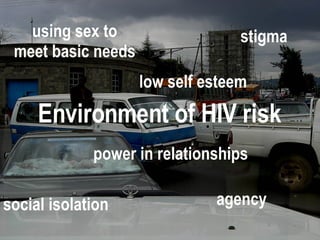
ENVIRONMENT OF RISK using sex to meet basic needs stigma low self esteem Environment of HIV risk power in relationships social isolation agency
Can we fight HIV/ AIDS by reducing the environment of risk?
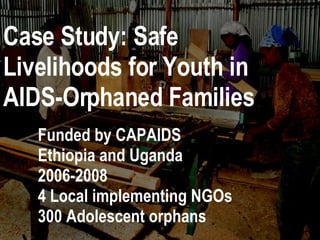
Case Study: Safe Livelihoods for Youth in AIDS-Orphaned Families Funded by CAPAIDS Ethiopia and Uganda 2006-2008 4 Local implementing NGOs 300 Adolescent orphans
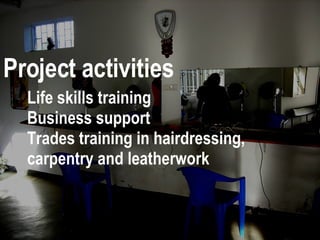
Project activities Life skills training Business support Trades training in hairdressing, carpentry and leatherwork
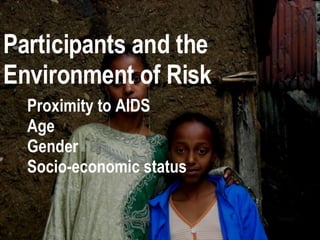
Participant Profile Participants and the Environment of Risk Proximity to AIDS Age Gender Socio-economic status
What is the project’s impact on the environment of HIV risk?
Study Methods 10 months Participant surveys Interviews with NGO staff, participants and community leaders Observation
“ There is a big difference between being an employee and being self employed.  With employment, you always get an agreed amount, but here I get as much as I work for.  Also, I get satisfaction from knowing its my own work.” male, carpenter, 25
Though male participants took a pay cut to be part of the project, they benefited from control over their own labour and independence. They expected income to increase over time.
“ I have a better economic situation because my income is stable and a little bit more.  Before I could sometimes go to bed hungry.” female, hairdresser, 23
All but one woman indicated her economic situation had improved, including stability, savings, independence and ability to leave unsafe employment.
“ Before the program when I was jobless, even the police considered me unworthy.  Now they have changed their mind” male, leatherworker
Decreased community stigma helps participants access community support and improves self perception.
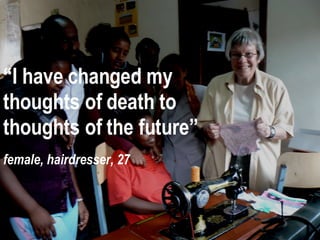
“ I have changed my thoughts of death to thoughts of the future” female, hairdresser, 27
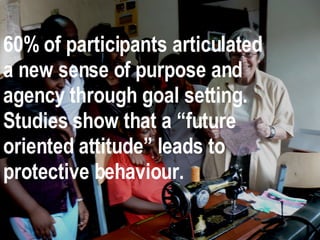
60% of participants articulated a new sense of purpose and agency through goal setting.  Studies show that a “future oriented attitude” leads to protective behaviour.
“ Since we are orphans we have had to struggle harder for a better life.  The program creates a supportive environment among us” male, leather worker
The project provided an entry point for participants to connect with other youth in similar situations, leading to informal discussion on HIV/AIDS, sibling care, sex and relationships.
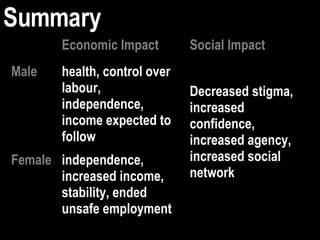
Summary independence, increased income, stability, ended unsafe employment Female Decreased stigma, increased confidence,  increased agency, increased social network health, control over labour, independence, income expected to follow Male Social Impact Economic Impact
Opportunities for Growth Integrating with other NGO services Safety of physical environment Scale up

Preventing HIV/AIDS through Microeconomic Development

  • 1.
    Preventing HIV/AIDS throughMicroeconomic Development Kate Jongbloed, Hon. BA International Development Studies [email_address] Full article available: http://unpackingdevelopment.com/?page_id=48
  • 2.
    ENVIRONMENT OF RISKSource: Simmons, Janie, Paul Farmer, and Brooke Schoepf. 1996. A global perspective. In Women poverty and AIDS: Sex drugs and structural violence . Maine: Common Courage Press. Defining the Environment of HIV Risk Poverty and marginalization create obstacles to acting on HIV knowledge. Microeconomic development is seen as a tool to tackle the environment of risk.
  • 3.
    ENVIRONMENT OF RISKusing sex to meet basic needs stigma low self esteem Environment of HIV risk power in relationships social isolation agency
  • 4.
    Can we fightHIV/ AIDS by reducing the environment of risk?
  • 5.
    Case Study: SafeLivelihoods for Youth in AIDS-Orphaned Families Funded by CAPAIDS Ethiopia and Uganda 2006-2008 4 Local implementing NGOs 300 Adolescent orphans
  • 6.
    Project activities Lifeskills training Business support Trades training in hairdressing, carpentry and leatherwork
  • 7.
    Participant Profile Participantsand the Environment of Risk Proximity to AIDS Age Gender Socio-economic status
  • 8.
    What is theproject’s impact on the environment of HIV risk?
  • 9.
    Study Methods 10months Participant surveys Interviews with NGO staff, participants and community leaders Observation
  • 10.
    “ There isa big difference between being an employee and being self employed. With employment, you always get an agreed amount, but here I get as much as I work for. Also, I get satisfaction from knowing its my own work.” male, carpenter, 25
  • 11.
    Though male participantstook a pay cut to be part of the project, they benefited from control over their own labour and independence. They expected income to increase over time.
  • 12.
    “ I havea better economic situation because my income is stable and a little bit more. Before I could sometimes go to bed hungry.” female, hairdresser, 23
  • 13.
    All but onewoman indicated her economic situation had improved, including stability, savings, independence and ability to leave unsafe employment.
  • 14.
    “ Before theprogram when I was jobless, even the police considered me unworthy. Now they have changed their mind” male, leatherworker
  • 15.
    Decreased community stigmahelps participants access community support and improves self perception.
  • 16.
    “ I havechanged my thoughts of death to thoughts of the future” female, hairdresser, 27
  • 17.
    60% of participantsarticulated a new sense of purpose and agency through goal setting. Studies show that a “future oriented attitude” leads to protective behaviour.
  • 18.
    “ Since weare orphans we have had to struggle harder for a better life. The program creates a supportive environment among us” male, leather worker
  • 19.
    The project providedan entry point for participants to connect with other youth in similar situations, leading to informal discussion on HIV/AIDS, sibling care, sex and relationships.
  • 20.
    Summary independence, increasedincome, stability, ended unsafe employment Female Decreased stigma, increased confidence, increased agency, increased social network health, control over labour, independence, income expected to follow Male Social Impact Economic Impact
  • 21.
    Opportunities for GrowthIntegrating with other NGO services Safety of physical environment Scale up

Editor's Notes

  • #2 Name Participation in CAPAIDS and Ethiopia Education Current status