Great Inventions  &  their Inventors
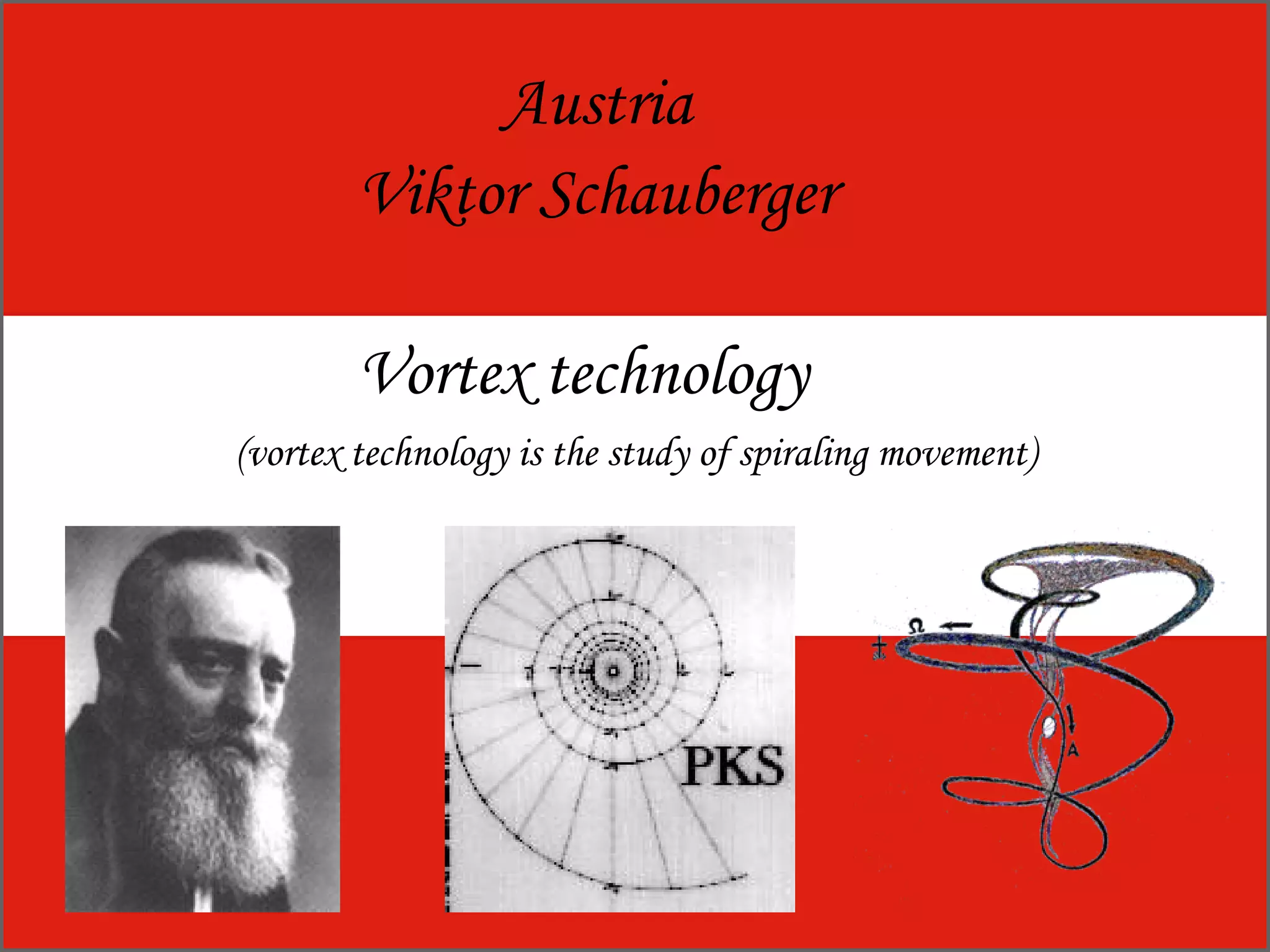
Austria Viktor Schauberger Vortex technology (vortex technology is the study of spiraling movement)
Belgium Leo Hendrik Baekeland Bakelite The original bakelizer* *The machine that creates bakelite a substance used as an electric insulator  and to make plastic-ware. Panagiotis Verykios Ms1/ESL 2
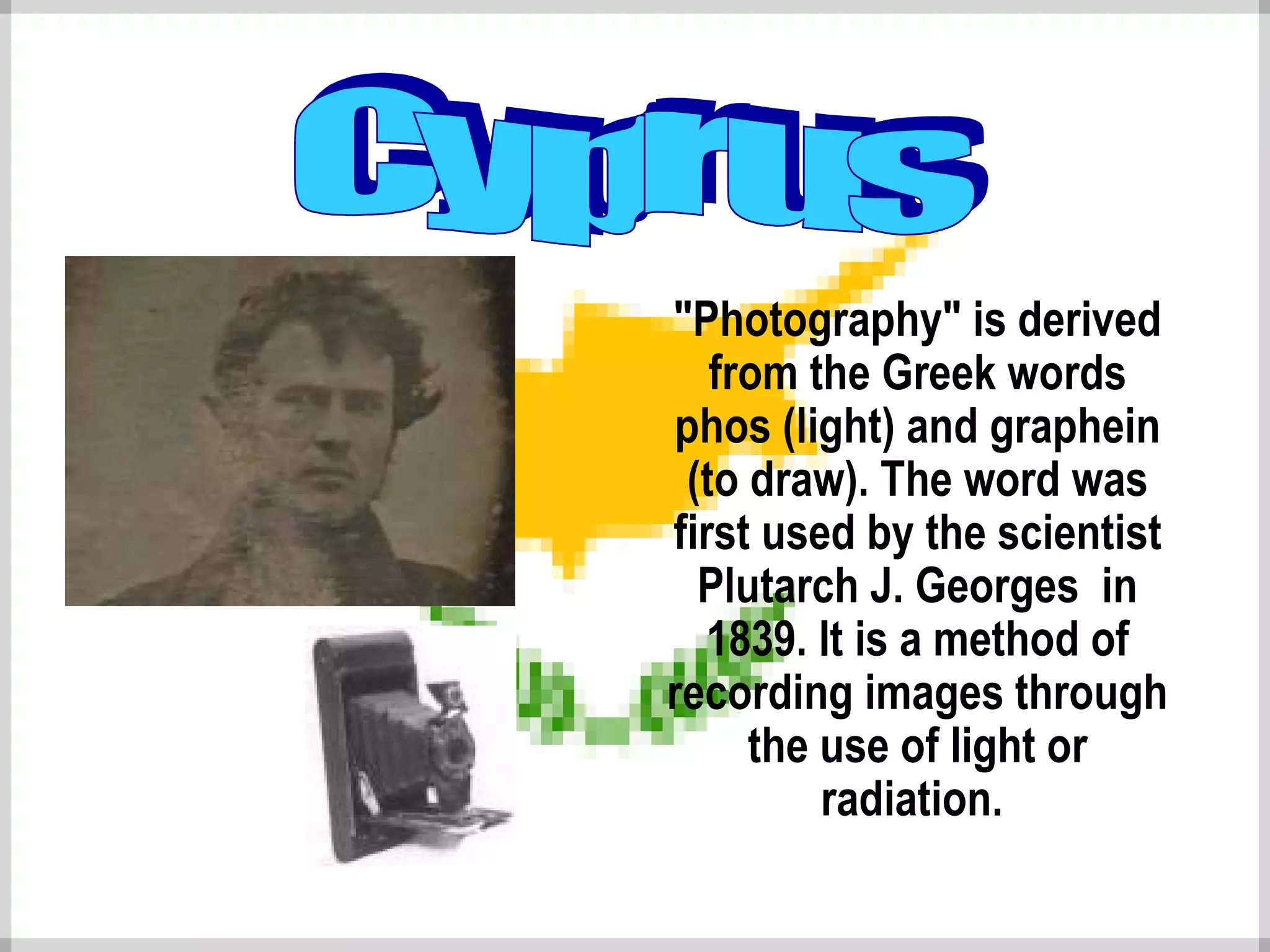
"Photography" is derived from the Greek words phos (light) and graphein (to draw) .  The word was first used by the scientist  Plutarch J. Georges  in 1839. It is a method of recording images  through the use  of light or radiation.   Cyprus
In 1941, science fiction writer Isaac Asimov first used the word "robotics" to describe the technology of robots and predicted the rise of a powerful robot industry.  This led him to the invention of the first most simple robot. CzEcH RePuBLiC
Denmark Hans Christian Orsted was born in 1777 and died in 1851. He  discovered electro - magnetism  and his  work led to the development of electro - technology.
ENGLAND James   Gregory   invented the  reflecting   (or Newtonian)   telescope  in 1663 . This telescope  uses two mirrors to magnify what is  being  viewed.
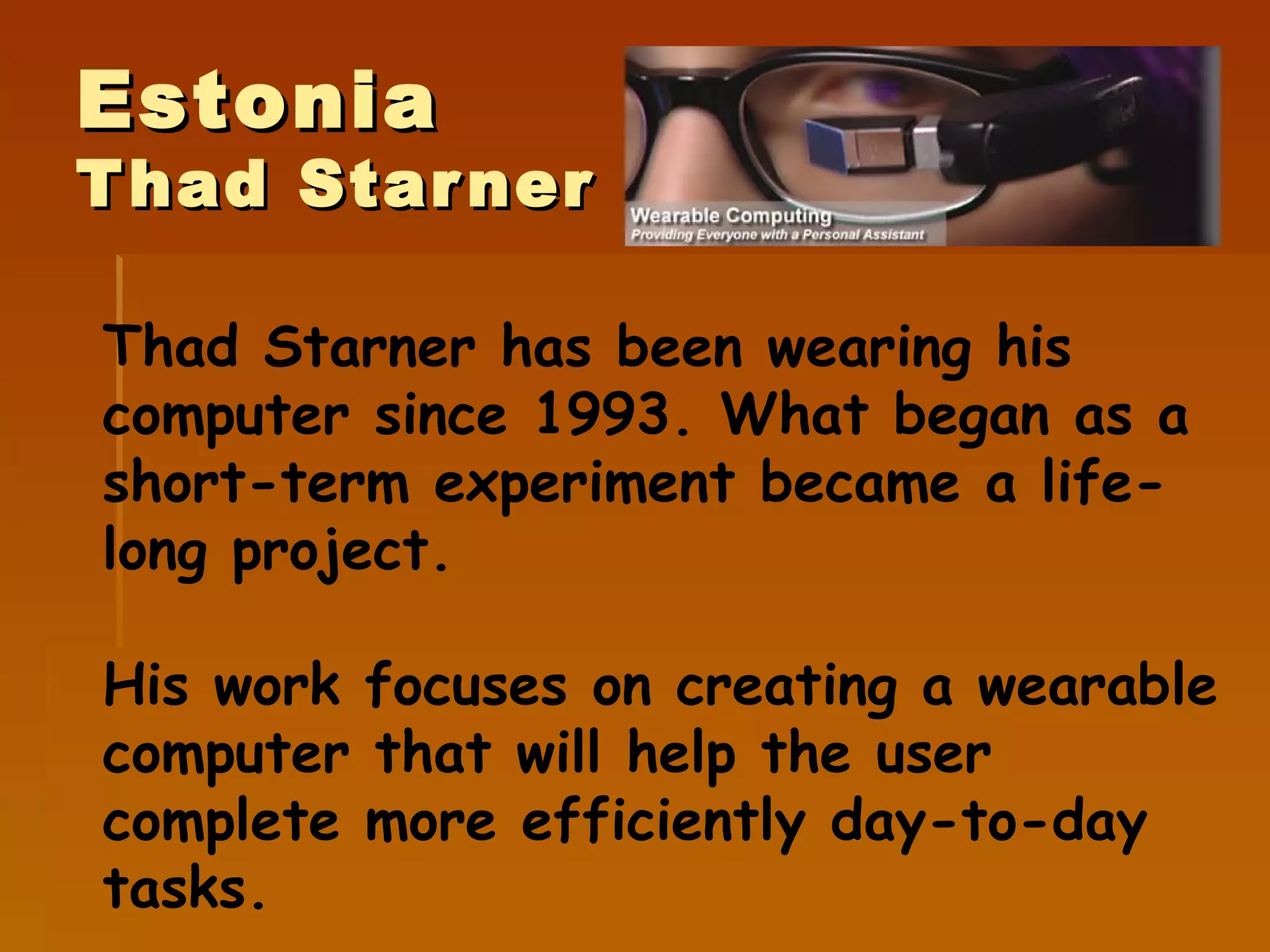
Estonia Thad Starner Thad Starner has been wearing his computer since 1993. What began as a short-term experiment became a life-long project. His work focuses on creating a  wearable computer  that will help  the user complet e   more  efficient ly  day-to-day tasks.
Finland Martin Hildebrand invented  lightweight armoured panels  which are  flexib le ,  and  can be produced from combinations of different materials.  This  technology is used to offer protection against high-penetration projectiles. Martin  Hildebrand
One of the most famous inventions is pasteurization.  Louis Pasteur discovered that diseases in wine are caused by micro-organisms. These  can be killed by heating wine to 55 degrees Celsius.  Today this process is applied to beer and milk. Louis Pasteur  (1822- 1895)
Albert Einstein was born on 14 March 1879.  He  showed that light quanta  or  particles of energy, could help to explain phenomena   being studied by experimental physicists.  He also  made clear how light ejects electrons from metals.  Germany
GREECE Archimedes   (287-212 BC)   invented the water screw, a device  used  for raising water .  It  us es  a n  encased screw  which is  open at both ends. The screw is set a t  an angle, and as the screw turns water fills the air pockets and is transported upwards. The Archimedes screw is still in use today.  .
Cornelis Jacobszoon Drebbel (1572-1634) was a Dutch inventor. Among his many inventions w as  the first navigable submarine.  His  submarine de sign  was the first to address the problem of air replenishment while submerged .  His inventions were so unusual,  that   they  gave  him  a reputation of being a sorcerer.  Holland
Edward Teller was born in Budapest, Hungary in 1908 .  Although his early training was in chemical physics, Edward Teller has made substantial contributions to  the  fields  of  nuclear physics, plasma physics, astrophysics, and statistical mechanics.  This made him able to help in the invention of the nuclear bomb!   HuNgArY
Ireland Henry Ford was an Irish  i mmigrant involved in the development of the tractor. He founded the giant Ford Motor Company in 1903, which manufactures cars and tractors.
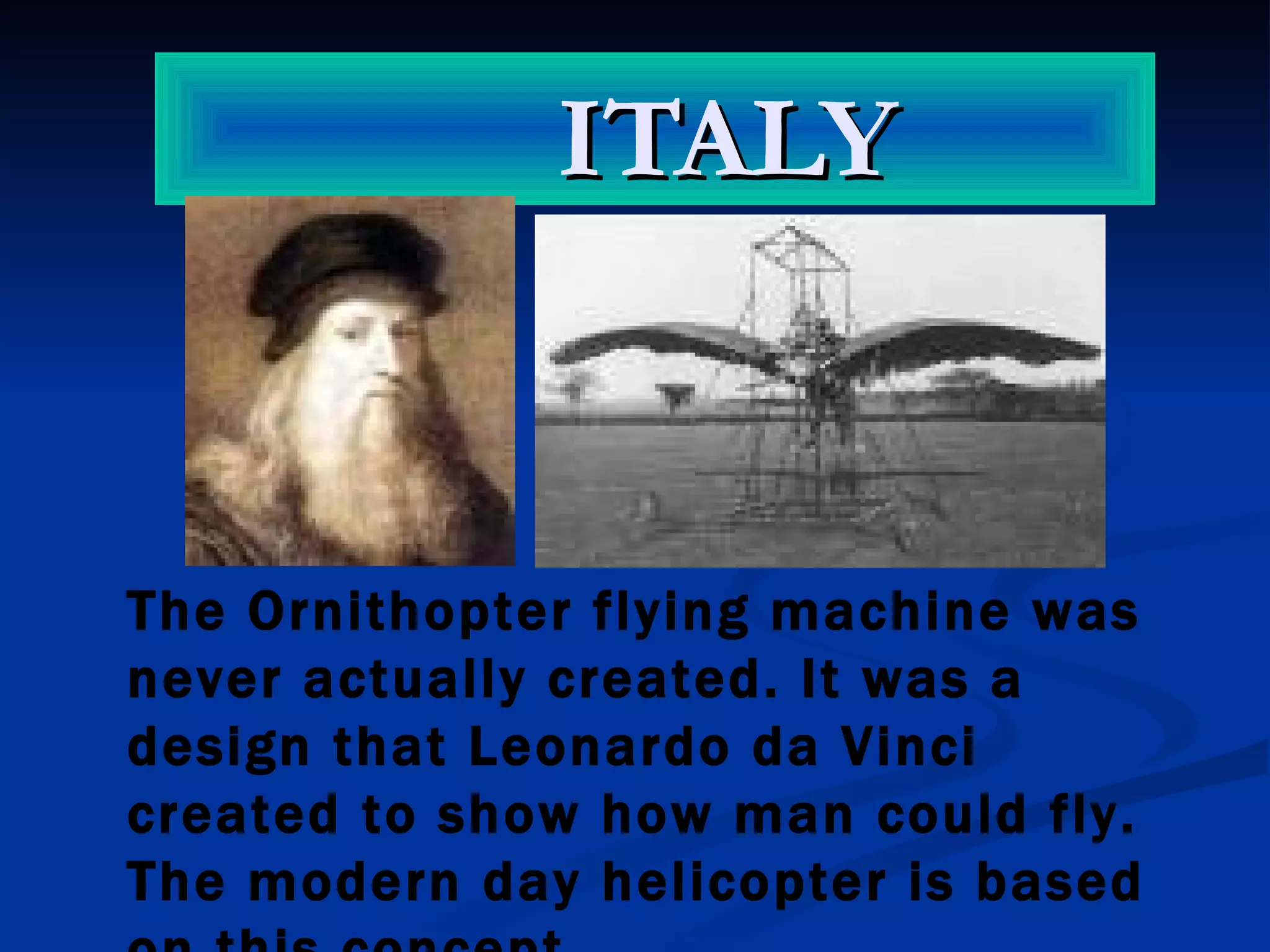
ITALY The Ornithopter flying machine was never actually created. It was a design that Leonardo da Vinci created to show how man could fly. The modern day  helicopter  is based on this concept .
LATVIA  Dr. Imants Kaimins Dr. Imants  Kaimins  invented an  ointment  which when spread onto a wound  form s a  hygienic  m embrane .  This new product   can be used instead of  bandage s to treat and heal wounds and cuts .
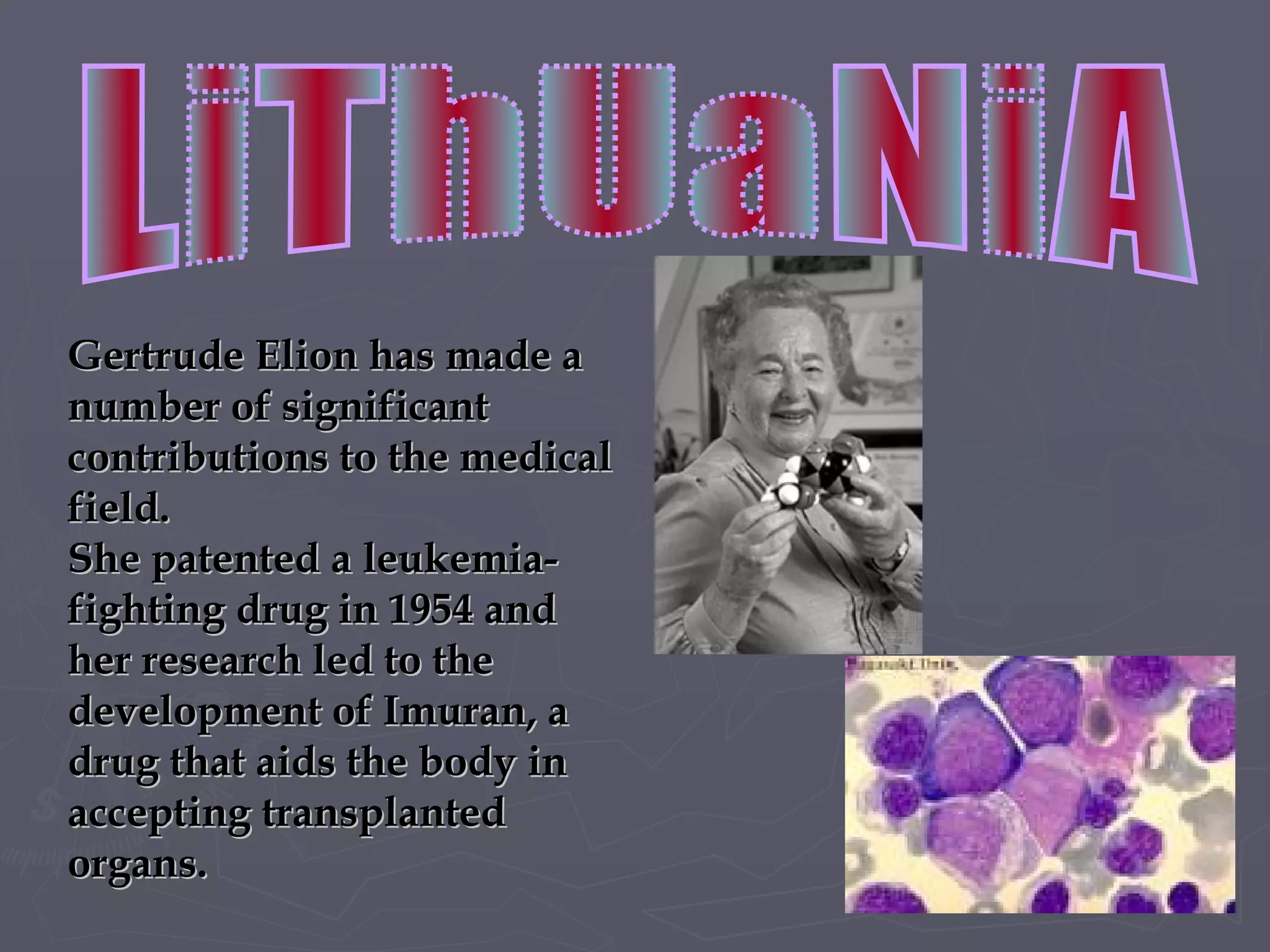
Gertrude Elion has made a number of significant contributions to the medical field.  She  patented  a  leukemia-fighting drug in 1954 and  her  research led to the development of Imuran, a drug that aids the body in accepting transplanted organs.  LiThUaNiA
 
MALTA Sir Temi Zammit 1864- 1935 Sir Temi Zammit discovered the Microcossus Melitensis in the blood of the goat. This was very important because humans drinking un-pasteurized milk would be infected with the microbe, which was the cause of the fatal Mediterranean Fever .
POLAND Nicolaus Copernicus  (1473-1543)  is a  renowned astronomer. He  i s the first in modern times  to  develop a heliocentric theory of the Solar System. He published his discoveries the year of his death in the work ‘On the Revolutions of the  Celestial Spheres’  (De revolutionibus orbium coelestium).
PORTUGAL Moniz Antonio Egas Antonio Egas Moniz was a physician  who developed cerebral angiography.  This operation was used as  a therapeutic procedure  to treat certain mental illnesses. He was awarded the Nobel Prize in physiology in 1949.
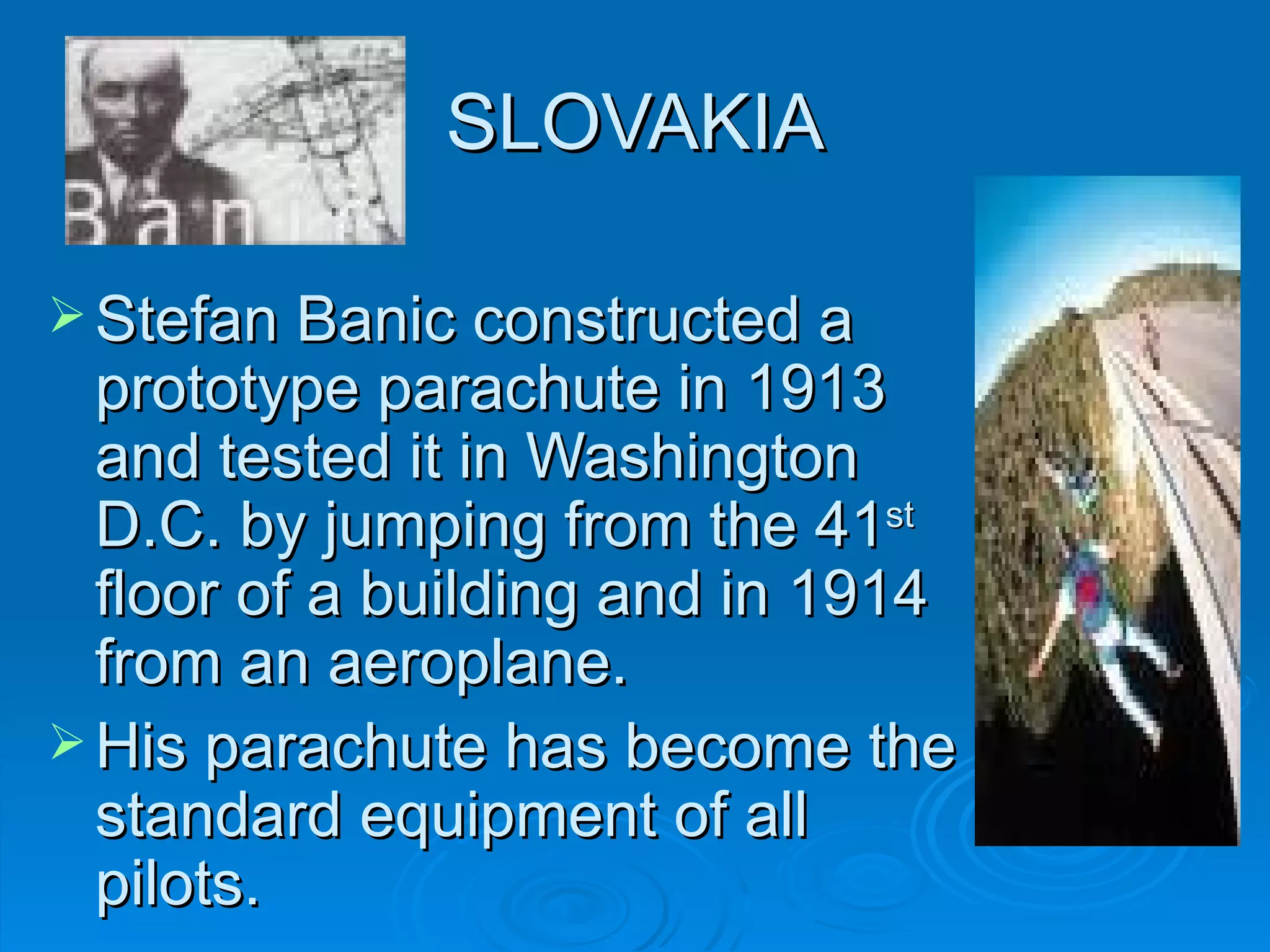
SLOVAKIA Stefan Banic constructed a prototype parachute in 1913 and tested it in Washington D.C. by jumping from  the  41 st   floor  of a  building and in 1914 from an a ero plane.  His parachute  has b ec o me  the  standard equipment  o f  all  pilots.
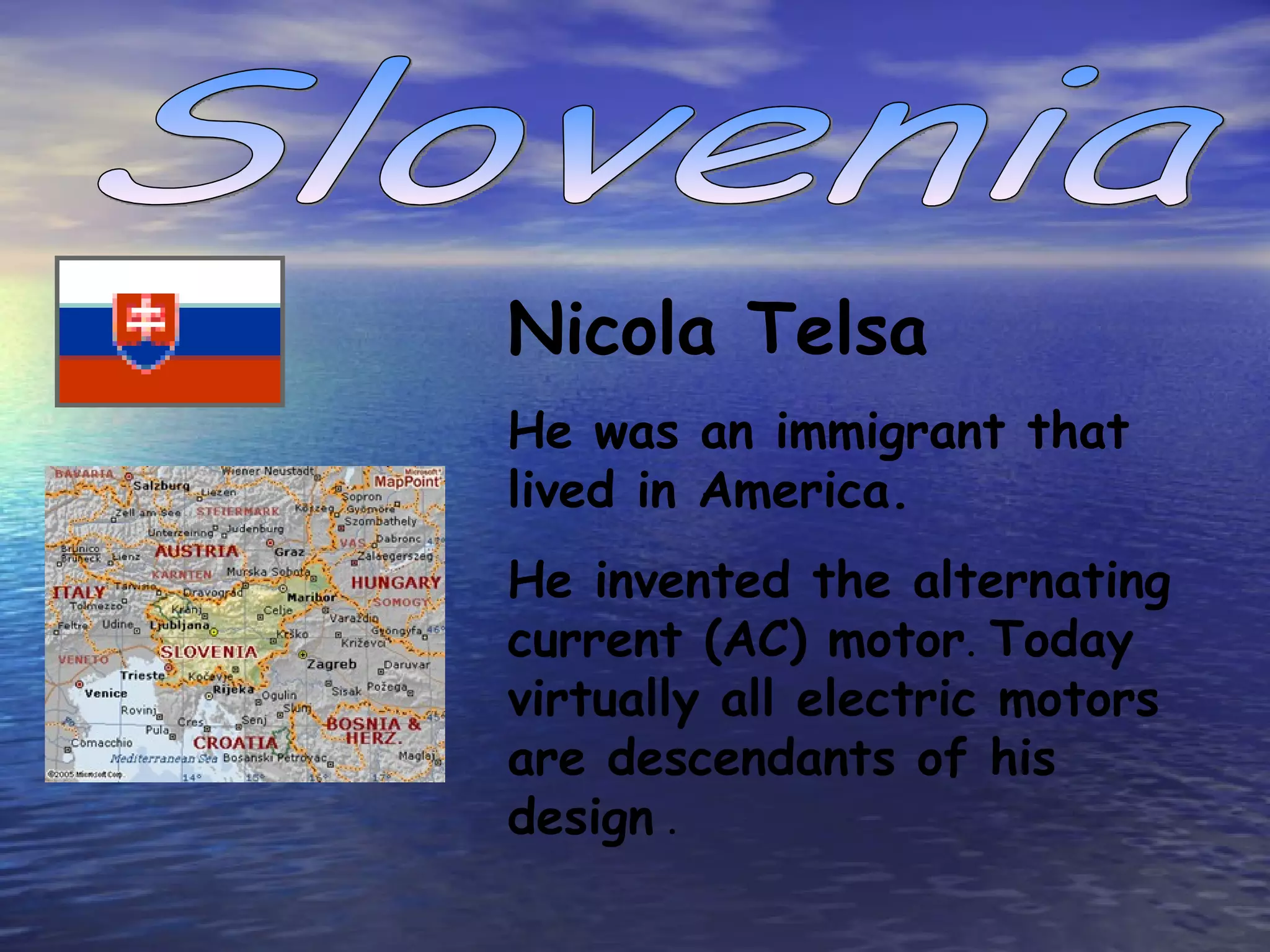
Slovenia Nicola T elsa  He was an immigrant that lived in America. He invented the  alternating current (AC) motor .  Today virtually all electric motors are descendants of  his  design   .
SPAIN The world famous  M&Ms Sir Forrest Mars invented the M&Ms. This chocolate product is enjoyed by many people worldwide.
Alfred Bernhard   Nobel,  who was a  chemist ,  develop ed  a safe way  of handling  nitroglyceri n. He also developed  dynamite  and  bal l istite . When he died in 1896 he   requested  that the major portion of his  property b e  used to  set up a fund . The NOBEL fund awards  yearly prizes for merit in  P hysics,  C hemistry,  M edicine ,   P hysiology,  L iterature, and  W orld  P eace. Sweden

Great Inventors Around The World

  • 1.
    Great Inventions & their Inventors
  • 2.
    Austria Viktor SchaubergerVortex technology (vortex technology is the study of spiraling movement)
  • 3.
    Belgium Leo HendrikBaekeland Bakelite The original bakelizer* *The machine that creates bakelite a substance used as an electric insulator and to make plastic-ware. Panagiotis Verykios Ms1/ESL 2
  • 4.
    "Photography" is derivedfrom the Greek words phos (light) and graphein (to draw) . The word was first used by the scientist Plutarch J. Georges in 1839. It is a method of recording images through the use of light or radiation. Cyprus
  • 5.
    In 1941, sciencefiction writer Isaac Asimov first used the word "robotics" to describe the technology of robots and predicted the rise of a powerful robot industry. This led him to the invention of the first most simple robot. CzEcH RePuBLiC
  • 6.
    Denmark Hans ChristianOrsted was born in 1777 and died in 1851. He discovered electro - magnetism and his work led to the development of electro - technology.
  • 7.
    ENGLAND James Gregory invented the reflecting (or Newtonian) telescope in 1663 . This telescope uses two mirrors to magnify what is being viewed.
  • 8.
    Estonia Thad StarnerThad Starner has been wearing his computer since 1993. What began as a short-term experiment became a life-long project. His work focuses on creating a wearable computer that will help the user complet e more efficient ly day-to-day tasks.
  • 9.
    Finland Martin Hildebrandinvented lightweight armoured panels which are flexib le , and can be produced from combinations of different materials. This technology is used to offer protection against high-penetration projectiles. Martin Hildebrand
  • 10.
    One of themost famous inventions is pasteurization. Louis Pasteur discovered that diseases in wine are caused by micro-organisms. These can be killed by heating wine to 55 degrees Celsius. Today this process is applied to beer and milk. Louis Pasteur (1822- 1895)
  • 11.
    Albert Einstein wasborn on 14 March 1879. He showed that light quanta or particles of energy, could help to explain phenomena being studied by experimental physicists. He also made clear how light ejects electrons from metals. Germany
  • 12.
    GREECE Archimedes (287-212 BC) invented the water screw, a device used for raising water . It us es a n encased screw which is open at both ends. The screw is set a t an angle, and as the screw turns water fills the air pockets and is transported upwards. The Archimedes screw is still in use today. .
  • 13.
    Cornelis Jacobszoon Drebbel(1572-1634) was a Dutch inventor. Among his many inventions w as the first navigable submarine. His submarine de sign was the first to address the problem of air replenishment while submerged . His inventions were so unusual, that they gave him a reputation of being a sorcerer. Holland
  • 14.
    Edward Teller wasborn in Budapest, Hungary in 1908 . Although his early training was in chemical physics, Edward Teller has made substantial contributions to the fields of nuclear physics, plasma physics, astrophysics, and statistical mechanics. This made him able to help in the invention of the nuclear bomb! HuNgArY
  • 15.
    Ireland Henry Fordwas an Irish i mmigrant involved in the development of the tractor. He founded the giant Ford Motor Company in 1903, which manufactures cars and tractors.
  • 16.
    ITALY The Ornithopterflying machine was never actually created. It was a design that Leonardo da Vinci created to show how man could fly. The modern day helicopter is based on this concept .
  • 17.
    LATVIA Dr.Imants Kaimins Dr. Imants Kaimins invented an ointment which when spread onto a wound form s a hygienic m embrane . This new product can be used instead of bandage s to treat and heal wounds and cuts .
  • 18.
    Gertrude Elion hasmade a number of significant contributions to the medical field. She patented a leukemia-fighting drug in 1954 and her research led to the development of Imuran, a drug that aids the body in accepting transplanted organs. LiThUaNiA
  • 19.
  • 20.
    MALTA Sir TemiZammit 1864- 1935 Sir Temi Zammit discovered the Microcossus Melitensis in the blood of the goat. This was very important because humans drinking un-pasteurized milk would be infected with the microbe, which was the cause of the fatal Mediterranean Fever .
  • 21.
    POLAND Nicolaus Copernicus (1473-1543) is a renowned astronomer. He i s the first in modern times to develop a heliocentric theory of the Solar System. He published his discoveries the year of his death in the work ‘On the Revolutions of the Celestial Spheres’ (De revolutionibus orbium coelestium).
  • 22.
    PORTUGAL Moniz AntonioEgas Antonio Egas Moniz was a physician who developed cerebral angiography. This operation was used as a therapeutic procedure to treat certain mental illnesses. He was awarded the Nobel Prize in physiology in 1949.
  • 23.
    SLOVAKIA Stefan Banicconstructed a prototype parachute in 1913 and tested it in Washington D.C. by jumping from the 41 st floor of a building and in 1914 from an a ero plane. His parachute has b ec o me the standard equipment o f all pilots.
  • 24.
    Slovenia Nicola Telsa He was an immigrant that lived in America. He invented the alternating current (AC) motor . Today virtually all electric motors are descendants of his design .
  • 25.
    SPAIN The worldfamous M&Ms Sir Forrest Mars invented the M&Ms. This chocolate product is enjoyed by many people worldwide.
  • 26.
    Alfred Bernhard Nobel, who was a chemist , develop ed a safe way of handling nitroglyceri n. He also developed dynamite and bal l istite . When he died in 1896 he requested that the major portion of his property b e used to set up a fund . The NOBEL fund awards yearly prizes for merit in P hysics, C hemistry, M edicine , P hysiology, L iterature, and W orld P eace. Sweden