INDUSTRIAL REVOLUTION
ARSALAN ALI RAJA
MBA (1.5)
Industrial Revolution
The industrial revolution was a
period from 1760 to 1840, when
major changes in agriculture,
manufacturing, mining, and
transportation were happening in
Britain.
These changes subsequently spread
throughout Europe, North America,
and eventually the world.
Old system
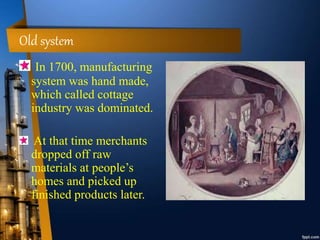
In 1700, manufacturing
system was hand made,
which called cottage
industry was dominated.
At that time merchants
dropped off raw
materials at peopleโ€™s
homes and picked up
finished products later.
Initial INVENTIONS
Cloth machinesโ€™
inventions was the
base of industrial
revelation.
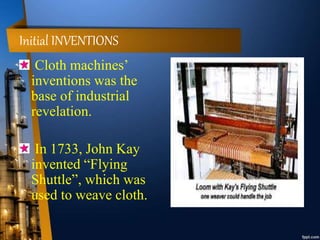
In 1733, John Kay
invented โ€œFlying
Shuttleโ€, which was
used to weave cloth.
Initial INVENTIONS (Cont.)
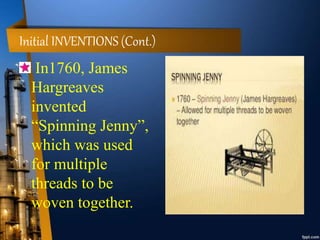
In1760, James
Hargreaves
invented
โ€œSpinning Jennyโ€,
which was used
for multiple
threads to be
woven together.
Initial INVENTIONS (Cont.)
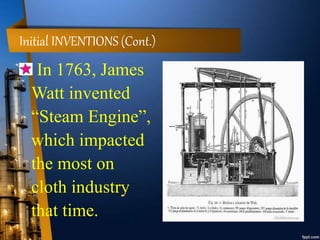
In 1763, James
Watt invented
โ€œSteam Engineโ€,
which impacted
the most on
cloth industry
that time.
Initial INVENTIONS (Cont.)
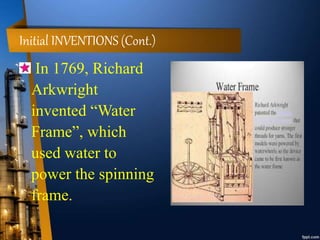
In 1769, Richard
Arkwright
invented โ€œWater
Frameโ€, which
used water to
power the spinning
frame.
Initial INVENTIONS (Cont.)
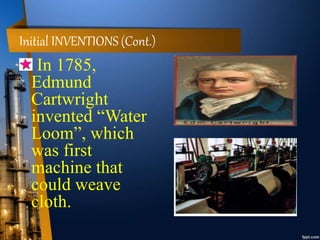
In 1785,
Edmund
Cartwright
invented โ€œWater
Loomโ€, which
was first
machine that
could weave
cloth.
Initial INVENTIONS (Cont.)
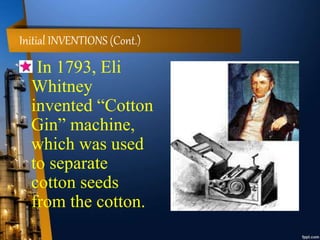
In 1793, Eli
Whitney
invented โ€œCotton
Ginโ€ machine,
which was used
to separate
cotton seeds
from the cotton.
Why industrial revolution started in Britain
In the time period 1715-1850, there
were many natural resources available in
Britain, including large amount of coal
and iron reservoirs.
Geographical advantages include a river
system for water power, many resources
and harbors for easy trade.
A strong, stable government allowed a
strong, stable economy to develop which
resulted in extra money to invest.
Why industrial revolution started in Britain
Colonial empire provided much needed
raw materials and markets.
After that, revolution spread to
continental Europe, United States of
America, and Japan between 1850 and
1914.
Changes Brought by the Industrial Revolution
Invention of the steam engine in 1763 by
James Watt shifted labor from humans and
animals to machines.
Inventions continue to make life,
manufacturing, and farming easier and better.
Continuous reinvestment of profits fueled even
greater growth.
Inventions in one area often led to inventions
in others.
Transportation and communication systems
have greatly enhanced.
Industrial revolution

Industrial revolution

  • 2.
  • 3.
    Industrial Revolution The industrialrevolution was a period from 1760 to 1840, when major changes in agriculture, manufacturing, mining, and transportation were happening in Britain. These changes subsequently spread throughout Europe, North America, and eventually the world.
  • 4.
    Old system In 1700,manufacturing system was hand made, which called cottage industry was dominated. At that time merchants dropped off raw materials at peopleโ€™s homes and picked up finished products later.
  • 5.
    Initial INVENTIONS Cloth machinesโ€™ inventionswas the base of industrial revelation. In 1733, John Kay invented โ€œFlying Shuttleโ€, which was used to weave cloth.
  • 6.
    Initial INVENTIONS (Cont.) In1760,James Hargreaves invented โ€œSpinning Jennyโ€, which was used for multiple threads to be woven together.
  • 7.
    Initial INVENTIONS (Cont.) In1763, James Watt invented โ€œSteam Engineโ€, which impacted the most on cloth industry that time.
  • 8.
    Initial INVENTIONS (Cont.) In1769, Richard Arkwright invented โ€œWater Frameโ€, which used water to power the spinning frame.
  • 9.
    Initial INVENTIONS (Cont.) In1785, Edmund Cartwright invented โ€œWater Loomโ€, which was first machine that could weave cloth.
  • 10.
    Initial INVENTIONS (Cont.) In1793, Eli Whitney invented โ€œCotton Ginโ€ machine, which was used to separate cotton seeds from the cotton.
  • 11.
    Why industrial revolutionstarted in Britain In the time period 1715-1850, there were many natural resources available in Britain, including large amount of coal and iron reservoirs. Geographical advantages include a river system for water power, many resources and harbors for easy trade. A strong, stable government allowed a strong, stable economy to develop which resulted in extra money to invest.
  • 12.
    Why industrial revolutionstarted in Britain Colonial empire provided much needed raw materials and markets. After that, revolution spread to continental Europe, United States of America, and Japan between 1850 and 1914.
  • 13.
    Changes Brought bythe Industrial Revolution Invention of the steam engine in 1763 by James Watt shifted labor from humans and animals to machines. Inventions continue to make life, manufacturing, and farming easier and better. Continuous reinvestment of profits fueled even greater growth. Inventions in one area often led to inventions in others. Transportation and communication systems have greatly enhanced.