Chapter Eight
EMOTIONAL/
BEHAVIORAL DISORDERS
©2017 Cengage Learning. All Rights Reserved.
LEARNING OBJECTIVES
(slide 1 of 2)
8-1 Describe how the lives of people with
emotional and behavioral disorders
(EBD) have changed since the advent of
IDEA.
8-2 Explain the various definitions and
classifications of EBD.
8-3 Describe the characteristics and
prevalence of children and youth with EBD.
©2017 Cengage Learning. All Rights Reserved.
LEARNING OBJECTIVES
(slide 2 of 2)
8-4 List the causes and risk factors
associated with EBD.
8-5 Describe the assessment procedures
used to identify EBD in children and
youth.
8-6 Describe the different interventions for
children and youth with EBD from early
childhood through adulthood.
©2017 Cengage Learning. All Rights Reserved.
8-1 A CHANGING ERA IN THE LIVES OF
PEOPLE WITH EBD
• Individuals with EBD may experience
great difficulties in relating appropriately to
other people.
• Recent advances in intervention
approaches are making a difference in
integrated settings.
©2017 Cengage Learning. All Rights Reserved.
8-2 DEFINITIONS AND
CLASSIFICATIONS OF EBD (slide 1 of 2)
• IDEA definition
– A condition exhibiting one or more characteristics
over a long period of time and to a marked degree
• Inability to learn not explained by other factors
• Inability to build or maintain satisfactory relationships
• Inappropriate behaviors or feelings under normal
circumstances
• General pervasive mood of unhappiness or depression
• Tendency to develop physical symptoms or fears
• Does not include children who are socially maladjusted
©2017 Cengage Learning. All Rights Reserved.
8-2 DEFINITIONS AND
CLASSIFICATIONS OF EBD (slide 2 of 2)
• National Mental Health and Special Education
Coalition definition
– Characterized by behavioral or emotional responses
in school so different from appropriate age, cultural,
or ethnic norms that they adversely affect educational
performance (including academic, social, vocational,
and personal skills)
• More than a temporary expected response to stress
• Consistently exhibited in two different settings
• Unresponsive to direct intervention
– Can co-exist with other disabilities
8-2b A STATISTICALLY DERIVED
CLASSIFICATION SYSTEM
• Derived from research data on children
with EBD
• Two broad categories of behavior:
– Externalizing symptoms
– Internalizing symptoms
©2017 Cengage Learning. All Rights Reserved.
8-2c CLINICALLY DERIVED
CLASSIFICATION SYSTEMS (slide 1 of 2)
• DSM-5 categories and subcategories
• Attention-deficit and disruptive behavior
disorders
• Disruptive, impulse control and conduct
disorders
• Feeding and eating disorders
©2017 Cengage Learning. All Rights Reserved.
8-2c CLINICALLY DERIVED
CLASSIFICATION SYSTEMS (slide 2 of 2)
• Tic disorders
• Elimination disorders and childhood
anxiety disorders
• Reactive attachment disorder
• Childhood schizophrenia
©2017 Cengage Learning. All Rights Reserved.
8-3 CHARACTERISTICS AND
PREVALENCE OF EBD (slide 1 of 2)
• Intelligence
– Recent research suggests average to below-
average IQ
• Social–adaptive behavior
– Social: difficulty playing, sharing, processing
and understanding language, withdrawing
– Adaptive: mood disorders, bipolar disorders
©2017 Cengage Learning. All Rights Reserved.
8-3 CHARACTERISTICS AND
PREVALENCE OF EBD (slide 2 of 2)
• Academic Achievement
– Staggering drop-out rates
• Prevalence
– Estimates vary from 2% to 20%
– Significant numbers of children remain
unidentified and do not receive care or special
education.
– Disproportionate number of African American
males identified as having EBD
©2017 Cengage Learning. All Rights Reserved.
8-4 CAUSES OF EBD
• Multidimensional and often complex
– Family and home environment
– Socioeconomic status
– Low-income families and communities
– Family discord
– Child management and discipline
– Child abuse
8-5 IDENTIFICATION AND
ASSESSMENT OF EBD (slide 1 of 2)
• Screening, pre-referral interventions, and
referral
– Positive behavior support (PBS) strategies
– Systematic screening for behavior disorders
(SSBD)
• Collaborative teams
– Response to intervention (RtI)
©2017 Cengage Learning. All Rights Reserved.
8-5 IDENTIFICATION AND
ASSESSMENT OF EBD (slide 2 of 2)
• Assessment factors
– Functional behavioral assessments
– Behavior intervention plans (BIPs)
• Assessment approaches and procedures
– Strength-based assessment
©2017 Cengage Learning. All Rights Reserved.
8-6 INTERVENTIONS AND
TREATMENTS FOR EBD
• Early childhood years
– Child-centered, intensive, community, and
family-focused services
• Elementary school years
– Collaborative wraparound services
• Adolescent years
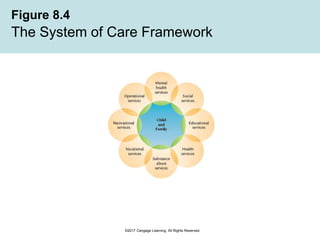
– Systems of care
©2017 Cengage Learning. All Rights Reserved.
The System of Care Framework
Figure 8.4
©2017 Cengage Learning. All Rights Reserved.
LOOKING TOWARD A BRIGHT
FUTURE
• Evidence-based practices
• Systems of care
• Early intervention
• School-wide positive behavior support
• Expectation of increased parental
engagement
©2017 Cengage Learning. All Rights Reserved.
CASE STUDY: LEON
• Background
• Issues
• Approaches
• Recommendations

Hardman 12e ppt_08

  • 1.
    Chapter Eight EMOTIONAL/ BEHAVIORAL DISORDERS ©2017Cengage Learning. All Rights Reserved.
  • 2.
    LEARNING OBJECTIVES (slide 1of 2) 8-1 Describe how the lives of people with emotional and behavioral disorders (EBD) have changed since the advent of IDEA. 8-2 Explain the various definitions and classifications of EBD. 8-3 Describe the characteristics and prevalence of children and youth with EBD. ©2017 Cengage Learning. All Rights Reserved.
  • 3.
    LEARNING OBJECTIVES (slide 2of 2) 8-4 List the causes and risk factors associated with EBD. 8-5 Describe the assessment procedures used to identify EBD in children and youth. 8-6 Describe the different interventions for children and youth with EBD from early childhood through adulthood. ©2017 Cengage Learning. All Rights Reserved.
  • 4.
    ©2017 Cengage Learning.All Rights Reserved. 8-1 A CHANGING ERA IN THE LIVES OF PEOPLE WITH EBD • Individuals with EBD may experience great difficulties in relating appropriately to other people. • Recent advances in intervention approaches are making a difference in integrated settings.
  • 5.
    ©2017 Cengage Learning.All Rights Reserved. 8-2 DEFINITIONS AND CLASSIFICATIONS OF EBD (slide 1 of 2) • IDEA definition – A condition exhibiting one or more characteristics over a long period of time and to a marked degree • Inability to learn not explained by other factors • Inability to build or maintain satisfactory relationships • Inappropriate behaviors or feelings under normal circumstances • General pervasive mood of unhappiness or depression • Tendency to develop physical symptoms or fears • Does not include children who are socially maladjusted
  • 6.
    ©2017 Cengage Learning.All Rights Reserved. 8-2 DEFINITIONS AND CLASSIFICATIONS OF EBD (slide 2 of 2) • National Mental Health and Special Education Coalition definition – Characterized by behavioral or emotional responses in school so different from appropriate age, cultural, or ethnic norms that they adversely affect educational performance (including academic, social, vocational, and personal skills) • More than a temporary expected response to stress • Consistently exhibited in two different settings • Unresponsive to direct intervention – Can co-exist with other disabilities
  • 7.
    8-2b A STATISTICALLYDERIVED CLASSIFICATION SYSTEM • Derived from research data on children with EBD • Two broad categories of behavior: – Externalizing symptoms – Internalizing symptoms ©2017 Cengage Learning. All Rights Reserved.
  • 8.
    8-2c CLINICALLY DERIVED CLASSIFICATIONSYSTEMS (slide 1 of 2) • DSM-5 categories and subcategories • Attention-deficit and disruptive behavior disorders • Disruptive, impulse control and conduct disorders • Feeding and eating disorders ©2017 Cengage Learning. All Rights Reserved.
  • 9.
    8-2c CLINICALLY DERIVED CLASSIFICATIONSYSTEMS (slide 2 of 2) • Tic disorders • Elimination disorders and childhood anxiety disorders • Reactive attachment disorder • Childhood schizophrenia ©2017 Cengage Learning. All Rights Reserved.
  • 10.
    ©2017 Cengage Learning.All Rights Reserved. 8-3 CHARACTERISTICS AND PREVALENCE OF EBD (slide 1 of 2) • Intelligence – Recent research suggests average to below- average IQ • Social–adaptive behavior – Social: difficulty playing, sharing, processing and understanding language, withdrawing – Adaptive: mood disorders, bipolar disorders
  • 11.
    ©2017 Cengage Learning.All Rights Reserved. 8-3 CHARACTERISTICS AND PREVALENCE OF EBD (slide 2 of 2) • Academic Achievement – Staggering drop-out rates • Prevalence – Estimates vary from 2% to 20% – Significant numbers of children remain unidentified and do not receive care or special education. – Disproportionate number of African American males identified as having EBD
  • 12.
    ©2017 Cengage Learning.All Rights Reserved. 8-4 CAUSES OF EBD • Multidimensional and often complex – Family and home environment – Socioeconomic status – Low-income families and communities – Family discord – Child management and discipline – Child abuse
  • 13.
    8-5 IDENTIFICATION AND ASSESSMENTOF EBD (slide 1 of 2) • Screening, pre-referral interventions, and referral – Positive behavior support (PBS) strategies – Systematic screening for behavior disorders (SSBD) • Collaborative teams – Response to intervention (RtI) ©2017 Cengage Learning. All Rights Reserved.
  • 14.
    8-5 IDENTIFICATION AND ASSESSMENTOF EBD (slide 2 of 2) • Assessment factors – Functional behavioral assessments – Behavior intervention plans (BIPs) • Assessment approaches and procedures – Strength-based assessment ©2017 Cengage Learning. All Rights Reserved.
  • 15.
    8-6 INTERVENTIONS AND TREATMENTSFOR EBD • Early childhood years – Child-centered, intensive, community, and family-focused services • Elementary school years – Collaborative wraparound services • Adolescent years – Systems of care ©2017 Cengage Learning. All Rights Reserved.
  • 16.
    The System ofCare Framework Figure 8.4 ©2017 Cengage Learning. All Rights Reserved.
  • 17.
    LOOKING TOWARD ABRIGHT FUTURE • Evidence-based practices • Systems of care • Early intervention • School-wide positive behavior support • Expectation of increased parental engagement ©2017 Cengage Learning. All Rights Reserved.
  • 18.
    ©2017 Cengage Learning.All Rights Reserved. CASE STUDY: LEON • Background • Issues • Approaches • Recommendations